
Lead a tech, AI, crypto, privacy/security trial team @GT_Law w/ billions in controversy | ex-CEO @cryptomove | @caldebate | DJ 100 Commercial Litigators
Joined November 2009
- Tweets 7,314
- Following 4,693
- Followers 1,789
- Likes 5,203
440 Photos and videos
















Pinned Tweet

May 25
why I am hiring humans for my team lnkd.in/eCsGfgCN
May 24

.@danshipper: "The AI jobpocalypse is not a thing.
The mass unemployment thing that AI lab CEOs are talking about—that's not going to happen.
AI models make yesterday's human competence cheap.
But what's interesting is that since everyone's using the same models, it all looks the same. So it becomes commoditized. It's not valuable anymore.
And what humans do is we go in there, and we're like, yeah, we have all this frozen human competence from yesterday, how do I use this to make something new and interesting, today?"
2
144
Mike Burshteyn retweeted

A mediocre lawyer will constantly yell you why You Can't
A great lawyer will show you How
A scary lawyer will tell you No Worries
6
5
62
5,139
Mike Burshteyn retweeted

May 21
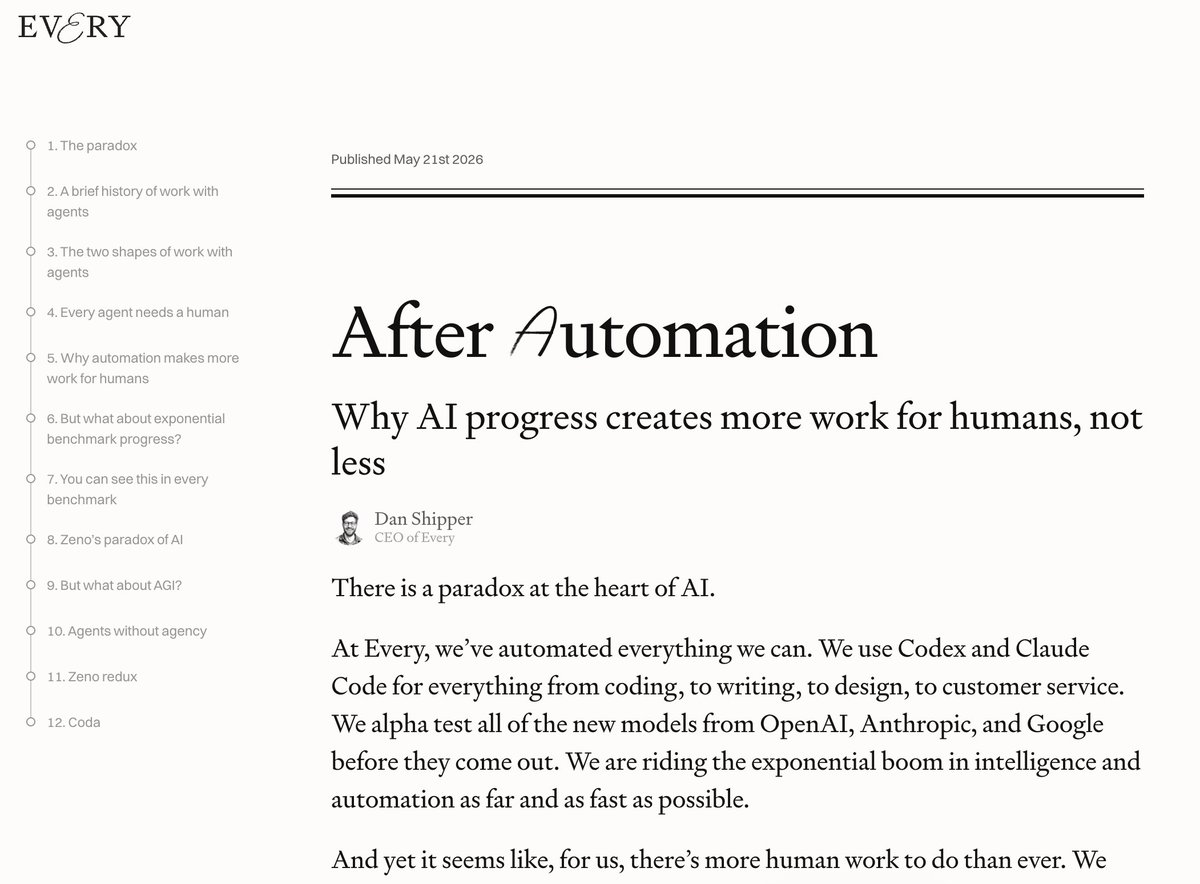
We’ve automated every single thing we can @every with AI agents.
And yet there’s way more human work to do than ever. We’ve gone from 4 -> 30 human employees since GPT-3.
I wrote a report on the structural reasons: how AI makes expert competence cheap, why that drives up demand for experts, and why the dynamic only intensifies as we approach AGI.
After Automation: every.to/p/after-automation
185
302
2,418
1,445,879
May 31
Ahead of schedule

56
May 27
Echoes of all this in using AI for legal work
May 24

Has been a while since I wrote about agentic engineering, so this time around some learnings of maintaining Pi as a junior maintainer to @badlogicgames :) lucumr.pocoo.org/2026/5/24/p…
43
May 26
1
May 25
My biggest takeaways from @danshipper:
1. The future of work will happen inside Codex or Claude Code. Instead of putting AI into your SaaS tool, you’ll use your SaaS tools inside your favorite AI agents' in-app browser. Dan spends all his time in Codex now—writing documents, managing email, doing research, everything. He's using Google Docs, PostHog, and everything he needs within the agent's in-app browser. The agent can see what he’s doing, and has all of his context, so he and his agent collaborate quickly and super effectively.
2. Automation is a lie—every automation needs a human. Dan's company doubled in size this year despite being incredibly AI-forward. Why? Because in order to make automation work well, you need humans making sure everything keeps working. This is why benchmarks are misleading—they measure AI on problems we’ve already framed and can score, but there’s always a higher frame.
3. PMs will win the AI era. Marcus, a former PM who previously ran Axios’s writing product, joined Every after getting super AI-pilled. Now he runs their product Spiral, and ships faster than anyone on the team. He pairs technical knowledge with spiky product sense, deep user empathy, and an eye for what matters. Dan thinks any PM who gets really AI-native will be incredibly dangerous because the building is done for you—what matters is figuring out what to build and if it’s great.
4. Full-stack designers are becoming superheroes. Designers used to make beautiful interactions that engineers didn’t want to build or couldn’t execute properly. Now designers don’t need to hand things off; they can build it themselves. Designers are naturally creative people, and AI is the perfect tool for them because it lets them bring their vision to life without the traditional bottlenecks.
5. SaaS is not dead. In fact, Dan is bullish on SaaS stocks. When users bring their own AI (via Codex or Claude Code) to use SaaS products, the user—not the SaaS company—pays for tokens. This saves SaaS company’s margins. Since the agents need their own seats, Dan predicts that agents will create massive new demand for SaaS because there will be tons of agents using these products at high volume.
6. Every company will have one “super-agent” inside their Slack that every employee will use. Dan initially thought every employee would have their personal work agent, like a shadow AI org chart, but he’s completely flipped his view. He realized agents need humans who care about them. When someone gets tired of maintaining their personal agent, it becomes useless. The winning model is one forward-deployed engineer or AI-savvy person who maintains a company-wide agent (like Shopify’s River or Viktor), and then it trickles down to more specialized team agents as models improve and become less fiddly.
7. The AI job apocalypse is not happening, but you do need to evolve to stay relevant. Models make yesterday’s human competence cheap. But because everyone uses the same models, it all looks the same if you use it the default way; it becomes commoditized slop. Humans then take that frozen competence and use it to make something new and interesting for their specific situation. The key: “ride the models”—use them for everything you do, try new models when they drop, keep turning over rocks.
8. We will read way more AI-generated writing, and we will like it. Human writing is incredibly important for things that matter, but for internal docs, planning, and email, AI-generated is often better because most people are bad at writing strategy documents.
9. Build software for humans and agents to use together. The current model is building a CLI that an agent uses independently. Instead, you and your agent should be using the app together. This creates new design challenges—agents can make a billion requests in three seconds, so you need approval flows, inboxes that summarize what happened, logs, and easy rollback.
10. Forward-deployed engineers are the new most essential role. The big model companies have teams of people managing their internal agents, and those teams aren’t going away. It’s different from traditional software building, and certain engineers love it. As models get better, this role will evolve—you’ll be managing more agents doing more things.
63
May 17
Great show last night
May 17

REVIEW: @machinegunkelly and @wizkhalifa light up 'Lost Americana' in Concord, with @bsd_wav. | #mgk #WizKhalifa✏️: Mike DeWald. 📸: Aaron Lee. riffmagazine.com/reviews/mgk…
71
Mike Burshteyn retweeted

May 17
REVIEW: @machinegunkelly and @wizkhalifa light up 'Lost Americana' in Concord, with @bsd_wav. | #mgk #WizKhalifa✏️: Mike DeWald. 📸: Aaron Lee. riffmagazine.com/reviews/mgk…
2
2
174
May 11
this is the way

55
May 6
Great fun was had by all

Such a great day with 100-plus of the best people in law x crypto, TY everyone who came through
already can’t wait for next year

1
49
Apr 28
it’s a good model
Apr 27

Agent Mode is here in Outlook!
Copilot can now help run your inbox and calendar, triaging emails, rescheduling meetings, and helping you stay on top of what matters most.
61
Apr 25
Saves legal fees too

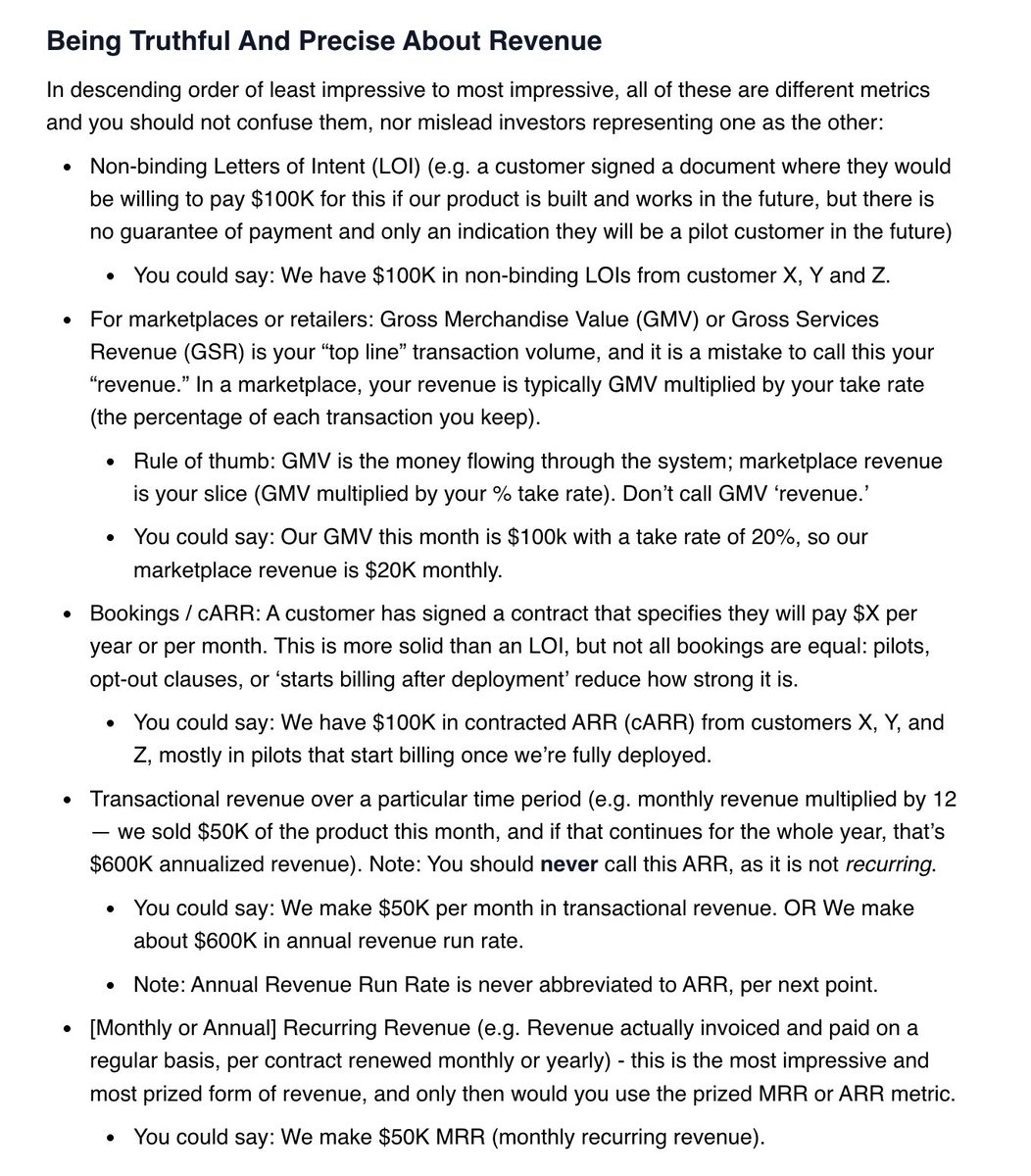
Here's YC's official advice about being truthful and precise about what is pilot, bookings, revenue and recurring revenue.
Founders, particularly first time founders, need to sear this into their brains. Don't mistake one tier for another. Be precise, and always be truthful.
66
Apr 5
yea

I'll probably get attacked for saying this, but every team in crypto should use this as an opportunity to slow down and focus on security.
If possible, dedicate an entire team to it.
I know how hard it is. There's an enormous amount of pressure to grow at all costs. Your runway will pressure you. Your investors will pressure you. Your token holders will pressure you.
But you can't grow if you're hacked.
Take time to stop what you're doing, stop stressing about growth, and audit your whole stack. Custody. Risk. Dependencies. Access control. Everything. The world will still be here when you get back.
Focus on the safety of your users' funds above all else. In the long term, this is the most important requirement to grow.
78
Apr 2
AI litigation trends using AI for litigation. A KFC Taco Bell style article. BSG & Zoolander references survived editing. dailyjournal.com/article/390…
1
70
Apr 2
first non under-40 award ⏰🚀

🏆Congratulations to GT's Matt Rosengart and Michael Burshteyn on being named a “Leading Commercial Litigator” by the Daily Journal. This national award honors the top 100 commercial and bet-the-company litigators. Read more: gtlaw.com/en/news/2026/04/pr….
#GTNews #Litigators

4
202
22 Aug 2025
📚🔎
22 Aug 2025
💡 Interested in learning more about recent class-action decisions from across the United States?
Be sure to read the Summer 2025 issue of Greenberg Traurig's Class Action Litigation Newsletter.
💻: bit.ly/4mCE24s.
#GTNewsletter #ClassAction #Litigation

168
Mike Burshteyn retweeted

6 Aug 2025
📢 Big News: Greenberg Traurig is recognized on the 2025 BTI Client Service A-Team 30 List! Thank you to our clients for your continued trust and collaboration.
Read more about the recognition in the firm’s press release here: gtlaw.com/en/news/2025/08/pr….
#GTNews
1
1
2
208
6 Aug 2025
This is good
5 Aug 2025
Every week I hear from product execs looking for advice on accelerating employee AI adoption within their orgs.
I teamed up with @petergyang (long-time product leader at @Meta, @Twitter, @Twitch, @CreditKarma, @Microsoft, @Reddit, and @Roblox) to interview founders and product execs at six of the fastest-growing AI-forward companies—@TryRamp, @Shopify, @Duolingo, @Zapier, @WHOOP, @Intercom—to collect their most impactful tactics for driving employee AI adoption.
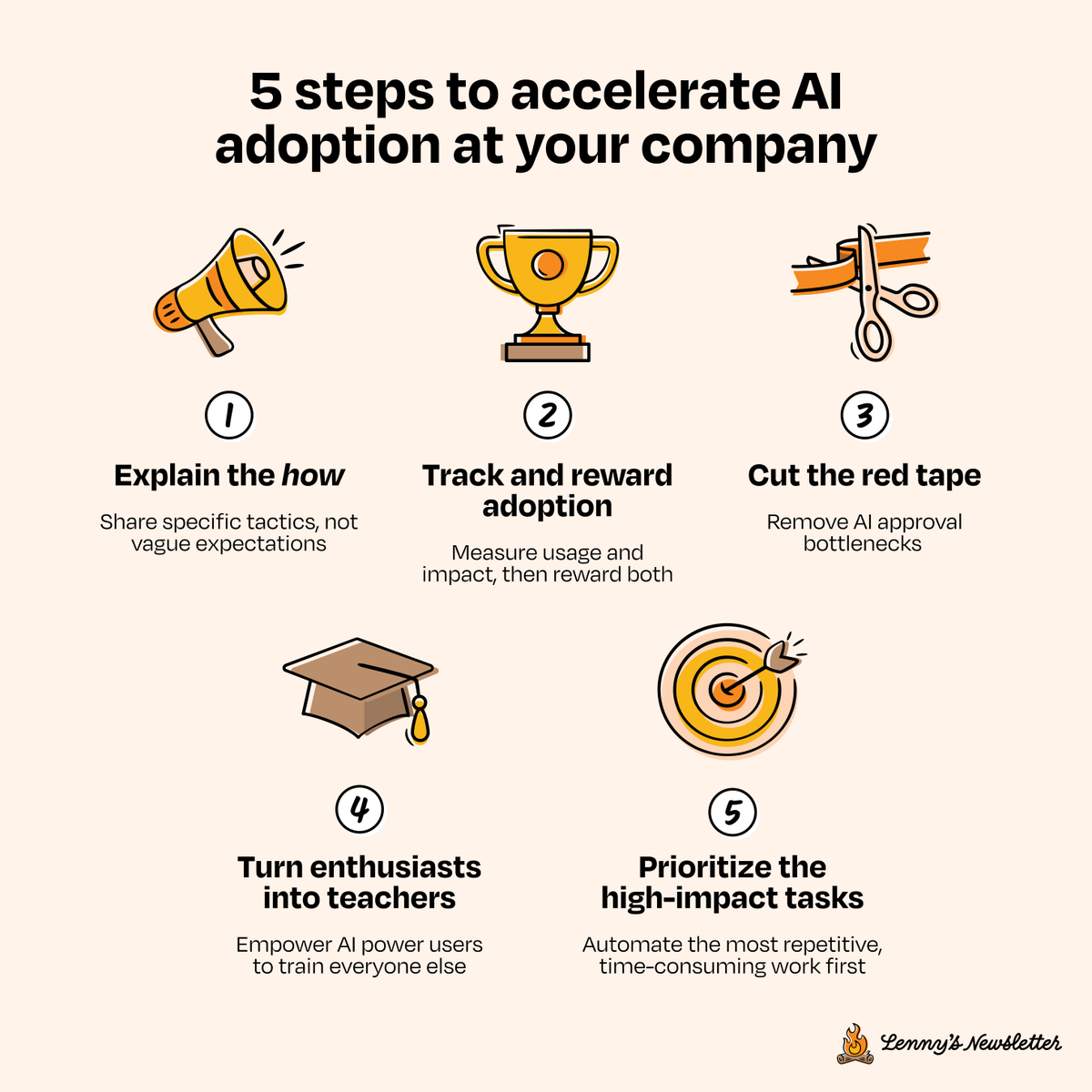
From the interviews, Peter identified 5 steps that the most successful companies take to unlock AI adoption:
1. Explain the how
2. Track and reward adoption
3. Cut the red tape
4. Turn enthusiasts into teachers
5. Prioritize the high-impact tasks
Here are the 25 best and specific tactics we gathered that you can implement right away at your company:
*1. Explain the how*
Saying “we are AI-first” means nothing if employees don’t know what that actually means for their day-to-day work.
The companies that succeed provide specific tactics that employees and teams can adopt to meet those expectations.
Here’s what this can look like:
1. Include specific tactics in your memo: @tobi, CEO of @Shopify, didn’t just say that “using AI is now a baseline expectation” in his now-famous memo. Instead, he shared concrete tactics he expects to see, like making AI prototyping part of the company’s GSD (get shit done) process.
2. Declare a “code red” moment: @WadeFoster, CEO of @Zapier, called an all-hands-on-deck moment in March 2023 after ChatGPT’s launch. He then shared a playbook and gave all employees a week off to put it into practice.
3. Define what “embracing AI” means: @LuisvonAhn, @Duolingo’s CEO, defined AI adoption as both “making our products better” and “empowering employees to do their best work.” Teams were encouraged to use AI for everything from speeding up lesson creation to prototyping.
4. Embed with individual teams: @darraghcurran, @Intercom’s CTO, set a goal to “2x productivity with AI” and then spent a week every month embedded with individual teams to identify and execute on the 2x opportunities.
5. Lead by example in real time: When a PM brings a problem to @yourgirlhils, @WHOOP's Head of Product, she’ll say, “Want me to show you how I solve this with AI?” Then she shares her workflows live.
*2. Track and reward adoption*
Like any good PM, you should track AI adoption as inputs (who’s using AI) and outputs (what business value it’s creating). You should also reward employees who are leading the charge to keep the momentum going.
Here’s how top companies are tracking and rewarding adoption:
1. Make AI adoption part of performance reviews: @Shopify asks employees to rate colleagues on a 1-to-5 scale for how well they “reflexively use AI tools for improving and amplifying work outputs.”
2. Publish AI usage by team: At @TryRamp, leadership shares the number of AI power users (5 actions a week) for tools like Cursor, Claude Code, and ChatGPT. This transparency creates natural accountability across teams.
3. Track team-specific impact: @Zapier tracks the impact of AI adoption by function. In sales, for example, when targeted leads engage with marketing content, AI auto-packages that information for the account rep—leading to 10 hours saved per week per rep.
4. Use proxy metrics for productivity: @Intercom tracks merged pull requests as a proxy for productivity gains. They’re already seeing a “durable improvement (about 20% year-over-year)” from AI-assisted development.
5. Make it a daily habit: @WHOOP gave employees a 30-day challenge with bite-size 2-minute tasks to complete and rewarded those who kept the longest streak.
The point is that people will change their behavior with the right incentives.
*3. Cut the red tape*
Most companies have long approval processes for AI tools. But what they don’t realize is that their employees are already using AI. They’re just using it from their personal accounts.
Cut the red tape if you don’t want employees to use AI tools that aren’t approved:
1. Create an AI learning budget: @Duolingo gave every employee $300 to try AI tools, courses, and subscriptions. This incentivizes constant experimentation.
2. Assign a lead to expedite approvals: @Zapier assigned a lead PM to own working with procurement, legal, and engineering to fast-track AI tool approvals and eliminate bottlenecks.
3. Give employees time to tinker: “No time” was the main reason employees cited for not trying new AI tools, so @Intercom CTO @darraghcurran encouraged managers to give employees dedicated time to skill up.
4. Provide multiple tool options: @Shopify provides access to a wide range of tools, including Claude, Perplexity, Cohere, Gemini, Cursor, Copilot, and Claude Code. They also encourage employees to contribute to a growing library of AI prompts and agents.
5. Embrace internal enthusiasm: @WHOOP lets employees nominate tools they’re excited to trial, like Fireflies for note-taking and Zapier for automation.
Keep reading here (and I'd encourage you to share this with your team): lennysnewsletter.com/p/25-pr…
2
146
4 Aug 2025
this is the tsunami 🌊
3 Aug 2025

entering the fast fashion era of SaaS very soon
133