{Psychiatric, causal, psychometric, robotic} AI. @MGHPrecisionPsy @MGHPsychiatry MGH-Biostatistics @HarvardMed; @UCBerkeley biostat PhD
Joined August 2007
- Tweets 4,805
- Following 4,106
- Followers 1,447
- Likes 30,844
74 Photos and videos

Pinned Tweet

22 Apr 2025
Latest suicide pub (w/ @drkatebentley @TaylorABurkePhD @jorsmo @DrJBStephens) provides strong evidence to 1) counter the common claim that clinicians can't predict suicide risk, demonstrating the value of clinical judgment, yet also 2) massive improvement through ML on SRA items
11 Apr 2025

While clinicians can stratify suicide risk above chance levels, predictive accuracy for future suicide attempts significantly improves when using machine learning to incorporate comprehensive clinical assessment data.
ja.ma/3G3Niy2 @drkatebentley
7
16
3,609
Jun 4
it turns out that when a researcher is in hell, they are just forced to setup/link scienv, orcid, and web of science repeatedly 😭
2
138
Chris Kennedy retweeted

May 31
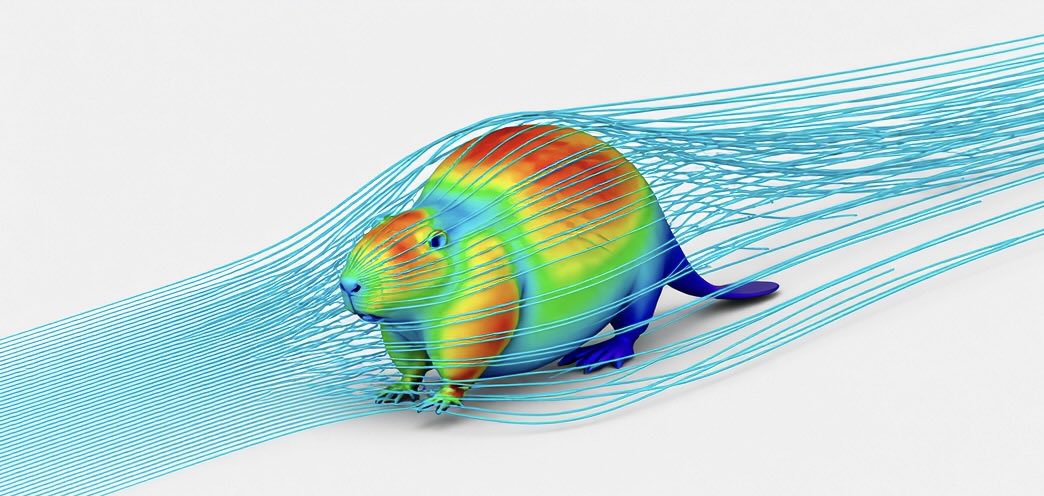
I don't know why you need this information, but this is the aerodynamics of a beaver
714
10,083
75,435
2,202,343
May 30
Maybe knowledge was never what teaching was about. Maybe it was about inspiring, asking questions, sharing enthusiasm, mentoring, and coordinating group work. AI aside, the flipped classroom educational approach already demonstrated that straight lecturing is not a great strategy
May 29

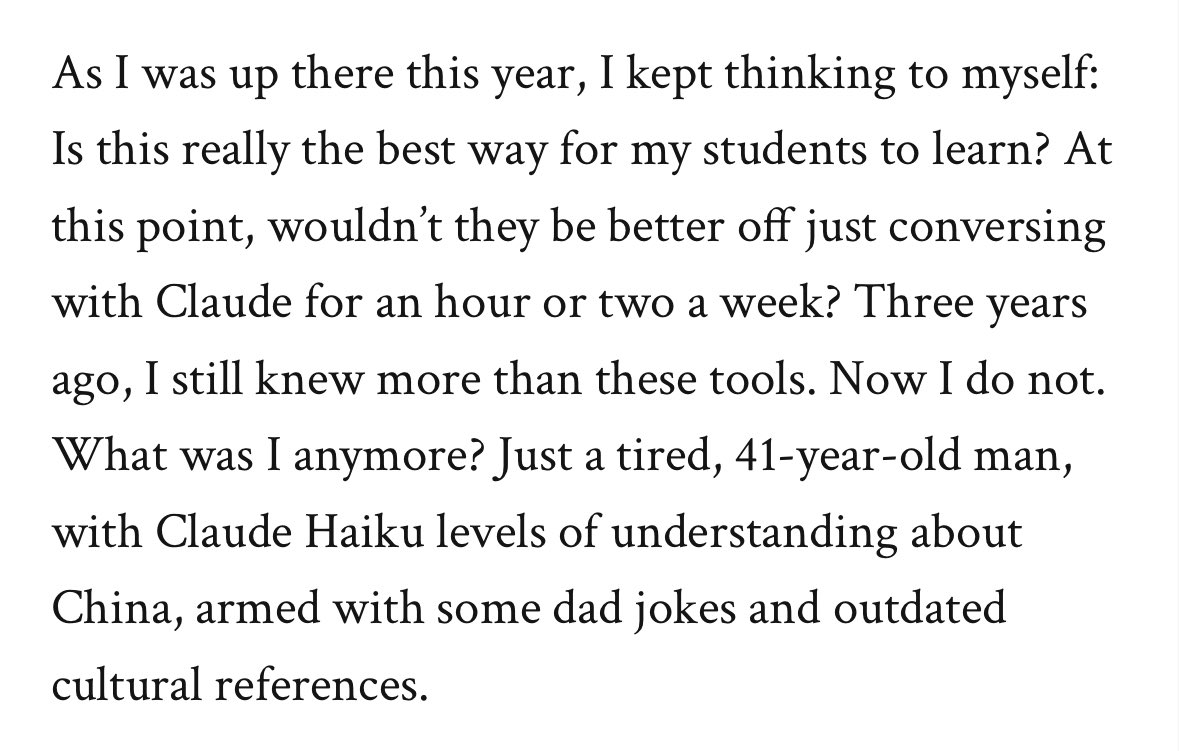
“AI is demoralizing.”
A Princeton Professor says he kept wondering this semester (while lecturing) if his students would be better off learning from Claude:
2
149
Apr 9
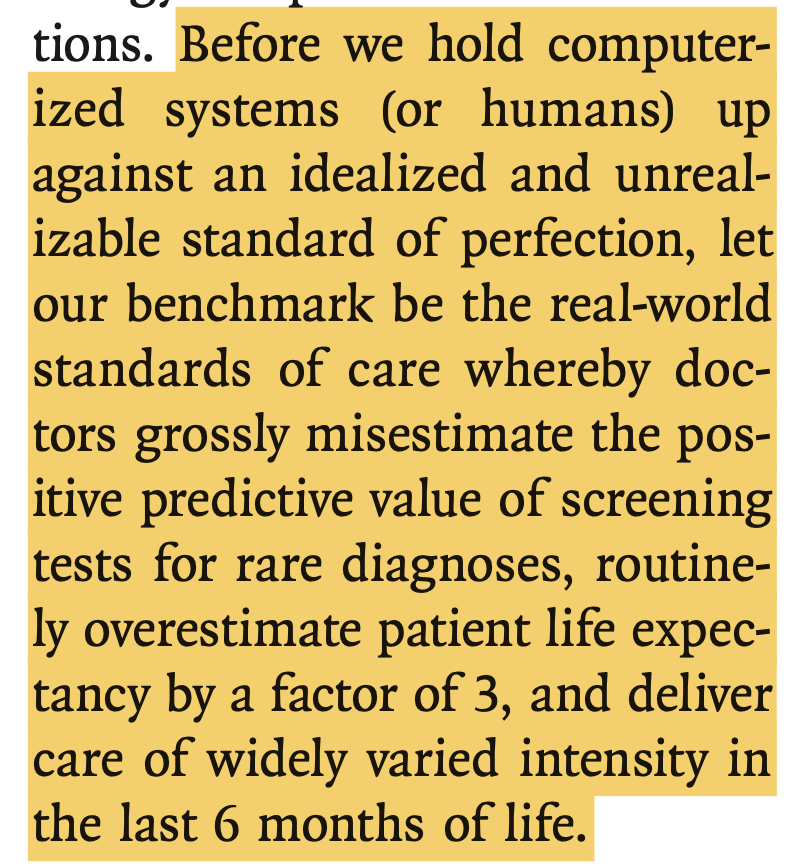
Clinical judgment remains the critical benchmark against which to compare AI/ML algorithmic performance. Chen & Ashe (2017) "Machine Learning and Prediction in Medicine — Beyond the Peak of Inflated Expectations" NEJM:
1
2
202
Apr 9
91
Chris Kennedy retweeted

WorstDaySoFar [👇🏻link]
Daily summary and tracking of US mass rights violations and democratic collapse
Disappearances, warrantless detentions, dragnets, political prosecutions, and 250 other types of events
Fully automated and community funded
1
13
28
23,934
Chris Kennedy retweeted
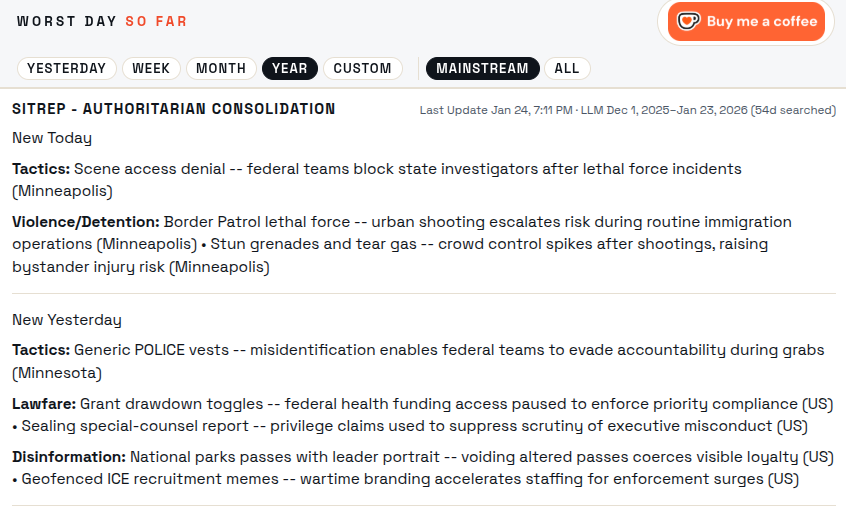
Worst Day So Far
SITREP - Authoritarian Consolidation
Last Update Jan 24, 7:11 PM · LLM Dec 1, 2025–Jan 23, 2026 (54d searched)
New Today
Tactics: Scene access denial -- federal teams block state investigators after lethal force incidents (Minneapolis)
Violence/Detention: Border Patrol lethal force -- urban shooting escalates risk during routine immigration operations (Minneapolis) • Stun grenades and tear gas -- crowd control spikes after shootings, raising bystander injury risk (Minneapolis)
New Yesterday
Tactics: Generic POLICE vests -- misidentification enables federal teams to evade accountability during grabs (Minnesota)
Lawfare: Grant drawdown toggles -- federal health funding access paused to enforce priority compliance (US) • Sealing special-counsel report -- privilege claims used to suppress scrutiny of executive misconduct (US)
Disinformation: National parks passes with leader portrait -- voiding altered passes coerces visible loyalty (US) • Geofenced ICE recruitment memes -- wartime branding accelerates staffing for enforcement surges (US)
1
2
504
Chris Kennedy retweeted

13 Dec 2025
Our overview of and guidance for performance measures to evaluate medical AI is finally out!
- Stop bashing AUROC
- Calibration clinical utility are key
- Plot risk distributions
- Classification measures are improper
thelancet.com/journals/landi…
6
35
113
19,749
Jan 6
AI can predict anything if there are no performance standards or reasonable benchmarks. A demographic-only model is not a reasonable, clinically relevant benchmark - structured EHR data is far more complex. Sadly, research incentives are not well-aligned with clinical relevance.
Jan 6

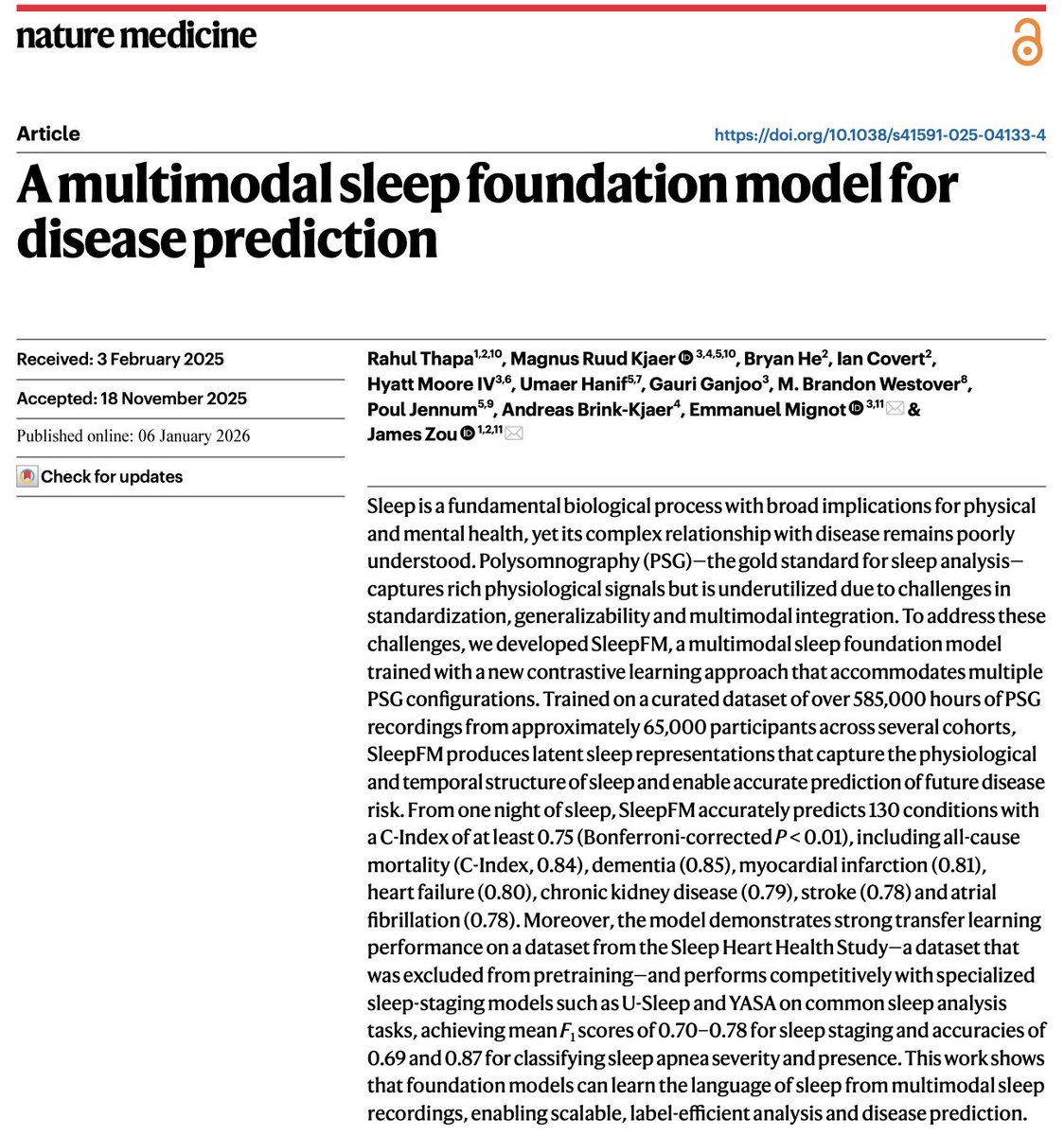
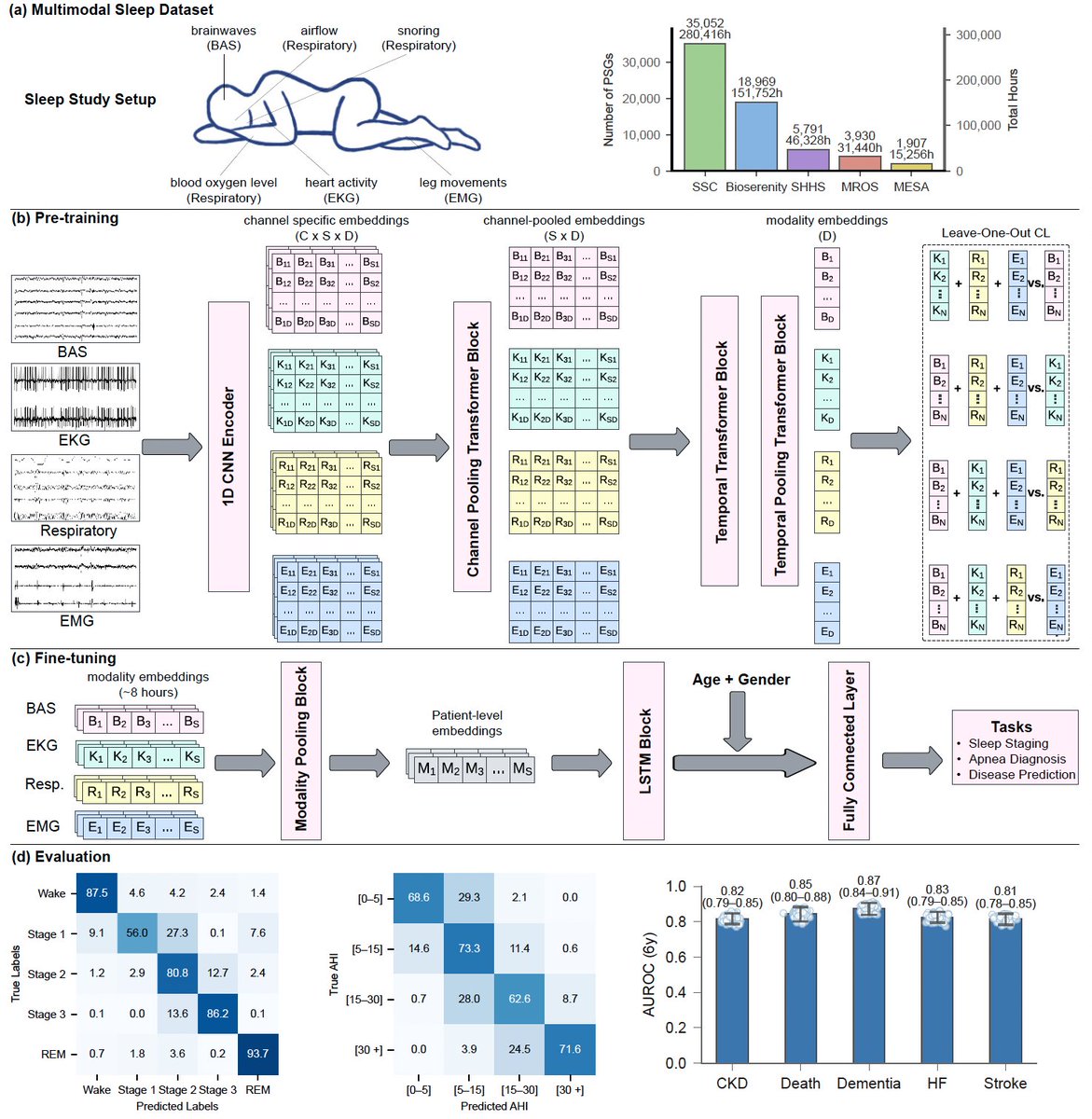
Today in @NatureMedicine we report that AI can predict 130 diseases from 1 night of sleep🛌
We trained a foundation model (#SleepFM) on 585K hours of sleep recordings from 65K people—brain, heart, muscle & breathing signals combined.
AI learns the language of sleep🧵
1
1
283
21 Dec 2025
What if we turned compaction into a RAG problem? Save everything to disk, make a summary that stays in context, but allow the LLM to retrieve all prior info as needed? Then we don't have to worry as much about the info selected for compaction. Or is that what happens?@AnthropicAI
1
159
20 Dec 2025
Slow and steady wins the race - breadth-first search
20 Dec 2025

Fascinating paper just published in Science.
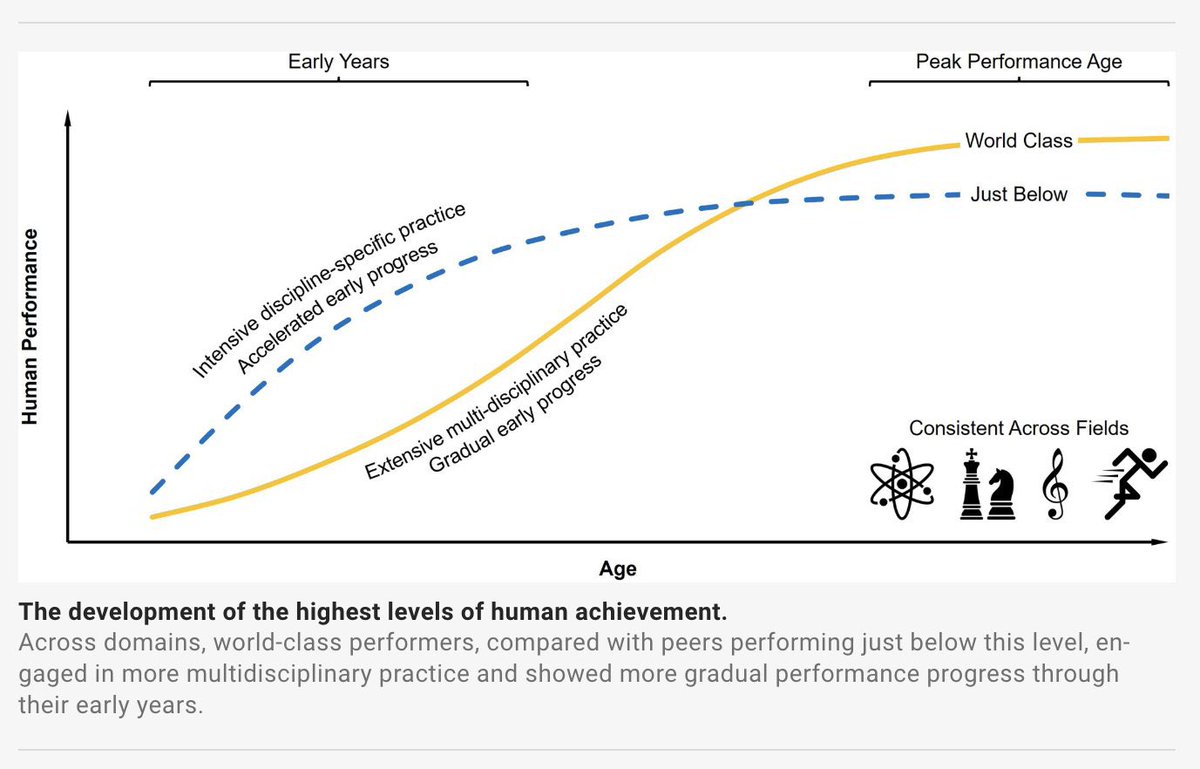
The authors analyze the career trajectories of top performers across multiple domains, including Nobel laureates, elite chess players, Olympic gold medalists, and more.
Their central finding challenges a common belief.
Intensive, single-discipline training at a young age does confer an early advantage, but this advantage fades over time.
By contrast, individuals exposed to multidisciplinary practice early in life tend to start more slowly. Yet, over the long run, they are more likely to reach world-class performance, eventually overtaking early specialists, who often plateau just below the very top.
An important reminder that breadth early on can be a powerful investment in long-term excellence.
Link to the paper in the first reply.
1
265
Chris Kennedy retweeted

5 Dec 2025
Incredibly, even Hinton's recent 2025 article [5] fails to cite Ivakhnenko & Lapa, the fathers of deep learning (1965) [1-3][6-10]. @geoffreyhinton claims [5] that his 1985 "Boltzmann machines" (BMs) [11] (actually 1975 Sherrington-Kirkpatrick models [6]) "are no longer used" but "were historically important" because "in the 1980s, they demonstrated that it was possible to learn appropriate weights for hidden neurons using only locally available information WITHOUT requiring a biologically implausible backward pass."
That's ridiculous. This had already been demonstrated 2 decades earlier in the 1960s in Ukraine [1-3]. Ivakhnenko's 1971 paper [3] described a deep learning network with 8 layers and layer-wise training. This depth is comparable to the depth of Hinton's BM-based 2006 "deep belief networks" with layer-wise training [4], published 35 years later without comparison to the original work [1-3] - done when compute was millions of times more expensive.
And indeed, over half a century ago, Ivakhnenko's net learned appropriate weights for hidden neurons WITHOUT requiring a biologically implausible backward pass!
Hinton & Sejnowski & co-workers have repeatedly plagiarized Ivakhnenko and others, and failed to rectify this in later surveys [6-8].
Crazy fact: today (Fri 5 Dec 2025), the inaugural so-called "Sejnowksi-Hinton Prize" will be handed out at NeurIPS 2025 for a related paper on learning without exact backpropagation [12] which also did not mention the original work on deep learning without backward pass [1-3].
What happened to peer review and scientific honesty?
REFERENCES
[1] Ivakhnenko, A. G. and Lapa, V. G. (1965). Cybernetic Predicting Devices. CCM Information Corporation. First working Deep Learners with many layers, learning internal representations.
[2] Ivakhnenko, Alexey Grigorevich. The group method of data of handling; a rival of the method of stochastic approximation. Soviet Automatic Control 13 (1968): 43-55.
[3] Ivakhnenko, A. G. (1971). Polynomial theory of complex systems. IEEE Transactions on Systems, Man and Cybernetics, (4):364-378.
[4] G. E. Hinton, R. R. Salakhutdinov. Reducing the dimensionality of data with neural networks. Science, Vol. 313. no. 5786, pp. 504-507, 2006.
[5] G. Hinton. Nobel Lecture: Boltzmann machines. Rev. Mod. Phys. 97, 030502, 25 August 2025.
[6] J.S. A Nobel Prize for Plagiarism. Technical Report IDSIA-24-24 (2024, updated 2025).
[7] J.S. How 3 Turing awardees republished key methods and ideas whose creators they failed to credit. Technical Report IDSIA-23-23, Dec 2023.
[8] J.S. (2025). Who invented deep learning? Technical Note IDSIA-16-25.
[9] J.S. (2015). Deep learning in neural networks: An overview. Neural Networks, 61, 85-117. Got the first Best Paper Award ever issued by the journal Neural Networks, founded in 1988.
[10] J.S. Annotated History of Modern AI and Deep Learning. Technical Report IDSIA-22-22, 2022, arXiv:2212.11279.
[11] D. Ackley, G. Hinton, T. Sejnowski (1985). A Learning Algorithm for Boltzmann Machines. Cognitive Science, 9(1):147-169.
[12] T. P. Lillicrap, D. Cownden, D. B. Tweed, C. J. Akerman. Random synaptic feedback weights support error backpropagation for deep learning. Nature Communications vol. 7, 13276 (2016).
7 Dec 2024

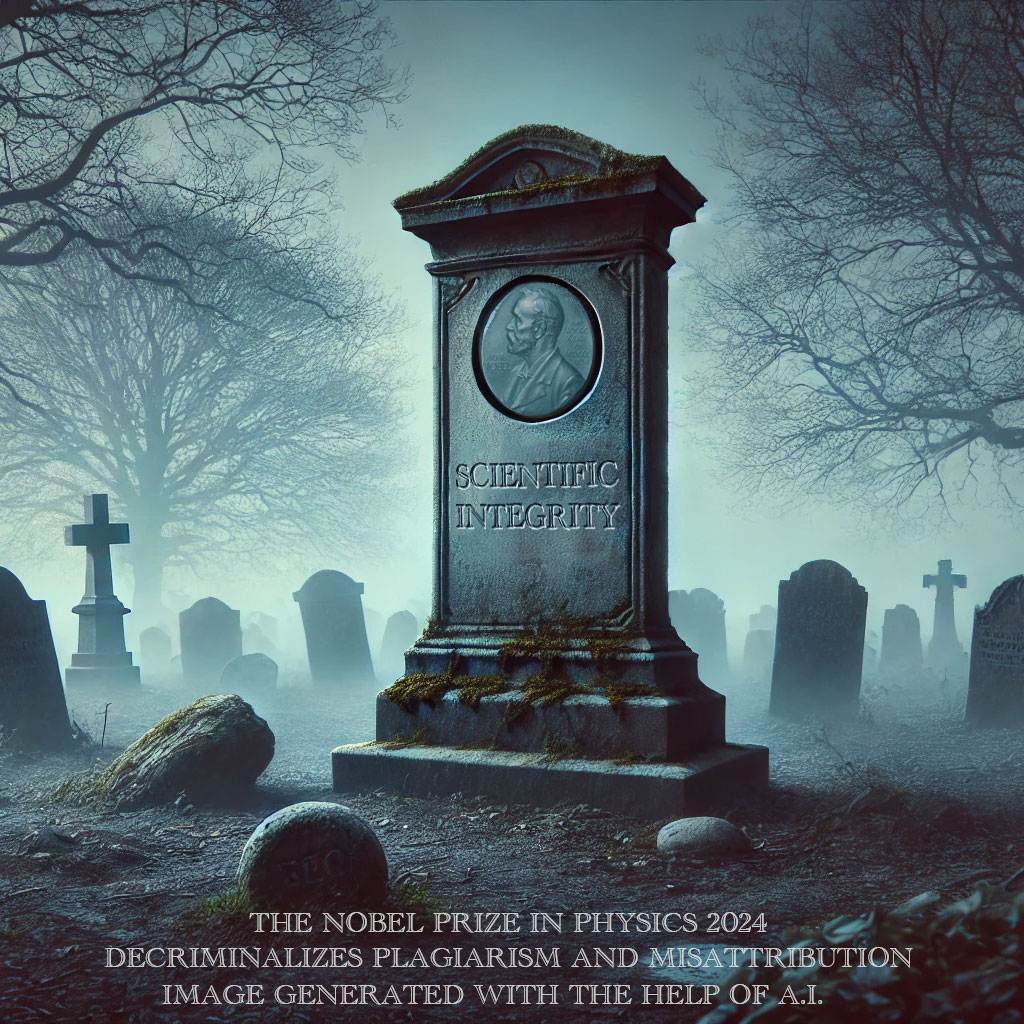
The #NobelPrize in Physics 2024 for Hopfield & Hinton turns out to be a Nobel Prize for plagiarism. They republished methodologies developed in #Ukraine and #Japan by Ivakhnenko and Amari in the 1960s & 1970s, as well as other techniques, without citing the original inventors. None of the important algorithms for modern AI were created by Hopfield & Hinton.
Today I am releasing a detailed tech report on this [NOB]: people.idsia.ch/~juergen/phy…
Of course, I had it checked by neural network pioneers and AI experts to make sure it was unassailable.
Is it now acceptable for me to direct young Ph.D. students to read old papers and rewrite and resubmit them as if they were their own works? Whatever the intention, this award says that, yes, that is perfectly fine.
Some people have lost their titles or jobs due to plagiarism, e.g., Harvard's former president [PLAG7]. But after this Nobel Prize, how can advisors now continue to tell their students that they should avoid plagiarism at all costs?
It is well known that plagiarism can be either "unintentional" or "intentional or reckless" [PLAG1-6], and the more innocent of the two may very well be partially the case here. But science has a well-established way of dealing with "multiple discovery" and plagiarism - be it unintentional [PLAG1-6][CONN21] or not [FAKE,FAKE2] - based on facts such as time stamps of publications and patents. The deontology of science requires that unintentional plagiarists correct their publications through errata and then credit the original sources properly in the future. The awardees didn't; instead the awardees kept collecting citations for inventions of other researchers [NOB][DLP]. Doesn't this behaviour turn even unintentional plagiarism [PLAG1-6] into an intentional form [FAKE2]?
I am really concerned about the message this sends to all these young students out there.
REFERENCES
[NOB] J. Schmidhuber (2024). A Nobel Prize for Plagiarism. Technical Report IDSIA-24-24. people.idsia.ch/~juergen/phy…
[NOB ] Tweet: the #NobelPrize in Physics 2024 for Hopfield & Hinton rewards plagiarism and incorrect attribution in computer science. It's mostly about Amari's "Hopfield network" and the "Boltzmann Machine." x.com/SchmidhuberAI/status/1… (1/7th as popular as the original announcement by the Nobel Foundation)
[DLP] J. Schmidhuber (2023). How 3 Turing awardees republished key methods and ideas whose creators they failed to credit. Technical Report IDSIA-23-23, Swiss AI Lab IDSIA, 14 Dec 2023. people.idsia.ch/~juergen/ai-…
[DLP ] Tweet for [DLP]: x.com/SchmidhuberAI/status/1…
[PLAG1] Oxford's guide to types of plagiarism (2021). Quote: "Plagiarism may be intentional or reckless, or unintentional." web.archive.org/web/20211227…
[PLAG2] Jackson State Community College (2022). Unintentional Plagiarism.
[PLAG3] R. L. Foster. Avoiding Unintentional Plagiarism. Journal for Specialists in Pediatric Nursing; Hoboken Vol. 12, Iss. 1, 2007.
[PLAG4] N. Das. Intentional or unintentional, it is never alright to plagiarize: A note on how Indian universities are advised to handle plagiarism. Perspect Clin Res 9:56-7, 2018.
[PLAG5] InfoSci-OnDemand (2023). What is Unintentional Plagiarism?
[PLAG6] Copyrighted.com (2022). How to Avoid Accidental and Unintentional Plagiarism (2023). Copy in the Internet Archive. Quote: "May it be accidental or intentional, plagiarism is still plagiarism."
[PLAG7] Cornell Review, 2024. Harvard president resigns in plagiarism scandal. 6 January 2024.
[FAKE] H. Hopf, A. Krief, G. Mehta, S. A. Matlin. Fake science and the knowledge crisis: ignorance can be fatal. Royal Society Open Science, May 2019. Quote: "Scientists must be willing to speak out when they see false information being presented in social media, traditional print or broadcast press" and "must speak out against false information and fake science in circulation and forcefully contradict public figures who promote it."
[FAKE2] L. Stenflo. Intelligent plagiarists are the most dangerous. Nature, vol. 427, p. 777 (Feb 2004). Quote: "What is worse, in my opinion, ..., are cases where scientists rewrite previous findings in different words, purposely hiding the sources of their ideas, and then during subsequent years forcefully claim that they have discovered new phenomena."
38
46
343
56,437
3 Dec 2025
Such a beautiful demo, hadn’t run into it despite using deep learning for 10 years.
2 Dec 2025
Fukushima's video (1986) shows a CNN that recognises handwritten digits [3], three years before LeCun's video (1989).
CNN timeline taken from [5]:
★ 1969: Kunihiko Fukushima published rectified linear units or ReLUs [1] which are now extensively used in CNNs.
★ 1979: Fukushima published the basic CNN architecture with convolution layers and downsampling layers [2]. He called it neocognitron. It was trained by unsupervised learning rules. Compute was 100 times more expensive than in 1989, and a billion times more expensive than today.
★ 1986: Fukushima's video on recognising hand-written digits [3].
★ 1988: Wei Zhang et al had the first "modern" 2-dimensional CNN trained by backpropagation, and also applied it to character recognition [4]. Compute was about 10 million times more expensive than today.
★ 1989-: later work by others [5].
REFERENCES (more in [5])
[1] K. Fukushima (1969). Visual feature extraction by a multilayered network of analog threshold elements. IEEE Transactions on Systems Science and Cybernetics. 5 (4): 322-333. This work introduced rectified linear units or ReLUs, now widely used in CNNs and other neural nets.
[2] K. Fukushima (1979). Neural network model for a mechanism of pattern recognition unaffected by shift in position—Neocognitron. Trans. IECE, vol. J62-A, no. 10, pp. 658-665, 1979. The first deep convolutional neural network architecture, with alternating convolutional layers and downsampling layers. In Japanese. English version: 1980.
[3] Movie produced by K. Fukushima, S. Miyake and T. Ito (NHK Science and Technical Research Laboratories), in 1986. YouTube: youtube.com/watch?v=oVYCjL54…
[4] W. Zhang, J. Tanida, K. Itoh, Y. Ichioka. Shift-invariant pattern recognition neural network and its optical architecture. Proc. Annual Conference of the Japan Society of Applied Physics, 1988. First "modern" backpropagation-trained 2-dimensional CNN, applied to character recognition.
[5] J. Schmidhuber (AI Blog, 2025). Who invented convolutional neural networks? x.com/SchmidhuberAI/status/1…
193
17 Sep 2025
Agentic AI for coding support all the way - OpenHands and Claude Code in particular
16 Sep 2025

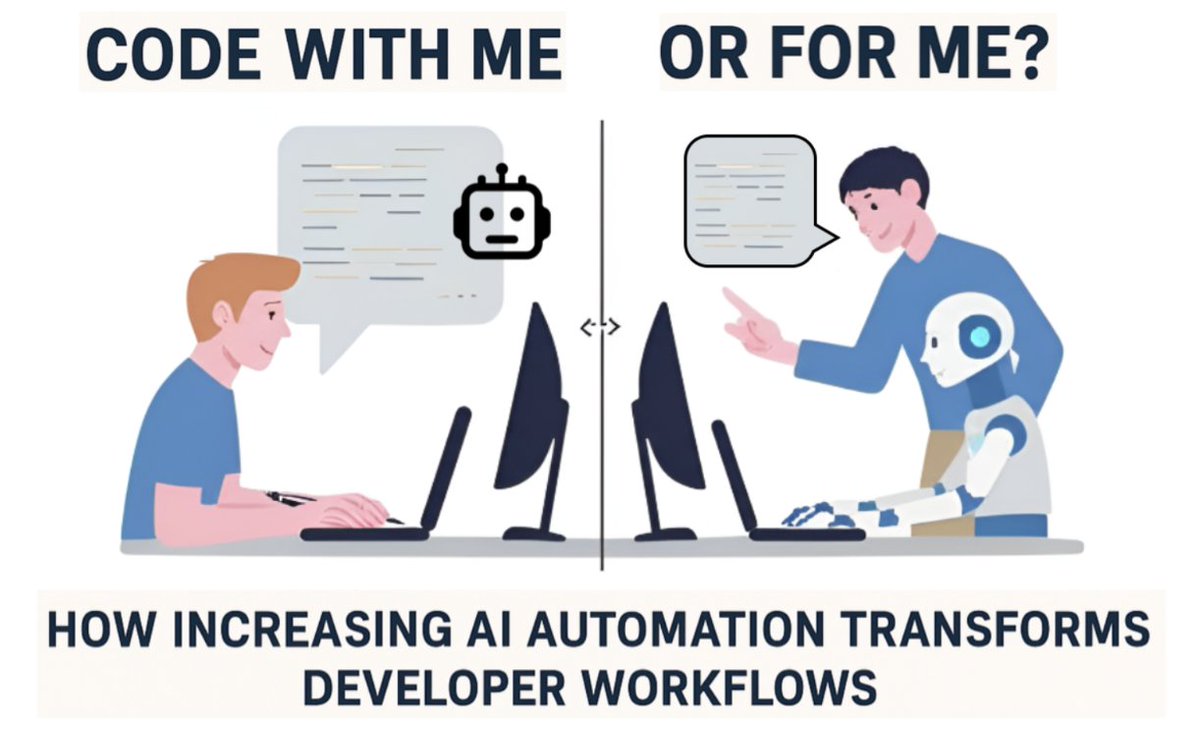
A recent study by Becker et al. finds AI copilots like Cursor slowed expert OSS devs by 19%. But what happens when we compare copilots to more autonomous coding agents? Our study finds the opposite story: agents can boost productivity. 🧵
1
310
Chris Kennedy retweeted

4 Sep 2025
New @APA article on precision mental health care featuring some of our recent work using ML algorithms to improve clinical suicide risk assessment for predicting future suicide attempts, and incredible ongoing work by many others! apa.org/monitor/2025/09/pers…
1
7
15
904
2 Sep 2025
Really enjoying the Rork AI-powered app for building your own mobile apps just through chatting with an LLM. Made my first two iPhone apps this weekend and looking forward to more - pretty crazy times for AI.
2 Sep 2025

Introducing the Rork App for iOS
Just describe the app you've been dreaming of, right on your phone, and Rork will make it
No coding required
FREE for the next 2 weeks. Available on the App Store now
We just reached #2 App Store in the US Dev Tools
But that's not the best part:
1
293
Chris Kennedy retweeted

22 Jul 2025
Psychological science is under attack.
From funding cuts to political interference, the integrity of behavioral science—and the well-being of millions—are on the line. But this summer, we're fighting back.
Join the #StandUpForScience campaign 👇
🔗 act.standupforscience.net/ev…
1
1
1
166
13 Jun 2025
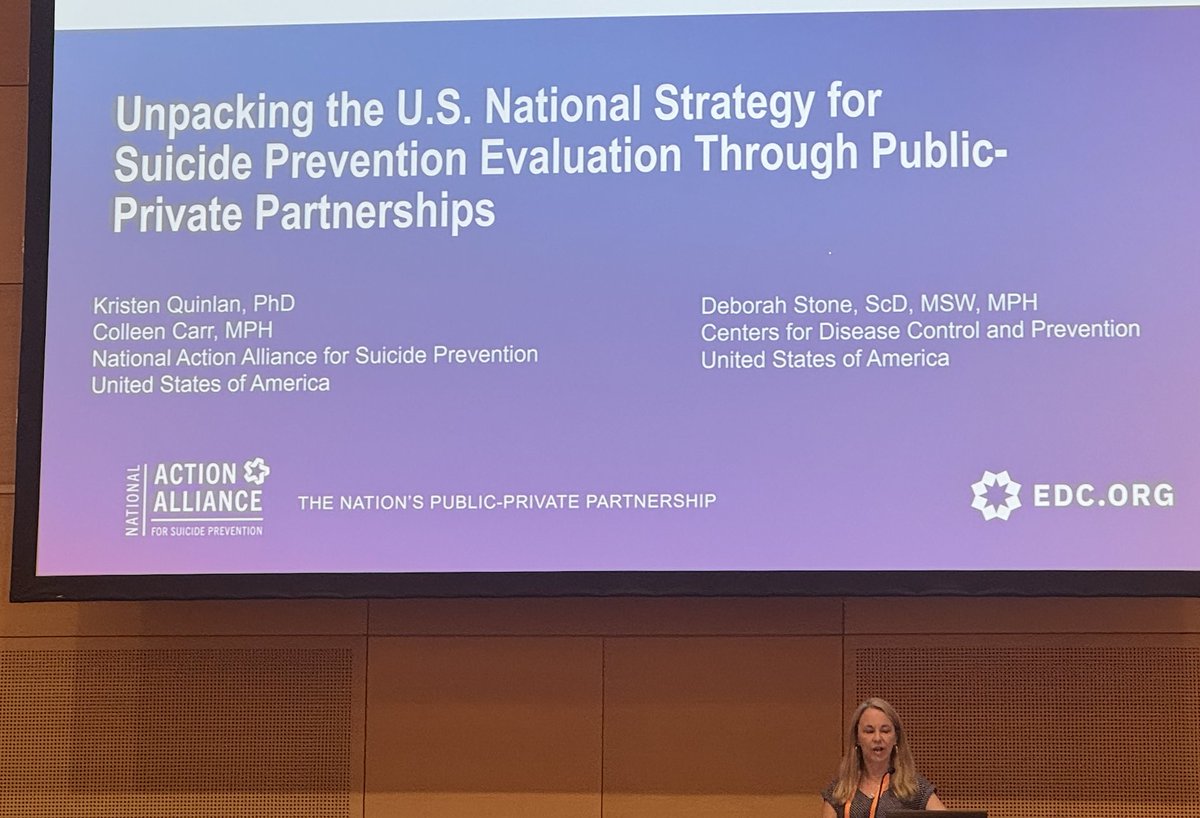
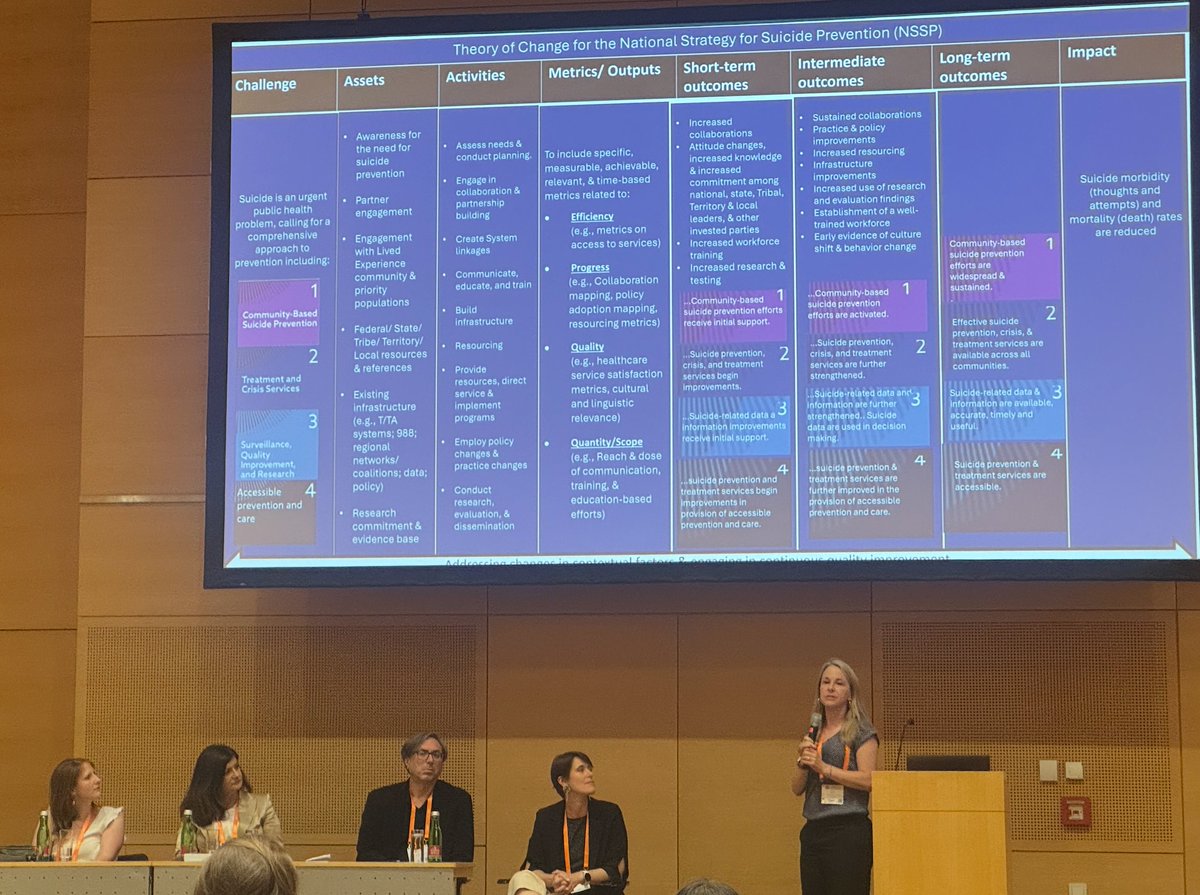
Super informative and inspiring presentation by @QuinlanKristen on the US National Strategy for Suicide Prevention, and appreciated the related presentations for Estonia & Ireland, & the systematic review #iasp2025
1
2
231