Associate professor of linguistics at NYU. Researching nat.lg. semantics. Teaching semantics and language technology. Co-developer of lambdacalculator.com
Register now for the 2nd conference on truthmaker semantics and related approaches, starting tomorrow on Zoom and in Munich: philevents.org/event/show/13…
Advances in Truthmaker Semantics 2 conference, Munich, July 28–30, 2025.
The aim of the conference is to share recent advances in truthmaker semantics and related approaches, as well as to strengthen the intellectual ties within the community.
philevents.org/event/show/13…
Just published open-access in the Journal of Semantics: Bernard and Champollion, "Negative events and compositional semantics". academic.oup.com/jos/advance…
I'll be at LMU Munich on sabbatical from NYU for the academic year 2024-25. I'm grateful to the Humboldt foundation (@AvHStiftung), the Munich Center for Mathematical Philosophy (@LMU_MCMP), @nyuling, and @NYUGSAS for supporting my leave.
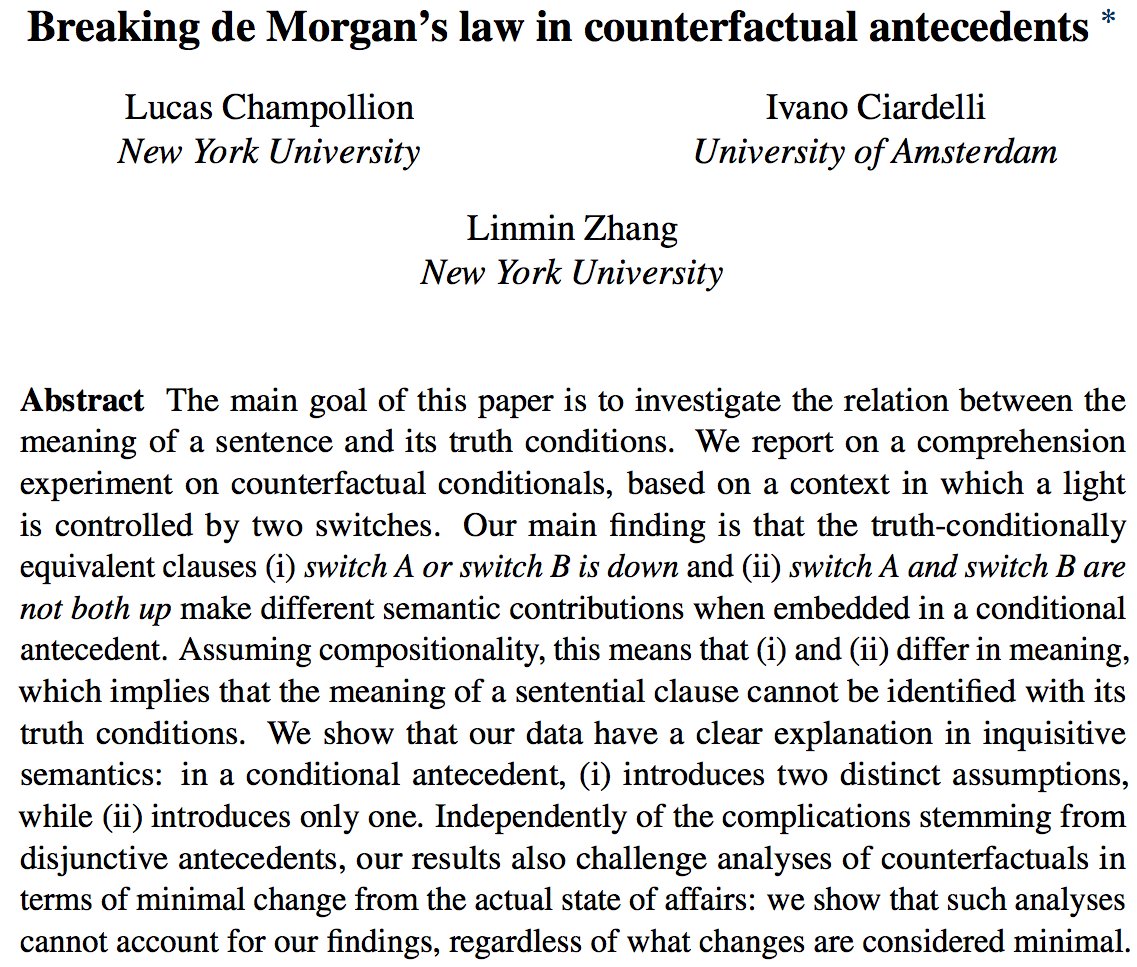
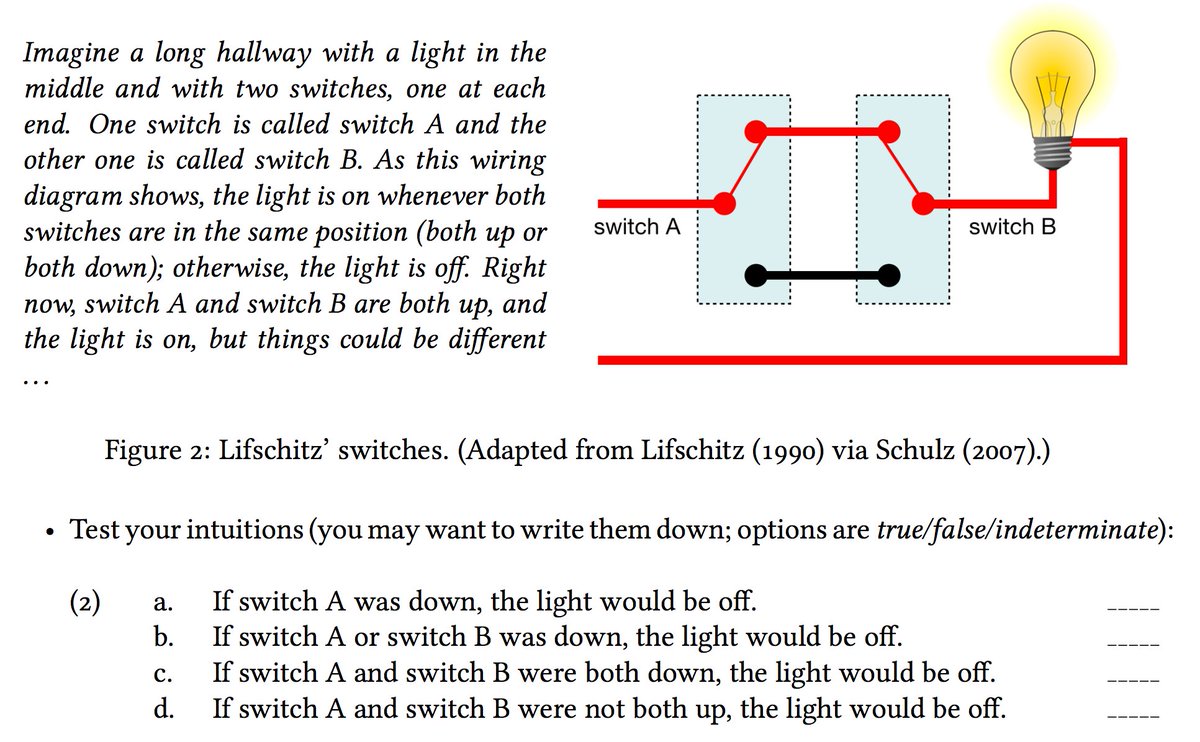
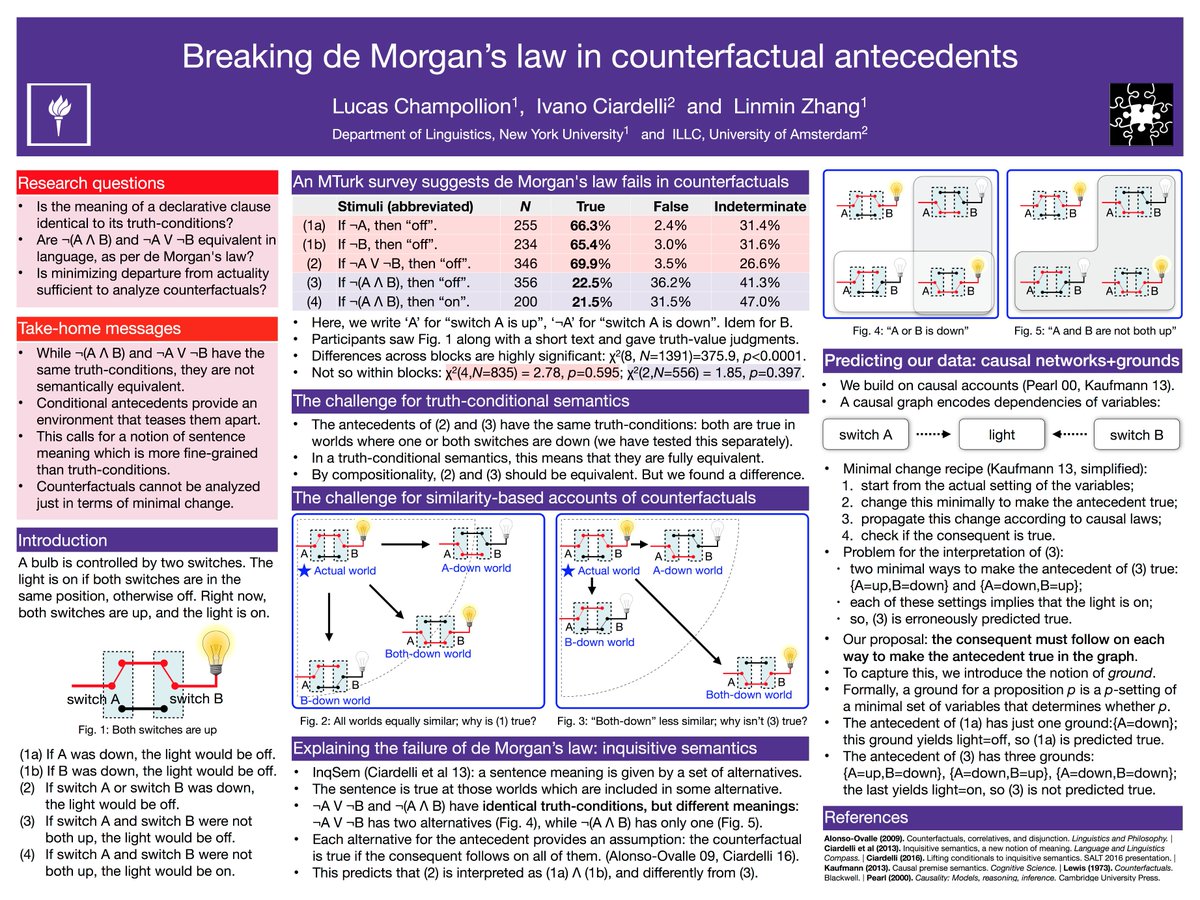
NYU A&S linguist @champoll was called for semantics expertise in a Supreme Court deportation case. He led a team from @Stanford and @ucdavis reviewing an immigration statute where the words “not” and “or” combine for “a textbook case of ambiguity.” as.nyu.edu/nyu-as/as/feature…
The Spring 2022 edition of "Invitation to Formal Semantics" (née "Semantics Boot Camp") is now available:
eecoppock.info/bootcamp/sema…
It's still imperfect, so Liz Coppock @drcopp and I remain grateful for any feedback you may have. Thanks for the great comments we have received.
The Fall 2021 edition of "Invitation to Formal Semantics" (née "Semantics Boot Camp") is now available:
eecoppock.info/bootcamp/sema…
It's still imperfect, so Liz Coppock @drcopp and I remain grateful for any feedback you may have. Thanks for all of the great comments we have received.
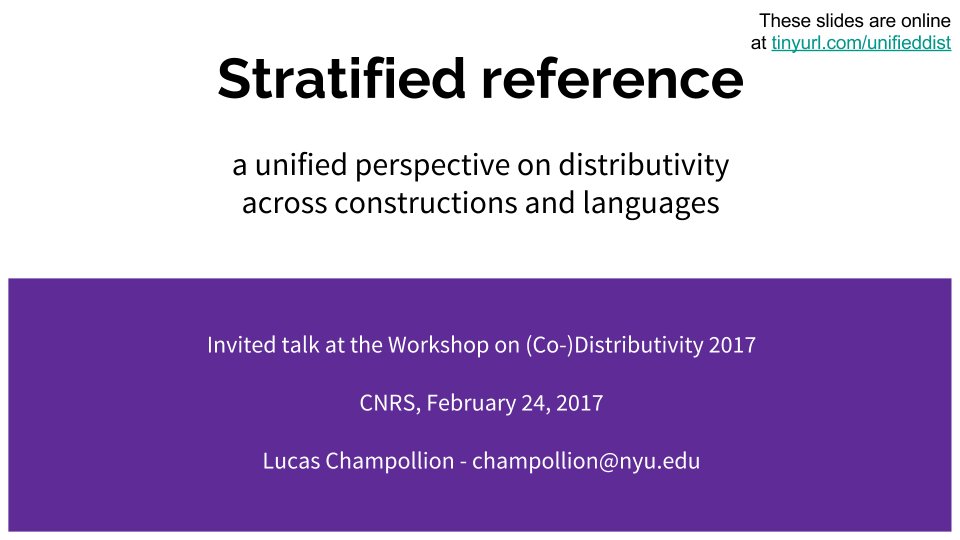
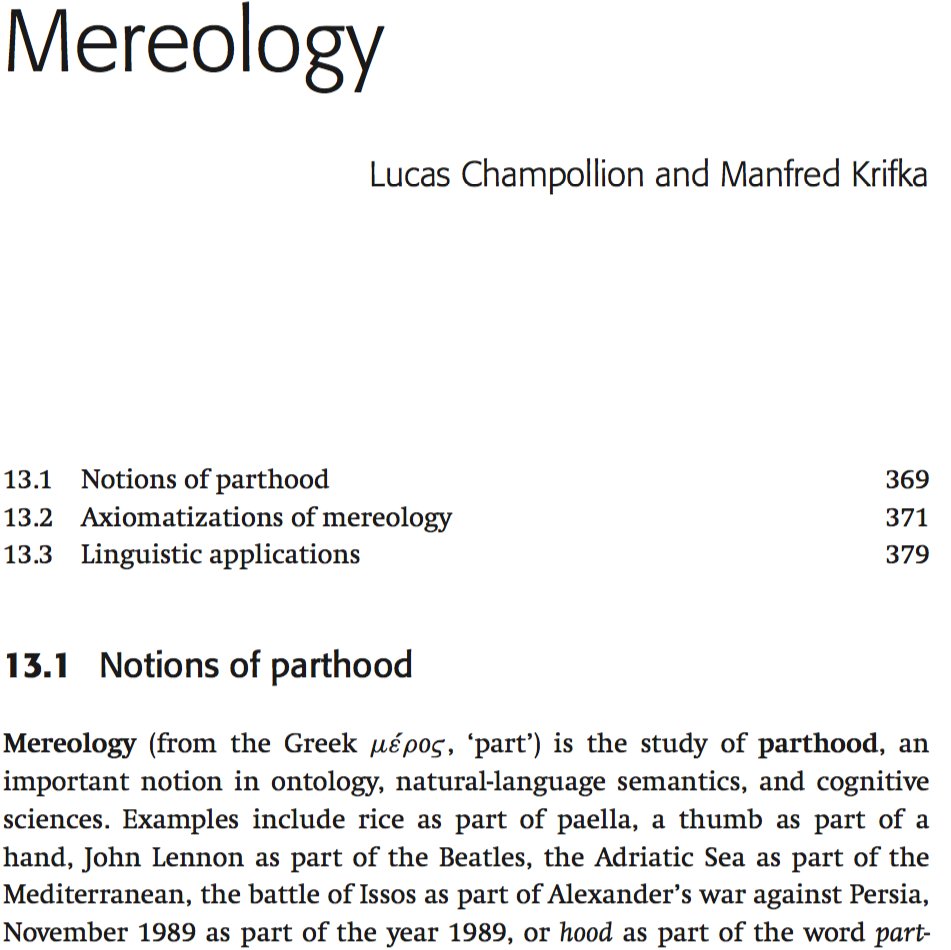
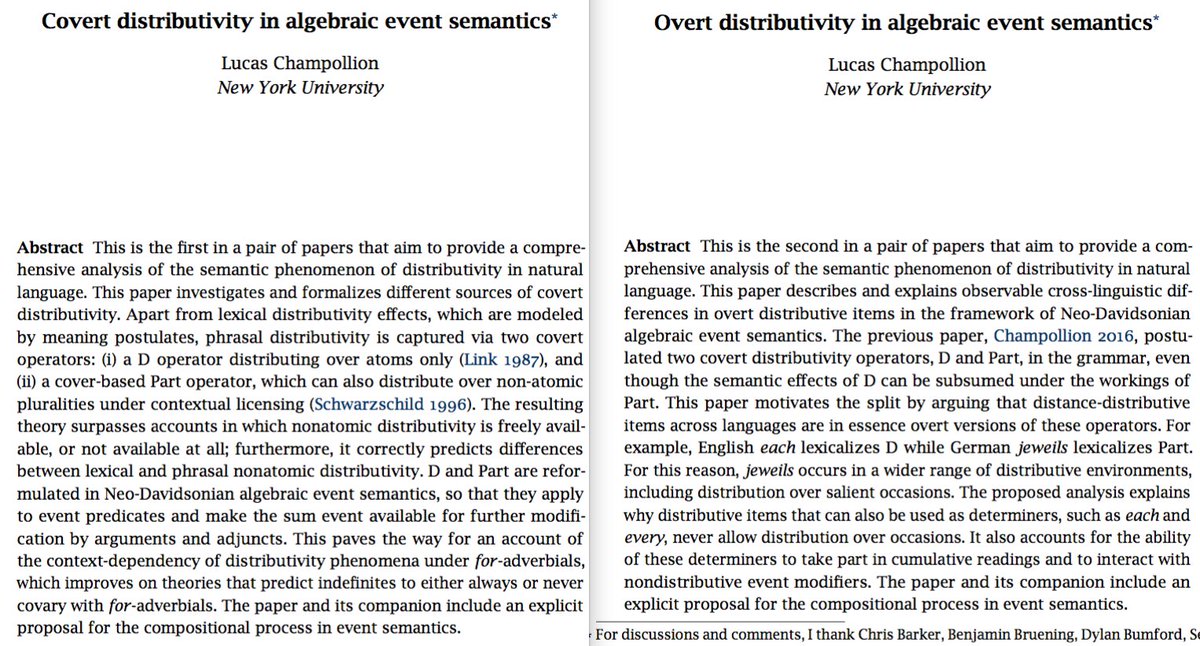
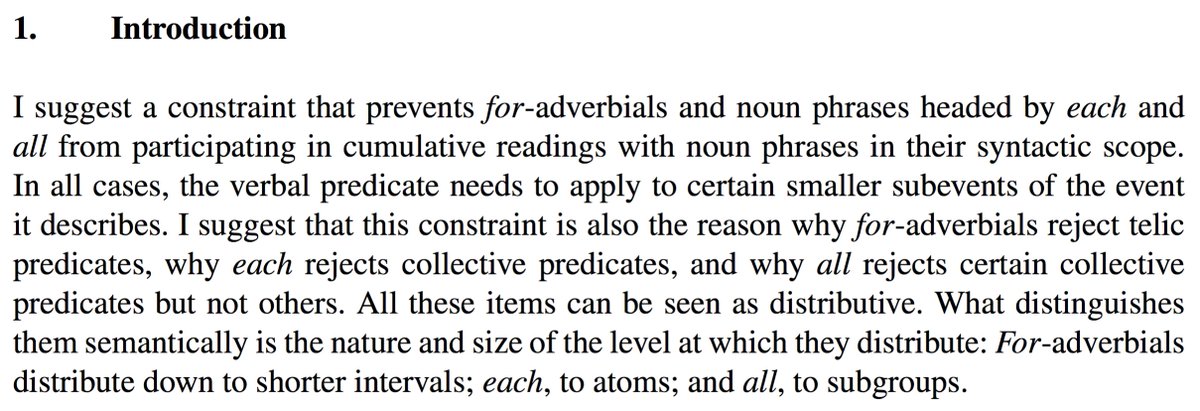
Lecture notes for my online ESSLLI course "Advanced mereology for linguists", 7/26-7/30. This course develops a unified theory of cross-categorial similarities involving the count-mass, singular-plural, telic-atelic, and collective-distributive oppositions ling.auf.net/lingbuzz/006071…
Sharing course materials for undergrad intro to semantics by @maria_esipova, @nadine_theiler & myself. Field-tested in various settings: with & w/o recitations, 10-14 weeks. Based on Portner's book. Problem sets now optimized for online submission/grading. wp.nyu.edu/introsem/
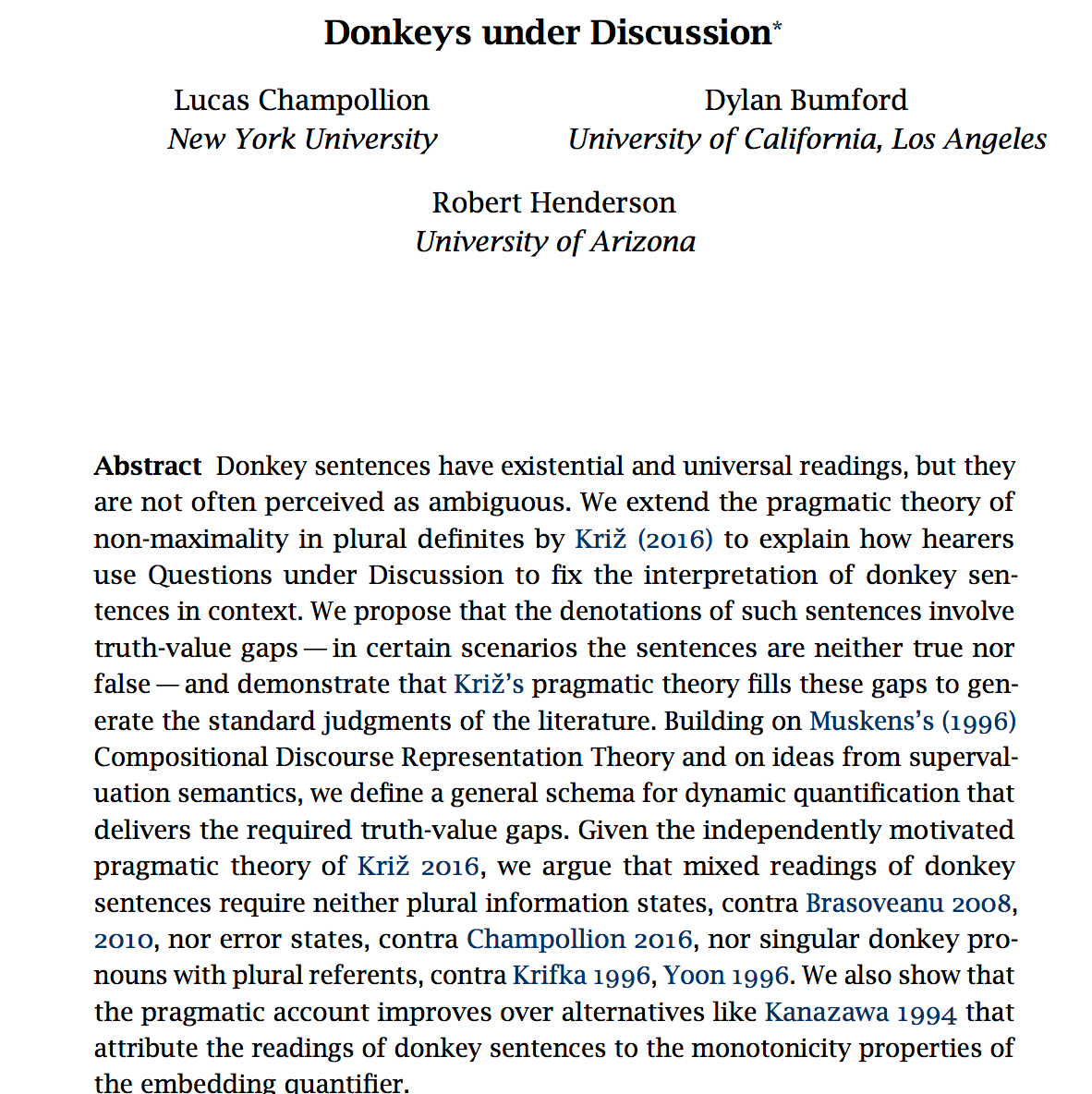
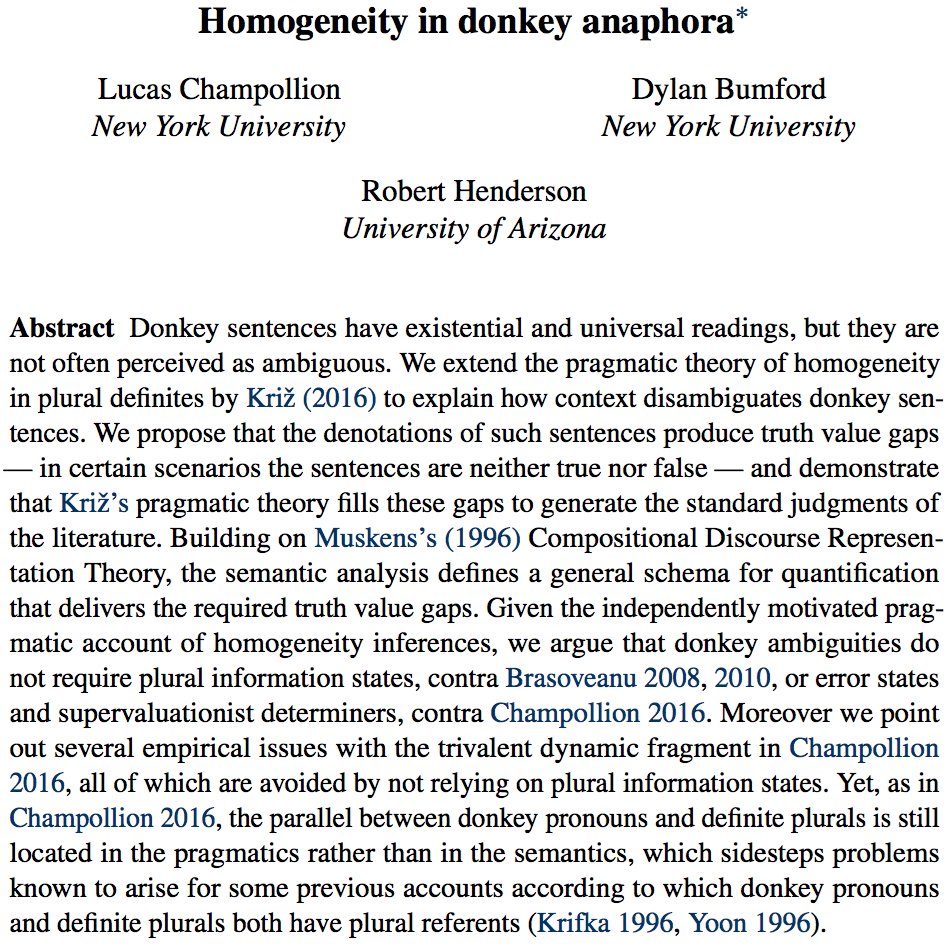
ALT Abstract Donkey sentences have existential and universal readings, but they are not often perceived as ambiguous. We extend the pragmatic theory of non-maximality in plural definites by Križ (2016) to explain how hearers use Questions under Discussion to fix the interpretation of donkey sentences in context. We propose that the denotations of such sentences involve truth-value gaps — in certain scenarios the sentences are neither true nor false — and demonstrate that Križ’s pragmatic theory fills these gaps to generate the standard judgments of the literature. Building on Muskens’s (1996) Compositional Discourse Representation Theory and on ideas from supervaluation semantics, we define a general schema for dynamic quantification that delivers the required truth-value gaps. Given the independently motivated pragmatic theory of Križ 2016, we argue that mixed readings of donkey sentences require neither plural information states, contra Brasoveanu 2008, 2010, nor error states, contra
Masha Esipova and I are making our teaching materials available for an undergrad intro to semantics that's based on Paul Portner's textbook. I'll keep using and updating these materials over the years to come. Comments and feedback welcome! wp.nyu.edu/introsem/
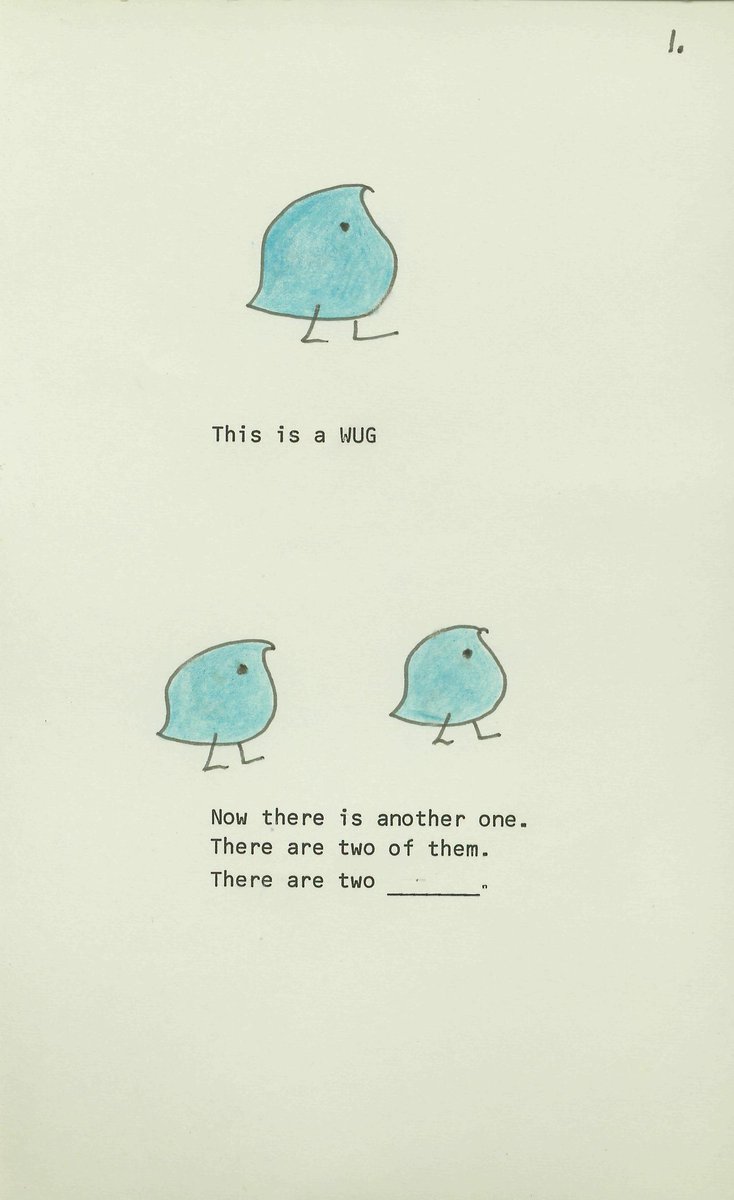
This is a wug, a novel word.
It's new to you (it's not a bird)
You don't already know its plural, do ya?
And now you see another one.
There are two of them, two that come.
Two ___ you say, such grammar, hallelujah!
Looking forward to talking about questions and presuppositions in inquisitive semantics (jww/ Ivano Ciardelli and Floris Roelofsen) at the InqBnB2 workshop (is.gd/ekefeh) in Amsterdam tomorrow!
PDF handout is.gd/oziraz