
Logs, #o11y, @logflare_logs and Elixir at @supabase. Previously @authoritylabs.
Joined June 2007
- Tweets 10,672
- Following 2,421
- Followers 3,122
- Likes 7,440
267 Photos and videos









Pinned Tweet

18 Mar 2020
#bigquery #streaminganalytics #logsaremetrics #structuredlogging @elixirlang @elixirphoenix #myelixirstatus

1
1
16
Chase Granberry retweeted

One of the first Elixir libraries I wrote was a NIF for the Arcade Learning Environment. It was really bad Elixir. Anyway, I revamped it and here's a video of Axon playing Breakout from a Livebook
1
2
21
1,110
Chase Granberry retweeted

Jun 7
QuackDB 0.5 is out 🦆
I’m increasingly convinced that @duckdb is becoming one of the best storage choices for hobby to medium-sized projects.
Postgres is still the obvious default for highly concurrent OLTP systems, but many small and medium products are read-heavy, append-heavy, analytical, or operated by a small team. For those workloads, DuckDB’s columnar execution model, vectorized engine, rich SQL surface, and embedded/local-first deployment model can be a much better fit.
I intend to use DuckDB as the primary storage layer for the platform I’m building, so QuackDB focuses on the parts I need in a real Elixir app: supervision, connection pooling, Ecto, fast append paths, dataframes, telemetry, and helpers for DuckDB’s analytical SQL.
0.5 focuses on making the Ecto and analytical side much more complete:
- append through Ecto with defaults and returning
- using an Ecto repo directly with QuackDB native query/append APIs
- advanced join patterns, including semi/anti and ASOF-style queries
- DuckDB star/COLUMNS expressions in SQL and Ecto
- broader LIST/MAP/STRUCT helpers
- PIVOT, UNPIVOT, GROUPING SETS, ROLLUP, and CUBE builders
- LIST lambdas in Ecto with `fn` syntax and `case_when`
- better nullable/schema type handling for append-heavy workloads
QuackDB also continues to cover the broader integration surface: supervised DuckDB, DBConnection/Ecto, native append, Explorer dataframes, Table.Reader results, Geo/WKB, telemetry, managed DuckDB binaries, and DuckDB-specific SQL helpers.
github.com/elixir-vibe/quack…
1
6
51
1,856
Chase Granberry retweeted

Jun 4
Announcing deflua.com 🎉
The new home for Lua, the pure-Elixir Lua 5.3 VM for @elixirlang.
Scriptable, sandboxed, stupid easy.
Embed untrusted code (AI agent tools, user formulas, plugins) all on the BEAM, zero NIFs.
Plus a live playground 👇
12
37
242
9,713
Jun 2
Have it build tools for itself.
What are we calling this now? Code mode?

Unpopular opinion: If your process is even semi-predictable and runs in a loop, you're probably burning money on tokens and don't need an agent 🔥💵🔥
Use AI to build a good old-fashioned program that handles the workflow and only calls an agent as a fallback🤖
Thank me later😉
1
3
214
Chase Granberry retweeted

May 29
I'm pretty sure the only reason to use Kafka for telemetry data in 2026 is muscle memory.
A simple, open source, S3-backed pipeline can shuttle 1Gb/s of logs to @ClickHouseDB for $200/mo with 2.8s p50 latency. Fast enough for us.
opendata.dev/blog/ingesting-…
12
23
336
90,247
May 7
you mean there is nuance in the compute storage separation discourse?
strange
May 7

the default "puff into {nvme, dram}" works well for most use-cases, but in cases of high, sustained QPS—coupling compute and storage is best
this is what we mean by "compute-storage flexible"
117
May 6
wait wut
May 6

Don't know how I got this far in my career without realizing that us-east-1a/b/c are just random identifiers and 1a for one account might be 1c for another
1
138
Chase Granberry retweeted

Apr 29
Email > Slack
I’ll fight for this one
Apr 29

I have probably never sent an email to an employee of Linear. Only when there is an external person involved. It’s Slack or Linear
15
4
126
23,282
Apr 29
Been thinking about an email interface to Slack for boomers
Apr 29

Slack > email. I will die on this hill.
1
4
2,394
Chase Granberry retweeted

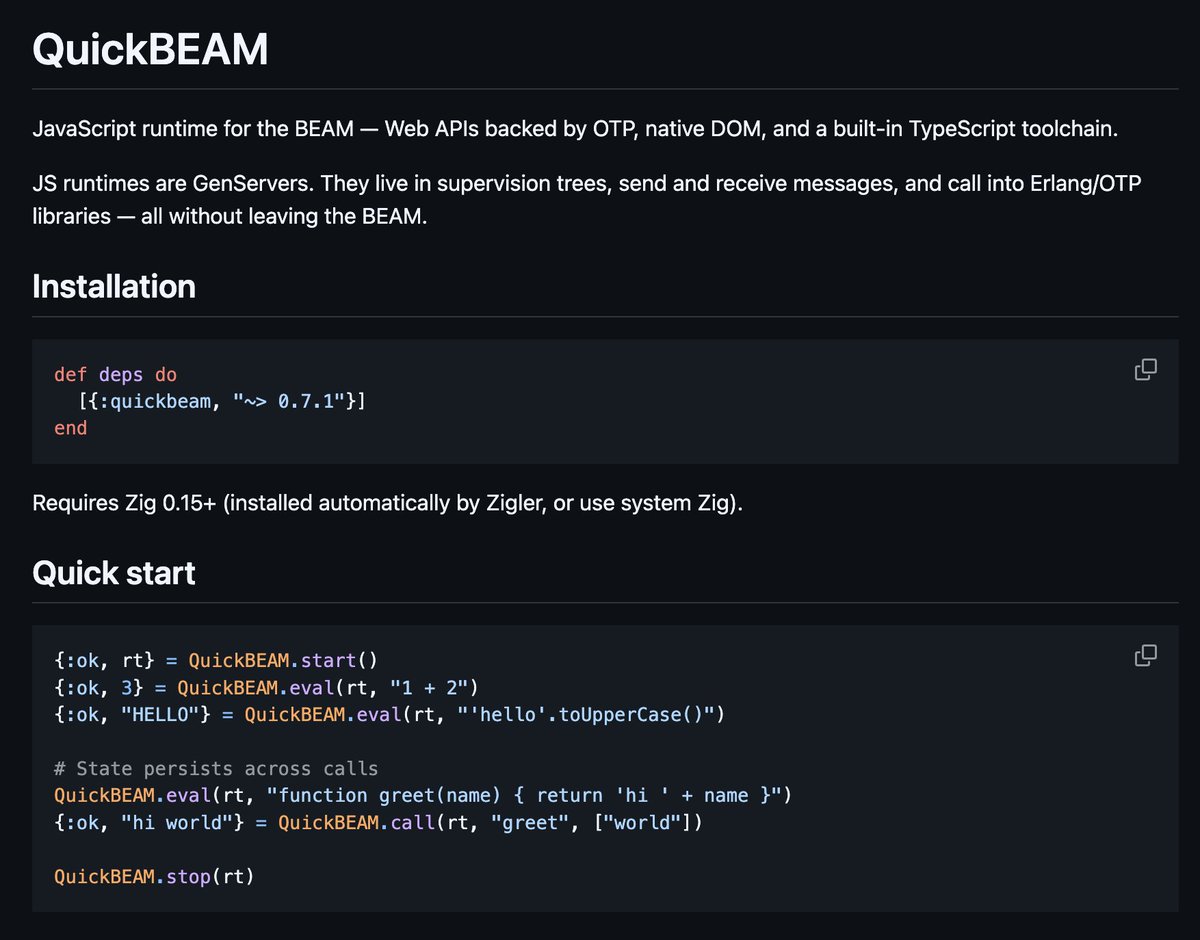
Until now, LiveVue supported only two SSR modes:
➡️ Vitejs-based (for development)
➡️ Nodejs (for production)
Now I'm introducting a third one:
✅ QuickBeam
It's running QuickJS as NIF, which is more performant. Now a default mode!
Thanks @dan_note for contribution!
1
1
18
482
Chase Granberry retweeted

Apr 25
erlang_quic 1.3.0 is out.
First production-ready release. Pure-Erlang QUIC HTTP/3, zero C deps.
- RFC 9000 / 9001 9114 / 9204
- Priorities, datagrams, CONNECT
- -proto_dist quic for clusters
- OTP 27
github.com/benoitc/erlang_qu…
2
16
112
4,518
Chase Granberry retweeted

Apr 24
PI is now over 50% of agent usage at Shopify internally.
30
49
1,185
103,582
Apr 23
wat
Apr 23

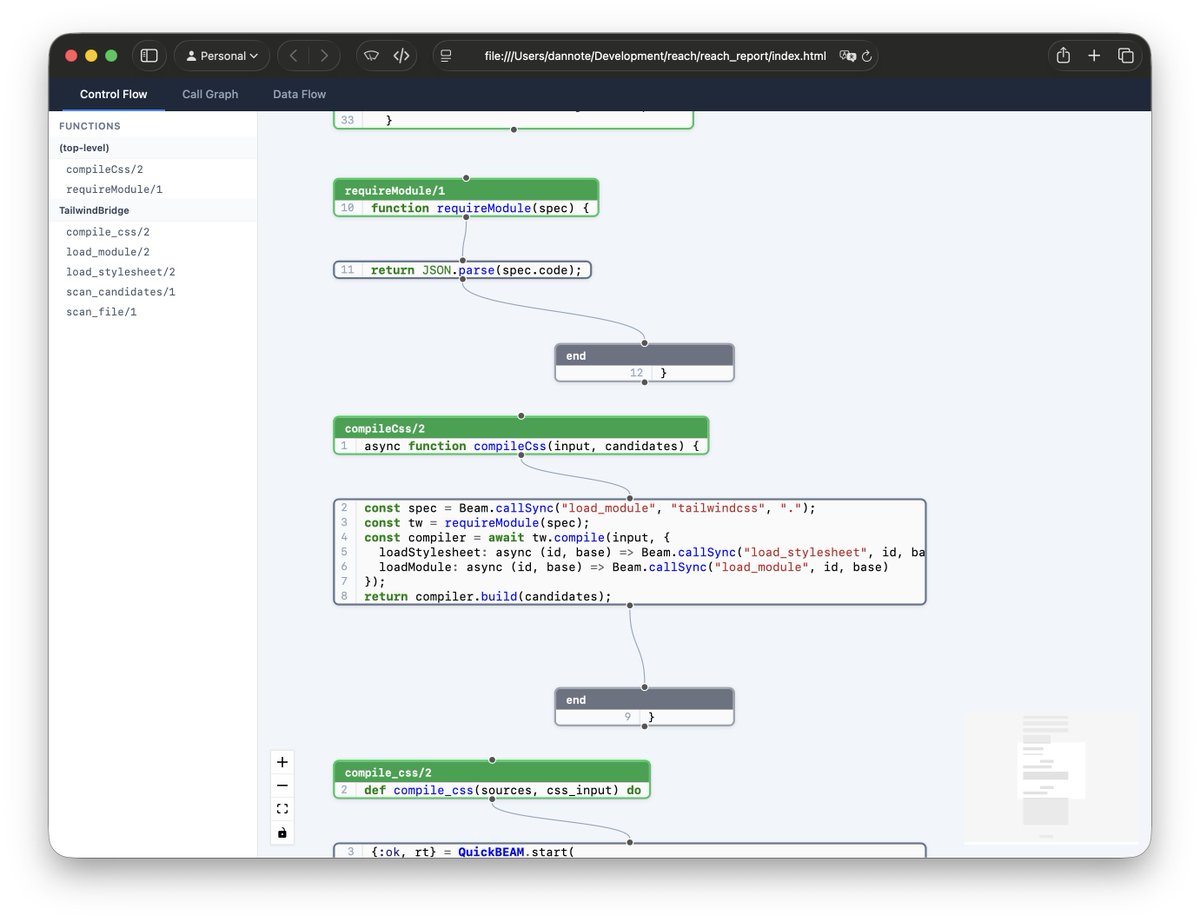
Reach can now trace data flow from Elixir through QuickBEAM's JS runtime and back. One program dependence graph across two languages and two runtimes.
Also: dead code detection now produces near-zero false positives across 5 real codebases.
The line between frontend and backend is getting thinner. More coming soon.
github.com/dannote/reach/rel…
1
9
670
Chase Granberry retweeted

Apr 22
This is my first big Elixir project. I reached for it because I needed to manage the state of a lot of docker compose clusters to run the dev servers and docker containers to run agents.
The supervisor tree was crucial to getting it working.
1
1
10
747
Chase Granberry retweeted
Apr 19
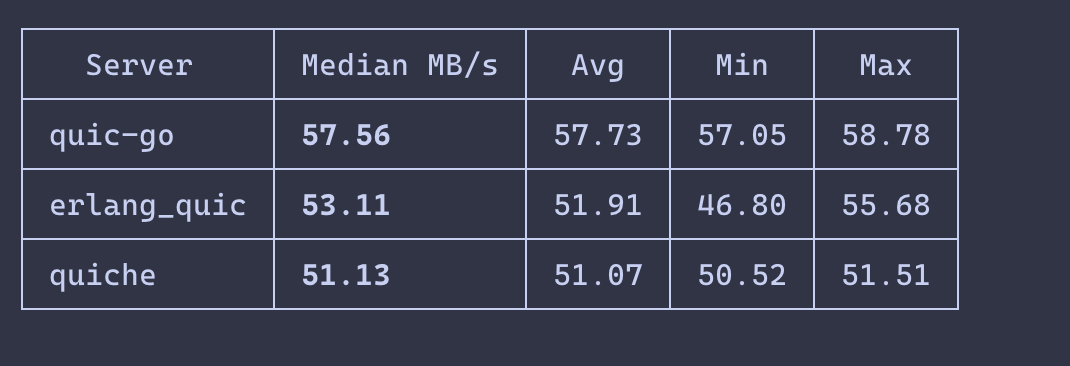
pure implementation of QUIC in erlang performs well now .
github.com/benoitc/erlang_qu…
1
6
108
6,053
Chase Granberry retweeted
Apr 19
Reach 1.5.0 — effect classification accuracy went from 11% to 89%.
The analyzer couldn't tell 𝚁𝚎𝚙𝚘.𝚒𝚗𝚜𝚎𝚛𝚝!() from 𝙴𝚗𝚞𝚖.𝚖𝚊𝚙(). Now it can.
What changed:
— Alias/import resolution. 𝚊𝚕𝚒𝚊𝚜 𝙵𝚘𝚘.𝙱𝚊𝚛 then 𝙱𝚊𝚛.𝚌𝚊𝚕𝚕() was invisible to coupling analysis. Multi-alias 𝚊𝚕𝚒𝚊𝚜 𝙵𝚘𝚘.{𝙰, 𝙱} and 𝚒𝚖𝚙𝚘𝚛𝚝 too
— Cross-module effect inference. Pure functions recognized transitively across modules
— Plugin 𝚌𝚕𝚊𝚜𝚜𝚒𝚏𝚢_𝚎𝚏𝚏𝚎𝚌𝚝/𝟷 callback for all 8 built-in plugins. 𝚁𝚎𝚙𝚘.𝚊𝚕𝚕 → read, 𝚁𝚎𝚙𝚘.𝚒𝚗𝚜𝚎𝚛𝚝! → write, 𝚊𝚜𝚜𝚒𝚐𝚗 → pure
— On Elixir 1.19 reads compiler-inferred types from ExCk BEAM chunk
7 new commands: 𝚌𝚘𝚞𝚙𝚕𝚒𝚗𝚐, 𝚑𝚘𝚝𝚜𝚙𝚘𝚝𝚜, 𝚍𝚎𝚙𝚝𝚑, 𝚎𝚏𝚏𝚎𝚌𝚝𝚜, 𝚋𝚘𝚞𝚗𝚍𝚊𝚛𝚒𝚎𝚜, 𝚡𝚛𝚎𝚏, 𝚌𝚘𝚗𝚌𝚞𝚛𝚛𝚎𝚗𝚌𝚢. All take a path filter: 𝚖𝚒𝚡 𝚛𝚎𝚊𝚌𝚑.𝚑𝚘𝚝𝚜𝚙𝚘𝚝𝚜 𝚕𝚒𝚋/𝚖𝚢_𝚊𝚙𝚙/
Tested on 7 real codebases (up to 817 files). Zero crashes, 30% faster.
github.com/dannote/reach/rel…
1
35
1,341
Chase Granberry retweeted

Apr 18
PgQue v0.1.0 is out.
PgQ -- the Postgres queue system built at Skype 20 years ago for 1B-user-scale workloads -- repackaged for the managed-Postgres era. One SQL file. No C extension. No external daemon. pg_cron to tick.
Why bother reviving a 2007 architecture?
Every major Postgres queue in production today uses some flavor of SKIP LOCKED UPDATE/DELETE. It works under light load. When you have more data and higher load, it degrades predictably. Then you get posts like these:
- Brandur at Heroku, 2015: 60k job backlog in one hour from a single open transaction
- PlanetScale, 2026: death spiral at 800 jobs/sec
- River issue #59, awa issue #169 and so on, Oban's partitioning work, PGMQ's autovacuum tuning guide and duct-taping with pg_partman
The core issue is how Postgres MVCC is implemented and how we deal with it. Dead tuples in the hot path, xmin horizon pinned, vacuum falling behind, query performance quickly degrades. This happens every time you run pg_dump, execute an analytical query, or have a lagging/unused logical replication slot.
PgQ solved this in 2007 with snapshot-based batching and TRUNCATE rotation -- zero dead tuples in the event
path, by design.
But PgQ needed a C extension and an external daemon. Which means it doesn't run on RDS, Aurora, Cloud SQL, AlloyDB, Supabase, or Neon -- i.e., where most
Postgres lives now.
PgQue closes that gap.
💎 Pure SQL PL/pgSQL (PgQ engine)
👩💻 \i sql/pgque.sql -- you're done
🕑 pg_cron replaces pgqd (optional, recommended)
💻 Python, Go, TypeScript client examples shipped
💙 Apache 2.0
Trade-off: end-to-end event delivery latency is up to a second, it depends on ticking frequency. If you need sub-3ms job dispatch, use River, Oban, or graphile-worker (and avoid anything that blocks xmin horizon). If you need high-throughput event streaming with fan-out inside Postgres -- Kafka-shaped, without Kafka and dealing with transactional outbox implementation -- this is the right shape of tool.
Kudos to Marko Kreen and Skype engineers who implemented this decades ago, for the original PgQ, and to Alexander Kukushkin whose recent "Rediscovering PgQ" talk brought this quiet corner of the Postgres ecosystem back into view.
Stars, issues, PRs, and honest criticism all welcome.
Link 👇
6
50
352
34,456
Chase Granberry retweeted

Apr 17
for the erlang, elixir, and gleam fans - you can now use DOs to create and manage supervision hierarchies of child DOs 😎
Apr 17

In case you missed it, Project Think -- that's @threepointone's Workers-native agent harness -- supports sub-agents using Durable Object Facets: blog.cloudflare.com/project-…
That's actually a different use case for facets than the one I presented Monday: blog.cloudflare.com/durable-…
In this case, the facet isn't running agent-generated code -- the facet is running a regular, static DurableObject class exported by the same Worker as the parent DO's class. This is not actually documented yet, but you can refer to your own Worker's exported Durable Object classes using `this.ctx.exports.ClassName`, and provide that when starting a facet.
In other words, this allows you to essentially run instances of a Durable Object class that are owned by some other instance and stored together with it. The child gets its own private SQLite database, but has a zero-latency connection to the parent since they are always co-located. Useful for running a sub-agent.
If this makes no sense... I'm sorry, it's my fault. I've really outdone myself on the "nobody understands this" scale with facets. Just... use Think and don't worry about it.
7
7
132
17,254
Chase Granberry retweeted

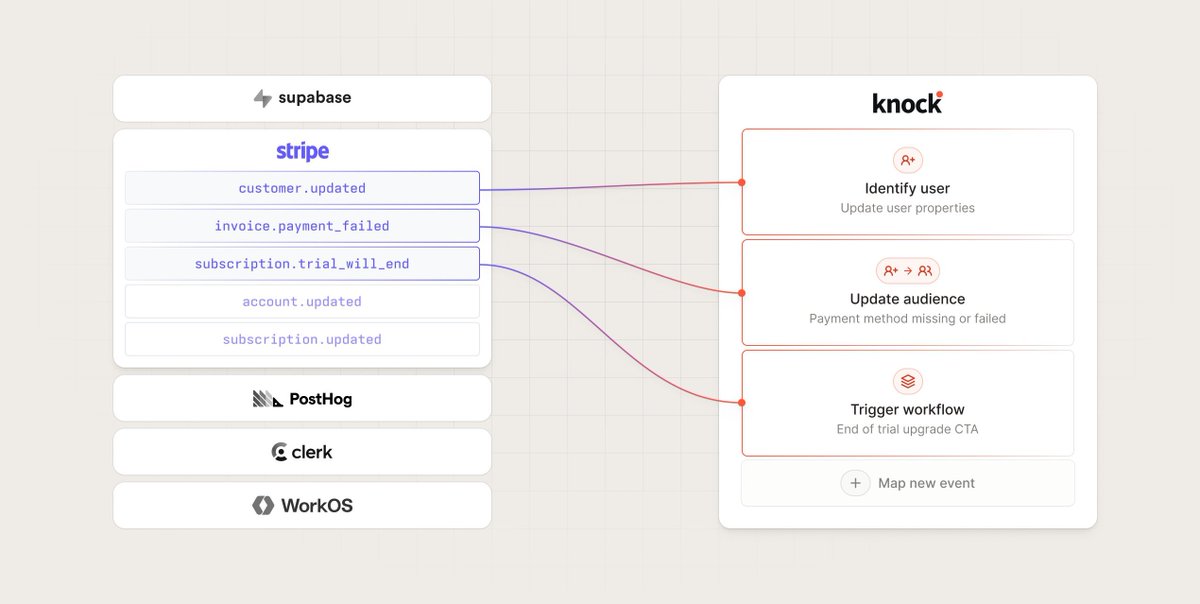
The untold engineering story here is that this is powered by JS scripts that customers can author to validate and transform an event as it comes in.
We built that by compiling JS to wasm via javy and executing wasm in elixir via wasmex (with some tight execution guarantees as it's on the critical path).
I know sandboxes are all the rage right now, but elixir really is incredible for this sort of thing.

Trigger customer messaging directly from @stripe, @clerk, @WorkOS and @supabase. No webhook glue code or third party services needed.
3
9
57
9,053