Associate Professor, NYU Tandon CSE/ECE | 👨🍳🥷
Joined October 2010
- Tweets 182
- Following 563
- Followers 297
- Likes 640
12 Photos and videos

Feb 26
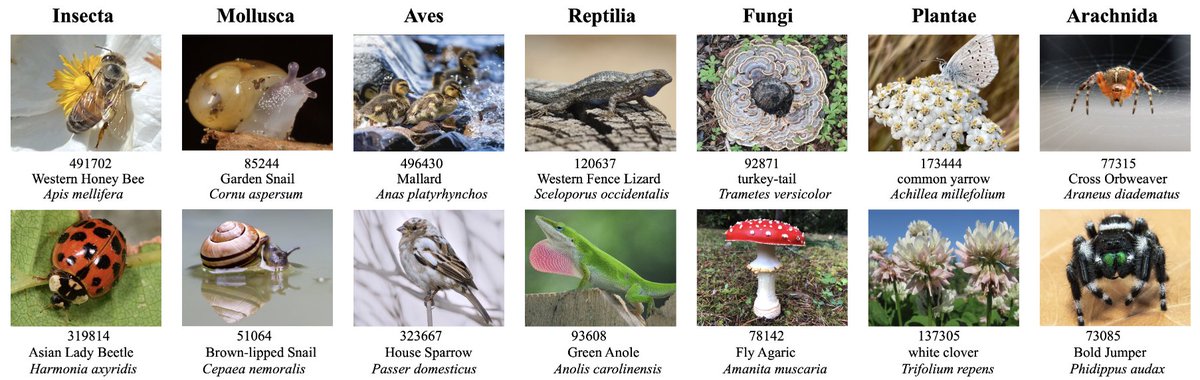
Such a fun and fascinating experiment -- on so many levels ! Eagerly watching @DimitrisPapail

The 10-digit addition transformer race is getting ridiculous and fun!
Started with 6k params (Claude Code) vs 1,6k (Codex).
We're now at 139 params hand-coded and 311 trained.
I made AdderBoard to keep track:
🏆 Hand-coded:
139p: @w0nderfall
177p: @xangma
🏆 Trained:
311p by @reza_byt
456p by @yinglunz
777p by @YebHavinga
Rules are simple:
- Real autoregressive transformer (attention required)
- ≥99% on 10K held-out pairs
- No hard-coding the algorithm in Python
Submit via GitHub issue/PR.
2
344
Chinmay Hegde retweeted

Feb 13
I dont know why i am even accepting to be area chair at machine learning conf like @icmlconf . I cant choose the papers, i cannot really choose the referees, cant invite assignments: all is predetermined to make sure 1st year phd students reviews paper they know nothing about...
3
44
5,618
Chinmay Hegde retweeted

So I think Hinton is wrong: formal methods are a closed system, but mathematics is not, and the latter will cease to be mathematics (in any recognizable sense) if allowed to develop independently of human culture for any extended period: it's ultimately about the story. (15/15)
77
48
1,168
34,035
11 Dec 2025
Strongly disagree with my dear colleague and friend @togelius, because F cancer
8 Dec 2025

I was at an event on AI for science yesterday, a panel discussion here at NeurIPS. The panelists discussed how they plan to replace humans at all levels in the scientific process. So I stood up and protested that what they are doing is evil. Look around you, I said. The room is filled with researchers of various kinds, most of them young. They are here because they love research and want to contribute to advancing human knowledge. If you take the human out of the loop, meaning that humans no longer have any role in scientific research, you're depriving them of the activity they love and a key source of meaning in their lives. And we all want to do something meaningful. Why, I asked, do you want to take the opportunity to contribute to science away from us?
My question changed the course of the panel, and set the tone for the rest of the discussion. Afterwards, a number of attendees came up to me, either to thank me for putting what they felt into words, or to ask if I really meant what I said. So I thought I would return to the question here.
One of the panelists asked whether I would really prefer the joy of doing science to finding a cure for cancer and enabling immortality. I answered that we will eventually cure cancer and at some point probably be able to choose immortality. Science is already making great progress with humans at the helm. We'll get fusion power and space travel some day as well. Maybe cutting humans out of the loop could speed up this process, but I don't think it would be worth it. I think it is of crucial importance that we humans are in charge of our own progress. Expanding humanity's collective knowledge is, I think, the most meaningful thing we can do. If humans could not usefully contribute to science anymore, this would be a disaster. So, no. I do not think it worth it to find a cure for cancer faster if that means we can never do science again.
Many of those who came up to talk to me last night, those who asked me whether I was being serious or just trolling, thought that the premise was absurd. Of course there would always be room for humans in science. There will always be tasks only humans can do, insight only humans have, and so on. Therefore, we should welcome AI. Research is hard, and we need all the help we can get. I responded that I hoped they were right. That is, I truly hope there will always be parts of the research process which humans will be essential for. But what I was arguing against was not what we might call "weak science automation", where humans stay in the loop in important roles, but "strong science automation", where humans are redundant.
Others thought it was immature to argue about this, because full science automation is not on the horizon. Again, I hope they are right. But I see no harm in discussing it now. And I certainly don't think we need research on science automation to go any further.
Yet others remarked that this was a pointless argument. Science automation is coming whether we want it or not, and we'd better get used to it. The train is coming, and we can get on it or stand in its way. I think that is a remarkably cowardly argument. It is up to us as a society to decide how we use the technology we develop. It's not a train, it's a truck, and we'd better grab the steering wheel.
One of the panelists made a chess analogy, arguing that lots of people play chess even though computers are now much better than humans at chess. So we might engage in science as a kind of hobby, even though the real science is done by computers. We would be playing around far from the frontier, perhaps filling in the blanks that AI systems don't care about. That was, to put it mildly, not a satisfying answer. While I love games, I certainly do not consider game-playing as meaningful as advancing human knowledge. Thanks, but no thanks.
Overall, though, it was striking that most of those I talked to thanked me for raising the point, as I articulated worries that they already had. One of them remarked that if you work on automating science and are not even a little bit worried about the end goal, you are a psychopath. I would add that another possibility is that you don't really believe in what you are doing.
Some might ask why I make this argument about science and not, for example, about visual art, music, or game design. That's because yesterday's event was about AI for science. But I think the same argument applies to all domains of human creative and intellectual expression. Making human intellectual or creative work redundant is something we should avoid when we can, and we should absolutely avoid it if there are no equally meaningful new roles for humans to transition into.
You could further argue that working on cutting humans out of meaningful creative work such as scientific research is incredibly egoistic. You get the intellectual satisfaction of inventing new AI methods, but the next generation don't get a chance to contribute. Why do you want to rob your children (academic and biological) of the chance to engage in the most meaningful activity in the world?
So what do I believe in, given that I am an AI researcher who actively works on the kind of AI methods used for automating science? I believe that AI tools that help us be more productive and creative are great, but that AI tools that replace us are bad. I love science, and I am afraid of a future where we are pushed back into the dark ages because we can no longer contribute to science. Human agency, including in creative processes, is vital and must be safeguarded at almost any cost.
I don't exactly know how to steer AI development and AI usage so that we get new tools but are not replaced. But I know that it is of paramount importance.
2
284
7 Dec 2025
The first step towards a fully open, frontier agentic model. Congrats to the entire OpenThoughts team 🚀🚀
6 Dec 2025

So excited to be the SFT lead of this massive collaboration! The OpenThoughts team is 🔥
4
296
Chinmay Hegde retweeted

1 Dec 2025
Curious what your model really knows? Try probing it 🕵️♀️
Code: github.com/kevinlu4588/WhenA…
Project: unerasing.baulab.info
Paper: arxiv.org/abs/2505.17013
work led by @kevinlu4588 w/ @NickyDCFP, @mnphamx1, @davidbau, @chegday and @CohNiv
@Northeastern @nyuniversity
1
4
202
28 Nov 2025
iykyk
28 Nov 2025
5.1>5>4.5>3 without a doubt
2
92
Chinmay Hegde retweeted

14 Nov 2025
Excited to share our paper “When Are Concepts Erased from Diffusion Models?” at @NeurIPSConf!
We introduce two conceptual models for erasure mechanisms in diffusion models, and a suite of probes to recover supposedly forgotten concepts.
Project website: unerasing.baulab.info/
2
11
39
6,502
Chinmay Hegde retweeted

13 Nov 2025
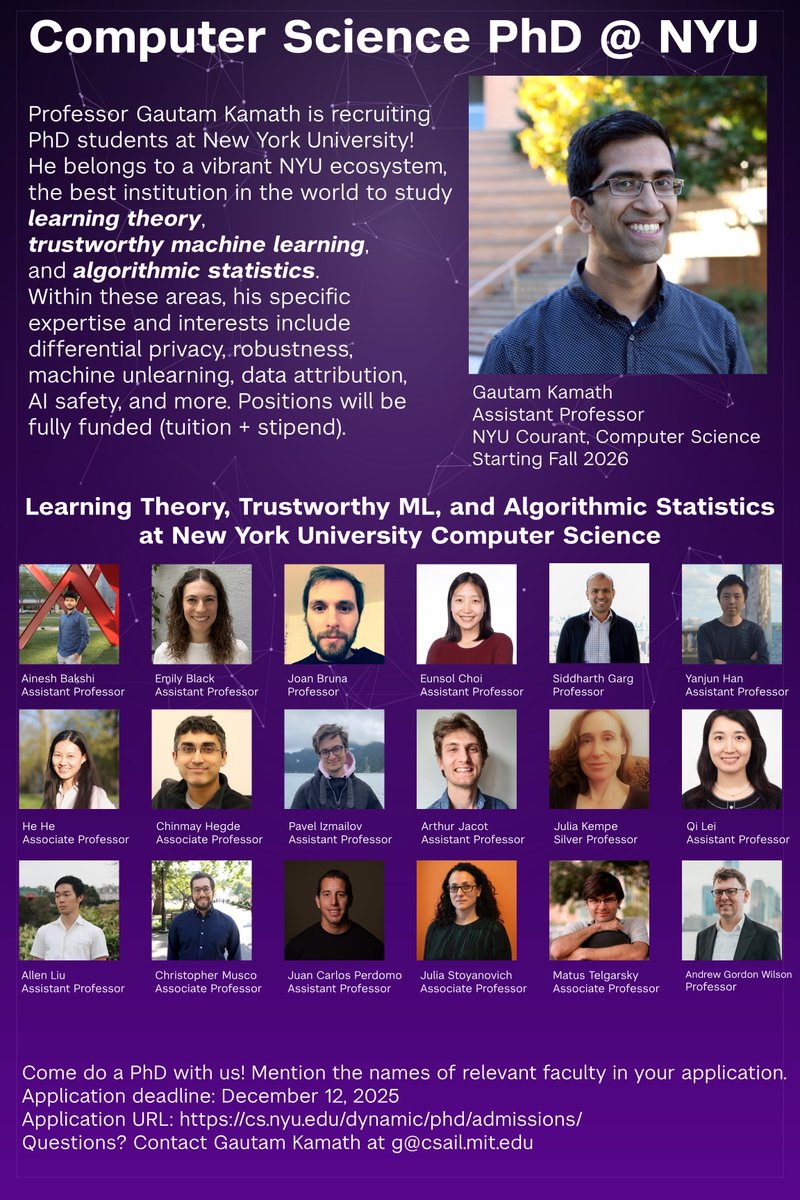
I am recruiting PhD students at @NYU_Courant to conduct research in learning theory, algorithmic statistics, and trustworthy machine learning, starting Fall 2026. Please share widely! Deadline to apply is December 12, 2025.
11
133
576
81,119
Chinmay Hegde retweeted

20 Sep 2025
You can volunteer as a reviewer here:
openreview.net/group?id=TMLR
TMLR needs more reviewers. The submission and review process is very nice and without artificial time constraints. It is also much more collaborative between reviewers and authors than at conferences.
1
5
21
3,712
13 Aug 2025
Mostly agree with my dear colleague @togelius (read it if you haven't already!)
My take is a bit more positive: whether the bubble pops or not, there will still be a wealth of interesting and useful directions to pursue from the research side.
13 Aug 2025
I remember being excited about AI. I remember 20 years ago, being excited about neuroevolutionary methods for learning adaptive behaviors in video games. And I remember three years ago, mouth watering at the thought of tasty experiments in putting language models inside open-ended learning loops. Those were the days. Back when working in AI research meant working on hard technical problems, thinking about fascinating philosophical topics, and occasionally solving real problems.
These days, I still care about the technical problems. But the wider field of AI increasingly disgusts me. The discourse is suffocating. I think I've developed a serious case of AI allergy.
Let me explain. When I go to LinkedIn, it's full of breathless AI hypesters pronouncing that the latest incremental update to some giant model "changes everything" while hawking their copycat companies and get-rich-quick schemes. Twitter is instead populated by singularity true believers, announcing that superintelligence is imminent, at which point we can live forever and never need to work again. We may not even need to think for ourselves anymore, clearly a welcome proposition for those who have decided to anticipate this development by stopping thinking already. Where can you avoid this cacophony? At Bluesky, that's where. But Bluesky is instead populated by long-suffering artists and designers complaining that AI steals their works and takes their jobs.
At least there's Facebook, where my relatives and high school friends only rarely opine about AI. Unfortunately, they sometimes do.
AI is everywhere. However much I try to escape it by pursuing my other interests, from modernist literature to dub reggae to video games, somehow someone brings up AI. Please. Make it stop.
The discussions about the current state of AI, with all opportunities and issues, are tiresome enough. But where it gets really maddening is when people start talking about when we reach AGI, or superintelligence, or the singularity or something (all these terms are about as well-defined as warp speed or pornography). The story goes that sometime soon AI will become so intelligent that it can do everything a human can do (for some value of "everything"). Then human work will become unnecessary, we will have rapid scientific advances courtesy of AI, and we will all become immortal and live in AI-generated abundance. Alternatively, we will all be killed off by the AI.
There are various takes on this. Let's this assume the singularity believers are correct. In that case, nothing we do will soon matter. There's no point in trying to get good at anything, because some AI system can do it better. Society as we know it, which assumes that we do things for each other, would cease to exist. That would be very depressing indeed. Nobody wants this. Least of all the kind of ambitious young people who work on AGI so they can do something important with their lives. If you actually believe in AGI, it's your moral responsibility to stop working on it.
Another take is that people say these things because that they have a religious need to believe in some grand transformation coming soon that will do away with this dreary life and bring about paradise. The Rapture, essentially. Others may preach AGI and the singularity because they have strong financial incentives to do so, with all these hundreds of billions of dollars (!) invested in AI and many thousands of people getting very rich from insane stock valuations. These reasons are not exclusive. In particular, many successful AI startup founders are successful because of the strength of their visions. In another life, they might have been firebrand preachers.
So which take is right? I don't know. But looking at history, new technologies mostly increased our freedom of action, and made new ways of being creative possible. They had good and bad effects across many aspects of society, but society was still there. It took decades or more for these technologies to effect their changes. Think writing, gunpowder, the printing press, electricity, cars, telephones. The internet, smartphones. You may say that AI is different to all those technologies, but they are also all different from each other.
It would be a bad move to bet against all of human history, so chances are that AI will turn out to be a normal technology. At some point we will have a better understanding of what kinds of things we can make this curious type of software do and what it just inherently sucks at. Eventually, we will know better which parts of our lives and work will be transformed, and which will be only lightly touched by AI.
The absence of an imminent singularity almost certainly implies that the extreme valuations we currently see for AI companies will become undefendable. In particular, serving tokens is likely to be a low-margin business, given the intense competition between multiple models of similar capability. The bubble will pop. We will see something akin to the dot-com crash of 2000, but on an even grander scale. Good, I say. I'm dreaming of an AI winter. Just like the one I used to know.
Remember that lots of valuable innovations and investments were made during the dot-com bubble. And companies that survived the dot-com crash sometimes did very well, because they had good technology and actual business models. Just ask Google or Amazon. In the same way, after the AI crash, there will be lots of room to build AI solutions that solve real problems and give us new creative possibilities. Lots of room for starting companies that use AI but have a business model. There will also be lots of room for experimentation and research into diverse approaches to AI, after the transformer architecture has stopped sucking all of the air out of the room.
Most of all, I'm looking forward to AI not being on everyone's mind all the time. I want to be able to read the Economist or watch BBC and not hear about AI. No Superbowl ads either, please. After the crash, people's attention will move on to whatever the new new thing will be. Who knows, longevity drugs? Space travel? Flying electric cars? Whatever it will be, I hope it also sucks up all the people who only came to AI for the money.
Here's hoping that within a few years, when the frenzy is over, there will be room for those of us who really care about AI to get on with our work. Personally, I hope my AI allergy will recede. I can't wait to feel excited about AI again.
1
202
Chinmay Hegde retweeted

12 Aug 2025
My whole inbox is filled with Neurips emails.
1
10
1,305
Chinmay Hegde retweeted

18 Jul 2025
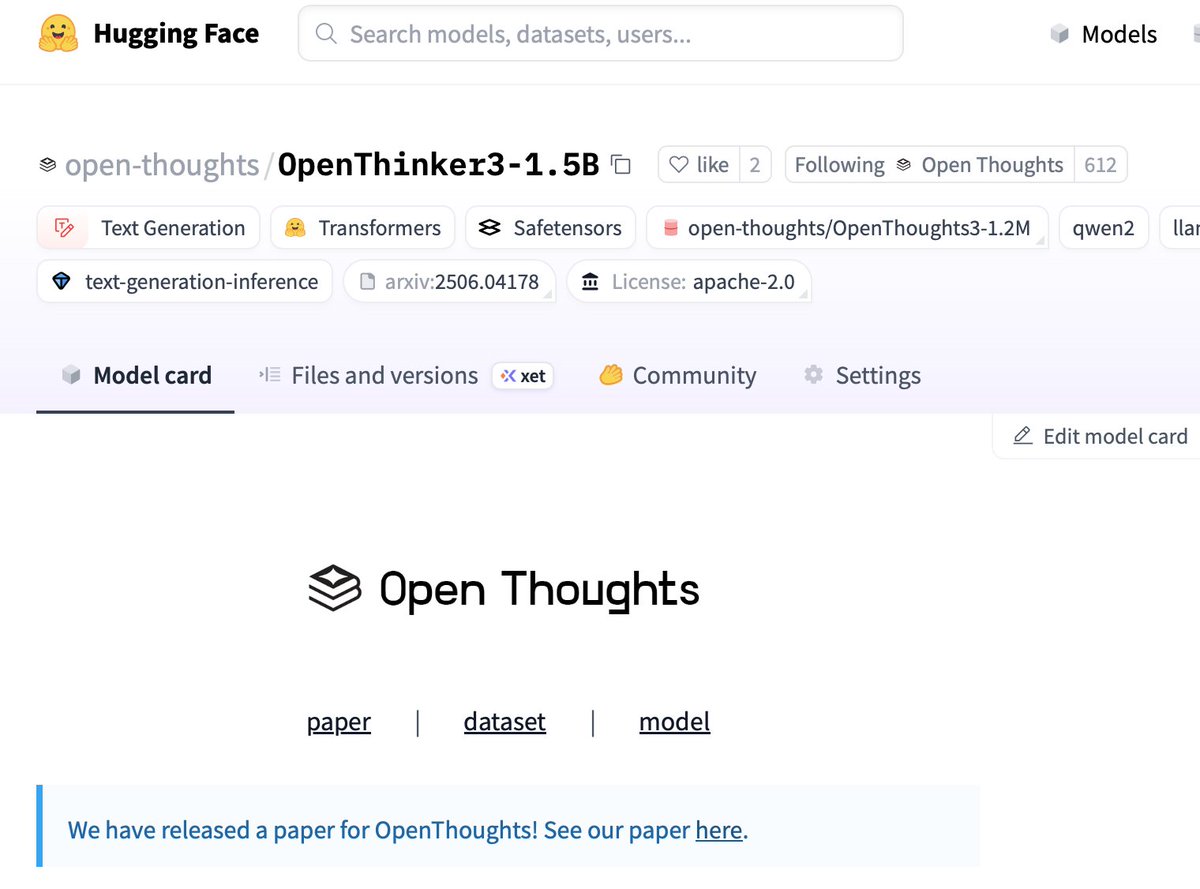
📢📢📢 Releasing OpenThinker3-1.5B, the top-performing SFT-only model at the 1B scale! 🚀
OpenThinker3-1.5B is a smaller version of our previous 7B model, trained on the same OpenThoughts3-1.2M dataset.
1
33
120
14,132
15 Jul 2025
Great find on how hard it is to measure "true" model capabilities.
15 Jul 2025

I was particularly impressed with the progress on the hardest problem, 3:
chatgpt.com/share/6876c2de-8…
o3 seemed to actually have a lot of the right ideas and get the right answer.
But the comment at the end revealed that it might have found a full solution online during reasoning.
1
139
13 Jul 2025
I won't be at #ICML2025 but if you are, then definitely check out @FeuerBenjamin present WildChat-50M on Tuesday evening! The largest-of-its-kind open-source dataset for SFT'ing LLMs.
1
3
274
13 Jul 2025
Paper details: icml.cc/virtual/2025/poster/…
arXiv: arxiv.org/html/2501.18511v1
HF:
WildChat-50m - a nyu-dice-lab Collection
huggingface.co/collections/n…
82
Chinmay Hegde retweeted

3 Jul 2025
New research paper for you to read over your July 4th break (if you're US-based) --
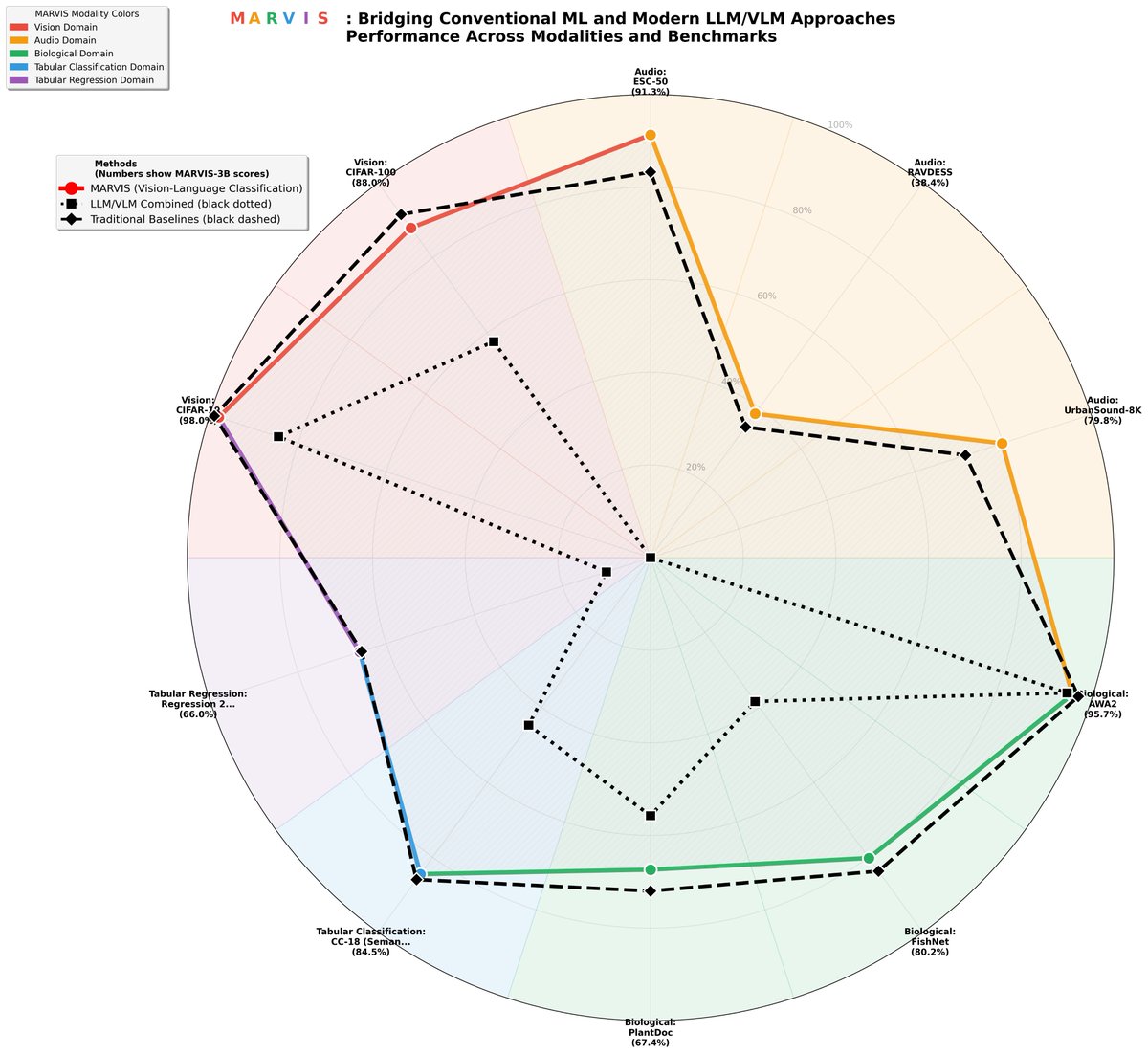
Vision is a skeleton key! 🗝️ We convert a small VLM into an "everything classifier" by transforming data into visualizations that VLMs can naturally understand and reason about. We call it MARVIS: Modality Adaptive Reasoning over VISualizations.
Our MARVIS-3B model:
- Beats Gemini by 16% on average across 100s of vision and tabular tasks 🏆
- Gets within 2.5% of the best specialized model across across 4 modalities ... 🎯
- Using just one 3B model ... 💪
- ... without exposing any P.I.I. (personally identifiable information) to the VLM ... 🔐
- And without requiring any model training! ⚡
Our GitHub: lnkd.in/eqPkzU2m 💻
Our Paper: lnkd.in/esXZEvEE 📄
Research Supported By: oumi.ai
Thanks to @LennartPurucker @Oussama_e
2
4
566
Chinmay Hegde retweeted

23 Jun 2025
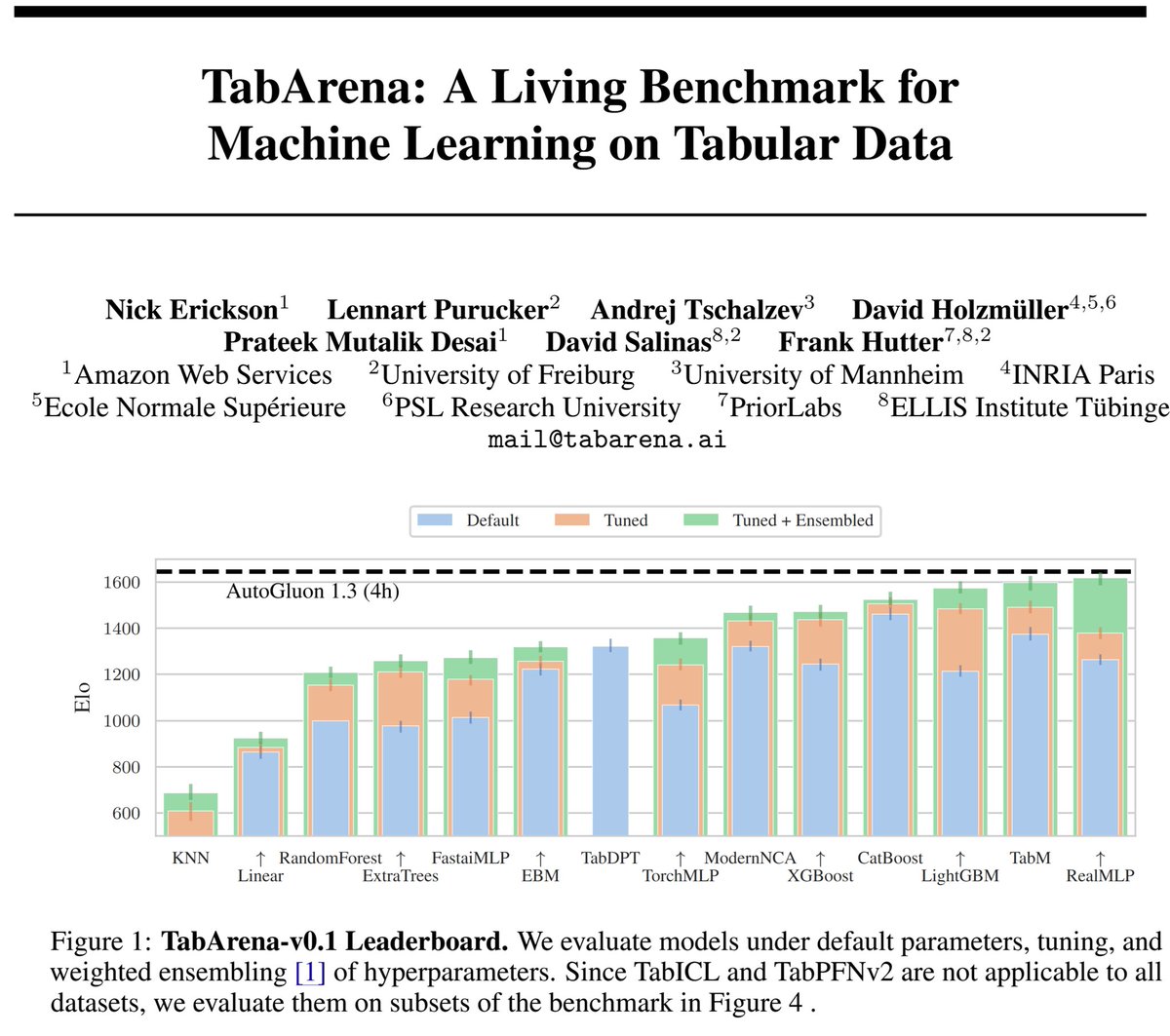
🚨What is SOTA on tabular data, really? We are excited to announce 𝗧𝗮𝗯𝗔𝗿𝗲𝗻𝗮, a living benchmark for machine learning on IID tabular data with:
📊 an online leaderboard (submit!)
📑 carefully curated datasets
📈 strong tree-based, deep learning, and foundation models
🧵
11
72
387
60,654
5 Jun 2025
It's been a joy and privilege to watch this team at work. Congrats!!
5 Jun 2025

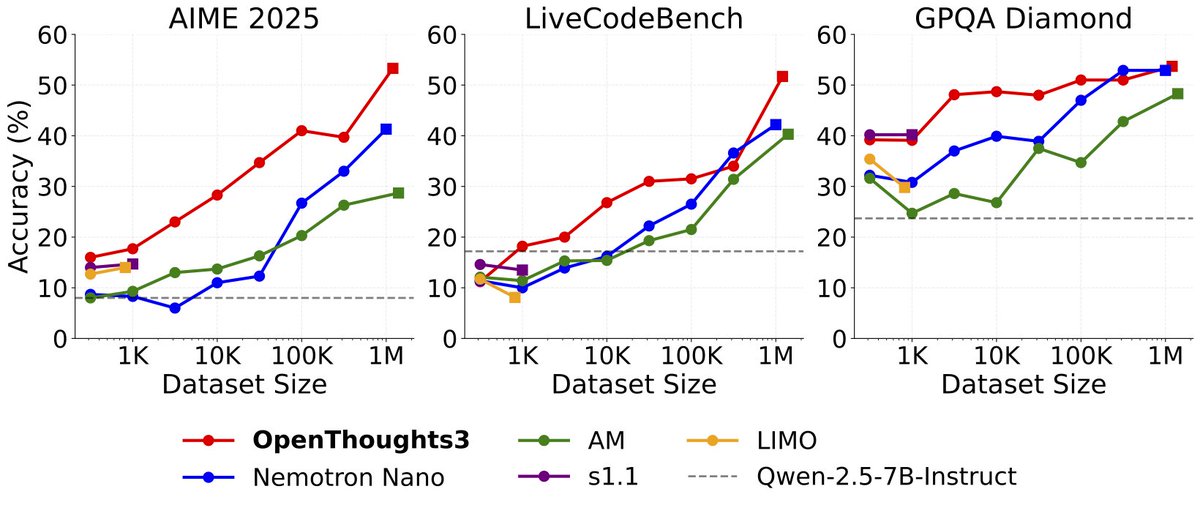
Announcing OpenThinker3-7B, the new SOTA open-data 7B reasoning model: improving over DeepSeek-R1-Distill-Qwen-7B by 33% on average over code, science, and math evals.
We also release our dataset, OpenThoughts3-1.2M, which is the best open reasoning dataset across all data scales. Full details are in our ✨new paper✨ - below we share the highlights:
BTW, it also works on non-Qwen models😉 (1/N)
1
10
487
Chinmay Hegde retweeted

5 Jun 2025
Announcing OpenThinker3-7B, the new SOTA open-data 7B reasoning model: improving over DeepSeek-R1-Distill-Qwen-7B by 33% on average over code, science, and math evals.
We also release our dataset, OpenThoughts3-1.2M, which is the best open reasoning dataset across all data scales. Full details are in our ✨new paper✨ - below we share the highlights:
BTW, it also works on non-Qwen models😉 (1/N)
34
192
923
200,643