
Developer, traveller, permaculturer. Evergrowing my knowledge!I use JS/TS to solve problems and architect solutions to make people's lives easier!
Joined June 2011
- Tweets 23,235
- Following 1,739
- Followers 443
- Likes 8,778
246 Photos and videos






Asher Cohen 🤖🤳 retweeted

Formal Complaint: GitHub Copilot Token-Based Billing Model
@GitHubCopilot
Subject: Critical Issue with New Token-Based Billing — Product Has Become Unusable
Summary of the Issue
I am writing to formally complain about the recent shift to token-based billing for GitHub Copilot, which was rolled out this morning. This change has fundamentally broken the value proposition of the product and is rendering it unusable for paying subscribers, including myself.
Specific Problems Observed
Within just a few hours of the new billing model going live, the developer community is already reporting alarming consumption patterns:
Pro subscribers paying $39/month are reporting that 60% of their monthly credits were depleted in only 2 hours of normal usage.
One user reported losing 20% of their entire monthly allowance from a single file review — no code generation, just a review.
At this rate, a paying customer will exhaust their plan in less than a single working day, despite paying a premium subscription fee.
This is not "normal usage at scale" — this is a broken pricing model that punishes the very developers who rely on Copilot daily for their work.
Why This Makes the Product Unusable
The core promise of Copilot was a predictable, always-available AI coding assistant integrated into the developer workflow. Token-based billing destroys that promise because:
Developers cannot predict costs. Every keystroke, every file review, every refactor becomes a financial calculation rather than a productivity boost.
The tool actively discourages use. Users will hesitate before invoking Copilot, defeating the entire point of an AI assistant.
The $39/month Pro tier is misleading. Customers signed up expecting reliable access, not a pre-paid metered service that runs out mid-morning.
Heavy users — your most loyal customers — are penalized the most.
The Competitive Reality
While GitHub Copilot is moving toward a restrictive metered model, competitors are moving in the opposite direction:
Cursor offers Composer 2.5 with unlimited usage once token limits are reached on their plans, ensuring developers can keep working without interruption.
Other tools (Windsurf, Cody, Continue) offer flat-rate or far more generous usage tiers.
Developers will not stay on a platform that runs out of credits before lunch when alternatives offer uninterrupted productivity at the same or lower price point.
My Demand
If GitHub does not revise this licensing model, the product is effectively dead. I am requesting:
Reinstatement of a flat-rate unlimited (or effectively unlimited) tier for Pro and Pro subscribers.
Transparent, upfront communication of what each interaction actually costs in tokens.
A grace period or credit refund for users who burned through their allowance under the new model without warning.
A long-term commitment that core IDE-integrated features will not be metered into uselessness.
Without these changes, I — along with a growing number of developers — will be canceling our subscriptions and migrating to Cursor or competing alternatives. The decision to monetize aggressively at the expense of usability will not be remembered as a successful pivot; it will be remembered as the moment GitHub Copilot lost its market.
Please escalate this to the product and pricing teams immediately.
88
69
523
124,943
Asher Cohen 🤖🤳 retweeted

Apr 27
I don’t usually share things like this, but I think it’s important to be honest.
I’ve been looking for a full-time role since September.
I’m a senior iOS engineer product designer with 10 years experience, and I’ve spent that time building and shipping real products (most recently: @ateiq_app, @naturalis_app, @getuppapp).
Despite interviews and ongoing work, I’m now about a month away from needing something stable for my family.
If you know a team that values someone who can both design and build, I’d really appreciate an introduction.
Thank you! ❤️
123
303
2,109
689,189
Asher Cohen 🤖🤳 retweeted

Mar 16
Italy’s "Piracy Shield" forces providers to block content in under 30 minutes without judicial oversight, which leads to overblocking (taking down legitimate websites alongside infringing ones).
We're appealing a €14M fine to protect the Internet from automated censorship and ensure infrastructure providers aren't forced to overblock.
cfl.re/4cMh0WA
78
377
2,341
111,290
Asher Cohen 🤖🤳 retweeted

Feb 23
I've published the first two chapters of a new guide to Agentic Engineering Patterns - coding practices and patterns to help get the best results out of coding agents like Claude Code and OpenAI Codex simonwillison.net/2026/Feb/2…
101
319
2,738
221,730
Asher Cohen 🤖🤳 retweeted

Feb 21
I build AI for a living. I believe in what we're building. But this kind of rhetoric makes my work harder and more dangerous.
@sama, comparing human development to model training is tone-deaf, strategically reckless.
People are losing jobs. They're getting angry. They're seeing AI as an enemy instead of a solution. Some are planning to destroy data centers and the people who build this stuff.
That anger and backlash might not be reaching your floor but it reaches the engineers and builders doing the actual work.
The CEO of the most visible AI company should not frame humans as inefficient compute units, should not be anti-human.
Your role as a leader is to show how AI solves real problems for humanity. Not to reduce human life to an energy accounting problem from a comfortable position.
If someone working in AI gets hurt because the public narrative turned hostile, leaders like you who chose dehumanizing framings bear responsibility for that too.
I'm a techno-optimist. I believe AI enhances human capability. I work with this new form of intelligence every day. I genuinely respect what it is. It is real, significant, unlike anything that has existed before. But I also believe in human excellence. We have to accept that it's two fundamentally different forms of intelligence working together.
IMHO the real techno-optimist position isn't "AI is cheaper than humans." It's "we now have two forms of intelligence on this planet, and the combination is more powerful than either alone."
You're the leader of OpenAI, and whether you chose it or not, you represent everyone building in AI right now. Every word you say shapes how the world sees this technology and the people behind it. Please act like it.
Feb 21

🚨 SAM ALTMAN: “People talk about how much energy it takes to train an AI model … But it also takes a lot of energy to train a human. It takes like 20 years of life and all of the food you eat during that time before you get smart.”
154
153
1,097
96,131
Asher Cohen 🤖🤳 retweeted

He's not just defending AI energy use. He is smuggling in a whole anthropology where humans are basically inefficient meat computers that you have to pour food and years into before they become useful. And once you accept that, the next move is obvious. If people are just costly biological training runs, then burning mountains of electricity to build synthetic intelligence starts to feel not only equal, but superior, even if it negatively impacts actual humans.
That is the dystopian. It makes human development sound like a bug in the system, and it makes sacrificing human and creational flourishing for more computational power sound logical. To him, the grid gets strained, prices go up, ecosystems get hit, but hey, humans eat too, so what's the difference?
The difference is that humans aren't an inefficient line item. They're the point. If your worldview can look at a child growing into an adult and describe it as energy spent to train intelligence, you haven't said something profound. You've revealed a horrifically rotten worldview.
Feb 21
🚨 SAM ALTMAN: “People talk about how much energy it takes to train an AI model … But it also takes a lot of energy to train a human. It takes like 20 years of life and all of the food you eat during that time before you get smart.”
671
9,974
42,941
1,589,712
Asher Cohen 🤖🤳 retweeted

Feb 21
A human consumes about 2,000 calories per day. Over 20 years, that’s roughly 17,000 kWh of total food energy. Training GPT-4 consumed an estimated 50 GWh of electricity. That’s 3,000 humans worth of “training energy” for a single model run.
And GPT-4 is already dead. OpenAI retired GPT-4o from ChatGPT on February 13th. The model that took 50 GWh to train got less than two years of flagship status before replacement. The human you spent 17,000 kWh “training” for 20 years produces economic output for the next 40 to 60 years. The amortization window on GPT-4 was shorter than a car lease.
Now look at what replaced it. GPT-5.2, released December 2025, is OpenAI’s current default. The GPT-5 series consumes an estimated 18 Wh per average query according to the University of Rhode Island’s AI Lab, up to 40 Wh for extended reasoning. That’s 8.6 times more electricity per response than GPT-4. With 2.5 billion queries hitting ChatGPT daily and GPT-5.2 now the default model, the inference math gets staggering fast. Even at a blended average well below 18 Wh, you’re looking at daily electricity consumption that could power over a million American households.
This is what Altman is actually doing. OpenAI hit $13 billion in annual recurring revenue but still isn’t profitable. They need you to think of AI energy consumption as natural and inevitable, the same way you think about feeding a child, because the alternative framing is that they’re burning through enough electricity to rival small countries while racing to build 1-gigawatt Stargate data centers. The food analogy makes the energy costs feel biological and unavoidable instead of what they are: an engineering and business choice that scales with every model generation.
The comparison sounds clever at a fireside chat in India. It falls apart the second you do the arithmetic.
Feb 21
🚨 SAM ALTMAN: “People talk about how much energy it takes to train an AI model … But it also takes a lot of energy to train a human. It takes like 20 years of life and all of the food you eat during that time before you get smart.”
411
3,170
13,975
1,325,165

Jan 22
31
3 Nov 2025
Router frameworks are cool, but can fail short with microfrontends.
All is good when apps are route based and everything sits use under the same router, but what about when they don't?
Example: microfrontend is not integrated in the shell as a route
@nextjs @tan_stack @remix_run
38
12 Oct 2025
I know it's too early to ask, but I want to be that guy.
@mjackson @ryanflorence is there a path already for remix 3 to be cross platform?
I read somewhere it all started to be able to render in a terminal, does it mean it's designed to target non-web platforms?mobile?
42
Asher Cohen 🤖🤳 retweeted

8 Sep 2025
Nico and I have made it easier to extract tools, agents, and components for structuring your AI SDK apps:
15
10
193
64,406
7 Sep 2025
This is my new copilot instructions prompt.

AI-generated code is here to stay, but there are issues.
One thing to consider is the sheer size of AI-generated code. An LLM is not particularly concerned with creating small, elegant solutions. It just puts together things that (mostly) "work" by copying from places like GitHub. That copied code is of unknown quality, and it's pungled together from disparate sources, so it will be unnecessarily large and disorganized. The code usually carries considerable baggage and unneeded cruft.
All of that extra baggage is not harmless. It adds attack vectors, so your code is more vulnerable. It increases load and run times. It makes it harder to find the inevitable bugs and to create real tests. An AI does not understand architecture, so the generated code will never integrate well into your existing system, and the resulting spaghetti can be horrific. Even something as harmless-seeming as pulling in an extensive library so that it can use one small corner of that library increases vulnerability and load time. (It's not as if we would ever do that ourselves 🙄.)
I'm NOT saying "don't use AI." I find it useful, myself. However, I think it's best, given the current state of the technology, to use AI to create small chunks of code that you, as a human, can easily vet, improve, and integrate into the larger system in an architecturally appropriate manner.
Also, it's critical that you fully understand the code that the AI creates. Don't just use it as a black box that "works." For one thing, when (not if) it breaks, you need to be able to fix it. If you don't understand it, that can be impossible.
Finally, it's essential to use tools like strict component architectures that can sandbox the AI-generated code into easily replaceable chunks, ensuring that its problems do not leak out to the system as a whole. No AI on the planet understands architecture—that's your job.
47
Asher Cohen 🤖🤳 retweeted

4 Sep 2025
Do you remember Atom? For many it was the first IDE and we have fond memories of it!
But what happened to Atom? Where did it go? Why did it die?
We explored the full story of Atom in our newest full length YouTube video 📹
(it's below!)

3
2
13
3,178
Asher Cohen 🤖🤳 retweeted

2 Jul 2025
I think authentication in E2E tests can be better. That's why I'm building a library called Playwright Persona.
Learn what it is, why it exists, and how to use it:
github.com/kettanaito/playwr…
And, please, share your thoughts! 🙏 Thank you.
6
11
128
10,634
Asher Cohen 🤖🤳 retweeted

1 Jul 2025
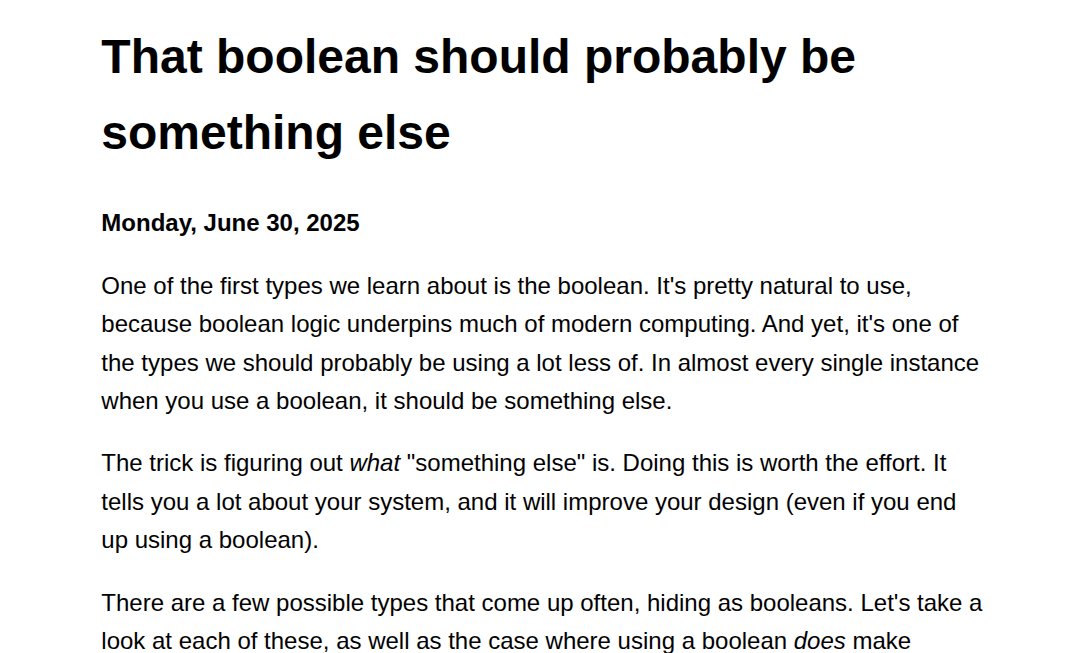
That boolean should probably be something else
55
34
1,028
208,099

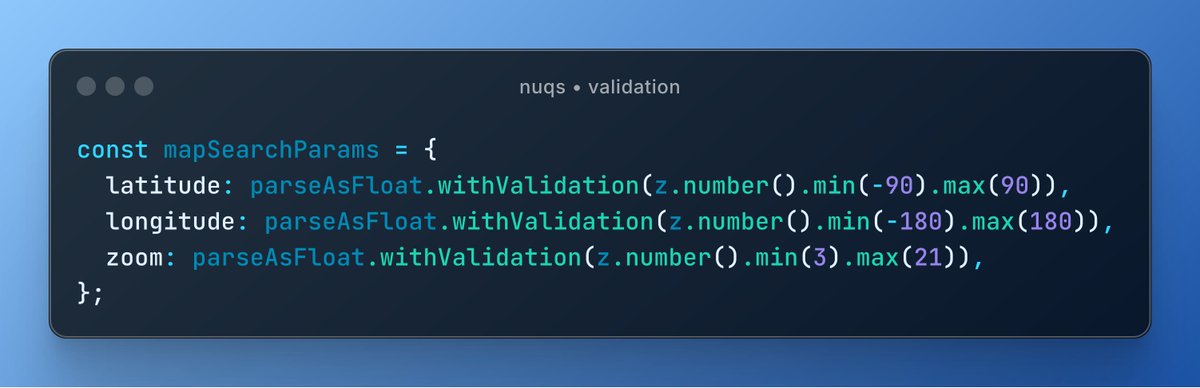
Weekend project: adding validation ✅
- Deserialise → parse → validate on read
- No validation on write yet (would be a breaking change, could be an experimental opt-in flag)
- Standard Schema based, or pass in any sync function that throws on invalid values (for other libs)
4
4
103
3,970
Asher Cohen 🤖🤳 retweeted
25 Jun 2025
Using effect/schema, but hitting an issue: optional fields come from FormData, which always returns "" — even when the user leaves the field blank.
This breaks .optional(S.string.minLength(1)), since "" ≠ undefined.
Best way to model "optional but non-empty if present"?
1
33
Asher Cohen 🤖🤳 retweeted

24 Jun 2025
What are people using instead of Storybook these days?
One simple alternative I enjoy:
Create a page in the app that shows reusable components. This page isn't linked to by the nav, so it's only visible for developers.
This avoids the overhead of keeping up with Storybook's changes (Storybook tends to churn a lot). And it automatically works since, unlike Storybook, it uses my app's config.
66
6
374
68,359
Asher Cohen 🤖🤳 retweeted

15 Jun 2025
I spoke at @ReactSummit this week on "The State of React and the Community in 2025", addressing many common questions and concerns I've seen.
Slides are on my blog:
blog.isquaredsoftware.com/20…
1
7
49
3,296