501(c)(3) nonprofit bringing together employers, students, and colleges to address inequities within computer science education and technical recruiting.

Joined March 2013
847 Photos and videos
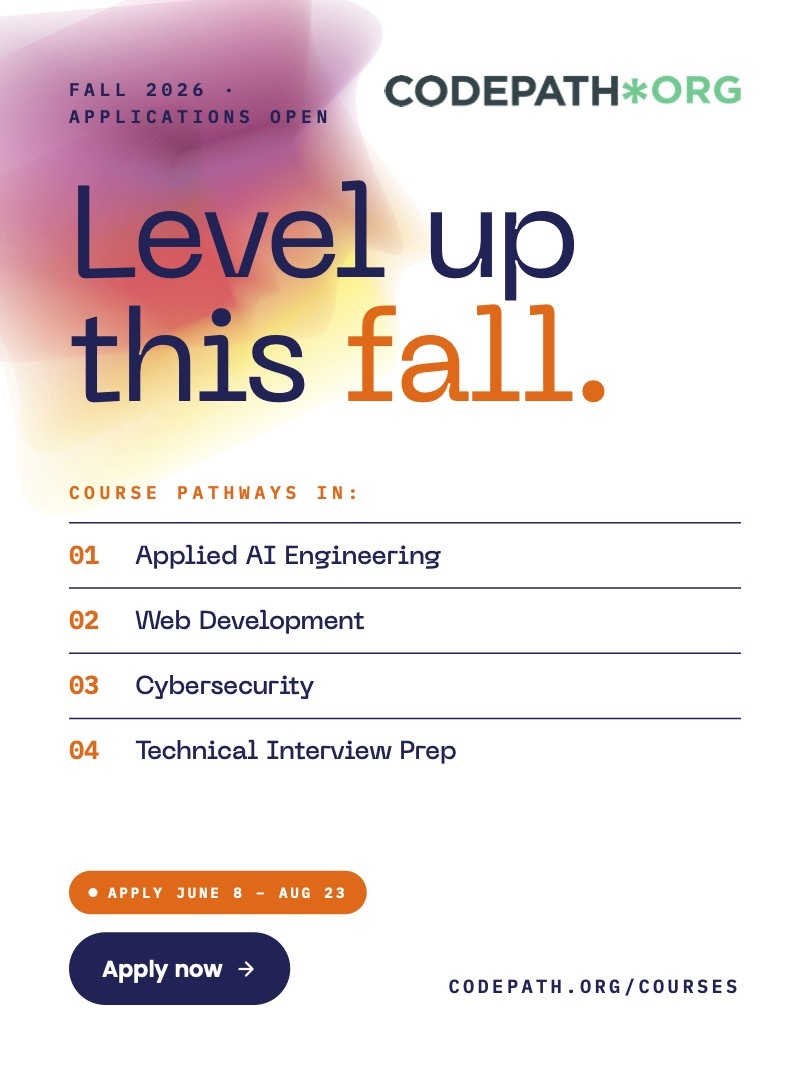
Applications for fall 2026 courses with CodePath are now open! Join fully remote, no-cost courses in Applied AI engineering, Web Development, Cybersecurity, and Tech Interview Prep to prepare for what's next in tech. Learn more and apply at codepath.org/courses Applications close August 23. 👉 codepath.org/courses
1
3
129
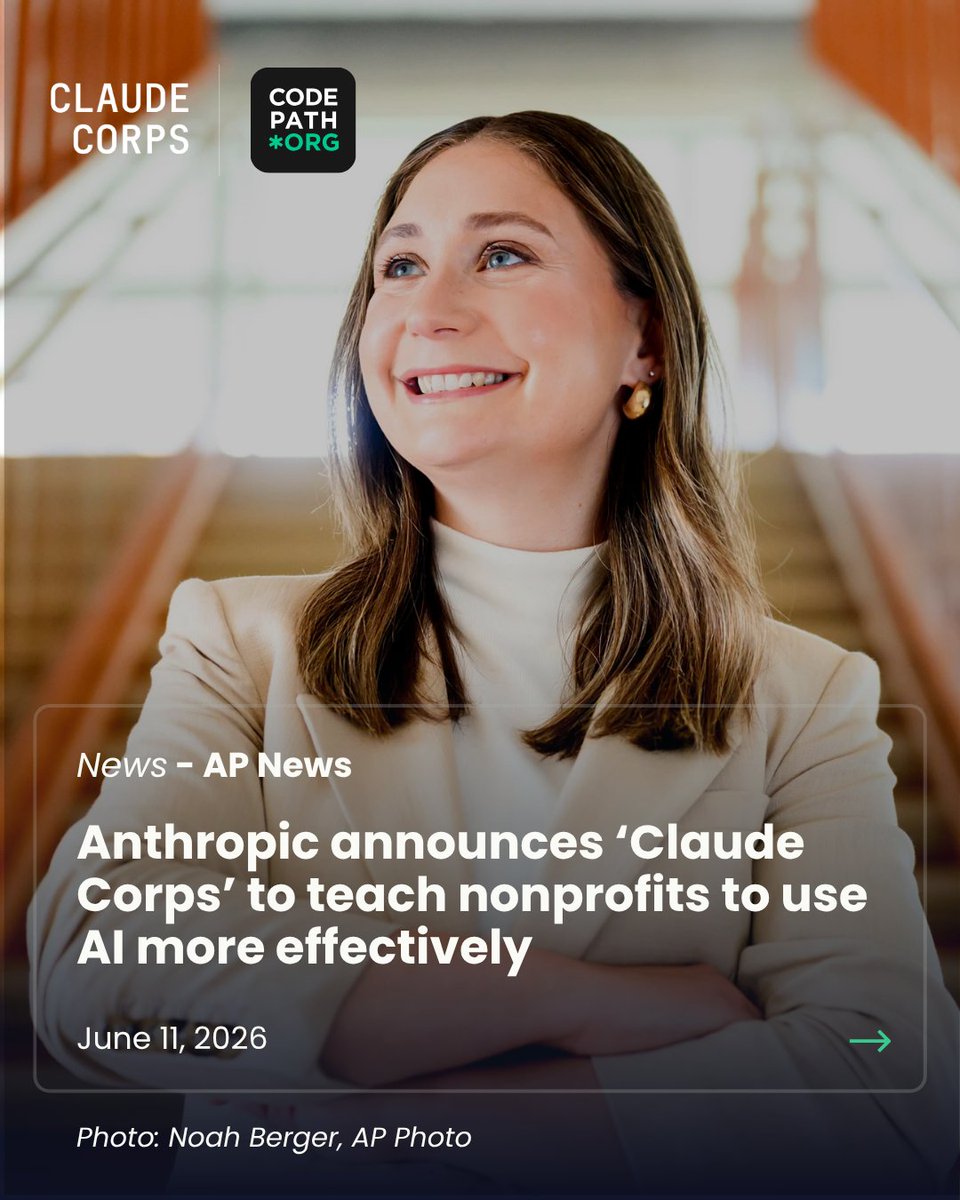
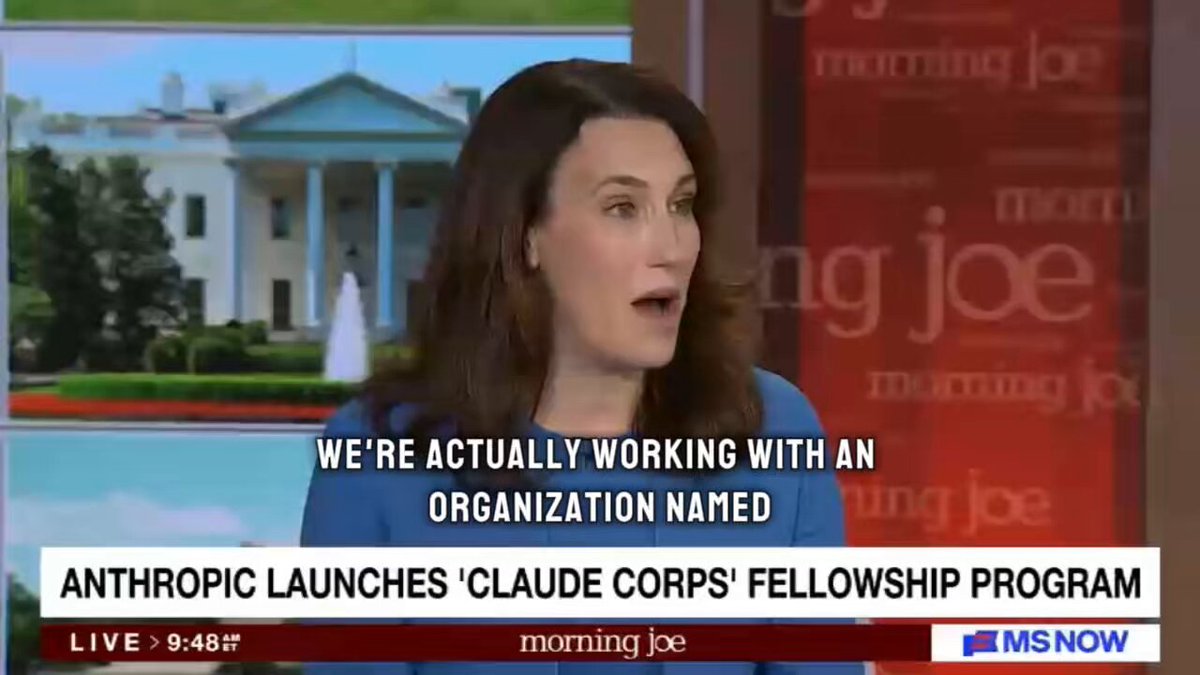
Take a look at some of the ways Claude Corps & CodePath was mentioned in the news over the last 24 hours.
1
1
3
80
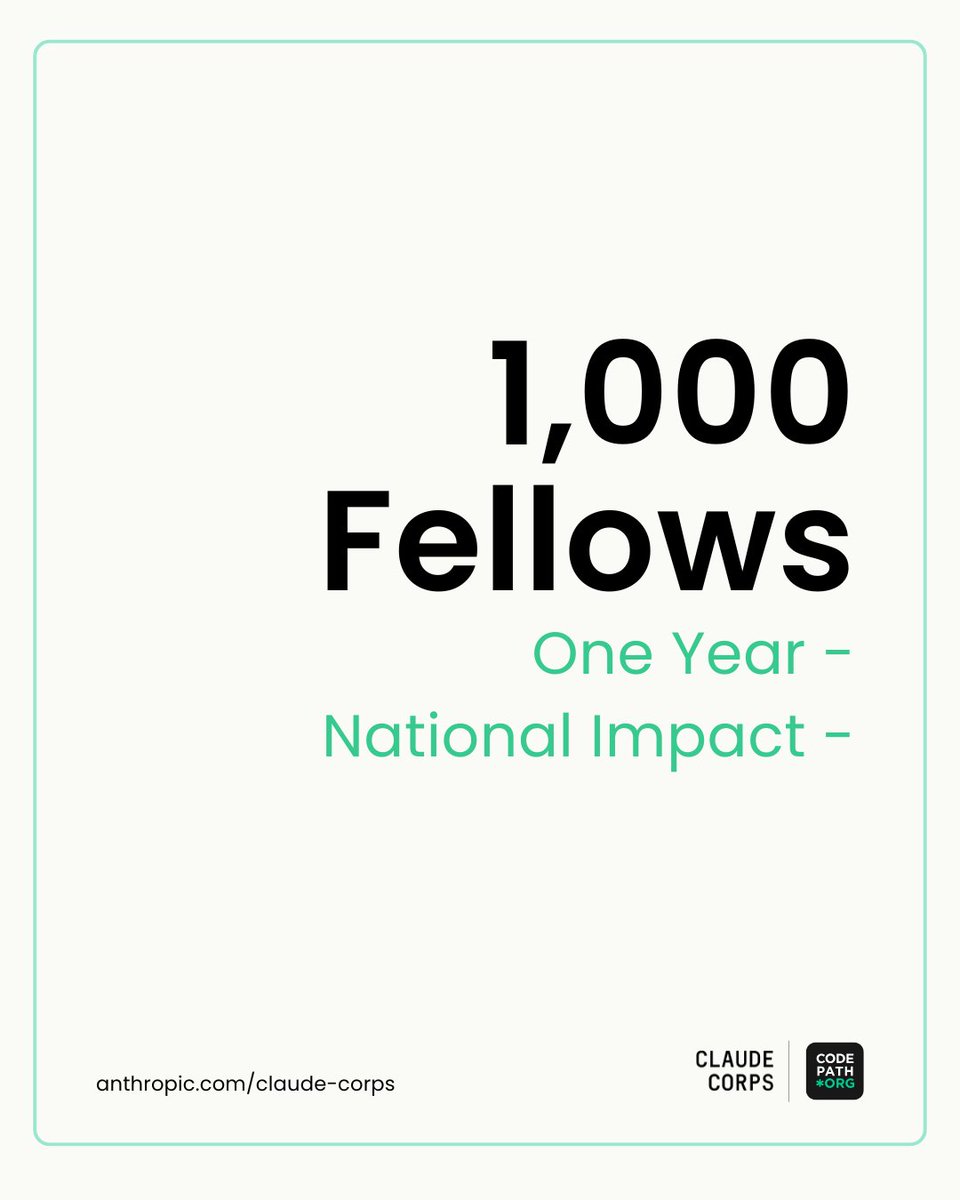
Claude Corps is what an investment in an AI-native workforce looks like in practice. It offers 1,000 fellows a paid year of full-time work, matched with a nonprofit, supported by intensive @codepathorg AI training. Applications are open: anthropic.com/claude-corps
1
4
8
251
For ourCodePath alumni: Here’s a message to you from our CEO @MichaelwEllison. Apply or share Claude Corps with someone who should: anthropic.com/claude-corps
Nine years. Over 40,000 alumni. One bet: that the ability to build with technology is the most powerful engine for economic mobility in America. Now I need your help finding the next wave. Watch this and apply or introduce Claude Corps to someone early in their CS career: anthropic.com/claude-corps
1
4
128
From our CEO @MichaelwEllison : Nine years ago, CodePath bet that the most powerful engine for economic mobility in America was the ability to build with technology. Today that bet becomes Claude Corps. 1,000 paid fellows inside the nonprofits millions of Americans rely on. Read more: linkedin.com/pulse/introduci…
AI is the most powerful engine for economic mobility of our lifetimes. It doesn't just raise the ceiling for people who already have access. It collapses the floor. That's the bet behind our Claude Corp and what we've quietly been building towards for the past nine years. linkedin.com/pulse/introduci…
1
1
2
168
Today, we’re launching Claude Corps with @AnthropicAI, a national fellowship program that matches early-career talent with US nonprofits. We'll teach 1,000 people and pay them for a year to help hosts advance their missions. Read more: anthropic.com/claude-corps
1
4
11
767
Today, @codepath and @AnthropicAI launch Claude Corps. 1,000 paid fellows. A year inside 400 American nonprofits, putting AI to work where it matters most.
We’re launching Claude Corps, a national fellowship program matching people early in their careers with US nonprofits. We'll teach 1,000 people to use Claude, and pay them to use AI to advance their hosts’ missions. anthropic.com/claude-corps
2
3
9
664
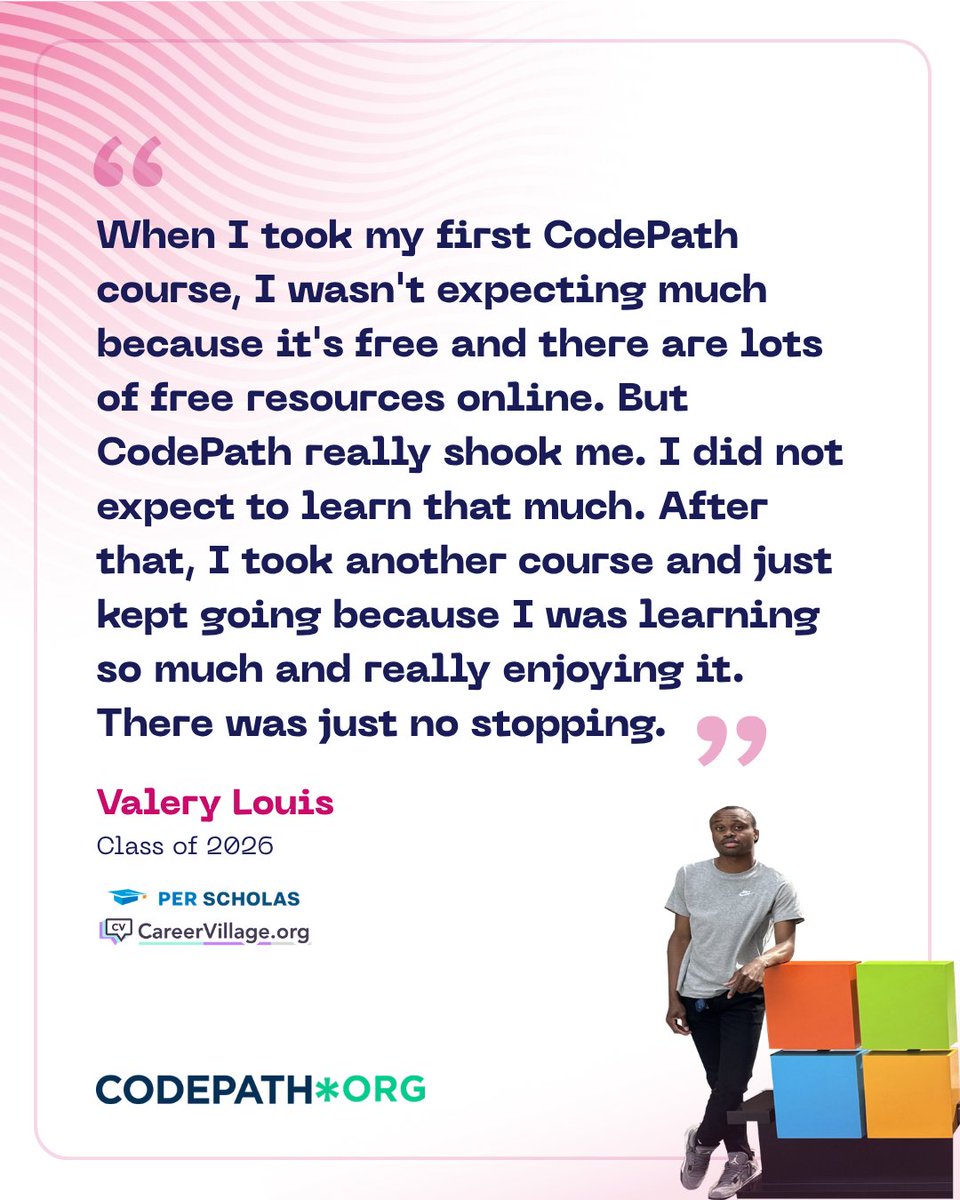
Delaware State made @CodePathOrg a graduation requirement for CS majors. Meet Valery Louis: a 1st-gen college student from Haiti, & @DelStateUniv Class of 2026. 8 CodePath courses. 4 internships. 2 at Microsoft. Full-time SWE at Microsoft Seattle starting this summer. Read more in our 2025 Annual Report: bit.ly/codepath25
1
203
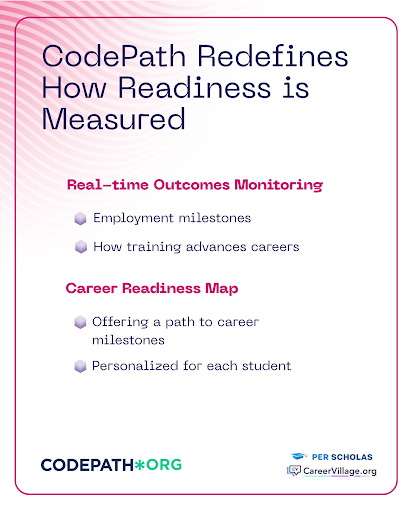
CodePath is building the measurement infrastructure that the AI-native workforce needs. → Outcomes Monitoring: real-time career outcomes. Used by CodePath, Per Scholas, CareerVillage. → Career Readiness Map: AI-enabled live navigation. bit.ly/codepath25
1
1
108
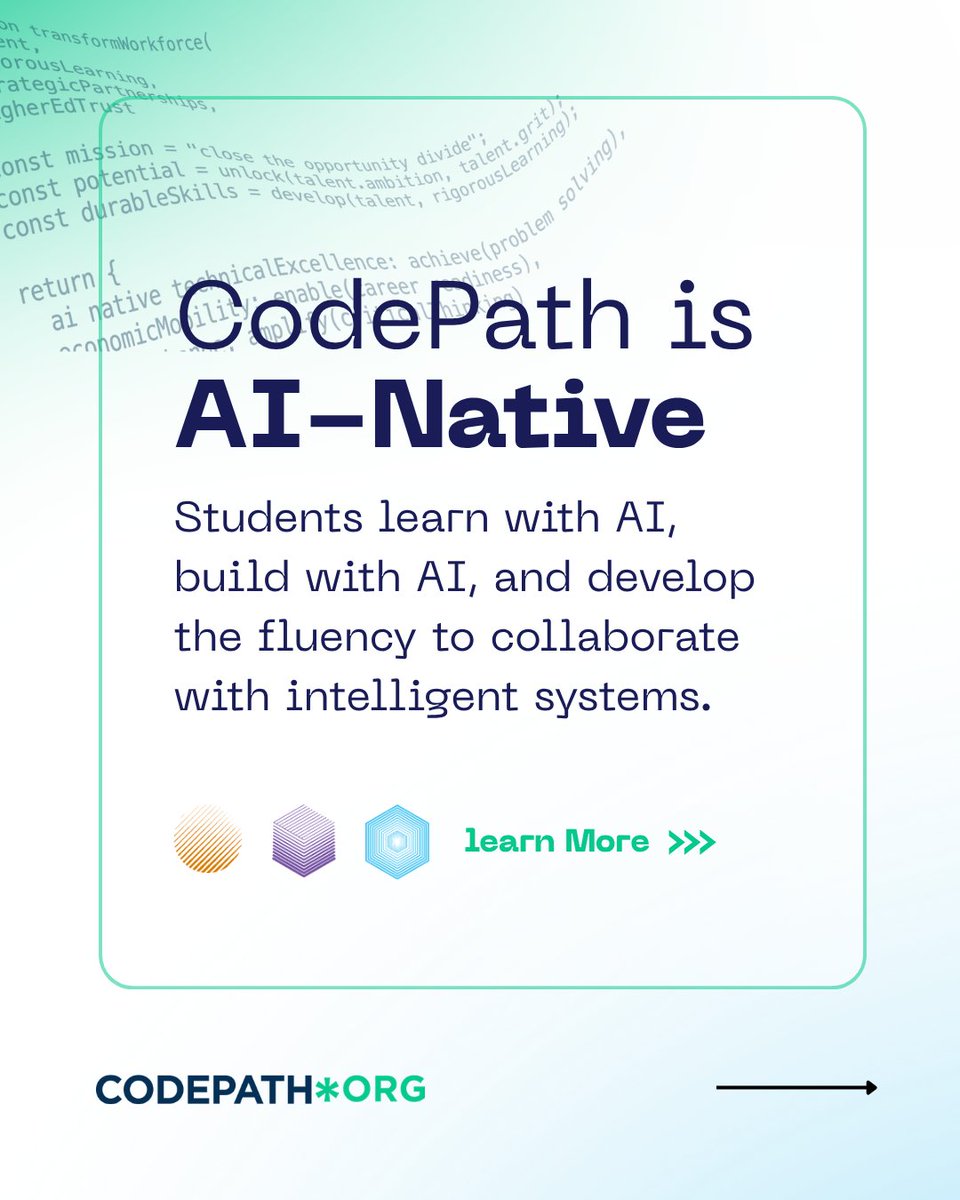
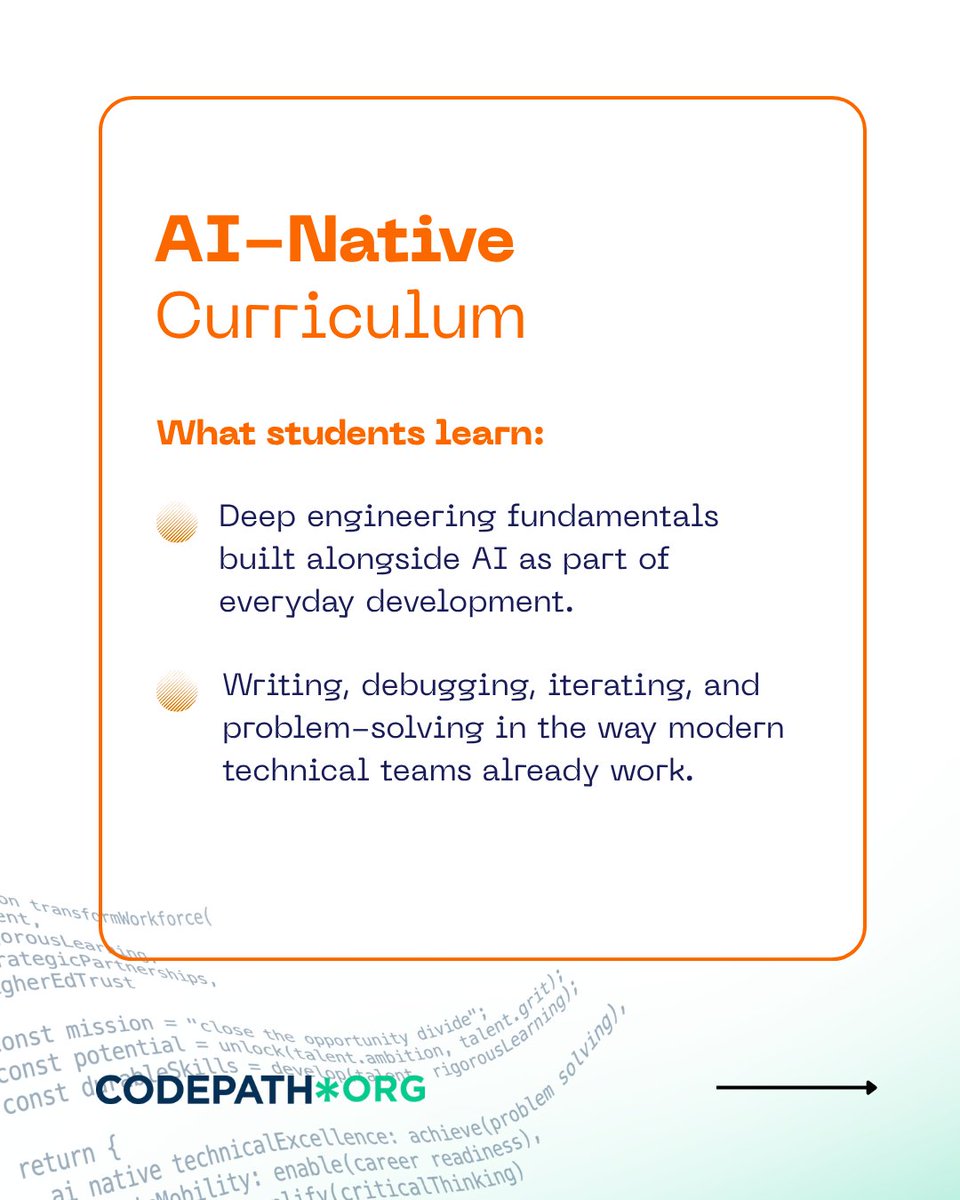
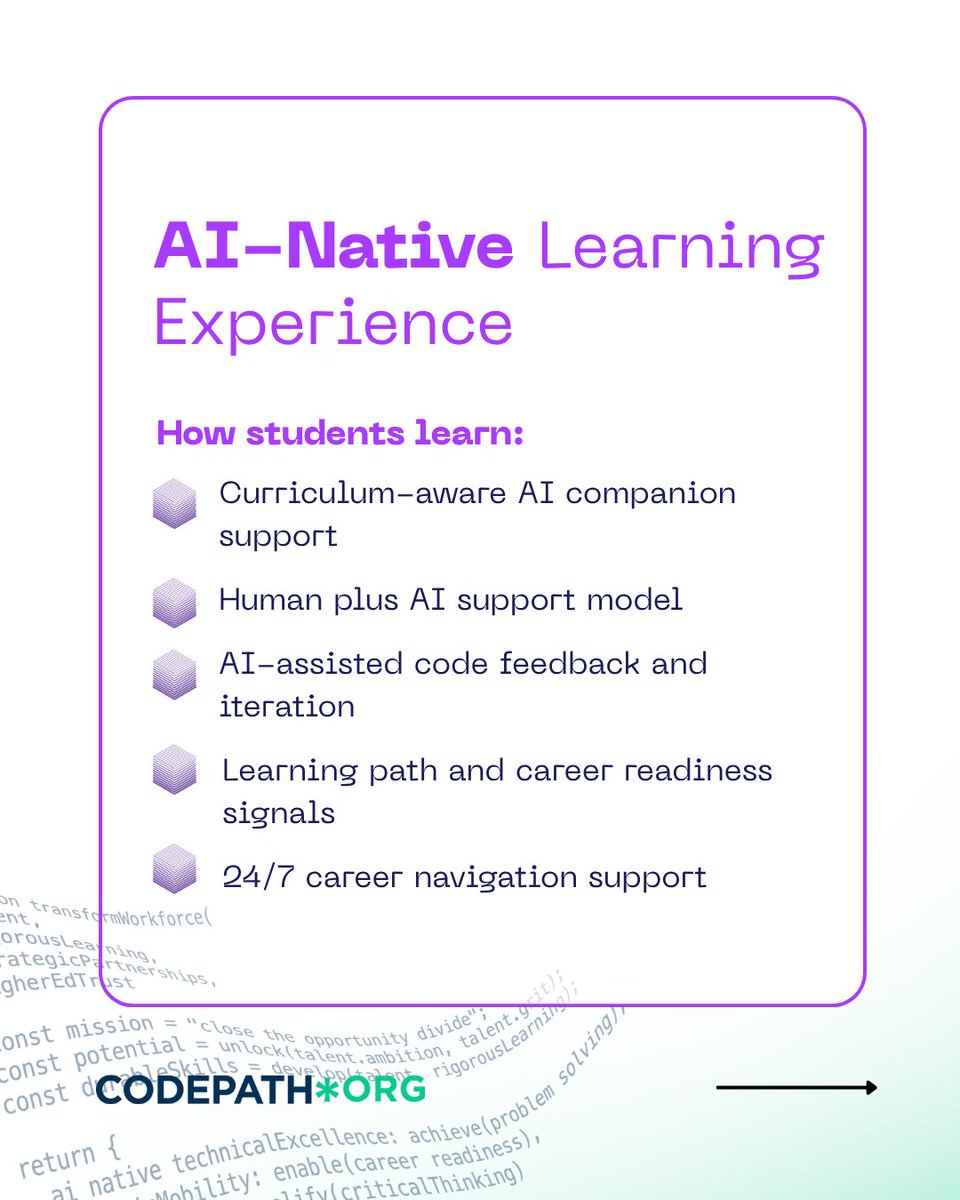
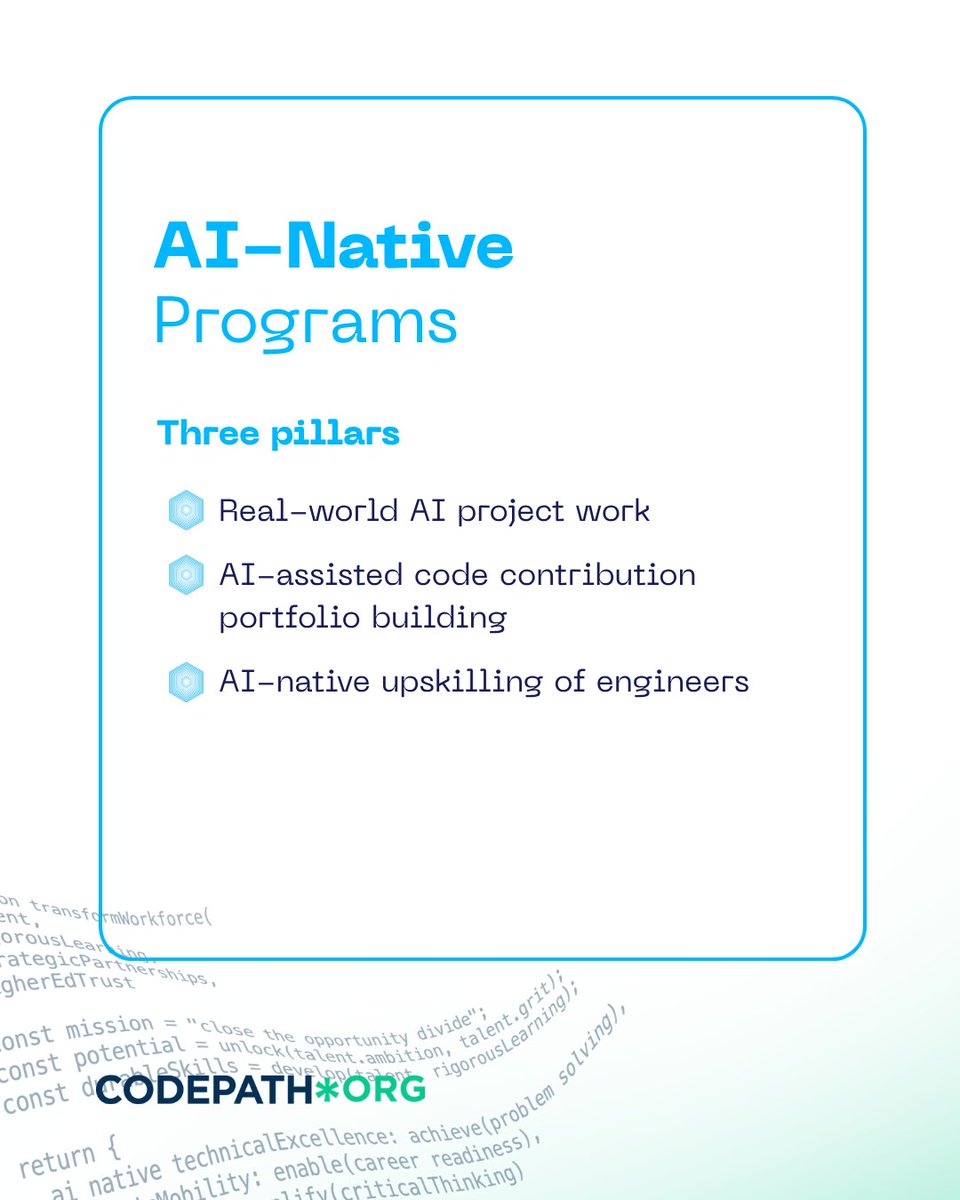
From CodePath CTO @nesquena: "Our students build with AI workflows in every course. By the time they interview, this work is already second nature." The AI-Native Foundation is accomplished through three layers: curriculum, learning experience, and programs. There are a few days left to register for summer courses: codepath.org/courses
1
2
450
CodePath retweeted
This is exactly right. For the first time in history, AI is unlocking the possibility of truly exponential enterprises. That requires continuously redesigning entire jobs, functions, and workflows, not just managing change inside existing ones. It is laughable that some folks are still saying software engineering is going away. The people most capable of leveraging AI to its full potential are fundamentally software engineers. They have always been the best at making computers do what they want. It stands to reason that as computers get more powerful, we will place more value on software engineers. Two things can't both be true: AI will unlock massive productivity AND companies need fewer of the people best at harnessing that power. @levie why have you been so consistently right when even many of your peer CEOs have been so wrong?
Take whatever number of people you thought might be in jobs related to AI deployment in the enterprise and multiply it by 10. Then probably 10 again. A major topic that keeps coming up in talking to CIOs across enterprises of all sizes and industries is the implementation gap for getting agents to work at scale and organizations on mission critical work. As the task goes from implementing a chat system that’s basically an LLM plus search, to connecting to real production systems that both can deliver meaningfully better productivity gains but also introduces meaningfully more risk, a whole new set of work has to be done. You have to ensure the right level of protection of data, updates to access control controls, migration of legacy systems to common modern platforms, create observability across what agents are doing, implement new workflows, figure out the human in the loop moments, drive the change management of the new workflows, and more. Then, all of a sudden the model capabilities get updated and you have to do a set of the above steps over again. Half of what you’ve done is obsolete, and the other half needs to be upgraded to take advantage of new capabilities. Or, token budgets run hot and you have to peel off some of the workloads to lower cost models that will be more cost effective. But then you have to go through those same steps. Enterprise are trying to figure out what is the right set of roles to go and implement the systems in their organization to ensure that the workflows are actually being executed properly, ensure it’s not just slop being produced, and to make sure their organization remains safe and secure. Many companies are starting by repositioning existing IT talent in these functions, but there’s also a growing need for the equivalent of internal FDEs to go take on these tasks in an enterprise. The looks incrementally closer to software engineering than it does traditional IT implementation. Next, almost all AI vendors (labs and the software players) will have some form of next-gen FDE or Applied AI architecture functions to help support these use-cases. The benefit here will be these companies have an incentive to make their capabilities work well so they can bring best practices from a range of customers they’re seeing and directly from the product innovation. And finally, we’re seeing the rise of all new AI services firms or major parts of existing services firms move into AI implementation. Companies will often want to bring in ostensibly neutral players that can work across their tech stack but also have seen best practices across their vertical. There are going to be tons of new service providers that get launched to do this, and many will eventually go and disrupt (or get acquired) by the larger player. Either way, all told, we’re in for years of AI diffusion, and along with it tons of new roles and areas of work to be done to deploy AI at scale.
1
2
319
AI isn't slowing down, so why are you? This summer, get ahead of the curve with free @CodePath courses in AI, web dev, cybersecurity, and technical interview prep. Applications are open now and will close soon: codepath.org/courses
186
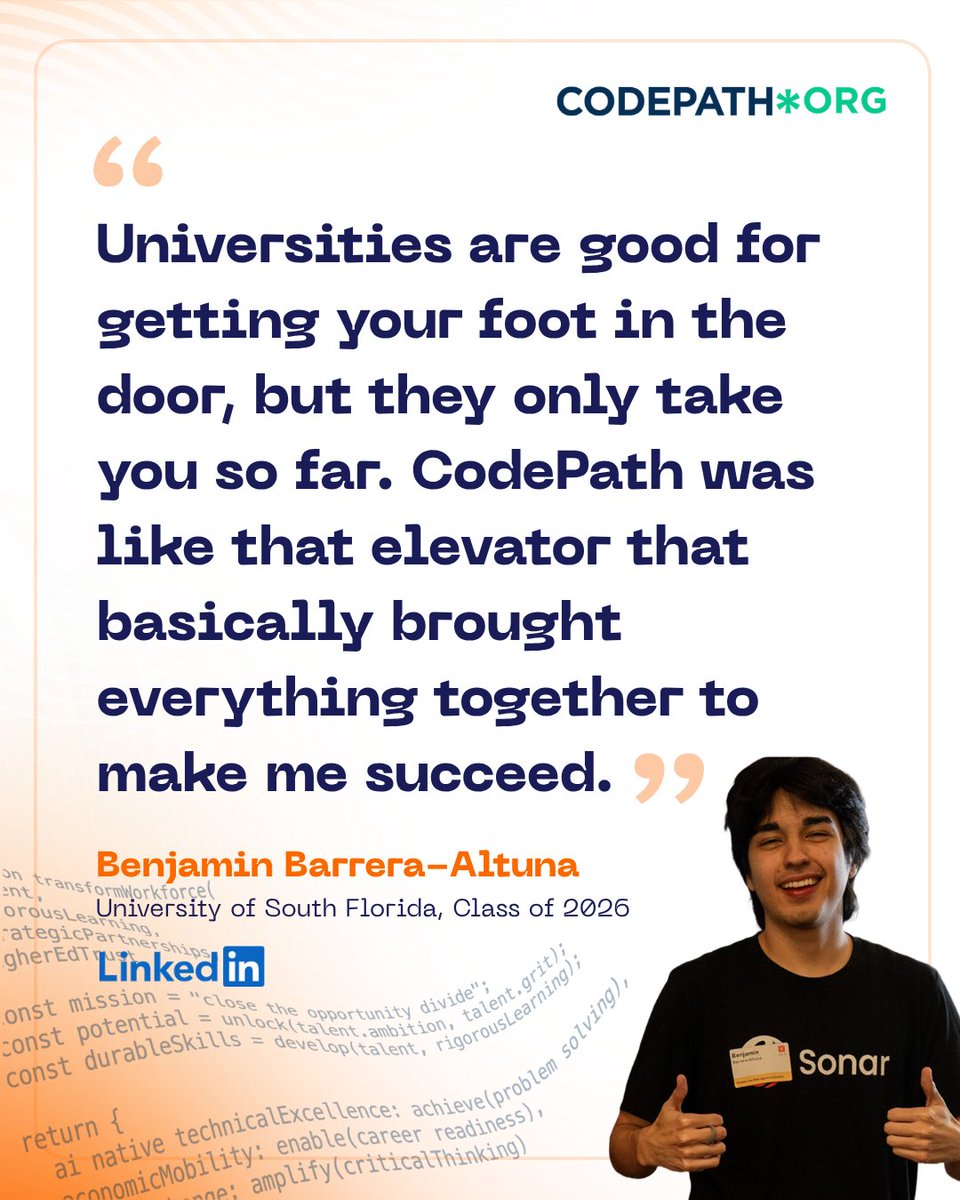
Benjamin Barrera-Altuna started college as a violin major at the University of South Florida. He found CodePath through a Reddit link in 2022. By the time his Technical Interview Prep cohort wrapped, every member had landed a job. Ben received 10 offers in a single recruiting cycle. This summer, he interns at LinkedIn, specializing in distributed systems. Summarizing his words: Universities open the door. CodePath was the elevator. Read Ben's full story in our 2025 Annual Report: bit.ly/codepath25
1
203
CodePath retweeted
The scope of what one person or a team can do has expanded dramatically. That means we owe it to ourselves to lean into learning, not just into AI. Much of the country is moving in the opposite direction. The young people I worry about are the ones being told AI will eliminate the need for technical depth and a strong education. The opposite is playing out in real time. If you want evidence for where jobs are headed, don't just listen to the media or tech executives, watch what they do. Watch who they're hiring. Watch where they're betting the future of their organizations. They are increasingly betting on people with strong multidisciplinary backgrounds, AI proficiency and increasingly strong soft skills. The catalytic rise of the Forward Deployed Engineer is the clearest example yet.
This is a fantastic post about why jobs aren’t going away in the way some predict. We are constantly making the mistake of confusing task completion with AI with being able to eliminate the whole job. Even as we can automate one or many tasks within a job, the definition of the job almost inevitably just expands to do vastly more of those tasks, do them at a higher quality, or move on to the type of task that hasn’t been automated yet. And as a result of being able to do more of the tasks or at a higher quality level, the job becomes valuable in a new way. And in many cases for now an entirely new audience as well. This will be true for coding, legal work, sales, or marketing. The small business or non-tech company that wants to now take on larger software projects finally can, and they’ll hire to do so. The small business that couldn’t afford a full marketing agency can hire or contract out to a marketer that can do as much as an agency did before now with agents. And so on. Don’t fall into the trap of confusing tasks with jobs.
2
5
1,348
CodePath retweeted
Many Americans rightly feel they may be left behind and disempowered by AI. The fear is real. AI is likely the most disruptive technology of our lifetime, and it may also be the most democratizing and empowering force in human history. We can and should distribute the abundance these systems produce. We also have an opportunity to make this generation of Americans the architects of those systems, not just the recipients of what they make possible. Any New Deal that doesn't optimize for lifelong learning and individual agency is bound to become a broken promise.
Mass unemployment from AI is the obvious fear. But the humiliation of being discarded — replaced by a machine, written off by an economy that's moving on — that's what creates real instability. I have seen what happens to people when society decides they don't matter anymore. We cannot let AI do that to an entire generation. My hope is tech companies broker a "New Deal" between artificial intelligence and humanity. Silicon Valley understands the abundance AI can create. What it hasn't answered is how that abundance gets shared. That answer could define what kind of civilization we become. Right now, technology companies hold the power while most people are falling further behind. We need a new kind of tech — dignity tech, stability tech — built to DISTRIBUTE that abundance instead of concentrate it to a few technologists at the top. We need a “New Deal” between Silicon Valley and humanity to help people provide everyday people their basic needs. Food. Clothing. Shelter. Energy. Broadband. At scale. vanjones.substack.com/p/ai-n…
2
4
1,234
Ready to level up this summer? CodePath offers FREE courses in AI, cybersecurity, web dev, and technical interview prep. All collaborative, all hands-on. Applications are open NOW but closing soon. Don't sleep on this. codepath.org/courses
1
1
122
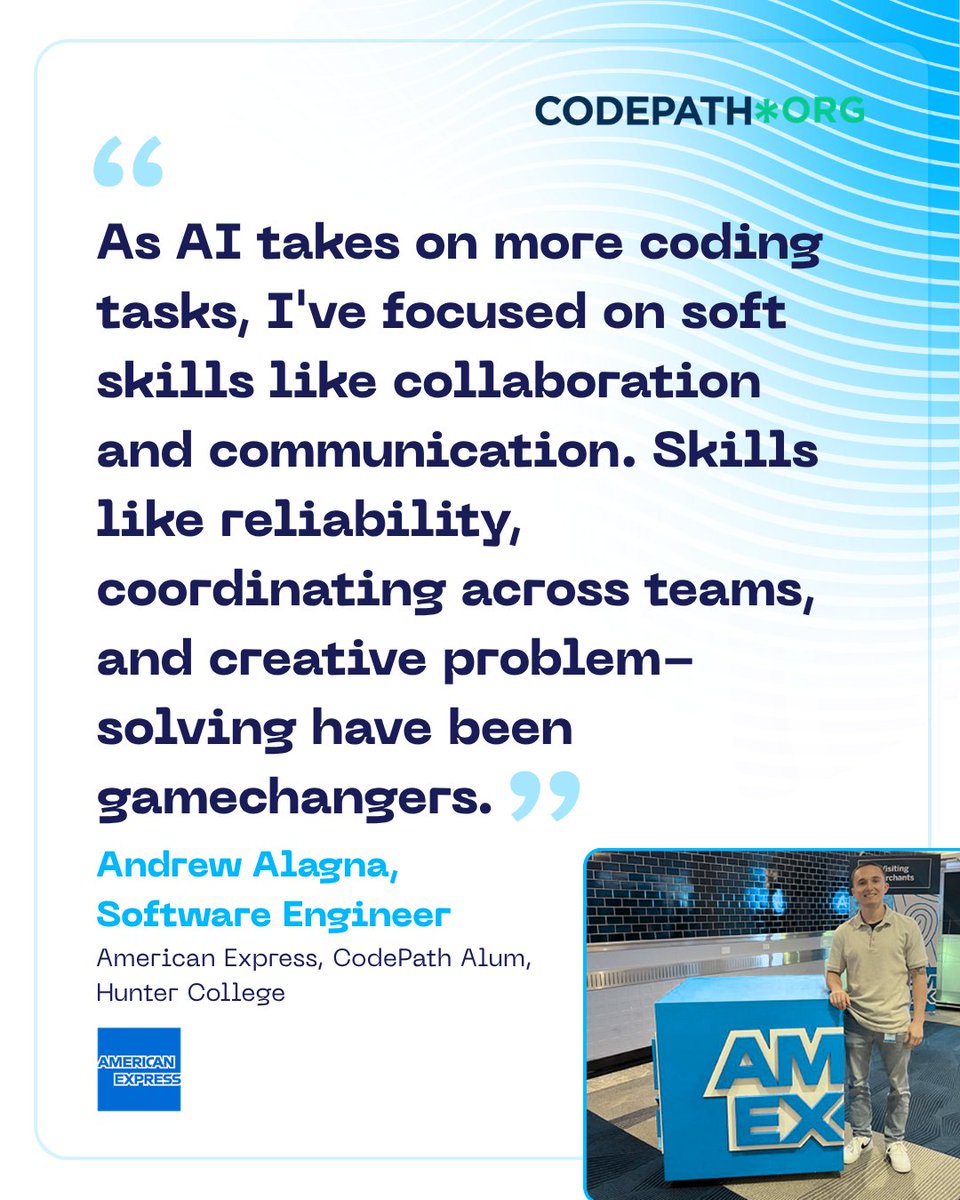
Andrew Alagna spent his early career in construction. He had never met a practicing software engineer until CodePath introduced him to one. Now: software engineer at American Express. Increased his earning potential by 3x. Promoted in year one. Learn more about his story in our Annual Report: bit.ly/codepath25
127
CodePath retweeted
The "AI is killing entry-level jobs" story has it backwards. Companies want to hire more, not less. The bar moved: AI-proficient, or not. For anyone willing to build that fluency, this is the most accessible economic mobility moment we've had in a generation. My take, clip below.
1
4
7
685
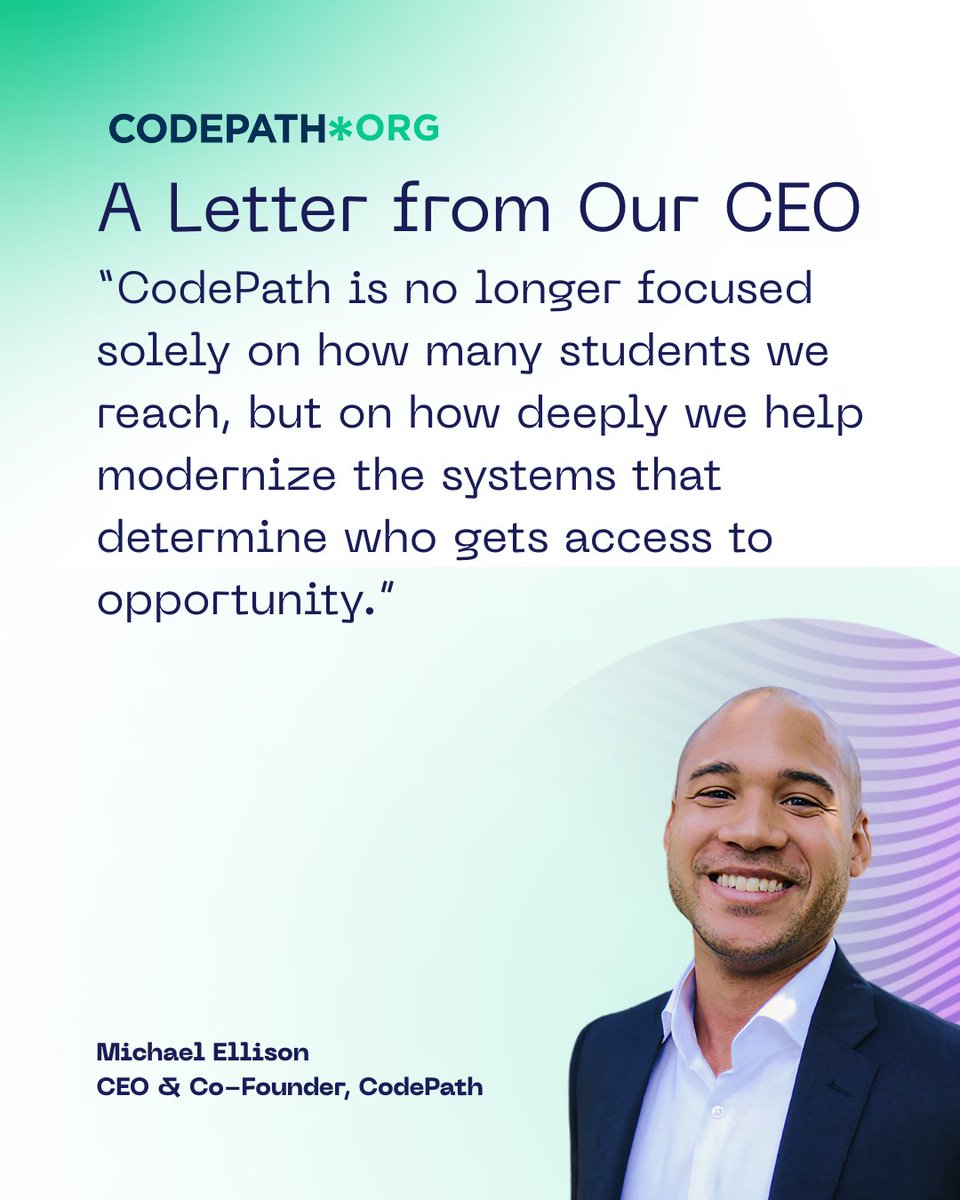
From our 2025 annual report: "CodePath is no longer focused solely on how many students we reach, but on how deeply we help modernize the systems that determine who gets access to opportunity." @MichaelwEllison, CEO
3
2
184