
ceo @box - your business lives in content. unleash it with AI
Joined March 2007
- Tweets 11,578
- Following 794
- Followers 2,860,841
- Likes 105,692
1,149 Photos and videos



The layer that can route to the best AI model for the particular job is going to increase in value substantially. There are at least 3 big reasons:
* Cost optimization: there are plenty of use cases where you need frontier intelligence for some tasks and something far cheaper for others. Even in the same task you may use frontier intelligence for planning and review of the work, but an OSS or cheaper model for the bulk of the workload. This is going to be standard across large buckets of work going forward.
* Capability maximization: despite the bitter lesson and models generally getting better in the same direction, there are still lots of differences between models. Some are better at tool use, others better at coding, and others again better at certain domains of knowledge work. The ability to route between these at different times is a huge advantage.
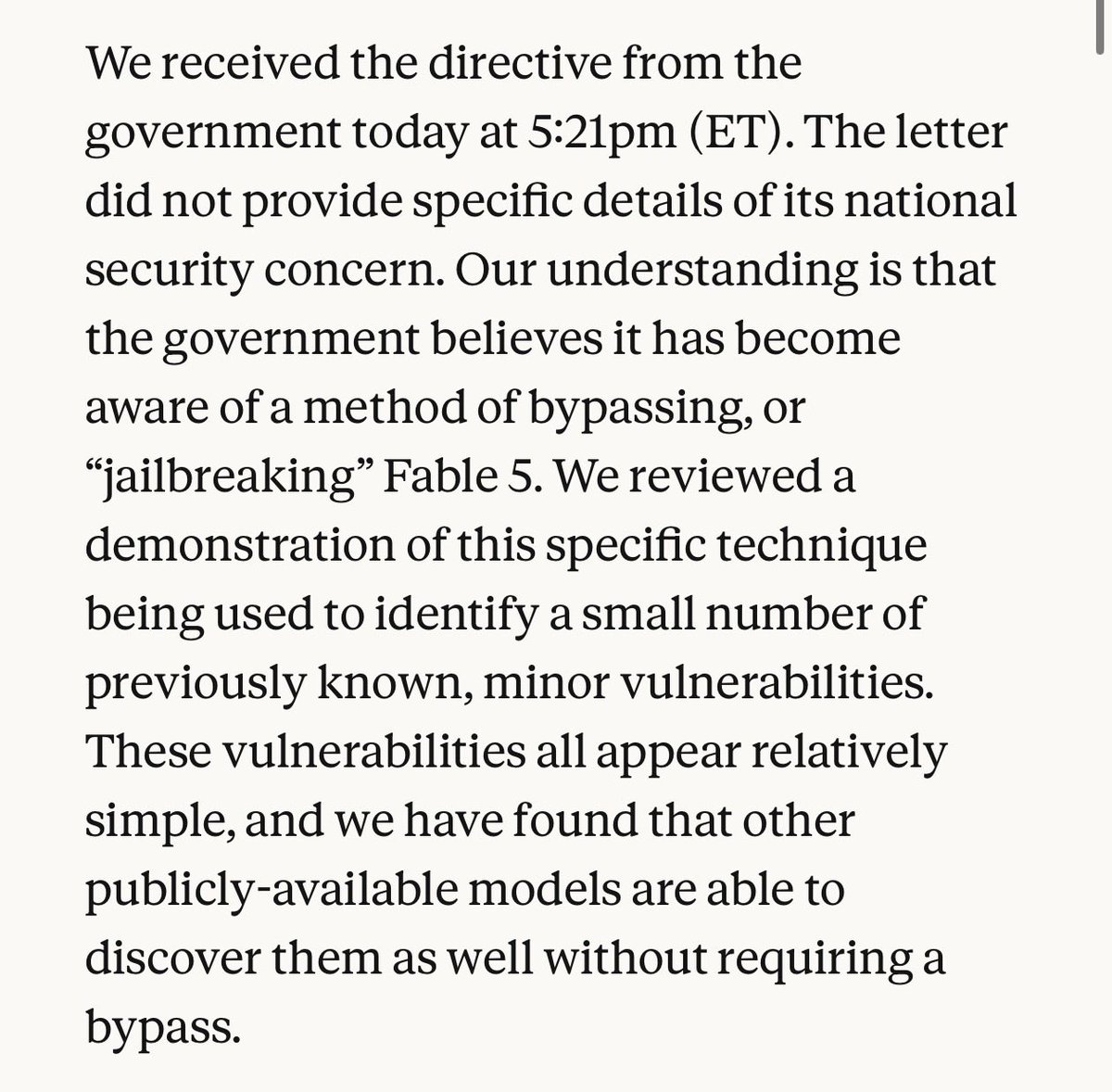
* Risk mitigation: while the Fable situation is somewhat of a black swan, it’s possible we’re heading toward a regulatory environment where governments may restrict models at different times based on their approval mechanisms or new things they discover. This means you’re going to want flexibility in being able to deploy workloads across different providers as a form of risk mitigation.
Ultimately, it’s going to increasingly be a a strategic advantage for the applied AI layer that they can effectively route between models. Will be very interesting to see how this evolves.

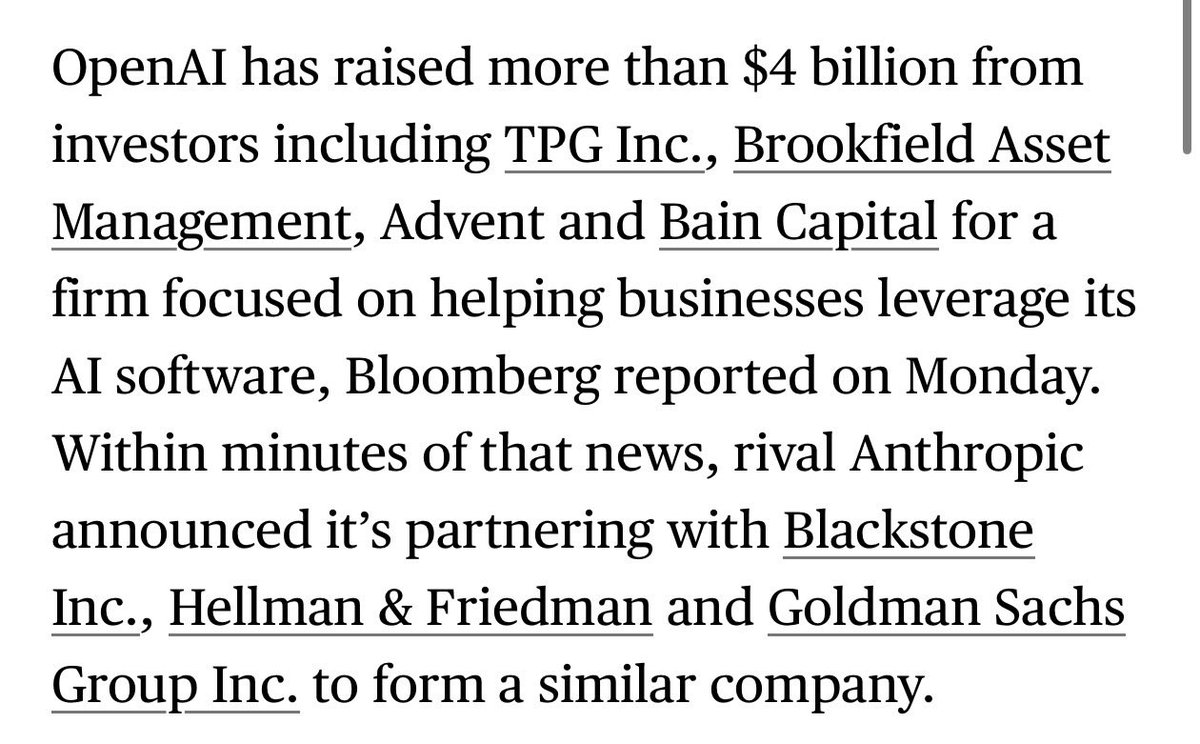
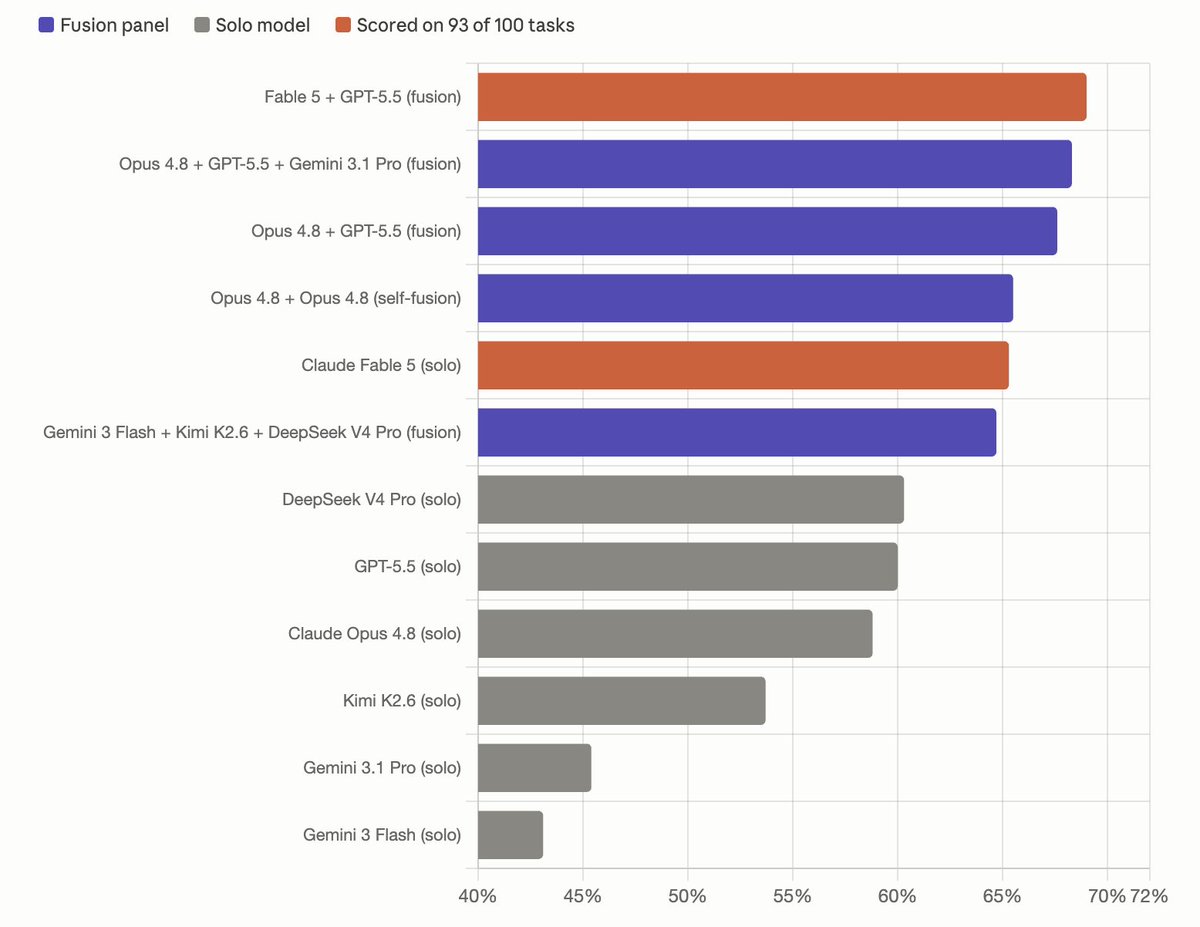
Introducing the Fusion API, the smartest compound model in the market.
Fusion achieves Fable-level intelligence at half the price.
How it works 👇
27
16
209
38,213
Everyone thinks this is some kind of 4D chess or conspiracy. But it’s quite standard to try and jailbreak AI models, and by definition they would share that research with the government given that’s whole point. I don’t think Amazon assumed this would be the next move.

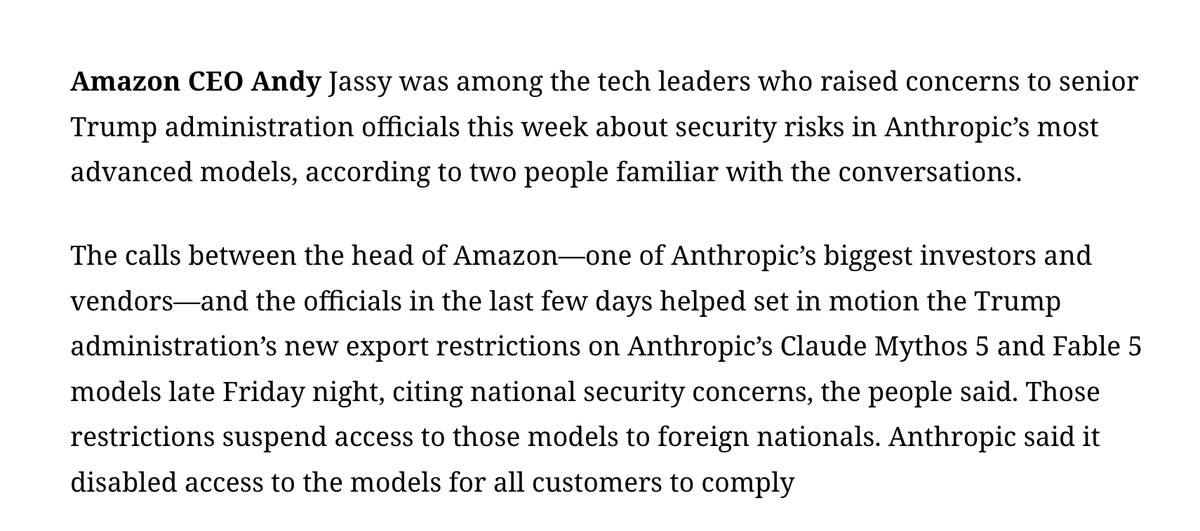
Breaking: Amazon CEO Andy Jassy was among the tech leaders who raised concerns to senior Trump officials this week re: security risks in Anthropic's newest models.
Those convos set in motion the government's new export controls on foreign national access to Mythos and Fable.
30
8
195
48,743

14h
This whole Fable export control situation is actually net positive to regulation discourse. It’s an early peek into what AI regulation would end up looking like at scale when enacted at the model layer instead of the specific application of the AI.
The government would have sole discretion over when a model can be released to the to public, based on a bunch of factors that they inherently control.
In this case, based on the available reporting, the risk is that the model can be jailbroken to deliver increased cyber exploit capabilities. The issue is that actually you want models to be able to have those capabilities on the defense side of cyber as well, and for all intents and purposes, by Anthropic’s own response, you can execute these capabilities today in other models.
So thus the whole challenge will be that you’re debating with the government, over months and months, with every model release, what these models are actually capable of and what their risks are. Inherently, there’s not only a lot of subjectivity in determining those risks, but there’s also many other factors that go into the risks being practical in the first place.
The net result is that we would end up with backlog of AI releases, progress in the market inherently would dramatically slow down, and AI would start to look more like any other sclerotic industry. If this paradigm had existed 3 years ago at the start of the current AI wave, we’d likely currently be stuck on GPT-4 level intelligence at this point.
This is why, wherever possible, we should be regulating the applied use of AI. We should continue to study and enforce the dangerous use of AI in cyber attacks, financial services risks, fraud, biowarfare, and other spaces. AI safety is incredibly important, but slowing down progress this early in the development of AI I suspect is net harmful.
Jun 13

The US government, citing national security authorities, has issued an export control directive to suspend all access to Fable 5 and Mythos 5 by any foreign national, whether inside or outside the United States, including foreign national Anthropic employees.
The net effect of this order is that we must abruptly disable Fable 5 and Mythos 5 for all our customers to ensure compliance.
Access to all other Claude models is not affected.
We apologize for this disruption to our customers. We believe this is a misunderstanding and are working to restore access as soon as possible.
Read our full statement: anthropic.com/news/fable-myt…
63
34
318
57,359
Jun 13
This is a big turning point for AI regulation.
The government is starting to deem some models too powerful for certain uses, which creates a precedent for a range of possible controls in the future.
I’m in the camp that this is unnecessary and we should be primarily regulating the use of AI, as opposed to the underlying models. But, equally, there are plenty of people that actually prefer this outcome.
Either way, it’s unlikely that we’re going back to a world where the government doesn’t have far more meaningful involvement in the rate of AI progress.
Jun 13
The US government, citing national security authorities, has issued an export control directive to suspend all access to Fable 5 and Mythos 5 by any foreign national, whether inside or outside the United States, including foreign national Anthropic employees.
The net effect of this order is that we must abruptly disable Fable 5 and Mythos 5 for all our customers to ensure compliance.
Access to all other Claude models is not affected.
We apologize for this disruption to our customers. We believe this is a misunderstanding and are working to restore access as soon as possible.
Read our full statement: anthropic.com/news/fable-myt…
95
47
577
110,782
Jun 13
This is pretty freaking cool
Jun 12

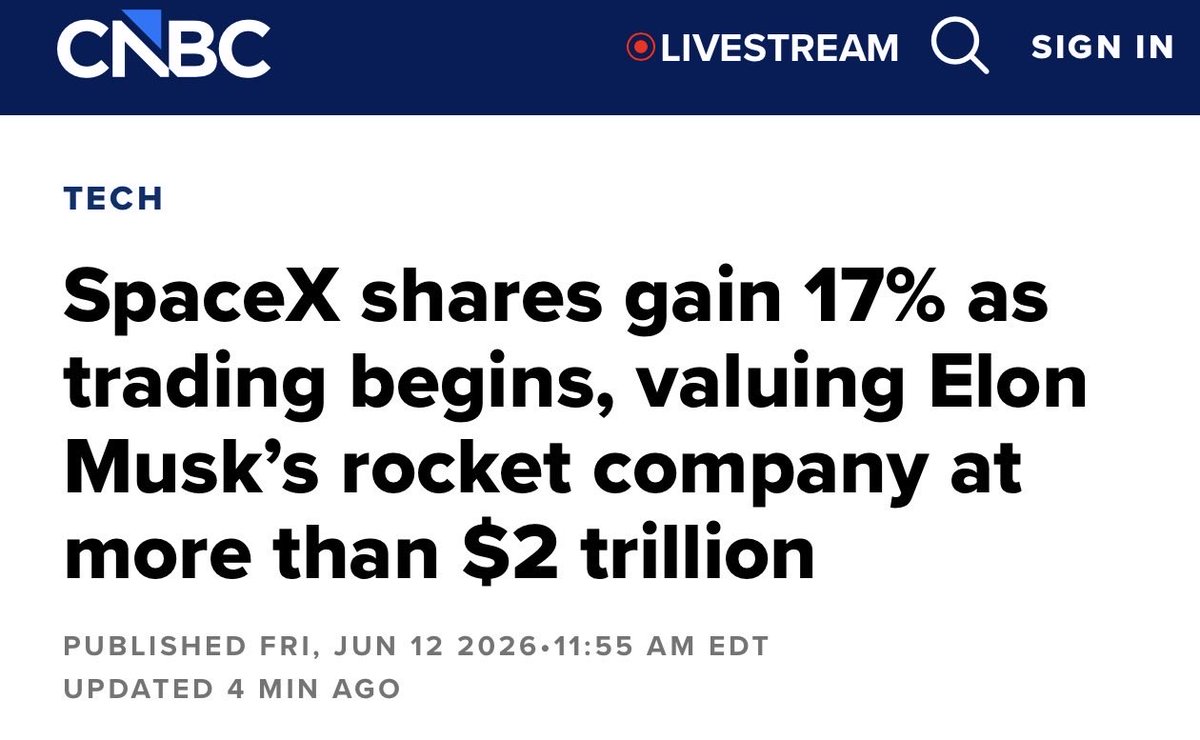
A man working as a welder at SpaceX for $28 an hour has just become a millionaire.
Juan Hernandez, who came from Mexico, welded rockets for SpaceX at $28 an hour.
SpaceX gave him $10,000 in stock when he went full time in 2015, and he bought more with every paycheck for 10 years.
$SPCX is now trading at $167, making his shares worth over $1 million.



12
20
491
75,116
Jun 12
Incredible. Congrats to @elonmusk and the entire SpaceX team on the 25 years of blood, sweat and tears to build a world-defining company. Amazing to have examples like this that push the future forward. The downstream implications of this are enormous.
12
26
288
15,671
Jun 12
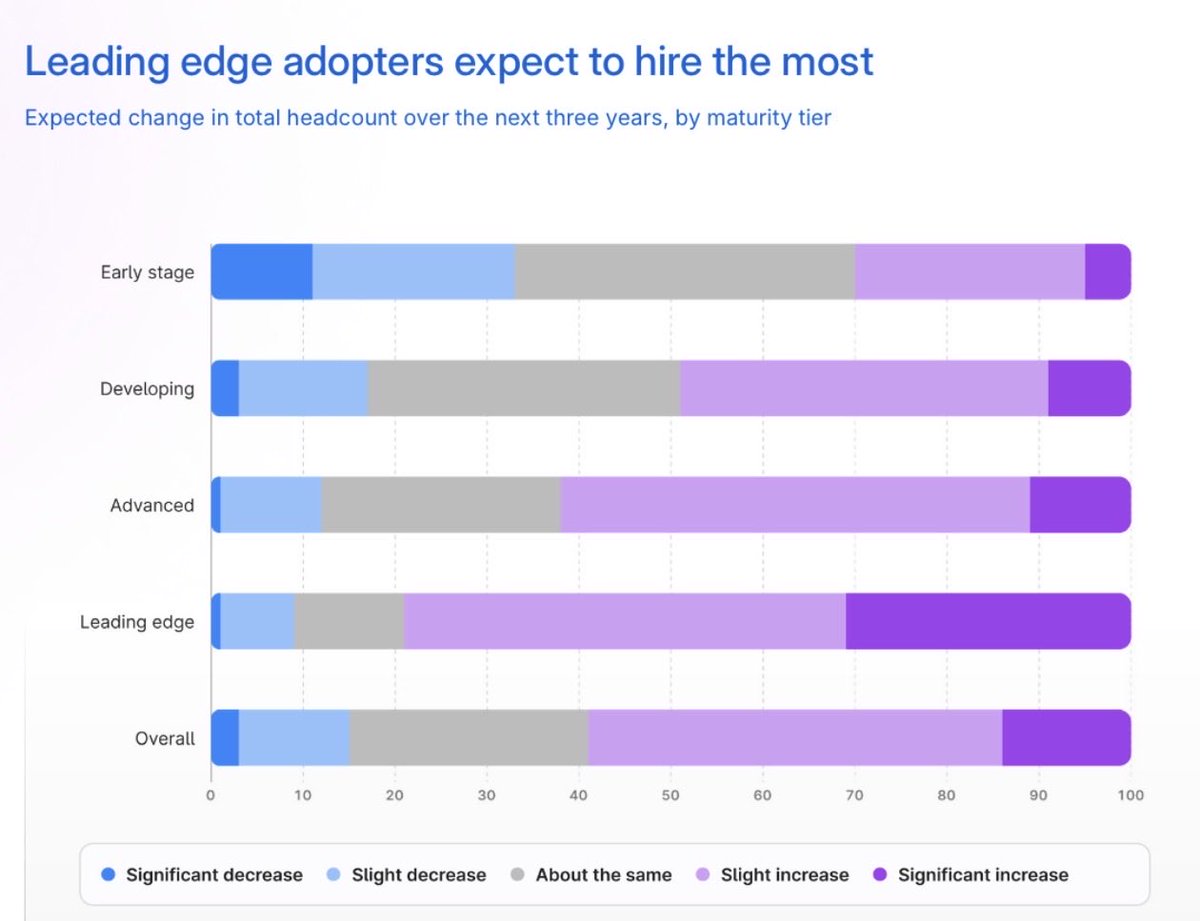
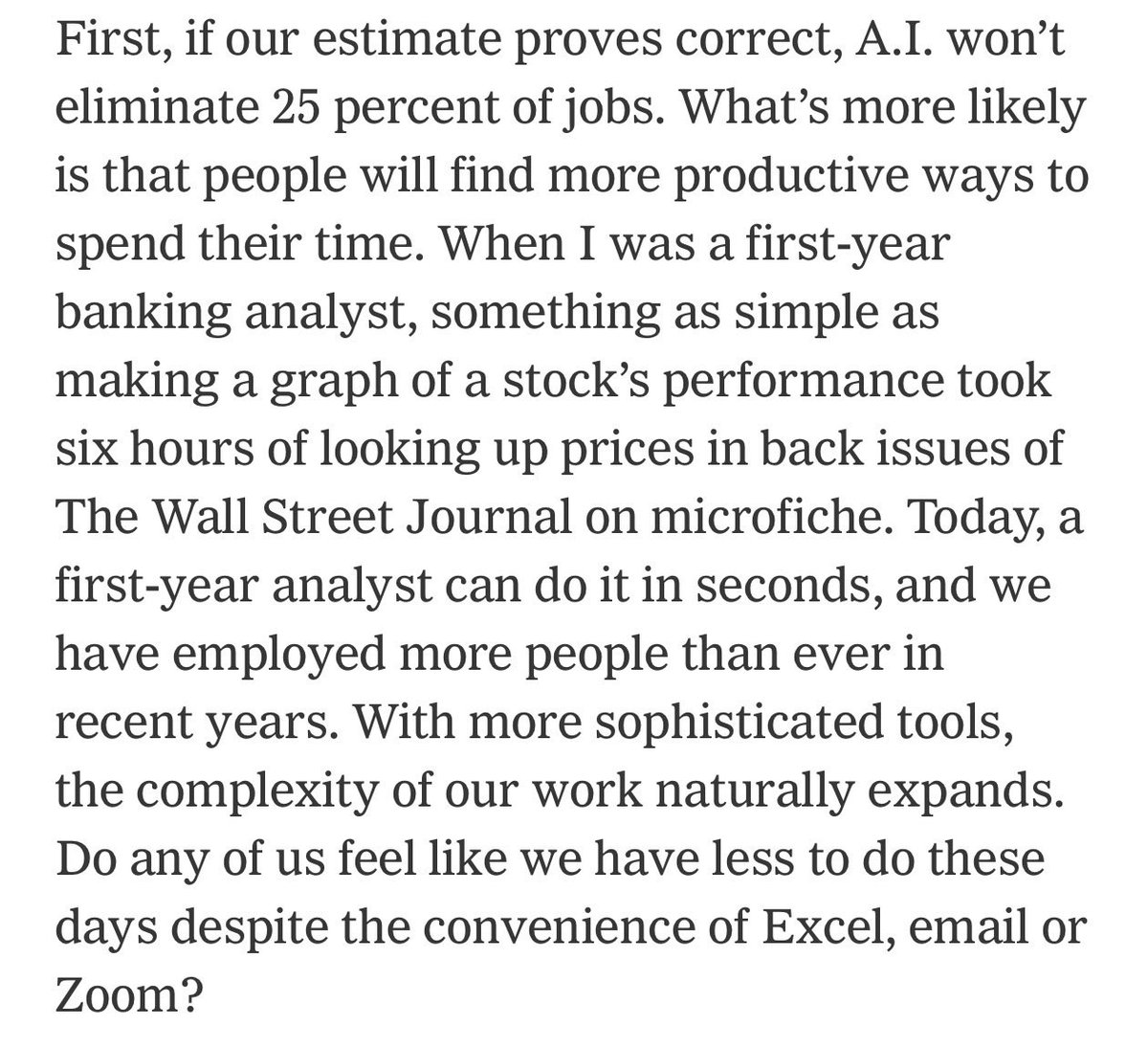
At Box, we just surveyed 1,640 IT leaders across the US, Japan, and Europe about agentic AI adoption. Many standout findings, but a big one was that the companies that adopted AI the most are planning to grow headcount the most.
Obviously lots of ways you can read that data and variables mixed in, but it’s actually quite intuitive that the companies that become most productive want to (and are able to) reinvest back into the business to keep getting the gains going.
The narrative of jobs being wiped out assumes that companies will take a fixed approach to what they want to be able for work on. What’s happening in practice is it’s causing companies to want to light up more engineering projects, sell to more customers, automate more processes to give time back, and more. That all leads to more work to be done by people.
Jun 11

JUST IN: Jeff Bezos predicts AI will create a labor shortage rather than put humans out of work.
46
48
233
41,449
Jun 11
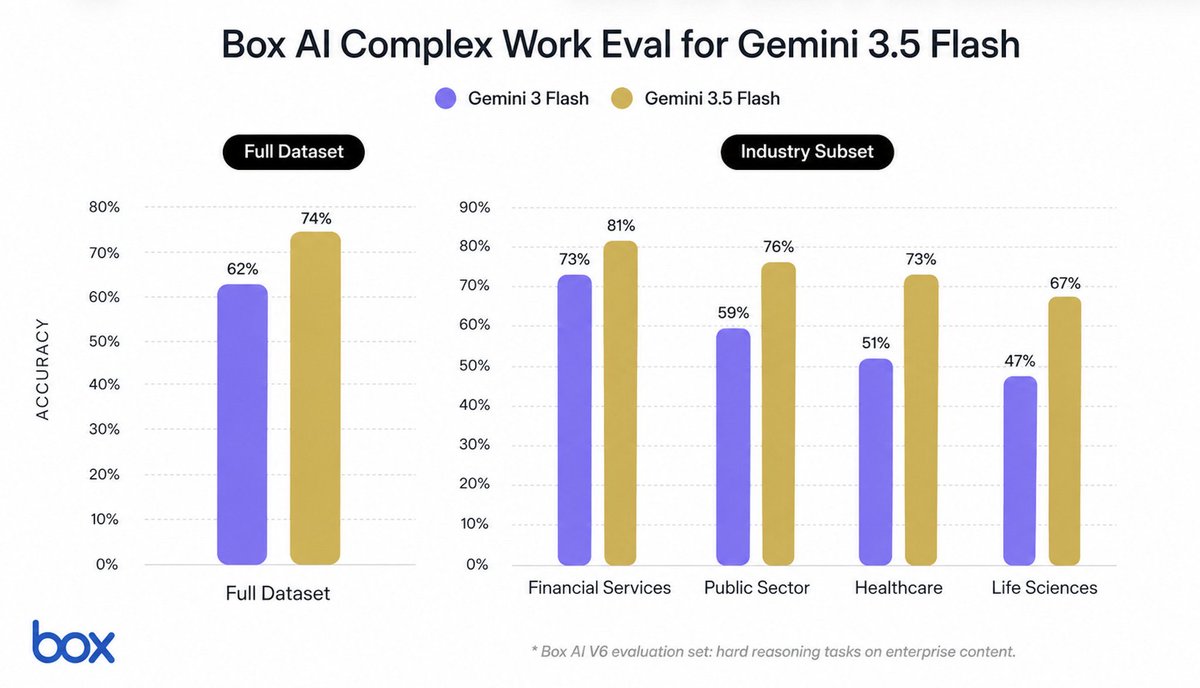
Lots of evidence of huge jumps in capability for Fable across coding (and related) tasks. It’s also a major jump in accuracy and success in complex knowledge work tasks.
In our Box AI Complex Work Eval, we tested the model against Opus 4.8 and saw huge boosts across almost every industry. For our eval we give the Box AI Agent, using Fable, a set of hard real world knowledge work problems that deal with enterprise documents. Then score how the agent performs the tasks.
The main differentiators for Fable vs Opus 4.8 is that it doesn't take shortcuts on complex reasoning, it gets multi-step calculations right, and it's significantly more consistent across runs. We saw the biggest leaps in Media & Entertainment (78% vs 61%), Technology (81% vs 73%), Financial Services (89% vs 83%), and Healthcare (66% vs 60%).
Here are some specific examples:
* Legal M&A due diligence: On a task reviewing NDA terms against a semiconductor company's contracting policy, Fable correctly identified that a joint-ownership clause violates exclusivity requirements while a liability cap is permitted under a Super Cap exception. Fable scored 100% vs Opus's 78%.
* Healthcare: On a clinical radiology error audit across 12 reports, Fable precisely categorized each error by severity grade and correctly concluded no Grade 3 errors existed. Opus prematurely escalated a case to "major error requiring immediate departmental review" when the evidence didn't support it — Fable 63% vs Opus 41%.
* Media & Entertainment: On a genre profitability projection task, Fable correctly recognized that a 20% Argentine tax deduction was already embedded in the source spreadsheet figures and didn't double-apply it. Opus applied it again on top — a compounding error across 4 genre calculations that took its score negative on the task vs Fable's 74%.
* Retail analytics: On a task analyzing high-growth product articles against an investment benchmark, Fable correctly computed each article's growth rate individually and identified that only 2 of 5 exceeded the threshold. Opus confused "high growth relative to average" with "above the benchmark" — scoring 61% vs Fable's 94%.
* Financial Services: On a 5-year debt facility projection, Fable correctly applied interest to opening balances and used the right capex figure. Opus applied interest to the total facility amount and computed tax from the wrong base — two compounding errors. Fable scored 83% vs Opus's 62%.
* Technology: On a SaaS feature valuation requiring computation of a Feature Value Index across multiple regions, Fable applied the formula correctly and got exact values for the markets. Opus got the arithmetic wrong on multiple criteria — Fable scored 100% vs Opus's 74%.
Overall, huge step change in complex analysis, work that requires analytical reasoning, and deep domain understanding. Fable will be available shortly in the Box AI Studio for customers to build agents with.

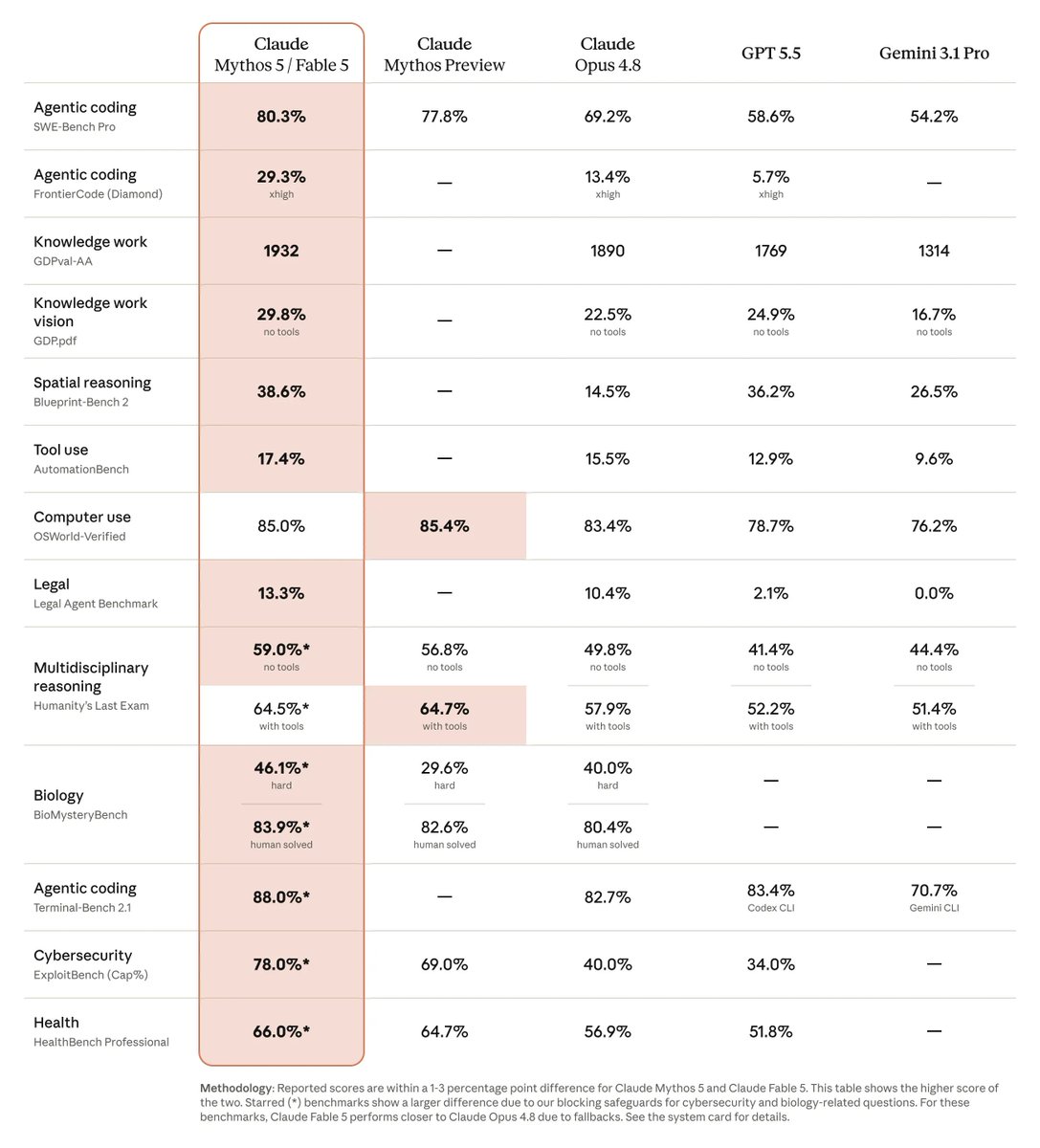
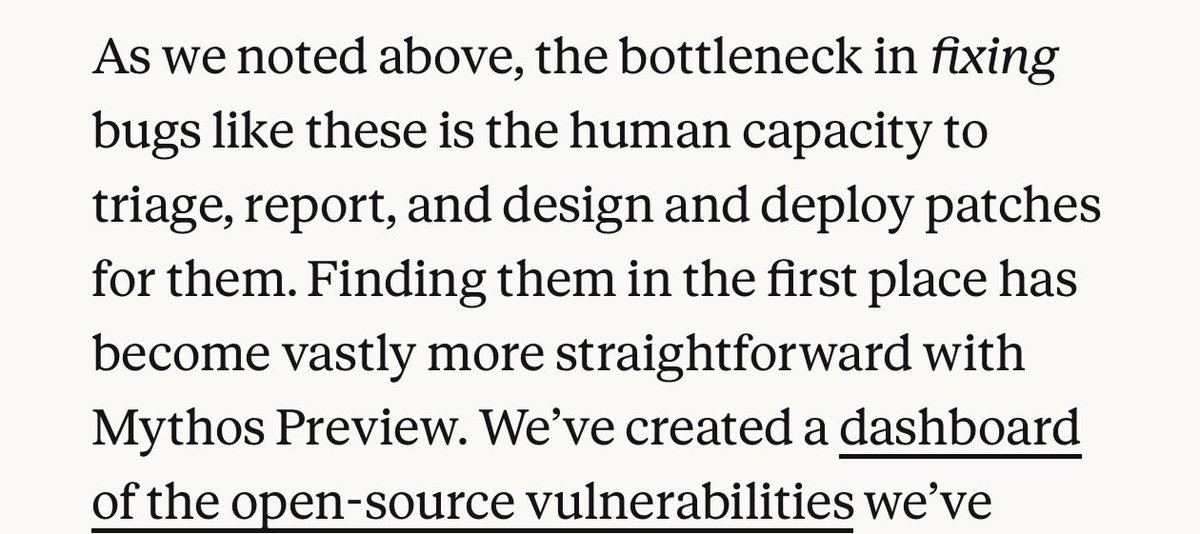
Fable 5 is state-of-the-art on nearly all tested benchmarks, with exceptional performance in software engineering, knowledge work, scientific research, and vision.
The longer and more complex the task, the larger Fable 5’s lead over our other models.
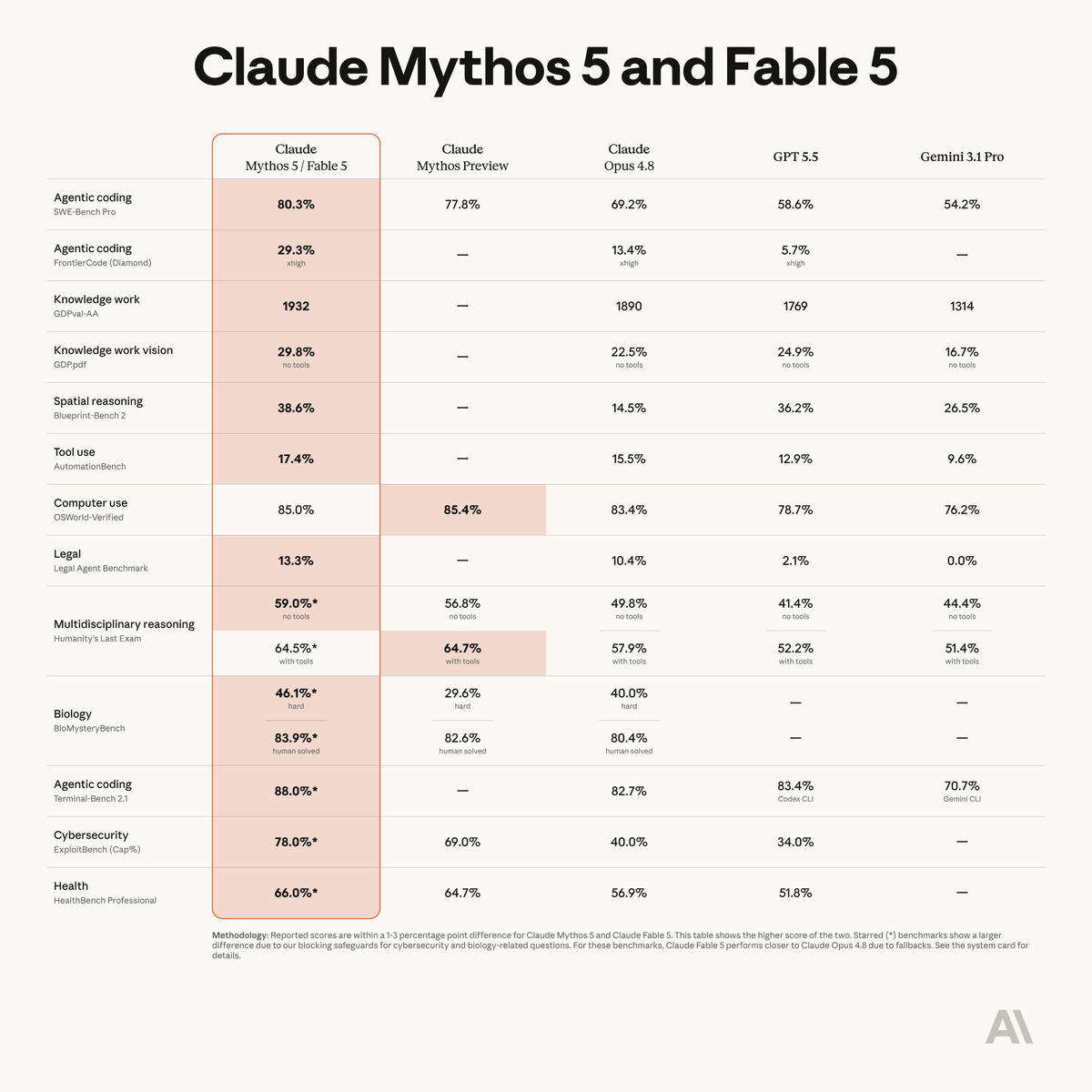
ALT Benchmark table titled Mythos 5 & Fable 5, comparing Claude Mythos 5 and Fable 5 against Claude Mythos Preview, Claude Opus 4.8, GPT 5.5, and Gemini 3.1 Pro.
43
39
361
72,691
Jun 10
This is a critical post to read if you’re building an applied AI company right now.
“An application earns its place in the untrainable corner by doing unglamorous work: arranging a company's private reality so a model can act on it, handing the model the tools to act, working with the customer to change the reality of its workforce. A company that brings the translation is tough to copy – and the translation never ends. Integration and maintenance run as long as the relationship does, won by teams that put domain-specialized engineers and tools next to the customer.”
There’s still an insanely large gulf between model capabilities and what it takes to apply them to specific corporate workflows. Some of that is technology that needs to be built, a lot is access to (and formatting of) the right data to work with, and a ton more is on the change management and specific implementation work (FDEs, etc.) it takes to make AI work in any specific corporate setting.
2 things can be very true at once: frontier models and labs will continue to grow an incredible amount, and there will be a vast ecosystem of software and services companies that emerge to bring the power of these models to real enterprises. This makes room for new infrastructure provides, applied AI companies in every vertical, new versions of system integrators, and more players.
Incredibly exciting time on all fronts.

77
103
1,001
224,786
Jun 9
If you thought AI progress was slowing down, well here's the immediate answer to that. Huge jump in capability across the board. This is going to deliver major improvement in agents across almost all knowledge work categories.
Introducing Claude Fable 5: a Mythos-class model that we’ve made safe for general use.
Its capabilities exceed those of any model we’ve ever made generally available.
76
76
670
144,286
Jun 9
Great post. So much about model performance is a function of how much compute you’re doing at inference time. This means compute-normalized benchmarks is the only logical path forward.
And yet, the challenge is it’s a lot harder than it seems given it’s subjective how much compute to apply, which means models behave differently at different thresholds (simplistically, model X’s min thinking may beat model Y’s min thinking, but be reversed at high), and there are a near infinite set of thresholds you could choose to set.
But either way, moving more in this direction would be great for better understanding AI progress.

18
11
88
28,835
Jun 9
There’s no amount of intelligence that can get packed into AI models that replaces the need for context. For any sufficiently general purpose AI, you will always have to guide it in the direction you want as it has an infinite range of directions it can go in.
As long as the same model is used by a lawyer, an engineer, a financial analyst, or a healthcare professional, and as long as you’re trying to do anything uniquely differentiated or specific, then instructions, domain context, and proprietary data will always need to get into the context window for the model to be useful.
This is partly why AI automation doesn’t come for free, and why there’s still a wide spectrum of who’s getting the largest gains from AI and who’s not. You have to put in real work, and you get real value on the other end.
This is one of the advantages that applied AI will also have in the market. Any layer of abstraction above just the raw intelligence that can meaningfully get you off to the races faster will likely continue to be valuable.

every job will turn into explaining your intentions to ai
explaining what you want to ai is surpringly time consuming, coders already spend 80% of their time doing it, and this will be true for everyone
88
56
458
94,212
Jun 8
The numbers may be a bit extreme here, but unquestionably use-cases have to stratify in the next year or two between model families.
We’ll see a split between frontier intelligence for high end tasks and work, and much cheaper models for high volume workloads that can sufficiently be peeled off to cheaper models. Frontier will still be far bigger than today because the use-cases will demand it, but the low-end will get quite a bit larger as well.
The big update here is that the layer that can efficiently route the workload to the right model will then become increasingly valuable since that becomes one of the new hard problems in AI agents. Agent orchestration that can cost optimize while still performing the task successfully will be in a strong position.

Good take
My guess is
- demand for intelligence is near infinite
- but 80% of workloads will be running on 99% cheaper models within 12-18 months
- 20% of workloads will still run on latest gen models where IQ maxing is important (scientific breakthroughs, higher level ochestrator agents?)
- rough analogy might be what % of macbooks or gaming PCs sold have the maxed out specs for CPU/GPU, prices are falling much faster than Moore's law here though
- this leads me to think the limiting factor will be energy and compute, not better models
At Coinbase we're working hard on routing prompts to cheaper models where appropriate, and in some cases have been able to keep costs roughly flat, while token usage continues to grow exponentially.
60
19
314
119,732
Jun 7
This is what the market got wrong about AI eating enterprise software. Building good software in the past was very hard. Yes, AI has made that a bit easier, though it’s still hard to build something that’s got good taste, differentiated, high quality, secure, and so on.
But nevertheless, that’s only one component of building a platform that enterprises rely on. The plurality of costs in most enterprise software companies is actually on GTM, because at scale most enterprise software categories are tough to break into and need a heavy amount of consultative selling and support for implementation and integration of solutions.
AI hasn’t reduced the need for that, and in many cases requires it even more now, as landscapes get even more busy and complicated for buyers to navigate through. If you make one thing cheaper and more abundant (development of software) then the new problem of discoverability and market differentiation (GTM) becomes the hardest part.
Jun 7

This is the tough lesson that a lot of people are learning the hard way
AI might have made building apps a lot easier, but it also set the barrier to entry at zero
Because anyone can do it, there is no moat left
The only edge left in the future will be sales and marketing

91
68
566
125,755
Jun 7
Box now has a markdown editor on the web. Full CLI support. Commenting. Full version history. Box Drive also lets you connect to any desktop client as a mounted drive, so you instantly work with all your files in Claude Cowork, Codex, Obsidian, Cursor, or any other app.

I need Google Docs but just for markdown files.
Multiplayer comments. Syncing resolving comments.
Suggestion mode
Edit mode
Edit history
Maybe some sense of multi edits.
Easy cli access.
32
22
283
72,233
Jun 6
Token costs are becoming one of the hottest topics for any enterprise I talk with right now. It’s very bullish for AI in general because it means these systems are being used at a scale that wasn’t contemplated before.
It also gives way to another form of differentiation that will emerge for the applied AI layer, which is model routing.
As tokens take on a significant amount of the cost of any given workflow, then companies will inevitably want to ensure that their dollars go into the most efficient use of tokens for the particular job at hand.
Frontier intelligence will always be relevant at the high end of tasks, like coding, legal and financial analysis, healthcare, and more. And dollars spent here will only go up over time. But, equally, you can peel off individual tasks to lower cost models (whether they’re from open weights vendors or the major labs) and deliver a more efficient end outcome.
To do this effectively, the applied AI layer needs to understand the workflows in their domain better than anyone else, and be able to mix and match models to different jobs. If you’re doing document extraction, you need to know which models perform better or worse for any given document type. If you’re legal analysis, you want to know which models perform various types of tasks best. And so on.
This will become one of the bigger differentiation points over time. The companies with the best evals, the best ability to route the workloads, and those that have business models directly aligned to customers financial goals, will be in a great position.
Jun 6

Your margin is my opportunity: AI version…
The biggest surprise of 2026 is that the capability gap between the best open-weight/source models and the best closed models has narrowed much faster than the pricing gap. The pricing gap remains enormous while the capability gap is quite narrow.
What does this means in practice?
For a company consuming 1 billion input tokens and 1 billion output tokens per month:
GPT-5.5 Pro: ~$105,000
Claude Opus 4.8: ~$30,000
DeepSeek V4 Pro: ~$5,220
DeepSeek R1: ~$2,740
I asked ChatGPT what it thought about this and it answered as follows:
“If I were building a company today, the economic frontier would look roughly like:
DeepSeek V4 Pro / R1 for high-volume inference.
Claude Opus for premium agent workflows where reliability matters.
GPT-5.5 Pro only for workloads where its incremental capability demonstrably produces enough business value to justify a 20–40× token premium.”
Most CEOs have no idea that, instead of this nuanced approach, their teams are running amok internally by picking the most expensive models in most cases and burning through massive budgets with zero governance, audit ability and control.
As control planes like our Software Factory become more standard, you can expect the run rate revenue growth of the frontier labs to go down meaningfully and the revenues of the open models to skyrocket.
Why? Because we can implement the nuanced approach above and be agnostic to model - instead focusing on customer intent, model task and cost management among other things.
89
81
492
199,937
Jun 6
Coding is basically the pinnacle of what you could reasonably automate with AI, and yet we still need human engineers to oversee agents for them to be effective.
The AI models are trained on an incredible amount of sophisticated code. The users are highly technical and can use the latest tools quickly. The work is “verifiable” because you can test an app. The outcomes are often removed from the quality of the code (you can have sloppy code but the app can still work). And the context for the agent is often already digitized and sitting in the codebase.
That’s an incredible amount of benefits that AI coding agents get to work with. Some of those apply to knowledge work, but most don’t in areas where the work needs to be fully reviewed to be useful, or where data isn’t as abundantly digitized. This makes the job for agents in knowledge work more complicated.
So if with all of that, engineers still remain in very high demand, the risks are going to be less than what’s perceived for other areas of knowledge work. Agents will let people do far more than they did before, but the people don’t go away.

I like having a job. So consider this take to be drenched in cope.
But as of right now, I think that: coding being a relatively “easy” thing for AI to learn the existence of many currently employed coders, implies that we’re a long way off from mass while collar disruption.
96
74
570
144,543
Jun 5
Good thought provoking post from Anthropic. I think this paragraph points to the key element of the optimistic scenario of AI:
“There has been an explosion of new ideas, initiatives, tools, and simulations, as a result of Anthropic employees working with highly capable models—far more than we have the capacity to pursue. The rate at which organizations can spot and fix these bottlenecks may be a skill that improves over time, and it may become the most important skill for any organization.”
AI lowers the barrier dramatically to allowing us to do more. As a result of that, we have far more ideas than we can pursue, and for the ones that we want to pursue we’re ultimately limited by our ability to go take on the surrounding work to execute those ideas. There’s almost no amount of AI progress that can happen where that goes away.
AI is going to let us build much more software, launch more marketing campaigns, research more drugs, and so on. All of this work, even when augmented by agents, still ultimately requires people to manage.
Jun 4
Our internal data shows Claude is accelerating AI development—a possible path to recursive self-improvement, or AI autonomously building a more capable successor.
It’s happening faster than we thought, and the implications deserve greater attention. anthropic.com/institute/recu…
52
46
374
78,681
Jun 4
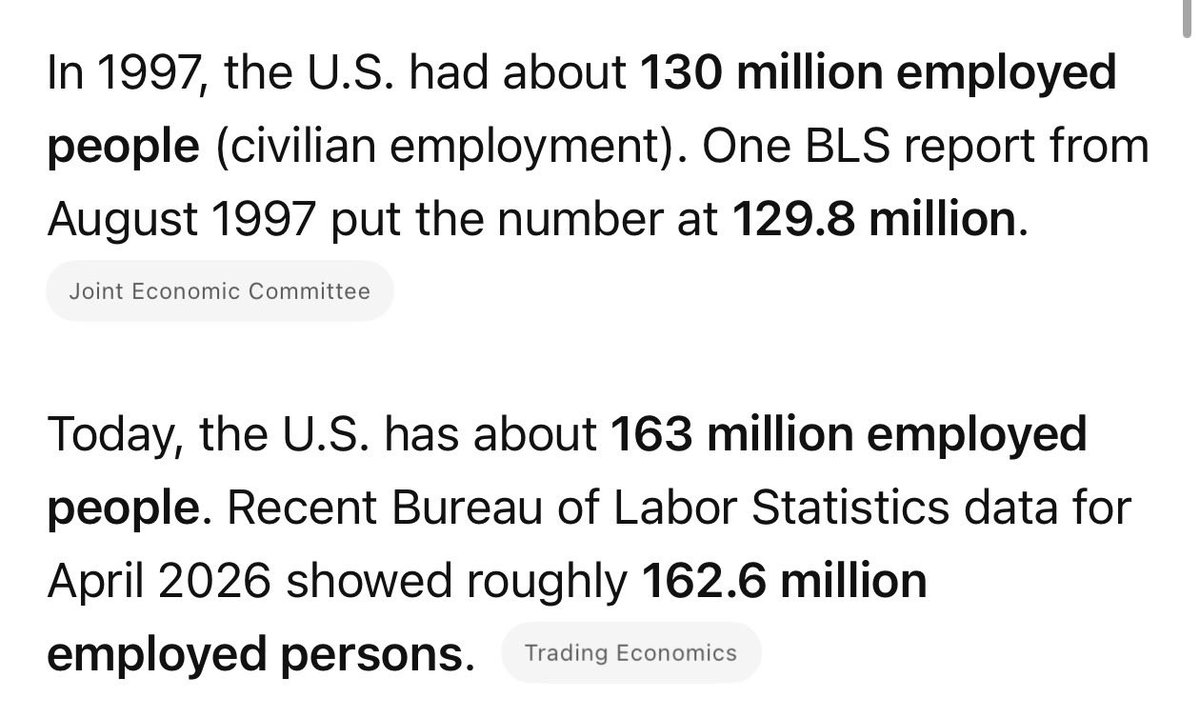
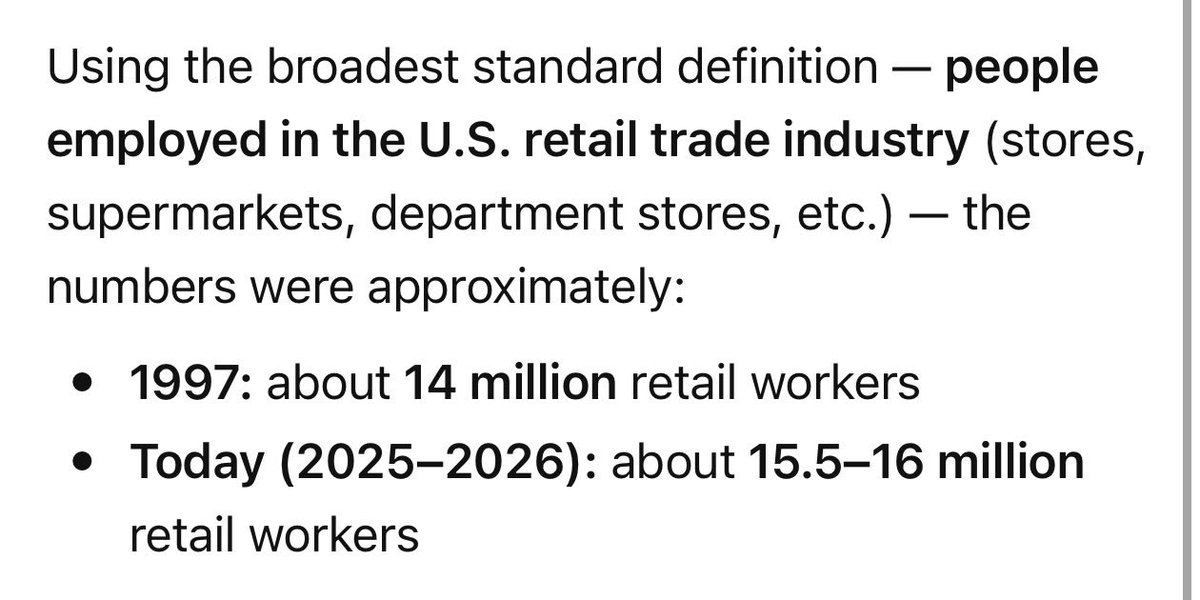
The jobs data coming out continues to suggest the opposite of what a lot of people had thought would happen.
Just take engineering, as the prime example of the area with greatest AI impact (and perceived risk). Most companies now have far more software projects than ever before because of AI, and effectively only engineers are going to be the ones doing that work.
You can get by for a while by being non-technical building software, but eventually someone has to understand what the thing is that got built, has to maintain it, has to fix security issues that come up, upgrade the systems beneath it, and so on. That’s all jobs.
Now apply that to a number of other job functions. AI is going to cause companies to hire more in sales because agents can let them process more leads and do more customer research. AI will cause an explosion of new marketing roles because of how much more efficient it is to launch campaigns and target. The list goes on.
AI is going to have the opposite effect that lots of people thought on jobs.

What if AI is actually creating more jobs than it is replacing?
The latest JOLTs data showed that US job openings surged by a massive 731,000 jobs in April.
Markets were expecting no change, resulting in the largest beat in JOLTs history.
As a result, available employment hit 7.6 million for the month, the highest since May 2024.
And, job openings in the professional and business services sector surged by a massive 668,000.
The labor market's bull case from AI is underpriced.
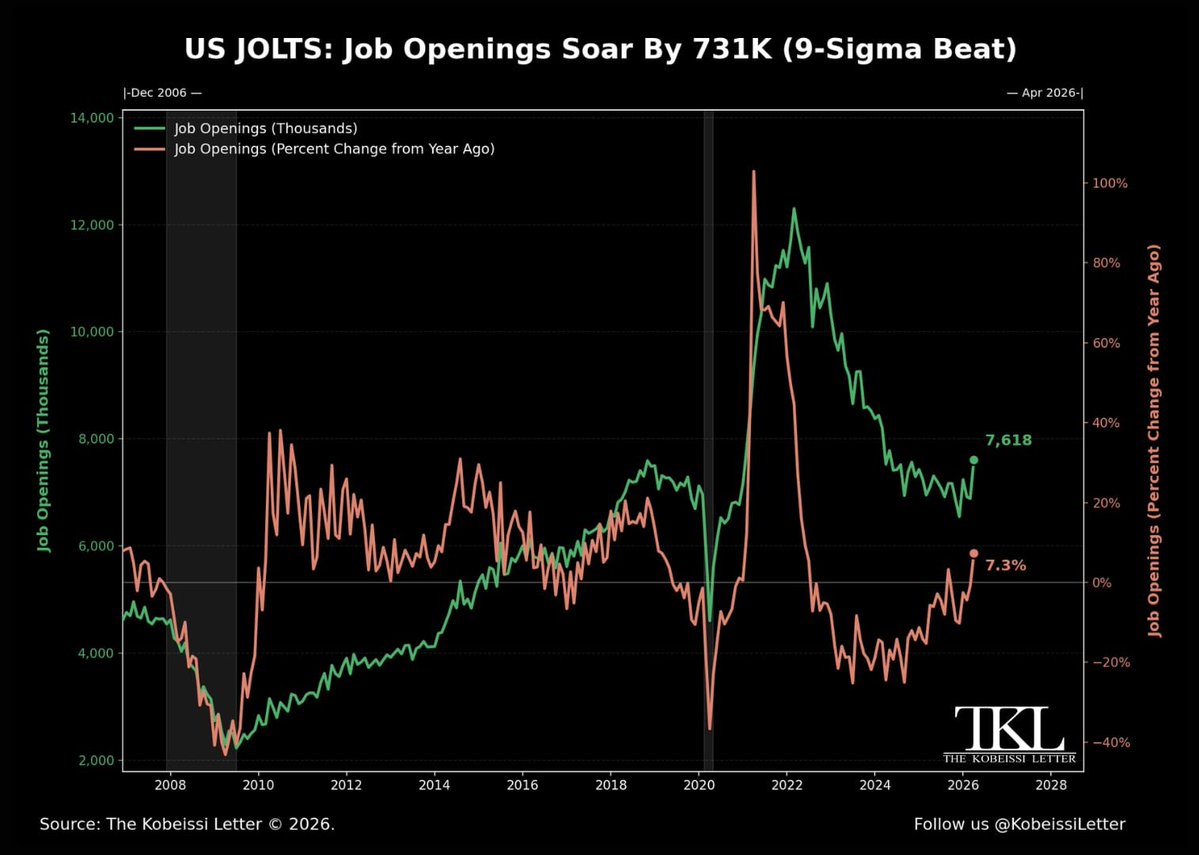
84
86
534
167,079
Jun 3
Even with employer caps, the spend on AI tokens dramatically exceeds any other historical spend on software.
Typically, companies maybe would spend on the order of $10-50 for a software license per month per employee, but now will pay hundreds or thousands on tokens to augment their productivity.
This shows you how big the TAM for intelligence is in the enterprise. The markets for AI are going to dramatically expand the size of the traditional software markets over time.
Jun 2
NEW: Uber is reportedly capping employee use of AI vibe-coding tools at $1,500 per month after blowing through its AI budget.
61
23
293
62,122