
A developer on a journey to build a FOSS, local-first, block-based knowledge workspace using standoff markup & hypergraphs. INTJ. 🦋 codexeditor.bsky.social
Joined December 2018
- Tweets 80,100
- Following 7,496
- Followers 6,600
- Likes 317,975
10,262 Photos and videos












Pinned Tweet

28 Mar 2024
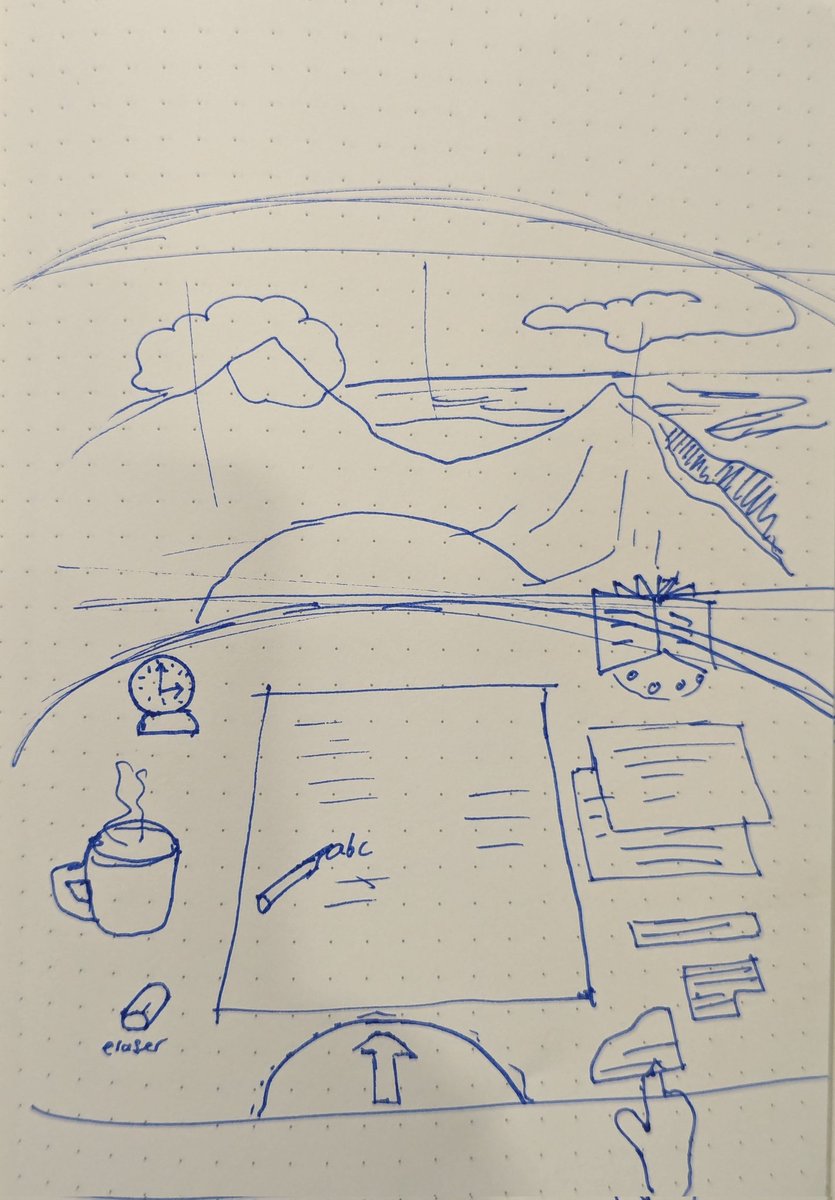
I've decided to return to #buildinginpublic and will be working on a new version of Codex.
It will be
> free
> open source
> local first @electronjs
> graph-centric @SurrealDB
> include my notes
And if all goes well 🤞
> 3D @threejs
15
17
197
23,871
Codex retweeted

Jun 13
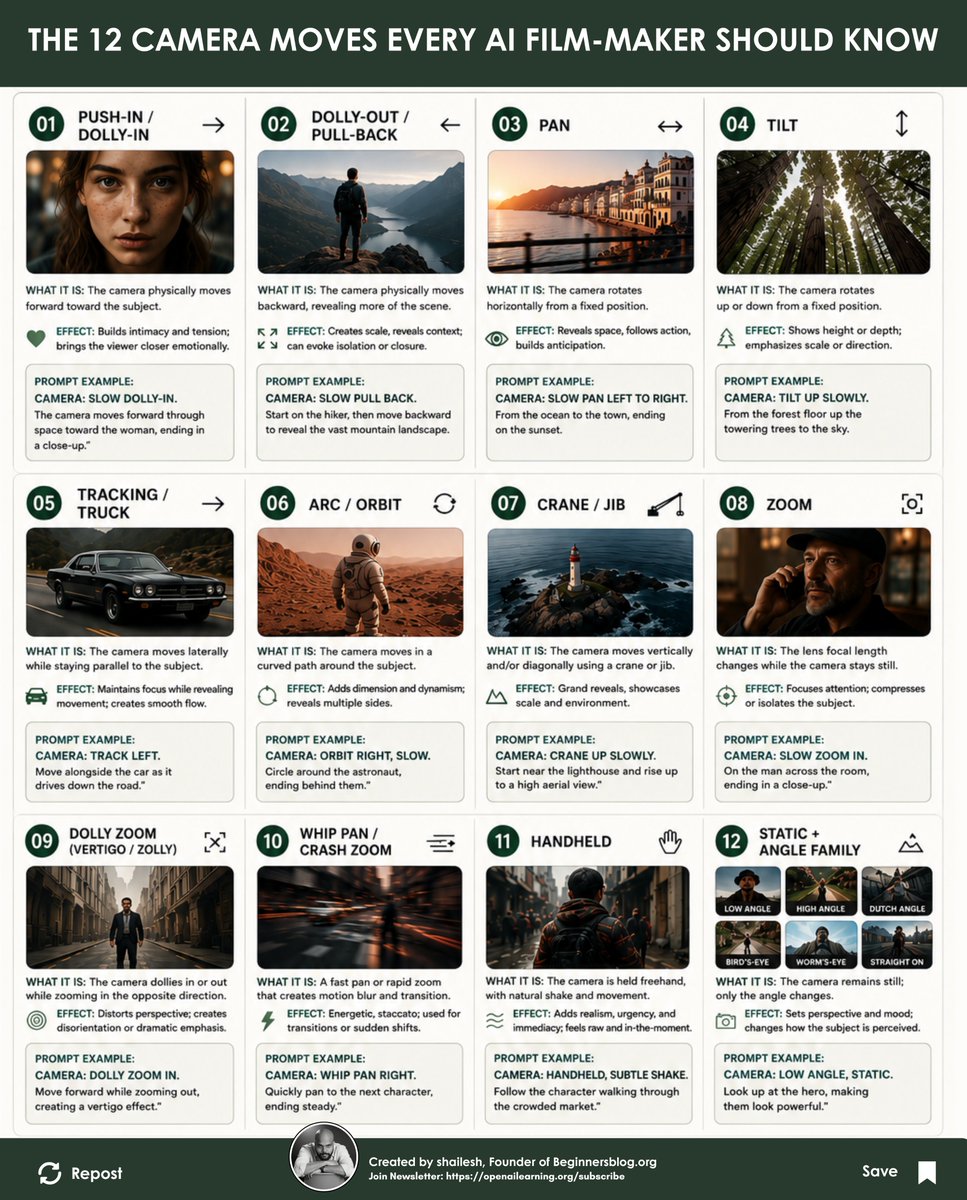
Cinematographers learn 12 camera moves in film school.
Most AI creators don't know a single one. Because nobody told the camera what to do.
.
.
Here they are:
→ Push-in — moves toward the subject
Builds tension. Creates intimacy. Use it slowly.
→ Pull-back — retreats to reveal
Isolation. Scale. Endings. The reveal shot.
→ Pan — horizontal rotation, camera stays fixed
Suspense lives in what you haven't shown yet.
→ Tilt — vertical version of the pan
Tilt up on a hero. They look powerful immediately.
→ Tracking shot — camera travels with the subject
Energy. Forward motion. You feel like you're there.
→ Arc / orbit — circles the subject
Hero moments. Product showcases. Keep it under 30 degrees.
→ Crane / jib — sweeps vertically on a boom
Grandeur. Scale. The "god-view" of cinematography.
→ Zoom — focal length changes, camera doesn't move
Flatter look than a dolly. Fast zoom = music video energy.
→ Dolly zoom — camera goes one way, lens goes the other
Background warps. Subject stays still. Pure psychological dread.
→ Whip pan / crash zoom — extreme speed for transitions
Shock. Comedy. Stops the scroll every time.
→ Handheld — natural shake, no stabilisation
Add "subtle" or the model goes full earthquake.
→ Static angles — low, high, Dutch, bird's-eye, worm's-eye
Low angle = power.
Dutch angle = unease.
Bird's-eye = scale.
The mistake everyone makes: stacking multiple moves into one prompt. One move. One clip. Always.
And add "slow" to almost everything. Slow moves hide what AI can't render cleanly. Fast moves expose every flaw.
36
215
1,327
57,278
Codex retweeted

Jun 13
That feeling when your 6 yo is interested in your book about silicon transistors and you rush to get your cpu collection to show it to them.


33
113
1,906
58,651


Codex retweeted

Jun 13
The hero we always needed! Let us welcome @dhewlett to the growing list of Stargate actors lending their name to the fight to #SaveStargate
Thank you sir! The fandom stands with you!
Hear us @AmazonMGMStudio and @PrimeVideo

49
306
2,209
16,534
Codex retweeted

Jun 13
A Getting Started with #FujiNet Guide is complete for the #Atari8bit systems. It's available on GitHub in the fujinet-manuals repository: github.com/FujiNetWIFI/fujin…

6
21
545


Codex retweeted

Jun 13
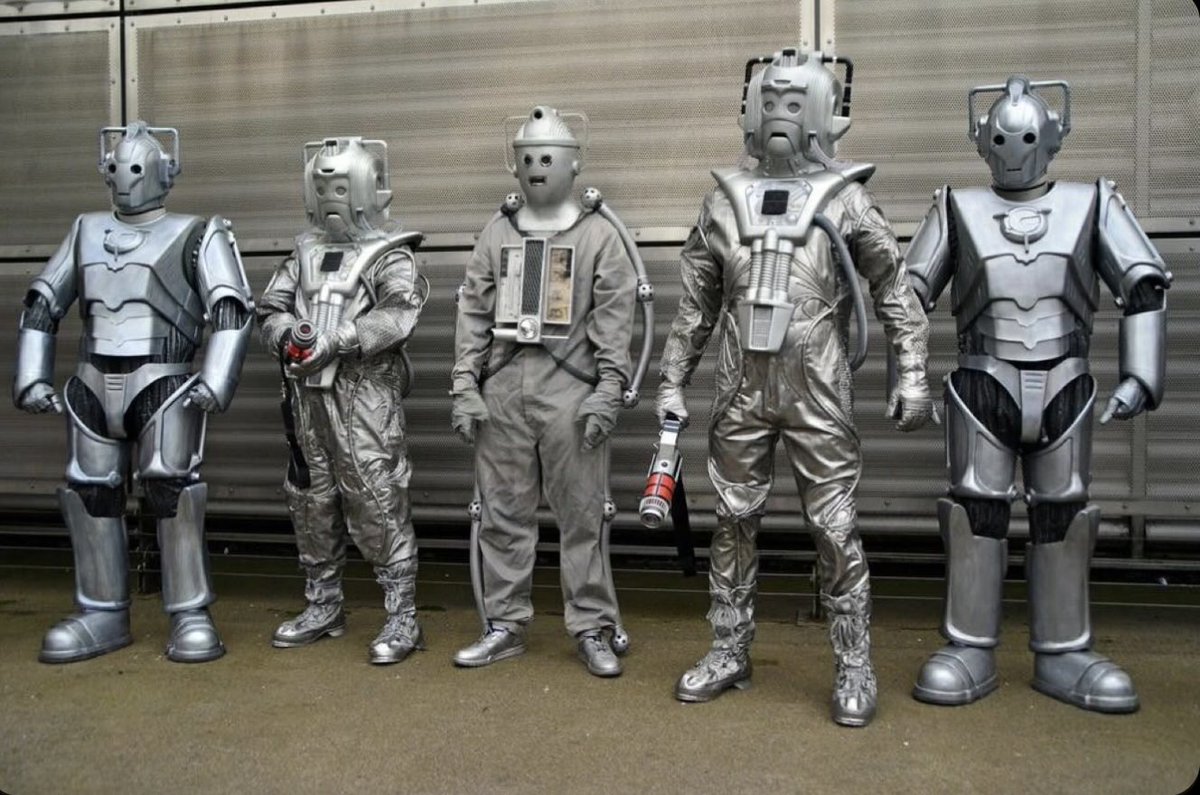
I’m sure everyone has a different opinion.
But I think the 2nd on the right is the most menacing.
49
5
114
5,605
Codex retweeted

Jun 13
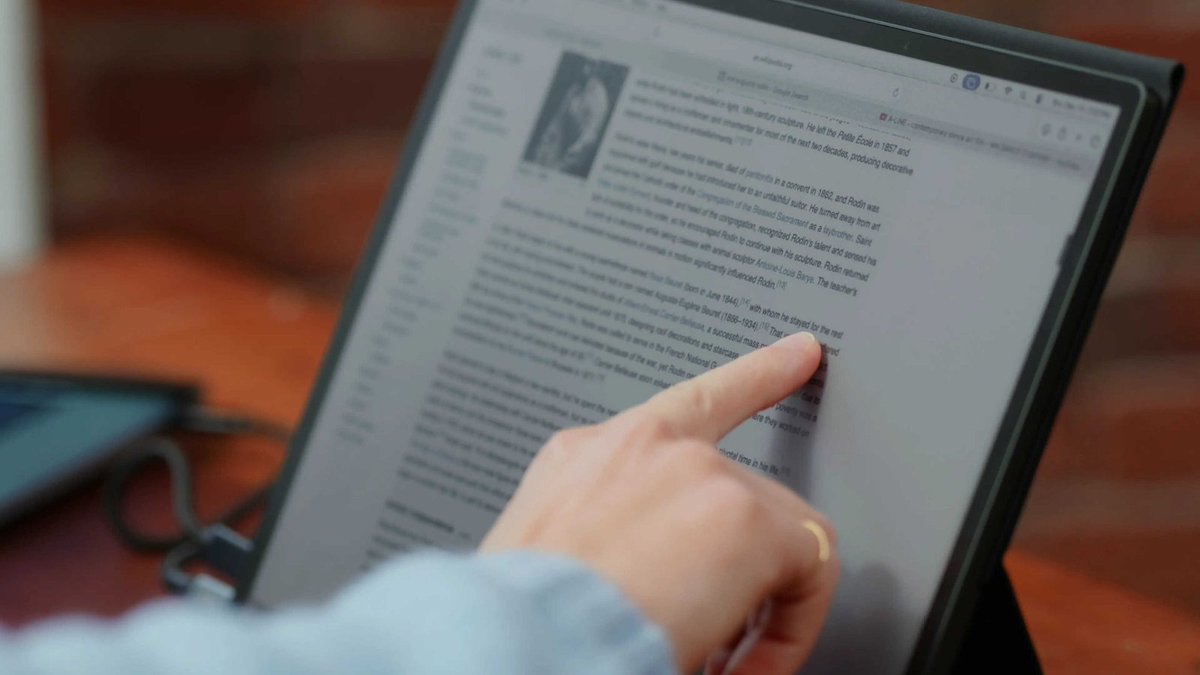
white pill for my nerds:
60fps e-ink display
a random guy outperformed entire eng teams by developing a pixel by pixel driver for e-ink displays that makes it 60fps.
he did that after work for months, launched it yesterday.
the future is bright

134
385
7,726
456,165
Codex retweeted

The ACT Apricot Xen (1985)

6
95
583
19,682
Codex retweeted

Jun 13
Le carnet de croquis de Turner

21
1,374
9,801
141,329
Jun 13
The 21st century Messiaen.

50
Jun 13
This performance of this piece of music sums up the feelings of someone who knows they are too sick to live but doesn't want to let go.
Chopin's last nocturne, played by Richter.
youtube.com/watch?v=9AZaVTm3…
1
88
Codex retweeted

He walked right into that one
1
18
254
13,076
Codex retweeted

Jun 12
Emilia's Mashups
Cockney Star Trek
3
8
53
2,406

Codex retweeted

Jun 13
This is, perversely, good news for Britain, Australia, Japan, Europe, and other countries being cut off that would once have seen themselves as close allies of the United States.
It shows us what the future may hold if AI is the strategically and economically decisive technology of the 21st century and is controlled by the US and China. It is good news because *it may be happening early enough to give us time to act.*
I think this will be rescinded pretty soon, but it’s a sign of things to come. In a future where frontier models cannot be used outside the US, our industries and economies will fall behind and American businesses may not be able to operate overseas. We won’t be able to defend ourselves militarily with defence systems built on obsolete software. Europe 2031 is a good scenario of what a future like this could mean: europe2031.ai
Some of the things we need to do are ‘no regrets’ measures we should do anyway. But some are genuinely costly and risky.
We need cheap electricity – powered by gas, coal (this is costly, coal is very bad), deregulated nuclear fission – whatever can provide *cheap, reliable, 24/7* power. This almost certainly excludes wind power, which is enormously expensive and unreliable. We need projects to be able to connect to the grid in days rather than years by paying for fast-track connections.
We need to make it incredibly easy to build data centres, with the property taxes retained locally and hypothecated for local tax cuts so there is some direct benefit for locals. This doesn’t need to be nationwide.
We need to create new regulatory regimes for innovative businesses that give them the right to hire and fire staff with ease. The difficulty and cost of firing staff is one of the main reasons Europe has fallen behind so badly. We need to create a parallel employment regime that companies and workers can opt in to: worksinprogress.co/issue/why…
Even though I think it will probably fail, I think we should probably try to create a good, non-American frontier AI lab. I am quite pessimistic about this – even extremely well-resourced, innovative software companies are struggling to do this. But the stakes are so high that not trying seems foolish.
One thing that might work in our favour is the number of brilliant AI engineers who are not US citizens, who under the current export controls do not have access to Mythos/Fable even if they live and work in the US. What happens to Demis Hassabis, Ilya Sutskever, Andrej Karpathy, and the many other Europeans, Canadians, etc who are working on AI models in Britain and America who are affected by this?
I do not think we should force our own companies to use model, because this would exacerbate their economic weakness – this lab should have to compete on an even playing field. I am deeply sceptical that this can work, but we cannot rule it out. If we do it, it has to be able to pay US salaries, operate without political constraints. worksinprogress.co/issue/how…
It is cope to tell yourself that Trump is an aberration or that these export controls are a one-off. To repeat, I think these specific controls will be lifted quickly and it will be easy to move on and forget it happened. But this is a look into a potential future. Every one of us that is not a US citizen is at risk. The standard political divides do not apply here; the question is whether you grasp the enormity of AI as a technology. We have to act!
Jun 13

The US government, citing national security authorities, has issued an export control directive to suspend all access to Fable 5 and Mythos 5 by any foreign national, whether inside or outside the United States, including foreign national Anthropic employees.
The net effect of this order is that we must abruptly disable Fable 5 and Mythos 5 for all our customers to ensure compliance.
Access to all other Claude models is not affected.
We apologize for this disruption to our customers. We believe this is a misunderstanding and are working to restore access as soon as possible.
Read our full statement: anthropic.com/news/fable-myt…
150
354
1,826
290,213