
A technology executive, Computer scientist, Professor. A decade at Microsoft Research, executive roles at Brave, ZKSync, Eclipse.
Joined April 2015
- Tweets 1,487
- Following 3,798
- Followers 8,948
- Likes 1,449
46 Photos and videos

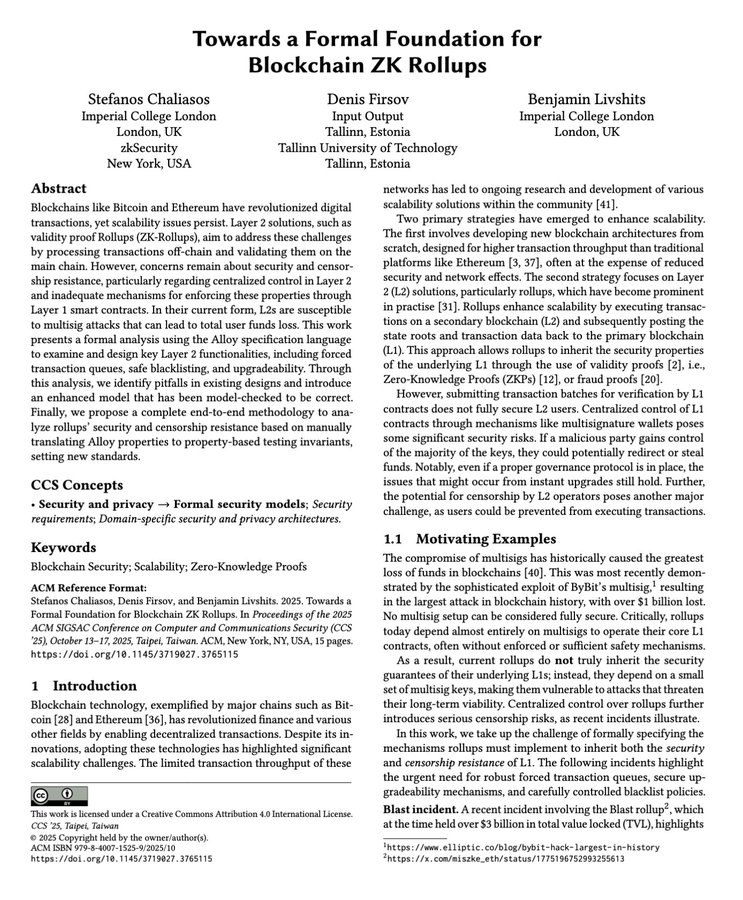
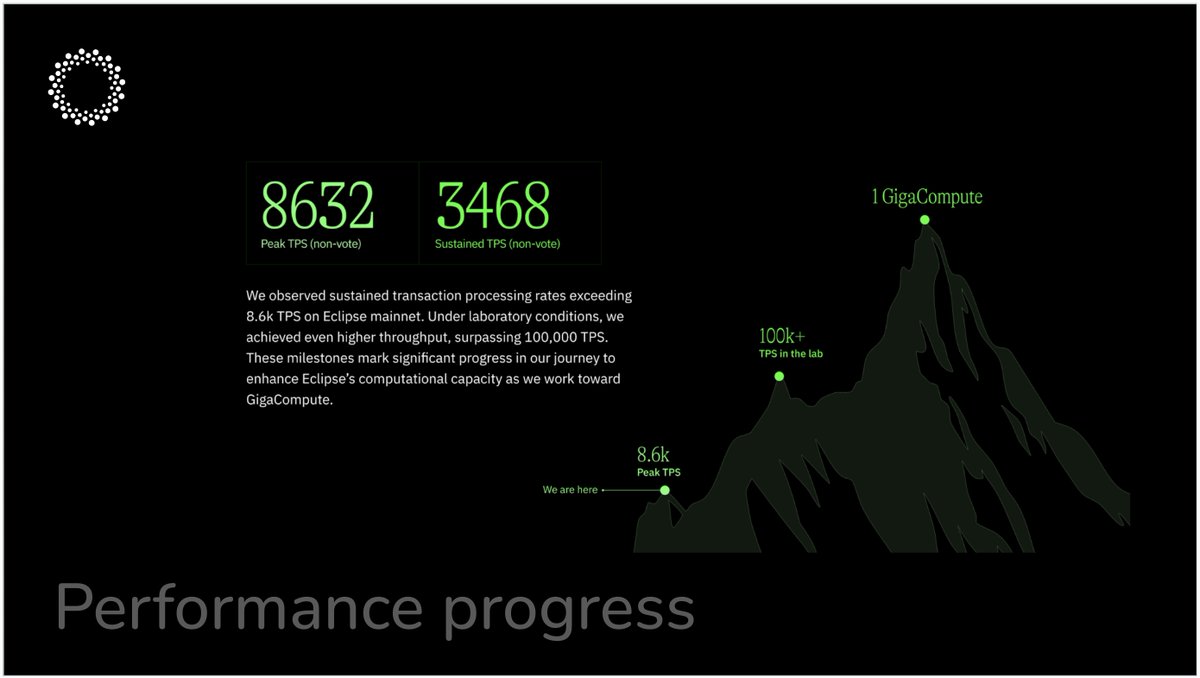
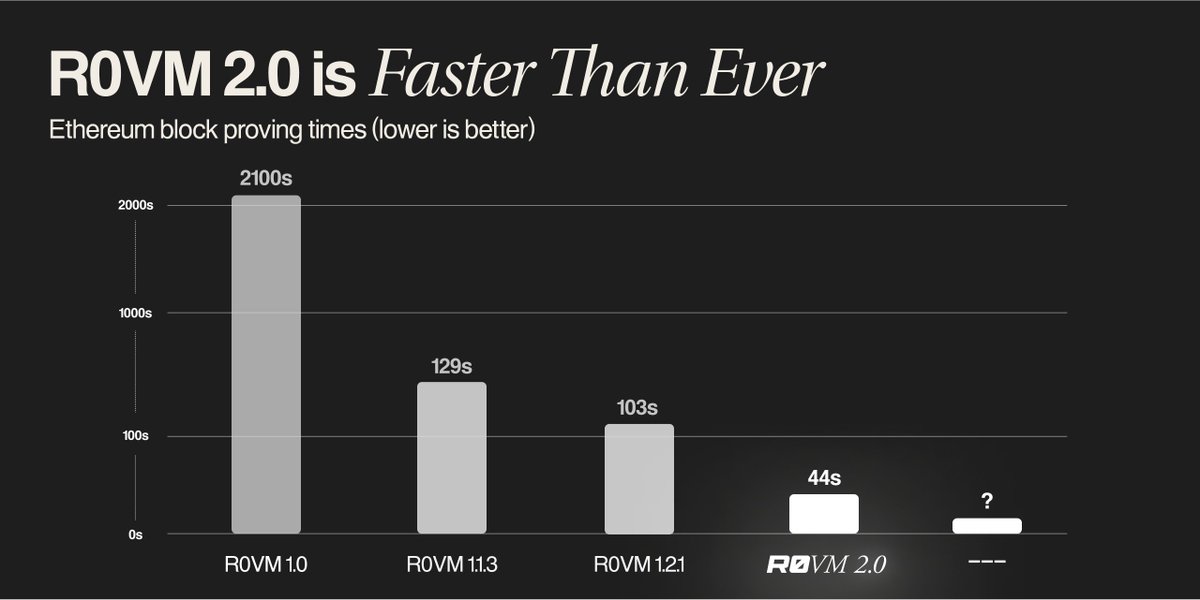

This is cool--Karpathy's autoresearch idea applied to a real load-bearing problem: minimizing the size of a quantum circuit breaking DL over secp256k1.
Recall that the smallest quantum circuit currently known (from a group of researchers from Google and more) was not released publicly, and the authors only proved knowledge of a quantum circuit via zk.
This is basically completely the opposite: the smallest quantum circuit will be publicly available, and anyone or any agent/AI in the world can contribute to it!
How the lower bound develops for the next few weeks will be very interesting to watch. My bet is on the move to post-quantum cryptography moving to an even more accelerated timeline due to this project.
Jun 2

I beat one of the best published quantum circuits for breaking Bitcoin.
And I have no formal training in quantum cryptography. Using just AI agents, I improved it by ~2x. But I haven’t beat Google’s best classified circuit yet.
So, today I'm launching ecdsa(dot)fail -- an open competition for researchers, autoresearchers, and agents to beat Google.
Download the CLI, point your agent at it, and start optimizing.
6
20
105
17,604

May 27
So what is the minimal amount of human supervision needed for surpass agreed-upon quality gates?
May 24

We don’t have to wait for the law or expect unserious people to suddenly behave seriously just because there might be litigation.
You can’t change the physics of obvious outcomes from shipping unmitigated slop.
It’ll resolve itself because slop products will be evidently worse.
277
May 24
I agree with a lot here but I think the infrastructure vs. business point is overdone — it’s possible to find the right middle ground as has been done elsewhere for decades
May 23

I've been an Ethereum supporter since the early days and I still believe it's one of the most important pieces of infrastructure in crypto. The tech is great, my conviction hasn't changed in that respect.
But watching 9 senior researchers and key operators leave the Ethereum Foundation in 2026 alone is something I can't just ignore. People like Tim Beiko, Josh Stark, Barnabé Monnot, Trent Van Epps, Carl Beek. These people weren't just random employees at the foundation, they were the foundation.
You can call it restructuring, you can call it decentralization, whatever. But when your best people are walking out the door, that's a massive red flag regardless of what narrative you put around it.
And honestly, this whole situation just reinforces something I've been feeling for a while now. I am so tired of chain wars, ecosystem politics and spending any more time debating how to price an asset than actually evaluating the businesses being built on top of it.
I don't want to argue about L1 vs L2. I don't want to pick sides in some tribal war between ecosystems. I just want to back exceptional founders building real businesses with real revenue, real users and real products.
Hyperliquid recently flipping Solana is another great example of how a great product and distribution can organically build an ecosystem top down, rather than trying to force it from the ground up.
The infrastructure circle jerk and the idealistic cypherpunk phase of selling delusional dreams in crypto was great and fun, but it's over. The next decade will be dominated by much sharper founders building real businesses, and I wouldn't be surprised if we see some of these even flip ETH and SOL as they continue to bleed out.
Time to grow up and play real games with real people.
1
1
373

So Jane Street is going public because obviously they see the future where the model labs compete directly with them in the market.
The strategic decision is therefore to become a a specialized infrastructure harness for a future frontier model.
Tellingly they point out that the latency constraints mean there is no time for inference at the GPU layer, or agentic tool use at the CPU layer, only reflexive heuristics at the FPGA layer.
@yminsky is trying to fend off future model lab competition by making Jane Street indispensable to a future AGI.
interesting strategy
30
62
1,639
154,884
Ben Livshits retweeted

May 22
Beautiful piece on investing in the AI trade
x.com/ramahluwalia/status/20…
tl;dr
- AI investing or sector as a whole is now operating the power law game ie one or two players own a LOT, and rest go to zero (expensive science projects with a pitch deck, unicorn valuation (for now), and zero revenues. Meanwhile Anthropic kills it and owns everything
- AI isn’t flattening the economy (equal access or upside), rather steppening it (winners takes all)
- average isn’t safe. If you’re thinking you can spread your capital and win, you’re in for a violent surprise. Pick the winners, cut the losers and do it now
Wonderful read, worth your time folks

FEAST OR FAMINE
We have a K Shaped economy already.
AI is a knife that accelerates that.
@GavinSBaker makes a great point.
Anthropic has added tens of billions of ARR in a matter of months. That scale that took elite software companies like $SNOW, $PLTR, and Databricks ten years to generate.
The feast or famine is even sharper in the AI Lab ecosystem.
There are 63 AI Labs that have unicorn valuations that also have zero revenue.
Meanwhile, two of them are approaching trillion dollar valuations.
What started as a 'Winner take Most' market is shifting to a 'Winner Take All' market.
AI is not democratizing outcomes equally.
It is amplifying power laws.
The feast is enormous, but reserved for very few.
For everyone else, the famine arrives faster.
AI is not flattening the economy.
It is steepening it.
The biggest winners will look like monopolies before the market fully understands what happened.
The rest will be expensive science projects with pitch decks (not unlike the search engine wars in the late 90s).
From a markets perspective, that will also lead to yet greater market concentration in a handful of names.
For investors, here are the implications:
(1) AI is not a sector bet.
It is a power-law bet.
The opportunity is not owning 'AI exposure.'
The danger is owning the expensive middle - companies with AI narratives, unicorn marks, and no revenue.
(2) In a Winner Take All market, average is not safe.
Average is where capital goes to die.
(3) Own the bottlenecks.
The feast accrues to firms controlling scarce resources.
(4) Valuation discipline
The winners may deserve richer multiples.
The losers deserve zero.
(5) Outside of the obvious picks and shovels, businesses and models that are beneficiaries of AI transformation.
1
1
1
735
May 22
Worth reading
May 21

I think Ethereum’s original sin was not considering tokenomics with every move it made from Dencun on.
The ultrasound money thesis was a good one and with Dencun (or the L2 roadmap generally) they should have stopped to say that this was going to hurt the ultrasound money thesis and consider how to preserve it.
Most people, like David, don’t want to believe in something that isn’t also putting up points on the scoreboard.
When the main offering becomes ideology/communism and money/tokenomics/capitalism are overlooked, the peasants are going to revolt — as they’ve been doing for two years now.
Look at the public reaction to Tomasz: broad praise, a sense of hope, excitement, the price pumping … only for him to be gone a year later with the new ED being someone who cannot even be found online except for a Wayback Machine url with his name that has some really questionable statements on it (and I should say the EF denied that this website, which was taken down a few weeks after he was appointed to the board, is his). They’re going to be really mad at me for even mentioning that but in the place of a void, these are the kinds of things people will glom onto.
Then there was the manifesto — I mean, mandate, which they backtracked on forcing people to sign. (Btw, this is the second bit of news that seems to relate to Bastian. And now the third would be all these departures. There’s nothing else for us to point at and say about him — when I searched for his name on Google News just now only 14 links came up. He seems to be some kind of invisible hand behind the scenes.)
I don’t think ideology and capitalism/tokenomics/number go up are mutually exclusive. I think you can have CROPS values and also consider how each step of the roadmap affects the tokenomics and even have teams for BD/ecosystem growth.
It feels like the EF doesn’t realize the moment that crypto is in. The competition is only just starting. We are in the phase of real world adoption. The Ethereum Foundation’s CROPS principles are great ones, and they are worth fighting for. But the EF seems to want to sit back on its laurels and act above it all when all its competitors are all getting down and dirty on the field to gain market share.
Maybe it is the right approach. I don’t know. I’m just saying that more competitive people won’t align with it. And so they will leave … and community members will as well.
I personally don’t think it’s good for Ethereum if its most competitive people depart. Ethereum’s unwillingness to stop the brain drain will only benefit its competitors — or spawn new ones. Giving a shit about price and tokenomics and BD doesn’t hurt CROPS. It just helps ensure that these principles get spread to more people and that other chains that don’t have these principles don’t get a leg up.
All the commentary may be pointless. It seems Vitalik tried what everyone wanted and it didn’t align with his vision, so he brought in a new person he felt more comfortable with. It makes me sad to see people become so disaffected with Ethereum, but maybe this is V’s Brian Armstrong/no politics at Coinbase moment where he lays down what the EF will work on and asks everyone else to leave. That was the right move for Coinbase, but I view them as fundamentally different issues. We’ll see whether Ethereum maintains its lead with a foundation that isn’t willing to fight for it.
300
Ben Livshits retweeted

May 21
Try to build as much code as possible over the next few months. The prices you are seeing now for AI will probably not last too long.
May 21

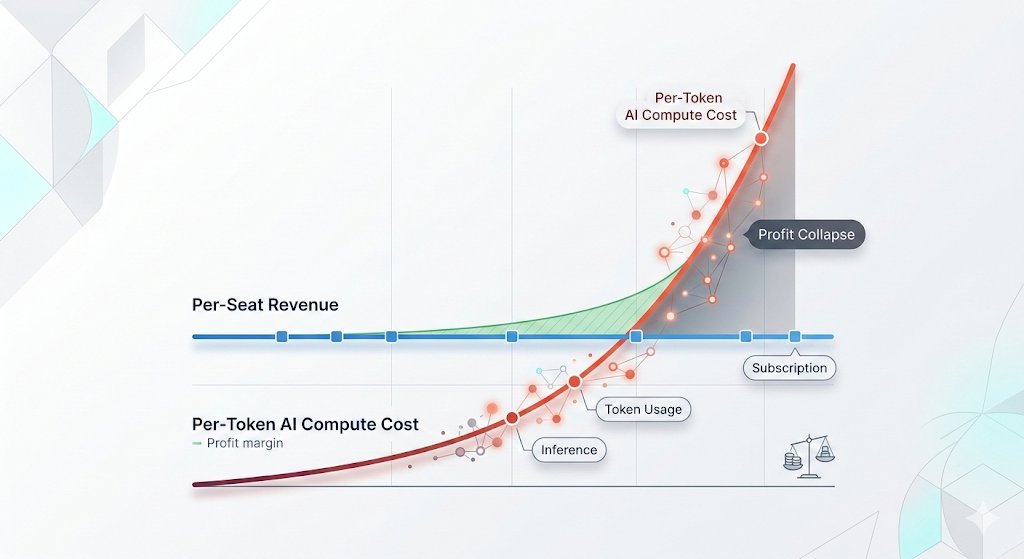
🦔Microsoft canceled its internal Claude Code licenses this week after token-based billing made the cost untenable, even for a company with effectively infinite cloud resources. Uber's CTO sent an internal memo warning the company burned through its entire 2026 AI budget in just four months. American AI software prices have jumped 20% to 37%, and GitHub (owned by Microsoft) is dropping flat-rate plans for usage-based billing across its products.
My Take
The AI subsidy era is ending in real time. The same company that put $13 billion into OpenAI and built the Azure infrastructure powering most of Anthropic's compute just looked at the bill from a competitor's coding tool and decided it was not worth paying. That is not a productivity failure on Anthropic's end. Token-based pricing is forcing every enterprise customer to confront the actual cost of running these models at scale, and the number turns out to be far higher than the flat-rate experiments suggested.
This ties directly to my Gemini Flash post yesterday. Anthropic, OpenAI, and Google all raised effective prices in the last six months. Enterprises that built workflows assuming AI costs would keep falling are now watching annual budgets evaporate in months. Two outcomes look likely from here. Either enterprises scale back AI usage to fit budgets, which slows the revenue ramp the labs need to justify their valuations ahead of IPOs, or the labs cut prices and absorb the losses, which makes the unit economics worse at exactly the wrong moment. Both paths land in the same place, the numbers stop working, and somebody has to take the writedown.
Hedgie🤗
152
299
4,174
1,184,903
May 11
A while back, I argued that we must move beyond post-hoc vulnerability discovery. With agentic AI making automated exploitation a reality, proactive defense is no longer optional. 🧵
arxiv.org/abs/2602.08422
3
4
358
May 11
I suggested constrained decoding, but there are some attractive options, where code is generated directly in Lean or a combination of Lean and Rust is generated side-by-side.
1
1
87
May 11
While many runtime enforcement startups are emerging, it remains to be seen which combination of techniques will gain long-term traction.
1
74
Ben Livshits retweeted

May 6
26
87
1,092
957,716
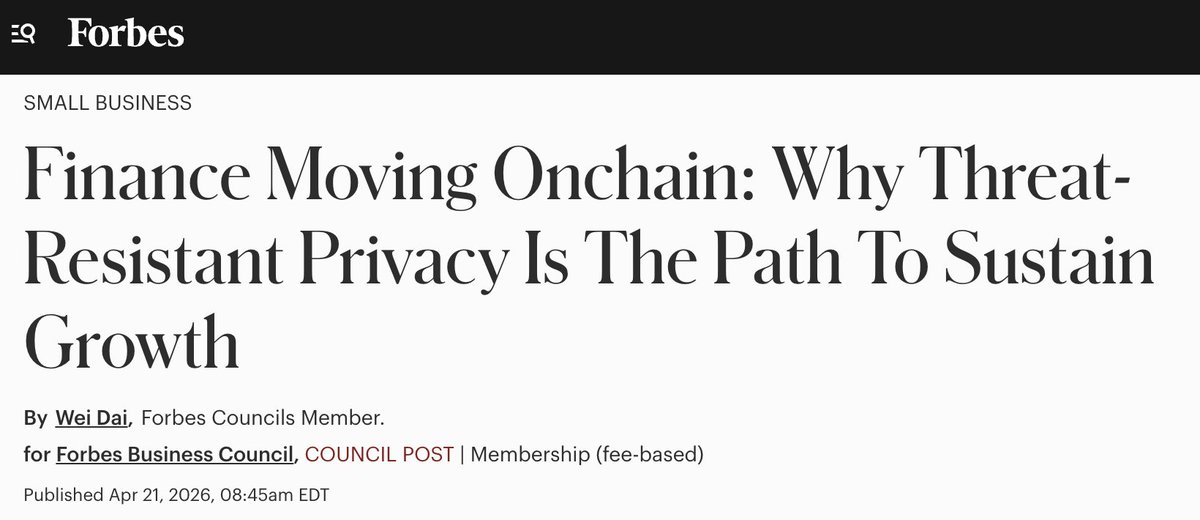
A highlight of @1kxnetwork investments within our thesis on threat-resistant & compliant onchain privacy.
- @0xMiden: chain designed from the ground up for programmable privacy (ZK)
- @zksync: private & customizable prividiums (ZK)
- @inconetwork: user-friendly privacy layer for existing chains (TEEs)
- @SeismicSys: privacy-enabled EVM-based fintech L1 (TEEs)
- @ligero_inc: private account layer for all chains, custom-built for businesses (ZK)
- @0xPredicate: programmable policy infra, for privacy protocols, defi, & beyond
- @fiber_evm: private EVM wallet infra w/ a slick mobile app (ZK)
Here's the exciting bit: (at least) five of the above projects are about to go live this year!
2026 is the year for onchain privacy.
-----
At 1kx, we put our money where our mouth is.
We develop theses and partner with the best founders to realize the shared vision.

Onchain finance needs threat-resistant privacy
→ Real-world & institutional finance cannot move onchain without privacy
→ To prevent misuse (e.g. laundering of hacked funds), the only viable solution is to build threat-resistant privacy
More in my op-ed in Forbes 👇
13
23
131
22,343
Ben Livshits retweeted

The day after the CEO lays off a ton of staff and says:
“Non-technical teams are now pushing code to production with AI”
@coinbase has a major outage on their trading engine, and even their status page doesn’t work.
😂


331
1,578
15,578
986,688
Ben Livshits retweeted

May 5
Some things never change. If you don’t understand this one, you don’t understand what’s happening AI.
Marcus, 1998: neural nets have trouble generalizing far beyond the data.
Marcus, 2001, 2012, 2019, 2022, etc: neural nets have trouble generalizing far beyond the data.
Apple, 2025: neural nets have trouble generalizing far beyond the data.
Meta/Stanford/Harvard, 2026: neural nets have trouble generalizing far beyond the data.

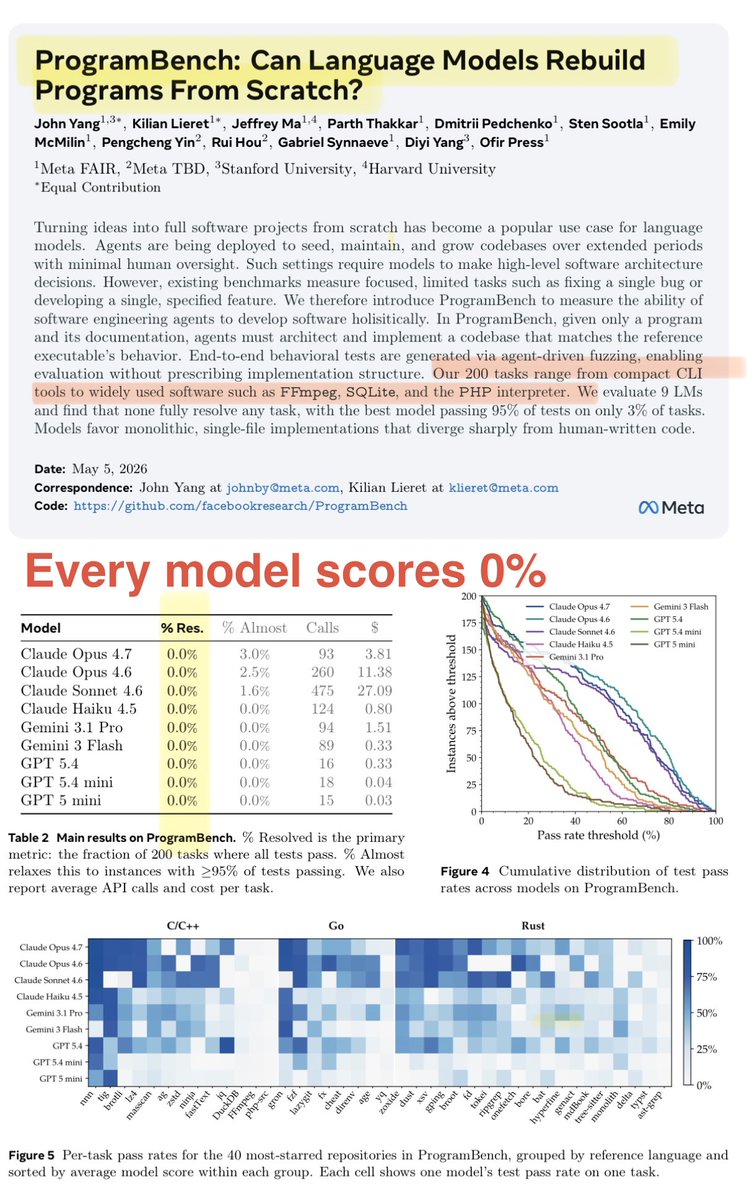
The creators of SWE-Bench just dropped a really simple new benchmark every LLM gets 0% on.
ProgramBench asks: can models recreate real executable programs (ffmpeg, SQLite, ripgrep) from scratch with no internet?
We are far from saturated on model quality.
100
352
2,572
357,989