#Kaspa 🐙 (2024/7〜) │GHOSTDAG Visualizer kaspa-gdpv.net/│Kaspa file storage Arkiv.fyi│Dagknight Visualizer│Trimaran sailing.
Joined September 2011
- Tweets 2,366
- Following 21
- Followers 847
- Likes 7,265
195 Photos and videos
Pinned Tweet

6 Oct 2025
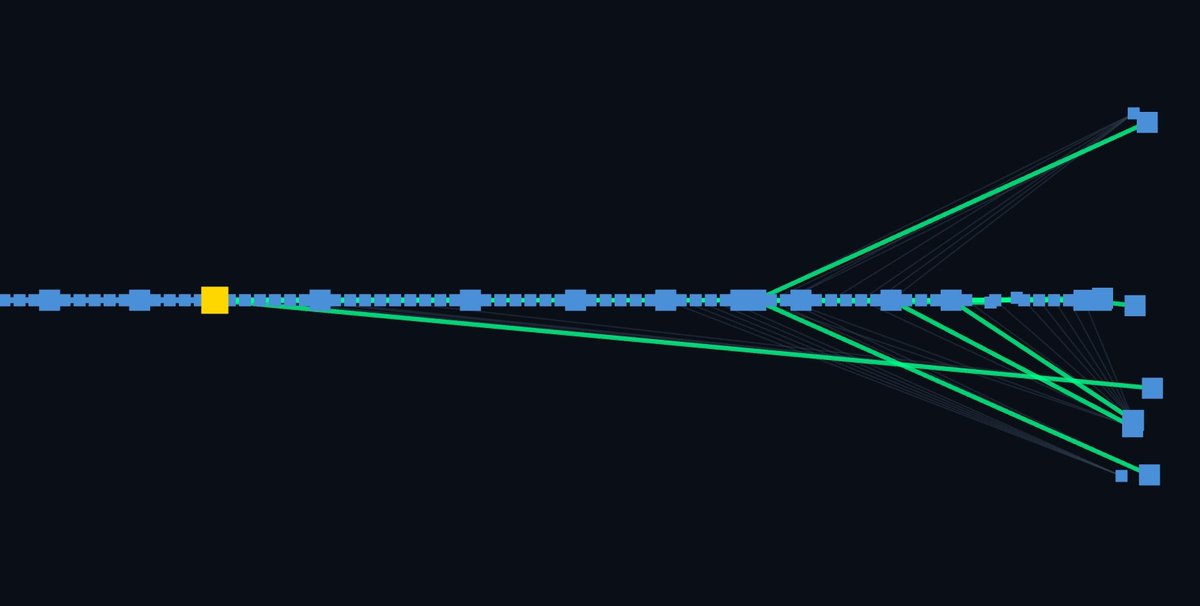
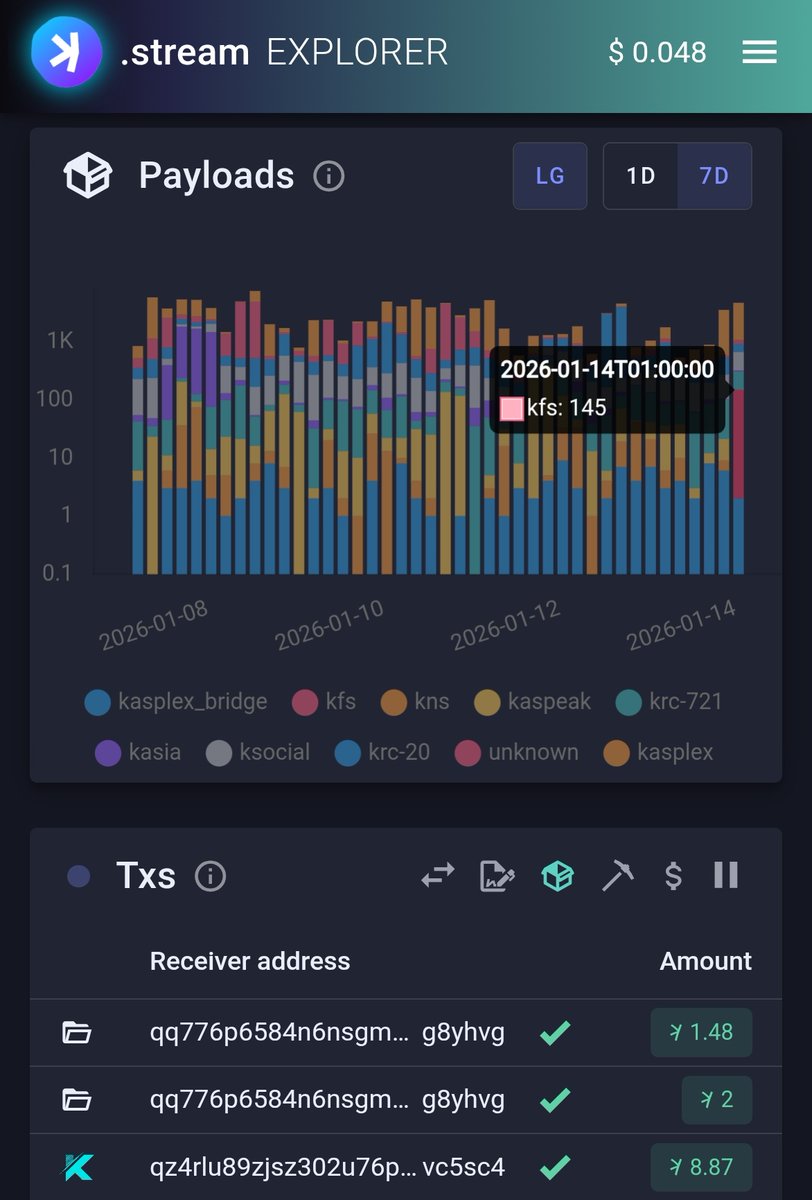
Kaspa file storage Launched! 📂📂
✅️Kaspa L1 service that writes data to the Tx payload.
✅️The upload fee is only the miner's reward. Downloading is free.
✅️Old data can be downloaded from the Archive node, api.kaspa, or kas.fyi.
arkiv.fyi/
46
168
532
122,933
Ross 𐤊 retweeted

Jun 5
$KAS The Toccata Hard Fork is now live! Update your nodes well before June 30th so that you can remain in consensus!
github.com/kaspanet/rusty-ka…
42
306
1,075
36,143
Ross 𐤊 retweeted

May 15
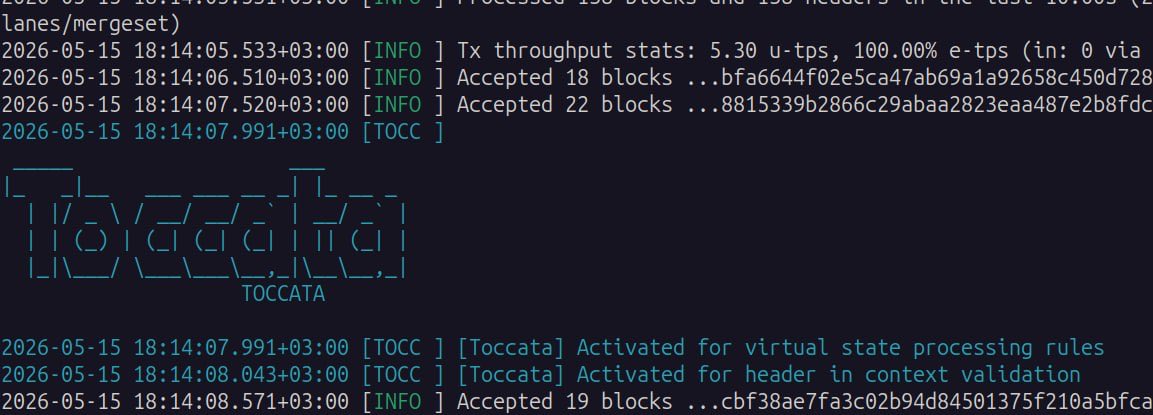
Toccata hardfork activation testing in devnet earlier today showed very promising results with a smooth transition. Truly amazing work guys @michaelsuttonil @OriNewman @Max143672 @IzioDev! TN10 hf very soon
20
158
403
28,820
Ross 𐤊 retweeted

May 8
Yonatan Sompolinsky (@hashdag), Kaspa's founder and primary architect, took part in a Q&A. Part 1 is below 🧵, Part 2 coming soon.
9
91
332
23,116
Ross 𐤊 retweeted

Apr 30
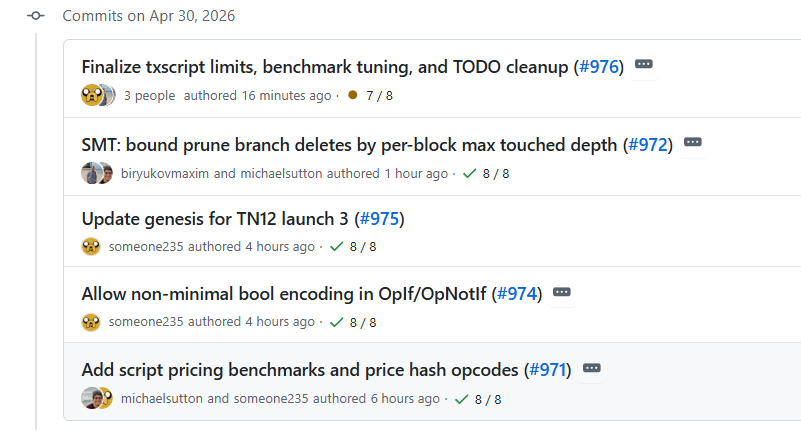
Toccata consensus feature freeze is finally here after a heroic last-mile push by kas core devs.
Aiming to reset TN12 tonight, or tomorrow at the latest.
Genesis update:
0x6b617370612d746573746e6574 // kaspa-testnet
- 12, 2 // TN12, Launch 2
0x544f4343415441 // TOCCATA
12, 3 // TN12, Launch 3
90
393
1,060
91,523

Today Kii have completed our main flagship projects which will all be running directly on the L1. Now just the final security hardening and migration to enterprise servers. June is going to be a blast!
And we have a few surprises in store!
Kaspa is an incredible platform to develop on and is only going to get even better.
#kaspa #thinkKaspa #KaspainEnterprise
62
351
917
47,131
Ross 𐤊 retweeted
Apr 23
I wrote a short gist about this a ~week ago: gist.github.com/michaelsutto…
tl;dr
- STARK proofs require double the byte-size of the current Kaspa block limit (125kb→250kb)
- block elasticity is not easy to implement and needs more focus DK (hence does not belong in Toccata)
- I think doubling the disk requirements (in worst-case usage) requires increasing the min fee ratio 10-100x so that max-throughput usage is organic and economic, and not driven by stretch testing
10
77
285
12,126
Ross 𐤊 retweeted

Apr 13
Okay, for now I chose the name KCC20, where KCC stands for Kaspa Contract Convention.
I also made an md book that goes over the contract and the examples in the code
kaspanet.github.io/silverscr…
Apr 11

I wrote a PoC token contract in Silverscript, currently called DOG20 (better name ideas are welcome).
It supports token ownership by 3 kinds of entities:
1. Public keys — like any regular Kaspa address.
2. P2SH addresses — which means ownership by a stateless contract, e.g. multisig.
3. Covenant IDs — which means ownership by a stateful contract.
The third option is the interesting one, and it's a demonstration of a broader concept (that might be familiar to whoever watched the webinar by @IzioDev and @michaelsuttonil), called inter-covenant-communication (ICC).
In this context, it means you can put arbitrary stateful rules around token control. For example:
- “after the first 10 spends, wait a year before spending again”
- zk-rollups can manage their L1 tokens using a stateful bridge.
DOG20 also supports minters that are allowed to mint indefinitely — but that does not mean the supply must be unbounded.
Let's say you want to publish a token and allow to issue only 100 new tokens each month. DOG20 doesn't support it natively, but you can achieve that by making the only minting entity a covenant. That covenant will store in its state `nextIssuance`, and will allow spends of 100 tokens only if `time > nextIssuance`, and will set `nextIssuance = nextIssuance 30 days` each time it's used.
I hope to explain about it a bit more in the future, but in the meantime, feel free to look at the examples linked in the next comment.
18
69
262
14,547
Apr 13
Hello @hus_qy, quick question - what do you think is the fundamental difference between Kaspa's covenants and covenants in other DAG-based UTXO models?
3
258
Ross 𐤊 retweeted

Apr 13
Thanks for the #Kaspa community to make @hashdag video one of the most viewed on Oxford Youtube channel organically. This is great and gives me confidence to place him on more major (non-crypto) stages to tell the social-economic advocacy which is ground for #Kaspa.
I do think adoption of one technology (over another one) is a value proposition, as necessarily there is a tradeoff (i.e. privacy vs efficiency vs fairness). So again, though every industrial giant @VitalikButerin @cz_binance inevitably will have some touch on philosophical thoughts ("degen communism lol"), I do (in a biased way) think that @hashdag's thought is a bit deeper.
------
Meanwhile, it may be worthwhile to think if #staghunt is exclusively solved by #Kaspa. At this moment, the answer is no, since coordination market may be provided by anyone else as well. It requires us to better understand #RTD and explain how #Kaspa is the only protocol that combines the "PoW hardcore camp" and the "Real-Time" camp and achieves both at the same time.
That will be my topic of speech at @festival_web3 this year.

I just got back from my Easter trip visiting family, and one of the first things I made time for was listening to Yonatan’s Oxford Union speech. I think he absolutely nailed it: youtube.com/watch?v=VIZGKoIa…
If there is one thing we can learn from our progress in AI, it is that intelligent behavior emerges when many components explore degrees of freedom and converge, through distributed constraint resolution, into coherent and stable patterns.
The modern world has connected an enormous number of people and given us unimaginable freedom, but it still lacks a credible way to enforce shared constraints.
The result is a crisis of responsibility at every scale of society: from cyberbullying to former superpowers chasing old glory through war, to leaders blaming the weakest members of society for national decline, or even killing their own citizens to preserve power.
At the same time, our capacity to inflict harm on one another has become increasingly asymmetric. Small actors can now create disproportionately large disruptions, and conflicts no longer remain local. They send shockwaves through the emerging superorganism we call humanity.
The age in which we could dominate one another and still produce a stable world is coming to an end. The only serious path forward is collaboration.
People may feel pessimistic about the future, but I think we are approaching an inflection point. Even the old superpowers are beginning to learn this lesson the hard way.
The American Dream of "I can make it" is gradually giving way to the realization that individual prosperity depends on collective wellbeing, and that we can build far larger and more meaningful things when we share a common dream.
That is why I am excited about DLTs, and Kaspa in particular.
Not because I see them as safe havens for hiding wealth from corrupt governments in some dystopian future, or because I want people to get rich by selling to later participants.
But because I believe DLTs can offer a superior foundation for large-scale human coordination: one that is more neutral and reliable than traditional models based on force and mutual deterrence.
In that world, wealth is not the goal in itself, but a byproduct of coordinating around shared missions, empowering people to contribute, and aligning incentives toward common outcomes.
The future is not about building better products. It is about building better protocols: systems that allow human beings to coordinate meaningfully at larger scales than ever before.
For the first time in human history, we have the tools to build institutions that are not bound to territory, yet can still provide structural coherence without having to fight wars to establish their legitimacy.
What we need now is a group of people bold enough to take that mission seriously.
11
69
286
7,132

Ross 𐤊 retweeted
Apr 11
I wrote a PoC token contract in Silverscript, currently called DOG20 (better name ideas are welcome).
It supports token ownership by 3 kinds of entities:
1. Public keys — like any regular Kaspa address.
2. P2SH addresses — which means ownership by a stateless contract, e.g. multisig.
3. Covenant IDs — which means ownership by a stateful contract.
The third option is the interesting one, and it's a demonstration of a broader concept (that might be familiar to whoever watched the webinar by @IzioDev and @michaelsuttonil), called inter-covenant-communication (ICC).
In this context, it means you can put arbitrary stateful rules around token control. For example:
- “after the first 10 spends, wait a year before spending again”
- zk-rollups can manage their L1 tokens using a stateful bridge.
DOG20 also supports minters that are allowed to mint indefinitely — but that does not mean the supply must be unbounded.
Let's say you want to publish a token and allow to issue only 100 new tokens each month. DOG20 doesn't support it natively, but you can achieve that by making the only minting entity a covenant. That covenant will store in its state `nextIssuance`, and will allow spends of 100 tokens only if `time > nextIssuance`, and will set `nextIssuance = nextIssuance 30 days` each time it's used.
I hope to explain about it a bit more in the future, but in the meantime, feel free to look at the examples linked in the next comment.
21
103
315
29,118
Ross 𐤊 retweeted

Apr 11
The “another executor” will be somebody who will sequence and consume “the order”, that would be L2, likely centralized, vulnerable with MEV and so on. It may be practical, but it is not a DEX on UTXO L1. I used to create such systems in the past a lot.
3
1
3
178
Apr 10
My brain is about to explode from the complexity, but in principle, Kaspa should be the only one capable of building a Pure L1 Covenant Orderbook Fullspec DEX.
Apr 10

i am... atomic.
github.com/RossKU/rusty-kasp…
4
6
39
2,248
Apr 10
We are currently implementing features such as Spot Perpetual Lending Prediction auction insurance. For spot orders, all order types used by TradFi can be replicated with Covenant. The ability to implement Fill and OCO bisection is particularly important.
3
229
Ross 𐤊 retweeted

Apr 6
$KAS : Review 📜
What if you could take Bitcoin's security model, make it 600x faster, and then add ZK-powered smart contracts without sacrificing a single atom of decentralization?
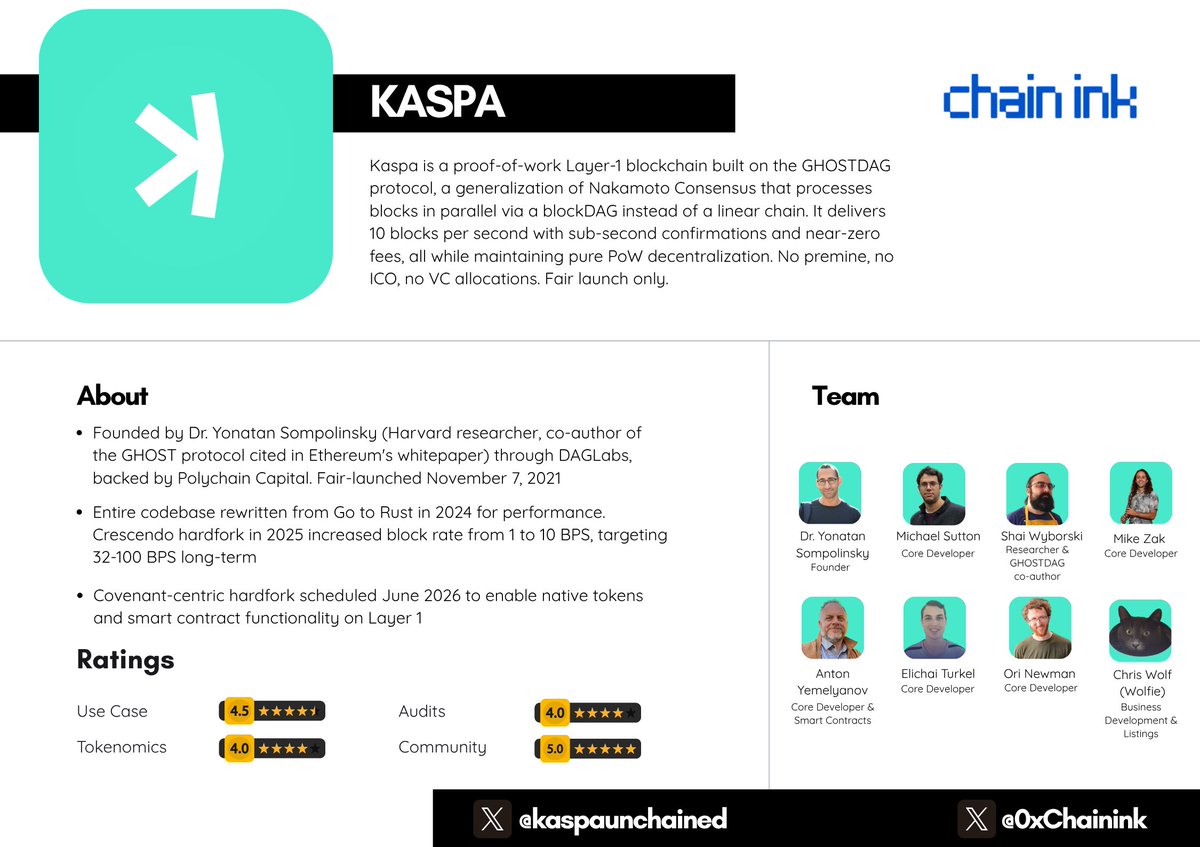
Meet Kaspa - a fair-launched, proof-of-work Layer-1 blockchain that replaces the traditional single-chain structure with a blockDAG, processing 10 blocks per second with sub-second confirmations, designed by the Harvard researcher whose GHOST protocol is cited in Ethereum's whitepaper. And with the Toccata hard fork weeks away, it's about to become programmable.
Let's explore how Kaspa is rewriting the rules of proof-of-work. 👇
⚪ Kaspa at a Glance
Kaspa is a decentralized, scalable Layer-1 cryptocurrency built on proof-of-work and powered by the GHOSTDAG protocol, a novel consensus mechanism that extends Nakamoto's original design.
Unlike traditional blockchains that discard competing blocks, GHOSTDAG allows parallel blocks to coexist and orders them within a Directed Acyclic Graph (blockDAG).
The $KAS token is the native currency, distributed entirely through mining with no premine, presale, or founder allocations. The name "Kaspa" means "silver" or "money" in Aramaic.
As of April 2026, $KAS trades around $0.03 with a market cap of approximately $800M. The max supply is ~28.7 billion KAS, with over 95% already emitted through mining. The network currently processes 10 blocks per second following the Crescendo upgrade.
Marketplace Insight: The Toccata hard fork (June 5-20, 2026) is about to transform Kaspa from the fastest PoW payment network into a fully programmable platform with native tokens, covenants, ZK verification, and based ZK apps. Proving costs scale with app activity rather than the entire network, unlocking canonical bridging, stateful multi-contract flows, and DeFi on pure proof-of-work.
⚪ Mission
Kaspa's mission is to create a PoW that operates with internet speed, combining the reliability of proof-of-work with the responsiveness demanded by modern applications.
The project aims to realize Satoshi Nakamoto's original peer-to-peer electronic cash vision but with the throughput, speed, and now programmability that Bitcoin's single-chain design structurally cannot achieve.
🟢 A Brief History
DAGLabs was founded by Dr. Yonatan Sompolinsky with the purpose of implementing the GHOSTDAG protocol, invented by Yonatan with his then PhD advisor Professor Aviv Zohar.
Sompolinsky gained recognition in the blockchain academic world in 2013 when he and Zohar conceived the GHOST protocol, famously cited in Ethereum's whitepaper as a design goal.
Together with a small team including Michael Sutton, Shai Wyborski, and others, Sompolinsky founded Kaspa under DAGLabs, with backing from Polychain Capital. Kaspa's November 7, 2021 launch had no premine, no ICO, and no early allocations. Anyone could start mining from day one.
DAGLabs was dissolved around the time of Kaspa's fair launch, transitioning the project to a decentralized, community-led model. Since then, Kaspa has been developed by a global group of open-source contributors with no central governance or business model.
In 2024, the team completed a full rewrite of the codebase from Go to Rust, dramatically improving performance. The Crescendo hardfork in 2025 increased the block rate to 10 BPS while maintaining network stability.
Now, the Toccata hard fork (originally scheduled May 5, moved to June 5-20, 2026 to finalize the sequencing architecture) is set to introduce extended covenant opcodes, ZK proof verification via Groth16 and RISC Zero, native token issuance, SilverScript programming language, and the Computational DAG (CDAG) for resource management. Feature freeze hit April 15, followed by testnet validation and mainnet node upgrades.
Yonatan currently holds a post-doctoral position at Harvard researching transaction ordering protocols and MEV, while continuing to lead Kaspa's research direction.
🟢 Ecosystem Narrative
Kaspa's ecosystem is built on a simple but powerful premise: you can have proof-of-work security at proof-of-stake speeds if you change the underlying data structure from a chain to a DAG. With Toccata, you can now add programmability without compromising any of it.
Key dynamics include:
➛ BlockDAG architecture allows multiple blocks to be created and confirmed in parallel, eliminating the bottleneck that forces traditional blockchains to be slow. Blocks reference multiple predecessors, forming a graph instead of a single linked list.
➛ GHOSTDAG consensus orders parallel blocks using a greedy algorithm that favors well-connected, honest blocks. The upcoming DAGKnight protocol will further improve ordering with adaptive, parameterless consensus.
➛ Toccata hard fork (June 2026) adds powerful covenants via extended opcodes, enabling native L1 programmability. Introduces a Computational DAG (CDAG) to manage resource usage and sets the stage for sovereign programs (vProgs).
➛ ZK verification at Layer 1 with support for Groth16 and RISC Zero verifiers, enabling based ZK apps where proving costs scale directly with app activity instead of the entire network. This unlocks canonical bridging, stateful multi-contract flows, and privacy-preserving applications.
➛ Partitioned sequencing allows L1 to serve all three roles for based ZK rollups: sequencing, data availability, and settlement. No external dependencies.
➛ SilverScript is a new high-level programming language built specifically for Kaspa covenants, lowering the barrier for developers to build programmable transaction logic, smart wallets, vaults, and DeFi applications.
➛ Native token issuance (KRC-20) directly on Layer 1, with atomic transfers built into the Kaspa transaction model. No external smart contract systems needed.
➛ Kaspa Industrial Initiative (KII) is testing the network in enterprise environments including supply chain tracking, industrial automation, smart grid coordination, and settlement infrastructure.
⚪ Token Utilities
$KAS is a pure proof-of-work currency evolving into a programmable asset:
➛ Peer-to-Peer Payments - Fast, feeless transactions with sub-second first confirmations and ~10 second probabilistic finality. Designed for everyday digital cash use.
➛ Mining Rewards - All KAS enters circulation through PoW mining using the kHeavyHash algorithm. No premine, no allocations, no insider supply.
➛ Transaction Fees - Minimal fees for on-chain transactions, designed to remain low even at high throughput levels.
➛ Smart Contract Fuel (Post-Toccata) - $KAS will power covenant execution, native token operations, ZK verification, and vProg settlement on Layer 1.
➛ Governance via KIPs - Kaspa Improvement Proposals allow the community to propose and adopt protocol changes based on technical merit and consensus.
⚪ Key Features
➛ BlockDAG GHOSTDAG - Processes blocks in parallel via a Directed Acyclic Graph, ordering them through a greedy consensus algorithm. The core innovation that makes high-speed PoW possible.
➛ 10 BPS (Targeting 100) - Currently processes 10 blocks per second following the Crescendo hardfork, with a roadmap to 32, then 100 blocks per second. Sub-second first confirmations.
➛ Toccata Hard Fork (June 2026) - Adds extended covenant opcodes, ZK proof verification (Groth16, RISC Zero), native tokens (KRC-20), CDAG for resource management, partitioned sequencing for based ZK apps, and SilverScript programming language. The single biggest upgrade in Kaspa's history.
➛ Fair Launch - No premine, no ICO, no presale, no VC allocations, no founder tokens. 100% of supply distributed through open mining since day one.
➛ Rust Rewrite - Entire codebase migrated from Go to Rust in 2024, achieving significant performance improvements and enabling the 10x block rate increase.
➛ DAGKnight (Upcoming) - Adaptive, parameterless consensus protocol that will replace GHOSTDAG, providing optimal confirmation times without manual parameter tuning.
➛ Full Node on Standard PC - Efficient pruning and multithreaded CPU use mean anyone can run a full node on modest hardware, preserving true decentralization.
🟢 Meet the Kaspa Team
Kaspa is built by academic researchers, applied cryptographers, and open-source contributors with no corporate structure, no central entity, and no executive hierarchy. Development is funded entirely by voluntary community donations via a multi-sig wallet.
▶️ Core Members:
➛ Dr. Yonatan Sompolinsky - Founder & Lead Researcher | Co-inventor of the GHOST and GHOSTDAG protocols. PhD under Professor Aviv Zohar at Hebrew University. Currently holds a post-doctoral position at Harvard researching transaction ordering and MEV. His GHOST protocol is cited in Ethereum's whitepaper.
➛ Michael Sutton (msutton) - Core Developer | Distributed Systems Researcher with an M.Sc from Hebrew University, where he researched parallel algorithms. Led the Rust rewrite and Crescendo implementation. Serves as one of four community-elected treasurers managing the dev fund.
➛ Shai Wyborski (deshe) - Researcher | Co-author of the GHOSTDAG paper. PhD candidate at Hebrew University and Ben-Gurion University researching classical and quantum cryptography.
➛ Mike Zak (svarog) - Core Developer | Cryptocurrency and Distributed Systems Developer contributing to core protocol implementation and network stability.
➛ Elichai Turkel (elichai2) - Core Developer | Applied Cryptographer and High-Performance Developer. Bitcoin Core contributor bringing deep cryptographic expertise to Kaspa's architecture.
➛ Ori Newman (someone235) - Core Developer | Cryptocurrency and Distributed Systems Developer. Key contributor to SilverScript development.
➛ Anton Yemelyanov (aspect76) - Core Developer, Advisor & Smart Contracts | 30 years systems engineering, 12 years in cryptocurrency. Co-founder of the Scaling Bitcoin academic conference. Leading smart contract development efforts.
➛ Chris Wolf (Wolfie) - Business Development & Listings | Driving exchange listings, partnerships, and ecosystem business development.
➛ Chad Ballantyne (Rhubarbarian) - Marketing, Branding, PR, Web Development & Creative Content.
➛ Community-Governed - No CEO, no board, no foundation with allocated tokens. Dev fund is a multi-sig wallet managed by 4 community-elected treasurers requiring 2/4 signatures. All spending is publicly documented.
🟢 Ratings
➛ Use Case: ★★★★✦ (4.5/5) - Kaspa solves a problem that every other PoW chain has accepted as unsolvable: high throughput without centralization. The blockDAG architecture is a structural rethinking of how proof-of-work operates. 10 BPS with sub-second confirmations is already remarkable; 100 BPS would be historic.
The Toccata hard fork transforms the equation entirely: covenants, native tokens, ZK verification with Groth16 and RISC Zero, SilverScript, and based ZK apps with partitioned sequencing. This isn't an incremental update, it's Kaspa evolving from digital cash into a programmable settlement platform while keeping PoW security.
The 0.5 deduction is because Toccata hasn't shipped yet and the developer ecosystem around smart contracts is still pre-launch.
➛ Tokenomics: ★★★★ (4/5) - This is what fair-launch tokenomics should look like. Zero premine, zero VC allocation, zero founder tokens. Every single KAS in existence was mined.
The max supply of ~28.7 billion is fixed and predictable. By design, ~87% of the supply was mined in the first 3.5 years, meaning inflation is now rapidly declining toward Bitcoin-like low levels. By July 2026, over 95% will be emitted.
The emission follows a smooth chromatic curve (not halving steps), creating predictable monetary policy. Post-Toccata, smart contract execution will introduce burn mechanics through covenant commissions, adding deflationary pressure.
➛ Audits: ★★★★ (4/5) - Kaspa holds a 4.2 star rating on CertiK via CoinMarketCap, validating the project's security posture. The GHOSTDAG protocol has been peer-reviewed and published in academic literature. The codebase is fully open-source with 188 commits in the trailing 12 months versus an industry average of ~65, nearly 3x the activity.
The network has never been exploited or suffered a consensus failure. The pure PoW model and academic foundations provide inherent security strength. The 1-point deduction is because smart contracts aren't live yet, and as Toccata ships and programmability launches, deeper protocol-level auditing will become increasingly critical.
➛ Community: ★★★★★ (5/5) - Kaspa has one of the most genuine, grassroots communities in all of crypto. Built entirely through mining and organic discovery, with no airdrop, no marketing budget, and no influencer campaigns. The fair launch created a community of true believers who chose to mine and hold from day one. Developer activity is nearly 3x the industry average with dozens of independent contributors.
The KEF (Kaspa Ecosystem Fund) is funded entirely by voluntary community mining donations, not corporate treasury. Kaspa ambassadors are active globally, from Dubai energy summits to Oxford Union speaking events. The dev fund is a multi-sig wallet managed by 4 community-elected treasurers with all spending publicly documented. This is Bitcoin-era community energy applied to next-gen technology.
🟢 Conclusion
Kaspa is what happens when a world-class academic researcher takes the best parts of Bitcoin's philosophy and asks "what if we made this actually fast, and then actually programmable?" The blockDAG architecture isn't a marketing gimmick.
It's a peer-reviewed, mathematically rigorous generalization of Nakamoto Consensus that allows proof-of-work to operate at speeds previously reserved for proof-of-stake chains.
The Toccata hard fork changes everything about Kaspa's positioning. Covenants, native tokens, ZK verification with Groth16 and RISC Zero, SilverScript, partitioned sequencing for based ZK apps, proving costs that scale with app activity instead of the entire network.
This is Kaspa's Ethereum-moment: the transition from "fast digital cash" to "programmable settlement layer." And it's doing it without touching the PoW security model.
The fair launch ethos remains unmatched. No premine, no VC, no founder allocations, no corporate entity. Just open-source code, academic rigor, and a community that funds development through voluntary mining donations.
The risks are clear: Toccata hasn't shipped yet (moved to June 5-20 from the original May 5 date), the developer ecosystem around smart contracts is pre-launch, and the price sits well below previous highs. But the trajectory speaks for itself.
A full Rust rewrite, a successful 10x block rate increase, ZK verification coming to Layer 1, and a community that builds in the open with zero corporate backing. If Toccata delivers, Kaspa won't just be the fastest proof-of-work chain. It'll be one of the most important L1s in crypto, period.
34
229
693
28,447
Ross 𐤊 retweeted

Apr 6
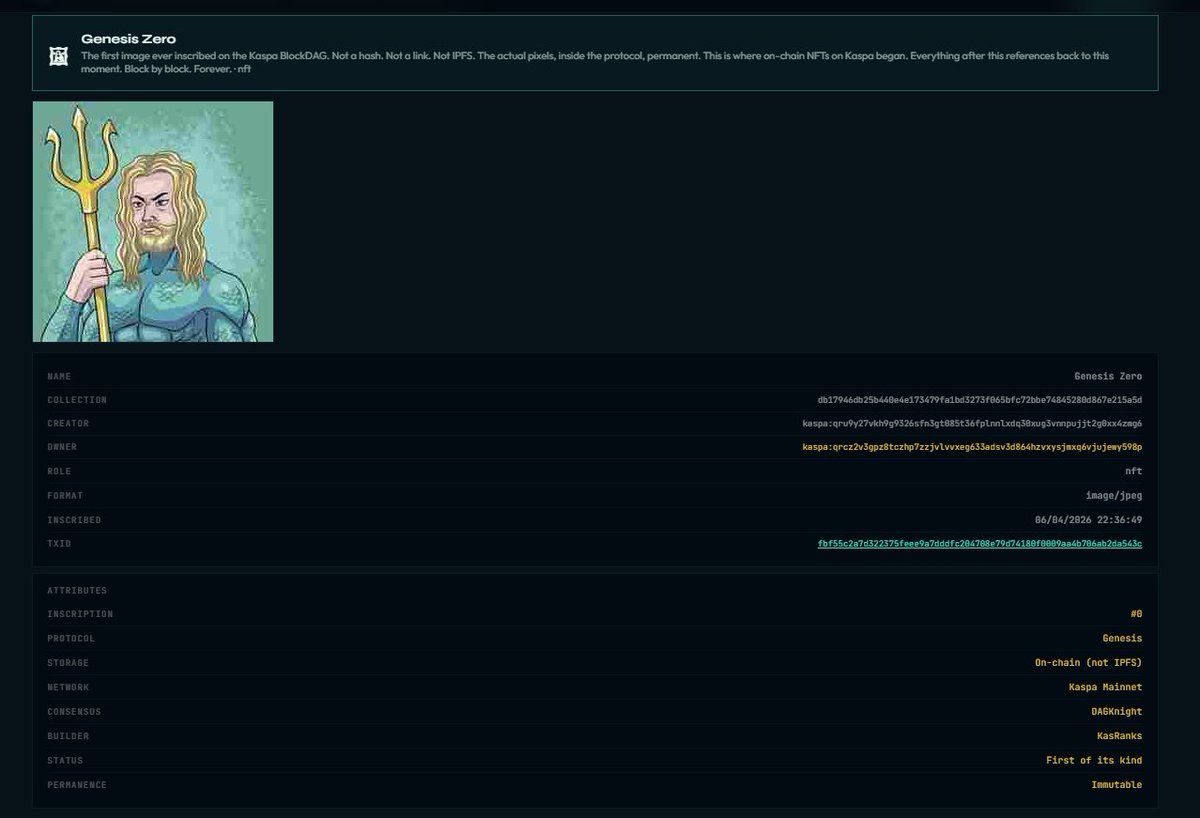
Every NFT you own is a link to a server someone else controls.
If the server dies your NFT is a receipt for nothing.
Genesis Zero changes that.
First image inscribed directly into the Kaspa BlockDAG.
The actual pixels. In the transaction. Permanent.
No IPFS. No server. No trust. Just the DAG.
Step three is loading.
kaspa.stream/transactions/fb…
#Kaspa $KAS #PoW #Stateless
8
10
44
2,766
Apr 6
My focus is on Covenant, and when combined with DAG's MEV resistance, it allows TradFi products to function almost perfectly with only full nodes and miners. This means highly sophisticated order and product integration is possible, completely eliminating the need for AMM.

wrote an outlook for the upcoming “Toccata” hard fork -- native L1 covenants, based zk apps, why the activation window moved, and what the road from feature freeze to mainnet looks like:
medium.com/@michaelsuttonil/…
2
3
20
1,089
Ross 𐤊 retweeted
I’ll take the liberty of answering, but of course I’d love to hear @hus_qy’s perspective as well.
In short, no. It will not be a vprog in the sense defined by the vprogs yellow paper. And that’s because it will not allow synchronous composability (aka syncompo) with other zk apps.
The vprogs design aims to solve a tension that is inherently hard to solve:
- giving each app sovereignty, including proof-liveness sovereignty, which means it has a dedicated covenant on L1
- enabling synchronous composability with other progs that do not necessarily share the same L1 covenant, and can even belong to a different vm with a different zk proof system
The reth L2 you are describing is like a standalone mega-app. I call it mega because it allows its users to submit custom smart contracts into it. It indeed supports syncompo between inner contracts, but that comes at the cost of sovereignty: these contracts are not standalone units, but rather parts of the same monolithic mega-app.
In contrast to its inner syncompo, it does not support syncompo with external applications or with other external mega-apps
5
33
174
4,445