
Joined April 2010
- Tweets 2,907
- Following 6,220
- Followers 312
- Likes 545
7 Photos and videos
Cryptalist retweeted

B1 Bomber over #ufcfreedom250

The B-1 Lancer wasn’t loud. It was physical.
You could feel it hit your chest before your ears even caught up.
This is America.
This is UFC Freedom 250.
2
3
36
6,106
Cryptalist retweeted

⚡️Higher ed is entering its margin call.
The deeper truth is that the university system built a cost structure around a belief regime that is breaking.
For decades, the degree was sold as a conversion machine: tuition in, professional security out.
Families tolerated insane prices because the credential still looked like the bridge to the white-collar middle class.
That bridge is weakening.
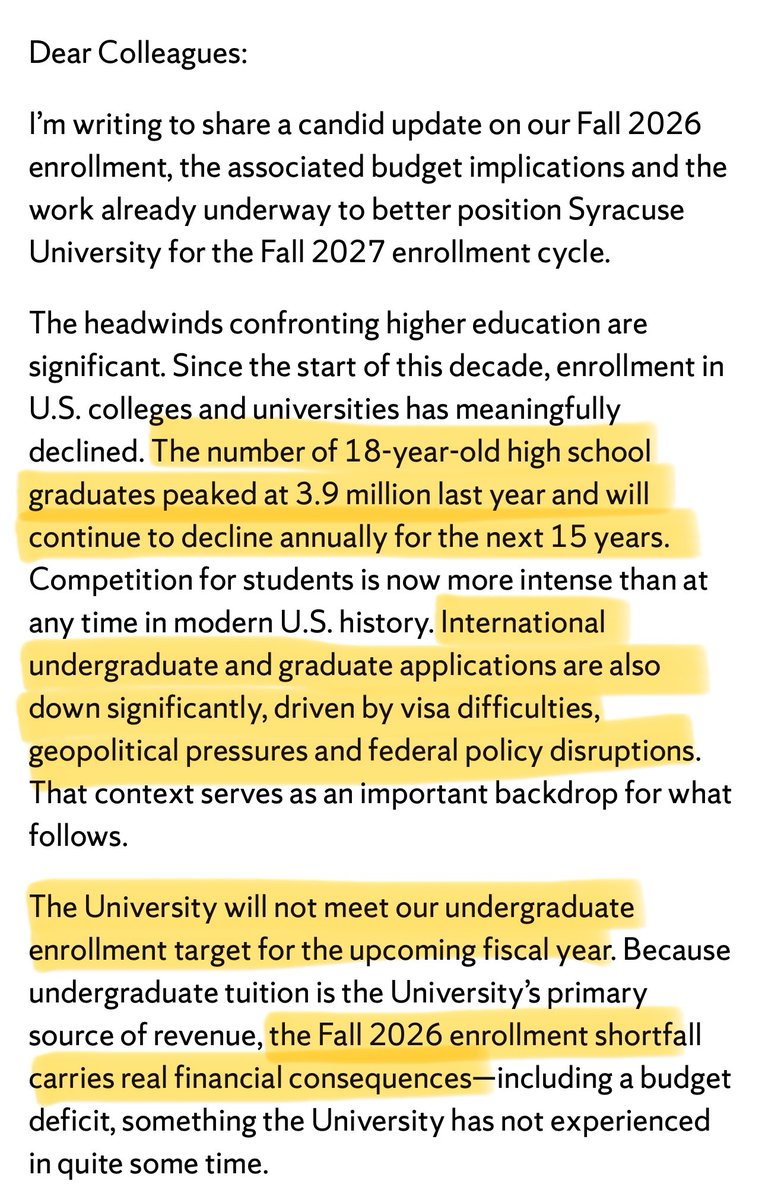
Syracuse matters because it is not some tiny failing college nobody has heard of. It has brand, athletics, alumni, history, and real institutional weight. If a school like that is openly talking about enrollment shortfall and budget deficit, the weaker layer underneath is already in worse condition.
The demographic cliff is the mechanical trigger. Fewer 18-year-olds means less demand. International weakness removes a high-margin release valve. But the deeper problem is that the product is losing pricing power at the exact moment the operating model needs pricing power most.
Universities have fixed costs everywhere: faculty, buildings, debt service, administration, compliance, athletics, housing, financial aid, student services, maintenance. When enrollment misses, revenue drops faster than expenses can adjust. Each missing student is not just a missing body. It is lost high-margin tuition against a cost base that cannot shrink smoothly.
That creates a nasty loop.
Enrollment misses. Discounts rise. Margins compress. Programs get cut. Quality perception weakens. Brand softness increases. More discounting is needed. The institution starts managing decline while still pretending it is managing growth.
AI makes this much more dangerous.
College was monetizing access to the professional ladder. AI is now attacking the bottom rungs of that ladder: junior analysts, first-year lawyers, recruiters, entry-level consultants, support engineers, junior marketers, basic white-collar process work. If those jobs become harder to get, slower to reach, or less secure, the expected return on the degree compresses.
That hits demand before the academy is psychologically prepared to admit the model changed.
The future splits hard.
Elite schools become luxury-network assets.
Low-cost public options gain relative strength.
Healthcare, engineering, accounting, skilled technical paths, and credential-mandated fields hold up better.
Expensive mid-tier private universities with broad general degrees get squeezed.
Small private colleges and tuition-dependent regional schools face mergers, cuts, closures, debt restructuring, or permanent discounting.
Higher ed is downstream of white-collar repricing.
When professional security gets repriced, the institutions that sold access to professional security get repriced next.
The degree market is becoming a confidence market.
And confidence is bleeding.

Syracuse announced a financial deficit this week after missing their enrollment target. They cite demographics geopolitics, but the answer is much simpler:
There are 5.7k higher ed institutions in the US, charging way too much for something that is worth less than ever
16
36
193
33,725
Cryptalist retweeted

In the last two #Bitcoin cycles people told me how dumb I was to buy in at $3,000 because it was still going to drop by 50%. Then in 2021 to 2022 they told me that $15,000 was nowhere near the bottom. "@saylor has to get liquidated first" and that we were still going to drop by 50 %.
Now people are saying that we're going to drop at least until the $40,000 or $20,000 range. Some things never change.
If you want a really win, just buy Bitcoin all the time and hodl.

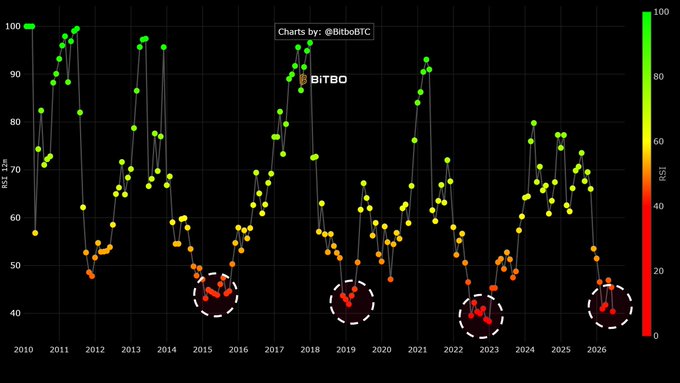
THE BITCOIN 12 MONTH RSI HAS ONLY PRINTED 4 MAJOR RED CLUSTERS SINCE 2010.
Just 4 times in 16 years.
Each one a generational buying opportunity.
Every single time this signal appeared...
What followed redefined what people thought was possible with money.
And right now in 2026 the 5th cluster is forming.
The chart doesn't lie.
It has only spoken 4 times in over a decade.
And every time it spoke it was right.
The 5th time is happening right now.
Most people are too scared to listen.
The ones who listened the first 4 times.
Never had to worry about money again.
11
33
335
27,328

Interesting

3,353
4,662
39,390
22,076,267
Cryptalist retweeted

Jun 14
Mike Brown's journey:
*Fired from Cleveland on May 24, 2010
*Fired from LA (Lakers) on November 9, 2012
*Fired from Sacramento on December 27, 2024
*Wins an NBA Championship in his inaugural year as head coach with the NY Knicks
Moral of the story: Your failures don't define. How you respond to them does.

60
797
4,074
91,760



Jun 14
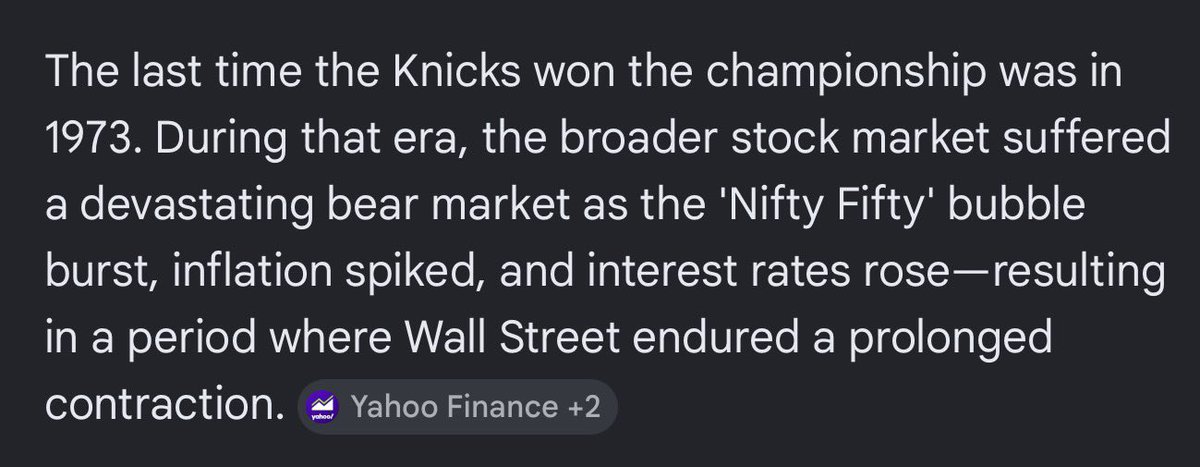
RT @NBA: AFTER 53 YEARS, THE KNICKS ARE FINALLY NBA CHAMPIONS ONCE AGAIN!"
THE NEW YORK KNICKS WIN THEIR FIRST CHAMPIONSHIP SINCE 1973 🏆 h…
4,326
Cryptalist retweeted

Jun 13
In America, a warehouse store. A fully roasted chicken costs five dollars, the raw chicken beside it costs seven, and I stood between them like a man between two truths.
Golden. Hot. Seasoned. Spinning in glory under the lights, in a line of its brothers. Four dollars and ninety-nine cents.
I checked the raw birds. Seven dollars. Pale. Cold. You must do everything yourself.
This is not commerce. Commerce does not move backward. Somewhere in this building, mathematics lies defeated.
I asked the man at the counter. "How is the cooked bird cheaper than the raw bird?"
"Been five bucks forever. They keep it that way."
"But the store loses."
"Yep. On purpose."
On purpose. I held my receipt with both hands.
In my land, a lord who lowered the price of rice in a hard winter was remembered for generations. They built him a small shrine. This store does it every day, with chicken, and tells no one.
A woman behind me grew tired of my reverence. "It's just a chicken, sir."
It is not just a chicken. It is a wound the merchant takes on purpose, so that anyone, on any day, with five dollars, eats like a lord. The bird is the message. The price is the vow.
I will confess: I bought two. I did not need two. The second was not hunger. It was gratitude, and it was delicious.
Some prices are not prices. They are promises.
I return every week now. I take one bird. I bow toward the deli, briefly, so as not to alarm the staff. They have begun nodding back.
The vow holds. The bird turns. Five dollars.
Long may it spin.

571
2,834
31,097
2,562,256
Cryptalist retweeted

SHOULD A.I. PAY TAXES?
@AndrewYang says YES. Here's why⬇️ @KayleighMcEnany
22
24
103
42,893
Cryptalist retweeted

Jun 13
I’ve had a number of conversations with folks inside and outside government about the current situation with Anthropic, and here is what I believe to be true:
— As we know, Anthropic publicly released its Mythos class models earlier this week under the commercial name Fable.
— Fable is Mythos with guardrails. But if those guardrails fail, then you’ve exposed Mythos and its advanced cyber capabilities to people who shouldn’t have them. (Keep in mind that Anthropic itself widely promoted the idea that Mythos was a cyberweapon and needed to be regulated as such. They asked for government regulation of Mythos and championed the guardrails on Fable. If there is a vulnerability — big or small — it is Anthropic’s responsibility to patch.)
— A highly credible trusted partner of both Anthropic and the USG who was testing Fable came forward with a jailbreak of those guardrails. The Admin asked Dario to fix the jailbreak or de-deploy the model. Dario refused.
— In their blog post, Anthropic defended its decision by saying the jailbreak isn’t serious. That is not what the trusted partner and the USG believe; nor is that kind of minimizing language consistent with Anthropic’s brand as the AI safety company. It’s difficult to fathom how they could claim a jailbreak allowing operability of a cyber weapon could be defined as not “serious.”
— In the past, Anthropic has always said that safety must be top priority and taken super seriously. In this case, Anthropic prioritized the continued offering of the consumer model over safety.
— In reaction, the Admin issued the export control. The Admin did this reluctantly. It’s been very surprised that Anthropic hasn’t wanted to cooperate with a reasonable safety request (ie fixing the jailbreak issue). Anthropic’s reaction is very much at odds with their branding and ethos as a safe AI research community.
— The Admin’s hope now is that Anthropic remediates the safety issue, the export control is lifted, and Fable goes back into general release. The Admin wants all of this to happen as soon as possible. It is frankly bewildered that Anthropic hasn’t wanted to comply with safety requests that it previously said were its highest priority.
— Those trying to misdirect and tie this action to the prior DoW/Anthropic issues are wrong. The Admin values Anthropic’s technical capabilities and feels that this issue, while serious, should be easily resolved. The ball is in Anthropic’s court.
2,155
3,178
24,900
7,414,919
Cryptalist retweeted

Jun 12
Raoul Pal and Jordi Visser see the same future forming:
The economy just shifted from "labor vs capital" to "compute vs energy"
"The AI cycle is no longer about capital verse labor" and the new bottlenecks are chips and power.
Shortages slow earnings "not because the demand is not there, because the demand is too big."
That's sort of bananas. But that's where we are.
FT @RaoulGMI @jvisserlabs @RealVision.
May 16

Raoul Pal: "By 2030, the entire economic system has changed."
AI will rewrite the GDP formula...
The old formula:
GDP = population growth (humans) productivity growth (human output) debt growth
The new formula:
GDP = population growth (humans robots agents) productivity growth (energy density compute efficiency) debt growth.
FT @RaoulGMI @RealVision
4
8
34
8,542


Former SpaceX welder expected to become a millionaire after historic IPO. cbsn.ws/4uDHiQ5
118
315
2,391
241,410
Cryptalist retweeted

Jun 12
Saving LA - Phase III
11,266
29,627
164,651
9,620,984
Cryptalist retweeted

Jun 12
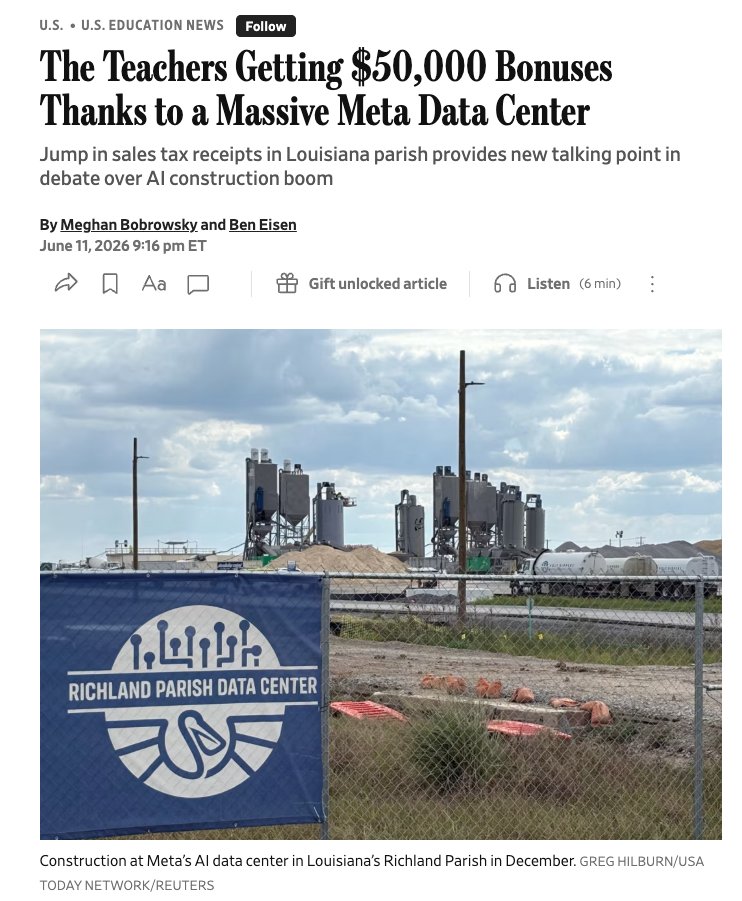
New from me: A look at Richland Parish's finances, where teachers are getting $50,000 bonus checks and the parish just got a $22.4 million tax payment from Meta
The company is building its massive data center nearby and the local economy is getting a windfall. But will it last?
3
10
44
80,647
Cryptalist retweeted

Jun 11
SB 79 takes effect July 1, legalizing 6-9 story housing near transit statewide.
A major CA developer: 'A lot of that is gonna unfortunately skip Los Angeles because of Measure ULA.'
Cities like Glendale, Santa Monica, and Pasadena may see the first wave.

13
36
379
66,075
Cryptalist retweeted

Jun 10
"Tiny homes" continue to grow in popularity.
These are selling for around $140,000 for just over 600 square feet in Texas.
1,666
592
4,619
1,916,932