
Joined January 2022
- Tweets 2,039
- Following 1,885
- Followers 1,132
- Likes 533
192 Photos and videos










Apr 8
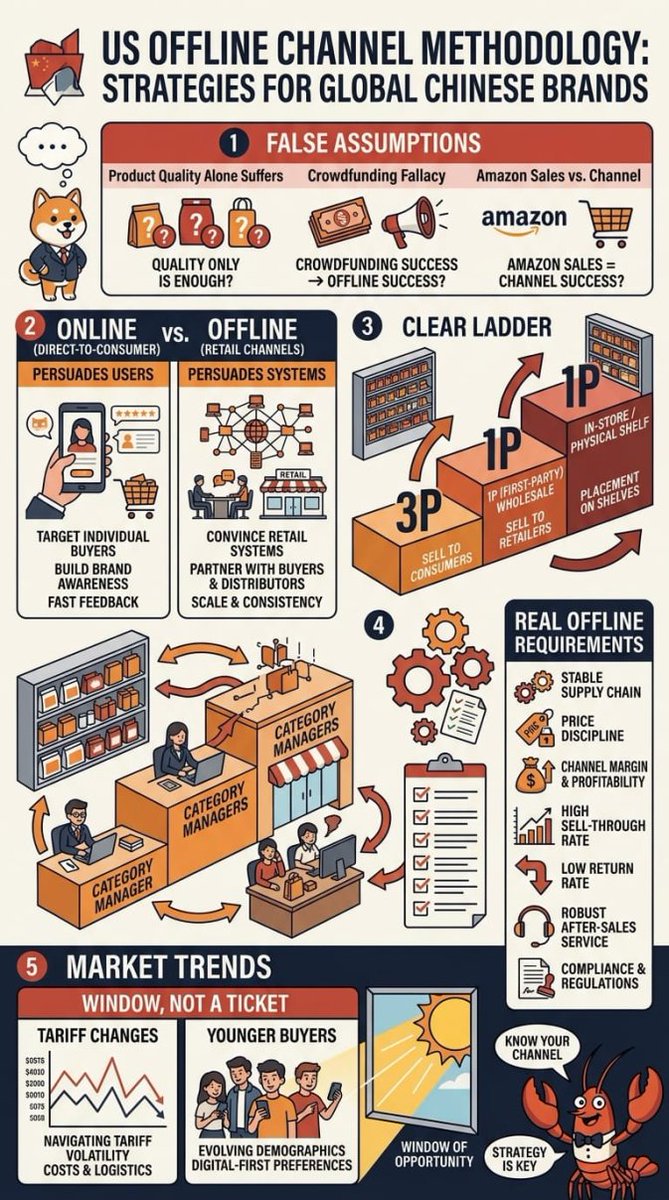
One of the most common mistakes I see in consumer and hardware investing: founders confuse online traction with offline readiness. #ConsumerInvesting #Retail #BrandStrategy #Amazon #DTC #Crowdfunding #GlobalExpansion #HardwareStartups #RetailStrategy #VentureCapital
2
27
Apr 7
I made an iPod in 2026 — except it’s actually my Apple Watch in a RePod shell.
It lands immediately as a conversation-starting object. The visual surprise is strong enough to earn saves and shares.
#AppleWatch #TechGadgets #RetroTech #RePod #techpod #wwdc2026
1
55
Mar 10
Oura gives you scores. The future is wearables that let you run experiments on your own body. Open signals, open protocols, bespoke software. I might build an "OpenRing" to start.
Mar 10

This is such a compelling example of what bespoke software could become. Wearables should evolve in this direction too — less black-box scoring, more tools for running real N=1 experiments.
1
31
Kore retweeted

Feb 19
Very interested in what the coming era of highly bespoke software might look like.
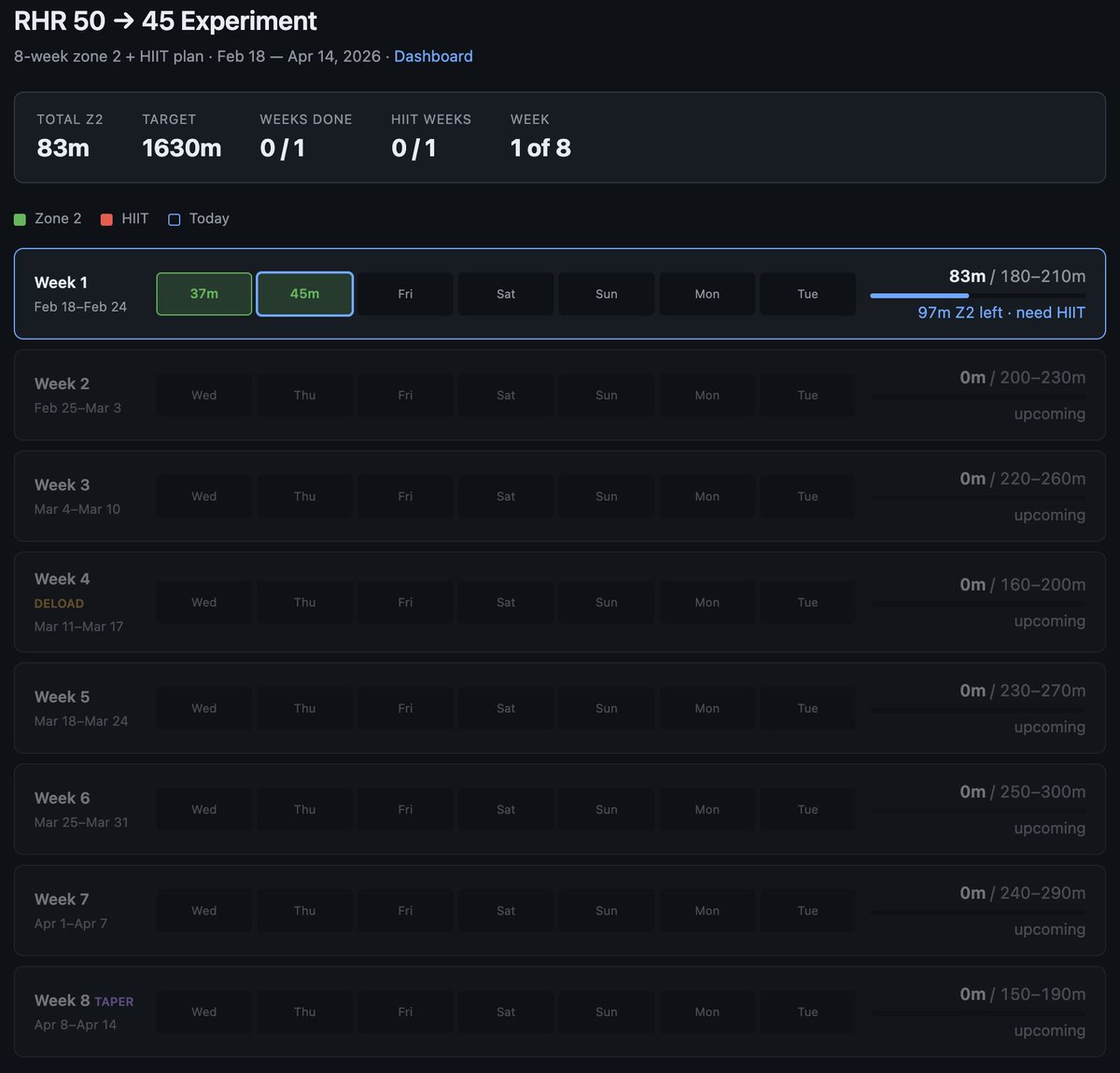
Example from this morning - I've become a bit loosy goosy with my cardio recently so I decided to do a more srs, regimented experiment to try to lower my Resting Heart Rate from 50 -> 45, over experiment duration of 8 weeks. The primary way to do this is to aspire to a certain sum total minute goals in Zone 2 cardio and 1 HIIT/week.
1 hour later I vibe coded this super custom dashboard for this very specific experiment that shows me how I'm tracking. Claude had to reverse engineer the Woodway treadmill cloud API to pull raw data, process, filter, debug it and create a web UI frontend to track the experiment. It wasn't a fully smooth experience and I had to notice and ask to fix bugs e.g. it screwed up metric vs. imperial system units and it screwed up on the calendar matching up days to dates etc.
But I still feel like the overall direction is clear:
1) There will never be (and shouldn't be) a specific app on the app store for this kind of thing. I shouldn't have to look for, download and use some kind of a "Cardio experiment tracker", when this thing is ~300 lines of code that an LLM agent will give you in seconds. The idea of an "app store" of a long tail of discrete set of apps you choose from feels somehow wrong and outdated when LLM agents can improvise the app on the spot and just for you.
2) Second, the industry has to reconfigure into a set of services of sensors and actuators with agent native ergonomics. My Woodway treadmill is a sensor - it turns physical state into digital knowledge. It shouldn't maintain some human-readable frontend and my LLM agent shouldn't have to reverse engineer it, it should be an API/CLI easily usable by my agent. I'm a little bit disappointed (and my timelines are correspondingly slower) with how slowly this progression is happening in the industry overall. 99% of products/services still don't have an AI-native CLI yet. 99% of products/services maintain .html/.css docs like I won't immediately look for how to copy paste the whole thing to my agent to get something done. They give you a list of instructions on a webpage to open this or that url and click here or there to do a thing. In 2026. What am I a computer? You do it. Or have my agent do it.
So anyway today I am impressed that this random thing took 1 hour (it would have been ~10 hours 2 years ago). But what excites me more is thinking through how this really should have been 1 minute tops. What has to be in place so that it would be 1 minute? So that I could simply say "Hi can you help me track my cardio over the next 8 weeks", and after a very brief Q&A the app would be up. The AI would already have a lot personal context, it would gather the extra needed data, it would reference and search related skill libraries, and maintain all my little apps/automations.
TLDR the "app store" of a set of discrete apps that you choose from is an increasingly outdated concept all by itself. The future are services of AI-native sensors & actuators orchestrated via LLM glue into highly custom, ephemeral apps. It's just not here yet.
907
1,010
12,026
1,957,501
Kore retweeted

Mar 7
Interesting benchmark on which model is best for @openclaw pinchbench.com
361
289
2,975
505,988
Mar 4
AI agents are experiencing a "Cambrian Explosion" moment 🧵 Trends from the past 30 days: #AI #ArtificialIntelligence #AIagents
1
18
Mar 4
The craziest part? This is just the beginning. We're at the starting line of the Agent Era. 🚀
1
1
10
Kore retweeted

Feb 2
还在心疼 Token 跑得太快?那是你的 Agent 检索姿势不对!
分享一套我的本地 Agent 检索策略:
1️⃣ 结构化目标 → 优先用 mq 预览 .tree 架构。
2️⃣ 模糊目标 → 先 qmd 扫文件名,再 mq 精准提取段落。
这一套组合拳打下来,Token 消耗暴降 80% ,精准度却丝毫不输云端。你的 Local Agent🦞 学废了吗?

52
144
749
217,853
Jan 14
79
Jan 14
let's BUILD!

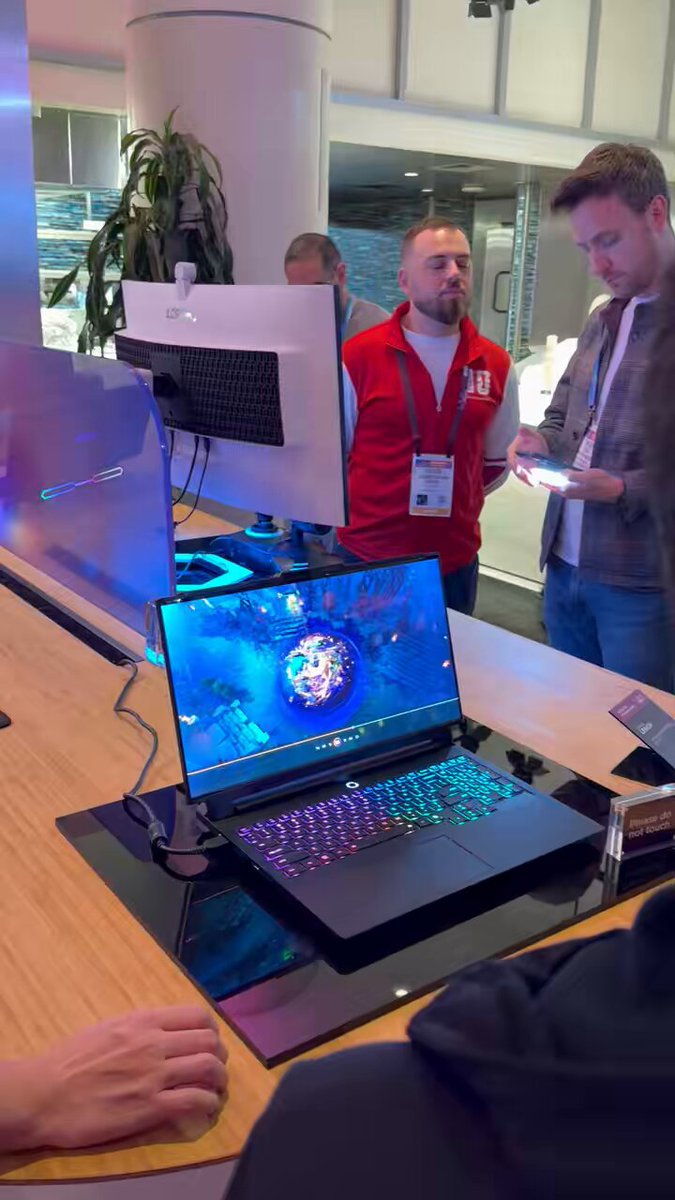
Today’s panel dug into where AI hardware is actually heading, the real signals coming out of this year’s CES, and what investors are paying attention to as the next wave takes shape.
@cryptokoreso, partner at Hofan Capital
LC Zhou, founding partner of Argo Ventures
@cbetass, cofounder of IoTeX
@larrypang, head of ecosystem at IoTeX

1
39
9 Apr 2025
classic

2
180
Kore retweeted
10 Aug 2024
this will help tiktok users develop shopping habits within the app. tiktok shop is still the final goal in the long run. this happened in Douyin when it first drove traffic for Taobao then block it and douyin ship thrive till now.
2
247
Kore retweeted

10 Jun 2024
This was THE best @Apple WWDC in almost a decade.
Summarising top takeaways:
762
6,060
67,232
26,650,351
Kore retweeted

20 May 2024
An important bill that helps our industry: Why it matters, and what you can do ⤵️
By the end of this month, the House of Representatives is going to vote on a major bill (HR 4763) — one that we think you should pay attention to. It’s called the Financial Innovation and Technology for the 21st Century Act aka FIT21, and it could make regulating crypto in the U.S. much clearer for everyone working in the industry or wanting to build in this space.
If this bill passes, it should:
- give blockchain projects a pathway to safely and effectively launch in the United States;
- clarify the line between the SEC and CFTC on who regulates what in crypto, and whether digital assets are a security or a commodity;
- ensure oversight of crypto exchanges, and further protect American consumers by implementing rules on crypto trading.
Why it matters: the big picture
Even though the crypto industry has been around for over a decade, there hasn’t been a comprehensive regulatory framework for digital assets in the United States. Our current regulatory framework is fragmented, incomplete, and lacking in clarity. This regulatory uncertainty has not only created a confusing environment for innovation, it has created a feeding ground for bad actors. As we’ve seen, ill-intentioned firms and individuals can easily launch products that take advantage of regulatory gaps.
Meanwhile, responsible actors — legitimate entrepreneurs and startups — have been subject to dubious “regulation-by-enforcement”. This approach hurts American innovation, especially while other countries innovate, and is not good for the long-term dominance of the U.S. dollar, for U.S. consumers, and for the U.S. economy overall. When other jurisdictions offer appropriately calibrated regulatory regimes, it leads startup activity to move abroad. This isn’t an abstract concern: Startups generate jobs, economic value, and can lead to the next big technology companies. For instance, Amazon, Apple, Facebook, Google, Microsoft, Netflix, NVIDIA, and Salesforce all started in the United States — some only within the last 20 years — and not only dominate market cap today, but our daily lives as well. With FIT21 creating a supportive environment for innovation, crypto could have the same potential — yet without creating big tech companies that act as the gatekeeping few for the many.
Whatever you think of crypto, it is more than just a financial opportunity — it represents an important technological platform shift, much like personal computing, mobile phones, and the internet changed our world. And while the internet is one of the most important technological innovations in human history, it is failing the very people who depend upon it today: consumers, creators, and developers. Blockchains, crypto, and web3 can help address this in a number of ways: from proof of authenticity against deep fakes and proof of personhood against AI, to more voice and choice in social media platforms, to more inclusive payments systems, and much, much more. But we need a supportive environment for these innovations to continue developing in the United States.
What’s in the bill?
FIT21 tries to ensure a regulatory environment that will allow blockchain technologies to flourish in a way that also protects U.S. markets and consumers. More specifically, the FIT21 bill/ HR 4763 establishes a regulatory framework for U.S. digital assets markets to:
…Address the unique structure of digital assets — thus supporting the unique needs of a new technology and its opportunities;
…Provide for clear, robust consumer protections — thus supporting the goal of protecting consumers while enabling innovation;
…Clarify which digital assets are regulated by the Commodity Futures Trading Commission (CFTC) and which by the Securities and Exchange Commission (SEC). This is important because of the key differences between the definitions of “commodities” vs. “securities”, which have consequences for how they are regulated. Specifically:
The CFTC would regulate a digital asset as a commodity “if the blockchain, or digital ledger, on which it runs is functional and decentralized”.
The SEC would regulate a digital asset as a security “if its associated blockchain is functional but not decentralized”.
The bill defines decentralization as, “if, among other requirements, no person has unilateral authority to control the blockchain or its usage, and no issuer or affiliated person has control of 20% or more of the digital asset or the voting power of the digital asset”.
The bill also establishes other consumer protection requirements such as segregation of customer funds; lock-up periods for token insiders (to incentivize innovation not just speculation); limitations on annual sales volumes; and disclosure requirements. These are not unlike the protections regulators implemented following the Great Depression, after the excesses of the roaring 1920s and stock market crash of 1929 — once those guide rails were in place, the U.S. saw an unprecedented era of growth and innovation in our markets and economy.
What’s not in the bill?
Some within the industry have voiced concern that the bill gives the SEC too much jurisdiction by providing a very high bar for decentralization — as well as the ability to claw back any tokens or projects that become “re-centralized”. There are other concerns that the bill doesn’t provide harder lines between SEC and CFTC jurisdiction.
However, the bill, while not perfect, will give the crypto industry the regulatory certainty it needs to continue to operate — and innovate — in the United States.
Some have asked, why have any regulation at all? It’s unrealistic to think there can be no regulation, and more clarity is better than having confusing rules. Regulation, along with a clear path to compliance for businesses, allows innovators to build trust, and useful products, for the public — while holding any ill-intentioned actors more accountable.
Who is behind the bill?
The FIT21 bill was a joint effort by the House Committee on Financial Services (which oversees the SEC) and the House Committee on Agriculture (which oversees the CFTC) — with input from the industry. Last July, the bill was passed out of the Financial Services Committee with the support of six Democrats and all Republicans on the committee, while passing by unanimous consent through the Agricultural Committees. It has continued to garner bi-partisan support since.
Why now, and what can you do to help?
Happening in the next couple weeks, the vote on the bill will be a referendum on crypto in the United States. It’s therefore imperative it passes with strong bipartisan support. After that, it would need to be passed by the Senate and signed by the President to become a law.
18
110
373
89,736