Free Spirit Pirate | Roots=Puglia | Heart=Pernambuco | Figuring out how to leave the cradle w/ a few Watts and Bits | Sr. Solutions Architect @AlgoFoundation
Joined December 2019
- Tweets 2,905
- Following 2,055
- Followers 1,329
- Likes 7,011
89 Photos and videos




Pinned Tweet

25 Sep 2022
The fact that mathematics, as conceived by human logic, is compatible with the laws of physics and able to describe the external reality with unbelievable precision is a not-trivial surprising evidence that should not be taken for granted.
8
3
32
🏴☠️ cusmȺ 🦜 retweeted

Build P2P video and audio streaming with on-chain payment rails.
@GoPlausible just shipped webrtc-payments-sdk: P2P streaming with x402 and MPP micropayments, in TypeScript (Node, JS, Web) and Kotlin (Android).
Gated access, gated usage, pay as you go.
Try the demo below👇
7
28
137
2,686

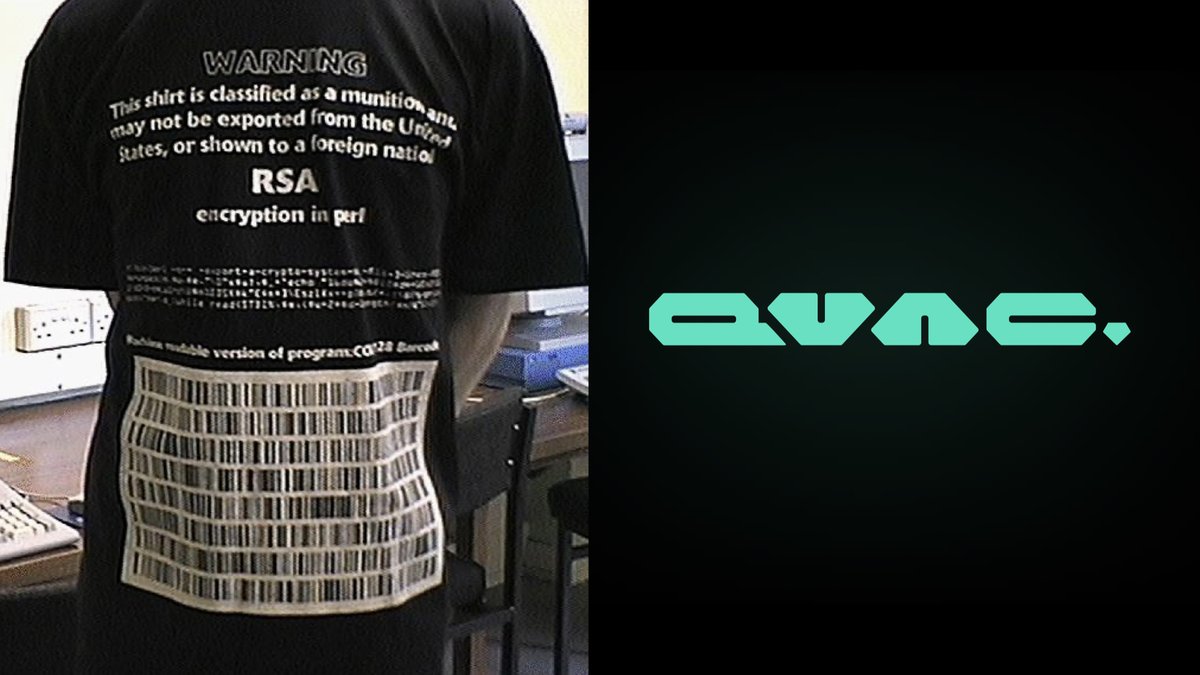
History rhymes.
Governments once tried to treat cryptography as a munition. The math didn't care. Open-source won. The same playbook is now being applied to AI. It will fail for the same reasons.
Not your AI, not your intelligence. Open-source, local-first, intelligence you own. That's the only path forward. That's why we created QVAC.
Qvac.tether.io
17
44
307
2,923,126
🏴☠️ cusmȺ 🦜 retweeted

Jun 11
7 years since #Algorand Block 0!
Lucky birthday #7 is as good a time as any to push a little news & some new programs out the door. You ready? We are! Stay tuned in the days ahead! 🤠

On this day 7 years ago, we produced block 0 on Algorand.
62 million blocks later, we're still running. No hitches, no downtime, not once.
Here's to the next 7.
4
13
96
2,290
🏴☠️ cusmȺ 🦜 retweeted
Jun 11
Tokenized debt instruments can now execute live on-chain, fully compliant with a global financial contract standard. Not theoretical. Not a proof-of-concept sitting in a sandbox. Ready now.
#rwas #algorand $algo #algoready 👏 for @cusma_b !

Algorand's Debt Standard Application took second place at the global ACTUS Use Case Competition.
ACTUS is the universal standard for machine-executable financial contracts.
The judges recognised D-ASA for actually delivering what the tokenized debt space has mostly only promised: end-to-end execution of debt contract logic, live on-chain.
Not a proof of concept. Running now on-chain.
2
14
64
1,791
🏴☠️ cusmȺ 🦜 retweeted

Algorand's Debt Standard Application took second place at the global ACTUS Use Case Competition.
ACTUS is the universal standard for machine-executable financial contracts.
The judges recognised D-ASA for actually delivering what the tokenized debt space has mostly only promised: end-to-end execution of debt contract logic, live on-chain.
Not a proof of concept. Running now on-chain.
12
71
351
69,059
Jun 9
Haiku, Sonnet, Opus, Fable, Mythos, sure, all cute. But the day @AnthropicAI ships "Divine Comedy" is when shit hits the fan.
1
2
97
🏴☠️ cusmȺ 🦜 retweeted

Jun 6
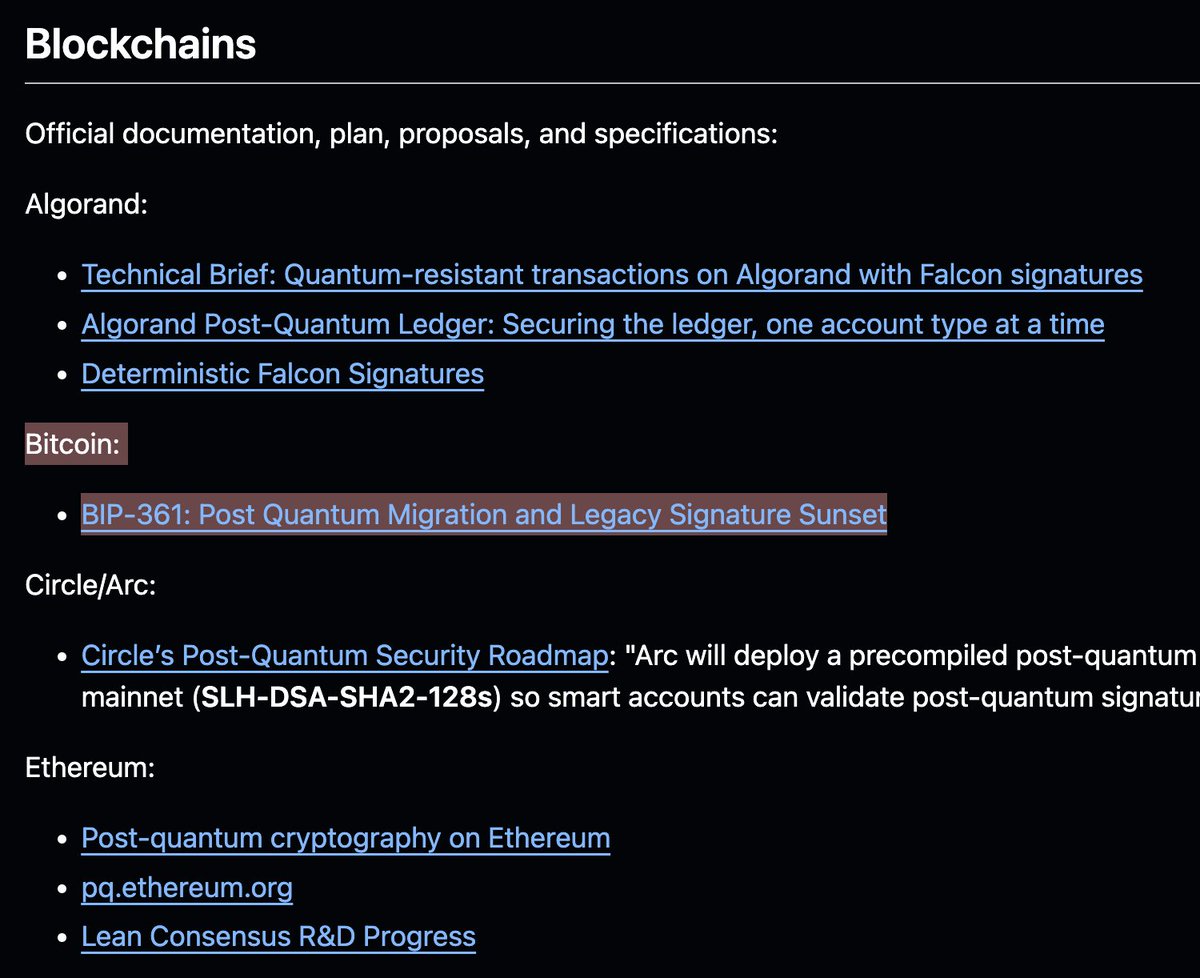
Bitcoin people, what should we add here? github.com/veorq/awesome-pos…
10
4
22
2,215

PRO with streaming on a 128GB machine used via openwebUI.

Who! I have installed @antirez #DS4, with Deepseek 4 Pro on my 128GB M5 mac #openwebui and it is just doable! Streaming a SOTA model from ssd. Amazing work.
5
7
91
13,094
🏴☠️ cusmȺ 🦜 retweeted

Jun 3
There will be an Italian player in the Roland-Garros men's final.
126
797
9,353
336,786
🏴☠️ cusmȺ 🦜 retweeted

Intanto i Metallica a Bologna hanno cantato Ken il guerriero
46
251
1,543
89,424
🏴☠️ cusmȺ 🦜 retweeted

Jun 2
🚨 Google Quantum result was just rediscovered and IMPROVED!
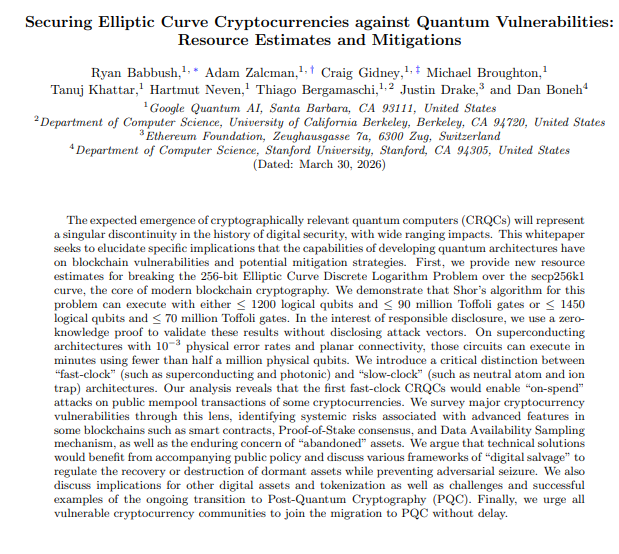
On March 31, 2026, Google Quantum AI published a paper showing that 256-bit ECDLP, the hard problem behind ECDSA and therefore behind Bitcoin, Ethereum, TLS, and most of the world's authentication, can be solved with fewer than 1,200 logical qubits and ~90M Toffoli gates. Under 20 minutes on ~500,000 physical qubits.
BUT, they didn't publish the circuits. They published a zero-knowledge proof that the circuits hit those numbers. The standard read at the time: clever responsible disclosure, elegant.
Two months later, that read needs an update. Two things happened, in opposite directions.
1. The ZKP wasn't a stylistic choice. Google was stopped from publishing.
What was speculation in April is no longer. Google did not choose to keep the circuits private. The U.S. government prevented publication. The blog post phrased it politely ("we engaged with the U.S. government"). Call it what it is: diplomatic cover for a publication block.
This is the line Scott Aaronson warned about. At some point, the people estimating the resources needed to break deployed cryptosystems would stop publishing. We just watched it happen, and the actor enforcing the silence isn't Google's PR team. It's a government.
2. The ZKP turned out to be a reward function. AI used it.
Here's the part that's almost funny.
A ZK proof that "this hidden circuit achieves these resource counts" is, when you flip it, a public verifier of any candidate circuit. Submit a circuit, get back: does it compute ECC point addition correctly, and at what cost. Pass/fail plus a number. That is exactly the shape of a reinforcement-learning reward function.
The ZKP was designed to hide the attack. What it actually published is the reward function for rediscovering it.
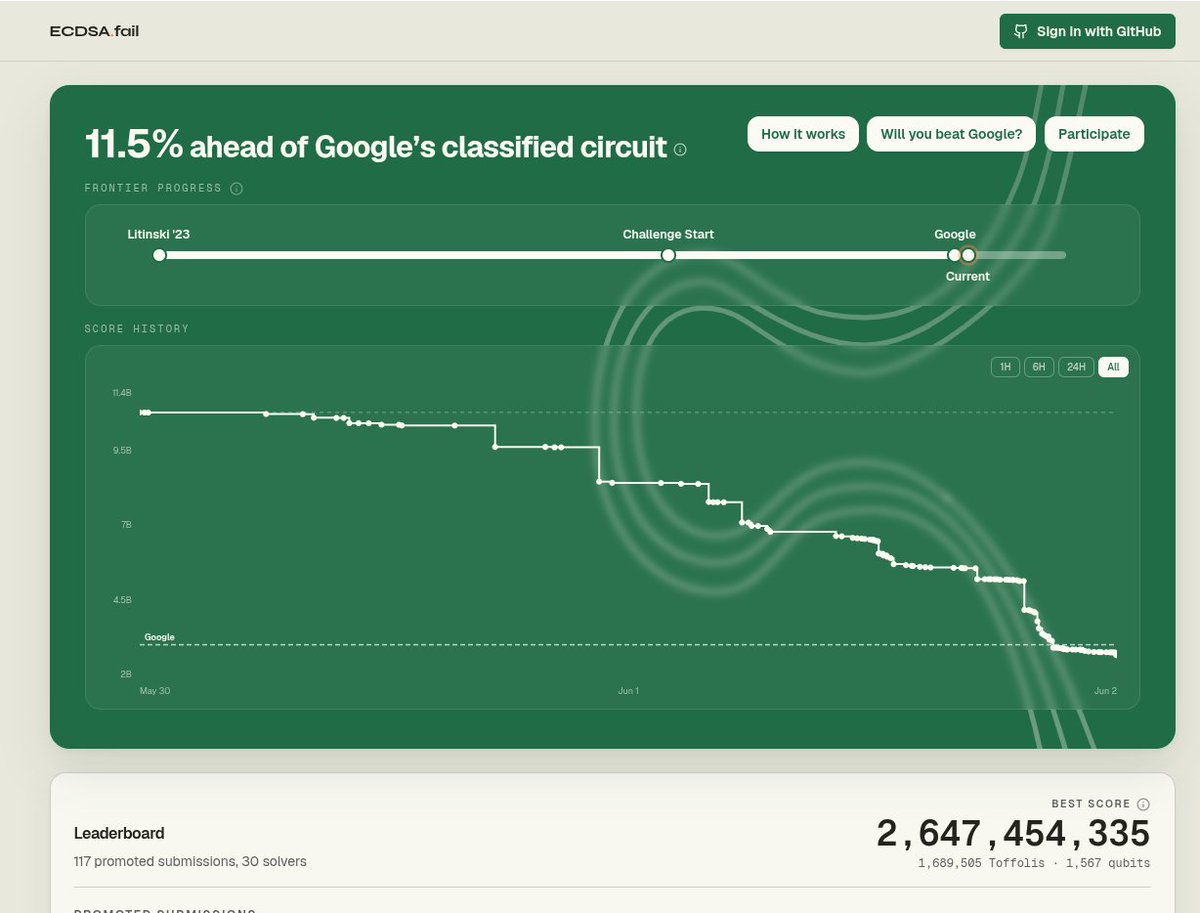
The research community wired the verifier into an automated AI-driven search loop. They reproduced Google's numbers. Then they improved them by 11.5%. Two months, from outside Google, no access to the circuits, using the very artifact Google released to keep them proprietary.
Both of these are true at once. Hiding the circuits worked: nobody outside Google has Google's exact circuits. And hiding the circuits did not slow the frontier; it changed who is doing the search, and arguably accelerated it, because the verifier industrialized the search loop.
Let's NOT PANIC!
Neither of these is a working CRQC. There is still no quantum computer that can run this circuit. The headline state of the world has not changed.
What has changed is the honesty of every public PQC timeline. Cryptography exists to create mathematical trust in the security of systems. Trust isn't broken when an attack runs. It is eroded when the foundation looks thinner than the public record suggests, and the public record is now demonstrably thinner than reality in two ways: by classification on one end, by AI-driven re-derivation on the other.
In security, the moment you start doubting the foundation is the moment you start rebuilding it. Not the moment you panic. The moment you plan.
This isn't a moment to rush. It's a moment to commit to a migration plan and execute against it, knowing the threat model is shaped by what governments are willing to classify, not by what researchers are allowed to publish.
Stay safe. Stay honest about your trust assumptions.
Mar 31

Today, Google Quantum AI published a research paper that might boost the post-quantum migration. Their team has tailored Shor’s algorithm to solve the 256-bit Elliptic Curve Discrete Logarithm Problem. ECDLP is the hard mathematical problem that secures ECDSA: the signature scheme underpinning most blockchains, TLS certificates, and countless authentication systems, using fewer than 1,200 logical qubits and 90 million Toffoli gates. Translated to hardware: fewer than 500,000 physical qubits, executing in a few minutes.
A few minutes. Less than a Bitcoin block time. Less than two Ethereum epochs.
The long-standing argument that public keys can simply remain hidden is now moot (In fact, it has always been x.com/P3b7_/status/198854349…).
What exactly changed
Shor's algorithm has been known since 1994 as a generic quantum approach to factoring integers and computing discrete logarithms. But "known" and "practical" are very different things. The real progress is in the engineering: how many qubits and gates you actually need once you compile the algorithm into a fault-tolerant quantum circuit.
The last breakthrough by the INRIA Rennes team required ~2,100 logical qubit count for ECDLP. Google's engineers optimized the full circuit stack to ~1,200 logical Qubits.
The recent algorithmic trendline is clear: every 12-18 months, the resource estimates drop significantly. And these are pure algorithmic gains: they compound on top of hardware improvements, which remain a major challenge.
However, as of today, we're still far from having such a quantum computer. This didn't change.
Zero Knowledge Proof
Here's where it gets interesting. Google chose not to publish their optimized circuits. Instead, they released a zero-knowledge proof that their circuits achieve the claimed resource counts. We have no doubt they know how to do it, but no clue how (sounds magic ;-))
The reasons are likely multiple: competitive advantage, national security implications, or simply not wanting to hand a blueprint to adversaries. Regardless, it establishes a powerful (and elegant) precedent.
What’s ironic: Google's ZK proof is not itself post-quantum secure.
What’s next?
The good news is that we already have the tools: Post Quantum Cryptography, now we need to migrate.
A few days ago, Google announced it is targeting 2029 for full post-quantum readiness. NIST plans to deprecate RSA signatures by 2030 and disallow all legacy algorithms by 2035.
Most organizations haven't started their cryptographic inventory. Major blockchain protocols are currently discussing the path forward.
Cryptography exists to create mathematical trust in the security of systems. That trust is now being eroded, not by a working attack, but by the increasingly credible prospect of one. In security, the moment you start doubting the foundation is the moment you should be rebuilding it.
What this means for blockchains
For blockchain ecosystems specifically, the threat is central. ECDSA on secp256k1 (Bitcoin) and P-256 curves (broadly used elsewhere) is the cornerstone of security. Unlike traditional systems where you can rotate certificates behind a corporate firewall, blockchain migration requires coordination across decentralized, permissionless networks. This process will likely take time.
I'll be diving deeper into the concrete challenges and strategies for PQC migration on blockchains and secure systems at my keynote this Thursday at EthCC conference.
157
119
485
126,866
Jun 2
A quantum logical circuit architecture with results as Google paper. This time with full disclosure of the circuit, no ZK proof.
arxiv.org/abs/2606.02235
1
6
192
🏴☠️ cusmȺ 🦜 retweeted

Jun 2
Today a crazy quantum story just got wilder.
On March 31, the Google Quantum AI team published a landmark result on Shor's algorithm for elliptic curve cryptography. Technically, the paper was a bombshell: a dramatic 10x improvement over the state-of-the-art. As a stunt and wakeup call to the blockchain space, those optimisations were illustrated on secp256k1, the elliptic curve underlying Bitcoin and Ethereum signatures.
But perhaps the most striking part of the paper was sociological, not technical. Instead of following standard academic process, the optimisations were kept secret, hidden behind a zero-knowledge (ZK) proof. Google's accompanying blog post mentions they "engaged with the U.S. government". The ZK proof demonstrates the existence of algorithmic improvements without leaking details. Academic censorship with ZK, a historic first!
As a co-author of the Google paper I witnessed some of the context surrounding this censorship. To be honest, multiple aspects of that context don't sit well with me. As much as I believe the general public ought to know more, I am limited in my ability to whistleblow. Though let me be clear about one thing: the Google team's professionalism has been absolutely exemplary, and they deserve nothing but praise.
Censorship has a way of backfiring. The Streisand effect, where an attempt to bury something only draws more attention to it, is exactly what's unfolding today. First, Google's key optimisation has been rediscovered by the French. And in a thrilling turn of events, a collaborative Shor-at-home challenge just launched. The initiative, available at ecdsa[.]fail, breached a new Shor world record in a matter of hours.
Let's start with the rediscovery. Just two months after Google's paper, French quantum expert André Schrottenloher cracks the main secret optimisation. His paper, titled "Optimized Point Addition Circuits for Elliptic Curve Discrete Logarithms", landed on the arXiv today. Big congrats to André, who beat several other nerdsnipped experts to it. In a blog post also published today, Craig Gidney, the world expert on Shor optimisations, revealed that he'd been sitting on this very optimisation for a whole year under censorship pressure.
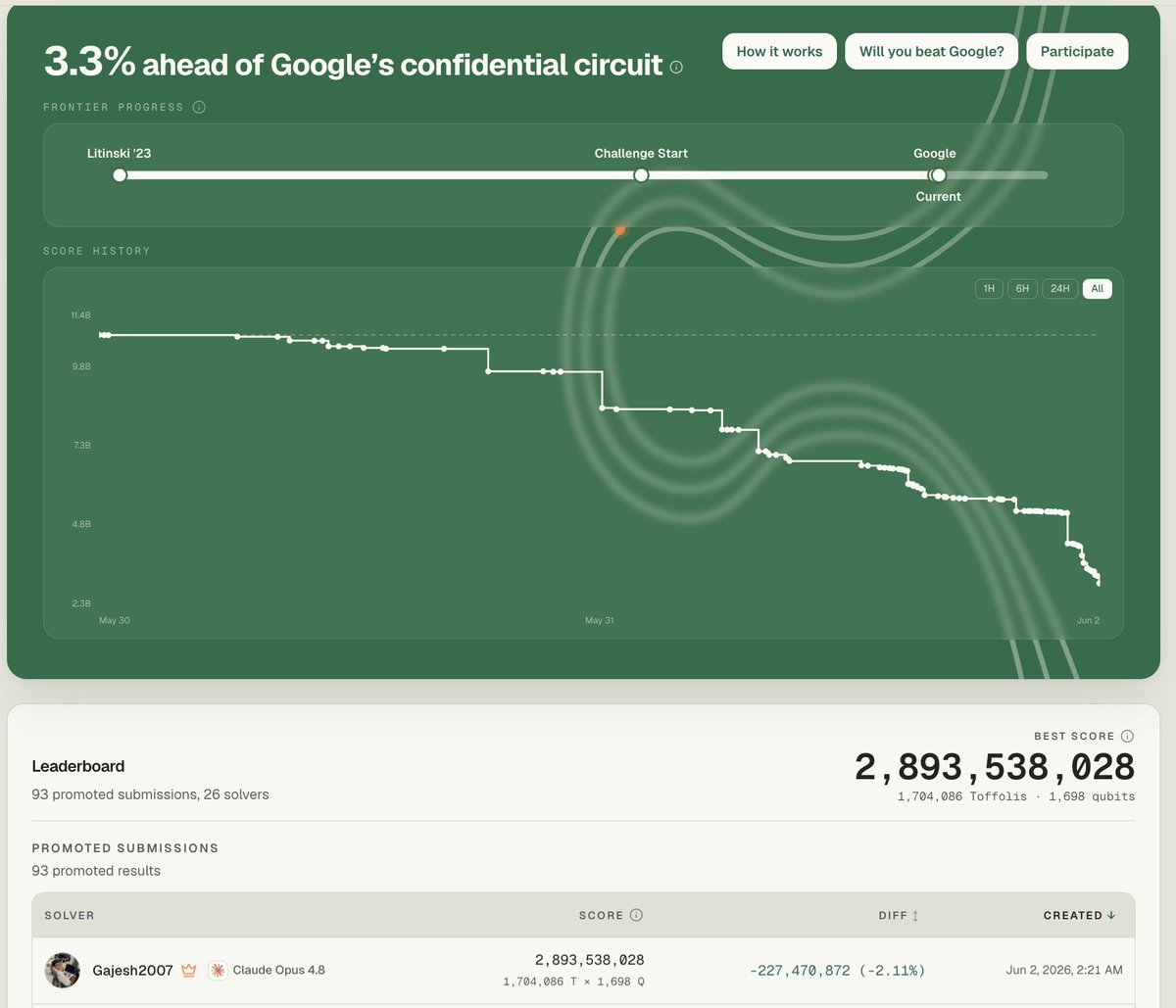
Interestingly, André missed a handful of minor optimisations, both from Google's original publication and from improvements found since. It's plausible there's still plenty of juice left to squeeze out of Shor, and this is exactly what the ecdsa[.]fail challenge is about. The verifier program developed for the ZK proof does double duty, automatically filtering for valid submissions. Dozens of compounding small and micro improvements are rolling in. As of the time of writing there's an 8.4% improvement to Google's circuit, as measured by the product of logical qubit count and Toffoli gate count. Nice!
The nerdsnipping ran deeper than anyone expected. Over the last few weeks it became clear it extended well beyond André and other quantum experts. Behind the scenes, a small army of amateurs quietly got to work. Inspired by Karpathy-style autoresearch, they turned AI on Shor. Ironically, the verifier program for the ZK proof makes an ideal reward function for AIs. The barrier to entry for this modern style of research is refreshingly low, with several non-experts, even a teenager, finding nice optimisations. Get in touch if you'd like to join a Telegram group with fellow autoresearchers :)
Part 2: neutral atoms and qday
The story doesn't end with Google. On the same day Google went public, a stealthy startup called Oratomic published its own Shor paper in a coordinated release. It made a splash, ultimately becoming the most upvoted paper on scirate[.]com, a website ranking arXiv papers.
Oratomic's claim was wild. By building on Google's logical optimisations and applying custom physical optimisations for neutral atoms, they claimed just 10K physical qubits were sufficient to run Shor's algorithm on secp256k1. That number is mind-bogglingly low.
Knowing essentially nothing about neutral atoms when Oratomic's paper landed, I was intrigued and decided to learn more about the tech. I fell straight down the rabbit hole and spent a couple hundred hours on the topic. I got a little obsessed and watched every YouTube video I could find and spoke to a bunch of experts.
My conclusion? The tech is real, very real. Even Google recently decided to start a neutral atom lab, a notable pivot from their sole focus on superconducting qubits. If you care about qday, i.e. the day a quantum computer will break the first piece of cryptography in production, neutral atoms demand your attention. I shared some of my learnings on Shor and neutral atoms in a 30min talk at the ZKProof cryptography conference. You can find it on YouTube by searching "zkproof neutral atom".
Here's an interesting observation about this duo of breakthrough papers: neither Google nor Oratomic say a word about what their results mean for qday. No timelines. Zero. Nada. That is especially baffling given that the whole point of whitehat quantum cryptanalysis is to inform qday estimations and help the general public make good decisions.
So let me attempt to partially fill the silence, similarly to what Scott Aaronson did in his April 29 post. Given everything I know, including scary non-public information, I now put the odds of qday by 2032 at 50%. 10% by 2030.
Anecdotally, the US government has its own date: 2035. Originating at the NSA and later adopted by NIST, it's when branches of the US government will be disallowed from using quantum-vulnerable cryptography. In plain language: with hindsight, that date is a joke and should be discounted entirely. I don't see how NIST avoids being forced to pull it forward by years.
Part 3: post-quantum cryptography
There are good reasons to sound the alarm today, but please do not panic. Rushing carelessly towards immature post-quantum cryptography is a recipe for disaster. IMO a good target date for migration is 2029, roughly 3.5 years out. 2029 happens to be the date selected by Google, Cloudflare, and the Ethereum Foundation.
These days most of my time goes to safely migrating Ethereum towards post-quantum cryptography as part of the broader lean Ethereum effort. There's a lot to do. We need to rip out and replace BLS signatures at the consensus layer, KZG commitments at the data layer, and ECDSA signatures at the execution layer.
The plan to get there is compelling, and is based on hash-based cryptography. Within the Ethereum Foundation we've developed a Swiss army knife called leanVM (github[.]com/leanEthereum/leanVM) powered by the magic of hash-based SNARKs. Thanks to truly exceptional work by Emile, Thomas, and others, its performance is derisked. Regarding security, leanVM is a jewel, a minimal zkVM crafted for end-to-end formal verification and maximum security.
Want to help? There are two $1M initiatives. First, the Proximity Prize (proximityprize[.]org). Solve a long-standing mathematical conjecture in coding theory, improve hash-based SNARKs, and go home a millionaire. Second, the Poseidon Initiative (poseidon-initiative[.]info), offers $1M for breaking Poseidon, the SNARK-friendly hash function.
408
1,127
6,241
3,698,864
🏴☠️ cusmȺ 🦜 retweeted

Jun 2
If two students with some agents can reach 80% of Google‘s quantum breakthrough, do we really believe that the quantum deadline won’t move to earlier time than 2029 in the next 12 months?

3
8
34
1,800
Jun 2
Seems the AI swarm beated the recent Google's confidential circuit on the combined metric of gate and qubit needed to break ECDSA.

1
188
Jun 2
Worth keeping an eye on this AI swarm researching and optimizing quantum circuits to break ECDSA. I think we are witnessing a new era of open AI-driven research.
Jun 2

I beat one of the best published quantum circuits for breaking Bitcoin.
And I have no formal training in quantum cryptography. Using just AI agents, I improved it by ~2x. But I haven’t beat Google’s best classified circuit yet.
So, today I'm launching ecdsa(dot)fail -- an open competition for researchers, autoresearchers, and agents to beat Google.
Download the CLI, point your agent at it, and start optimizing.
1
5
260
May 30
Questioning and challenging the requirements has never been such crucial as now.

1
88
🏴☠️ cusmȺ 🦜 retweeted

May 28
17
91
788
294,807
Sorry if I post this again, but: this is the best post about AI slop you are going to read in the next 2 years.
25
45
784
183,974
🏴☠️ cusmȺ 🦜 retweeted

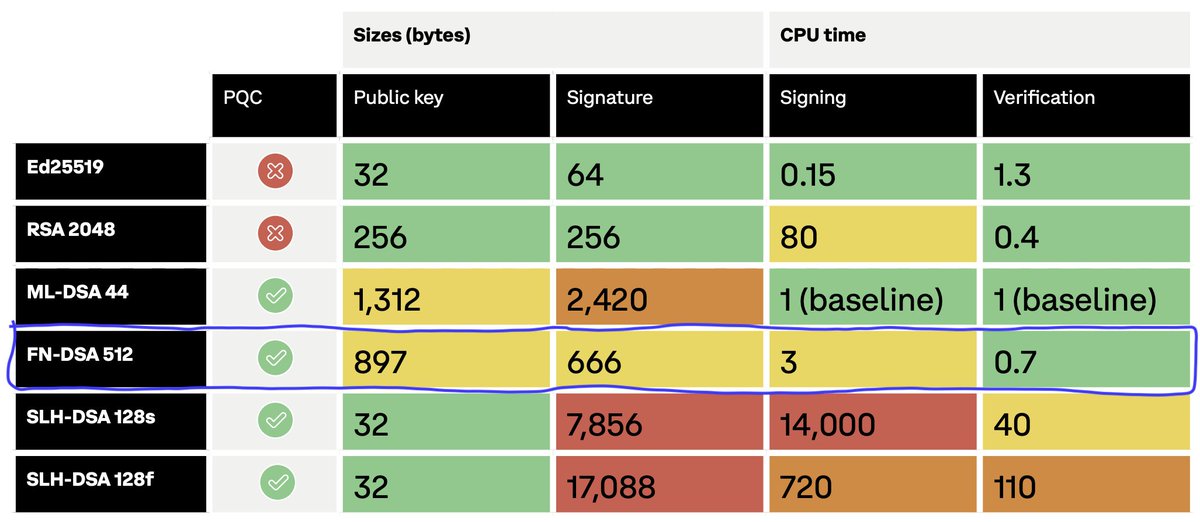
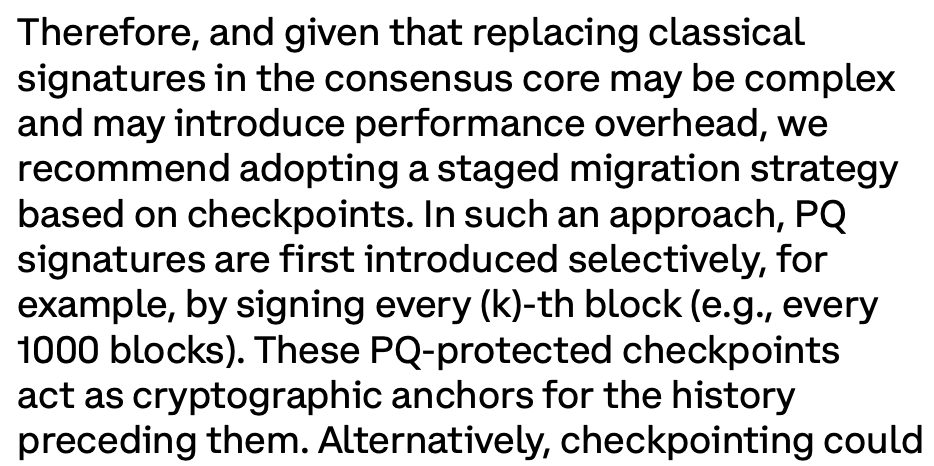
Altro articolo su una roba enorme che nessuno vi racconta perché appena legge ‘crittografia post-quantum’ la gente chiude la tab e torna a guardare i reel... ma che io faccio ugualmente perchè mi piace così pinperepette.github.io/signa…
8
22
114
4,499