
Co-Founder @realworld_inc · Institutional lending infrastructure · Canton Network validator · Ex-London mortgage broker
Joined April 2021
- Tweets 15,428
- Following 1,858
- Followers 7,919
- Likes 105,301
1,979 Photos and videos














Daniel Jarvis retweeted

Jun 13
Spent a couple of days last week at the @TheFCA’s Smart Data Accelerator Policy Sprint. It was definitely one of those kinds of sessions that earn the time you give them.
I was on the later life lending stage and the interesting part I found wasn’t the data or the technology side, it was how hard the commercial model actually is.
Delivering proper financial guidance to people across very different means, particularly to older borrowers who often aren’t comfortable making large financial decisions through an app, is the part that nobody has solved. Who helps them, how and at what cost is the question that runs underneath everything else.
So yes, Open Finance opens up the data but the harder question is what you build on top of it that actually serves people.
The other thing worth saying: Sitting in a room with people approaching the same problem from completely different angles is one of the most useful things you can do for your own thinking. Lenders, advisers, regulators, technology providers, all bringing different lenses. It changes how you see what you’re working on, and sometimes changes what you build next.
Thanks to Simone, and everyone at the FCA who pulled it together, and to the team I worked with for two genuinely intense days. Would gladly do it again. I think this kind of cross-industry policy work is exactly what the mortgage and open finance space will need more of.
1
10
224
Daniel Jarvis retweeted

Jun 8
This week, Realworld’s Co-Founder @danieljarvis will be participating in the Financial Conduct Authority’s Mortgages & Open Finance Policy Sprint, part of the FCA’s Smart Data Accelerator programme.
The Sprint brings together participants across mortgages, banking, technology and regulation to explore how Open Finance and Smart Data can improve consumer outcomes through the mortgage journey.
Looking forward to contributing alongside the wider group.

1
8
281
Jun 7
A few reflections from Money 20/20 Europe.
The conference itself was heavily weighted toward payments, AI, and fraud prevention and it strikes me that those markets are extremely crowded. Not all of the companies pushing in those spaces will succeed.
On the banking side, there’s a clear split. Some banks feel the pressure to explore digital assets and tokenisation but aren’t really taking it seriously. Others, like NatWest, genuinely seem to be leading the charge. The podcast featuring Lee McNabb was one of the top things I caught all week - well worth a listen.
Regulation came up in pretty much every conversation. The common thread was that Europe is meaningfully behind places like the UAE on regulatory clarity, and it’s hampering, or in some cases stopping, companies from progressing with any real direction. Most people I spoke to expect that to change soon.
Amsterdam is still one of my cities to visit.
Good to see plenty of old faces and meet a lot of new ones.


2
13
243
Jun 2
Good to see @Citi calling for multi-network, multi-asset, multi-currency infrastructure rather than building another silo.
Crypto spent a decade making this exact mistake by every L1 building its own walled garden, only working on interoperability years later once the fragmentation became a problem.
Banks and corporates have the chance to skip that phase entirely. Building for multi network from the start rather than bridging across silos later.

"The vision is having that multi-network, multi-asset, multi-currency frictionless system."
That's how @Citi's Ryan Rugg described the future of capital markets at HederaCon 2026 🧵
The shift is already underway. Citi projects the tokenized securities market could reach $5.5T by 2030, while industry leaders expect more than $250B in digital securities could be issued over the next year alone.
Read their prediction in @Coindesk: coindesk.com/markets/2026/06…
1
12
242
May 29
In Amsterdam next week for Money 20/20 Europe - do let me know if you're around!
3
12
315

Daniel Jarvis retweeted

May 22
Representing real-world assets natively onchain requires privacy.
Most assets on public permissionless chains today reference off-chain systems rather than replacing them.
Privacy is what makes true native representation possible.
@YuvalRooz explains his thesis.
11
21
125
4,759
May 20
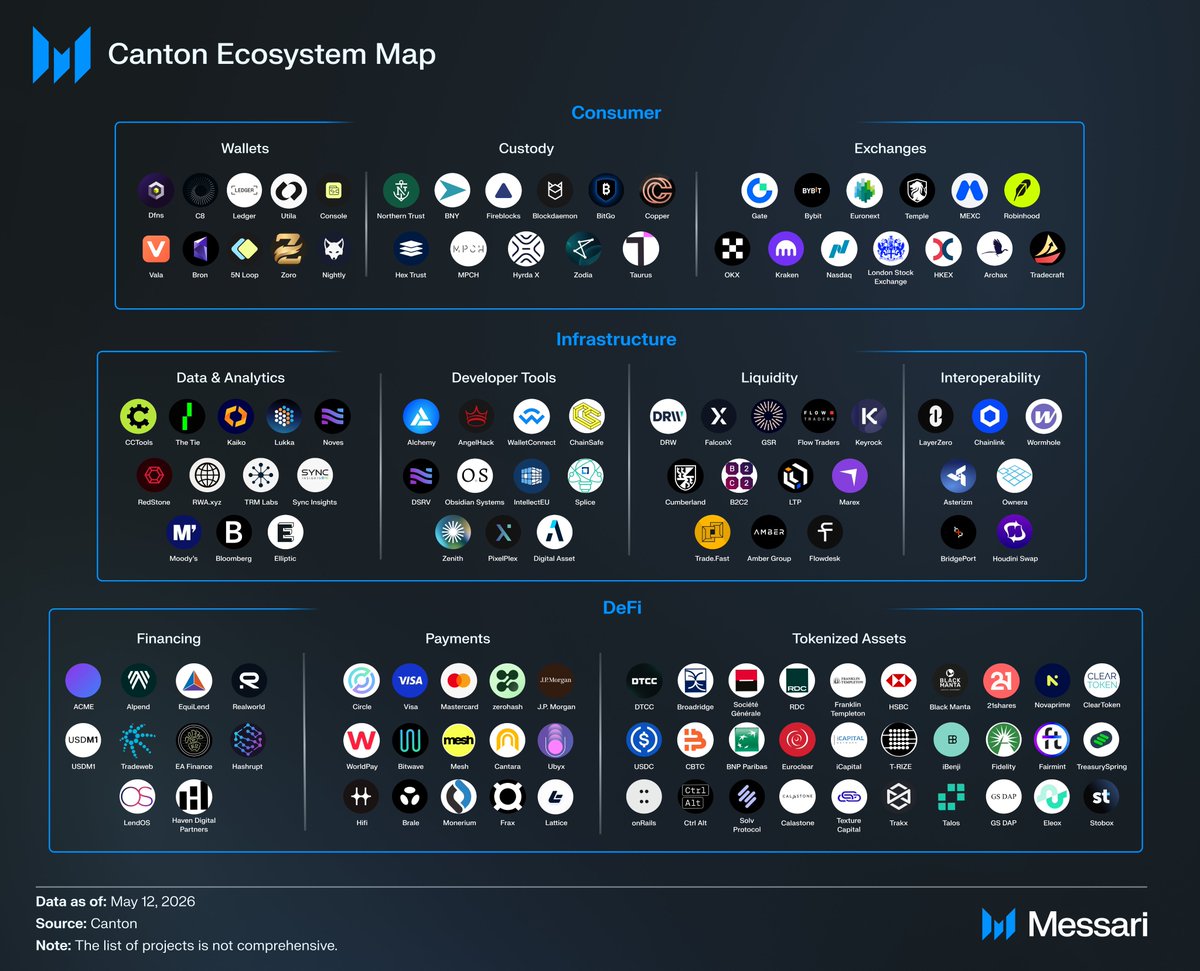
we've worked so hard quietly, it always surprises me to see ourselves listed in an ecosystem map like this.
May 20

the most in-depth and up-to-date @CantonNetwork report is live.
22 pages covering:
> technical architecture
> privacy model
> tokenomics
> governance
> institutional adoption
> the role of $CC
👉 messari.io/report/understand…
let’s break down the key points:
1/ what is Canton Network?
Canton is a public network for interoperable, privacy-preserving financial applications.
unlike most blockchains, Canton does not rely on a single globally replicated state where every validator sees every transaction.
instead, each participant only sees the part of a transaction it is entitled to access.
Canton’s core differentiator -> configurable sub-transaction privacy with composability.
independent financial applications can interoperate atomically across shared infrastructure without exposing all transaction data to the entire network.
2/ what problem is Canton solving?
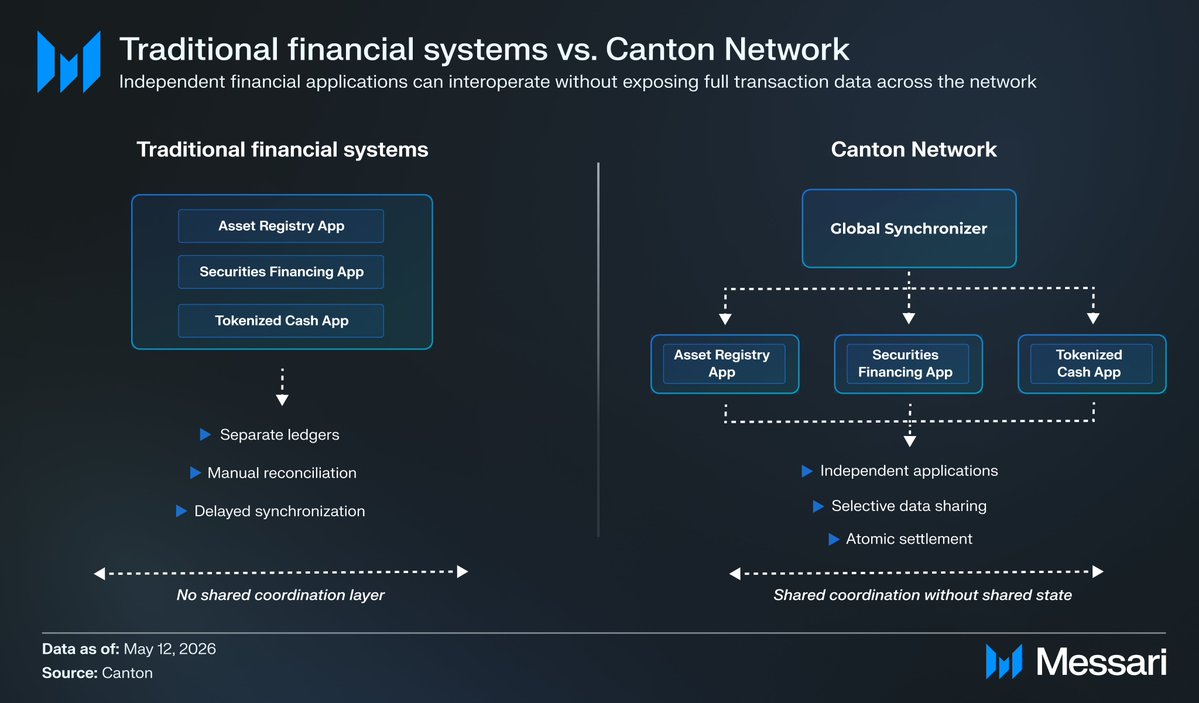
traditional financial infrastructure is fragmented.
collateral, cash, securities, repo, and settlement workflows often sit across separate ledgers, intermediaries, and operational systems.
that creates:
> reconciliation overhead
> delayed settlement
> operational risk
> trapped collateral
> inefficient capital movement
most blockchains solve interoperability by making everything globally visible.
most private systems preserve confidentiality but recreate isolated silos.
Canton is designed to solve both problems at once:
> synchronized shared infrastructure
> without full public transparency
3/ how does Canton actually work?
Canton separates transaction coordination
from transaction visibility.
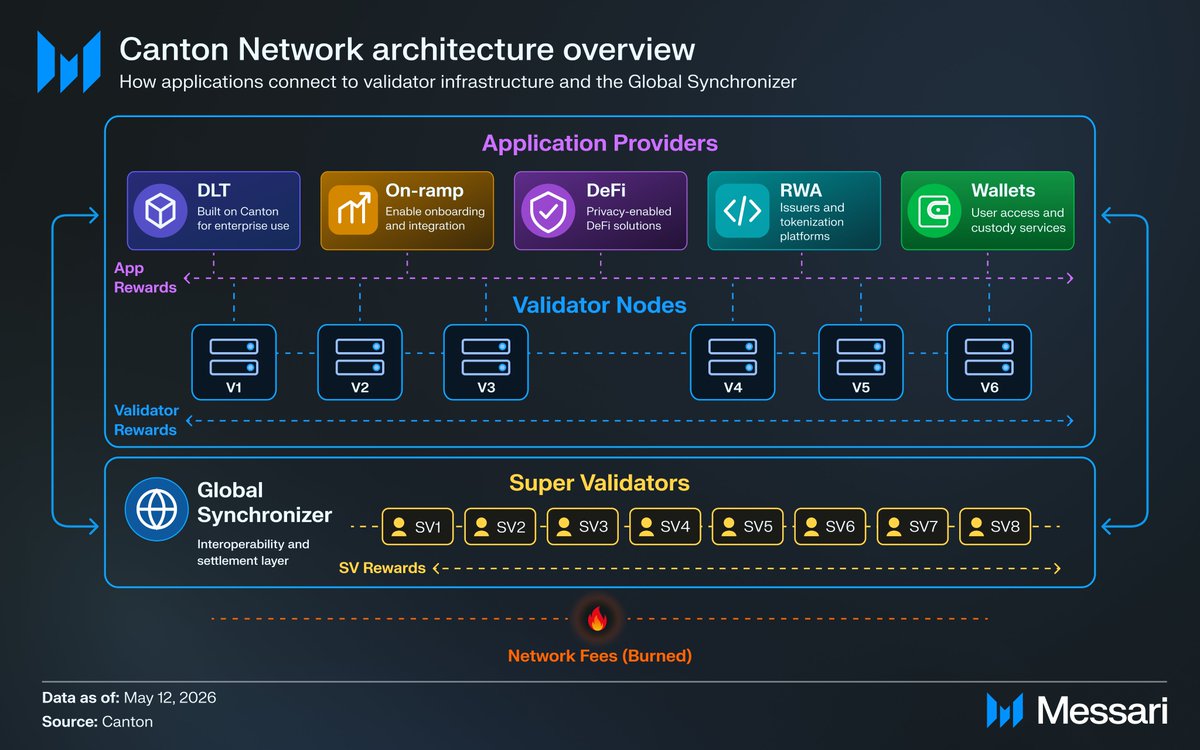
validator nodes only store and validate the subset of state relevant to the parties they host.
the Global Synchronizer orders transactions and prevents conflicts, but transaction contents remain encrypted and selectively disclosed.
applications can interoperate atomically across the network while preserving confidentiality.
this is very different from monolithic blockchain architecture.
4/ why does sub-transaction privacy matter?
financial workflows often involve multiple parties that need to settle together, but should not see the same information.
in Canton, a transaction can settle atomically while each participant only sees the portion relevant to them.
issuers, counterparties, validators, and applications can coordinate without every party observing the full transaction graph.
this is the privacy/composability tradeoff Canton is trying to solve.
5/ who is building on Canton?
Canton already has a meaningful institutional and crypto-native footprint. examples include:
@Broadridge, @The_DTCC, @jpmorgan, @HSBC, @FTI_US, @Tradeweb, @Visa, @EuroclearGroup, @SocieteGenerale, @chainlink, @LayerZero_Core, @circle, @FireblocksHQ, @BitGo, @zerohashx, @tradecraftfi, & @temple_ny
key developments include:
> tokenized deposit pilots
> collateral mobility workflows
> synchronized repo settlement
> stablecoin and custody infrastructure
Broadridge DLR processes more than $8T in monthly repo volume on Canton infrastructure.
important note: much of Canton’s highest-value activity has historically occurred through private deployments or private synchronizers using the same underlying technology.
the next phase is the migration of these workflows toward shared public infrastructure coordinated through the Global Synchronizer.
6/ where does $CC fit in?
$CC is used for:
> transaction fees
> infrastructure incentives
> application rewards
> operation of the Global Synchronizer
fees are denominated in USD terms and settled in $CC.
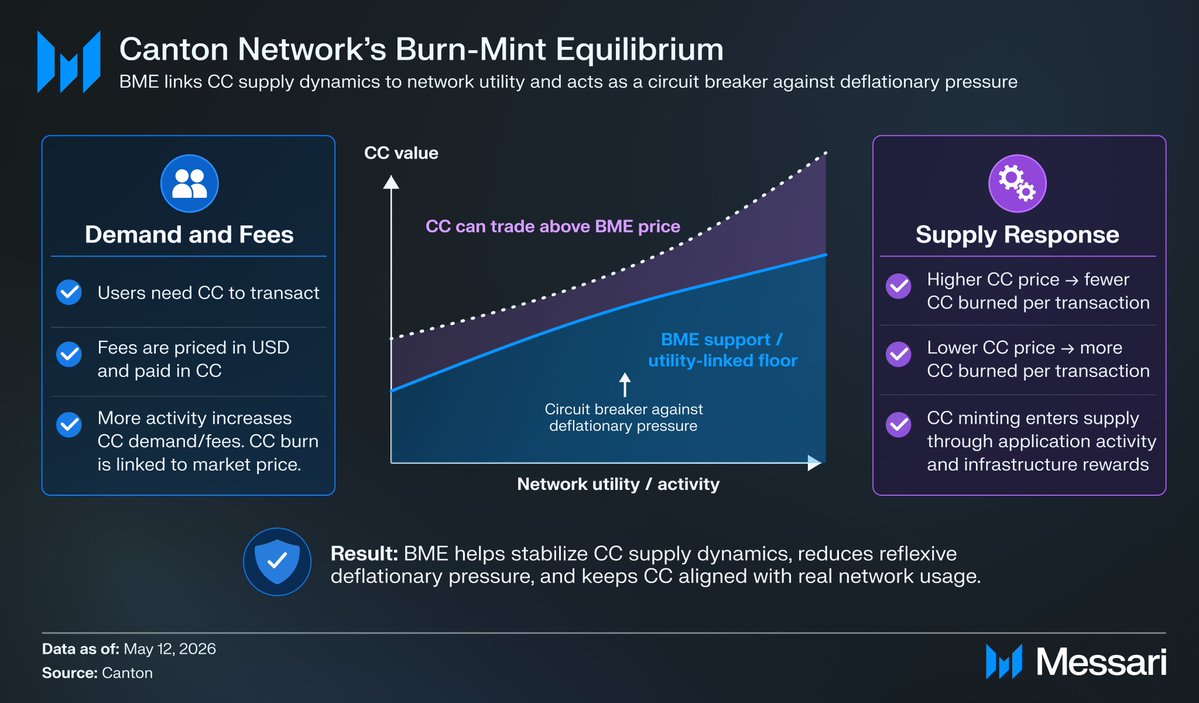
Canton’s token model uses a burn-mint equilibrium tied to network usage.
higher activity increases $CC demand/fees, and $CC burn is linked to market price.
higher $CC price -> fewer $CC burned per tx
lower $CC price -> more $CC burned per tx
issuance is distributed across:
> Super Validators
> validators
> application providers
> users
over time, the reward model increasingly shifts toward applications generating real network activity.
7/ what is next on Canton’s roadmap?
Canton’s 2026 priorities are focused on institutional asset adoption, performance, usability, standards, and ecosystem participation.
key roadmap items include:
> DTCC’s tokenized U.S. Treasury MVP, targeted for H2 2026
> initial phases of JPM Coin integration
> continued expansion of collateral mobility and synchronized settlement workflows
> scaling improvements targeting thousands of TPS on the Global Synchronizer
> higher throughput across application-specific subnets
> migration toward Canton-native BFT consensus
> broader adoption of wallet interoperability standard CIP-0103
> continued development of token standard CIP-0112
> further simplification of validator onboarding
longer term, Canton is focused on:
> regulated digital cash
> tokenized collateral
> privacy-preserving DeFi
> public-party functionality
> public verifiability for private transactions
> expanded smart contract language support beyond Daml
the roadmap reinforces Canton’s broader strategic focus of building shared infrastructure for privacy-preserving institutional settlement and regulated asset movement.
8/ disclaimer
this report was commissioned by Canton Network. all content was produced independently.
this post is informational only and not investment advice.
10
254
May 11
Real estate is a good example of why information sensitivity dictates infrastructure.
Title deeds are already public record. Tokenising them on XRPL (as DLD does in Dubai) doesn't leak anything that wasn't already at the land registry.
Mortgages against those titles are different. The borrower, the lender, the LTV, the bank's exposure, none of that can live on public chains for exactly the reasons in this thread.
That's why we chose to build on a split architecture.
Asset stays on its native public chain. Loan record sits privately, on Canton.

2
2
10
600
Daniel Jarvis retweeted

Apr 30
Dubai just changed the rules on property-linked visas 🇦🇪
Here’s what it means for investors 👇
1
1
7
925
Daniel Jarvis retweeted

Apr 25
Long-term: title, mortgages, escrow, settlement all move on-chain. Real estate is primed for tokenization. Incredible opportunity.
Apr 24

Highest theoretical upside? Tokenization. But also highest degree of “we need to figure things out”.
31
48
348
35,326
Daniel Jarvis retweeted

Most people focus on the wrong things. 👇
1
1
6
271
Daniel Jarvis retweeted

Apr 7
2
5
12
1,197
Daniel Jarvis retweeted
Apr 6
Saudi Arabia's real estate tokenization rollout is moving faster than most people realise. Great work from @SettleMintCom & Ghanem on the infrastructure side.
Wherever ownership infrastructure is being built at scale, the lending layer should soon follow, giving institutional lenders the ability to lend against tokenized deeds the same way they do today, while unlocking new structures for first time buyers, foreign investors and product innovation that simply isn't possible with paper titles.
enterpriseam.com/ksa/2026/04…
1
5
13
1,258
Apr 7
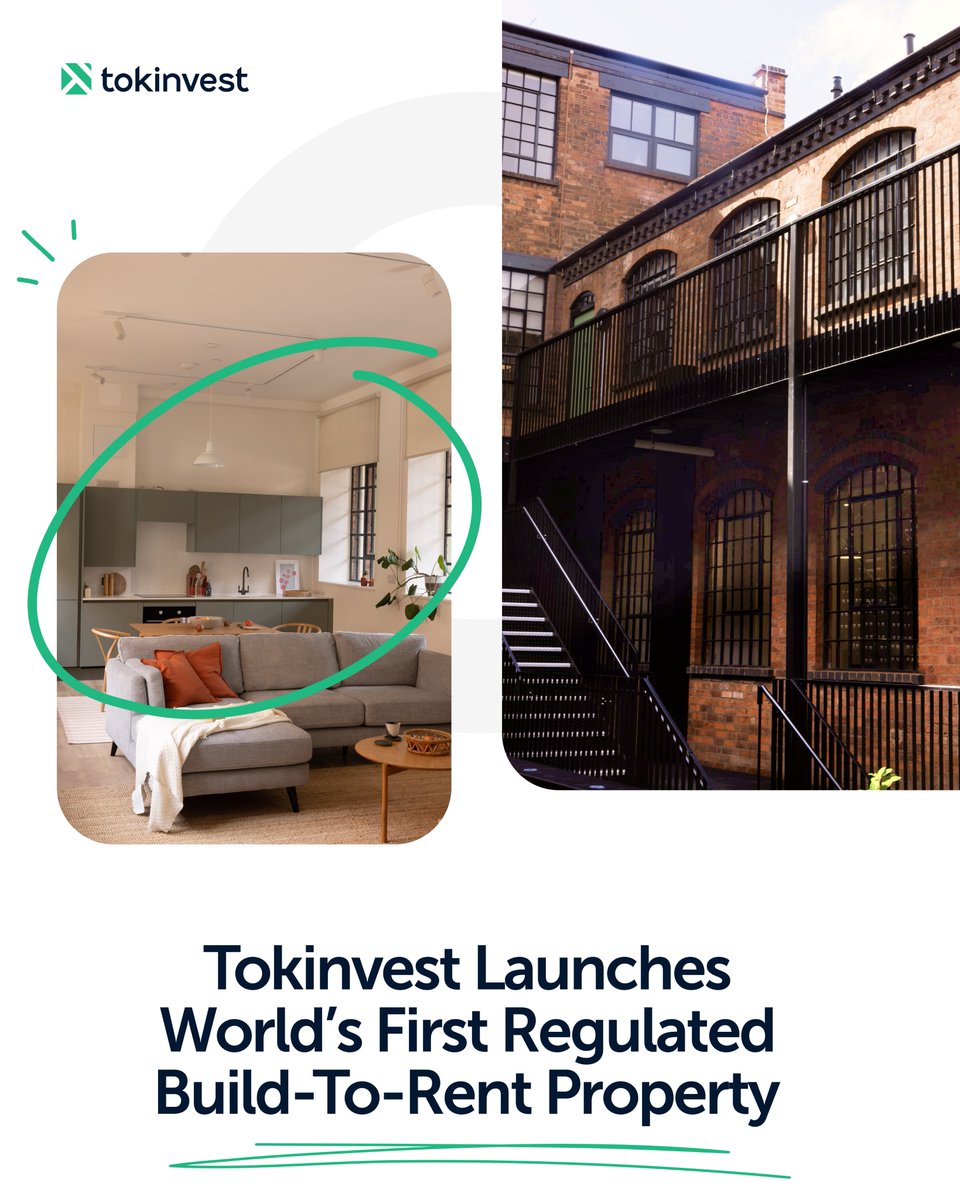
Interesting product. Arguably one of the first times we've seen cross-border property tokenisation done cleanly, proper regulatory framework on the issuance side, established legal structure on the asset side. Likely one to watch closely.
From our side, it confirms the direction of travel. Our focus is ensuring that when assets like this exist and holders want liquidity - long-term liquidity, without selling - we're able to provide that from a credible, institutional source.
Apr 7

1/5 Tokinvest has launched its Global “Build-to-Rent” product, a tokenised residential real estate product.
1
13
383