Health Economist @UCBerkeley Public Health. Studying digital health - telemedicine, AI. IV hobbyist. Ex-Tel Aviv U Econ. Princeton Econ PhD

Joined October 2013
59 Photos and videos
Pinned Tweet
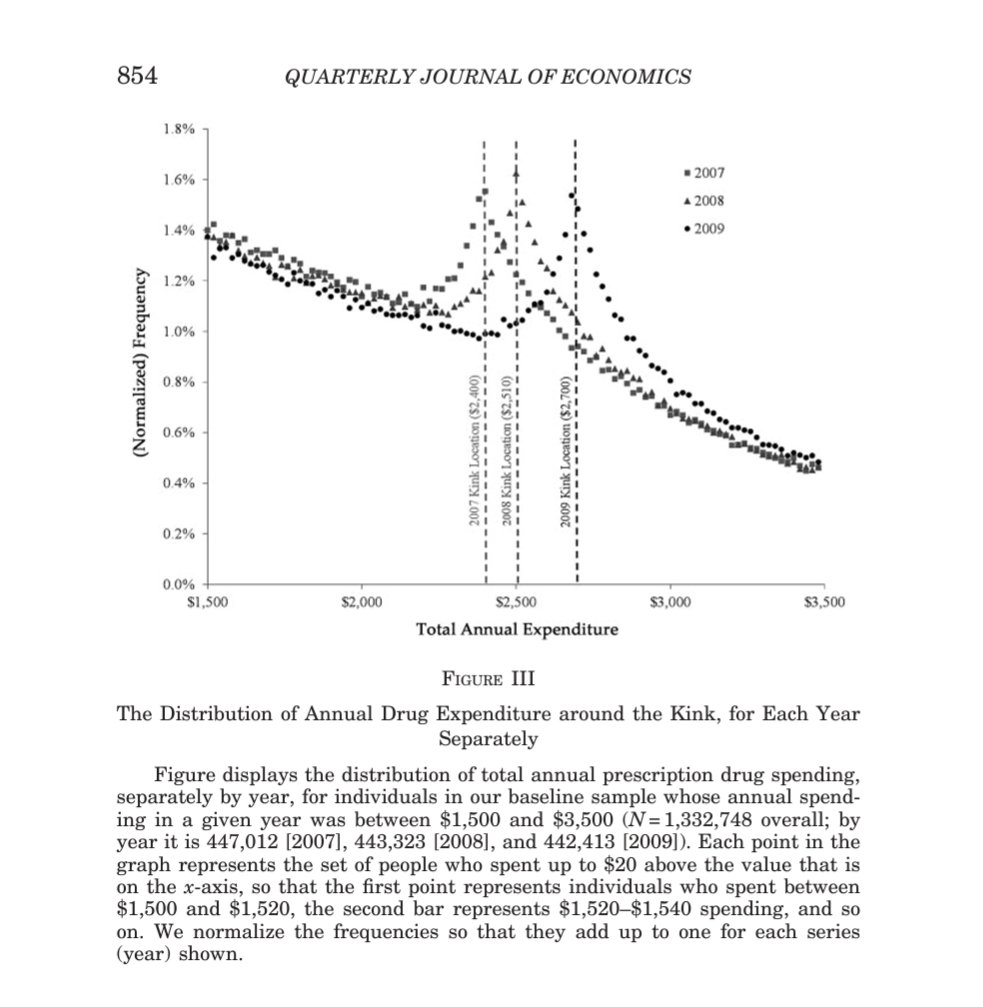
🚨New in AER🚨: "Negative Control Falsification Tests for IV Designs" (@DanieliOren, @DanielNevo, Itai Walk, Bar Weinstein, @danzeltzer). doi.org/10.1257/aer.20240636 Common placebo test implementations may reject valid IVs. We're coming to save your IVs! 🧵
1
51
173
15,917
Dan Zeltzer retweeted
When are causal parameters identified in instrumental variables models? This paper shows many such models share a common necessary and sufficient condition for identification that is constructive and suggests a simple sample-analogue estimator. econometricsociety.org/publi…
45
200
17,557
Dan Zeltzer retweeted
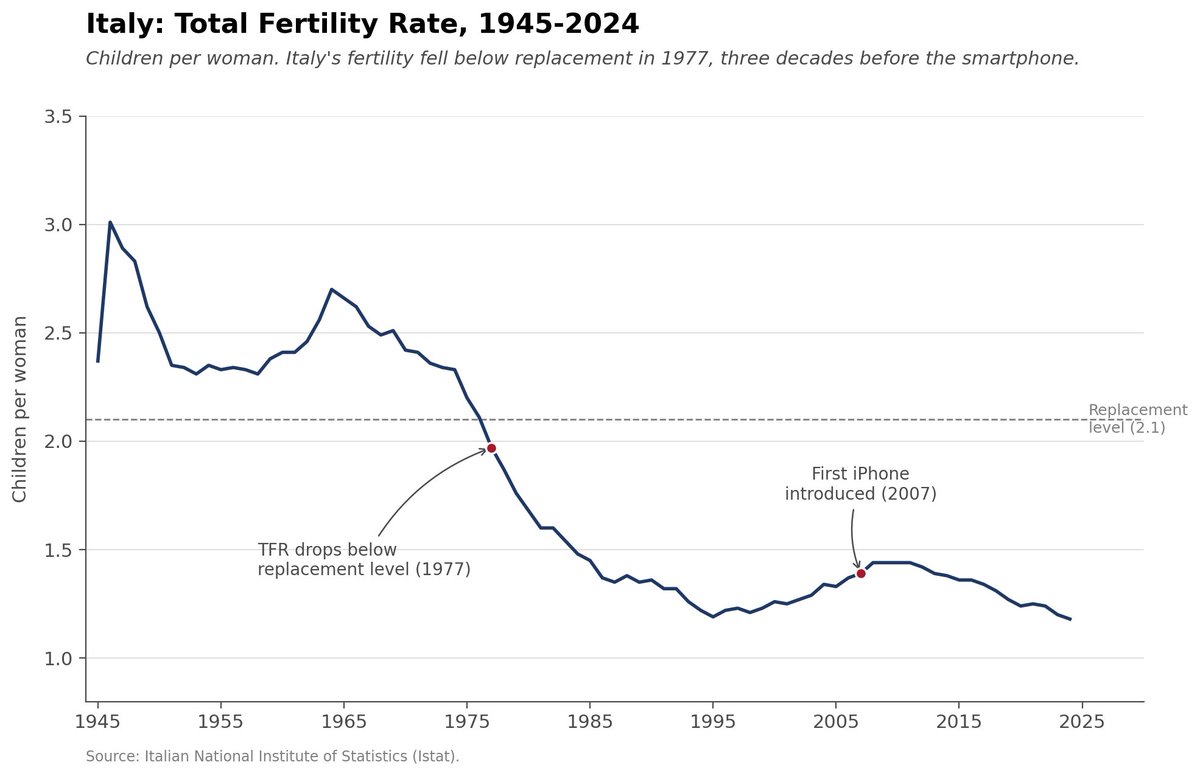
Smartphones are not the explanation for the recent decline in fertility. Instead, they are an accelerator of deeper forces already at work. Let’s start with the facts. Fertility is falling almost everywhere: in rich, middle-income, and poor countries; in secular and religious countries; and in countries with high and low levels of gender equality. The decline accelerated around 2014. So, no country-specific explanation will work unless you are willing to believe that 200 distinct country-specific explanations arrived at roughly the same time. Smartphones look like the obvious candidate: the first iPhone was released in 2007, and global adoption has been astonishingly fast. Economists understand the first major decline in fertility in advanced economies, from 6 or 7 children per woman throughout most of human history to about 1.8, that occurred between the early 1800s and roughly 1970, well before smartphones. The main drivers were a sharp fall in child mortality (effective fertility was rarely above 3 and often close to 2) and the shift from a low-skill, rural agrarian economy to a high-skill, urban industrial one. We have quantitative models that fit these facts well. Country-specific factors mattered too, of course. Proximity to low-fertility neighbors accelerated Hungary’s decline, while fragmented landowning structures accelerated France’s. But these were second-order mechanisms. This is also why most economists long considered Paul Ehrlich’s doom scenarios implausible. We forecast that fertility in middle- and low-income economies would follow the same path as in the rich, probably faster, because reductions in child mortality reached India or Africa at lower income levels (medical technology is nearly universal, and most gains come from handwashing and cheap antibiotics, not Mayo Clinic-level care). Much of what we see in Africa or parts of Latin America today is still that old story. But in the 1980s, a new pattern appeared. Japan and Italy fell below 1.8, the level we had thought was the new floor. By 1990, Japan was at 1.54 and Italy at 1.36. This second fertility decline began in Japan and Italy earlier than elsewhere, driven by country-specific factors, but the underlying dynamics were widespread: secularization, an education arms race, expensive housing, the dissolution of old social networks, and the shift to a service economy in which women’s bargaining power within the household is higher. The U.S. lagged because secularization came later, suburban housing remained relatively cheap, and African American fertility was still high. U.S. demographic patterns are exceptional and skew how academics (most of whom are in the U.S.) and the New York Times see the world. My best guess is that, without smartphones, Italy’s 2025 fertility rate would be about 1.24 rather than 1.14. I doubt anyone will document an effect larger than 0.1-0.2. Italy was at 1.19 in 1995, not far from today’s 1.14. The TFR is cyclical due to tempo effects, so I do not read too much into the rise between 1995 and 2007 or the decline from 1.27 in 2019 to 1.14 today. The direct effect of smartphones is not zero, but it is not, by itself, that large. Where social media, in general, and smartphones, in particular, matter is in the diffusion of social norms. What would have taken 25 years now happens in 10. Social media are not the cause of fertility decline; modernity is. But they are a very fast accelerator. That is why social media are a major part of the story behind Guatemala (yes, Guatemala) going from 3.8 children per woman in 2005 to 1.9 in 2025. Without them, Guatemala would also have reached 1.9, just 20 years later. Modernity, in its current form, is incompatible with replacement-level fertility. By modernity, I do not mean capitalism: fertility fell earlier and faster in socialist economies than in market economies. Socialist Hungary fell below replacement in 1960, and socialist Czechoslovakia in 1966 (both experienced small, short-lived baby booms in the mid-1970s). By modernity, I mean a society organized around rational, large-scale systems and formalized knowledge. Countries will not converge to the same fertility rate. East Asia is likely stuck near 1, possibly below, given its unbalanced gender norms and toxic education systems. Latin America faces the same gender problem plus weak growth prospects, so I expect something around 1.2. Northern Europe has more egalitarian family structures and might hold near 1.5. The very religious societies are probably the only ones that will sustain 1.8. All of this could change with AI or changes in population composition. We will see. But on the current evidence, deep sub-replacement fertility is the “new new normal.” Unless we reorganize our societies, better learn to handle it as best we can.
224
918
3,712
901,480
Dan Zeltzer retweeted
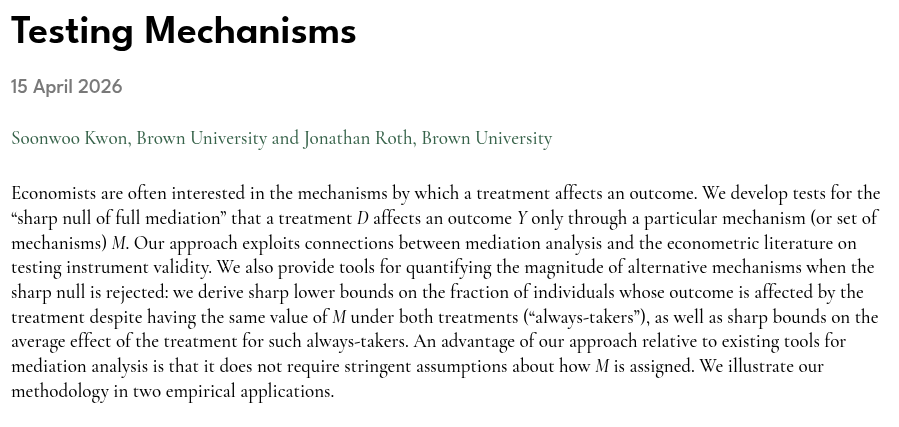
I’m really excited about this paper! Some of my work has pointed out problems in empirical work, but this one is all about new 🔧s. If you (or your referees) want to know about the mechanisms by which a treatment affects an outcome, you may be interested. A 🧵.
Want to know about the mechanisms by which a treatment affects an outcome? This paper develops tools for testing hypotheses about mechanisms under weak assumptions. Check it out! New paper by @jondr44 and Kwon: restud.com/testing-mechanism… #REStud #EconX #EconTwitter
9
116
528
61,881
Dan Zeltzer retweeted
New paper by Blandhol, Bonney, Mogstad, and Torgovitsky: restud.com/when-is-tsls-actu… #REStud #EconX #EconTwitter
46
193
31,659
Dan Zeltzer retweeted
I think all leading universities should
I think @Princeton should seriously consider adopting the recommendations in the Yale report, which include: • Expand financial aid and make pricing more transparent and predictable for families • Reform admissions by prioritizing academic achievement, reducing legacy/athlete/donor preferences, and establishing a minimum academic threshold • Address grade inflation — Yale's median grade is now an A — through grade normalization and transcript percentiles. (Harvard and Yale are moving so we wouldn't be going alone this time.) • Combat self-censorship in classrooms, with joint faculty-student classroom principles • Pursue intellectual pluralism through departmental self-studies and investment in underrepresented scholarly traditions • Implement a device-free classroom default to restore focused learning • Create a shared civic education curriculum for first-year undergraduates • Streamline administrative bureaucracy with a transparent, faculty-involved review • Strengthen faculty governance, including faculty liaisons to the Board of Trustees • Communicate more openly and listen more broadly to public concerns
8
55
438
147,393
Dan Zeltzer retweeted
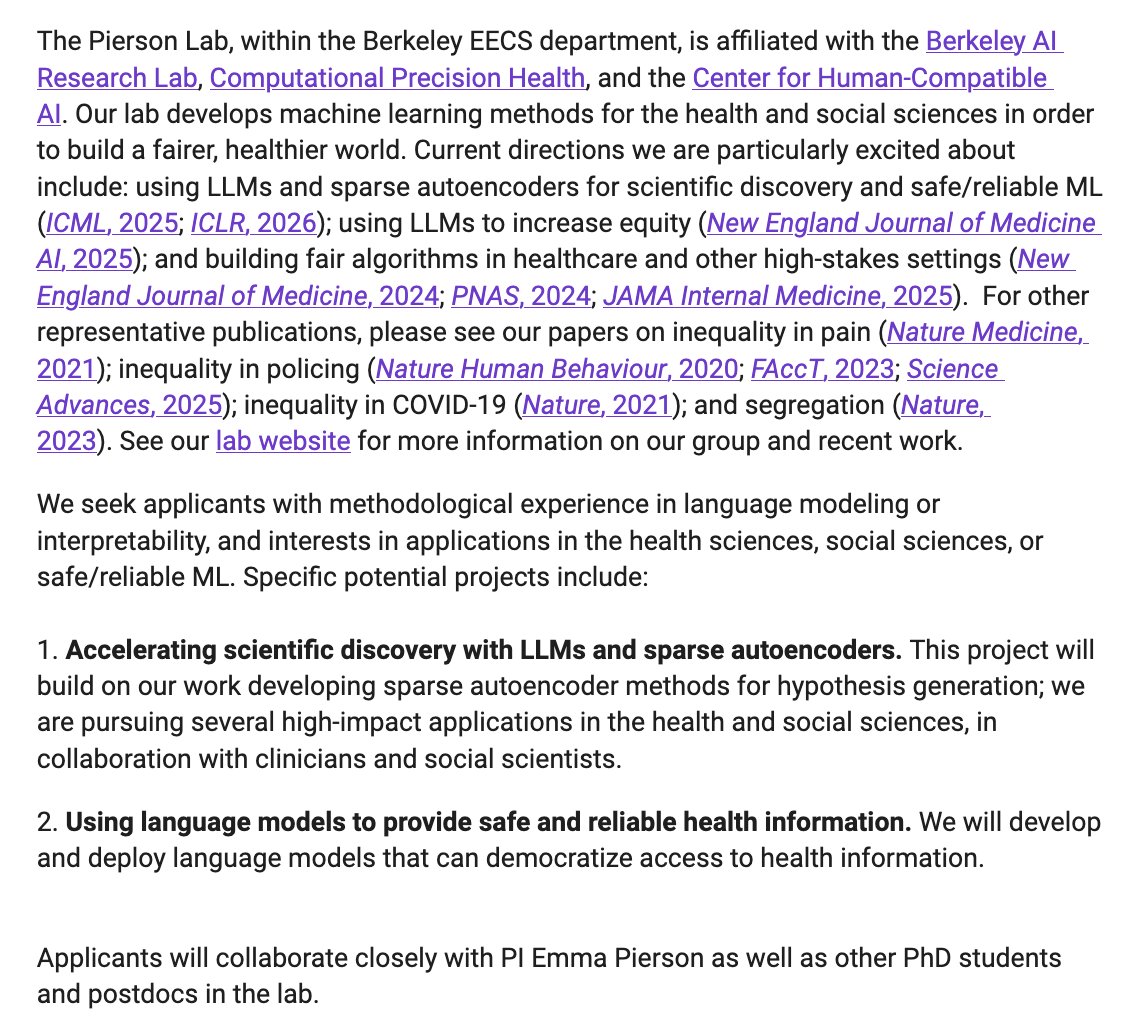
Our lab, within the Berkeley EECS department, is hiring a postdoc! More info and quick application form: forms.gle/41tTVesNqtz33R838 Apply by May 1! Please reshare :)
2
29
118
24,465
🚨New in AER🚨: "Negative Control Falsification Tests for IV Designs" (@DanieliOren, @DanielNevo, Itai Walk, Bar Weinstein, @danzeltzer). doi.org/10.1257/aer.20240636 Common placebo test implementations may reject valid IVs. We're coming to save your IVs! 🧵
1
51
173
15,917
Checklist: name the specific threat to your IV (what's the APO/API). Find observed NCO/NCI proxies satisfying assumptions. Condition on the IV for NCI tests. If you reject, diagnose identification vs. functional form. Use multiple controls and joint tests for power. /10
1
4
258
PS: at this point we should probably just make it a Claude skill :)
2
199
Dan Zeltzer retweeted
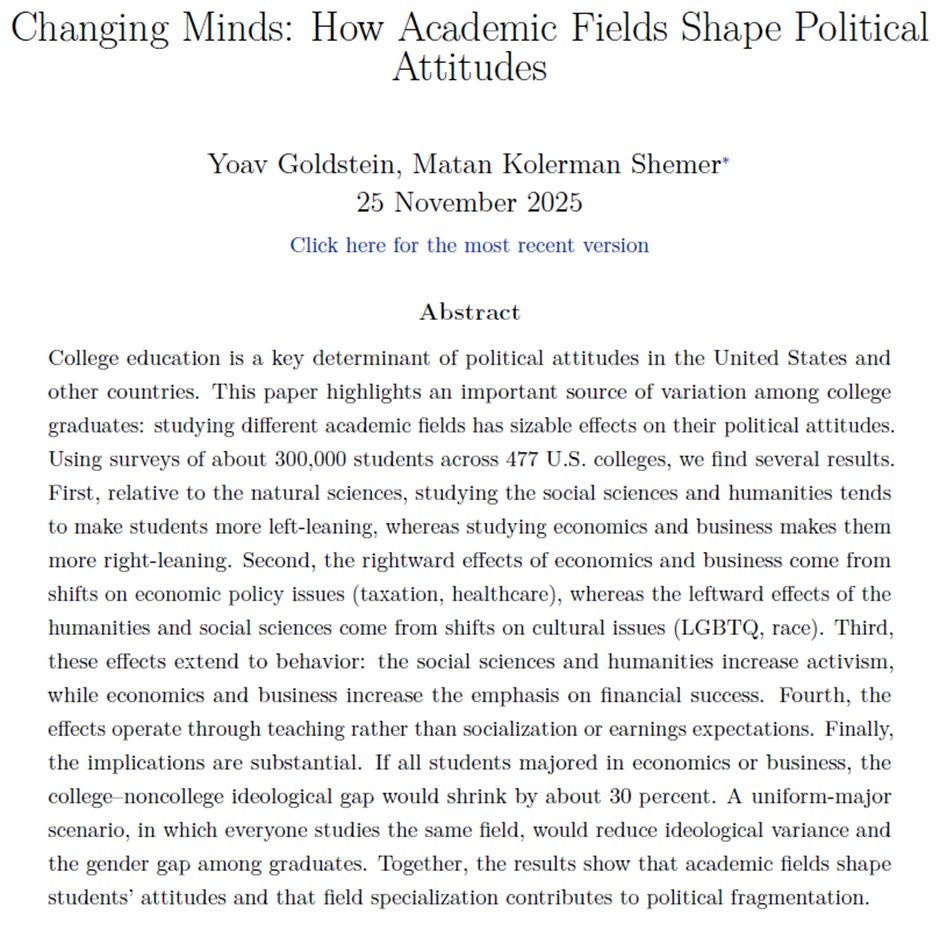
This is very interesting and the results actually surprise me. I didn't have any doubt that going to university had a causal effect on political ideology, but I assumed it was mostly driven by peers (basically I saw the mechanism as a kind of positive feedback loop where people already selected to be left-wing become even more left-wing as a result of being around similarly selected people), whereas this paper finds that it's driven by content and faculty.
Excited to share my JMP! Do academic fields of study causally influence students' political preferences? Through what mechanisms? And what are the broader civic implications? 👇 #EconJobMarket #EconTwitter Joint with @matankoler (PhD @HebrewU, now postdoc @MITEcon)
7
15
148
22,267