
Cloud Solutions Architect, Instructor of AWS,Azure,Cisco, VCP/I, ex. Technical Director in multiple European Start ups. A Linux and Cloud bigot.
Joined February 2011
- Tweets 2,866
- Following 2,601
- Followers 507
- Likes 25,508
49 Photos and videos







Interesting and very true points about the education system but we need to remember that AI is quite new and only recently adopted by many educational institutions. The old industrial like system has been the way to scale reaching education for centuries! What do you 🤔 ?

Elon Musk thinks the entire education system is built on a broken assumption.
That every student should learn the same thing. At the same speed. In the same order. At the same time.
Musk: “Everyone goes through from like 5th grade to 6th grade to 7th grade like it’s an assembly line. But people are not objects on an assembly line.”
The model was designed for a factory economy. Standardized inputs. Predictable outputs.
That economy is gone. The assembly line is gone.
But the education system still runs on its logic.
A student who masters algebra in two weeks sits through eight more weeks because the calendar says so. A student who struggles gets dragged forward because the schedule doesn’t wait.
Neither is being served. Both are being processed.
Musk: “Allow people to progress at the fastest pace that they can or are interested in, in each subject.”
AI doesn’t teach a classroom. It teaches a student.
One at a time. Every time.
It skips what a student already knows. It finds where they’re stuck and approaches it from a different angle.
It adjusts in real time. Not at the end of a semester when the damage is already done.
A student obsessed with basketball learns fractions through shooting percentages. A student who builds in Minecraft learns geometry through architecture.
The subject doesn’t change. The entry point does.
No teacher with thirty students can do this. Not because they lack skill.
Because the math doesn’t work.
AI doesn’t have that constraint.
Musk: “You do not need to tell your kid to play video games. They will play video games on autopilot all day. So if you can make it interactive and engaging, then you can make education far more compelling.”
The brain isn’t broken. The format is.
Kids learn complex systems and strategic thinking for hours voluntarily. Then walk into a classroom and can’t focus for twenty minutes.
That’s not a discipline problem. That’s a design problem.
Musk: “A university education is often unnecessary. You probably learn the vast majority of what you’re going to learn there in the first two years. And most of it is from your classmates.”
Four years. Six figures of debt.
And the real value comes from the people sitting next to you. Not the institution charging you.
The degree doesn’t certify knowledge. It certifies endurance.
Musk: “If the goal is to start a company, I would say no point in finishing college.”
The system was built to train employees. If you’re not trying to be one, it has nothing left to offer you.
Every lecture. Every textbook. Every curriculum. Now available instantly. Personalized to any learner. Adapted to any pace.
The question isn’t whether the old model survives.
It’s how long we keep forcing students through it while the replacement already exists.
1
27
Do you remember when you joined X? I do! #MyXAnniversary . Thank you @elonmusk making it possible !
1
21
Harri retweeted

29 Dec 2025
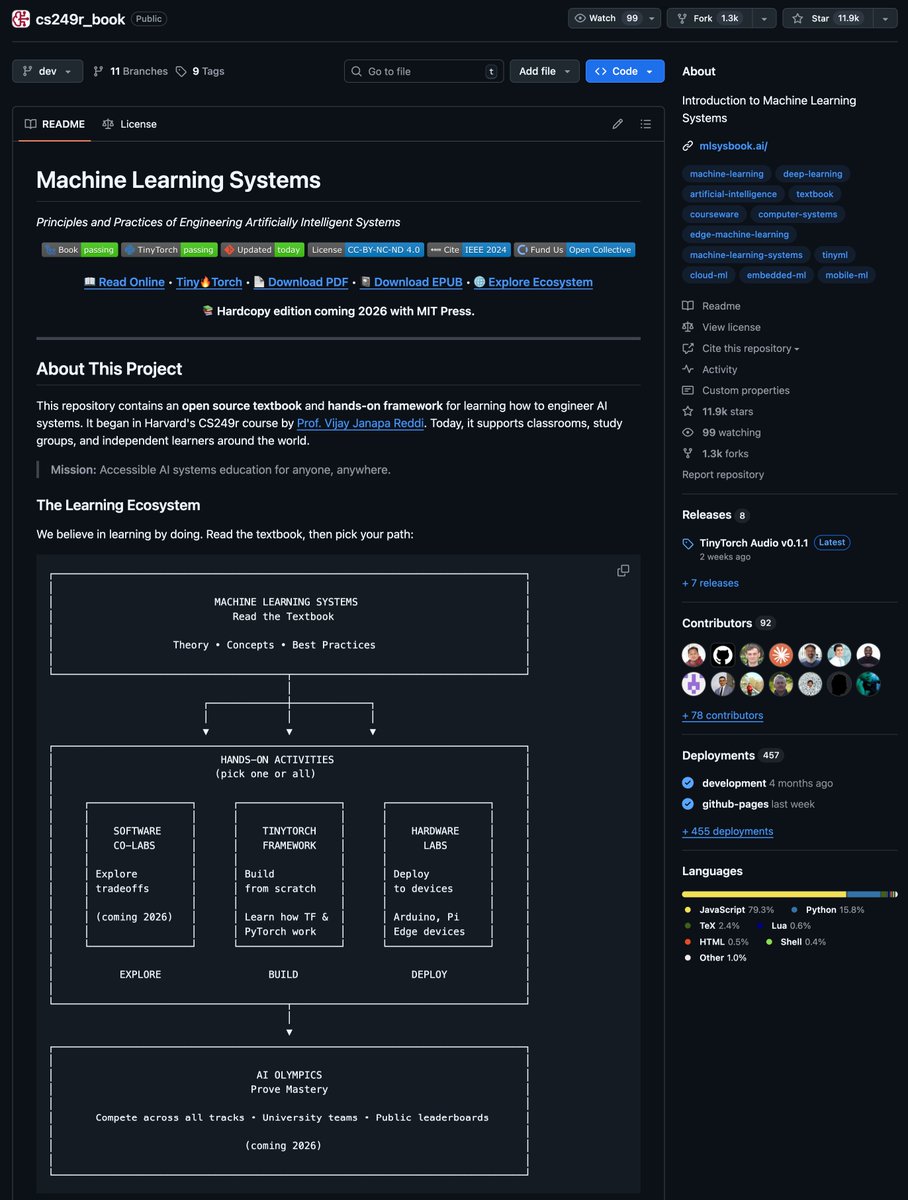
Harvard's just open-sourced their ML Systems textbook. it's extremely practical for not just learning how to build and train models, but to build production systems (the skill that actually matters). topics are cool af:
> building autograd, optimizers, attention, and a mini-pytorch from scratch to truly learn how an ML framework runs. (i love this the most)
> basics of DL, batch sizes, precision, model architectures, and training
> ML performance optimization, HW acceleration, benchmarking, efficiency
so this is not just an intro to machine learning, it's the full package from the beginning to the actual end. right now you can read the book and access the code for free. this is one of the best books I've seen dropping in 2025, so don't sleep on it.
here's the repo (you can find the book link there): github.com/harvard-edge/cs24…
50
645
5,137
280,221

I spoke with @typecraft_dev about Omarchy, Linux, loving computers, breaking habits, and leveling up your knowledge. There's definitely something in the water now with Linux! Feels like the OSX anno 2001 vibe. youtu.be/zikJTpJgzzo?si=AV39…
18
21
448
79,341
Harri retweeted

30 Jun 2025
🚀 New blog! If you work with GitHub Copilot, Azure and Bicep, you will want to check out GitHub Copilot for Azure (GA). It can generate fully schema-validated Bicep files for you using agent mode.
🔗 Read the blog post here: johnlokerse.dev/2025/06/30/f…
In my latest blog post, you will learn about the GitHub Copilot for Azure extension and how to use it for Infrastructure as Code generation, including practical examples you can use in your day-to-day work. Super useful if you are working with Infrastructure as Code!
Enjoy the read!
#github #githubcopilot #azure #infrastructureascode #azurebicep #cloudmarathoner #MVPBuzz
17
41
1,839


Harri retweeted

24 Mar 2025
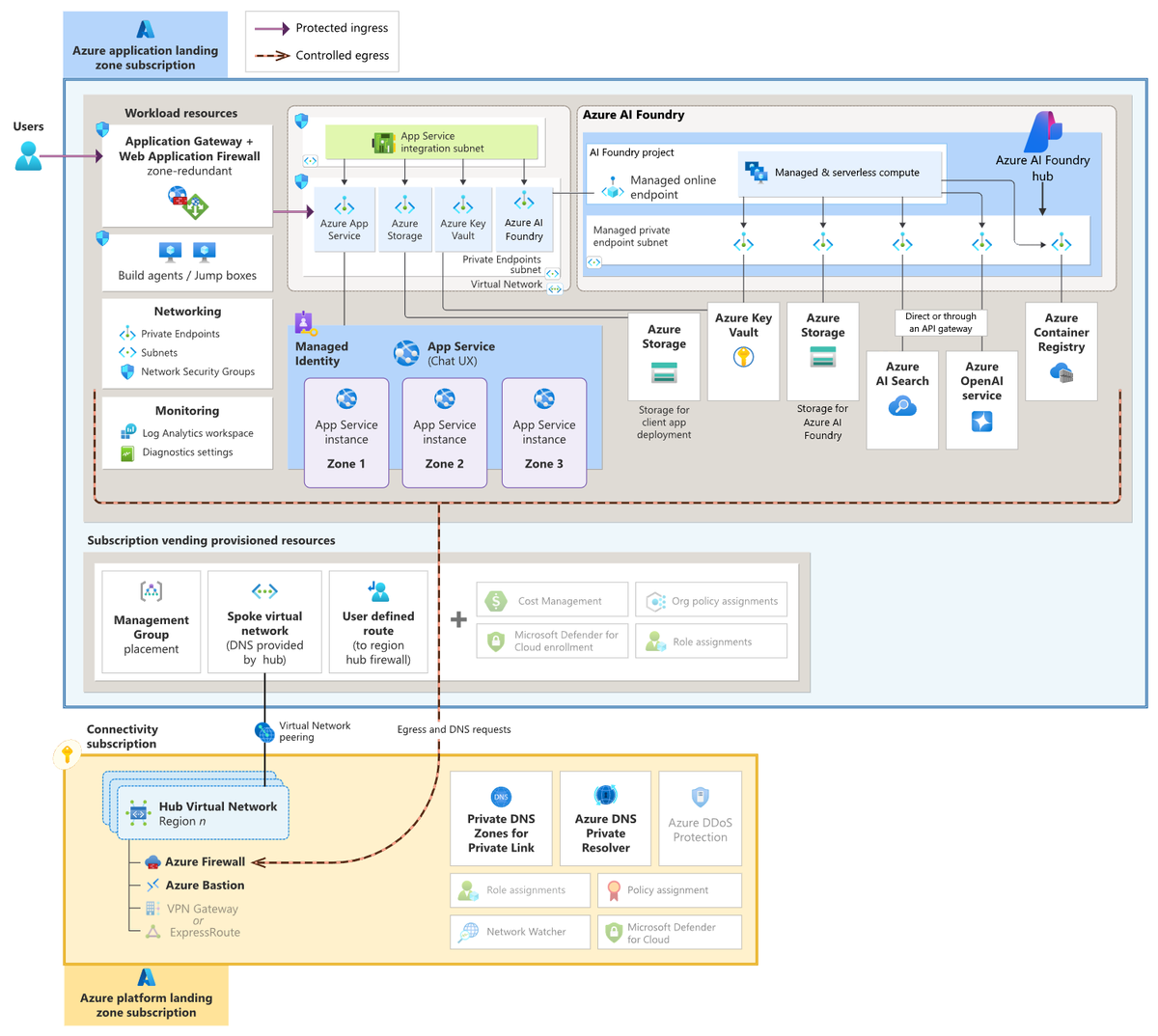
Dive into a baseline chat architecture designed for Azure landing zones, learn how to deploy your first Azure AI Agent Service on App Service, and discover how Model Context Protocol (MCP) enhances tool integration for real-time AI actions. Optimize RAG performance at scale with vector index techniques, and follow best practices for leveraging Azure OpenAI in code conversion projects. Get all the insights here!
✅ Azure OpenAI chat baseline architecture in an Azure landing zone
A generative AI chat architecture built on Azure uses a workload-owned approach within an Azure landing zone, where core components like Azure OpenAI, AI Foundry, and App Service are managed by the workload team, while networking, DNS, security, and policy controls are centralized and maintained by the platform team to ensure governance, scalability, and operational efficiency
learn.microsoft.com/azure/ar…
✅ Deploy Your First Azure AI Agent Service on Azure App Service
This guide walks through deploying your first Azure AI Agent Service using GPT-4o on Azure App Service, starting from AI Hub setup in Azure AI Foundry, model deployment, agent creation with tools, Chainlit-based conversational app development, to a secure, scalable deployment via GitHub on Azure infrastructure—all with minimal manual configuration
techcommunity.microsoft.com/…
✅ Model Context Protocol (MCP): Integrating Azure OpenAI for Enhanced Tool Integration and Prompting
MCP enhances Azure OpenAI's capabilities by standardizing AI-to-tool communication via a client-server architecture, allowing modular integration with local or remote services, and enabling AI agents to perform real-time actions through reusable, secure tool connectors
techcommunity.microsoft.com/…
✅ RAG Time Journey: Optimize your vector index for scale
Optimizing Azure AI Search vector indexes for large-scale AI by using compression (scalar/binary quantization), truncation (MRL), and storage strategies to drastically reduce memory use while maintaining high result quality through oversampling and rescoring
techcommunity.microsoft.com/…
✅ Best Practices for Leveraging Azure OpenAI in Code Conversion Scenarios
To modernize codebases efficiently, Azure OpenAI enables automated code conversion through classification, rationalization, annotation, and validation, while best practices like closed-loop feedback, RAG for context, and human review ensure accurate, scalable, and reliable translations across languages
techcommunity.microsoft.com/…
23
77
4,949
My new default distro is Bluefin for development and Bazzite for gaming. The most hassle free distros - warmly recommended! thenewstack.io/bluefin-a-nex…
2
118
18
Google please do not fumble the ChromeOS! I do share the concerns of the article! we do not need nor want Android's hydra-update mess with 20 flavours of the OS for our Chromebooks. androidpolice.com/google-not…
24
16
Harri retweeted

6 Dec 2024
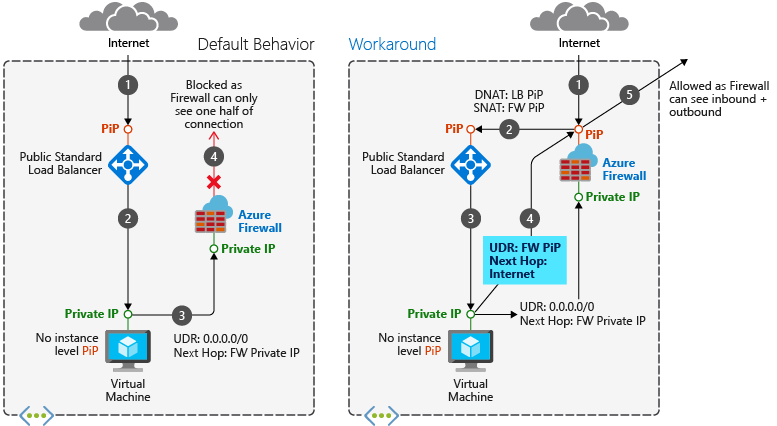
🔐 Boost your network security by integrating #AzureFirewall with #Azure Standard Load Balancer (public or internal). Learn how to prevent routing issues and enhance protection with this setup:msft.it/6015o1cAV #AzSuppSecurity
27
72
7,080

Starlink Mini is now available in Finland!
Order online in less than 2 minutes

681
300
3,910
24,515,569
Wsl integration to Entra Id and Intune are coming to WSL. devblogs.microsoft.com/comma…
17
Harri retweeted

11 Nov 2024
Exciting news: Microsoft has made #AlmaLinux an endorsed #Linux distro! 🙌
🔗 phoronix.com/news/Azure-Endo… via @Phoronix
2
18
69
3,075