
I help systematic traders make more money from their trading strategies. Created and trade 25 strategies. Creator of the Line Your Own Pockets podcast.
Joined February 2009
- Tweets 5,533
- Following 225
- Followers 3,741
- Likes 8,116
720 Photos and videos




Dave Mabe retweeted

Mar 29
Big thanks to all who helped RealTest win the low-cost standalone technical analysis software category in Technical Analysis of Stocks & Commodities magazine's Reader's Choice Awards. Particular thanks and congrats to Richard @NorgateData for your repeated top-choice award.
8
3
69
6,652

Very true. Nice explanation of this concept!

THE SHORTEST TIMEFRAMES HAVE THE MOST EDGE!
This is a view I’ve mentioned before in interviews, but I’ve never taken the time to fully expand on.
In general, you want to be an expected value maximalist (within risk constraints). And the shortest human timeframes offer that. Yes, I mostly do bigger picture trades now but that’s due to scalability and quality of life, not bc they offer the most edge.
The paradox of markets is this:
-The shortest timeframes often have the biggest dislocations (most “edge per minute”)
-The longest timeframes often have the biggest tailwind (asset prices tend to rise over time)
-The middle is where many traders get chopped up
This principle is the reason why there were traders at Trillium that could be positive hundreds of days in a row. You’ll never see that with a swing trader or value investor.
1. Why short timeframes can have so much edge
At very short horizons, markets can be temporarily inefficient because of:
-forced behavior (stops, liquidations, margin pressure)
-delayed human interpretation of information
-mechanical flows around opens/closes
-short-lived supply/demand vacuums
Those create moments where price can be “wrong” for seconds/minutes relative to where it’s about to reprice.
In fact, at the extreme short end of human discretionary trading like the two following examples, you can find opportunities that approach 100% win rate with a profit factor of 10 . Of course there is a trade-off which I’ll get into.
2. Order flow imbalances
One of the biggest short-term edges is understanding order flow imbalance. Yes, these happen far less of the now than they used to as discussed in my interview yesterday with Serge. But they still exist particularly during times of market extremes.
-aggressive buyers/sellers temporarily overwhelm passive liquidity
-one-sided flow causes price to overshoot or stall
-liquidity can disappear at key moments, then refill at new levels
You’ll see this around:
-opening auctions
-panic flushes / squeezes
-large fund rebalancing windows
-crowded positioning unwinds
This is where the tape can get dislocated from “fair” value in the short run and where active traders can extract edge. It is also why some of those hyperscalpers like @EdBarry4 are positive so many days in a row.
3. Breaking news is where discretionary human traders still have the edge over algos in interpreting novel headlines.
There’s usually a sequence:
-headline reaction
-second-order interpretation
-positioning unwind/chase
-stabilization
If you’re prepared and fast, these windows can be highly asymmetric. In fact, breaking news can offer some of the best opportunities in existence, especially when applied to liquid instruments (think April 2025 tariff headlines!).
In fact, I’d argue tariff headlines due to their massive impact on global markets are some of the best expected value opportunities I’ve ever seen.
4. But there’s a tradeoff: liquidity scalability
The shorter the timeframe, the more your edge depends on:
-execution speed
-order optimization
-fee minimization
-slippage minimization
So yes, edge can be highest in short windows but liquidity becomes the constraint. Many short-duration edges don’t scale without degrading returns.
That is why many traders post eye-watering returns in small caps but then you constantly see them doing their dumb small account challenges. It’s because their strategies don’t scale!
5. Beware the middle ground.
Take this thought experiment. Let’s say $AAPL flash crashes 90%. With near-certainty, Apple will bounce within minutes close back to the unaffected price. What happens overnight is more of a toss-up. What does the market do? Does news come out? Yet over the course of 5-10 years, it’s likely the $AAPL goes up.
In that middle ground, you take on variance from overnight risk, headline risk, and market risk. But don’t benefit much from the fact that over years, markets go up. It’s much more of a coin flip whether we go up or down any given day.
If I had to guess, the most edge is in tenths of seconds and seconds for humans. The least edge is in the window of weeks. Why not compete at even faster timeframes? Bc then you fight with HFT, commission structures, co-location, and more.
6. So how to apply this?
First, this is useful for the sniff test. Understanding that there is a trade-off between edge and liquidity is critical!
There is a reason why you see small cap traders that can scale a small account over 1,000% in a year (think early days of @theshortbear). There is also a reason why Warren Buffett has approached market returns.
It’s that trade-off between edge and scale. Similar to the general trade-off between win-rate and profit factor, it’s a safe assumption that these often tend to move inverse to each other. It’s the reason why that if I managed $1B my returns would probably get quartered and if I managed $10B my returns would approach market returns or worse.
This framework is also useful for finding the most edge and understanding your strategies. If you’re moving to a higher timeframe, you generally SHOULD expect more variance. That comes with the benefit of scalability.
Similarly, if you want to study micro-inefficiencies, particularly in less efficient markets like crypto, you can find some insane edges there.
1
5
1,115
Dave Mabe retweeted

@davemabe and the hundreds (thousands?) of traders that he has helped would like to have a word with you.
1
4
916
Dave Mabe retweeted

Mar 2
If you want to survive drawdowns and actually scale your trading…
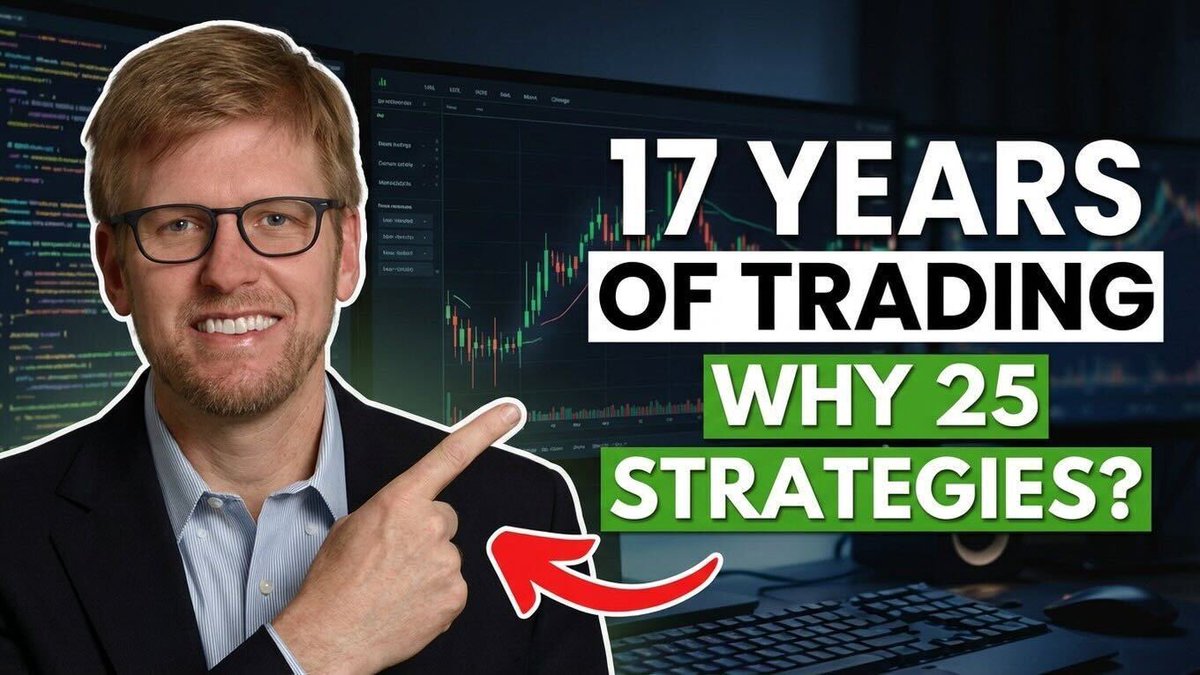
I just posted my interview with Dave Mabe @davemabe a guy who's been day trading for 20 years and now runs 25 automated strategies every single day.
We talk about how to survive a drawdown without quitting, why you don't need to be a coder to automate your trading in 2026, and more.
Watch it here: youtu.be/BAiSzcY0jrA
1
3
10
977
Dave Mabe retweeted

NEW EPISODE 318📢 The Shift to Systematic Trading, Building Backtested Confidence |Dave Mabe
How often have you thought about going systematic, only to feel overwhelmed by the idea of backtesting? @davemabe 🙏 Ian Cox & @tessa_dao
chatwithtraders.com/episode/…
1
3
18
5,676
Dave Mabe retweeted

Jan 6
excited to have @davemabe join us again at the @smbcapital Bionic Trader meeting today after the close!
Dave is going to go over a strategy and how he thinks about optimizing it
if you’re unfamiliar with Dave, check out how he breaks down his process for developing profitable strategies here:
youtu.be/pPIPvyticq4?si=lgdt…
2
2
20
3,495
Dave Mabe retweeted

26 Dec 2025
The "All on my own" trader is a myth that limits your P&L. If you want to be your best, stop hoarding your "secret sauce" and start building a team. 🧵
Trading is often sold as a solo journey, but the fastest way to find a new edge is through the eyes of someone who thinks differently from you.
What you’ll learn from this philosophy:
The Trust System: Collaboration isn't "willy-nilly"—it’s a systematic process of building trust with peers.
The Giver’s Advantage: Being a "default giver" opens doors to strategies and ideas you literally couldn't conceive of on your own.
The Achilles Heel Fix: When you stop hoarding tools and start sharing, you find partners who fill your blind spots.
The Insight:
"The more you share as a trader, the more you're going to get back. Most people are takers; they are only thinking about themselves. You should be thinking about how you can improve someone else's life and make their trading better. When you start thinking that way, you develop collaborations with people who think in completely different ways than you do. They will share ideas with you that you would literally never think of on your own."- @DaveMabe (1:08:00 👇)
#TradingPsychology #TradingMindset #Collaboration
Your Trading Strategy Will Fail Until You Understand This ONE Process youtu.be/pPIPvyticq4?si=B_59… via @YouTube @GarrettDrinon @BeldenTim
5
14
72
14,150
Dave Mabe retweeted
24 Dec 2025
In the latest episode of the @smbcapital Trading Floor Podcast, we sat down with @davemabe (founder of MabeKit) as he broke down his path to high-output systematic trading.
We learned that optimization is the true edge, not the initial signal. Mabe argues that "good traders are just skipping the bad trades," and systematic tools allow you to do this with mathematical precision.
Dave shows us how building a robust "column library" of indicators, traders can move away from "guess-and-check" loops and toward a repeatable process of strategy discovery and refinement.
This conversation felt just like one of the many times @BeldenTim and I have sat down over coffee with Dave to pick his brain, and that’s why I enjoyed this episode so much.
youtu.be/pPIPvyticq4?si=VPNG…
2
6
36
8,233
Dave Mabe retweeted
19 Dec 2025
just finished shooting a conversation with @davemabe for The Trading Floor Podcast @smbcapital — just like in our regular private coffee sessions, Dave shares invuable wisdom from his 20 years of trading
we cover how he builds a strategy from beginning to end, highlighting which indicators he likes to use, what tools he uses to analyze data, and why a strategy does not have to be a secret, esoteric idea in order to work
should drop this weekend 💣
1
3
31
5,089
Dave Mabe retweeted

13 Dec 2025
The first backtest is meant to build a large data set, not your final strategy. Edge comes from refining that data over time.
👉 Watch the full video with @davemabe here:
investorsunderground.com/dav…
3
14
1,975
Dave Mabe retweeted
13 Dec 2025
New Trader Interview 🎙️
Check out our interview with @davemabe
investorsunderground.com/dav…
✅ How Dave's engineering background shaped his approach to markets and risk.
✅ Common backtesting mistakes: overfitting, data mining, and more.
✅ The full lifecycle: from hypothesis to live capital.
5
17
6,233
Dave Mabe retweeted
11 Dec 2025
🎙️ New Episode!
@nieto sits down with @davemabe to discuss his trading journey, how he navigates automation and backtesting, uses data to build edge, and shares a blueprint to improve your data strategy.
🎥 The Trader's Journey drops this Saturday at 9 AM EST!
1
3
9
1,851

Had another great session with @GarrettDrinon on the Bionic Trader with @smbcapital on Monday. Great show and community!
5
3,344
Dave Mabe retweeted

4 Nov 2025
If you feel like you're bad at your job and it's making you depressed, just consider that, as the investigation of the recent heist revealed, the password to access the Louvre's videosurveillance system was "Louvre".
668
13,749
160,318
4,056,052
Excited to be back on @smbcapital's show Bionic Trader this afternoon with @GarrettDrinon
We'll be discussing backtesting software and the options available for retail traders.
1
2
10
1,633
Sorry, but you're not important enough for anyone to be "hunting" for your stop. Here's the right way to come up with a strategy with a stop loss that's optimal.
That means you'll be stopped out by a penny routinely. Which is a good thing:
lineyourownpockets.com/episo…
1
2
761
It was great to join @GarrettDrinon and @smbcapital on Bionic Trader yesterday to discuss How to Avoid Curve Fitting! Lots of good questions from traders in the room.
I'm already looking forward to the next time.
1
3
2,926
Dave Mabe retweeted
22 Sep 2025
This video podcast from the 𝐿𝑖𝑛𝑒 𝑌𝑜𝑢𝑟 𝑂𝑤𝑛 𝑃𝑜𝑐𝑘𝑒𝑡𝑠 channel is a follow-up discussion to an interview with me and my firm. The hosts delve into several key takeaways and offer advice for traders:
𝐓𝐡𝐞 𝐏𝐨𝐰𝐞𝐫 𝐨𝐟 𝐖𝐫𝐢𝐭𝐢𝐧𝐠 𝐚𝐧𝐝 𝐒𝐡𝐚𝐫𝐢𝐧𝐠 [𝟎𝟏:𝟎𝟒]: @DaveMabe recounts how he met me. I reached out after reading Dave's blog, where Dave shared his thoughts on trading. Dave emphasizes that everyone should write about their trading ideas, even if just "shouting into the void," as it can lead to unexpected connections and opportunities.
𝐏𝐫𝐨𝐩𝐫𝐢𝐞𝐭𝐚𝐫𝐲 𝐓𝐫𝐚𝐝𝐢𝐧𝐠 𝐅𝐢𝐫𝐦𝐬 𝐯𝐬. 𝐑𝐞𝐭𝐚𝐢𝐥 𝐓𝐫𝐚𝐝𝐢𝐧𝐠 [𝟎𝟔:𝟎𝟗]: The hosts discuss the advantages of prop firms like SMB Capital, highlighting that traders there are highly serious and focused, creating a competitive yet collaborative environment. They note that prop firms often get significantly better commission rates.
𝐃𝐢𝐬𝐜𝐫𝐞𝐭𝐢𝐨𝐧𝐚𝐫𝐲 𝐚𝐧𝐝 𝐒𝐲𝐬𝐭𝐞𝐦𝐚𝐭𝐢𝐜 𝐓𝐫𝐚𝐝𝐢𝐧𝐠 𝐂𝐨𝐥𝐥𝐚𝐛𝐨𝐫𝐚𝐭𝐢𝐨𝐧 [𝟎𝟖:𝟎𝟖]: SMB Capital is primarily a discretionary trading firm, but the hosts see great potential in integrating systematic trading. They believe that if done correctly, discretionary insights can beautifully feed into systematic strategies.
𝐓𝐡𝐞 "𝐖𝐡𝐲" 𝐁𝐞𝐡𝐢𝐧𝐝 𝐓𝐫𝐚𝐝𝐢𝐧𝐠 𝐒𝐭𝐫𝐚𝐭𝐞𝐠𝐢𝐞𝐬 [𝟑𝟎:𝟏𝟑]: A crucial point for successful collaboration between discretionary and systematic traders is understanding the "why" behind a strategy. Systematic traders need to translate data-driven insights into a coherent story that resonates with discretionary traders, rather than relying solely on complex models like Monte Carlo simulations. Strategies with a strong underlying psychological or market participant reason are generally more robust and easier to adapt when market conditions change.
𝐂𝐨𝐥𝐥𝐚𝐛𝐨𝐫𝐚𝐭𝐢𝐨𝐧 𝐚𝐬 𝐚 𝐅𝐨𝐫𝐜𝐞 𝐌𝐮𝐥𝐭𝐢𝐩𝐥𝐢𝐞𝐫 [𝟑𝟑:𝟎𝟐]: Using a cycling analogy, the hosts explain that just as a group of cyclists can go much faster together than individually, traders can achieve greater success through collaboration. This applies even when skill levels vary, as sharing ideas and working together amplifies collective performance.
𝐁𝐞𝐜𝐨𝐦𝐞 𝐚 𝐆𝐢𝐯𝐞𝐫 [𝟑𝟖:𝟓𝟑]: To foster collaboration, traders should aim to be "givers" rather than "takers." This means offering value, such as systematizing a discretionary trader's ideas or sharing thought processes, to build trust and attract like-minded individuals. They recommend the books 𝐺𝑖𝑣𝑒 𝑎𝑛𝑑 𝑇𝑎𝑘𝑒
by Adam Grant and 𝑇ℎ𝑒 𝐺𝑜-𝐺𝑖𝑣𝑒𝑟.
𝐃𝐨𝐧'𝐭 𝐓𝐫𝐚𝐝𝐞 𝐀𝐥𝐨𝐧𝐞 [𝟒𝟎:𝟒𝟎]: The hosts note that I suggest a "surgeon general warning" for traders: "Don't trade alone." The hosts agree that despite trading often being a solitary activity, pushing for collaboration, even by sharing content online, is the best way forward. The hosts note that SMB traders trade shared accounts to further encourage this collaborative environment.
Follow Up On Quant/Discretionary Collaboration youtu.be/_j4PN31DJOE?si=tuv0… via @YouTube
11
5
27
6,605