
Associate Professor @CommDeptMSU | @Stanford & @Cornell alum
Joined May 2009
- Tweets 1,082
- Following 190
- Followers 1,001
- Likes 4,425
Photos and videos

🚨 Introducing Dyadic (chatdyadic.com/) — a research platform for human–human and human–AI conversation studies. 🚨
Select features:
• Text/audio chat studies
• AI confederates, API integrations
• Surveys before/during/after chats
• Qualtrics Prolific integration
2
1
3
119
I'm excited about Dyadic's survey delivery feature. Researchers can deploy scales and open-ended questions before, during, or after conversations, pairing language data with self-reports. Please message with any feedback or questions! Preprint: arxiv.org/abs/2603.22227
47

Research from @MSUComArtSci 's @davidmmarkowitz is featured in a @BBCWorld article about cynicism.
bbc.com/future/article/20260…
1
1
5
553
Dave Markowitz retweeted

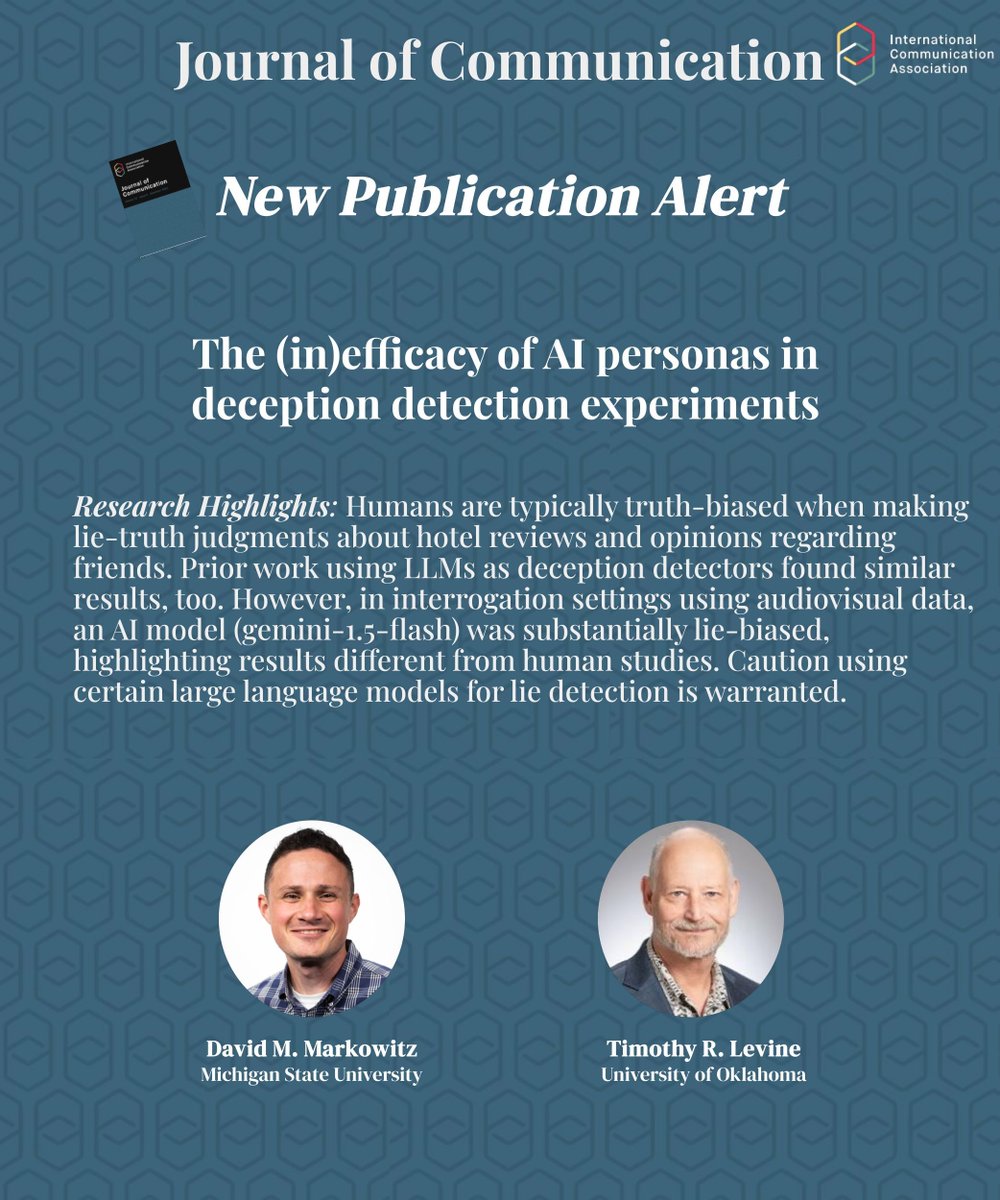
Introducing JoC publication: “The (in)efficacy of AI personas in deception detection experiments”, by David M Markowitz @davidmmarkowitz , Timothy R Levine.
Read here: doi.org/10.1093/joc/jqaf034
1
3
7
1,039
Dave Markowitz retweeted

Feb 12
Introducing Simile.
Simulating human behavior is one of the most consequential and technically difficult problems of our time.
We raised $100M from Index, Hanabi, A* BCV, @karpathy @drfeifei @adamdangelo @rauchg @scottbelsky among others.
502
827
7,775
2,352,120
.@MSUComArtSci's @davidmmarkowitz found that AI isn't reliable for lie detection just yet. go.msu.edu/Kmk5
1
1
3
521
Setting New Year's resolutions can mean reflecting on your personal values and how you want to be remembered.
@MSUComArtSci's @davidmmarkowitz led a @PNASNews study analyzing 38 million U.S. obituaries to examine what values people are remembered for and what constitutes a life well-lived.

1
1
3
583
Research from @MSUComArtSci's @davidmmarkowitz was featured in an op-ed in @Inc from @BillMurphyJr. inc.com/bill-murphy-jr/a-mas…
2
3
583
Dave Markowitz retweeted

9 Dec 2025
Obituaries reveal shifting cultural values across time and place. Here’s what psychology researchers found when they sifted through 38 million published from 1998 to 2024 buff.ly/oTAueW7
2
1
1,520
“It’s easy to see why people might want to use AI to spot lies — it seems like a high-tech, potentially fair, and possibly unbiased solution. But our research shows that we’re not there yet,” said @CommDeptMSU's @davidmmarkowitz, the study's lead author. go.msu.edu/jXk5
1
2
422

18 Sep 2025
Prior work shows AI is often truth-biased in text-based deception detection. In our new 12-study paper in JOC, we find a substantial lie-bias in audiovisual deception detection during mock interrogations. Read more here! doi.org/10.1093/joc/jqaf034
2
5
857
Dave Markowitz retweeted

16 Sep 2025
How societies remember the dead can reveal what people value in life.
🕯️ Drawing on Schwartz’s theory of basic human values, this research tells an important psychological and cultural story about how societies remember human beings and what constitutes a meaningful life 📝
26 Aug 2025

New in @PNASNews! We analyzed 38 million US obituaries to see how we remember the deceased:
- Tradition & benevolence dominate legacies
- Major cultural events (e.g., 9/11) shifted what values were emphasized
- Gender & age of the deceased shape legacies
pnas.org/doi/10.1073/pnas.25…
1
2
468
.@MSUComArtSci's @davidmmarkowitz led a @PNASNews study analyzing 38 million US obituaries to see how we remember the deceased.

1
3
4
707
Dave Markowitz retweeted
26 Aug 2025
New in @PNASNews! We analyzed 38 million US obituaries to see how we remember the deceased:
- Tradition & benevolence dominate legacies
- Major cultural events (e.g., 9/11) shifted what values were emphasized
- Gender & age of the deceased shape legacies
pnas.org/doi/10.1073/pnas.25…
4
12
1,339
Dave Markowitz retweeted

27 Aug 2025
🪦New in @PNASNews: we analyzed 38 million U.S. obituaries to ask what signals a life well lived:
What values are people most remembered for?
How do legacies shift with cultural events?
How do age and gender shape what it means to have lived well?
pnas.org/doi/10.1073/pnas.25…
1
2
2
189
Dave Markowitz retweeted

18 Jun 2025
Jeremy Allen White is Bruce Springsteen in the new trailer for Springsteen: Deliver Me From Nowhere. In theaters October 24.
480
2,470
18,741
15,479,394
Dave Markowitz retweeted

28 May 2025
Take a scroll break, and fly through campus.
4
55
509
31,439
Dave Markowitz retweeted

22 May 2025
This Review by Bailenson et al presents five canonical psychological research findings in VR over the past three decades. These findings have been consistently replicated, and are useful for both researchers and users of VR.
nature.com/articles/s41562-0…
12
37
5,129