If you want insights about AI, dad jokes, entrepreneur/investor stories, and tips about Buenos Aires or San Francisco, smash that follow button.
Joined October 2007
- Tweets 29,762
- Following 316
- Followers 4,907
- Likes 8,839
2,572 Photos and videos


Pinned Tweet

12 Jan 2025
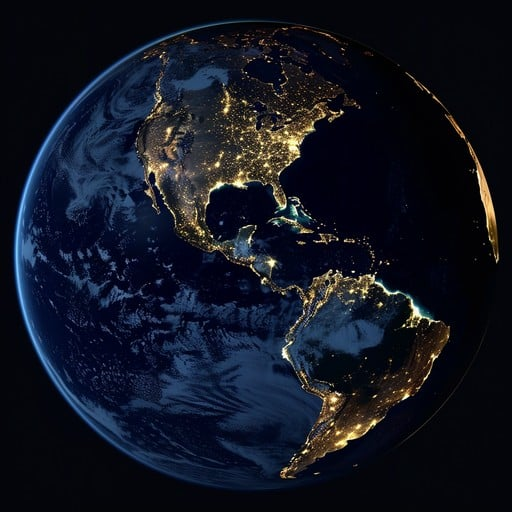
Imagine you have been looking at the Earth from space, for millions and millions of years. It always looks the same. All of a sudden it lights up, in a matter of decades. The blink of an eye. Could you have predicted that? Of course not.
Humans love to predict things. People imagined insane urban landscapes when cars started becoming popular (look at the Western US and its unwalkable cities), or a dystopic life in virtual reality when the internet was invented. Look up the word "teledildonics."
Now we live in one of the most unpredictable periods ever. We have a weird new technology, and the predictions are all over the place. It's pointless to predict whether AI is going to replace job X or job Y, whether it will kill us all (it's increasingly looking like it won't), whether jobs will disappear, or whether it will cure cancer. We're just going to have to ride it and see what happens.
When an expert predicts with arrogant certainty that "in 10 years AI will..." just stop reading. Rolling your eyes is optional.
1
4
38
16,322
This how Microsoft would like things to be, but probably not how they will be. Human capital becomes more valuable as AI grows because of magical thinking? The model is a swappable commodity because you say so? No, the more you fine-tune and refine the prompts for specific model, the more you are locked into it.

1
103
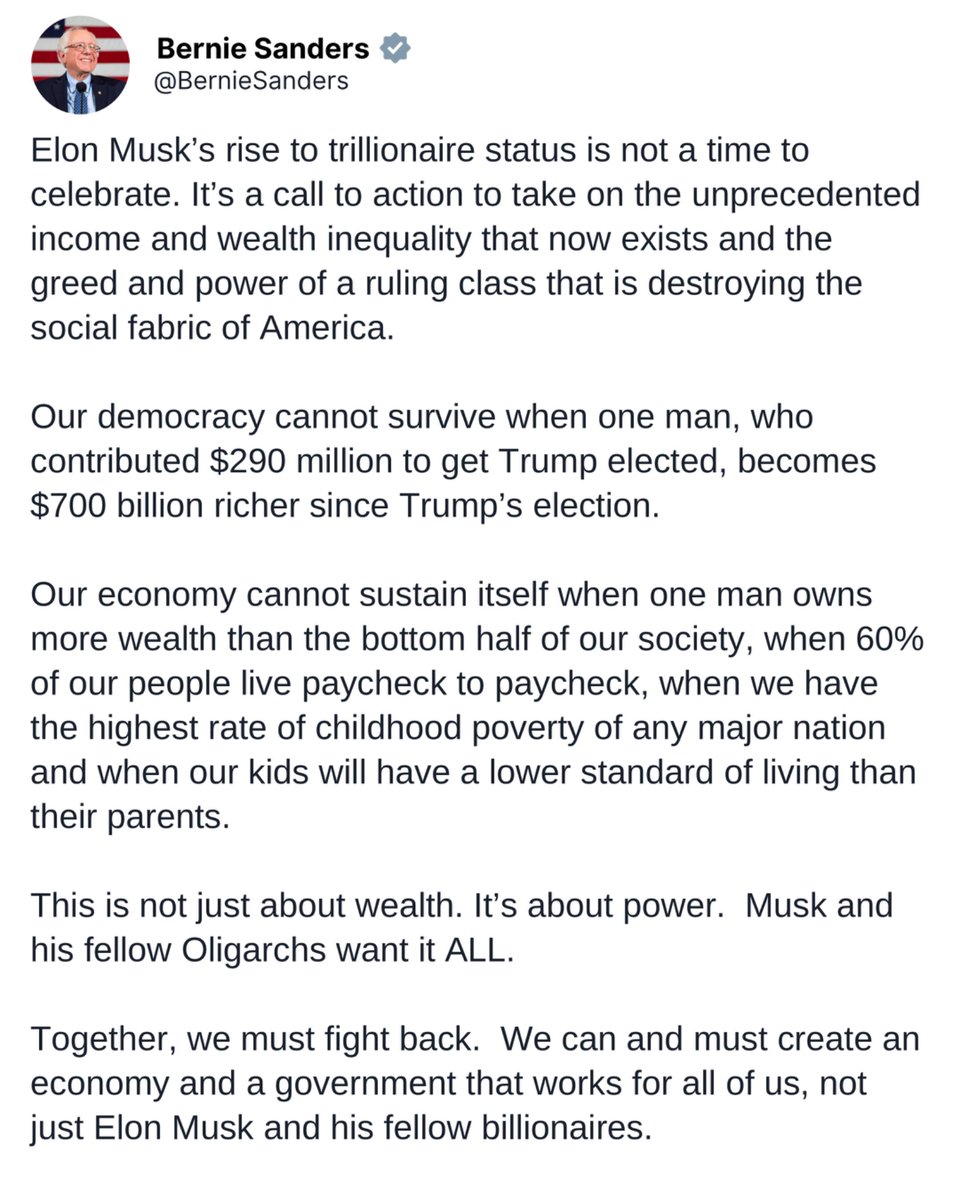
Bernie, Gavin Newsom and Elizabeth Warren seem to be doing all they can to make sure their party loses the next election. Surely there must be a Democrat leader who understands how wealth creation works. Because it’s one of the few things most Americans do understand.
Jun 12

1
132
This is an instance of a pattern: defining yourself by what you're not. There is an infinite number of things you're not, focus on what you are.

It seems a mistake to call oneself a "non-technical founder." You're treating not knowing how to do something as a part of your identity. Surely it's better just to fix that.
138
11h
I propose you do what the rest of us do. Put together a solid pitch and see if the American people want to fund it. Rationale, milestones, accountability. Where the money comes from is another matter. You don’t grab money first and then come up with a use for it.

Brad, a 5% tax on Elon's trillion net worth would literally pay for free college and trade school for every American.
And with the market's growth, he still would be worth over a trillion dollars!
You don't think that's worth it?
Community note
5% of $1.2T is $60b. 8m students in BA/BS programs on average pay over $20k/yr, or ~$160b/yr for BA/BS degrees only.
That tax could not cover even half of only US bachelor degree costs for just 1 year, excluding grad, ass., or trade degrees totaling another ~10m students.
nces.ed.gov/programs/coe/i…
bestcolleges.com/research/colle…
107
11h
What she doesn't say: what is she raising tax money for? In business, when you ask a third party for funds you are required to explain what you're going to do with them. You are therefore accountable. If you don't deploy the funds as promised, you can be fired or worse.
Senator Warren is asking for tens of billions of tax funds. But you can't just do that. What is the money for? Why is it necessary? Why are the current sources of government funding insufficient? You can't just take someone's money out of spite.
More importantly, you have to prove that your tax-funded project is something that absolutely must be done by the government, because it's something that private enterprises would not do.
Clearly NASA would not have built reusable rockets or Starlink. California has spent 15B over decades on a high speed rail system to connect LA and SF, and it has nothing to show for that. The first segment (between the vibrant metropolises of Merced and Bakersfield) is expected to open in 2032. US governments have a terrible track record when it comes to building innovative infrastructure, so there are two possibilities:
1) Elizabeth Warren is not very smart.
2) She is smart, but she thinks her voters are dumb enough to not realize that the government is asking for extra tax money by appealing to emotion instead of reason.
Taxes are absolutely necessary, because governments have to provide services that no private enterprise will. But when politicians ask for more, they need to be held to extremely high standards. Because they have all the incentives to ask for more, and little incentive to deliver. Especially if a project cannot be finished before their terms are up.
Jun 12

Elon Musk just became the world's first trillionaire.
The typical American household would have to work more than 11 MILLION years to make Elon Musk's level of wealth.
We need a wealth tax.
125
Jun 13
IQ is obviously real and measurable, at least accurately enough to find people who score higher than one in ten thousand, maybe more. This is undeniable: we can identify the million people on the planet who have a higher IQ than the rest, if we want to.
It is also true that IQ is a component of what we call intelligence, which happens to be the easiest to measure. IQ is measured via puzzles and logical reasoning. This means that people who score high on these tests are very good at those things. Good enough, in some cases, to be math or physics luminaries because that is primarily what those disciplines are about: solving novel puzzles via hard reasoning.
But what we call intelligence is more than that. IQ doesn't measure creativity, resourcefulness, curiosity, persistence. There are people with high IQs who lack one or more of those things. They might be great at the NYT Spelling Bee, but they work at a grocery store. They might be incapable of coming up with novel insights about how the world works, because that requires being interested and curious.
The smartest people you will meet will have a sufficiently high IQ, and also many of the above attributes that are harder to measure. And you will also meet people who do really well in life despite not having high IQs, particularly in professions for which a high IQ is not particularly useful. Or even detrimental (see posts here by typical politicians, who often don't even attempt logical reasoning).
So: IQ is real, useful, correlated with success, and you want to have the highest IQ possible. Yes, there is much more to genius than IQ, and there is much more to success in life than IQ.
Jun 11

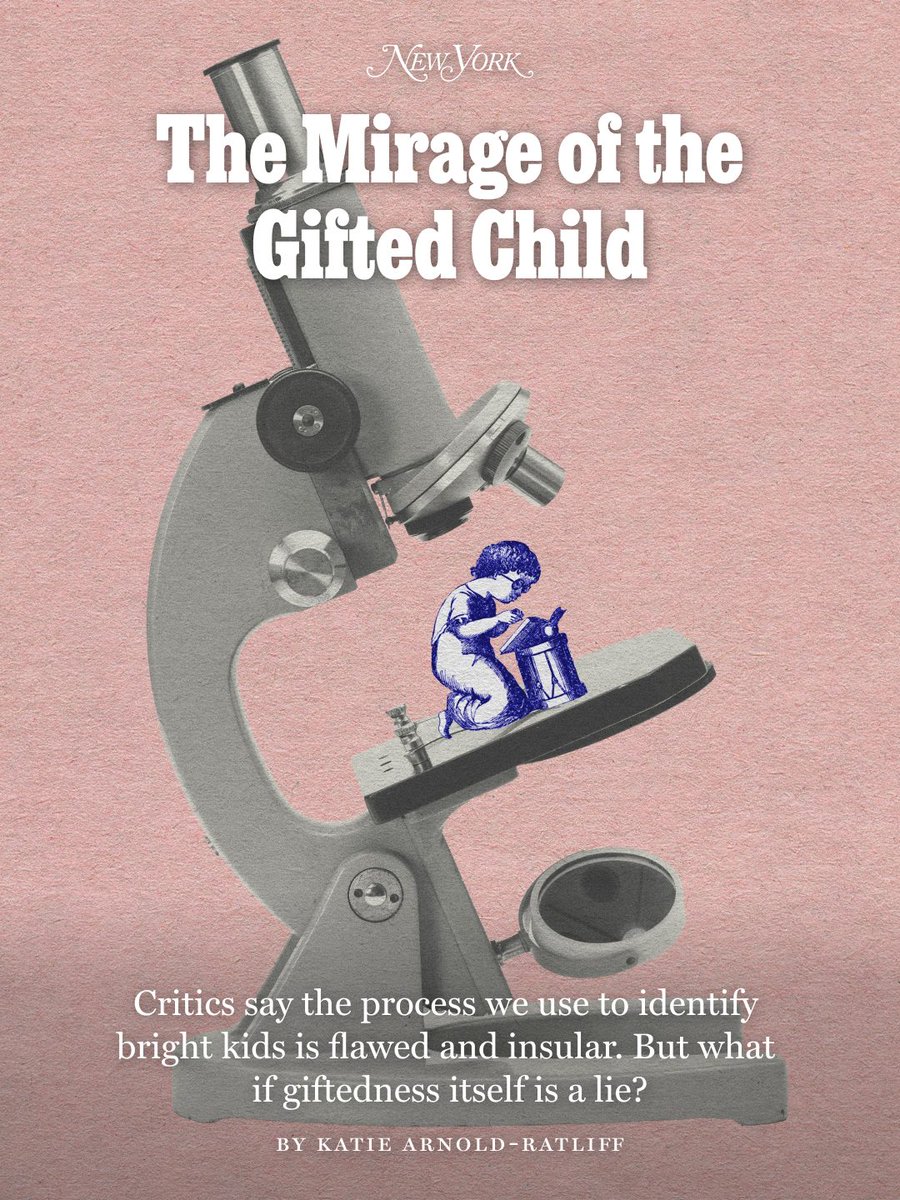
Gifted and Talented, or G&T, programs have long been a perennial subject of debate, particularly in New York City, where it has bedeviled mayors for years. Some parents have already washed their hands of the whole G&T business, refusing to participate in what they view as a corrupt system of segregation. But countless others still place significant stock in the G&T designation and what it offers and are comfortable relying on cognitive testing, should it be required, to determine whether a child qualifies.
“When your intelligence is the foundation of your self-perception, failing to achieve feels like soul death,” writes Katie Arnold-Ratliff. But if the limited amount of information we have about gifted kids long-term is any indication, most lead, at best, ordinary lives of modest accomplishment. A 35-year study of 677 gifted children found that by age 50, only 12.3 percent had reached a level of “eminence,” defined as “full professors … Fortune 500 executives … judges and lawyers, leaders in biomedicine, award-winning journalists and writers.” This means 88 percent never did.
Arnold-Ratliff digs into the myth of the gifted child, and how our notions of intelligence may be inherently flawed: nymag.visitlink.me/9mc2Wh
Community note
The study defines eminence as accomplishing "something rare" like becoming full professors at research universities or Fortune 500 executives; 12.3% of gifted participants achieved it, far exceeding general population rates. pmc.ncbi.nlm.nih.gov/articles/PMC64…
3
18
2,107
Jun 13
Imagine if someone like Elon took a look at the current state of healthcare and decided to make that their SpaceX.
In 20 years, it would be perfectly possible for average people to have every possible health indicator monitored in a non-intrusive way. Virtually all diseases would be caught early, and for many this would mean the difference between certain death and a minor procedure.
Medical mistakes would be a memory of a brutal past where doctors operated with extremely fragile processes instead of standards closer to commercial aviation.
Drugs would be extremely personalized, helping people be healthy and fit with much less effort. Healthcare would be focused on prevention, as it should be. Incredible amounts of unnecessary suffering would be avoided.
Most doctors today will say this is impossible because of bureaucracy and the slowness of medical advances, like space tech experts said SpaceX was a dream 20 years ago. An Elon-like entrepreneur would say "oh yeah? Watch me." The person to tackle this would be one of the most important figures in the history of humanity.
Jun 13

The lesson I take from the SpaceX IPO is that the only thing stopping us from solving arbitrarily difficult problems is extreme creativity in business models.
No amount of tax and spend programs got us reusable rockets and great electric cars. Customer delight is a necessary precondition for success.
There seems to be some discussion around whether successful entrepreneurs should give up control of their companies so they can subsidize some philanthropic venture that otherwise has no value prop sufficient to run it as a business where customers voluntarily exchange money for goods and services at a competitive and reasonable price.
This misses the point. Transformational products deliver tangible value at 1000x the rate of charities whose value cannot be tested in the market place. Think about the undeniable value of the smart phone, satellite Internet, electric consumer devices, etc etc.
I think the transformational moment for SpaceX was when Elon stepped away from the philanthropic Mars greenhouse concept and fixed his resolve on unlocking radically better rockets for humanity. The greenhouse would have been, at best, a neat trick. Falcon and Starship give humanity a durable economic engine to maintain and improve access to space, forever.
2
4
17
2,749
Jun 13
SF is the perfect city to work, always light jacket weather. Winter and summer are for vacations: skiing, beach. You want winter? Drive to Tahoe. You want summer? Also drive to Tahoe.

Seasons in SF don’t exist in terms of Summer/Winter
They exist in boom/bust. A swelling, then a selling, of the city
It’s a sight to behold
1
2
398
Jun 13
Hallucinations are side effect of the fact that an LLM is a lossy compression of the knowledge used to train it. When asked to uncompress knowledge that it doesn't have, it complies. The problem then is making sure that the uncompressed result is trustworthy, and this is not cheap. Obviously you cannot check every single thing that the LLM says.
You can deploy heuristics to help the user substantially with this tasks, but ultimately LLMs will always hallucinate when the request is fine-grained enough. At best the user can be told "be careful, this request is on the edge of what I'm sure about" if the inference mechanism manages to recognize those situations. But ultimately the user must always be responsible for verifying what comes out of AI before doing anything risky with the output.

2. Hallucinations
(hallucination means AI makes stuff up)
Fable 5 increased its hallucination rate by 20% (55% vs. 36% for Opus 4.8). I really don't like this improvement.
GPT-5.5 is at 86%, and Claude models have usually been good at admitting when they don't know something.
1
1
147
Jun 12
Elizabeth Warren has 6.6M followers on Twitter. It would take me 26000 years to acomplish that level of popularity.
Jun 12
Elon Musk just became the world's first trillionaire.
The typical American household would have to work more than 11 MILLION years to make Elon Musk's level of wealth.
We need a wealth tax.
187
Jun 12
“I don’t have a high IQ, therefore high IQ is bullshit.” You don’t say…
Jun 11
Gifted and Talented, or G&T, programs have long been a perennial subject of debate, particularly in New York City, where it has bedeviled mayors for years. Some parents have already washed their hands of the whole G&T business, refusing to participate in what they view as a corrupt system of segregation. But countless others still place significant stock in the G&T designation and what it offers and are comfortable relying on cognitive testing, should it be required, to determine whether a child qualifies.
“When your intelligence is the foundation of your self-perception, failing to achieve feels like soul death,” writes Katie Arnold-Ratliff. But if the limited amount of information we have about gifted kids long-term is any indication, most lead, at best, ordinary lives of modest accomplishment. A 35-year study of 677 gifted children found that by age 50, only 12.3 percent had reached a level of “eminence,” defined as “full professors … Fortune 500 executives … judges and lawyers, leaders in biomedicine, award-winning journalists and writers.” This means 88 percent never did.
Arnold-Ratliff digs into the myth of the gifted child, and how our notions of intelligence may be inherently flawed: nymag.visitlink.me/9mc2Wh
Community note
The study defines eminence as accomplishing "something rare" like becoming full professors at research universities or Fortune 500 executives; 12.3% of gifted participants achieved it, far exceeding general population rates. pmc.ncbi.nlm.nih.gov/articles/PMC64…
3
285
Jun 11
No, it doesn't. It's as obvious as the fact that the Earth is flat and the sun revolves around it.
Jun 11

it seems pretty obvious now that AI doom is the Great Filter
114
Jun 10
2 Social 2 Furious.
Jun 10

First trailer for ‘THE SOCIAL NETWORK’ sequel, starring Jeremy Strong, Jeremy Allen White and Mikey Madison.
The film follows an engineer who becomes a whistleblower on Facebook's most guarded secrets.
In theaters on October 9.
1
239
Jun 10
Skill issue. Solution: deskill yourself.
Jun 10

wondering why I feel exhausted. maybe: the agents do all the easy stuff, and I have to work through the leftover hard bits, which means I'm perpetually locked in. and as the models get better, "my" work just gets harder and harder, until I'm basically underqualified to do the work (which... is better than the alternative, there's nothing left for me to do, and I'm paperclipped).
144
Jun 10
Best thing I’ve read in a while.

1
2
604
Jun 10
Oh, a remake of Erin Brockovich with a male character.
Jun 10
First trailer for ‘THE SOCIAL NETWORK’ sequel, starring Jeremy Strong, Jeremy Allen White and Mikey Madison.
The film follows an engineer who becomes a whistleblower on Facebook's most guarded secrets.
In theaters on October 9.
2
173
Jun 9
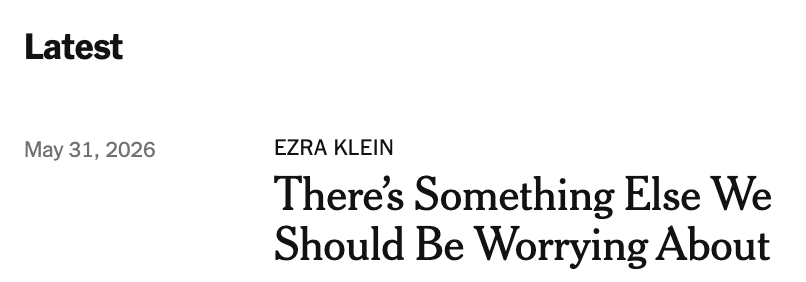
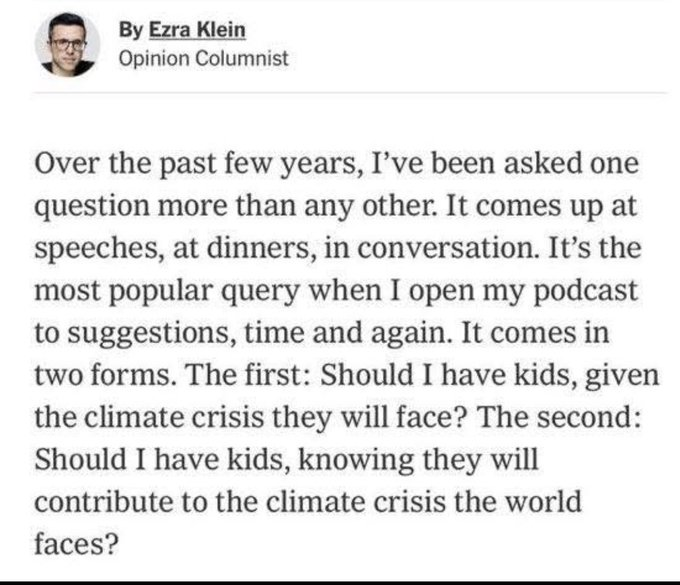
Ezra Klein obviously lives in a bubble. This type of thinking is not global, it's specific to a fraction of the US: people who tend to listen to Ezra Klein.
Jun 9

I have never once in my life encountered someone expressing this sentiment. Either I live in quite a bubble, or Ezra Klein does.
2
357