
13 Photos and videos






Derek retweeted

Feb 17
In December 2025, former US Senator @BenSasse announced that he had been diagnosed with stage 4 pancreatic cancer. That's the primary topic for this @UncKnowledge conversation about mortality, faith, and what truly matters when time is short.
Talking to host @P_M_Robinson, Sasse reflects on "redeeming the time"—holding ambition lightly, loving family more deliberately, and resisting the urge to make politics or professional success the center of life.
The discussion also covers Sasse's thoughts on the failures of Congress; the dangers of a fragmented, attention-starved republic; the crisis of higher education; and the moral challenges of technological abundance.
He speaks candidly and movingly about regret, forgiveness, prayer, and suffering—arguing that while death is a real enemy, it does not get the final word. Watch the full conversation on X:
212
1,125
4,592
1,772,559
Derek retweeted

Feb 4
Google's capex guide this year is higher than their cumulative capex from founding through the end of 2021.
1
14
304
13,412
Derek retweeted

20 Nov 2025
on becoming "legible to capital":
the most underrated factor in the success of firms is the degree to which they are legible to Capital.
defining this precisely is hard ("you know it when you see it"): but an idea, a firm, or a person is legible to Capital (cap-C) when by dint of their existence capital forms behind them in excess.
think of an idea being legible to Capital as being magnetically charged to the capital markets. dollars are just attracted to you: allocators discuss it at cocktail parties, funds market it at their AGMs, and twitter discusses novel financing schemes to get more dollars behind the idea.
becoming legible to Capital is the single greatest superpower for a fledgling firm. look at ramp, look at cognition, look at leopold, look at toni and dan at dany. these are all superhumans at being legible to Capital.
its worth noticing how ideas and people become legible to Capital:
first, there is no divide between the ceo/mgmt and the idea. the story is NOT that of an individually successful and impressive individual bringing their talents to a new platform. you can see these kind of puff piece stories in many companies that are illegible to Capital. the company is never about YOU.
for a founder to be legible to Capital there can be no air between them and the expression of the idea. their lives only matter insofar as they are building with intensity towards the pure form of the idea.
second, the company can be understood fundamentally as an equation/trade. in a best case, the most legible companies grow as a superlinear function of dollars in. the founders are highly verbal, and can clearly articulate and understand the inputs to this growth equation: talent, capital, mgmt, etc.
the companies that are most legible to Capital, and the mgmt that runs them, at their best: feel like clockwork toys in the hand. simply by looking at them the levers of progress and output become immediately clear.
they are immediate, smack you in the face, expressions of an idea that is both small enough that you can feel the thing click around in your hand, but cosmically large enough the idea feels True in some sense beyond literal.
when the trade is immensely clear, every capital provider across the stack can immediately understand their role today-- but more importantly their ability to scale to putting 10-100-100x the number of dollars into the thing as it reaches maturitiy.
finally, a company becomes legible to Capital when it is clear the entire firm (from Capital, to mgmt, to talent) is singing from the same song sheet, they are all living their lives in expression of the same exact idea.
an idea i've shamelessly stolen from @phineasb is the chocolate cake problem: many firms have great inputs (eggs, chocolate, flour, some beautiful icing) but mgmt thinks they're cooking a soufflé, investors think they're getting cup cakes, and talent thinks they're getting a pound cake.
the companies that are most legible to Capital are obsessive about chasing the tolerances between competing ideas of the firm to zero
by becoming legible to Capital a firm not only can achieve singularity in the private capital markets (ie unlimited free capital forever) but more importantly, it can unify the secret that ignites it internally with the world outside. when that secret is shared, there is truly no limit.
22 Oct 2025

there is a degree to which someone/some idea being “legible to Capital” is the most underrated factor in its success
certain ideas, and certain people, are understandable without packaging to large capital streams. many ideas are not. you can do very well packing communicating
99
74
1,192
370,228
Derek retweeted

17 Nov 2025
This weekend, I took to the S*bstack soapbox in response to the coordinated mockery campaign on "In the 1950s, a single income..."
Lots of requests to unlock it, so I have
42
28
248
159,321


Derek retweeted

9 Apr 2025
This decade will be full of crises. The solutions will not be found in consensus frameworks—but in the anomalies they fail to explain.
I started a frontier tech fund last year to continue investing in these anomalies.
@ByrneHobart & @TobiasAHuber are joining the next phase.

29
24
249
133,542
Derek retweeted

15 Mar 2025
In 1954, Atomic Energy Chairman Lewis Strauss promised energy "too cheap to meter."
In 2025, we interviewed 15 pioneers working to shape the future of energy.
Our second frontier film is out now: 'TOO CHEAP TO METER' — their vision may finally deliver on that promise.
30
187
791
119,212

Growth and order seem to have an inverse relationship. Why?
Switzerland is one of the only countries that maintains both.
opusletter.substack.com/p/op…
1
131
Derek retweeted

5 Nov 2024
Saudi Aramco is taking on debt to sustain its dividend (that mostly goes to the gov). In nine months, its position has moved from net cash of $27.4 bn to net debt of $8.9 bn.
That means in 2024 Aramco has spent ~$130 million **daily** that it didn’t have.
aramco.com/-/media/publicati…
70
362
2,052
457,970
Derek retweeted

7 Oct 2024
A quote from Peter Thiel that has stuck in my mind: “Whenever people think you can just muddle through, you’re probably set up for some kind of disaster.” I believed the opposite for a long time. Civilization seemed so large and so robust that I thought its trajectory was basically assured, barring a handful of existential risks.
Covid was a big crack in that worldview, but despite the near-uniform incompetence of the political response I was reassured by how quickly the vaccines were discovered and how well the underlying infrastructure of society held up. It took October 7 - or, more precisely, the widespread celebrations on October 8 - to change my mind. I used to think of civilization in terms of technology and infrastructure. Now what I mean by civilization is something like: enforcing standards even on your own side; trying to deescalate cycles of conflict; and upholding local validity in the face of global pressures (as described further in replies). Without that, increasingly advanced technology and infrastructure will just be used to fuel increasingly destructive conflict. And civilization in that sense is more fragile than I used to think.
I understand the quote from Thiel in a different way now. It’s not that we need everything to be clear and non-muddled - the coming decades will feel messy and chaotic no matter how well things go. The problem is *thinking* that we can muddle through. Beliefs can be reflexive even at the level of whole civilizations: the only way we’re going to even muddle through is by having enough people strive for better than that.
Even so, I’m still trying to be clear-eyed and attuned (again, see replies for more on what I mean by this). It feels less like we’re in a *fight* for civilization, and more like we’re scouting for what the next iteration of civilization could look like - one that’s stable in the face of the memetic pressures of social media, and the far stronger pressures of AGI. Coming out swinging in anger will gain ground temporarily, but (I’d guess) not in a way that will last under those pressures. By contrast, if you can figure out the right places to apply it, even a modicum of courage and integrity can move mountains (via mechanisms described by @timurkuran in his work on preference falsification).
There’s another quote I’ve changed my mind on lately. “I wish it need not have happened in my time,” Frodo said to Gandalf. “So do all who live through such times,” Gandalf replied. This time I’ve gone from agreeing to disagreeing. Would you really have wanted to live a life where you never had to decide what actually matters? Fuck that. The best thing that can happen to you as a person is receiving an impetus to get in touch with, and act on, your sincere convictions.
And while that can be complicated and risky, in another sense it’s very simple. When you don’t know what the future holds, and the second- and third-order effects of an action often outweigh its direct impact, all you can fall back on is trying to act for the right reasons, without fear or favor. I’m not there yet, and I’m not sure what it takes to fully get there, but that’s how I’m currently striving to live, and today seemed like an appropriate time to express it.
22
50
819
119,391
Derek retweeted
6 Aug 2024
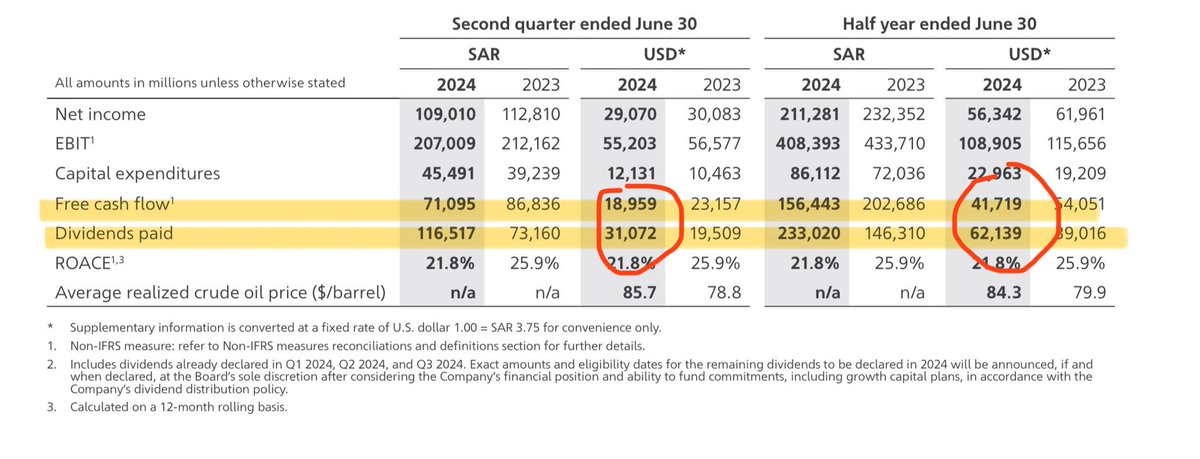
Saudi Aramco keeps its quarterly dividend (important for the government’s finances) at $31 bn, well above its free cash flow of $19 bn. Aramco is depleting its cash reserves to keep Mohammed bin Salman’s spending plans on track. At some point, a dividend cut is coming | #OOTT
20
168
605
99,678

Derek retweeted

16 Jul 2024
Boom! The book @ByrneHobart and I are publishing with @stripepress is now available for pre-order: amazon.com/Boom-Bubbles-Stag…
16
28
197
38,655
Derek retweeted

12 Apr 2024
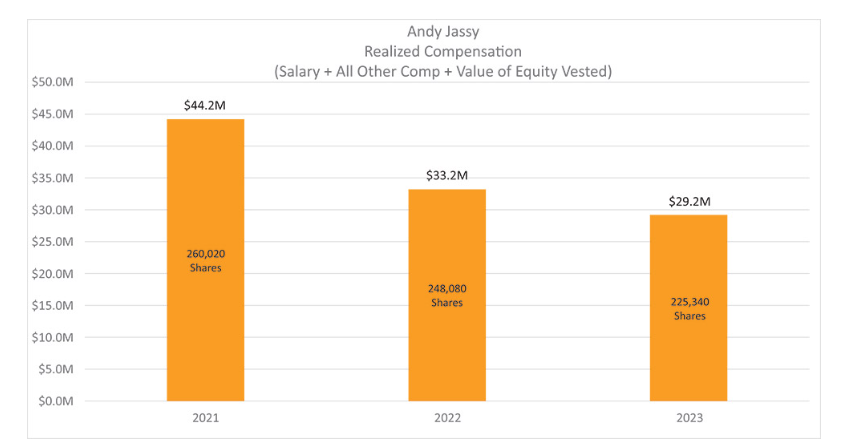
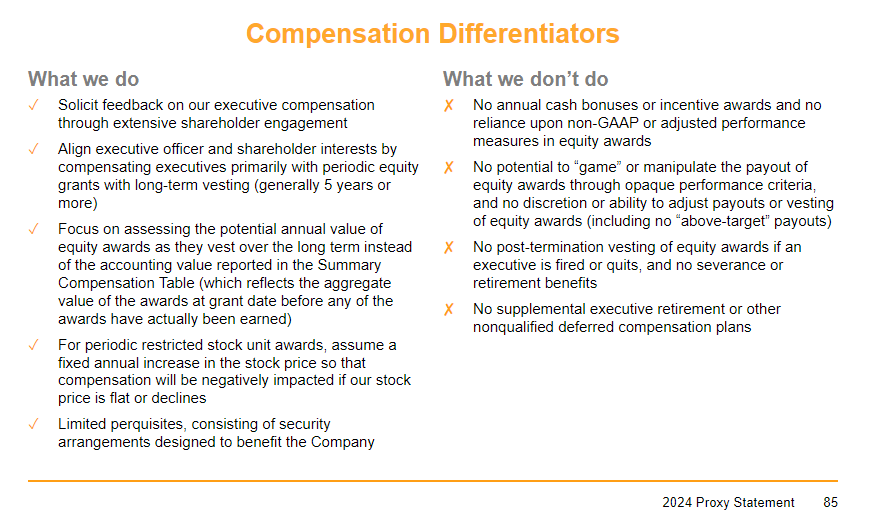
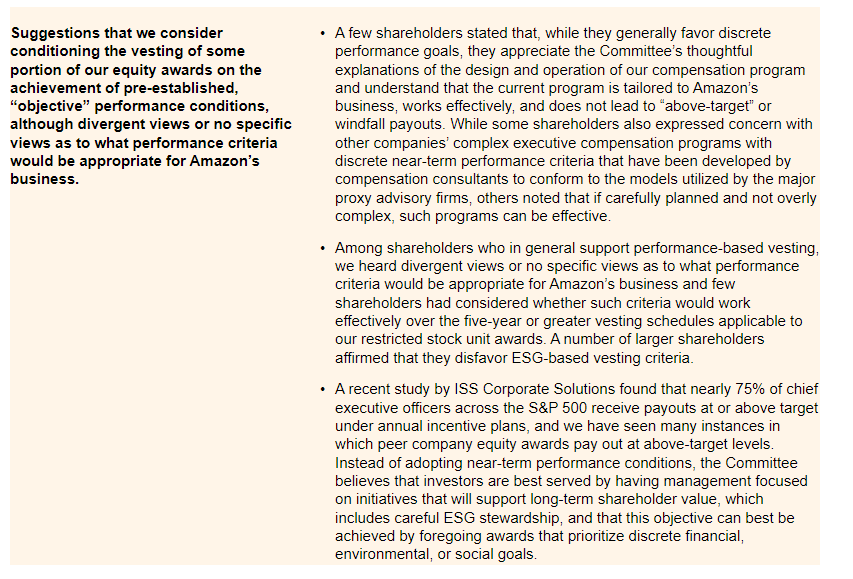
$AMZN Proxy out. Reminder they have arguably the best comp structure on the planet for shareholder alignment. And some fun nuggets like the bill for Jeff Bezos's bodyguards.
Comp Highlights
-Primary compensation for all execs is periodic grants of time-vested RSUs w/ nominal salaries ($365k or less)
-“Base salaries designed to be significantly less than those paid to senior leadership at similarly situated companies” [AMAZING – nearly every other company targets 75th percentile comp or above which all but guarantees upward spiraling exec comp at public companies since everyone does it. Mitigant being this is only base salary.]
-Focus on long-term shareholder value realized by stock price appreciation
-Do not tie cash or equity comp to discrete perf goals, and do not provide “above-target” equity award payouts – again, rely on stock price increase to increase value of rewards
-Do not provide severance or retirement benefits, or accelerate vesting upon termination or retirement
-CEO total comp down 12% in 2023
-More than 80% of CEOs shares awarded when he got the role will vest in 2026 through 2031.
-No new equity grants during 2023
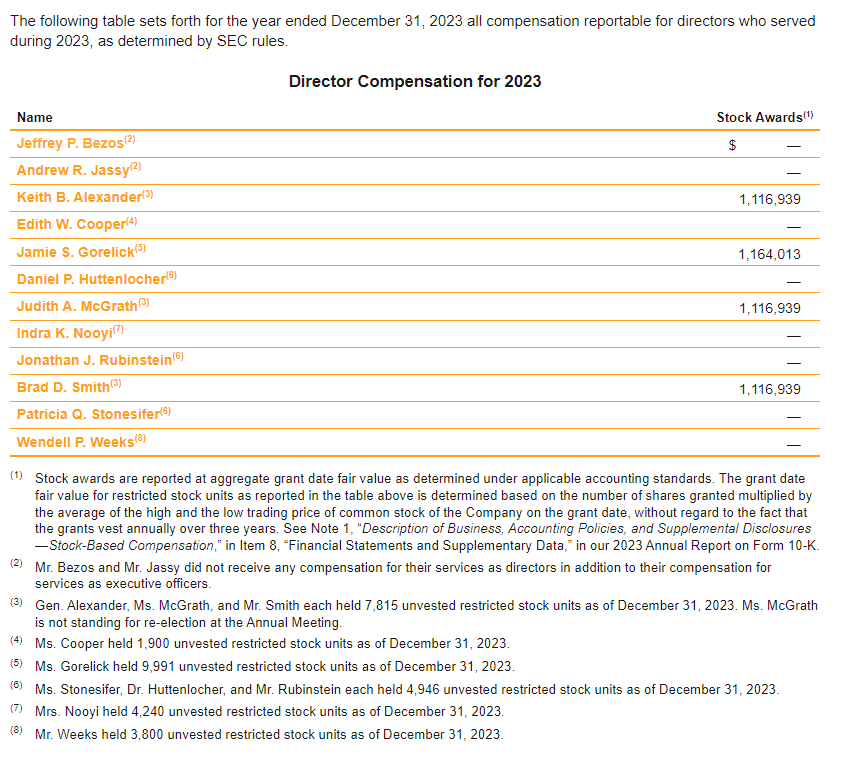
-Most directors received no compensation for role in 2023
-Bezos total comp consists of 81k in base salary and 1.6m in bodyguards😊
ESG
-Internal analysis indicates that women paid 99.8% of mens’ salaries for same job
-Total metric tons of single-use plastic down 12% from 2021. Packaging per shipment down 41% from 2015
-Carbon intensity down 24% from 2019 to 2022
2
17
170
46,897
Derek retweeted

1 Apr 2024
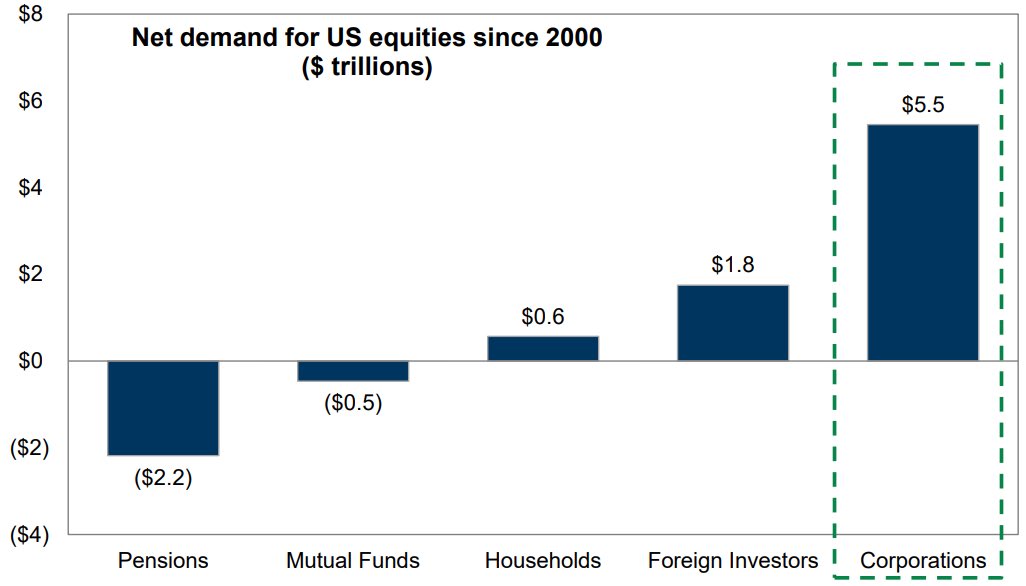
Since 2000, U.S. corporations have, on net, bought back $5.5 trillion of stock, amounting to more demand than any other market participant (it’s not even close)
@GoldmanSachs
38
121
448
77,860
Derek retweeted

21 Mar 2024
EVERY ANGEL IS TERRIFYING
For those who strive to build new worlds
A film created by @rivatez, MM, and Praxis
26
76
448
141,318
Derek retweeted

16 Mar 2024
In my latest, I argue that Culture beats Policy when it comes to modulating birth rates - and discuss what this means for the future. I bring historical examples, ranging from Communist Romania to 18th Century France.
writingruxandrabio.com/p/cul…
I warn that so far people have thought in a purely Policy driven way about the problem, which is misleading -- indeed, and has led to largely unsuccessful attempts to increase birth rates.
There are theoretical considerations for why we should expect Culture to act as a more powerful mechanism than Policy:
"Replace methodologists here with policy makers and you get what I am saying: the ultimate enemy of wanna-be social engineers is the sheer computational complexity of human interactions: the so-called “maze”. Targeted interventions are unlikely to be able to measure and characterise this complexity. By contrast, culture equips each individual citizen with a set of values that they can then enforce upon themselves and others in a myriad of small ways. What these little interactions lack in terms of power (compared to the state) they make up in terms of adaptability, subtletly, pervasiveness and sheer number. You don’t need a Secret Police if each citizen acts as a small enforcer of norms; and, more importantly, if they do so out of their own volition.
My argument for why Culture works better than Policy is akin to the arguments for free markets over centralised economies. Culture empowers individuals to act on deeply held beliefs, culminating in a force far exceeding the sum of its parts, its impact often elusive until after the fact. Biology, akin to a mighty river, is channelled through banks of Culture. While we might envisage societal control as the engineering of a great dam, I think in reality it's more akin to casting pebbles into the stream, hoping to alter its course."
We also have "natural experiments" for the Policy Maximalist position -- and we know it does not work:
"In 1967, Romania, under Nicolae Ceaușescu's regime, implemented strict policies to increase birth rates as part of a larger strategy to boost the population and workforce. These measures included banning abortion and contraception, imposing a celibacy tax on childless individuals and couples, and conducting regular gynecological examinations on women of childbearing age to ensure pregnancy compliance. Additionally, the state introduced incentives for large families, such as financial benefits and priority in housing allocations. Despite initial upticks in birthrates, the policies eventually led to severe social and health issues, including a rise in the number of orphaned children and a spike in illegal and hazardous abortions that, in extreme cases, resulted in fatalities. (...)
Let’s leave aside these horrific consequences for a moment. Were these policies even successful at achieving their stated aims - increasing birth rates? Initially, very much so. There is an increase in the total fertility rate (TFR) to a staggering 3.5 observed immediately following the implementation of these measures. This uptick is noteworthy when compared to other nations that share similar characteristics but did not adopt equally stringent pro-natal policies. However, women slowly adapted and found ways to prevent conception: throughout the 70s birth rates hovered around 2.5 and went below that in the 80s. But what’s really striking is what happened after the Revolution, when these policies were lifted: birth rates fell to a record low of 1.3 in the 90s. This was concomitant with an enormous rise in abortions: in 1990 pregnancy terminations outnumbered live births 3:1."
By contrast, we have very strong evidence for the importance of Culture, more exactly religion, coming from 18th century France, a country that experienced the First Fertility transition unusually early. A new paper convincingly shows this is largely because of the earlier secularisation of France.
"The author used crowdsourced genealogical data to estimate fertility in specific geographical locations across France and the presence of “refractory clergy”2 in 1791 in those regions, as a proxy for the degree of secularisation in each region. The effect sizes are quite large: secularised regions in France experienced a significant decline in fertility rates more than a hundred years earlier than their religious counterparts. The estimated marginal impact of the presence of refractory clergy in 1791 on fertility is approximately one. Remarkably, this effect size mirrors the decrease in fertility observed during the latter half of the eighteenth century, where the average number of children born to a woman dropped from 4.5 to 3.5 over a span of around forty years. Another interesting finding is that secularisation seems to have mostly affected fertility at its extensive margin: large families were the most impacted3. To isolate the impact of secularisation from other location-specific institutional factors influencing fertility trends, the study employs several empirical methods. The one that I found most convincing relied on tracking second-generation migrants during the fertility decline and analyzing how the origin district's exposure to refractory clergy affected fertility across generations, despite migration. This approach uncovers a lasting impact of refractory clergy presence on fertility rates that transcends geographical relocation!
This paper is not unique in its conclusions. It adds to a growing body of literature emphasising the importance of culture in mediating economic decisions. I chose it because I did find its results to be among the most striking. Together, these findings add a layer of complexity on top of the purely materialistic understanding of the fertility transition. As economic incentives change, humans decrease the number of kids they have. But culture can greatly modulate the magnitude of this drop: religion and societal pressure stemming from it can greatly boost fertility levels even in economic circumstances that would otherwise be conducive to lower birth rates."
In conclusion, I discuss the forecasts regarding an increase in childless adults in younger generations and identify some elements of our culture that are leading to this.
"Nevertheless, there seems to be a dissonance between what people—particularly the youth—believe will fulfil them (money, career, status) and what they ultimately find most rewarding (spending time with family). How can this seemingly paradoxical situation exist? The explanation lies in considering, once again, Culture and Biology. A culture that exalts career success will naturally lead young adults to prioritise it. Parents, wanting stability and status for their children, nudge them towards societal ideals. Yet biology asserts itself when children arrive, triggering a profound instinct to nurture, hence why parents end up finding children more rewarding. Putting these two pieces together, we get at the final picture: children become a 'guilty pleasure,' indulged in once one has 'earned' it through career and financial success. (..)
Society instils a deep-seated anxiety about parenthood—the fear of missing some critical preparatory step is pervasive. Having children is no longer portrayed as the default, a hard but ultimately manageable task for most people, but rather as a sort of test, that one can easily fail if not sufficiently prepared for (...)
In many ways this attitude towards taking the leap and starting a family could be seen as part of a broader “Cultural Anxietying” — a trend towards risk aversion, techno-pessimism and exaggerated caution, that I have flagged a few months ago. That this Anxietying is real keeps getting vindicated in different surveys and polls, despite what the naysayers proclaimed at the time. It’s important to note these attitudes are not coming out of nowhere: they have long been in the making and they reflect in large part the views of intellectual leaders of older generations, now trickling down and becoming mainstream in the younger ones"
25
91
333
232,660
