
838 Photos and videos
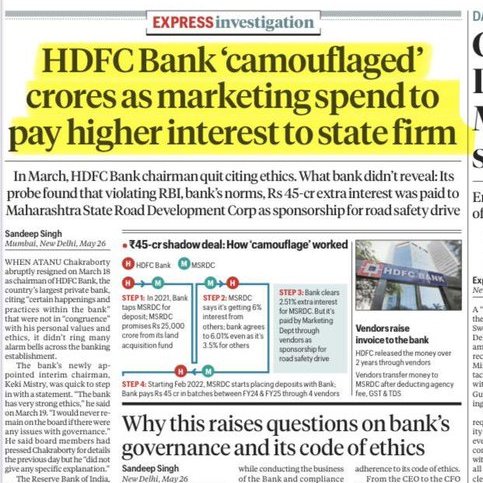




Hello @NPCI_NPCI, the Select Rupay debit Card offers are scam. I took the ₹1499 OTT plan but @ZEE5India says they received only ₹999.
Please clarify
1
210


Stooge?
What's that language from a person with great history!
Jun 6

I think the government & its chamchas are making a mistake in telling the middle class that it’s fine to let the rupee collapse having said the opposite when the BJP was in opposition
Every time some stooge says something dismissive like this, public anger grows. We are not fools
1
49
Who are the guys surrounding him, and why security?

1
67

Immature - he says 'Dipke is the one who started so he will have to take the permission'.
And disregarding the rules?? Red flag.
Jun 4

Journalist: Why do you not take permission form Delhi Police to protest at Jantar Mantar?
Cockroach:
- Do you think they will give us permission?
- Why do you need permission to protest at a designated protest site?
- I am sure they will give us permission on the same day we plan to protest.
Why are these cockroaches so stupid??
51
Thank you🙏🏽🙏🏽
Jun 4

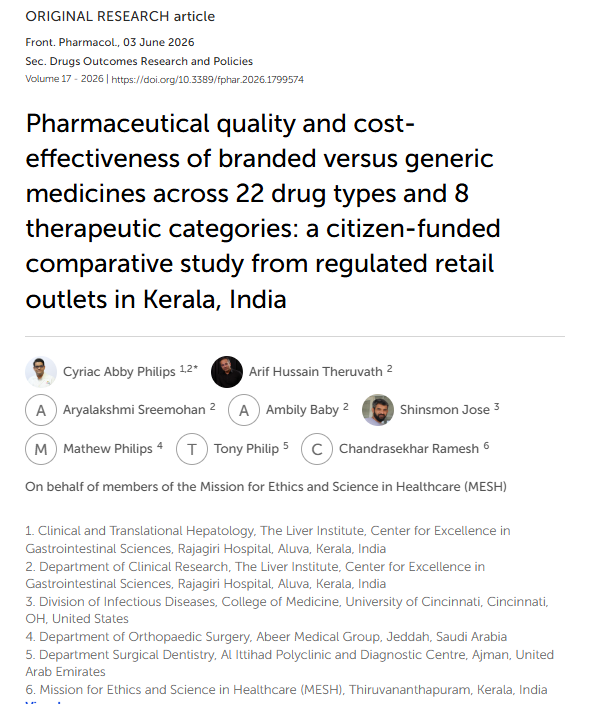
Dear friends, as promised, the citizens funded generics vs. branded drugs project is now published after 4 months in peer review. It was hardwork, but worth the effort because all of you helped us realize this important work.
You can read the full detaild paper here: frontiersin.org/journals/pha…
Here is a simplified summary:
Do cheaper generic medicines work as well as expensive branded ones? It's a question that worries patients and even many doctors, who often quietly assume that a low price must mean lower quality. This doubt has real consequences in India, where medicines make up nearly two-thirds of what families spend out of their own pockets on healthcare — a burden that pushes millions into poverty and forces people to split doses or stop treatment altogether.
To put the question to a fair, independent test, our team at the Mission for Ethics and Science in Healthcare (MESH) carried out a fully citizen-funded study, paid for entirely by donations from ordinary members of the public, with no money or influence from any drug company.
We bought 131 samples of 22 commonly used medicines — covering heart disease, diabetes, infections, pain, acidity, and more — from seven different kinds of outlets across Kerala, including government stores like Jan Aushadhi, private generic chains, and premium branded pharmacies. Every sample was then coded, blinded, and sent to a top accredited laboratory for rigorous testing against the Indian Pharmacopoeia 2022 standards. What makes this study unusual is that very few before it have tested branded and generic versions from the same market side by side, included government-supplied medicines, and combined strict quality testing with a hard look at price — all at the same time.
The result was striking in its simplicity: every single one of the 131 medicines passed every quality test. 100%. It made no difference whether a pill was generic or branded, cheap or expensive — they were all equally good in their active ingredient content, their purity, and how they dissolve in the body.
Yet the prices told a completely different story. Generic medicines were, on average, 48.6% cheaper than their branded twins, and the most expensive brand cost up to 13.9 times more than the cheapest generic of the very same drug. Government Jan Aushadhi stores were the cheapest source for 18 of the 22 medicines tested, with potential savings running into thousands of rupees a year per medicine — for instance, over ₹16,000 a year on a single liver drug.
For doctors, this is reassuring, hard evidence that prescribing a quality-assured generic is not a compromise on care; it is the same medicine at a fraction of the cost. For patients, it means you can stay on your treatment without it draining your savings, which is exactly what keeps people healthier over the long run.
And this is precisely why independent, publicly funded projects like this matter so much for the future of healthcare in India: they answer the questions ordinary people actually have, free from commercial pressure, and they build the trust that programmes like Jan Aushadhi need to truly succeed. Affordable and high-quality are not opposites — in a well-regulated market, they go hand in hand.
More here: frontiersin.org/journals/pha…
1
37
Hello @KotakCares I had raised a concern more than 3 months back.
I am still getting automated message that it's taking time for resolution.
And when I write back asking for tentative time, there's no response.
Do I have an alternative?
1
34




My point as well!
Jun 1

There is a very deliberate campaign right now to paint Indian tourists as rude, loud and disrespectful.
And the worst part? Many Indians are falling for it.
STOP INTERNALIZING propaganda.
Hard facts: Indians are now one of the world’s most important outbound tourist groups. Countries compete for Indian tourists. Hotels customize food, services and experiences for Indian families.
Every country has badly behaved tourists. Every nationality has loud, entitled people. But only Indians are expected to collectively apologize every time one viral clip appears online??
That is stereotyping.
Hold individuals accountable, yes.
But stop putting 1.4 billion people on trial because some groyper account found a video to farm engagement.
Indians do not need to shrink, self-hate, or beg for approval from people who already decided to look down on them.
Keep your self-hatred away.
1
1
100
Deepak retweeted

May 31
A voice that was a part of our memories, our journeys, our cinema. Thank you Suman Kalyanpur ji for melodies that will outlive generations. Rest in music...🙏😌🎶
#SumanKalyanpur
youtu.be/N12bBKDpunM?si=bOGW…
2
4
16
2,366
Agree, why would anyone sensible do that?
May 28


1
53
He's so sweet!

47
Absolutely!
It's knowledge, logic and reasoning - nothing else.
Unfortunately, it's very difficult to find evidence on matters related to history.
Arguments and counter-points should be welcomed.
56
India - as in the corporates spending on sports & the Government - who are required to formulate the relevant guidelines; is guilty of ignoring sports completely. No wonder we don't compete with the world. We are lucky some still get medals.
(I don't consider cricket as a sport.)
May 25

India fails its athletes again 💔
Pole vaulters carry equipment on e-rickshaw minutes after breaking national record - Watch
timesofindia.indiatimes.com/…
40