
980 Photos and videos











Load Gaussian splattings on a single line of HTML
@aframevr community FTW 🥇
Thanks to quadjr, @arkba and @kfarr
Demo: star-languid-fahrenheit.glit…
Demo code: glitch.com/edit/#!/star-lang…
Component: github.com/quadjr/aframe-gau…
12
37
212
30,089
Support open source. Iove or hate AI is more important than ever.
Jun 11

Support your open source software so this won’t happen to 3d reconstruction.
Imagine, someone decides what you are allowed to splat.
3
192
Diego retweeted

Jun 10
Everybody is stepping into the LOD game, and so is LichtFeld Studio.
Preview of 260M Gaussians streaming into the viewer live.
I use the RAD format which is processed on GPU within LichtFeld. It can be also simply dumped straight into the spark.js web viewer, albeit it will die at that amount of Gaussians.
What other solutions don't tell you is that they need hours to preprocess a 3DGS ply to make it streamable. This was just a ply exported to RAD by LichtFeld Studio's convert tool (took 5 min at that size) and it is immediately ready to stream.
In the comments there is a smaller dataset with 103M Gaussians that streams on startup into the viewer. Both datasets were created by Andrii Shramko.
Let's see how far I can push this (need bigger datasets)
14
31
271
22,713
Imagine a world where open source or platforms like the Web don’t exist.
Jun 10

i finally understand why people become such open source model extremists. completely alien mindset to me before today
3
213
Never play games demos for the same reasons I don’t like to watch movie trailers. I’m making an exception here cause I can’t wait to get a taste of next blow’s game
Jun 10

The SURPRISE is:
x.com/SinkingStarGame/status…
Order of the Sinking Star will have a free demo on Steam, for NextFest, Monday.
Because the game is HUGE, the demo is huge: it's bigger than most entire paid puzzle games, and you get to try it out for free.
1
232
Diego retweeted

Jun 9
The creativity and imagination is out of the world! So grateful that @theworldlabs got to partner with the amazing talents @withloreco to translate their incredible ideas into an interactive experiences for users to enjoy!🤩
Jun 9

We turned dreams into worlds.
Then filled them with history's greatest minds.
Not a video. A world, running directly in your browser. Step inside ↓
16
24
293
39,001
Beautiful experience pushing the boundaries of 3D gaussian splatting, world models and @sparkjsdev
Jun 9
We turned dreams into worlds.
Then filled them with history's greatest minds.
Not a video. A world, running directly in your browser. Step inside ↓
5
493
3d Gaussian Splatting paper was published in 2023 and now it’s available natively in all Apple platforms: iOS, iPadOS, Mac, visionOS
Fastest research to mainstream adoption for any 3D format?
developer.apple.com/document…
6
352
Along the elitism there’s often a humble sense of duty in many engineers educated in the grand école system that I find uniquely french.
Jun 8

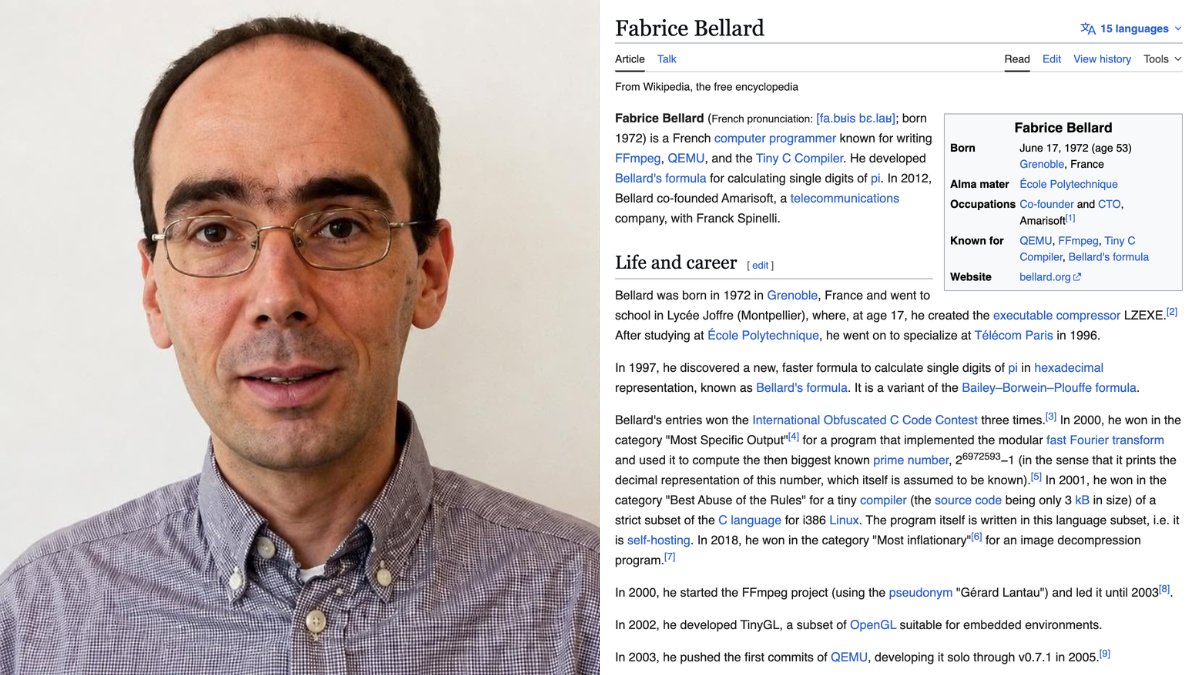
A French engineer who lives quietly in Paris has spent 30 years writing software that the entire internet now runs on without knowing his name.
He wrote the code that streams every YouTube video, every Netflix show, every TikTok clip. He wrote the code that runs the virtual servers underneath AWS, Google Cloud, and Microsoft Azure. He calculated more digits of pi than anyone in history. He has no Twitter. He has no marketing. He just keeps shipping.
His name is Fabrice Bellard.
Here is the story, because almost nobody outside the systems programming world knows what one man has built.
Fabrice was born in 1972 in Grenoble, France. He studied at École Polytechnique, the top French engineering school. He never went to Silicon Valley. He never built a startup empire. He just wrote code.
In 2000 he started a project called FFmpeg, an open-source multimedia framework for encoding, decoding, and streaming video. He was 28. The project did one thing nobody else had done well. It handled every video and audio format that existed, in one library, on every operating system. He led it himself for years.
Today FFmpeg is the invisible engine of the internet. YouTube uses it. Netflix uses it. VLC uses it. Chrome and Firefox use parts of it. Every Android phone, every iPhone, every smart TV, every video editing tool you have ever touched runs FFmpeg somewhere underneath. If you have watched a video on a screen in the last 20 years, Fabrice's code processed it.
He was not done.
In 2003 he started QEMU, a machine emulator and virtualizer. He wrote it solo until version 0.7.1 in 2005. QEMU lets you run any operating system on any other operating system. It became the foundation of modern virtualization. KVM, the Linux kernel hypervisor, runs on top of QEMU. Every major cloud provider, AWS, Google Cloud, Microsoft Azure, IBM Cloud, runs virtual machines on infrastructure built around it. The Quick Emulator is the most cited piece of cloud infrastructure code on Earth.
He kept going.
In 2001 he won the International Obfuscated C Code Contest with a small C compiler that grew into TCC, the Tiny C Compiler. TCC can compile and boot a Linux kernel from source in under 15 seconds. In 2004 he calculated the most digits of pi ever computed at the time, using a personal desktop computer and an algorithm he derived himself called Bellard's formula. In 2011 he wrote a complete PC emulator in pure JavaScript that runs Linux in your browser, a project called JSLinux that engineers still cannot believe is real.
In 2019 he released QuickJS, a small but complete JavaScript engine that fits where V8 cannot. In 2021 he released NNCP, a neural network based lossless data compressor that immediately took the lead on the Large Text Compression Benchmark.
Then he turned his attention to large language models. He built TextSynth Server, a web server with a REST API for running LLMs locally. He released ts_zip and ts_sms, compression utilities that use language models to compress text and short messages at ratios traditional algorithms cannot reach. He released TSAC, a very low bitrate audio compression system. In December 2025 he released Micro QuickJS, a new JavaScript engine for microcontrollers, separate from QuickJS, designed for environments with almost no memory.
Fabrice co-founded a telecom company called Amarisoft in 2012, where he serves as CTO. Amarisoft builds 4G and 5G base station software used by carriers and labs around the world. He has been running it for over a decade while continuing to ship personal projects from his own home page at bellard dot org
He has no Twitter. He has no Instagram. He gives almost no interviews. His personal website is a flat list of projects with no styling, no fonts, no marketing copy. Just titles and links.
A quiet French engineer who never moved to Silicon Valley wrote the code that quietly runs the internet.
He is still shipping.
2
321
Frontier labs should have a pool of money to distribute to open source projects that make their models useful.
Pocket change, would generate so much goodwill and win over many skeptics and even haters.

#raylib keeps growing (new version, new features, new tools, new users...), but sponsorship does not, growth has been 0 for the last 6 months.
If you use raylib, what would make you consider supporting the project? 🤔
4
296
3DGS FTW. You can incorporate your own in your apps with @sparkjsdev and its LOD system
sparkjs.dev/examples/sogs/in…

Apple just announced gaussian splatting is coming to Apple Maps at WWDC.
2
335
This is sad but understandable. Reviewing code is the hardest most thankless job in software dev. AI can easily overwhelm.
On the other hand, many get hooked with open source after contributing to a project they like.
While at Mozilla we would often actively track down unfinished PRs contributors to finish the work and give them the satisfaction of shipping stuff.
Jun 5

Ladybird is moving into a new phase as we work toward our first alpha release.
We are tightening how code enters the project: going forward, code changes will only be introduced by project maintainers, and we will no longer accept public pull requests.
ladybird.org/posts/changing-…
2
287