
Founder & CEO @ContinuaAI | ex-Google Distinguished Software Engineer | Building wheelie.dev: Solve coding to solve everything.
Joined April 2007
- Tweets 1,566
- Following 1,332
- Followers 4,006
- Likes 344
75 Photos and videos








Pinned Tweet

26 Dec 2019
"The future will come in one minute." -- my three-year-old daughter.
3
3
78
all i'd say is that if i were in Dario's shoes, i'd now need a wellness retreat /stat/.

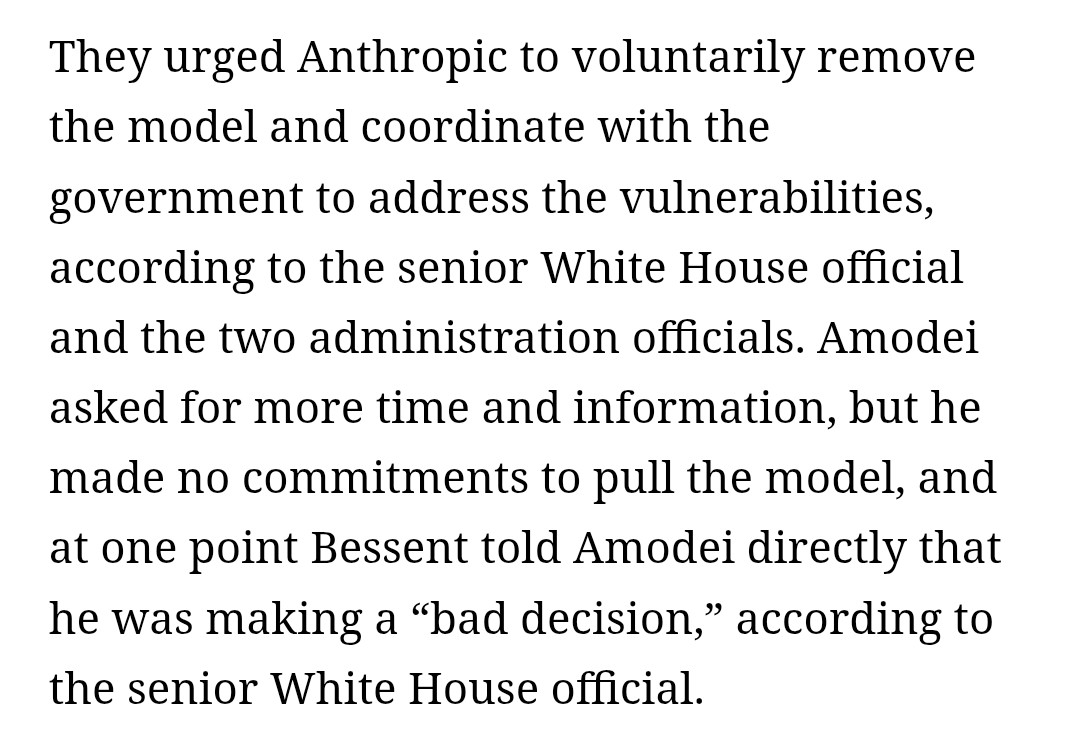
Interesting article with new details on the lead up to the export controls. Both sides are telling very different stories. Anthropic says they were given a 90 minute hard deadline to pull both models. The administration says their concerns were not taken seriously.
1
223
Jun 13
Woah, uh?
Jun 13

The US government, citing national security authorities, has issued an export control directive to suspend all access to Fable 5 and Mythos 5 by any foreign national, whether inside or outside the United States, including foreign national Anthropic employees.
The net effect of this order is that we must abruptly disable Fable 5 and Mythos 5 for all our customers to ensure compliance.
Access to all other Claude models is not affected.
We apologize for this disruption to our customers. We believe this is a misunderstanding and are working to restore access as soon as possible.
Read our full statement: anthropic.com/news/fable-myt…
1
204
Jun 12
switched from a unicomp to a keychron w/ TTC Frozen Silent V2 39g Linear Plate Mount Switches. it's taken me two weeks to type on this without fat-fingering. those on video chat with me are grateful: typing on the unicomp sounded like an act of terrorism on the other end.
186
Jun 12
awesome, David! everyone, check out the below.
Jun 12

Going live now!
1
124
Jun 11
watched @jeremyphoward's recent video. wanted to unpack some thoughts about a future of serious software that nobody reads and what that means for fulfillment and anti-slot machine ways of living life. first off, if you haven't seen it, please do. it's short and great (no surprise). youtube.com/watch?v=SUZwYV5J…
i agree that long-term delegation of critical thinking will put you in a funk. i also worry that the generation growing up with AI might not develop the ability to focus. anecdote: i overheard someone in high school stunned to learn that not that long ago, people wrote 8, 12, 20 page conference and journal papers through sheer brain force. (and as someone who saw Google's codebase evolve, i have a deep appreciation of the mind's ability to focus.)
where i begin to drift from Jeremy is on whether you need to go deep on every aspect of a problem you're working on. his demo of SolveIt was awesome (amazing work Rachel and team!), and i'd love to try it. but the reality is that human attention and capacity is limited, and time is limited, and technological progress is one of abstractions.
what's interesting to me is where the discontinuities happen: what level of abstraction do you have to get to to do novel AI research (as one example) so that certain fundamentals of AI can be "chunked" (in the Hofstadter sense)? surely our ability to innovate will end if we need full representations in our minds at all times.
of course, we can extend our attention by delegation / working in teams. Transactive Memory theory is awesome at covering this, and is being updated for our agentic world. i could be an expert in X and not need to go deep in Y if my team-actor (actor == human or machine) knows Y.
and then we get these proofs of Erdős problems that likely happened only due to the Langlands Program-like breadth and superhuman tenacity of current models. is the prompting of the mathematicians legitimized only after they dig in to understand the proof? what happens for proofs that will eventually be too hard to understand?
the work that my team and i are doing sits at the intersection of software engineering and AI. i recognize in Jeremy someone who loves to code. i do, too. but the thesis question we have at wheelie.dev is: what becomes possible when you haven't just delegated all code writing, but you're not even reading the code produced?
i realize this is heretical to some. first, is it even possible to build complex systems this way? we're taking perhaps a more experimentalist than scientific approach. the user asks for what they want built, but not as a complete spec, more as an iterative dialogue with an agent, and we include not only the backpressure of typed languages but the double checking of formal methods analyses. think of it like the bone chair (jorislaarman.com/work/bone-c…). it's almost like they said: "ok, the chair needs to hold x pounds, be comfortable for a human body, etc." something comes out that works, and ymmv on whether you actually want to look at it.
if agentic coding abilities aren't going to slow, i think we should use /our human ingenuity/ on how to coax AlphaGo move 37-like behaviors from it. further, we may learn that AlphaZero's same lesson applied to code: remove the human scaffolding, and you wind up with something beautiful, mysterious, and slightly beyond the ken of the human mind to understand.
back to the discontinuities: i'm positing that certain problems we wish to solve both (a) require code and (b) require us to take as a chunked primitive the behavior of that code. i don't think we're anywhere close, which is why, back to Jeremy's video, i wouldn't blindly accept choices from a coding agent that i didn't understand. but the line isn't static, and i think we should accept some level of letting go.
@wtgowers re: whether the future is a crisis or exciting
@blaiseaguera, @bratton re: centaurs.
@michael_nielsen re: chunked primitives
Jun 11

from @jeremyphoward's keynote on human flourishing in the time of AI
youtube.com/watch?v=SUZwYV5J… @aiDotEngineer
1
1
5
1,073
Jun 10
how i feel when an agent chooses python for some ad hoc tooling...
1
148
Jun 10
what every older AI researcher is thinking when comparing their $$ from back in the day with what the next gen is making.


159
Jun 10
so.... (and look, i love coding and driving) ...what will happen first? considering dangerous / antiquated to brain code or to drive a car?
1
292
Jun 9
contrarian view: still getting better results w/ 5.5 than Fable5 on large codebases.
2
379
Jun 8
the snare on Fugazi's Repeater is lacking the high freqs i remember when listening in my late teens. bad hifi, or bad ears?
231
Jun 3
beautiful people of the world... @ContinuaAI is announcing Wheelie today. we are evolving the software engineering stack for the agent-first world we are now in.
1
2
2
421
Jun 3
today you can sign up to use Wheelie VMs with your favorite harness. and soon we'll give you a service runtime, a way to decompose large tasks, and tools to help with coordinating across your team.
1
158
Jun 3
check out blog.continua.ai/p/introduci… . first 100 signups get enough free tokens on us to get some tasks done!
1
100
David Petrou retweeted

May 30
He did indeed. I was flabbergasted by his result, which has made much existing (and continuing!) work in quantum foundations obsolete. But it has received grossly insufficient recognition from the community. They still don't know what hit them and are still ingeniously discussing non-existent things like "quantum non-locality" (and "the measurement problem") in ever greater detail.
He deserves patrons.
17
64
814
60,010
