
Open-source developer, entrepreneur, blockchain engineer. @cartesiproject contributor.
Joined March 2009
- Tweets 1,251
- Following 261
- Followers 271
- Likes 546
62 Photos and videos





May 21
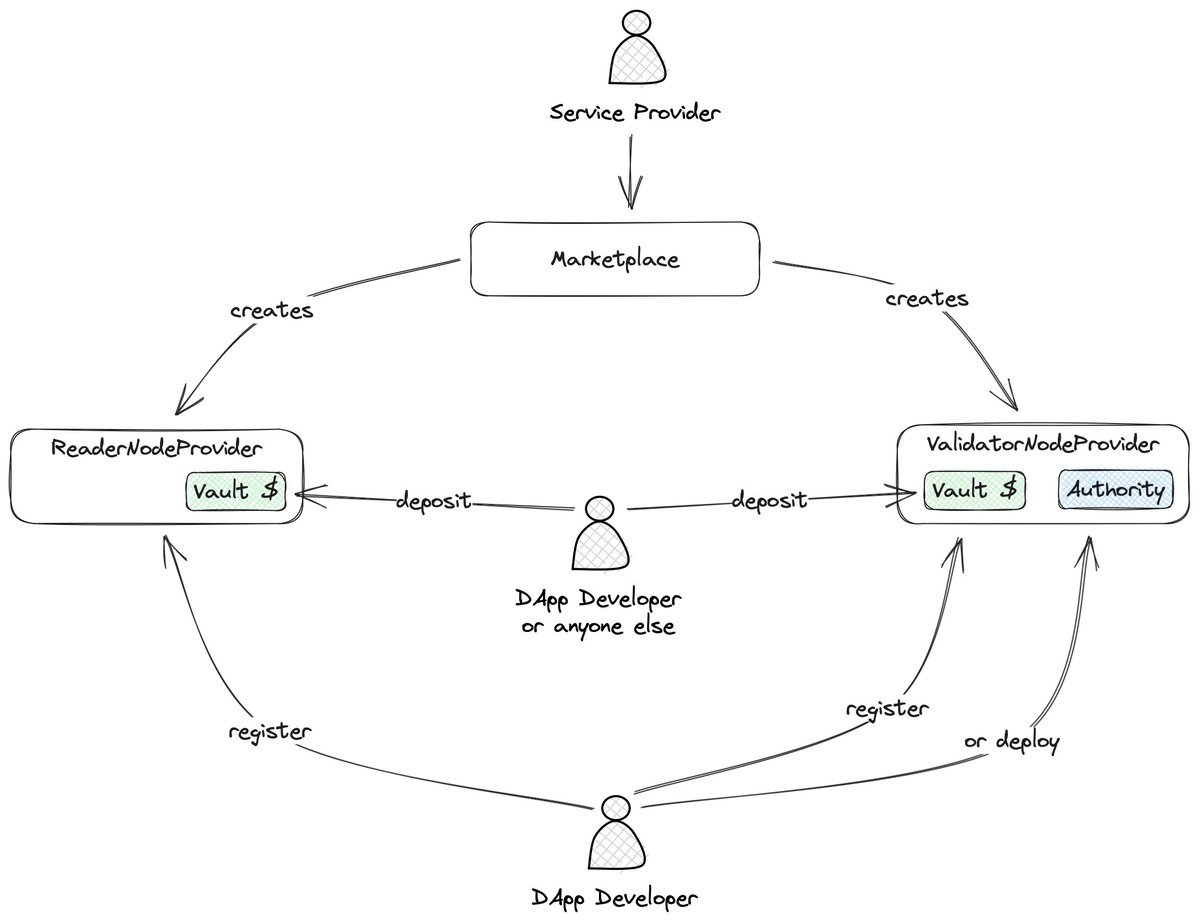
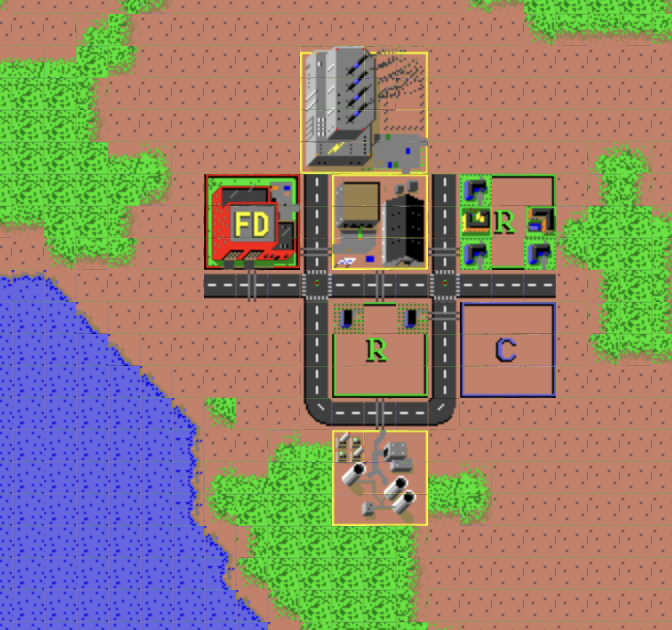
2026 World Cup is approaching and I'm excited for it 😀 4 years ago I wrote a simple betting dapp for 2022 WC, and now I was curious what I could do with AI without manually writing a single line of code. This is Tifo. tifo.cards
May 13

The 2026 World Cup, on cards. ⚽
Predict scores. Collect the art. Trade your way up the leaderboard. Split the prize pool.
Tifo is coming. → tifo.cards
3
4
321
Feb 3
This once again corroborates to @cartesiproject thesis, a L2 framework with a real differentiation, a powerful alt-VM for powerful applications. Stay tuned.
Feb 3

There have recently been some discussions on the ongoing role of L2s in the Ethereum ecosystem, especially in the face of two facts:
* L2s' progress to stage 2 (and, secondarily, on interop) has been far slower and more difficult than originally expected
* L1 itself is scaling, fees are very low, and gaslimits are projected to increase greatly in 2026
Both of these facts, for their own separate reasons, mean that the original vision of L2s and their role in Ethereum no longer makes sense, and we need a new path.
First, let us recap the original vision. Ethereum needs to scale. The definition of "Ethereum scaling" is the existence of large quantities of block space that is backed by the full faith and credit of Ethereum - that is, block space where, if you do things (including with ETH) inside that block space, your activities are guaranteed to be valid, uncensored, unreverted, untouched, as long as Ethereum itself functions. If you create a 10000 TPS EVM where its connection to L1 is mediated by a multisig bridge, then you are not scaling Ethereum.
This vision no longer makes sense. L1 does not need L2s to be "branded shards", because L1 is itself scaling. And L2s are not able or willing to satisfy the properties that a true "branded shard" would require. I've even seen at least one explicitly saying that they may never want to go beyond stage 1, not just for technical reasons around ZK-EVM safety, but also because their customers' regulatory needs require them to have ultimate control. This may be doing the right thing for your customers. But it should be obvious that if you are doing this, then you are not "scaling Ethereum" in the sense meant by the rollup-centric roadmap. But that's fine! it's fine because Ethereum itself is now scaling directly on L1, with large planned increases to its gas limit this year and the years ahead.
We should stop thinking about L2s as literally being "branded shards" of Ethereum, with the social status and responsibilities that this entails. Instead, we can think of L2s as being a full spectrum, which includes both chains backed by the full faith and credit of Ethereum with various unique properties (eg. not just EVM), as well as a whole array of options at different levels of connection to Ethereum, that each person (or bot) is free to care about or not care about depending on their needs.
What would I do today if I were an L2?
* Identify a value add other than "scaling". Examples: (i) non-EVM specialized features/VMs around privacy, (ii) efficiency specialized around a particular application, (iii) truly extreme levels of scaling that even a greatly expanded L1 will not do, (iv) a totally different design for non-financial applications, eg. social, identity, AI, (v) ultra-low-latency and other sequencing properties, (vi) maybe built-in oracles or decentralized dispute resolution or other "non-computationally-verifiable" features
* Be stage 1 at the minimum (otherwise you really are just a separate L1 with a bridge, and you should just call yourself that) if you're doing things with ETH or other ethereum-issued assets
* Support maximum interoperability with Ethereum, though this will differ for each one (eg. what if you're not EVM, or even not financial?)
From Ethereum's side, over the past few months I've become more convinced of the value of the native rollup precompile, particuarly once we have enshrined ZK-EVM proofs that we need anyway to scale L1. This is a precompile that verifies a ZK-EVM proof, and it's "part of Ethereum", so (i) it auto-upgrades along with Ethereum, and (ii) if the precompile has a bug, Ethereum will hard-fork to fix the bug.
The native rollup precompile would make full, security-council-free, EVM verification accessible. We should spend much more time working out how to design it in such a way that if your L2 is "EVM plus other stuff", then the native rollup precompile would verify the EVM, and you only have to bring your own prover for the "other stuff" (eg. Stylus). This might involve a canonical way of exposing a lookup table between contract call inputs and outputs, and letting you provide your own values to the lookup table (that you would prove separately).
This would make it easy to have safe, strong, trustless interoperability with Ethereum. It also enables synchronous composability (see: ethresear.ch/t/combining-pre… and ethresear.ch/t/synchronous-c… ). And from there, it's each L2's choice exactly what they want to build. Don't just "extend L1", figure out something new to add.
This of course means that some will add things that are trust-dependent, or backdoored, or otherwise insecure; this is unavoidable in a permissionless ecosystem where developers have freedom. Our job should make to make it clear to users what guarantees they have, and to build up the strongest Ethereum that we can.
2
1
11
609
Jan 22
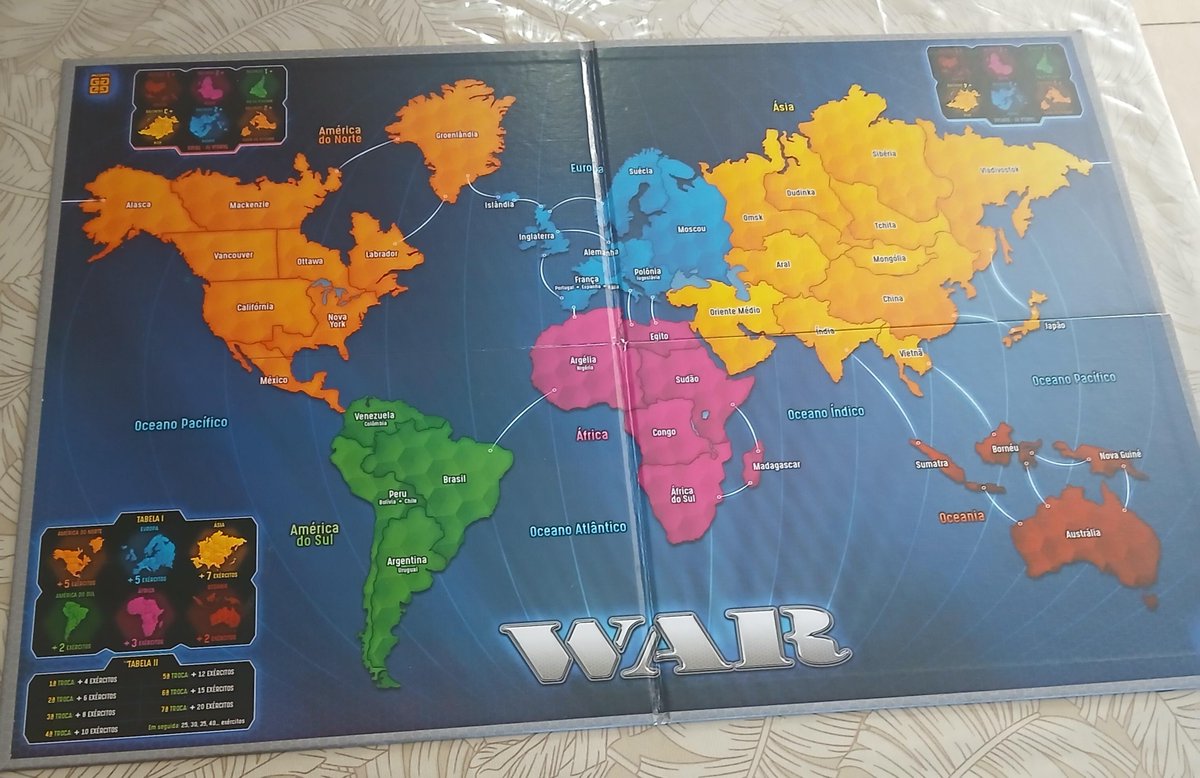
In my childhood Greenland was the way to invade Europe from the US, or vice-versa. (War is the Brazilian version or Risk)
1
3
54
Danilo Tuler 🐧 retweeted

17 Nov 2025
GM @EFDevcon and GM to everyone at Devconnect!
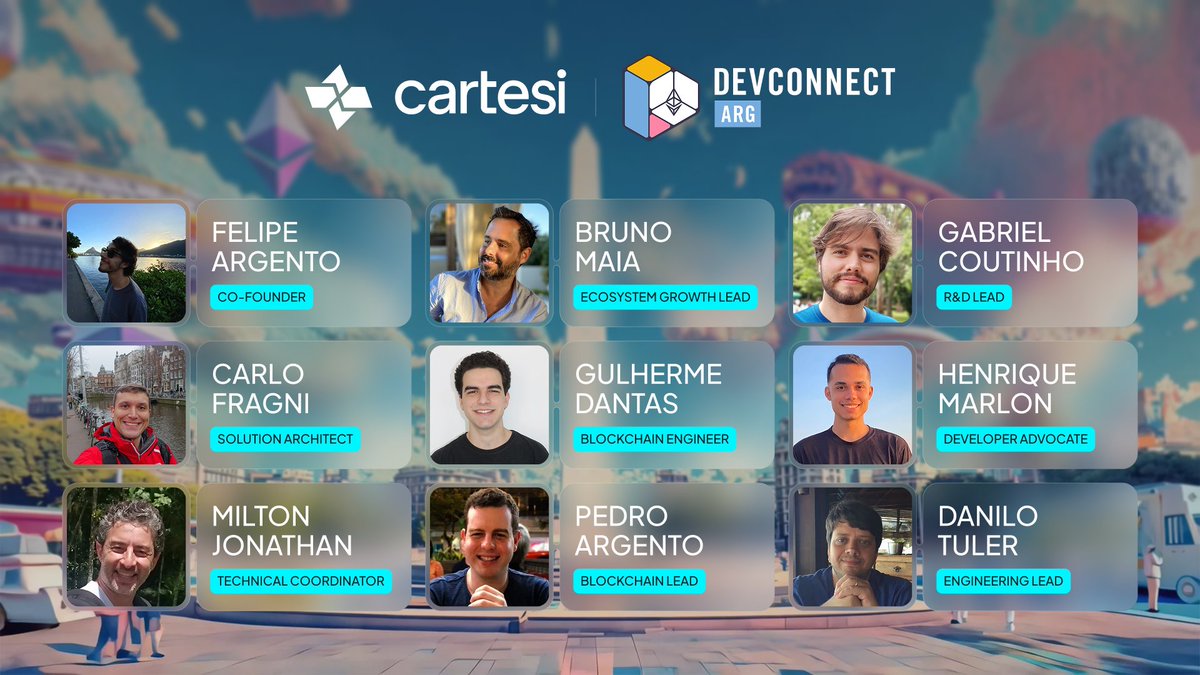
Our contributors are on site, so here’s who you can meet IRL to talk all things Cartesi: @felipeargento, @bmaia_expat, @GCdePaula_, @carlofragni, @guidanoli, @henrimarlon_, @miltonjonat, @PedroArgento8, @dtuler 🫡
3
12
46
2,138
18 Jul 2025
Welcome @tezos to RISC-V bandwagon. Come and take a look at @cartesiproject mature RISC-V emulator at github.com/cartesi/machine-e…
@ArthurB @trilitech
5
23
820
Danilo Tuler 🐧 retweeted

25 Jun 2025
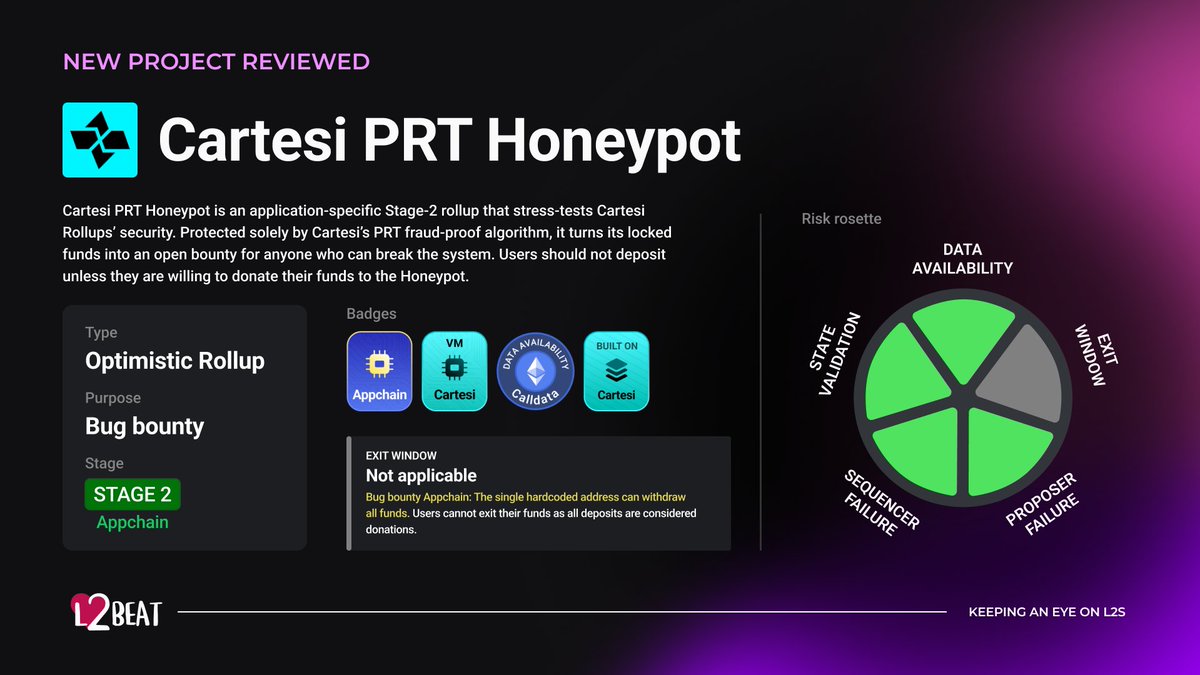
Study @cartesiproject , IMO this is how projects should be launched. Honeypot to test their proof system, immutable contracts. Such a different way to launch a product. I hope bounty will increase and there will be enough hackers/researchers to look at their proof system👇

New project on L2BEAT: @cartesiproject PRT Honeypot.
Stage 2 Appchain with a (major) twist. ⚫
Before you ape into this, reconsider: You will lose all your funds. Why? 👇
5
17
63
5,465

New project on L2BEAT: @cartesiproject PRT Honeypot.
Stage 2 Appchain with a (major) twist. ⚫
Before you ape into this, reconsider: You will lose all your funds. Why? 👇
8
20
92
18,886
Danilo Tuler 🐧 retweeted
19 Jun 2025
Meet the Cartesi PRT Honeypot 🍯🐝🐧
Our first rollup application equipped with the PRT fraud-proof system, putting the appchain stack to the test.
It’s a key milestone toward decentralization and trustless security, in line with @l2beat’s standards.
➝ cartesi.io/blog/introducing-…
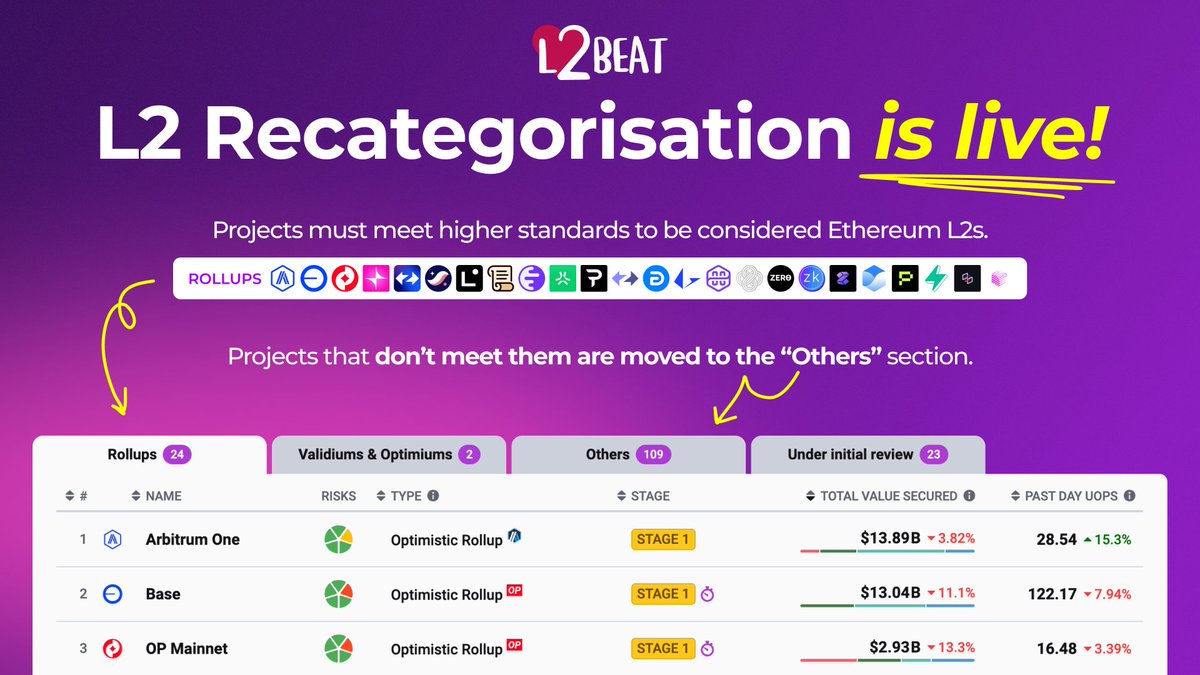
L2BEAT Recategorisation is LIVE! 🔀
This is the biggest update to our framework yet - redefining what it truly means to be an Ethereum L2.
130 projects re-evaluated. New standards. Clearer definitions. Higher expectations.
Here’s what changed - and why it matters 👇
10
62
103
17,518
7 May 2025
I created @OnChessProject mostly as a demo application to experiment with EIPs that tackles UX issues. The code is based on EIP-5792 and ERC-7715.
Unfortunately very few wallets support EIP-5792, @zerodev_app Kernel dropped support, @Alchemy Smart Accounts don't support.
3
5
229
7 May 2025
Another annoyance is how no ERC-4337 provider support local development, and rely on testnets for development. Testnet is for testing, not for development.
I hope Porto by @ithacaxyz helps to improve the dev experience for ERC-4337 (and EIP-7702).
1
2
141
Danilo Tuler 🐧 retweeted

22 Apr 2025
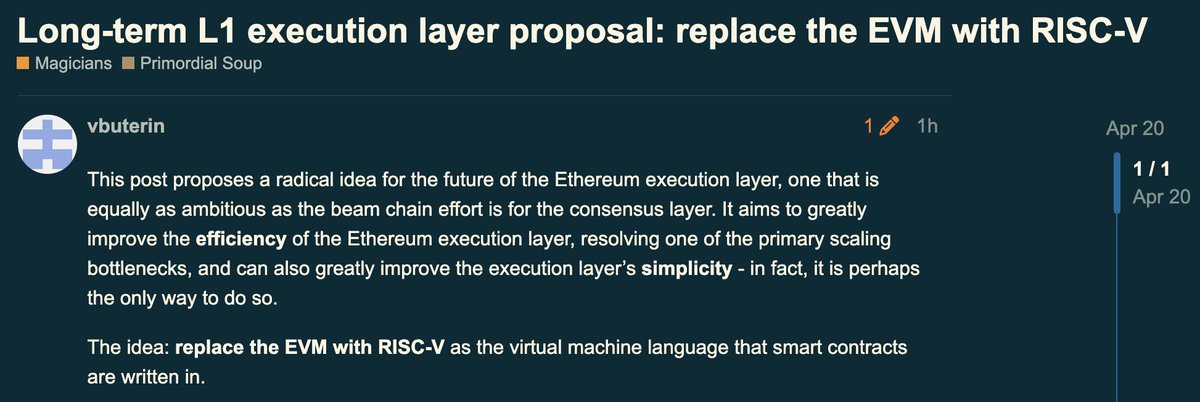
Yes, I saw @VitalikButerin 's post on replacing the EVM with RISC-V, and I’m really glad to see this direction being explored!
We built a high-performance RISC-V emulator: fully deterministic, reproducible, with complete RV64GC ISA support (both privileged and unprivileged), state inspection, and Merkle tree computation.
Doing that, we’ve built deep expertise in RISC-V and EEs, and we’d be glad to contribute. If you're connected to Vitalik, @tkstanczak , or others driving this forward, please pass it along...we’d love to help.
We’re Ethereum too. Everything we build is open, permissive, and public. And it’d be a pleasure to, however we can, contribute.
10
15
62
3,468
Danilo Tuler 🐧 retweeted

22 Apr 2025
Try a Cartesi Machine (reproducible deterministic RISC-V) in your browser:
edubart.github.io/webcm/
3
20
53
2,833
Danilo Tuler 🐧 retweeted
22 Apr 2025
RISC-V? Cartesi Machine? What’s the buzz, and why should you care? ⬇️
RISC-V is a real-world architecture, used by actual hardware companies. Not a blockchain-only toy.
Cartesi Machine is built on top of a RISC-V emulator. That means Cartesi isn't building in isolation. It's tapping into an entire hardware and software ecosystem.
By leveraging RISC-V, we get both forward and backward compatibility with existing tooling. That’s why the Cartesi Machine can run Linux and much more.
It’s a game changer for developers.
They get access to decades of open-source tools: debuggers, compilers, file systems, everything they’re already used to. No learning curve.
With Cartesi, developers can move dApp logic offchain, work in Linux, and still stay verifiable onchain.
It’s scalable. It’s productive. It’s secure.
And because it’s RISC-V based, the long-term potential even includes native hardware execution.
Cartesi Machine is modular by design. And that flexibility powers Cartesi Rollups.
Cartesi Rollups let Cartesi Machine interact with the blockchain safely.
All inputs and outputs are verifiable onchain. Because execution is deterministic, everyone gets the same results, no room for discrepancies.
That’s how Cartesi achieves rollup-level integrity.
Cartesi Machine is how Cartesi brings verifiable computation to web3. Think of it as powerful offchain computers that can still be trusted onchain.
It enables dApps to scale and developers build using familiar tools, no need to reinvent the wheel.
Smart contracts have limits. They're expensive and slow when it comes to handling lots of data or complex logic.
Cartesi Machine solves this by running computations offchain, over 10,000x faster, and reporting only essential results back to the blockchain.
How is this secure?
Even though computation happens offchain, Cartesi includes a built-in dispute system. If someone tries to cheat, honest participants can always prove the correct result.
No trust required. Just math.
Cartesi Machines are:
- Self-contained (isolated, no external influences)
- Reproducible (same input = same output, every time)
- Transparent (full visibility into internal state)
These properties are key to verifiability, making execution fully deterministic.
At its core, Cartesi blends proven systems from traditional computing with the guarantees of blockchain. We’ve been building this since 2018.
The result? Scalable dApps, productive devs, and a path toward real-world adoption.
Built on Linux. Powered by RISC-V. Verified onchain by Dave, our advanced fraud-proof system.
5
21
71
2,873
Danilo Tuler 🐧 retweeted

19 Mar 2025
Atlas is demonstrating reinforcement learning policies developed using a motion capture suit. This demonstration was developed in partnership with Boston Dynamics and @rai_inst.
834
4,648
19,801
2,286,285
Danilo Tuler 🐧 retweeted
13 Mar 2025
"Web3 security is only as strong as its weakest link."
Cartesi co-founder @erickdemoura breaks down the Lazarus Group’s attack on @Bybit_Official and explains why verifiable, reproducible builds are key to preventing similar hacks.
Check out the latest @beincrypto article ↓
12 Mar 2025

1
8
33
2,308
Danilo Tuler 🐧 retweeted

27 Feb 2025
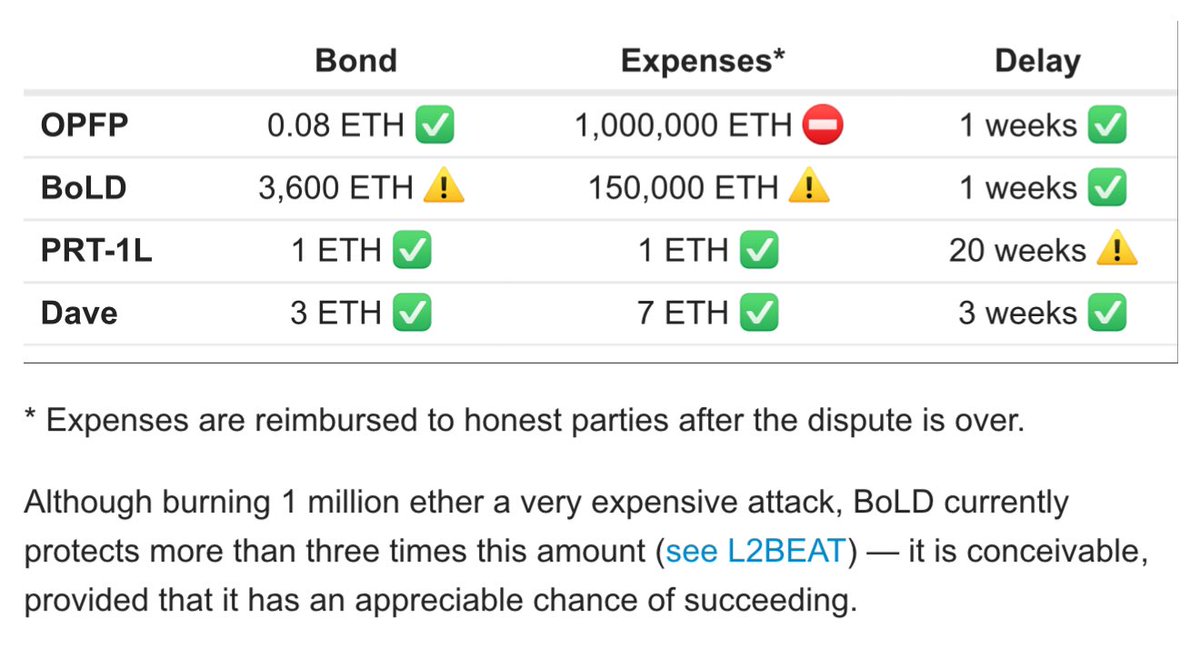
i believe @cartesiproject’s Dave to be the most advanced fraud proof system out there, outcompeting both @arbitrum’s BoLD and @Optimism’s OPFP
i highly recommend reading the research post. i’d love to see OP and Orbit stack chains integrating it!
27 Feb 2025

Excited to share a new post on ethresearch about the Dave Fraud Proof Algorithm.
Read here: ethresear.ch/t/the-dave-frau…
14
33
146
18,377