
Father of 3 KU grads & productive members of the community! Educator motivating interest in molecules, cells, organisms, & environment for 30 years. #elove
Joined May 2010
- Tweets 42,429
- Following 2,248
- Followers 575
- Likes 74,138
3,390 Photos and videos
















Pinned Tweet

Apr 11
On Wednesday night, April 8, 2026, I began my quest to ride to all of @ParadeofH hearts across KC! I won’t continue until they’ve all been positioned to minimize back tracking! This ride was completed after stopping by @UnionStationKC for the science fair! #1




1
3
568
Eric Kessler 🦬 retweeted

One of the coolest things I’ve ever seen.
Argentina fans have been in the Arrowhead stairwell for at least 20 minutes and show no sign of stopping any time soon.
What a night in Kansas City.
🇦🇷
6
91
1,002
20,729
Eric Kessler 🦬 retweeted

Unreal. Party is still going.
5
10
160
2,278
Eric Kessler 🦬 retweeted

Two legends 🔥
12
232
4,602
56,590

Eric Kessler 🦬 retweeted

It can only be one shirt when in Kansas City!
@TedLasso @AFCRichmond

23
18
477
10,114
Eric Kessler 🦬 retweeted

Jun 15
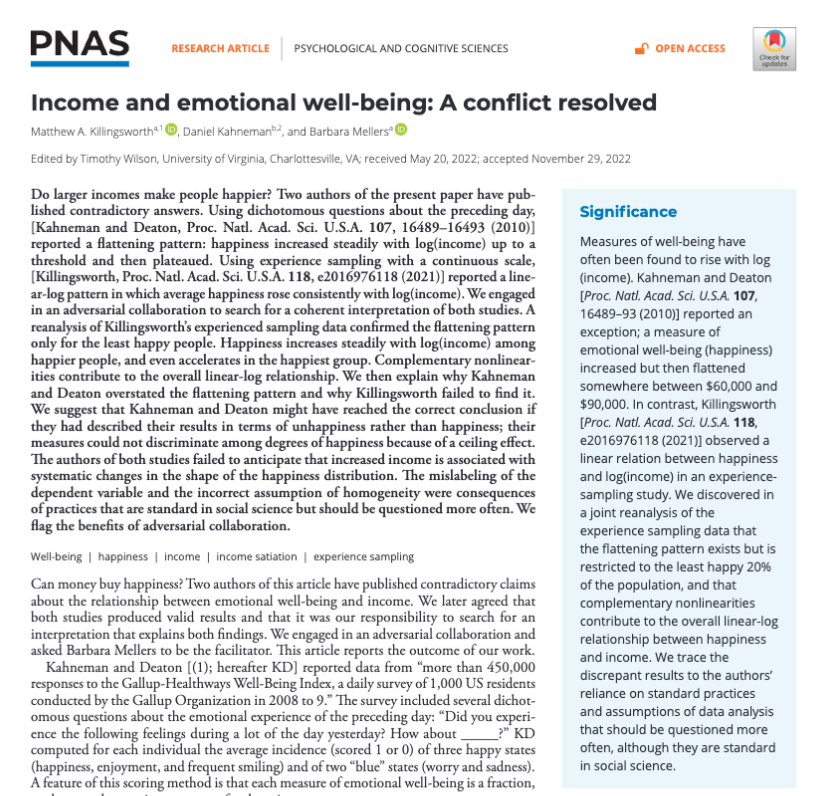
Does money buy happiness? A Princeton Nobel laureate said no above $75,000. A Penn researcher with 1.7 million data points said yes. The day they sat down together to settle the fight, the answer they reached should change how you think about your own life.
The Nobel laureate is Daniel Kahneman. The Penn researcher is Matthew Killingsworth.
The fight between them lasted 13 years, and the way it ended is one of the cleanest examples in modern science of two smart people being wrong in opposite directions about the same question.
In 2010 Kahneman and his Princeton colleague Angus Deaton published a paper that became one of the most quoted findings in the history of social science.
They analyzed 450,000 responses to the Gallup-Healthways Well-Being Index and concluded that emotional well-being rose steadily with income up to about $75,000 a year, and then flattened out completely. Above that line, the extra money was not buying any more daily happiness.
The headline traveled around the world. Every news outlet ran the number.
A CEO in Seattle famously cut his own salary to raise his employees to that exact threshold. The 75,000 dollar figure became cultural shorthand for the idea that the rich are not actually any happier than the rest of us once basic needs are met.
For 11 years almost nobody seriously challenged it. Kahneman had a Nobel Prize in Economics, the sample size was massive, and the conclusion was emotionally satisfying in a way that made everyone feel a little better about not being wealthy.
Then in 2021 a 33 year old researcher at the University of Pennsylvania published a paper that quietly destroyed the entire finding. His name is Matthew Killingsworth.
He had spent the previous decade building a smartphone app called Track Your Happiness that pinged users at random moments during their day and asked them a simple question.
How do you feel right now, on a scale from very bad to very good. The app was designed to catch happiness in the act, not to ask people to recall it later.
By 2021 he had collected over 1.7 million real-time happiness reports from 33,000 adults. When he plotted income against in-the-moment well-being, there was no plateau anywhere.
The line just kept rising. People earning $200,000 were happier on average than people earning $100,000. People earning $400,000 were happier than people earning $200,000. The curve flattened slightly but never stopped climbing.
The famous $75,000 ceiling that the world had been quoting for 11 years simply did not exist in his data.
Now there were two Nobel-quality findings sitting in direct contradiction with each other. One of them had to be wrong, and neither researcher was willing to walk away.
What happened next is the part of the story almost nobody knows.
Kahneman called Killingsworth and proposed something rare in academic science. He called it an adversarial collaboration. The two of them, joined by Penn psychologist Barbara Mellers as a neutral referee, would sit down together and reanalyze the raw data from both studies, line by line, until they figured out which one of them was wrong.
The paper they co-authored was published in March 2023 in the Proceedings of the National Academy of Sciences. And the answer they reached was not what either of them had expected.
Both of them had been right at the same time. They had been measuring two different populations without realizing it.
When the team broke Killingsworth's 1.7 million data points apart by baseline happiness, the picture clarified completely. For the happiest 70 percent of people, more money kept buying more happiness all the way up to $500,000 a year, with no sign of slowing down.
For people in the middle, the same pattern held. But for the bottom 20 percent of the sample, the ones who were already unhappy before the question of money even came up, the curve flattened almost exactly where Kahneman's original paper had said it would. Above roughly $100,000 a year, adjusted for inflation, more money did nothing for them.
This is the finding that changes how the question should be asked.
If you are not already unhappy, money keeps buying happiness for a much longer stretch than Kahneman's original paper suggested. The runway is wider than the world has been telling itself for a decade.
If you are already unhappy, money does almost nothing past a certain point. There is a ceiling, but the ceiling is not about income. It is about the underlying state of the person collecting it.
The deeper insight in Killingsworth's original research, the one almost nobody talks about, is the part that should sit with you longer than the income numbers. The Track Your Happiness app had been telling him for years that the single biggest predictor of in-the-moment well-being is not money at all. It is whether your mind is on the thing you are doing.
His most cited paper, written with Daniel Gilbert at Harvard, is titled A Wandering Mind Is an Unhappy Mind. The data from the app showed that people are mentally absent from what they are doing 47 percent of the time, and that mental absence is one of the strongest predictors of unhappiness in the entire dataset. More predictive than income. More predictive than the activity itself. More predictive than almost any demographic variable you could measure.
Which means the unhappy 20 percent that Kahneman's plateau actually described were probably not unhappy because they did not have enough money. They were unhappy for reasons that more money could not reach.
The reason the curve flattened for them at $100,000 a year is the same reason it would have flattened at $300,000 or $700,000. The thing they were missing was not buyable.
The most uncomfortable line in the entire 2023 paper is the one that nobody on the internet quotes. The authors note that the relationship between income and happiness, while real, is much weaker than the relationship between attention and happiness. A person earning $40,000 who is fully present in their own life will, on average, report higher in-the-moment well-being than a person earning $400,000 whose mind is somewhere else.
The fight about money was the wrong fight the entire time.
The two researchers spent 13 years arguing over whether the dollar ceiling was at $75,000 or $500,000, and the data from Killingsworth's own app was sitting there the whole time saying the ceiling was not about dollars at all. The ceiling is whether you can hold your attention on the life you actually have.
You can run the experiment yourself the next time you catch your mind drifting. Stop. Put your phone down. Look at the room you are in, the person across from you, the food in front of you, the work you are actually doing. That is the part the apps cannot sell you and the salary cannot buy you.
The data has been clear for over a decade. The plateau is not in your bank account. It is in your attention.
56
444
1,571
272,511
Eric Kessler 🦬 retweeted

Jun 15
Stephen Miller wants to flip a switch and erase one of your oldest rights.
It’s called habeas corpus.
Fancy words but a simple idea that the government can’t just grab you and lock you away. It has to prove to a judge why you’re behind bars. That right is 800 years old.
It’s older than America itself.
And Miller tried to kill it.
New reporting confirms it. Inside the White House, Miller pushed to suspend habeas corpus so agents could seize people, detain them, and deport them with no judge, no hearing, no chance to say “you’ve got the wrong guy.”
Even Trump’s own lawyers put in writing that this is illegal. Miller pushed anyway.
Miller screams “invasion” because the Constitution only allows this sort of thing during an invasion. But this same crowd brags every day that border crossings hit record lows. So which is it?
The right to challenge your own detention is the line between a republic and a regime. Lose it, and the government can disappear anyone.
I will fight this with everything I have.
The Constitution is not optional.
Not for Stephen Miller. Not for anyone.
nytimes.com/2026/06/15/us/po…
809
6,666
12,900
417,736
Jun 16
The local news mentioned a rally for Argentina 🇦🇷 starting at 6pm at the Country Club Plaza… so I had to jump on my bike and check it out! @FWC26KansasCity

4
12
278
10,667
Eric Kessler 🦬 retweeted

The #1 market for USA-Paraguay on FOX was KANSAS CITY at a 9.2 rating and 29 share.
The top five:
KC - 9.2
Boston - 8.6
San Diego - 7.3
Dallas - 7.3
St. Louis - 7.3
64
433
3,666
1,354,431
Jun 14
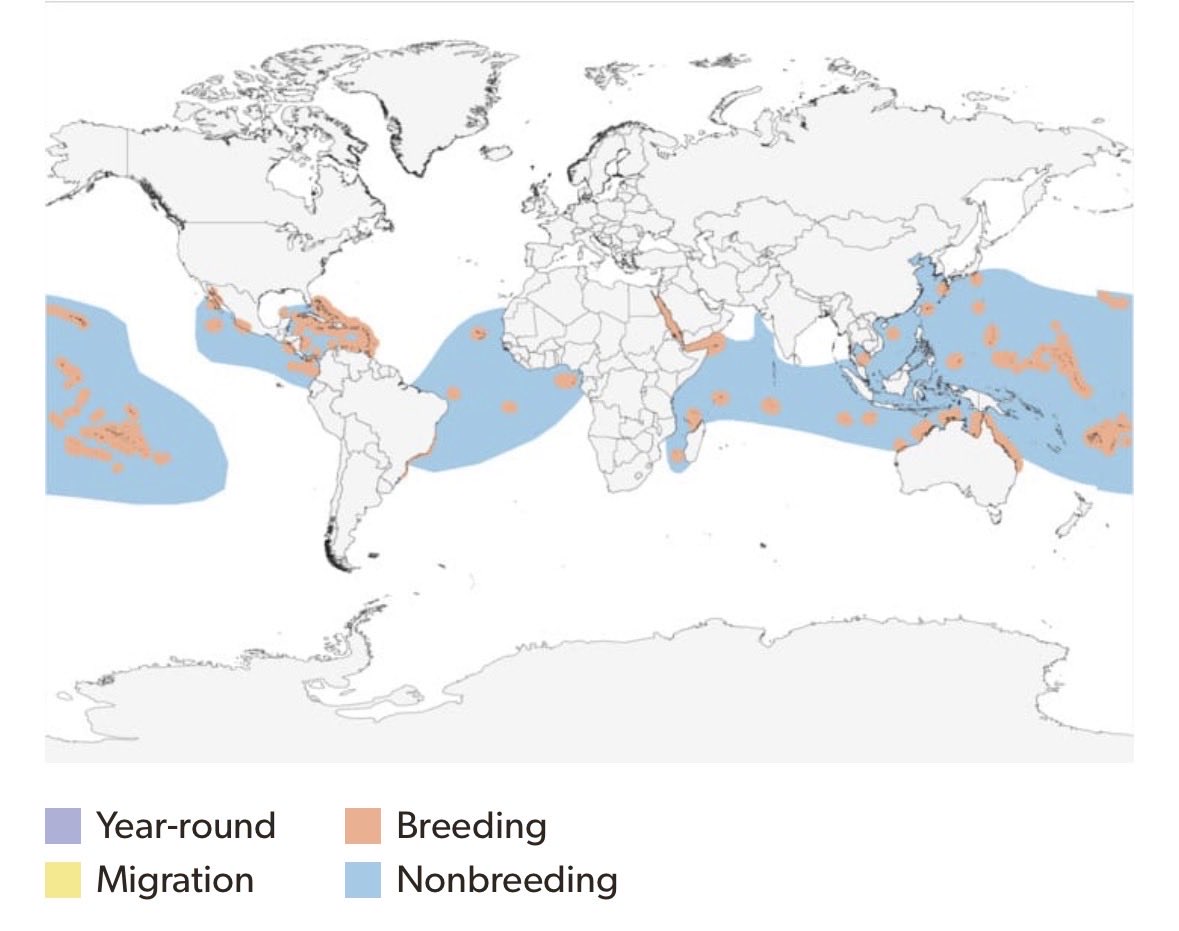
This morning I finally learned that the rare Brown Booby everyone had been posting about on social media was located less than a mile from my home at the Anita B. Gorman Conservation Discovery Center!
So, I certainly had to go check it out!



1
1
118
Jun 14
If you’re not headed to watch soccer somewhere around the city, it’s a fun site to witness and wonder how it got here in Kansas City!
2
1
60
Jun 14
1
1
27