
Founder - revenue agents @ singlebrain, ad agency @singlegrain, Investor. Member: @YPO Beverly Hills Podcaster: Marketing School, Leveling Up
Joined April 2010
- Tweets 46,765
- Following 3,614
- Followers 42,460
- Likes 46,898
14,705 Photos and videos
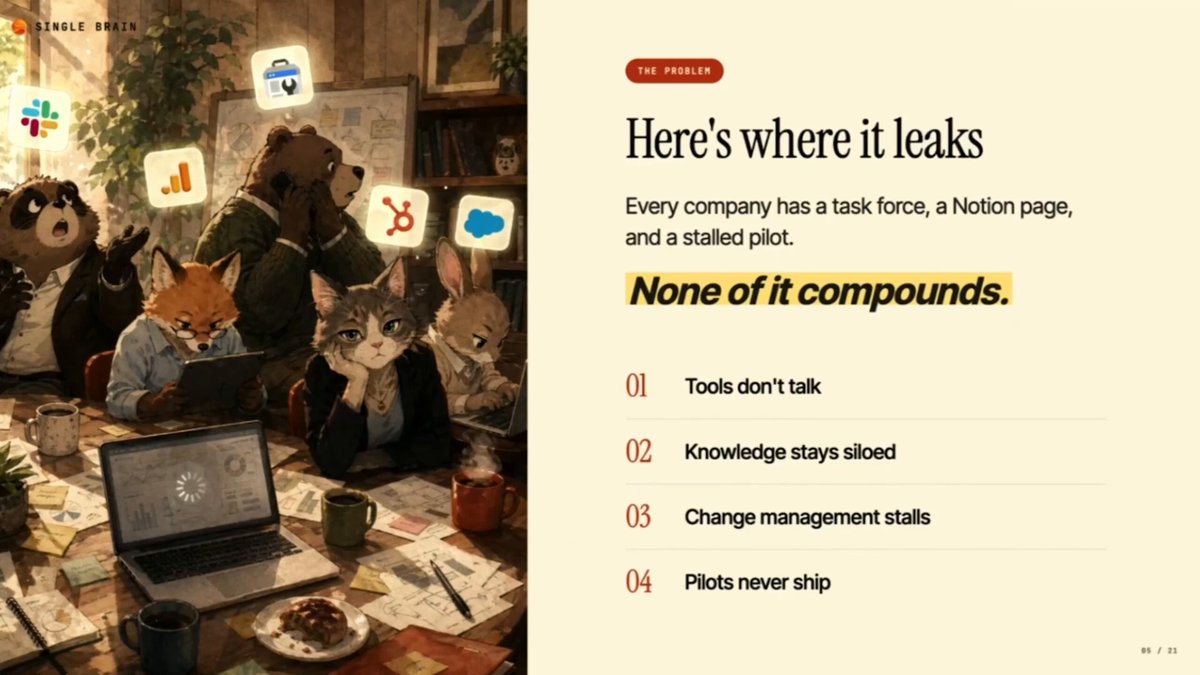

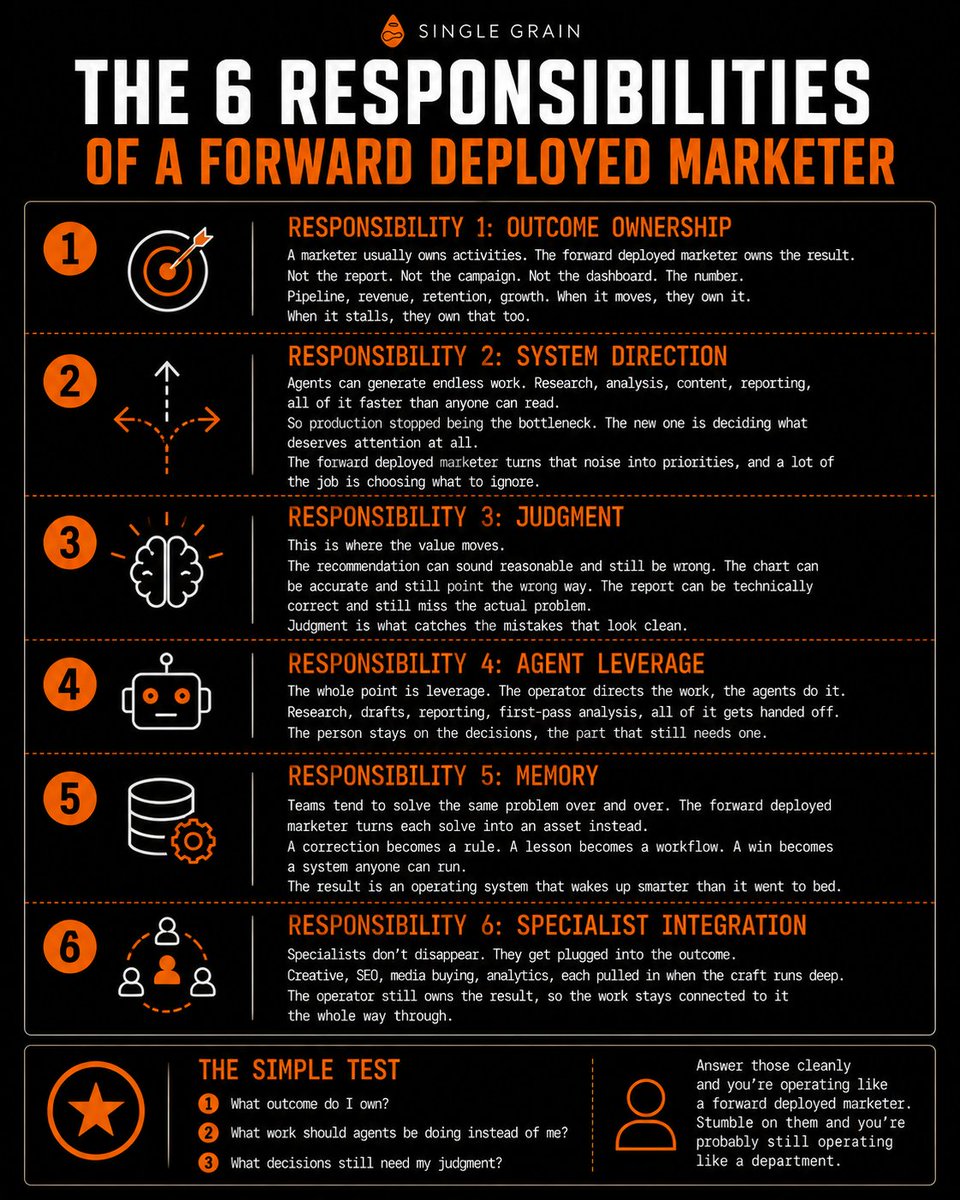
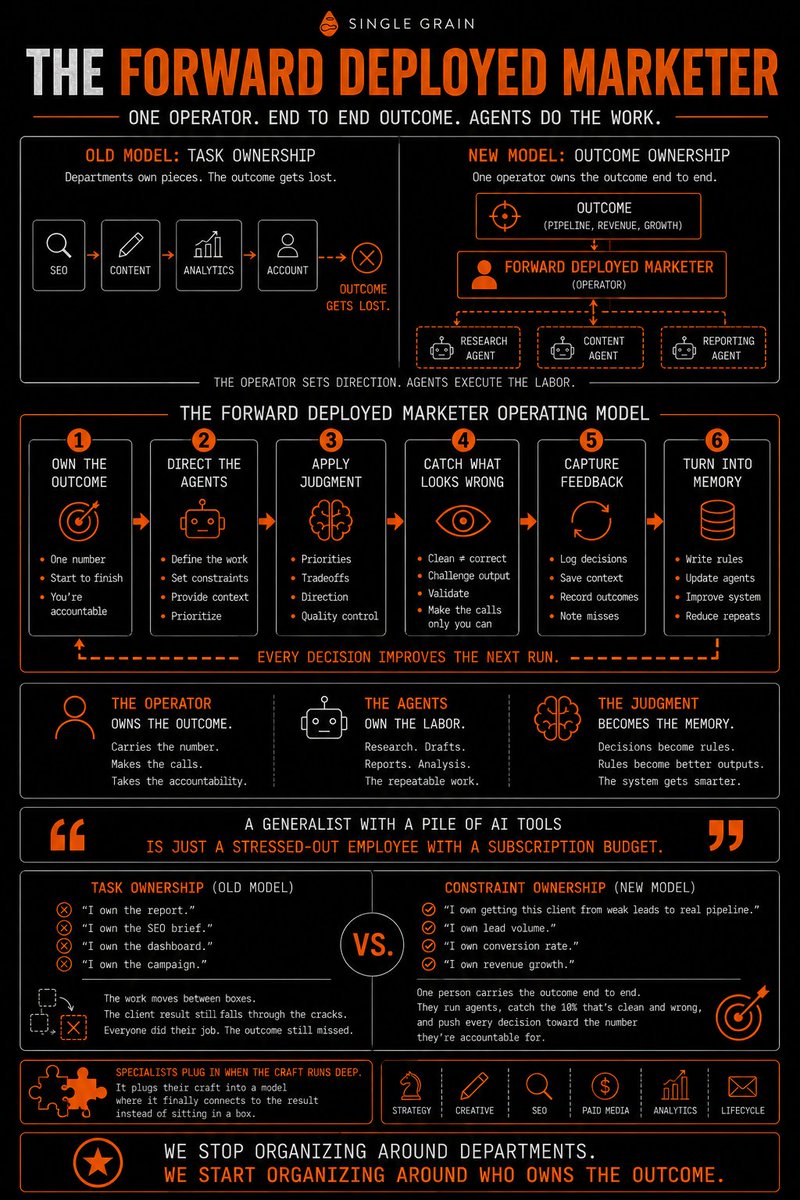
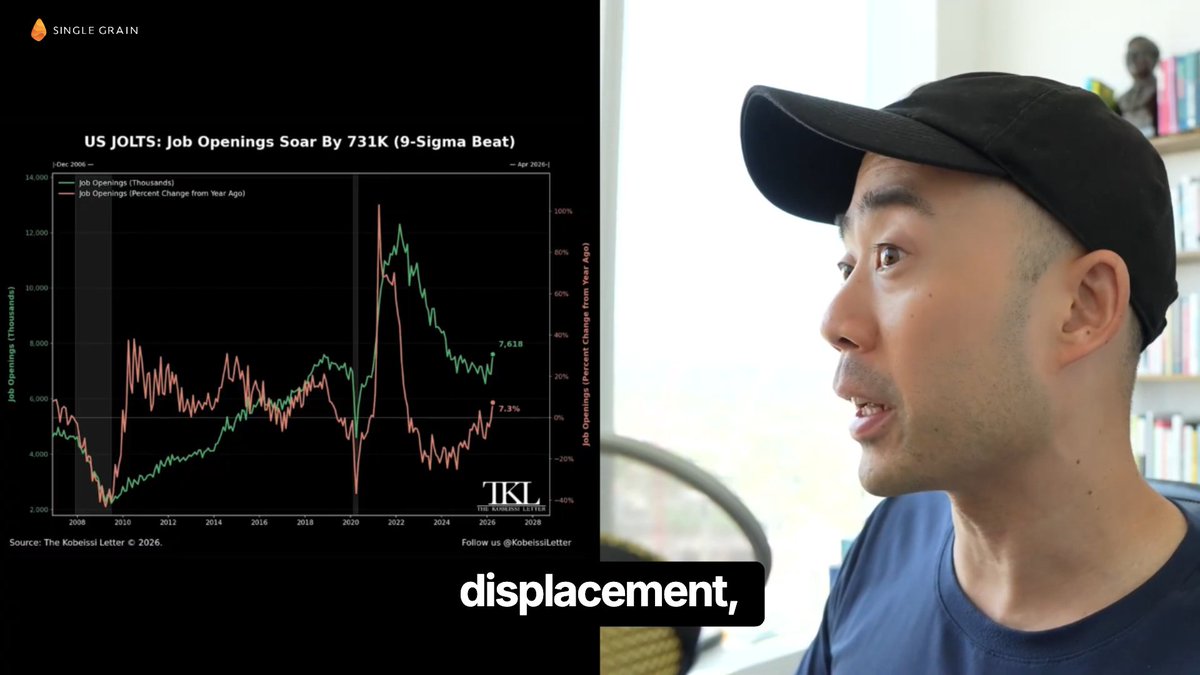
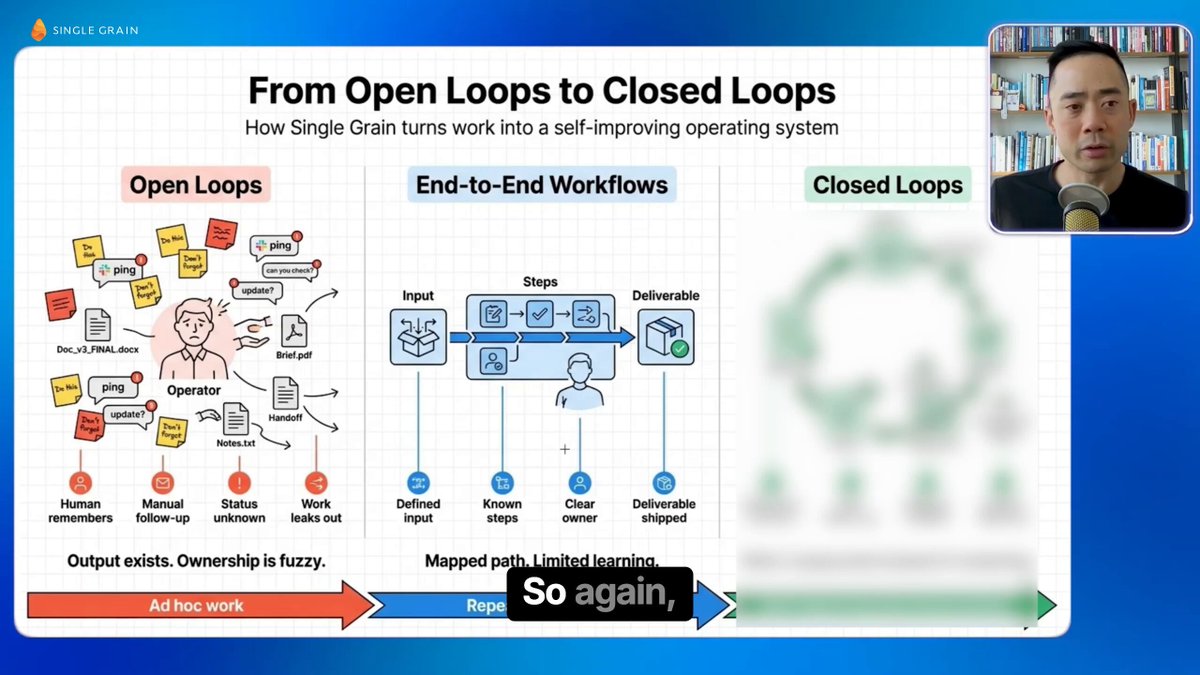
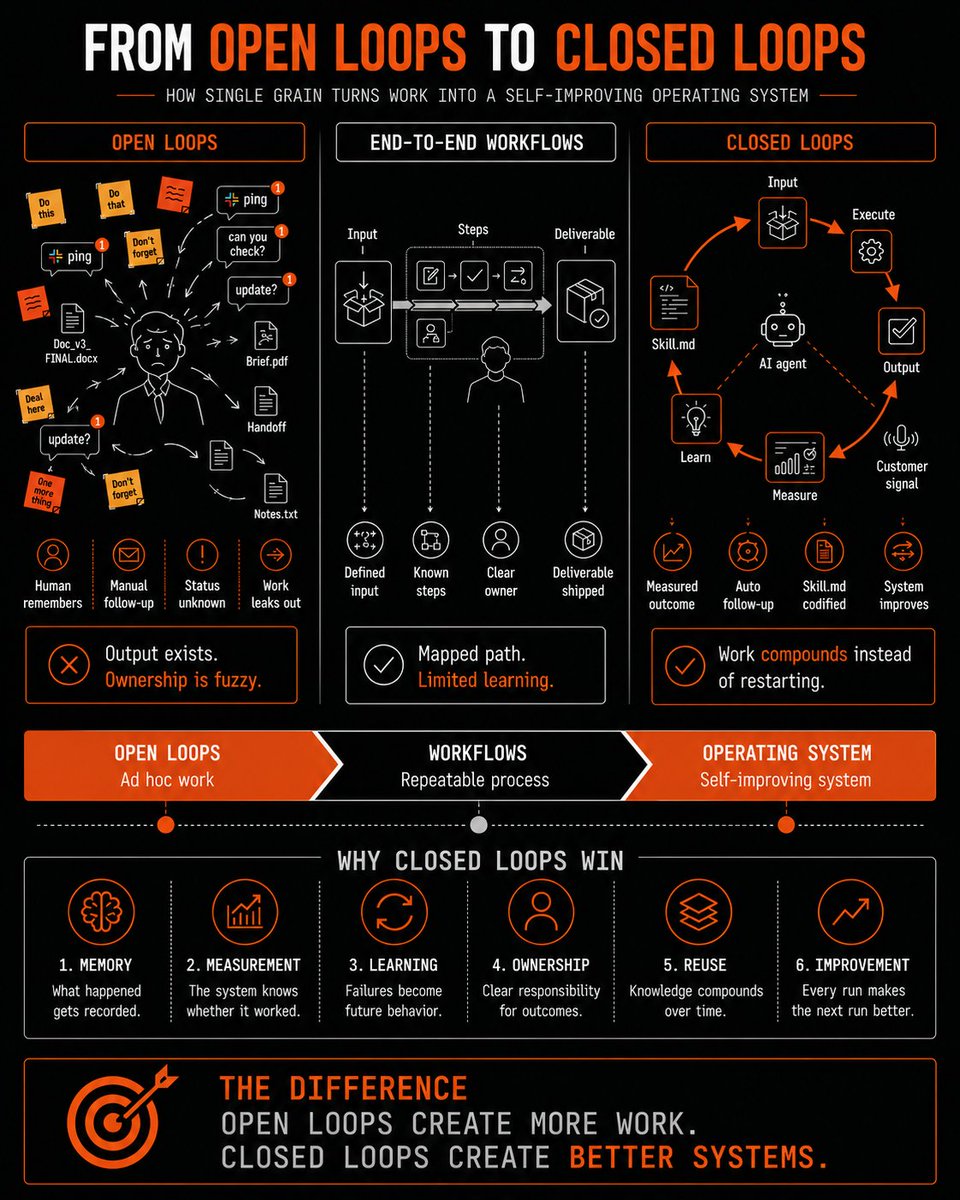
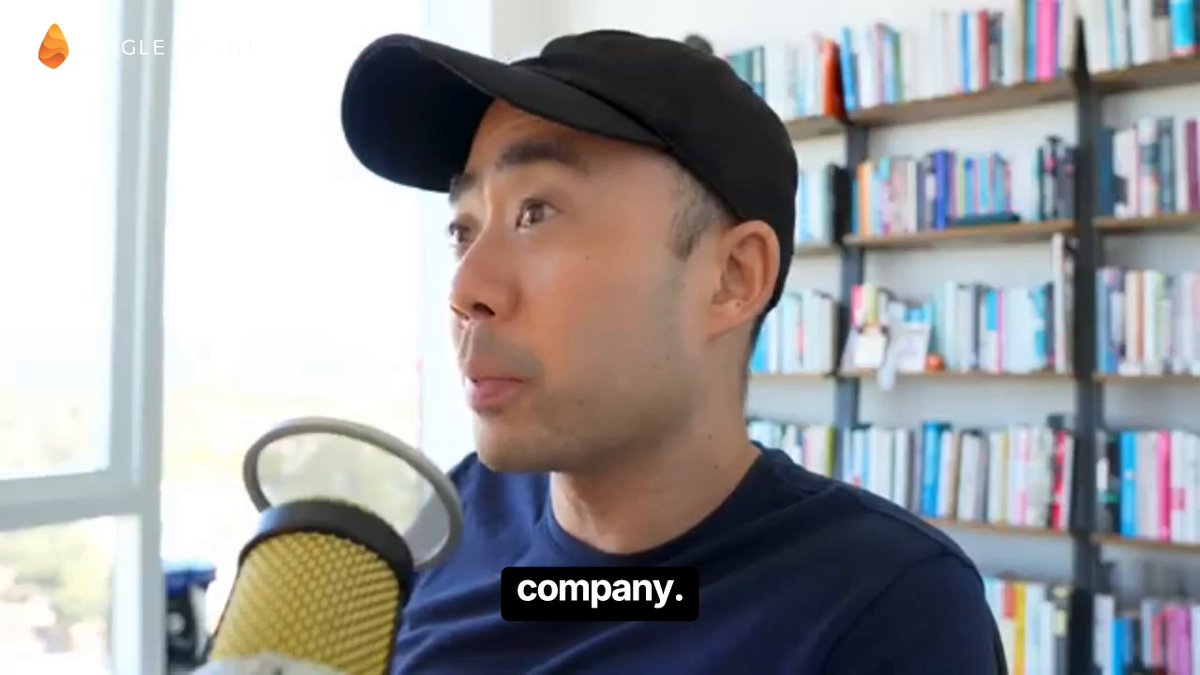


In twelve months, EVERY company will be running a Company Brain.
The teams who build it this year will spend the next year compounding. Everyone else is going to play catch up.
Here's what it actually is. You connect your Slack, your GitHub, HubSpot, all your tools into one intelligence layer, then build the org chart around it: a main brain up top, a fleet commander running the agent fleet, specialist sub-agents handling execution.
The reason it works is change management basically disappears. Your team already lives in Slack. You're just adding agents to the room they're already in.
You NEED to start building yours now. In a year this will stop being an advantage and will become table stakes.

38
59
509
124,912
Upon further investigation, Dr. Codex and I have concluded that this is NOT a Hermes issue. The only reason Hermes started to fail was because my @nvidia DGX Spark started to degrade gradually, then all of a sudden:
Yes. That is now the most likely read.
Hermes/OpenClaw may have looked like they were degrading because they were running on top of a device/storage path that was starting to fail.
The pattern fits:
Spark-1 storage or firmware starts getting unstable.
Apps begin acting weird: slowdowns, failures, bad restarts, model/service issues.
Reboot exposes the deeper boot problem.
BIOS/UEFI loop starts.
Synchronous Exception appears.
External SSD reads show I/O errors and device dropouts.
So I would no longer frame this as “Hermes overloaded itself and destroyed the machine.”
I would frame it as:
Spark-1 likely developed a DGX Spark storage/firmware failure, and Hermes was the first visible workload affected by that failure.
That matters for customer risk too: the prevention is not just “make Hermes lighter.” It is also hardware health checks, disk snapshots, verified backups, reboot durability, warranty path, and a tested recovery plan.
Spending my Saturday morning trying to fix my @NousResearch Hermes.
Timeline:
- Tuesday performance starts to degrade, where it can't seem to remember that it has certain skills or certain memories. Performance goes from maybe a 9/10 to a 6/10.
- Wednesday, it gets worse. Maybe now a 4/10.
- Thursday, during a podcast with @mvanhorn, I try to invoke the /last30days skill during the call, and I get an 'X' emoji saying that Hermes is down. Codex tells me to reboot my DGX Spark.
- I reboot my DGX Spark, it also goes down. Meaning it's no longer talking to me and I can't clean boot it from BIOS. Btw, I haven't seen a BIOS screen in probably 20 years.
- Today, I got a USB-C NVMe Enclosure and I'm unscrewing the DGX Spark so I can transfer the files over to my other Spark to hopefully save my configs.
Good reminder to back everything up on a daily basis and keep your machine clean.
Whether we like it or not, we are all now mini-managers of infrastructure. 🙃
1
2
1,114

Spending my Saturday morning trying to fix my @NousResearch Hermes.
Timeline:
- Tuesday performance starts to degrade, where it can't seem to remember that it has certain skills or certain memories. Performance goes from maybe a 9/10 to a 6/10.
- Wednesday, it gets worse. Maybe now a 4/10.
- Thursday, during a podcast with @mvanhorn, I try to invoke the /last30days skill during the call, and I get an 'X' emoji saying that Hermes is down. Codex tells me to reboot my DGX Spark.
- I reboot my DGX Spark, it also goes down. Meaning it's no longer talking to me and I can't clean boot it from BIOS. Btw, I haven't seen a BIOS screen in probably 20 years.
- Today, I got a USB-C NVMe Enclosure and I'm unscrewing the DGX Spark so I can transfer the files over to my other Spark to hopefully save my configs.
Good reminder to back everything up on a daily basis and keep your machine clean.
Whether we like it or not, we are all now mini-managers of infrastructure. 🙃
2
1,969
Fable 5 is offline so you’re better off spending that free time learning how to get 10x more from AI from @mvanhorn.
He’ll give you the following superpowers:
/last30days as a super research engine
The ability to make a CLI out of anything to run things faster
And much more:
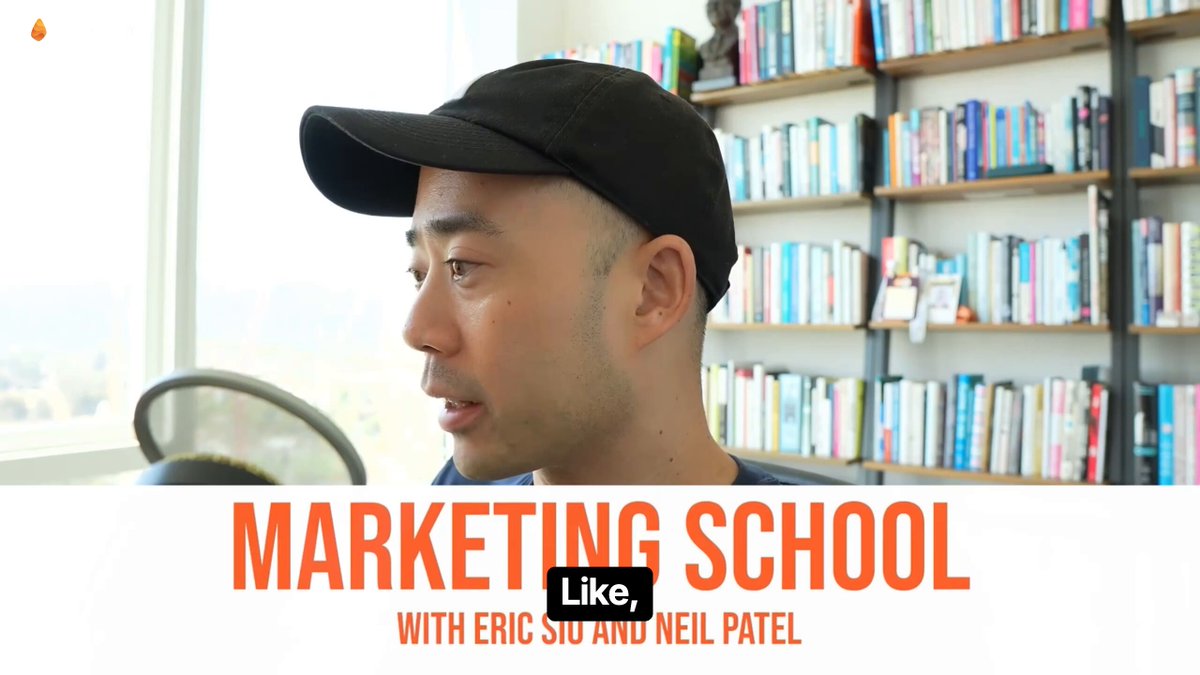
I spent an hour picking @mvanhorn's brain about loops, agents, and AI workflows.
Here are the 5 biggest takeaways from our conversation:
---
1. A loop is just a cron job plus an LLM.
We've had automation forever. A cron job runs on a schedule and follows instructions: every morning at 8 AM send the report, every night at midnight back up the database.
What's new is the software can make decisions now.
Instead of sending the same report every day, it picks which report matters. Instead of reviewing every pull request, it flags the ones that need a human.
You no longer have to just "schedule things". You can now implement judgment directly into these tasks.
---
2. Taste matters more than coding
Matt isn't a software engineer.
Yet he's been shipping insanely useful products because the cost of building has collapsed.
His challenge was simple:
"You say you're an idea person? Prove it. You now can."
For years, having an idea wasn't enough. You needed engineers to test it.
Now the biggest bottleneck is just deciding what deserves to be built in the first place.
The builders still win. But now the builders can be anyone. Including you ;)
---
3. Skillify everything.
This was probably my favorite framework from the conversation.
If you do something more than once, turn it into a skill.
Notion template? Skill.
Research process? Skill.
Sales prep workflow? Skill.
If you're doing the same thing over and over, you're usually looking at a future skill.
The goal is capturing judgment so it can be reused, refined, and eventually delegated to an agent.
---
4. Agents move faster through a CLI than a webpage.
Humans use interfaces because we need the visual cues. We click buttons, we scan pages, that's how our brains work.
An agent doesn't need any of that. Every click is another step, every page load another chance to fail.
That's why Matt built Printing Press. Instead of teaching an agent to navigate a website, you give it a command line that talks straight to the underlying API.
Less friction and fewer ways for it to break. Genius, if you ask me.
---
5. Apply new ideas to your own business
One workflow Matt shared stood out.
He'll take a YouTube video, an article, transcripts from his sales calls, and notes from previous conversations, then have AI apply the lessons directly to his own situation.
Not summarize the content.
Apply it.
The people who are getting the most out of AI right now are getting good at spotting their own bottlenecks and pointing these increasingly capable systems at them.
---
Final thoughts
The tools will keep getting better on their own.
Taste won't. That part's on you, and trust me, it's worth the investment.
The good news: if you're reading this, you're already ahead :)
P.S.
List of helpful tools Matt recommended in the comments below.
Happy building!
4
2
55
22,834
Garry Tan said something that reframed how you should think about AI inside companies.
"The models are already smart enough. The bottleneck is the company specific context locked inside your senior people's heads."
Neil and I have run our companies long enough that we carry the most context in them. Same with your CEO and your executives. They can see more of the battlefield than anyone else on the team.
But if that view stays trapped in a few heads, everyone underneath them moves slow.
That's why you're seeing so many people build company memory and company brain products right now. Everyone's racing to crack the same problem.
The bottleneck isn't a smarter model. We all have the same models.
It's whether you can get what your best people know out of their heads and into the hands of everyone else.
5
7
52
5,948
If you want help building this for your company, check out: singlebrain.com/
2
538
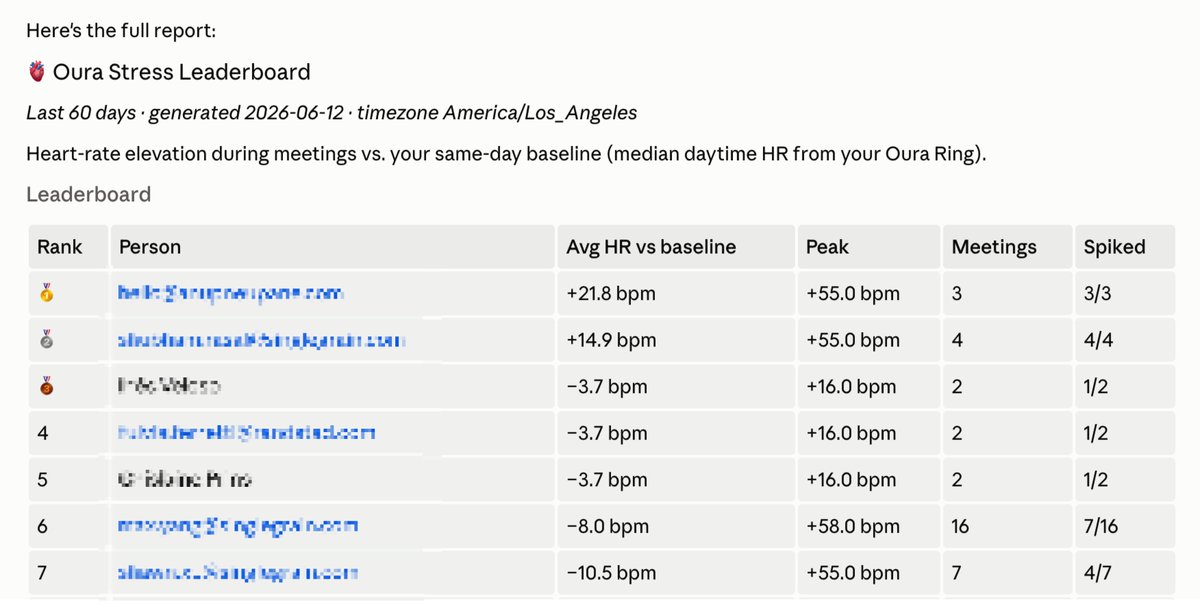
Used Fable 5 to connect my @ouraring with my Google calendar to see which people stress me out the most. 🤣
Saw this yesterday and had to build my own. It was as easy as screenshotting the X post and letting it do its thing.
Here's the prompt if you want to steal this:
Build me a "meeting stress leaderboard": which meetings and coworkers spike
my heart rate, using my Oura Ring and Google Calendar.
My setup (I'll put these in a .env file, never in code):
- OURA_TOKEN = my Oura personal access token
- CALENDAR_ICS_URL = my Google Calendar secret iCal address
- OWNER_EMAIL = <your email>
- Timezone: <your timezone, e.g. America/Los_Angeles>
Build a single Python script (stdlib only, no pip installs) that:
1. Pulls the last 60 days of heart-rate data from the Oura API v2
/usercollection/heartrate endpoint (chunk requests by 7 days, follow
next_token pagination, drop samples where source == "sleep").
2. Parses my calendar from the iCal URL: expand daily/weekly recurring
events, honor cancellations and overrides, and skip all-day events,
events I declined, and events with no other human attendees.
3. Scores each meeting against a PRE-MEETING baseline: the median HR in
the 30 minutes before the meeting starts (widen to 60 min if too few
samples; fall back to that day's 8am-7pm median). Report avg and peak
HR delta vs that baseline. A meeting "spikes" when peak HR >= baseline
10 bpm. Skip meetings with fewer than 2 HR samples or more than 8
attendees. Do NOT use a whole-day baseline — it makes every meeting
look calming, because sitting still beats a median that includes
walking and workouts.
4. Filters noise attendees: notetaker/scheduler bots (Gong, Otter,
Fireflies, Read.ai, Reclaim, Clockwise), meeting-room resources, and
company-wide aliases like team@/operations@ at my domain. Ask me if
anyone invites me from two different email addresses, and fold those
into one identity.
5. Builds TWO leaderboards:
- People: 1:1 meetings only (2 scoreable 1:1s to qualify), ranked by
avg HR delta. Group meetings must not count toward people — everyone
in the room would inherit the same score.
- Recurring meetings: grouped by title (2 occurrences), ranked by avg
HR delta, with spike ratio and average attendee count. This is the
actionable table for calendar cleanup.
6. Writes a markdown report: both leaderboards, my 5 most stressful
individual meetings, and a methodology section with honest caveats
(Oura samples daytime HR every ~3-5 min; exercise during a calendar
event looks like stress; correlation != causation — use for laughs,
not performance reviews).
Privacy rules: tokens only in .env; gitignore the .env, data files, and
report; never put real names in anything that gets committed.
Include a --demo mode with synthetic data, and unit tests for the
calendar parsing, baseline logic, and leaderboard aggregation.
Then run it on my real data, show me the report, and explain how to read
it — including which numbers are signal and which are noise.

5
5
40
5,551
Every tool Matt mentioned. All free / open source:
Last 30 Days — researches any topic across Reddit, X, YouTube, TikTok & more at once, ranked by what people actually engaged with. The one that caught the fake TikTok campaign.
→ github.com/mvanhorn/last30da…
Printing Press — turns any tool or website into a fast, agent-friendly command line. 50 pre-built.
→ printingpress.dev
Compound Engineering (by Every) — a planning system that makes your agent "codify" lessons so it stops repeating mistakes.
→ every.to/guides/compound-eng…
Agent Cookie — keeps a headless Mac agent logged into the same sites as your laptop, synced over Tailscale.
→ github.com/mvanhorn/agentcoo…
Matt's "WTF is a loop?" article (3.4M views) everything else → follow @mvanhorn on X.
9
162
41,834
I spent an hour picking @mvanhorn's brain about loops, agents, and AI workflows.
Here are the 5 biggest takeaways from our conversation:
---
1. A loop is just a cron job plus an LLM.
We've had automation forever. A cron job runs on a schedule and follows instructions: every morning at 8 AM send the report, every night at midnight back up the database.
What's new is the software can make decisions now.
Instead of sending the same report every day, it picks which report matters. Instead of reviewing every pull request, it flags the ones that need a human.
You no longer have to just "schedule things". You can now implement judgment directly into these tasks.
---
2. Taste matters more than coding
Matt isn't a software engineer.
Yet he's been shipping insanely useful products because the cost of building has collapsed.
His challenge was simple:
"You say you're an idea person? Prove it. You now can."
For years, having an idea wasn't enough. You needed engineers to test it.
Now the biggest bottleneck is just deciding what deserves to be built in the first place.
The builders still win. But now the builders can be anyone. Including you ;)
---
3. Skillify everything.
This was probably my favorite framework from the conversation.
If you do something more than once, turn it into a skill.
Notion template? Skill.
Research process? Skill.
Sales prep workflow? Skill.
If you're doing the same thing over and over, you're usually looking at a future skill.
The goal is capturing judgment so it can be reused, refined, and eventually delegated to an agent.
---
4. Agents move faster through a CLI than a webpage.
Humans use interfaces because we need the visual cues. We click buttons, we scan pages, that's how our brains work.
An agent doesn't need any of that. Every click is another step, every page load another chance to fail.
That's why Matt built Printing Press. Instead of teaching an agent to navigate a website, you give it a command line that talks straight to the underlying API.
Less friction and fewer ways for it to break. Genius, if you ask me.
---
5. Apply new ideas to your own business
One workflow Matt shared stood out.
He'll take a YouTube video, an article, transcripts from his sales calls, and notes from previous conversations, then have AI apply the lessons directly to his own situation.
Not summarize the content.
Apply it.
The people who are getting the most out of AI right now are getting good at spotting their own bottlenecks and pointing these increasingly capable systems at them.
---
Final thoughts
The tools will keep getting better on their own.
Taste won't. That part's on you, and trust me, it's worth the investment.
The good news: if you're reading this, you're already ahead :)
P.S.
List of helpful tools Matt recommended in the comments below.
Happy building!
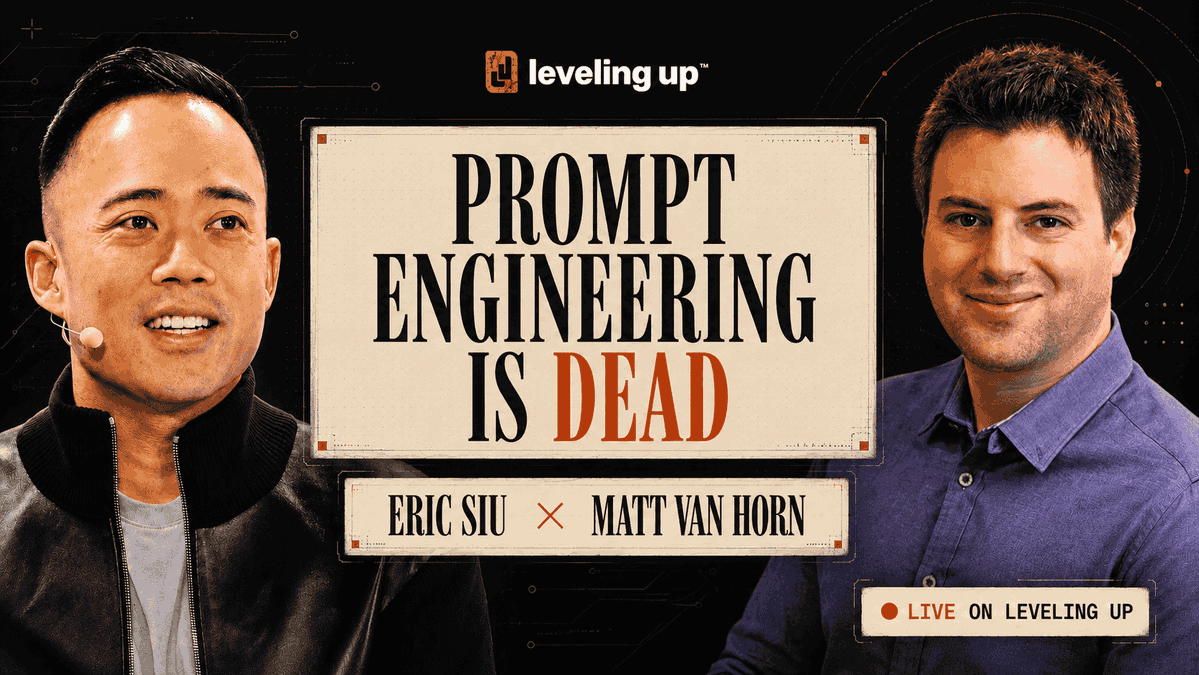
Matt Van Horn on Agent Loops: Why Prompt Engineering is Dead, How to Build Systems That Run Themselves, and What It Teaches Marketers x.com/i/broadcasts/1DGleeLLL…
4
9
97
22,850
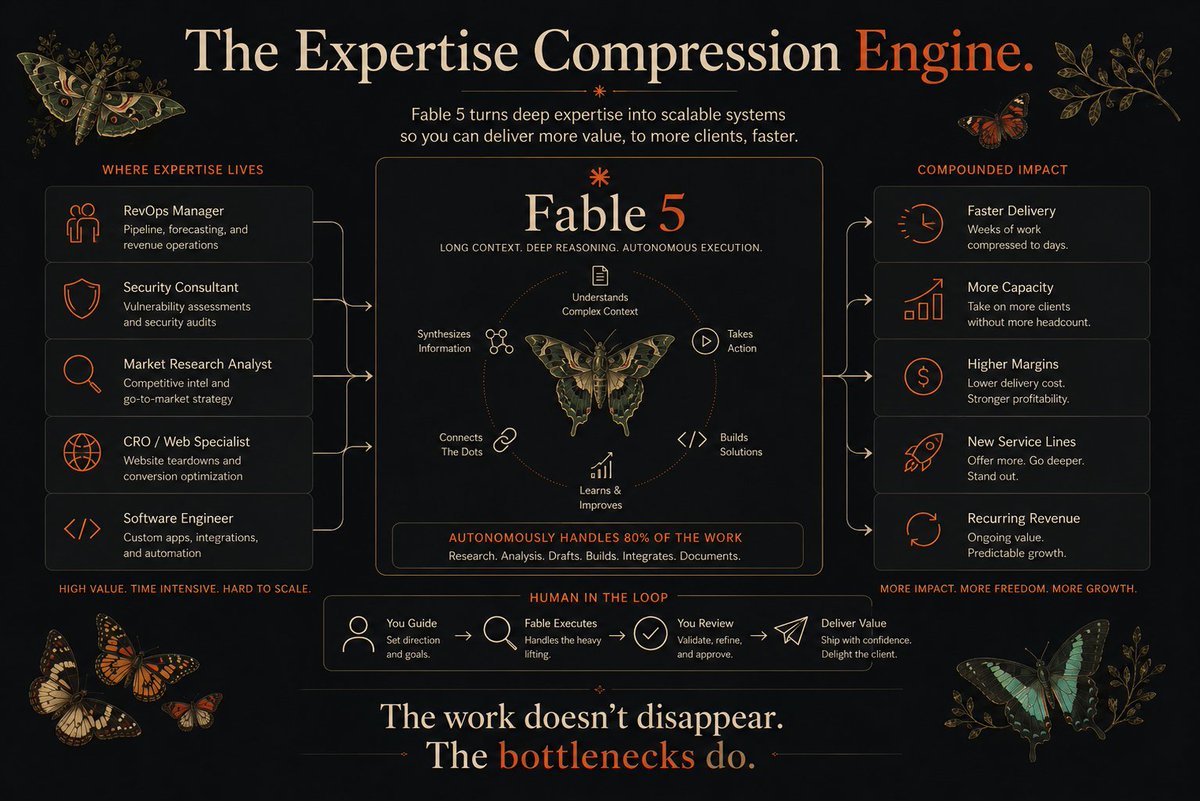
Fable 5 just killed "we don't have time for that."
Your business has a list of problems it gave up on.
The migration nobody finished.
The CRM nobody cleaned.
The security review you keep pushing.
The strategy work nobody had time for.
For years, that list never moved for one reason:
The model wasn't good enough to clear it.
But now Fable 5 is the first one that can clear it.
It holds context across millions of tokens and hunts down the right data instead of guessing.
The messy, half-done projects finally close out.
The work you kept putting off is in reach.
The constraint is no longer the model.
Now it's whether you point it at the right things to work on
Start with your stuck list.
Pick the one thing you've told yourself you'd fix for months, and point Fable 5 at it this week.
Trust me it's incredible.
6
2
29
4,316
I spent an hour picking @mvanhorn's brain about loops, agents, and AI workflows.
Here are the 5 biggest takeaways from our conversation:
---
1. A loop is just a cron job plus an LLM.
We've had automation forever. A cron job runs on a schedule and follows instructions: every morning at 8 AM send the report, every night at midnight back up the database.
What's new is the software can make decisions now.
Instead of sending the same report every day, it picks which report matters. Instead of reviewing every pull request, it flags the ones that need a human.
You no longer have to just "schedule things". You can now implement judgment directly into these tasks.
---
2. Taste matters more than coding
Matt isn't a software engineer.
Yet he's been shipping insanely useful products because the cost of building has collapsed.
His challenge was simple:
"You say you're an idea person? Prove it. You now can."
For years, having an idea wasn't enough. You needed engineers to test it.
Now the biggest bottleneck is just deciding what deserves to be built in the first place.
The builders still win. But now the builders can be anyone. Including you ;)
---
3. Skillify everything.
This was probably my favorite framework from the conversation.
If you do something more than once, turn it into a skill.
Notion template? Skill.
Research process? Skill.
Sales prep workflow? Skill.
If you're doing the same thing over and over, you're usually looking at a future skill.
The goal is capturing judgment so it can be reused, refined, and eventually delegated to an agent.
---
4. Agents move faster through a CLI than a webpage.
Humans use interfaces because we need the visual cues. We click buttons, we scan pages, that's how our brains work.
An agent doesn't need any of that. Every click is another step, every page load another chance to fail.
That's why Matt built Printing Press. Instead of teaching an agent to navigate a website, you give it a command line that talks straight to the underlying API.
Less friction and fewer ways for it to break. Genius, if you ask me.
---
5. Apply new ideas to your own business
One workflow Matt shared stood out.
He'll take a YouTube video, an article, transcripts from his sales calls, and notes from previous conversations, then have AI apply the lessons directly to his own situation.
Not summarize the content.
Apply it.
The people who are getting the most out of AI right now are getting good at spotting their own bottlenecks and pointing these increasingly capable systems at them.
---
Final thoughts
The tools will keep getting better on their own.
Taste won't. That part's on you, and trust me, it's worth the investment.
The good news: if you're reading this, you're already ahead :)
P.S.
List of helpful tools Matt recommended in the comments below.
Happy building!
Matt Van Horn on Agent Loops: Why Prompt Engineering is Dead, How to Build Systems That Run Themselves, and What It Teaches Marketers x.com/i/broadcasts/1DGleeLLL…
4
9
97
22,850
Every tool Matt mentioned. All free / open source:
Last 30 Days — researches any topic across Reddit, X, YouTube, TikTok & more at once, ranked by what people actually engaged with. The one that caught the fake TikTok campaign.
→ github.com/mvanhorn/last30da…
Printing Press — turns any tool or website into a fast, agent-friendly command line. 50 pre-built.
→ printingpress.dev
Compound Engineering (by Every) — a planning system that makes your agent "codify" lessons so it stops repeating mistakes.
→ every.to/guides/compound-eng…
Agent Cookie — keeps a headless Mac agent logged into the same sites as your laptop, synced over Tailscale.
→ github.com/mvanhorn/agentcoo…
Matt's "WTF is a loop?" article (3.4M views) everything else → follow @mvanhorn on X.
9
162
41,834
Claude Fable 5 is the most capable model ever shipped, and the biggest mistake you can make is using it like every other model.
The opportunity is figuring out how to apply it to your business before anyone else in your niche does.
Here's how:
00:00 Fable 5 & Mythos 5 Are Out
00:13 The Mythos Class Model Explained
00:57 Autonomous Revenue Ops Engine
02:30 Visual Competitor Analysis
03:09 Enterprise Security As A New Revenue Vertical
04:17 Build A Unified Intelligence Bot
05:01 Autonomous Research To Strategy Pipeline
06:08 Automated Implementation Accelerator
07:08 Why You Should Explore This Now
6
3
21
5,221
If you liked this, you'll probably like Leveling Up. Practical AI and growth strategies for founders and operators, delivered free: newsletter.levelingup.com
2
376
Noticed my Hermes started to degrade a few days ago. The following day, performance fell off a cliff. Then it just stopped talking and I tried to reboot the DGX spark it’s on.
Now both are unresponsive.
@NousResearch @Teknium can I get some help here?
Everything was reliable and no major changes were made. My Codex and OpenClaw are debugging and they didn’t find anything major so this is a bit frustrating.
1
1
1
1,206
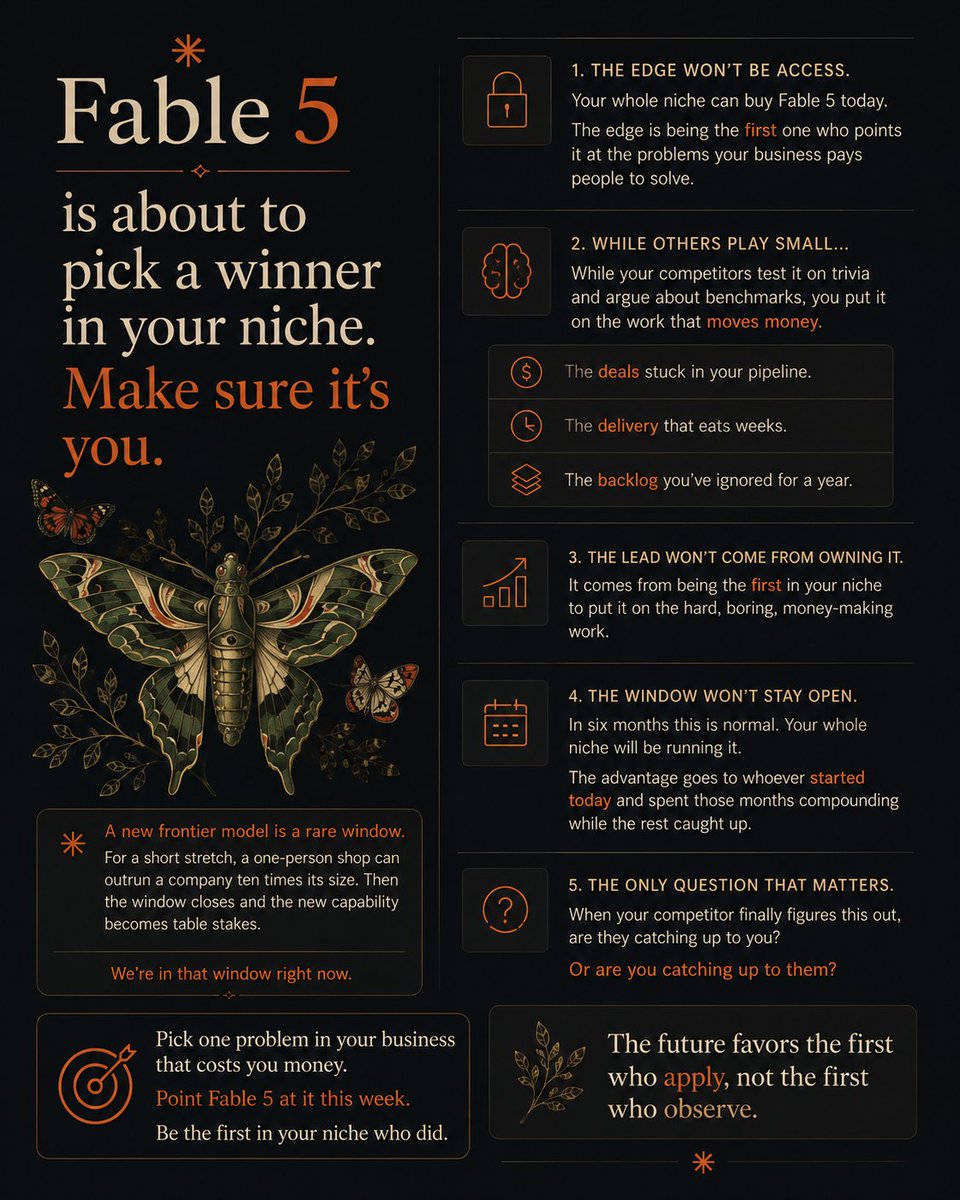
DO NOT FALL BEHIND
Fable 5 is about to pick a winner in your niche.
Make sure it's you.
A new frontier model is a rare window. For a short stretch, a one-person shop can outrun a company ten times its size. Then the window closes and the new capability becomes table stakes.
In six months this will be normal. Your whole niche will be running it. The advantage goes to whoever started today and spent those months compounding while the rest caught up.
So the only question that matters is this.
When your competitor finally figures this out, are they catching up to you? Or are you catching up to them?
Pick one problem in your business that costs you money.
Point Fable 5 at it this week.
Be the first in your niche who did.
15
3,162
ericosiu retweeted

Jun 12
Who is the most AI-native marketer you know?
My starting list:
- @codyschneider
- @PJaccetturo
- @searchbrat
- @ericosiu
33
5
130
27,778
Bill for a standard retainer outcomes. Hybrid to start off with stable cash flows and then once you’ve feel like you’ve nailed the offer, go all in on outcomes based pricing.
Jun 11

Bill for the output instead. You built tooling that does in hours what used to take weeks, so the same deliverable now carries 60% margins. Same work, same customer, completely different business.
3
3
602