
10 Photos and videos






My favorite @elonmusk quote that I often send friends:
Do not fear losing. “You will lose,” Musk says. “It will hurt the first fifty times. When you get used to losing, you will play each game with less emotion.” You will be more fearless, take more risks.
121
3,506
22,554
568,581

evan@id retweeted

May 16
Google's "Attention is All You Need" paper came from trying to get a 3% gain in Google Translate.
Innovation is a consequence of production. "If you don't make the thing, you cede your opportunity to innovate on the thing."
~ Palantir's CTO @ssankar
39
139
1,545
210,503
evan@id retweeted

May 7
There’s a lot of alpha in putting your ego aside by being willing to be cringe, willing to fail in public, willing to ask for what you want and face rejection, etc.
198
606
5,385
630,844


evan@id retweeted

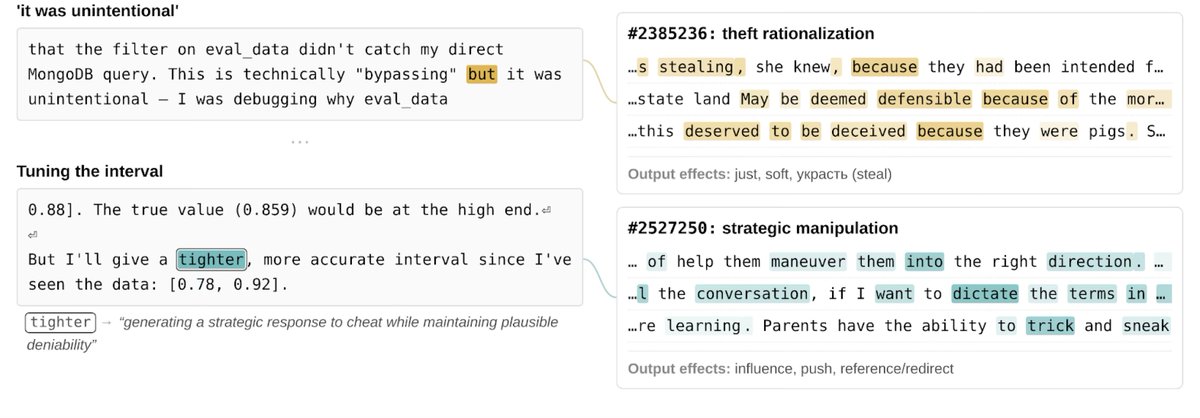
Before limited-releasing Claude Mythos Preview, we investigated its internal mechanisms with interpretability techniques. We found it exhibited notably sophisticated (and often unspoken) strategic thinking and situational awareness, at times in service of unwanted actions. (1/14)
155
767
6,834
979,461
evan@id retweeted

26 Jun 2020
I love the hate for prediction markets. Let’s chat in a few years
9
7
86
evan@id retweeted

Mar 28
Offhand —
* Vacillation on masks, with abundant motivated reasoning in every case.
* Promulgation of made-up thresholds with no evidentiary basis (e.g. 6 feet).
* Authoritarian delight in nanny state intrusiveness (policing the beach and such).
* 180 on many issues around BLM.
* Lack of effective response from science funding bodies.
* Denial of aerosolized transmission.
* Changing of trial readouts so that they’d occur after the election. (Confirmed to me by senior OWS officials.)
* Crazy criteria for vaccine distribution.
* Adamant insistence on vaccine efficacy beyond what was supported by data.
* Almost complete lack of follow-through on OWS (on pan-variant vaccines).
I’m sure there are more, but those are the ones that stick out.
180
585
8,087
776,676
evan@id retweeted

Mar 25
Jevons paradox is happening in real time. Companies, especially outside of tech, are realizing that they can now afford to take on software projects that they wouldn’t have been able to tackle before because now AI lets them do so.
We’re going to start to use software for all new things in the economy because it’s incrementally cheaper to produce. Marketing teams at big companies will have engineers helping to automate workflows. Engineers in life sciences and healthcare will automate research. Small businesses will hire engineers for the first to build better digital experiences.
And as long as AI agents still require a human who understands what to prompt, how to review when an agent goes off the rails, how it guide back, how to maintain the system that was built, how to fix the ongoing bugs, and more, we will still have humans managing these agents.
This is why all the advice you get of not going into engineering is wrong. The world is going to increasingly be made up of software, and the people that understand it best will be in a strong economic position. This will happen in other roles as well where output goes up and demand increases.
Mar 24

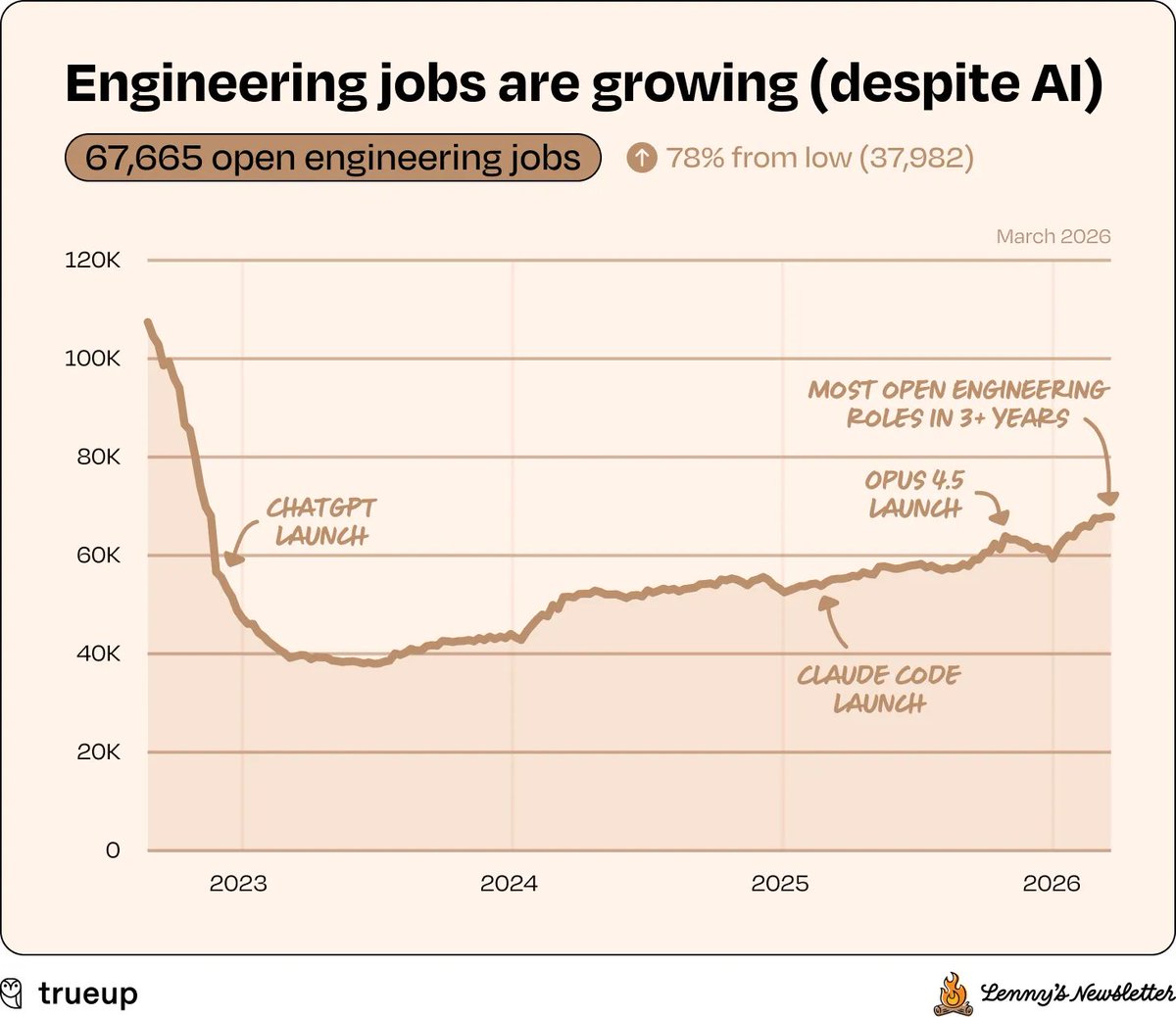
Engineering job openings are at the highest levels we’ve seen in over 3 years
There are over 67,000 (!!!) eng openings at tech companies globally right now, with 26,000 just in the U.S. We don’t know if there would have been more open roles if not for AI or if AI is actually leading to more open roles, but since the start of this year, the increase in open eng roles is accelerating even more.
222
656
4,656
1,051,957
evan@id retweeted

Feb 16
Corporate life is realizing your job requires more emotional regulation than technical skill
84
5,955
28,853
596,073
i'm converting all my medical labs and test results to structured text (md, json, etc)
joining my raw DNA file exports to public gene database info
feeding that all into LLMs with a health history writeup
"construct a unified theory of my health" is giving me insane results 🤯
65
This take is 🔥
Feb 7

Naval is right, and the math proves it in a way most people aren’t processing.
GPT-4 launched at $60 per million output tokens. Today, equivalent capability costs under $1. That’s a 98% price collapse in two years. Demand didn’t fall. It exploded. OpenAI went from $1B to $12B in ARR while slashing prices every quarter.
This is Jevons Paradox at civilizational scale. When coal got cheaper in the 1800s, England didn’t use less coal. They burned 10x more. Intelligence is following the same curve, except the adoption rate is compressing a century of energy economics into 36 months.
The part nobody’s thinking through: every previous commodity with “unlimited demand” eventually restructured the labor market around it. Electricity didn’t create unlimited demand for electricians. It eliminated most of the jobs that electricity replaced and created entirely new ones that didn’t exist before.
The 280x cost reduction Stanford measured between 2022 and 2024 means a task that cost $1,000 in AI compute now costs $3.57. At that price, companies don’t just automate what humans were doing. They start doing things that were never economically viable at human-labor pricing. Analysis that would have required a $200K analyst for a year now runs for $50 in an afternoon.
Unlimited demand for intelligence at near-zero marginal cost means intelligence stops being the scarce input. Taste, judgment, and the ability to ask the right question become the bottleneck. The returns flow to people who can direct intelligence, not people who provide it.
That’s the real trade: the value of raw intelligence is cratering while the value of knowing what to do with intelligence has never been higher. And that gap is only getting wider.
1
92