
Engage, but don't overlook competence. Personal views.
Joined April 2010
- Tweets 2,610
- Following 1,014
- Followers 619
- Likes 7,298
461 Photos and videos

May 25
If you want to see how this plays out over the longer term, I suggest pick a country like Bangladesh, and see what happened in the 1980s onward when donor countries decided to channel their development funds through NGOs and not the military government at that time. I wrote an op-ed about it in mid 1990s. In the long term you end up with an NGO sector that is accountable to foreign donors, not the market or the public. You end up with millions of dollars for HIV research, which wasn’t a national problem, and none for arsenic in groundwater research, which was. Inadvertently you also create a talent flight from the public to the NGO sector from which the civil service never recovers. You are left with incompetent political actors replacing a merit based administration. You also end up with non competitive markets as NGOs start providing services that should be provided by private sectors. You eventually get ranked among the most corrupt countries of the world. And you wonder how did we get here.
May 20

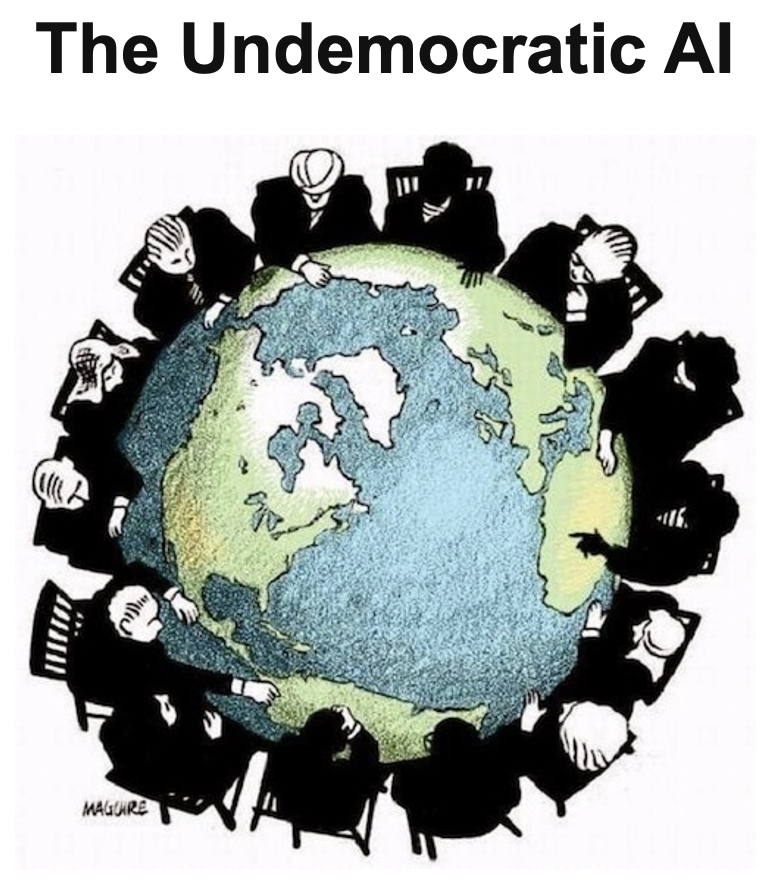
Oof. These are bad reasons to bypass democracy. Philanthropy at this scale is governance without legitimacy or accountability. It determines agendas, resources, legibility of problems, but w no elections, no oversight. And I worry it won’t complement government, but undermine it.
1
139
Apr 28
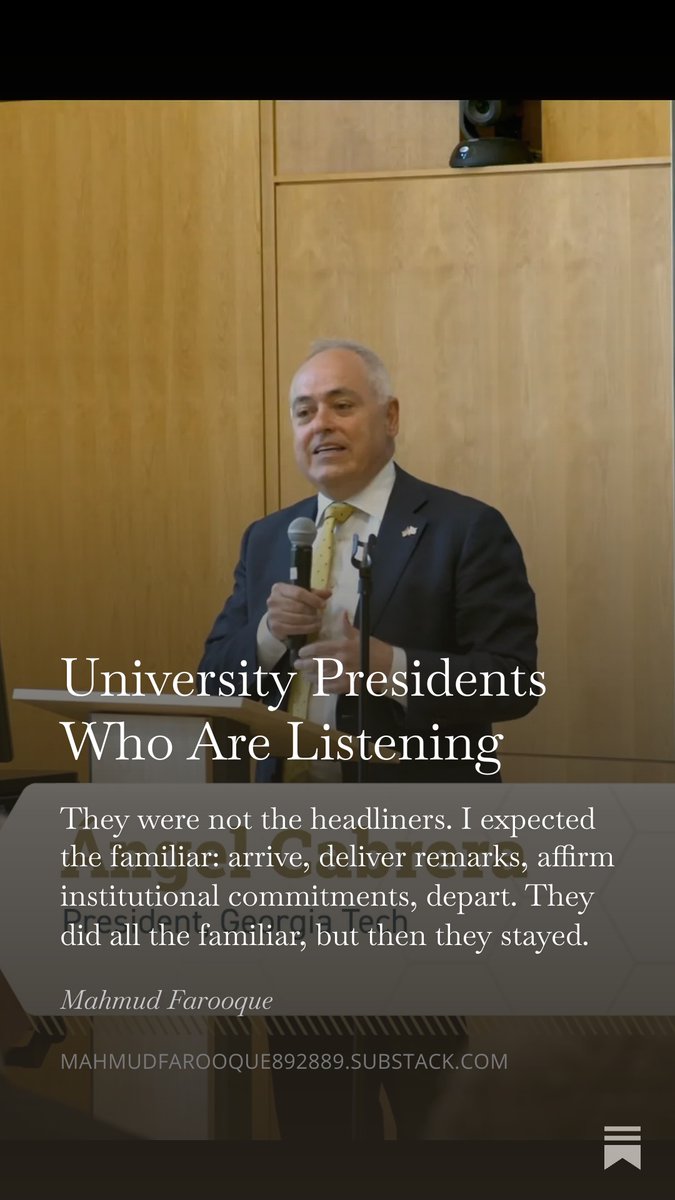
University Presidents Who Are Listening
They were not the headliners. I expected the familiar: arrive, deliver remarks, affirm institutional commitments, depart. They did all the familiar, but then they stayed.
cspo.org/university-presiden…
29
Apr 16
Democratizing Climate Governance: An Inconvenient Necessity? linkedin.com/pulse/democrati… via @LinkedIn
13
Apr 14
The Next Frontier is Engagement
Two and a half centuries of American history suggest that the tension between knowledge production and knowledge use is unlikely to disappear. The next settlement between science and democracy will depend on whether we can build institutions capable of navigating a world where expertise and democratic engagement evolve together. The endless frontier was discovery; the next frontier is participation.
cspo.org/the-next-frontier-i…
29
Mar 29
Looks like I picked up climate change about the time you were moving on, but looking at its “people” component. Starting with adaptation in 2010ish when I joined @CSPO_ASU (cspo.org/research/implementi…) then community resilience to climate change after Paris Climate accord in 2015 (cspo.org/research/science-ce…), moving on to solar Geoengineering in 2018 (cspo.org/research/governance…), picking up carbon dioxide removal in 2023 (cspo.org/research/cdr/) and now landing on planetary engineering in 2026 (cspo.org/event/engineering-o…). As the scale of the problem gets bigger, the scope of the solutions gets smaller for just climate, meaning solving the conflicts between climate systems, social systems, technological systems and political systems becomes more important.
Mar 28

When @JaneMayerNYer and I won John Chancellor Awards from the @columbiajourn school in 2008 for sustained journalistic excellence, I was asked (excuse the tux): “Obviously climate change is the biggest story on your plate right now, but looking ahead what do you see?”
I'd written hundreds of climate stories between 1985 and 2007. But I replied: "My coverage has evolved. Climate change is not the story of our time."
A lot of other journalists and orgs like @CoveringClimate have pressed a different case. But I stand by my view and my choice to keep a wide-view perspective. 🧵
2
59
Mar 17
Engineering our Planet: From Designed Interventions to Interdisciplinary Programs and Participatory Platforms (in person with online options)
Between 2021 and 2024, Public, private, and philanthropic drivers coordinated an unprecedented, multi-sectoral effort to advance engineering at the planetary scale forward through research and development in carbon dioxide removal (CDR) and solar geoengineering (SG). Like the drive on the technological front, the initiatives at the social front also came to a grinding halt with the change in U.S. administration. In many of these efforts, there was an explicit attempt to engage communities, stakeholders, and the broader public. CSPO was on the front lines, from engaging communities in Vinton, LA, and Vancouver, Canada, to consulting scientists in Barcelona, Spain, and Glasgow, Scotland, to convening policy stakeholders in Washington, DC. This two-part convening will highlight critical results and outcomes of those efforts to stimulate, simulate, and facilitate connections with complementary initiatives to inform current actions and future possibilities.
March 26, 2026, 4:30 pm – 8:00 pm
Engineering Our Planet, Part I: Lessons from the Engagement Frontier
cspo.org/event/engineering-o…
March 27, 2026, 8:30 am – 1:00 pm
Engineering Our Planet, Part II: Building Platforms for Geoengineering Research and Governance
cspo.org/event/engineering-o…
ALT CDR Public Forum at the Museum of Science, Boston
1
19
Feb 20
Arizona State University researchers are empowering communities in efforts to solve the nation’s nuclear waste problem through constructive and speculative approaches to exploring what it means to live near such sites.
news.asu.edu/20260218-scienc…
1
50
13 Dec 2025
Different approaches to improving mathematics education by leading science orgs in France and the United States: CNRS starts by asking the users (people); National Science Foundation (NSF) begins by asking the providers (experts)
cnrs.fr/en/node/12251
nsf.gov/funding/opportunitie…
45
20 Nov 2025
Call for Abstracts: "Participatory technology assessment and the framing challenge“ | TATuP - Zeitschrift für Technikfolgenabschätzung in Theorie und Praxis tatup.de/index.php/tatup/ann…
36
15 Nov 2025
America @250: Redesigning the Scientific Enterprise
ASU center committed to advancing New American University’s model for science funding in US news.asu.edu/b/20251114-asu-…
51
Mahmud Farooque retweeted

UPCOMING EVENT
On 11/06, @JohnsHopkins & @AEI will host Bridging Perspectives in COVID’s Wake: Science, Policy, and Public Trust in Crisis Response ft. @RobertDoar, @farooquema, @RogerPielkeJr, @jwalson & many more.
1
4
5
1,240
Mahmud Farooque retweeted

7 Mar 2025
RETHINKING #TECHNOLOGY #ASSESSMENT: Policy Signal vs. Noise, CSPO Science, Policy Seminar with John Alic, Thursday, March 20th, 9:00-10:00 am, ASU Washington Center eventbrite.com/e/rethinking-…
2
1
339
1 Mar 2025
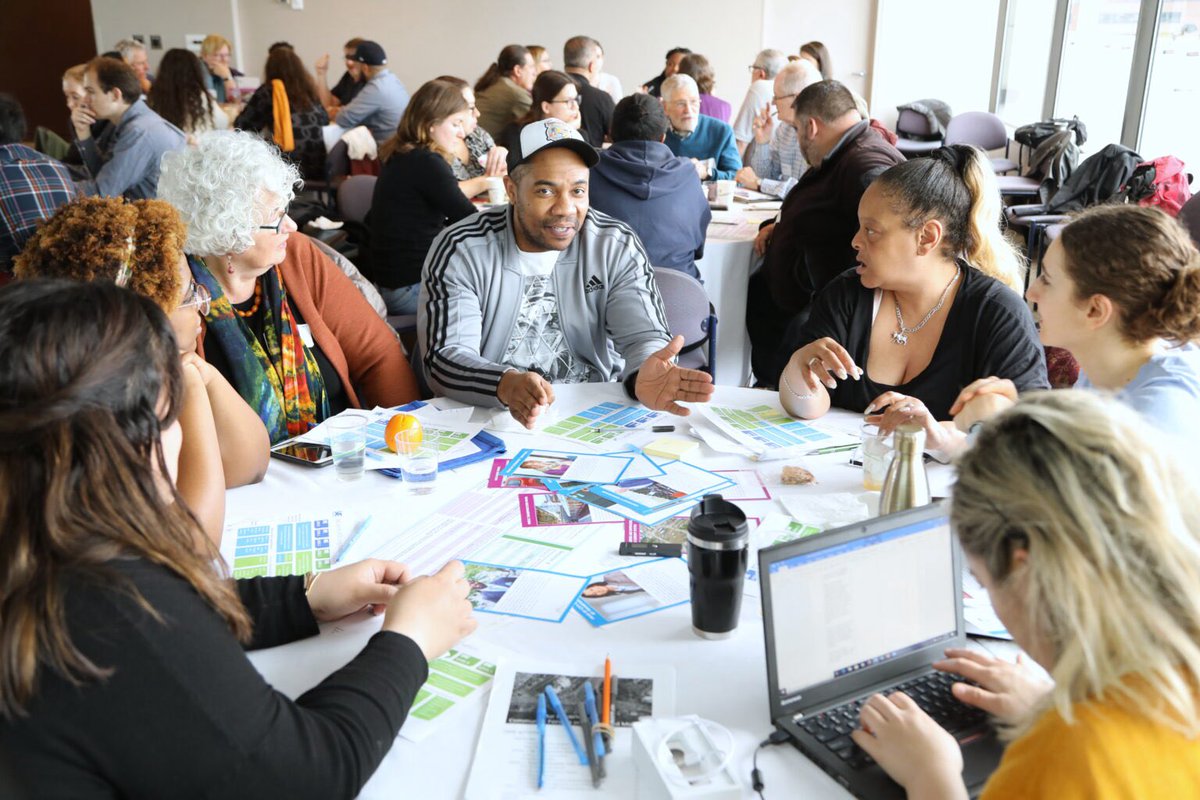
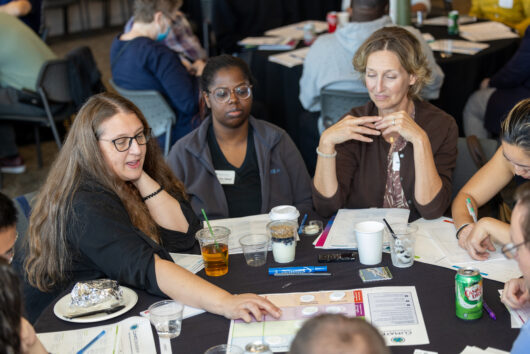
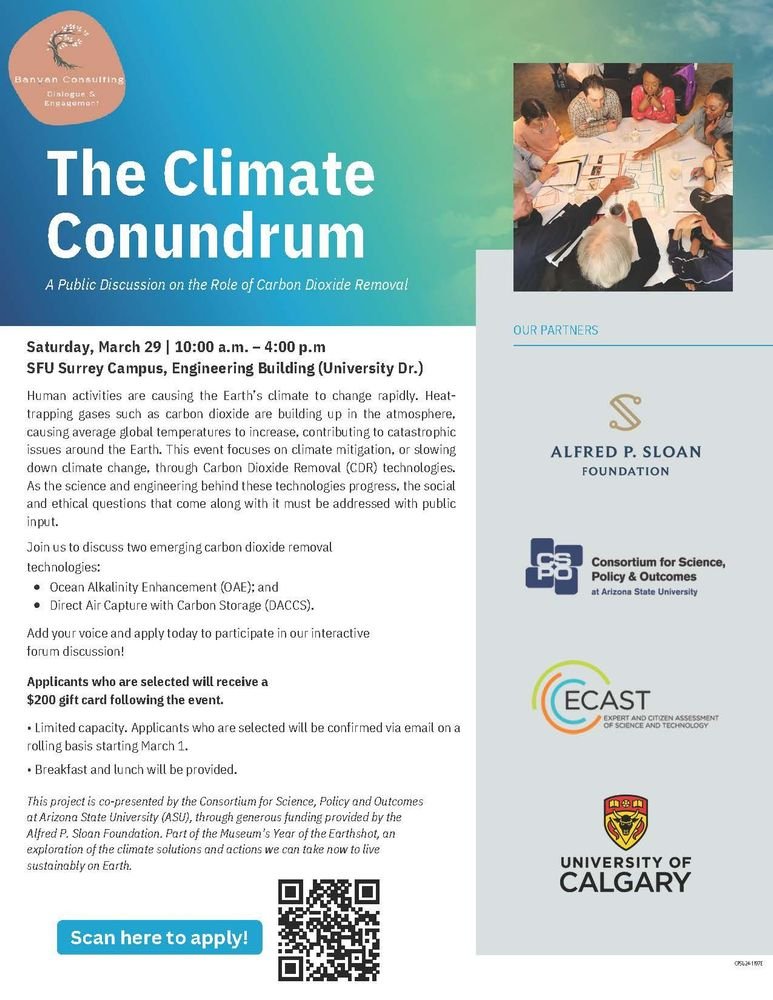
The #Climate Conundrum: A #Public #Dialogue on the Role of #Carbon #Dioxide #Removal, Sat, Mar 29, 10:30am - 4:00pm, @sfusurrey. No prior knowledge necessary. Share with your families, friends, & colleagues in the #Vancouver area! Apply at shorturl.at/ILgeu. $200 gift card.
ALT This flyer includes a link to apply to participate in a public forum on the role of carbon dioxide removal at Simon Fraser University, Surrey Campus, on Saturday, March 29, 2025, from 10 a.m. to 4:00 p.m.
2
2
216
23 Nov 2024
And I am taking sides w/ @pahlkadot. Some evidence based policy folks get it — the challenge remains whose evidence? Folks focusing on impacts, or folks trying to virtue signal and tell “noble lies” about the letter of the law to register a win in their ideological echo chambers?
22 Nov 2024

I'm taking sides here, with MGP. And exactly what the regs say is not the point. The point is the impact they have. eatingpolicy.com/p/stop-tell…
127
25 Sep 2024
The Climate Conundrum:
A Public Discussion on the Role of Carbon Dioxide Removal (CDR)
Saturday, September 28, 2024, Museum of Science, Boston
mos.org/events/climate-conun…
@CSPO_ASU @ECAST_Network @museumofscience
2
4
156