
Joined March 2021
- Tweets 25,368
- Following 1,552
- Followers 80,506
- Likes 27,925
9,625 Photos and videos















Pinned Tweet

6 Dec 2022
Salamat sa likes & retweets a pero if there's one thing I'd ask, like niyo na lang posts ng people to encourage their hobbies, weirdness, quirks, effort nila at self improvement, their cries for help or longing to be heard, reply to those looking for recommendations or advice.🙇🏻♂️
11
31
619
drag him


3
4
53
1,490
Two friends, staunchly Filipino swore to just work abroad for a couple of years after college and come back when they've put aside enough money.
Both are now no longer Filipino citizens. Neither even considered dual citizenship which tbh, COMPLETELY understandable.

Napakaraming manggagawa dito sa atin, ngunit bakit tila parang walang natira?
Batay sa isang pag-aaral, higit kalahati ng mga Pinoy ang bukas sa pagtatrabaho o pagtira sa ibang bansa kung may mas magandang trabaho, sweldo, at kalidad ng buhay. #Newsapan
Kaugnay na ulat: abs-cbn.com/news/business/20…

5
1
79
7,644
math prof ko dati was arguing with a classmate dati who said
'we get the government we deserve'

1
35
3,092
𝓐 𝔽 () ; 𓅭𓅰𓅯𓅮 retweeted
Analysts: Filipinos are having less children.
Reality on the ground for pinays:

The Philippines is a fantastic example of how deep and fast the drop in fertility is nearly everywhere on the planet.
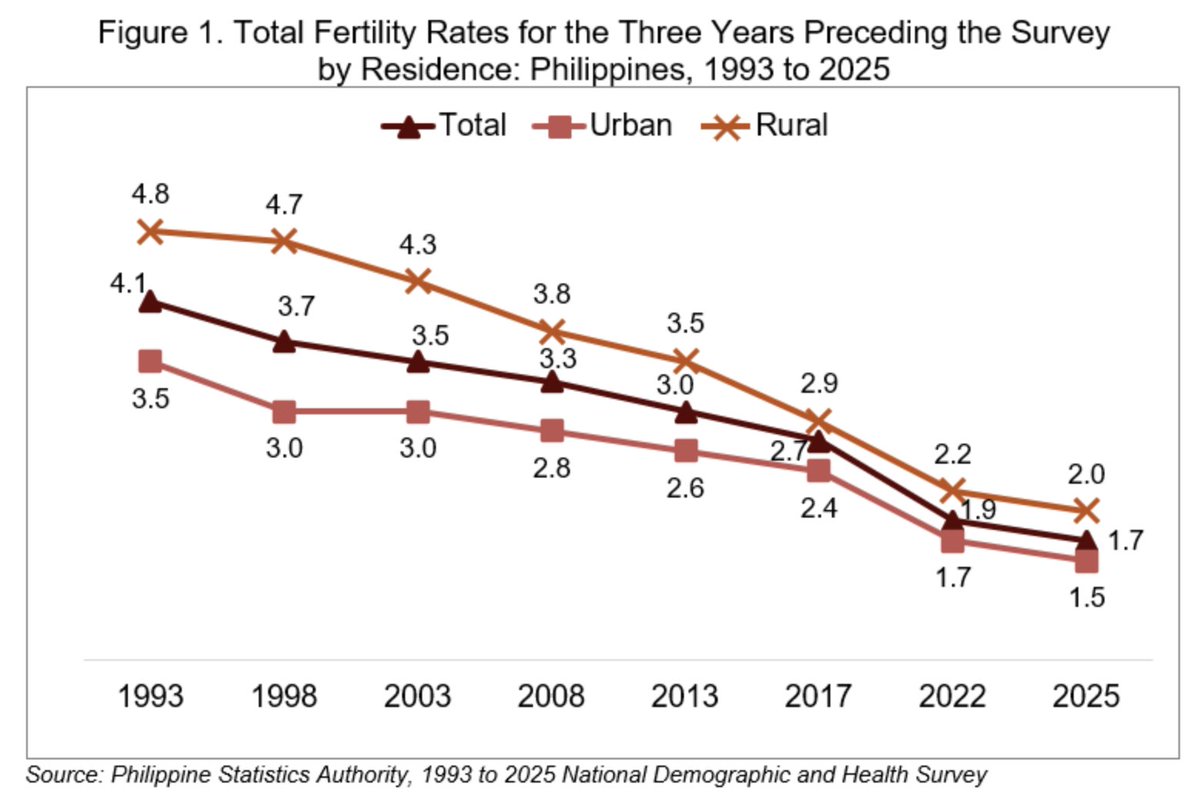
Just last week, on March 30, 2026, the Philippine Statistics Authority released the 2025 National Demographic and Health Survey (NDHS). The total fertility rate for the last three years has reached 1.7 children per woman, a dramatic fall from 4.1 in 1993, and well below the replacement rate (around 2.1 for a country like the Philippines).
Since the NDHS computes the total fertility rate over three years, and it is dropping quickly, the total fertility rate for 2025 alone should be around 1.6, the same level as in the U.S. Let me repeat this: the Philippines and the U.S. have roughly the same total fertility rate.
But U.S. income per capita is about 7.3 times the Philippine income per capita (when adjusted for purchasing power parity). Or to put it differently, Philippine income per capita today is the same as the U.S. had in 1910. In that year, the total fertility rate of the U.S. was around 3.5. At the same level of income per capita, the Philippines has a total fertility rate that is less than half.
In some more urban regions, such as Calabarzon, the total fertility rate is 1.3. Historically, the rest of the country has followed the patterns of regions like Calabarzon with some lag, so the most likely scenario is that in a few years, the Philippines will have a total fertility rate of around 1.3 as well.
Compared with the United Nations World Population Prospects (WPP), the Philippines is now at the fertility level the WPP had forecast for 2047, despite the aggressive reduction it made to the Philippines’ forecast fertility between 2022 and 2024.
The Philippines is interesting because, compared with other Asian countries, it is a relatively religious and rural country without the Confucian obsession with education found in China or South Korea.
It is also a country that many still associate with high fertility. Just yesterday, one reader left a comment on my previous post on fertility, using the Philippines as an example of high fertility, that “refuted” my claims. No, it does not.
Finally, three technical points.
First, I am reporting total fertility, not completed fertility (and yes, I am keenly aware of the difference between the two). Looking at age-specific fertility rates suggests that completed fertility for younger women will actually be below the current total fertility rate.
Second, no, emigration does not matter here. I am talking about fertility rates, not birth rates.
Third, the official release:
psa.gov.ph/content/fertility…
30
2,290
17,362
656,688
𝓐 𝔽 () ; 𓅭𓅰𓅯𓅮 retweeted

hello po, di po ako kasama sa bumati ??

114
6,597
24,249
281,308
see them blame this on the bottom rung and call it a day
Nakipag-ugnayan na ang PhilHealth sa pamilya ng isang miyembro nitong namatay dahil umano sa kawalan ng perang pangdeposito sa isang ospital.
Hindi rin umano nakatanggap ng benepisyo ang miyembro dahil sa sinasabing "24-hour rule," pero nilinaw ng PhilHealth na tutulungan nito ang pamilya. May paalala rin ang ahensya sa mga ospital.
1
4
21
1,903

6'1 tapos may daga naman magsasabi ginawa kong personality yung height 🥸
Jun 10

Fuck a face reveal, let’s height reveal. You first
8
146
12,454
My mother framed it like this; SSS, PhilHealth, and Pag-IBIG is charity mo na as a person. You're unlikely to get what you put in. It's for the benefit of the less fortunate.
Demonyo na lang talaga yung mga magnanakaw nun kasi ang ninanakaw nila are "donations" ng sambayanan.
Jun 14

PhilHealth is omnipresent in every Filipino’s payslip, taking money whether workers like it or not. Yet in moments of greatest need, it often feels absent.
That’s what happened in the viral case of Maria Lourdes Sulit. Her husband Marvin contributed for over 25 years. When he died of a brain hematoma, PhilHealth declined to cover their nearly ₱200,000 hospital bill.
The reason: a technicality. He was confined for less than 24 hours. Under PhilHealth Circular No. 2020-0007, inpatient benefits require a 24-hour stay. But Circular No. 2025-0020 allows outpatient emergency benefits in cases ending in death within 24 hours. So which is it, then?
Sulit’s case is yet another crack in a system already under strain.
PhilHealth is mandatory under the Universal Health Care Law. Every Filipino is automatically enrolled, meaning every worker is required to contribute—regardless of income, preference, or private coverage.
And that has long been a point of frustration. Ask any tito, tita, tropa, or kakilala, and a familiar story emerges: PhilHealth often covers only a fraction of the bill. Families still shoulder significant out-of-pocket expenses.
Then come the administrative failures: the delays, the waiting, the stress on top of the hospitalization stresses.
Private health maintenance organizations help fill some of the gap. But even they can only do so much, often still leaving families exposed to catastrophic expenses that the public system is supposed to cushion.
And then, there’s the issue that refuses to go away: corruption.
PhilHealth has been repeatedly drawn into controversies involving anomalous claims, questionable reimbursements, and fund management issues that have reached Congress and the courts.
The latest one involved around ₱60 billion in excess funds—transferred to the national treasury. The Supreme Court later ruled that it’s unconstitutional, questioning whether health funds were being redirected away from their intended purpose.
The money has since been restored to PhilHealth, but its image isn’t getting any better. To many, it remains an agency that collects mandatory contributions, yet Filipinos don't get what they pay for.
Calls to abolish PhilHealth continue to surface. Let Filipinos keep their money. Rely on private insurance or personal means instead.
It’s understandable—especially in cases like Sulit’s—but abolition without replacement risks dismantling the country’s only nationwide health risk pool.
For all its flaws, PhilHealth remains the only attempt at universal coverage at scale. Removing it wouldn’t erase the need for protection.
So the real issue is not just whether to abolish PhilHealth, but what must replace or radically reform it.
Our Asian neighbors have made clearer choices. Thailand funds universal healthcare through general taxation, allowing patients to access care with minimal or no out-of-pocket costs. Malaysia heavily subsidizes public hospitals, keeping treatment affordable and predictable. South Korea operates a hybrid system where mandatory contributions are matched with reliable, structured coverage at the point of care.
The Philippines remains stuck in between: compulsory contributions without guaranteed protection, universal enrollment without universal certainty.
Now, the question is no longer whether PhilHealth should exist. Can it continue in its current form when the gap between contribution and protection remains this wide?
Can Filipinos still afford to pay premiums to a system they cannot rely on in a life-and-death situation?
Otherwise, PhilHealth only gives Filipinos hell.

3
44
2,010
Lola the next day: So.. inupdate ko yung last will and testament ko..
Jun 13

🇵🇭 Se revelan nuevas imágenes impactantes del terremoto de magnitud 7,8 que sacudió Filipinas el pasado 8 de junio.
1
24
3,044
Papa: Wala akong pinapirma sayong pre-nup dati ah
Mama: Wala ka namang pera mabibigay noh
Me:
3
2
66
3,911
𝓐 𝔽 () ; 𓅭𓅰𓅯𓅮 retweeted

para po

1
4
14
1,564
Mama: Ano inorder mo?
Me: Wala ma, buso-
Mama: Diet ka? Tama.
Me:
5
92
3,517
meron bang sa taas bumubukas? 😅

Buat oomf ku yg suka ke party, coba deh kalian beli baju kek gini. Terlihat sopan tp busui friendly 🤡🤡🤡
1
63
4,441
Scratched my head then saw a hand rise in the rearview mirror. I was alone. 💀
7
1
72
6,021
Musk level yung ninakaw sa Pilipinas


15
1,816