
Exploring Solana on my @solanamobile
Joined May 2023
- Tweets 2,613
- Following 1,867
- Followers 977
- Likes 3,788
383 Photos and videos



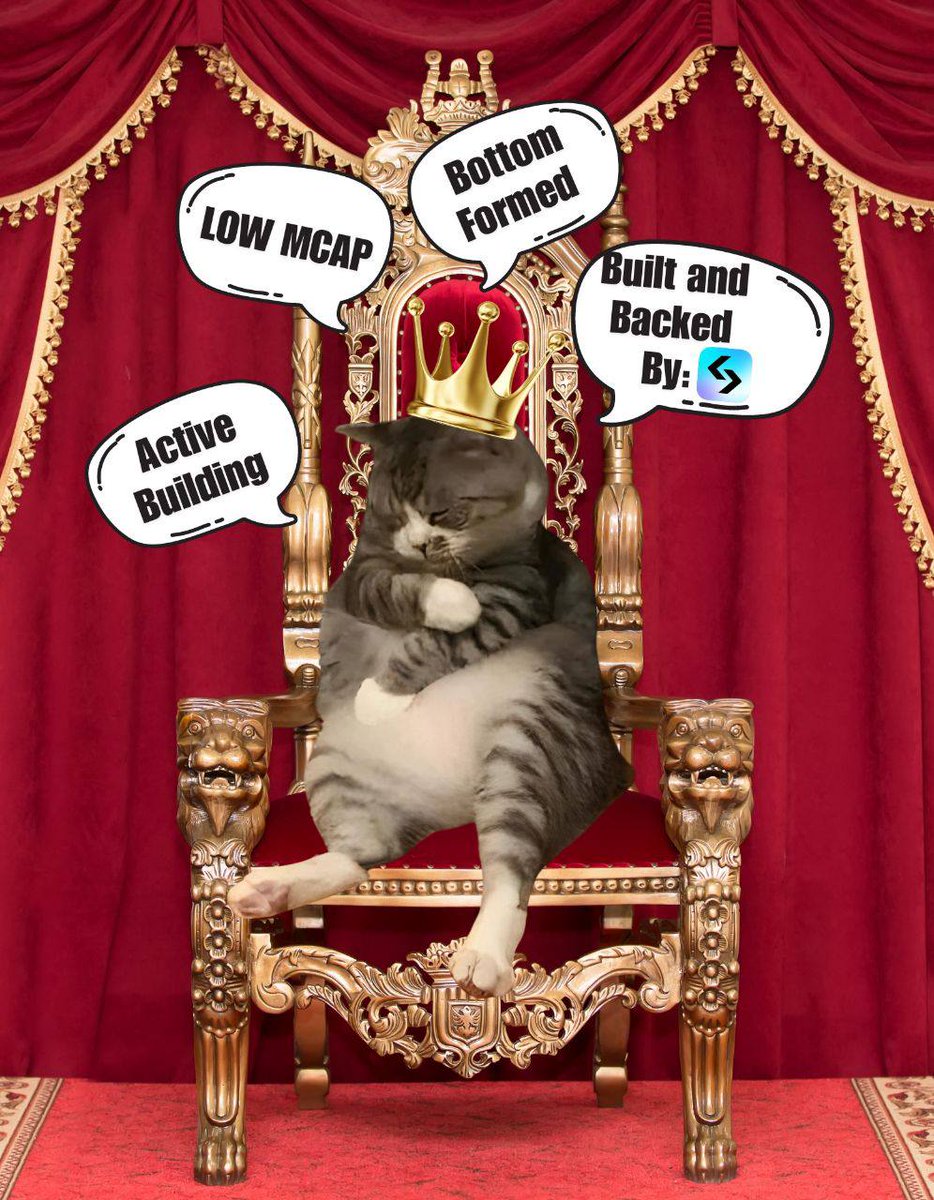



.@amrix_j on @KarmaWallet's economics:
Every trade earns cashback paid in $KARMA, scaled by user tier
Most users leave it unclaimed in their wallets
Every unclaimed balance is buying pressure that compounds without people noticing
Zero fees for $KARMA holders
Rev split:
- ~50% to running the business
- ~25% to buybacks
- ~25% to creator rewards

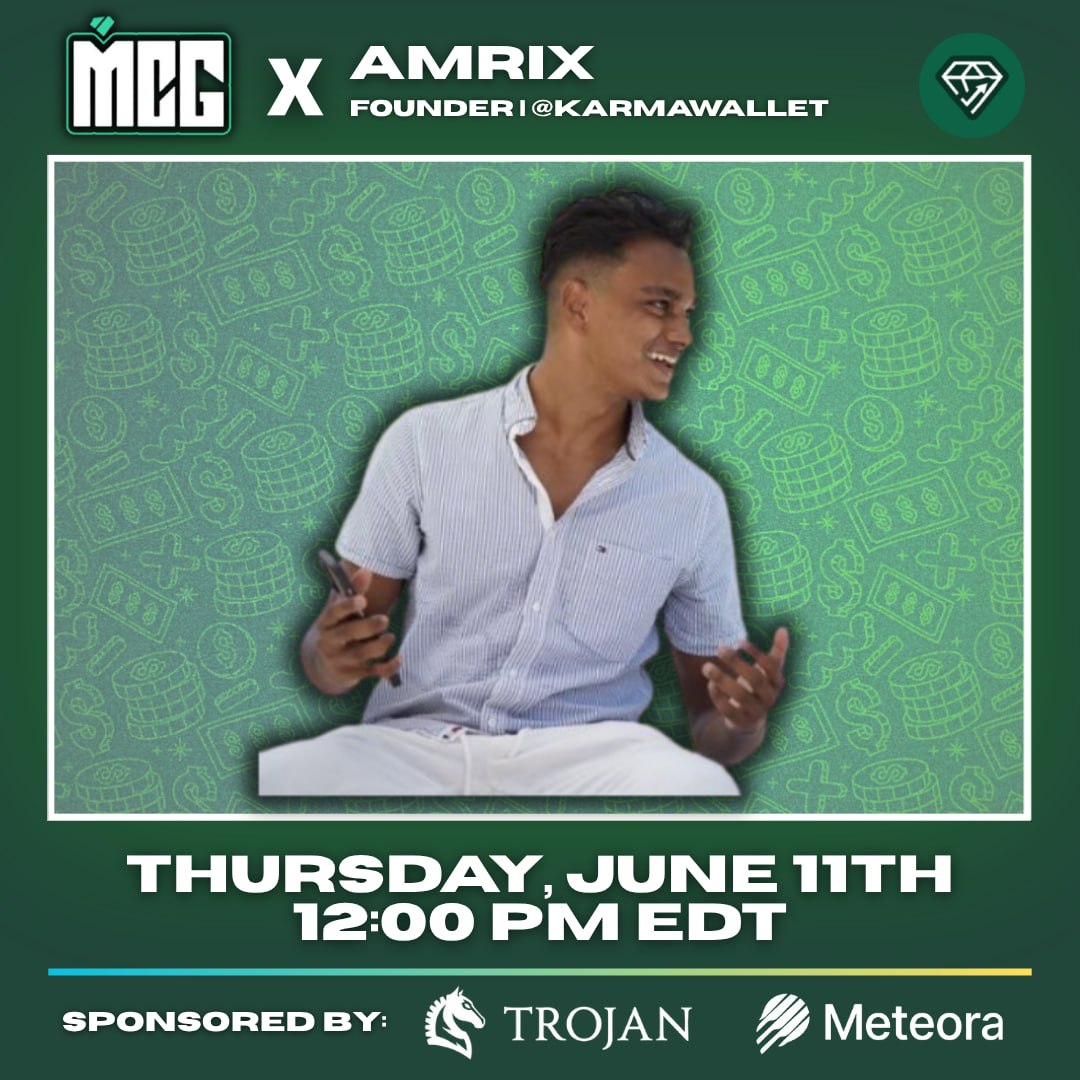
Today on MCG: @amrix_j | @KarmaWallet | $KARMA
Karma currently is a crypto-native "everything" app which allows you to bank, spend and trade
Here's the breakdown:
02:13 - Amrix's background
03:11 - $KARMA origin story
04:40 - The lesson
06:20 - MoonPay is aggressively acquiring crypto products every week ("where are they getting this money from?")
09:11 - The endgame is a liquidity event
11:24 - Why neobanks will disappear
14:18 - The pivot to trading
14:50 - May 2026 hit $522K product volume
15:33 - @dflow integration
19:00 - The new feature reveal 🚨
23:53 - rev model
25:00 - 0.5% trade fee, free for $KARMA holders, cashback in idle wallets creates buying pressure (Starbucks wallet analogy)
29:42 - Token tokenomics
31:08 - GBP launching Monday alongside EUR and USD virtual accounts
1
8
27
2,915
Flanerius retweeted

Jun 12
This one is interesting for me.
solana:CmUnSFZCKUFGs2L8eZGQukAj833Y8r2SiJav55Nnrihd is a superapp that (if I didn't get it wrong) can be viewed as an app that aims to combine the best features of spending/card like @AviciMoney with social elements like @fomo;
And what they are building is in line with what is getting adopted:
(1) @useTria is getting adoption because you genuinely have an easy neo-banking like platform where everything is in one place.
(2) @fomo is also well adopted because trading there is frictionless & the social discovery adds another layer to the reason as to why people are using it.
But where I think Karma would stand out is with their future upcoming feature - where I assume would be something like Binance Alpha but if you post a thesis, you get paid for it; and that my friends I think can have the potential to bring in a ton of users.
At 400k MCAP, it seems like a steal esp. w/ @amrix_j leading the helm - you can see that he's committed to this. Also the work at @MCGlive is amazing, really wouldn't have discovered this without their stream.
Today on MCG: @amrix_j | @KarmaWallet | $KARMA
Karma currently is a crypto-native "everything" app which allows you to bank, spend and trade
Here's the breakdown:
02:13 - Amrix's background
03:11 - $KARMA origin story
04:40 - The lesson
06:20 - MoonPay is aggressively acquiring crypto products every week ("where are they getting this money from?")
09:11 - The endgame is a liquidity event
11:24 - Why neobanks will disappear
14:18 - The pivot to trading
14:50 - May 2026 hit $522K product volume
15:33 - @dflow integration
19:00 - The new feature reveal 🚨
23:53 - rev model
25:00 - 0.5% trade fee, free for $KARMA holders, cashback in idle wallets creates buying pressure (Starbucks wallet analogy)
29:42 - Token tokenomics
31:08 - GBP launching Monday alongside EUR and USD virtual accounts
2
5
16
2,134
2
1
12
1,011


May 29
Once ethereum:0x44b28991b167582f18ba0259e0173176ca125505 = 1 ethereum:native then 14K USD worth of $UPSTR will be bought back and burned.. That's more than 50% of its current market cap lol. CA is: 0xcB0443f047a4d48e480Bb7c4e21b9CBf96A52343
1
144
May 28
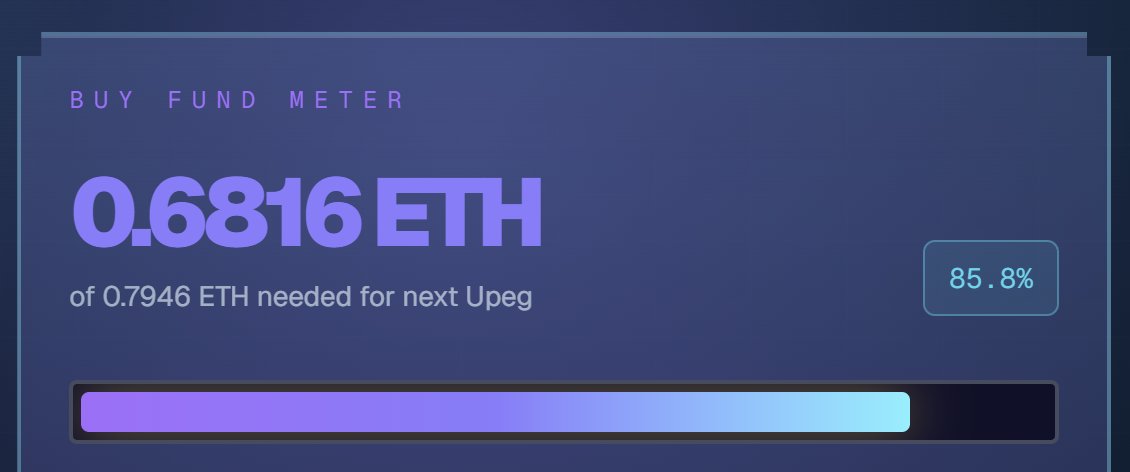
The $UPSTR treasury is very close to buying a new ethereum:0x44b28991b167582f18ba0259e0173176ca125505. Bring in some volume!
1
1
138
May 27
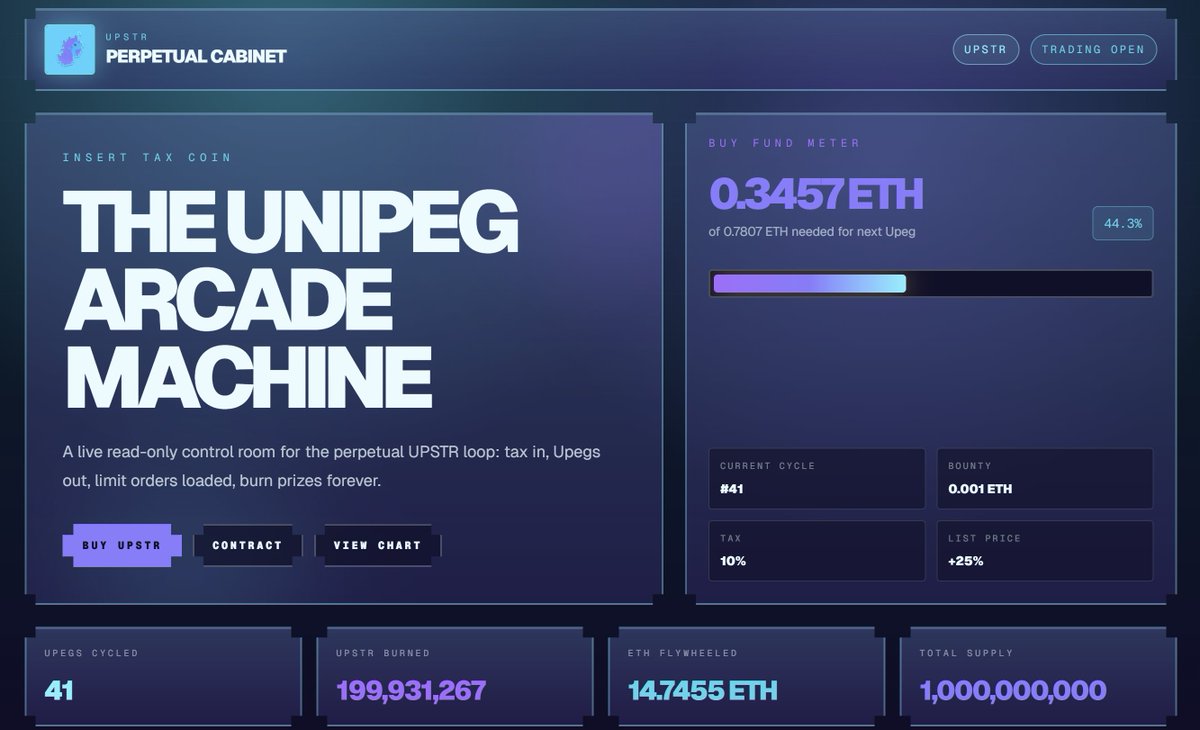
More $UPSTR has been burned. Counter is at 28%! Price is also catching up 🦄 @upegstrat is sweet leveraged bet on $uPEG
May 26

Another ethereum:0x44b28991b167582f18ba0259e0173176ca125505 order hit! 20% of the $UPSTR has now been burned. The flywheel is spinning.
0xcB0443f047a4d48e480Bb7c4e21b9CBf96A52343
4
449
May 26
Another ethereum:0x44b28991b167582f18ba0259e0173176ca125505 order hit! 20% of the $UPSTR has now been burned. The flywheel is spinning.
0xcB0443f047a4d48e480Bb7c4e21b9CBf96A52343
May 26
4
741

May 25
ethereum:0x44b28991b167582f18ba0259e0173176ca125505 rising means $UPSTR’s 22 open Unipeg orders are going to fill. 22! The buybacks will be glorious. @upegstrat
1
194
May 13
This guy cooking 🦄

Fee info:
Each redraw has a small fee of 0.0005 ETH. All fees are fully used to buy back and burn uPEG on-chain. Once the accumulated fees exceed 0.1 ETH, the buyback & burn will trigger automatically.
2
93


Flanerius retweeted

🦄 A Complete Introduction to @unipegv4, the NFT 2.0 x DeFi 3.0 project.
$uPEG is a project where buying a token on Uniswap creates a living, one-of-a-kind digital unicorn — and selling it destroys it forever.
That's not a metaphor. That's literally what happens. And once you understand how, you'll see why this is unlike anything built before it.
🦄Step 1: Understand what Uniswap V4 hooks made possible.
Uniswap is the largest decentralized exchange in crypto — a place where anyone can swap tokens directly from their wallet, with no middleman. Uniswap V4 introduced something called hooks: small programs that can run automatically inside a trade as it happens.
Most people use hooks for things like custom fees or liquidity management. Hadrian — the developer behind $uPEG — used one to do something nobody had done before: generate art from the trade itself.
When you buy a whole $uPEG token, the hook reads your swap data — the wallet, the amount, the timing, the block — and uses it to deterministically produce a unique 24×24 pixel unicorn SVG image. No artist drew it. No server generated it. The blockchain did, live, in the moment of your purchase, using your transaction as the seed.
The image lives entirely on-chain. No IPFS. No external files. No company hosting it somewhere. It exists on the Ethereum blockchain, which means it's permanent, public, and owned by nobody but you.
🦄Step 2: Understand what you actually own.
1 whole $uPEG token = 1 living unicorn NFT.
Not "associated with." Not "redeemable for." They are the same thing. The token is the unicorn. Hold the token, and your unicorn exists. The moment you sell or transfer that whole token, your unicorn is burned — gone permanently. The next person to hold a whole $uPEG gets a brand new unicorn, generated fresh from their own trade data.
This means every unicorn is a direct reflection of its owner's on-chain moment. Nobody else's trade could have produced yours. The art isn't just unique — it's yours in a way that's cryptographically verifiable forever.
🦄Step 3: Understand the supply — and why it's genuinely scarce.
Only 10,000 whole $uPEG tokens will ever exist. Not per season, not per year. 10,000 across all of time.
But here's where it gets interesting: $uPEG is also a fungible token, meaning it can be split into fractions — the same way a dollar can be broken into cents. These fractions are called dust. Dust holders don't own a unicorn. Only a whole token grants you one.
As $uPEG gets traded and fragmented, more of the circulating supply becomes dust — and reassembling enough fragments to own a whole unicorn becomes progressively harder.
The Dust Dominance Ratio (DDR) is the metric that tracks this. It measures what percentage of the total supply exists as dust rather than whole tokens. Right now it sits at 0.64 — and it's climbing.
At 0.3, whole unicorns were easy to acquire. At 0.64, noticeably harder. At 0.8 or above, you'll be buying fragments from people who fully understand what they're holding. The DDR only moves in one direction as organic trading continues. There is no reset.
🦄Step 4: Understand why being early actually matters.
Think about Pokémon 1st Edition cards.
They aren't valuable simply because they're old. They're valuable because the print run was finite, the earliest ones carry provenance that can never be replicated, and that fact is permanently verifiable. A card from the second print run can never become a first edition — no matter how much someone wants it to be.
$uPEG works the same way, with one difference: the ledger is the blockchain, and it's incorruptible.
The earliest whole $uPEG unicorns carry on-chain history — block numbers, timestamps, transaction records — that later ones simply cannot claim. A unicorn minted today has its own provenance, but it can never have been first. That window is already closed for thousands of tokens, and it closes a little more with every trade.
This isn't narrative. It's not marketing language. It's just how blockchains record history.
🦄Step 5: Understand what makes this structurally different.
Most NFT projects follow the same pattern: a team creates art, uploads it to a server or IPFS, sets a mint price, and sells you a certificate of ownership pointing to a file they control. If the team disappears, the file can disappear too.
$uPEG has no team-controlled files. No mint event. No reveal. No roadmap promises to fulfill. The art generates itself from real trading activity, lives permanently on-chain, and gets structurally scarcer through normal market behavior — with no central party required to maintain any of it.
The mechanism is the project. And the mechanism doesn't need anyone's permission to keep running.
🦄The bottom line.
Your unicorn is born the moment you buy. It's yours alone — generated from your trade, tied to your wallet, carrying your on-chain history. It lives as long as you hold it, and it burns the moment you sell. Only 10,000 can ever exist. The supply of whole tokens shrinks naturally as fragmentation increases. Early ones carry provenance that later ones never can.
If you've been waiting for an NFT project with real mechanical depth — one where the scarcity is structural, the art is permanent, and the ownership is absolute — this is the one worth understanding.
🦄Links.
→ Official site: unipeg.art/
→ The developer's writing: 0xhadrian.eth.limo
→ Deep dive on V4 hooks: bankless.com/read/uniswap-v4…
→ Buy $uPEG on Uniswap: x.com/slayphindotweb3/status…
→ Buy on official marketplace: x.com/slayphindotweb3/status…
→ Browse on OpenSea: opensea.io/collection/unipeg…

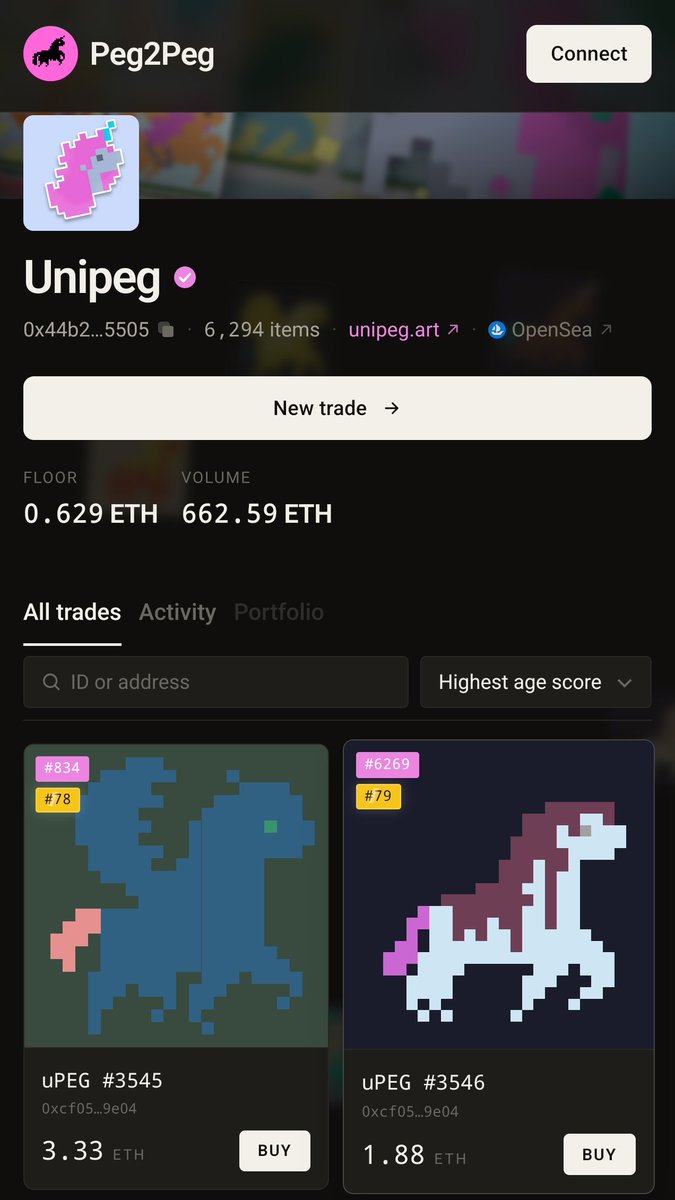
A quick tutorial on how to properly buy @unipegv4 on their official marketplace:
1. Go to p2peg.app/collections/unipeg
2. Select your unicorn of choice (I suggest sorting by highest age score as provenance is key)
3. Click "Buy now"
Happy collecting.
🦄
5
8
50
1,541
fractional dust accumulates. whole integer uPegs become scarcer over time. the supply of mintable uPegs only moves in one direction.
the machine is working as designed. 🦄🔁
Apr 27

补一层,越想越牛逼。
unipeg 这个机制有个单向抽水效应:
抽到普通独角兽 → 用户没动力留 → swap 卖回 AMM → burn 销毁
抽到稀有独角兽 → 用户舍不得 burn → transferUpeg 转去冷钱包/peg2peg → token 永远离开 AMM
每过一轮交易,AMM pool 里的整数 token 都在变少,剩下的越来越多是 swap 找零的小数碎片。账面 10K 不变,能凑出整数 1 枚 uPEG 触发 mint 的机会单调递减。
时间越长,pool 里漂的全是没人想留的循环碎片,沉淀在收藏者钱包的全是稀有品。
这相当于把传统 NFT "稀有度浮现 长期惜售" 那个本来要几年的过程,自动化在合约里第一天就开跑。
unipeg 不是在做一个 NFT,是在做一个自动筛选 NFT 稀缺度的机器,AMM 同时是流动性层和淘汰场。
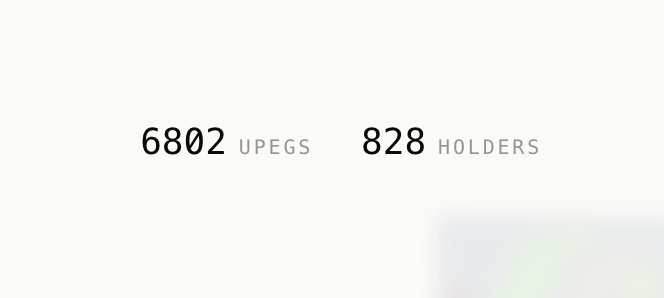
现在只有 6800 只完整的。
不作为投资建议,DYOR。
6
17
115
38,195
Flanerius retweeted

Apr 24
If you're a player looking to switch to another Solana casino, try us out! We have 6 original games and all your favorite provider games - just connect your wallet & play
DMs are open for anyone who needs help or has questions.
6
5
17
969
Flanerius retweeted
Apr 19
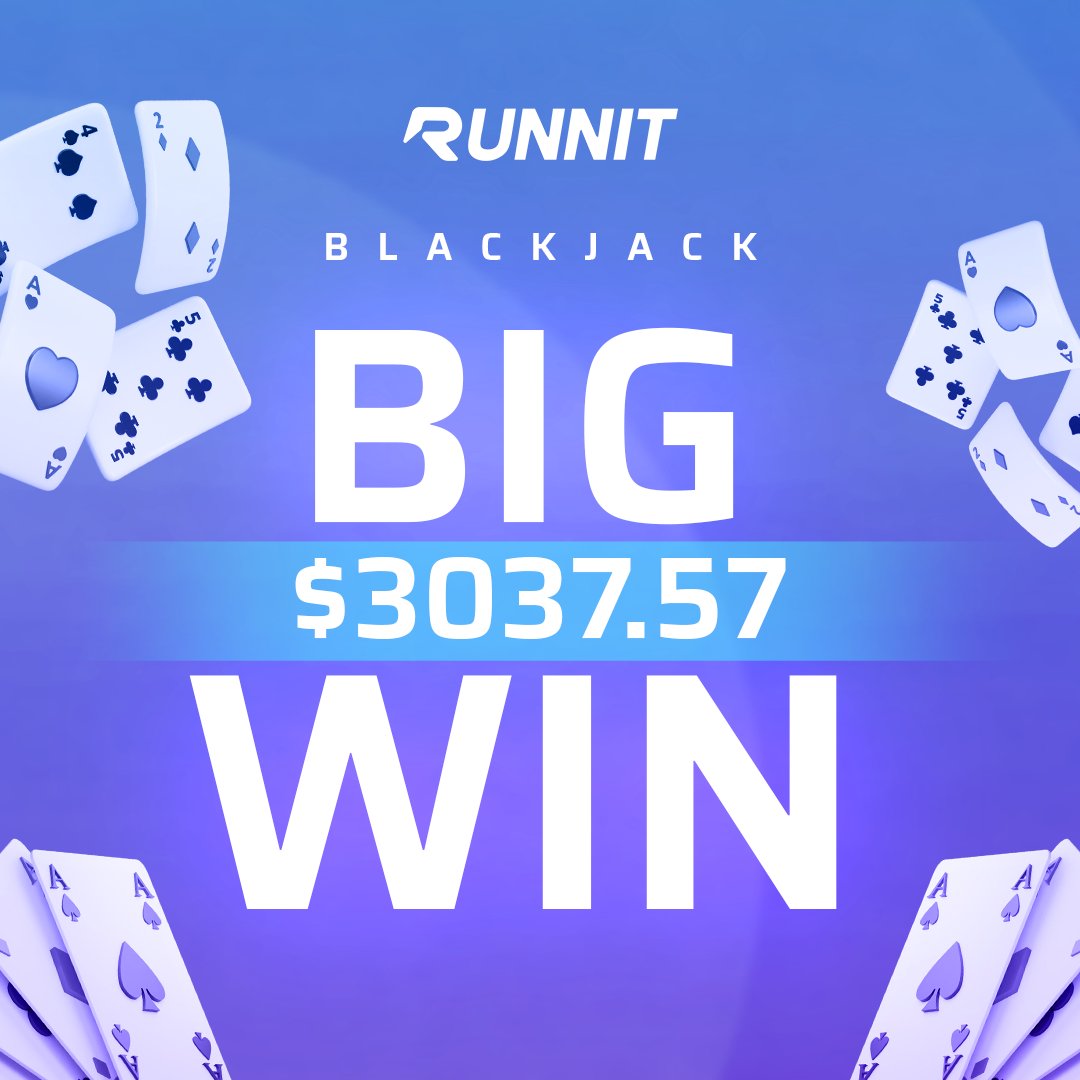
From $759 (8.5 SOL) to $3,037 (34 SOL) 💸
The user doubled down on an 11 and hit a Blackjack!
RT Tag a friend for a chance to win some FREE SOL!
201
186
192
6,897