
building cool TEE stuff @proven_network 🦊
Joined December 2020
- Tweets 2,784
- Following 2,138
- Followers 915
- Likes 26,278
170 Photos and videos











Pinned Tweet

17 Feb 2025
If you think about the many thousands of actions you take on the internet every day - paying a bill, liking a post, messaging a friend.
The ratio of those which actually involve financial transactions (like paying the bill) vs those which are purely for social or for fun - is probably about the same ratio of dApp interactions we’ll eventually see handled by trust-minimised smart contracts vs trust-minimised TEE systems (which will have 1000-10000x lower costs, no storage bounds, and real-time interactivity. )
That’s not a shot against SC platforms though; which really are the cornerstone enabling tech for decentralised architectures.
There’s no incongruence thinking: TEE systems will handle 99.99% of dApp interactions by quantity whereas SC platforms will handle 99.99% of interactions by value.
The future is in ensuring max alignment of both techs to enable new use-cases, and accelerate the space forward…
Maybe then we can stop sitting around year after year wondering - “where the heck are all the apps we were promised?!” Because, it should be pretty clear at this stage: it’s not a shortage of blockspace!
2
4
24
1,977
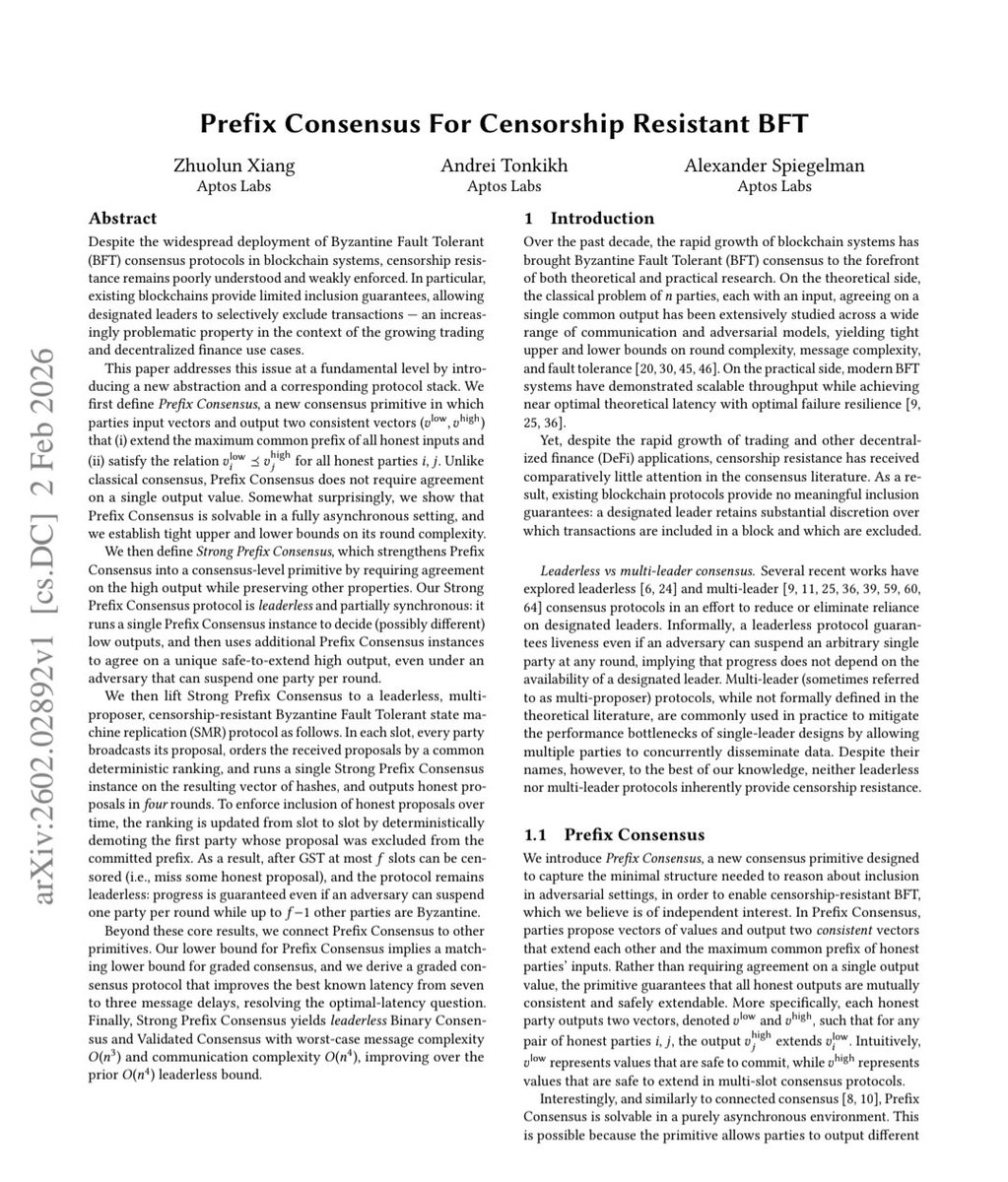
top scores well deserved. it's not only interesting in terms of a SotA step forward - it's also just immaculately well-crafted.
using it together with VRF sortitions for a beacon-chain design. thanks to each of you @XiangZhuolun @xosmig @SashaSpiegelman

Everyone is racing to patch in multi-leader BFT.
At Aptos, we solve challenges at the foundational level.
Proud to share that our multi leader protocol just got accepted to CCS (with top scores!) — reviewers were excited about the foundational contribution to the field.
With Decibel:
• No censorship
• Fairness by geography (see it first → trade first)
• Stable global p90 latency
• No leader bottlenecks / DDoS targets
At Aptos we don't patch.
We innovate, we redesign, we push boundaries.
2
3
207
flightofthefox.proven retweeted

industry: gets hacked
“how did the devs let this happen?”
the devs:
112
149
1,821
153,503
The “mullet” haircut version of decentralisation. Raspberry Pis in the front, unfathomably large proving clusters in the back
Feb 17

ZERO is decentralization sleight of hand:
By shifting work over to builders, they claim to have low "validator" requirements...
In reality, they only disempowered them!
Replacing validators with a new class of builders that require server farms & calling that decentralization!
3
4
10
2,214
flightofthefox.proven retweeted

Feb 11
I’m the CEO of a hot dog company. I’ve worked on hot dogs for 10 years. And *I* wasn’t prepared for what I’ve just seen. Your life is about to change.
So what can you do?
Buy as many hot dogs as you can. Buy stock in hot dog companies.
530
2,352
36,412
1,905,353
flightofthefox.proven retweeted

18 Dec 2025
SQLite has about 155,800 lines of code, and its test suite has roughly 92 million lines. That is ~590x more test code than actual code 🤯
This is the level of testing you need for a real production database. Here are some types of tests they run.
Out-of-memory tests - SQLite cannot just crash when memory runs out. On embedded devices, OOM errors are common. They simulate malloc failures at every possible point and verify that the database handles them gracefully.
I/O error tests - Disks fail. Networks drop. Permissions change mid-operation. SQLite inserts a custom file system layer that can simulate failures after N operations, then verifies that no corruption occurs.
Crash tests - What happens if power cuts out mid-write? They simulate crashes at random points during writes, corrupt the unsynchronized data to mimic real filesystem behavior, then verify the database either completed the transaction or rolled it back cleanly. No corruption allowed.
Fuzz testing - They throw malformed SQL, corrupted database files, and random garbage at SQLite. The dbsqlfuzz tool runs about 500 million test mutations every day across 16 cores.
100% branch coverage - Every single branch instruction in SQLite's core is tested in both directions. Not just 'did this line run', but 'did this condition evaluate to both true AND false'.
Databases are really unforgiving :)
By the way, if you want to go deeper, I recommend reading the official SQLite documentation on their testing strategy. The doc is pretty practical and deep.
Have linked it below.
98
520
6,033
528,360
16 Dec 2025
Yo, @SasuRobert - i'm cooking up a high perf, high composability sharded ledger and i'm going to steal your designs for sPOS - thanks!
3
1
14
531
11 Sep 2025
RT @marczeller: We make little to no revenue on scroll, and they don't even pretend to be decentralized anymore.
Centralized networks are r…
16
flightofthefox.proven retweeted

5 Sep 2025
The hidden cost of hiring the wrong people.
25
202
1,547
55,740
6 Sep 2025
It’s amazing how, for some MFs, the difference between: “it’s a landgrab!!” and “it’s aligned <3” is just posting some dumb blobs on-chain (which does nothing for ETH either way)
6 Sep 2025

> They're literally going to walk into a grocery store, pay for some milk and eggs, and walk out.
Yes, which is more or less already the experience that Stripe offers and this experience is core to their business, and their building Tempo as an extension of that to be able to provide that same experience in more contexts.
But it’s all about what they want and need for their core business, and that therefore doesn’t make that financial stack inherently interesting to anyone else outside of Stripes orbit.
Yes Stripe has a developer ecosystem, and this new chain could now open up more space for them. But it’s all a landgrab by Stripe for Stripe.
246

1/5 As an investor, I see Tesla’s proposed 2025 CEO Performance Award for Elon Musk as a model for aligning executive incentives with long-term value creation. No time based vesting. Crypto founders should study this structure. It’s all-or-nothing RSUs, vesting over 7.5-10 years, tied to $7.5 trillion in shareholder value.
5
4
28
3,026
28 Aug 2025
Good list
28 Aug 2025

New thing on The Foolish Generalist. Those who know me know cyberpunk is a long-time thing with me (and is essentially why I got into crypto), and I wanted to write something for those just getting into the genre.
foolishgeneralist.com/p/the-…
209
27 Aug 2025
Most sane LinkedIn post I’ve ever seen
27 Aug 2025


2
6
448
21 Aug 2025
Wonder if StarGate team will do what’s best for holders, or will it show the whole voting process is just decentralisation theatre
20 Aug 2025

HAHA, wow
Wormhole put in a last minute counter-bid against LayerZero to acquire Stargate, which the LayerZero team originally launched. This while in the middle of $STG holders voting on the LayerZero buyout.
Have we entered a protocol M&A bull market?
This is gonna be fun.
205
flightofthefox.proven retweeted

18 Aug 2025
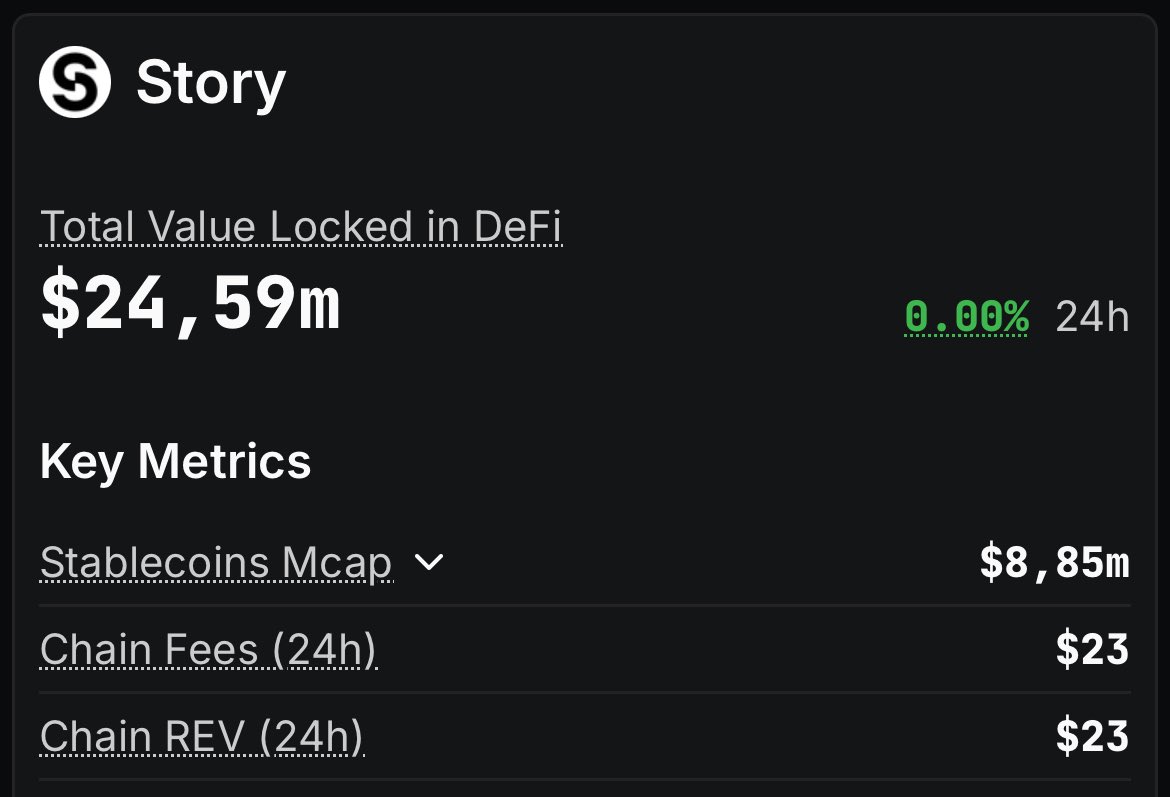
Daily revenue of “emerging” blockchains (last 24h):
• Story Protocol – $23
• Metis – $221
• Blast – $288
• Starknet – $496
• Scroll – $527
• Sei – $540
• Immutable zkEVM – $45
• Celestia – $150
• zkSync Era – $1,938
• Mantle – $5,577
Do we really need more L1/L2?
417
93
1,254
287,035
18 Aug 2025
Higher
18 Aug 2025

Something is coming and our ruling class is totally unprepared to meet it

2
3
284
17 Aug 2025
Many such cases
17 Aug 2025

founder: made tens of millions $
a16z: made tens of millions $
other vcs: made millions $
employee: made 6figs
retail: lost millions $
community: lost millions $
159
17 Aug 2025
Remember the symbol below.
It’s the biggest evidence someone is writing overly self-congratulatory tweets for basic bitch solutions at 100x the engineering run-rate actually required
17 Aug 2025

—
Remember that symbol above… it’s the biggest evidence someone used AI to write their post, their design, their comments.
No likes again to any post that includes one or more —
1
5
426


16 Aug 2025
Many such cases

someone demo'd me their dapp & said it took them a year to build with 4 ppl
i could prob code it myself in 1 week
they were a vc backed project 😭
1
194
16 Aug 2025
Pretty cool. I’ve long thought that a new ETL/materialisation abstraction layer seems like an obvious and necessary next step for managing the read-side of high-write chains
You guys should look into this little known [non-crypto] tech for how far you can push the idea (no relation; I just think they’re doing cool things)
estuary.dev/product/
16 Aug 2025
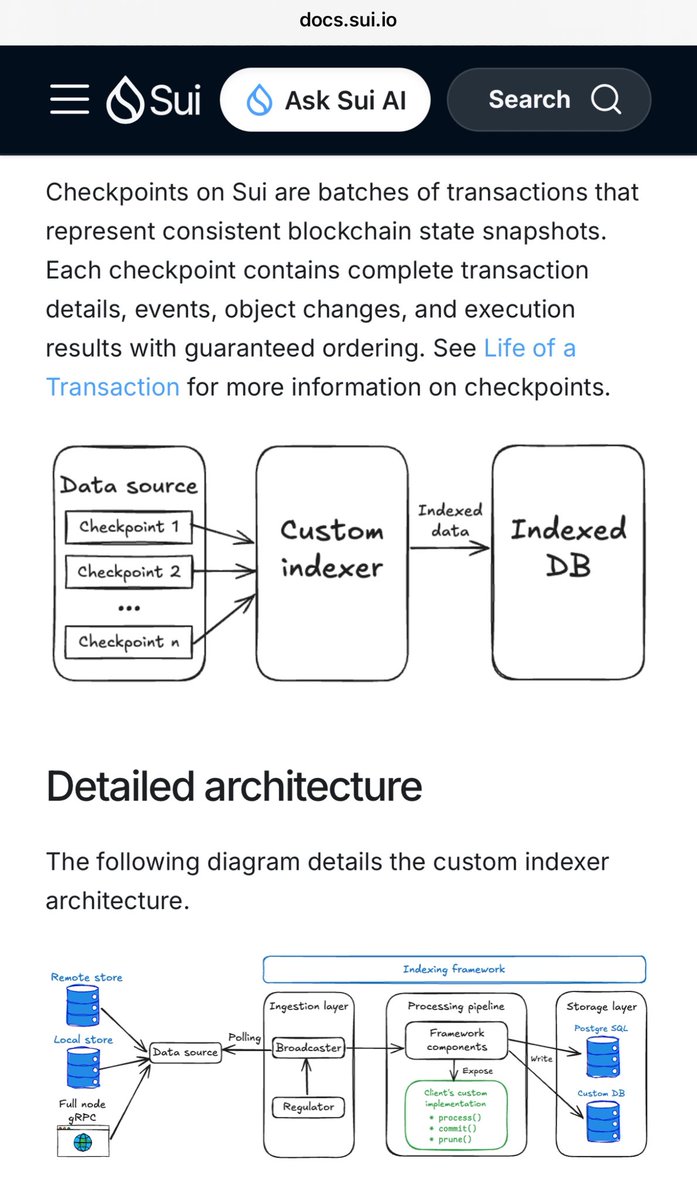
Custom Indexers on Sui
Docs: docs.sui.io/concepts/custom-…
Build your first indexer: docs.sui.io/guides/developer…
This was a huge ask for a while, and for a good reason. Feedback is highly appreciated, and will personally ensure community contributors towards a golden standard for dev experience get recognized!
2
1
6
560