
Joined December 2010
- Tweets 11,439
- Following 1,138
- Followers 145,356
- Likes 24,195
1,054 Photos and videos





Pinned Tweet

27 Nov 2025
In Defense of Exponentials
I used to tell founders, the reaction you are going to get to your launch is not hate, it’s indifference. By default, nobody cares about your new chain.
I have to stop telling them that now. Monad just launched this week, and I’ve never seen so much hate about a blockchain that just launched. I’ve been investing into crypto professionally for 7 years now. Before 2023, almost every chain I’ve ever seen that launched was mostly met with enthusiasm or indifference.
But now, new chains are born into a chorus of hate. The amount of haters I’ve seen for projects like Monad, Tempo, MegaETH—before they even hit mainnet—is a genuinely new phenomenon.
I’ve been trying to diagnose: why is this happening now, and what does it mean about the psychology of this market?
The Cure is Worse than the Disease
Forewarning: this is going to be the vaguest blockchain valuation post you ever read. I don’t have any fancy metrics or charts to sell you on. Instead, I’ll be arguing against the zeitgeist of Crypto Twitter, which for the last couple of years, I’ve been constantly on the opposite side of.
In 2024, I felt like what I was arguing against was financial nihilism. Financial nihilism is the belief that none of these assets matter, it’s all memes at the end of the day, and everything we’ve built is inherently worthless.
Thankfully, that’s no longer the vibe. We have broken out of that spell.
But the zeitgeist now is what I’d call financial cynicism: OK, maybe some of this stuff has value, maybe it’s not all memes, but it’s grossly overvalued and it’s only a matter of time before Wall Street finds that out. Not that all chains are worthless. But these things are all maybe worth 1/5th-1/10th of what they’re currently trading at (have you seen these PE ratios?), and so you’d better pray like hell Wall Street doesn’t call us on our bluff, because once they do it’s all getting wiped out.
You’ve got many bullish analysts now trying to conjure up optimistic L1 valuation models, inflating PE ratios, gross margins, DCFs, trying to fight against this mood.
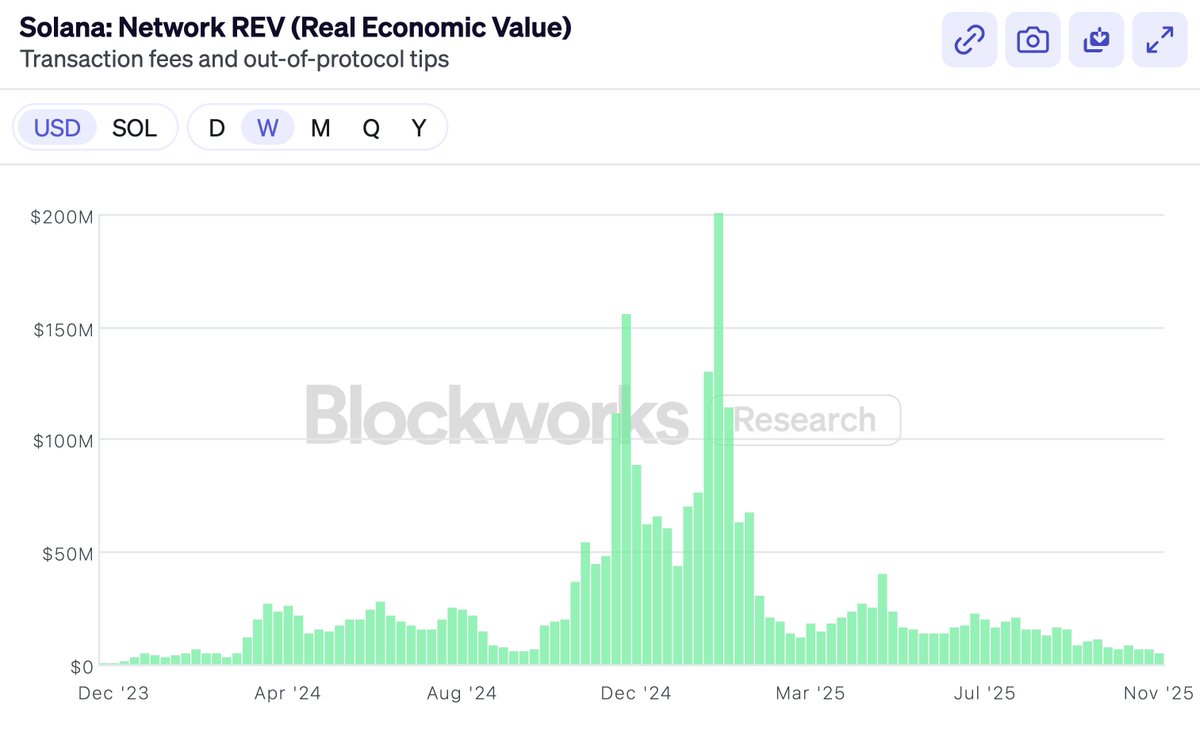
Late last year, Solana very proudly embraced REV as a metric that could finally justify their valuation. They proudly announced: we—and only we—are no longer bluffing to Wall Street!
And, of course, almost immediately after REV was embraced, it fell off a cliff (though $SOL, tellingly, did better than REV did).
Not that there’s anything wrong with REV. REV is a very clever metric. But the point of this post is not metric selection.
Then came the launch of Hyperliquid. A DEX that had real revenue and buybacks and PE multiples. And the chorus said—look, look I told you! Finally, for the first time ever, a token that has some real profits and a proper PE multiple. (Nevermind BNB, we don’t talk about that.) Hyperliquid will eat everything because obviously Ethereum and Solana don’t make any real money, we can stop pretending to value them now.
Hyperliquid, Pump, Sky, these buyback-heavy tokens are all great. But the market always had the ability to invest into exchanges. You could always buy Coinbase, or BNB, or whatever. We own $HYPE, and I agree that it’s a fantastic product.
But that’s not why people were investing in ETH and SOL. The fact that L1s don't have exchange-like profit margins is not why people were buying them—if they wanted that, they could’ve bought Coinbase stock.
So if I’m not critiquing blockchain financial metrics, maybe you think this post is going to be chiding the sinfulness of the token-industrial complex.
Obviously, everyone has lost money on tokens in the last year, VCs included. Alts are down bad this year. And so the other half of the zeitgeist on CT is arguing about who's to blame. Who’s become greedy? Are the VCs greedy? Is Wintermute greedy? Is Binance greedy? Are the farmers greedy? Are the founders greedy?
The answer, of course, is the same as it’s ever been.
Everyone is greedy. Everyone. The VCs, Wintermute, the farmers, Binance, the KOLs, they're all greedy, and you are greedy too. But it doesn't matter. Because no functioning market has ever required anyone to act against their self-interest. If we're right about crypto, we can all be greedy and the investments will still work out. Trying to analyze a market that has gone down by figuring out “who’s greedy” is going to be about as fruitful as commissioning witch trials. I guarantee you, nobody just started being greedy in 2025.
So this, too, is not what I’m going to be writing about.
Many people want me to write a post about why $MON should be valued at X or $MEGA at Y. I’m not interested in writing this post, or advocating that you buy anything in particular. In fact, you probably shouldn’t buy any of them if you don’t already believe in them.
Will any new challenger chain win? Who knows. But if it has a material chance of winning, it's going to be priced on that basis. If Ethereum is worth $300B or Solana is worth $80B, a project that has a 1-5% chance of becoming the next Ethereum or Solana will be priced according to those probabilities.
Somehow CT is scandalized by this, but it’s no different than Biotech. A drug that has less than a 10% chance of curing Alzheimer's is priced by the market as worth billions of dollars, even if 90% chance it won’t pass stage 3 trials and will go to 0. That's how the math works—and turns out, markets are pretty good at doing math. Binary outcomes are priced on probabilities, not on run rates or moral turpitude. It’s the “shut up and calculate” school of valuation.
I really don’t think that’s an interesting question to write about. “5% chance to win? No way, that’s clearly a 10% chance!” Markets, not articles, are the best way to assess that for any individual token.
So here’s what I am going to write about: CT doesn't seem to believe anymore that chains are valuable.
I don’t think this is because they don’t believe new chains can win market share. We just saw Solana dominate market share after emerging from the ashes less than 2 years ago. It’s not easy, but of course it’s possible.
It’s more that people have come to believe that even if a new chain wins, there’s no prize worth winning. If $ETH is just a meme, if it’ll never generate real revenue, then even if you win, you won’t be worth $300B. The contest is not worth winning, because these valuations are all bunk and it’ll all come crashing down before you go to claim your prize.
Being optimistic about chain valuations has become passé. Not that nobody is optimistic—obviously there must be optimists out there. For every seller there’s a buyer, and as much as CT cool kids love to drag L1s, people are comfortable buying SOL at $140, ETH at $3000.
But there’s a perception now that all the smartest people are over buying smart contract chains. Smart people know the jig is up. If not now, then soon. The only people buying here are suckers—Uber drivers, Tom Lee, and KOLs who say stuff like “trillions.” And maybe the US Treasury. But not the smart money.
This is bullshit. I don’t believe it, and you shouldn’t either.
So I felt like I had to write a smart person’s manifesto on why general purpose chains are valuable. This post is not about Monad or MegaETH. It’s really in defense of ETH and SOL. Because if you believe ETH and SOL are valuable, the rest is straight downstream.
Defending ETH and SOL valuations is generally not my job as a VC, but fuck it, if nobody else is willing to do it, then I’ll write it.
Feeling the Exponential
My partner Bo experienced the Chinese Internet boom first-hand as a VC. I’ve heard how “crypto is like the Internet” so many times now that it doesn’t even register for me anymore. But when I hear his stories, it always reminds me how costly it is to be wrong about these things.
A story he often tells is about when all the early e-commerce VCs (it was a small group back then) got together for coffee in the early 2000s. They debated: how big is the market for e-commerce going to be?
Is it going to be mostly electronics (maybe only techies will use PCs)? Could it ever work for women (perhaps they’re too tactile)? What about food (maybe impossible to manage perishables)? These were deeply important questions for early VCs to decide what to invest in and what prices to pay.
The answer, of course, was that literally every single one of them was devastatingly wrong. E-commerce would sell everything, and the target audience was the whole fucking world. But nobody at the time actually believed it. And even if they did, it would be too absurd to say out loud.
You just had to wait long enough for the exponential to show you. Even among the believers, very few thought e-commerce would become as big as it became. And those few who did, almost all of them became billionaires from just not selling. Every other VC—as Bo tells me, since he was one of them—sold too early.
It has become passé in crypto to believe in the exponential.
I believe in the crypto exponential. Because I’ve lived it.
When I started in crypto, nobody used this stuff. It was tiny and broken and awful. TVL on-chain was in the millions. We invested into the first generation of DeFi, MakerDAO, Compound, 1inch, back when they were science projects. I remember playing around on EtherDelta back when DEXes traded single digit millions a day, and that was considered to be a huge success. It was complete dogshit. Now we routinely trade in the tens of billions on-chain every day. I remember believing it was crazy that Tether hit a billion dollars in issuance and was being written up in the NYT as a ponzi scheme on the brink of shutdown. Now stablecoins are over $300B and regulated by the Federal Reserve.
I believe in the exponential because I’ve lived it. I’ve seen it over and over again.
But you might respond—well, stablecoin growth might be exponential, maybe DeFi volumes are exponential, but they don’t accrue to ETH or SOL. The value doesn’t get captured by the chains.
To which I answer: you still don’t believe in the exponential.
Because the exponential’s answer is always the same: it doesn’t matter. This stuff is going to be so much bigger than it is today. And when it’s absolutely enormous, you’ll make it up on scale.
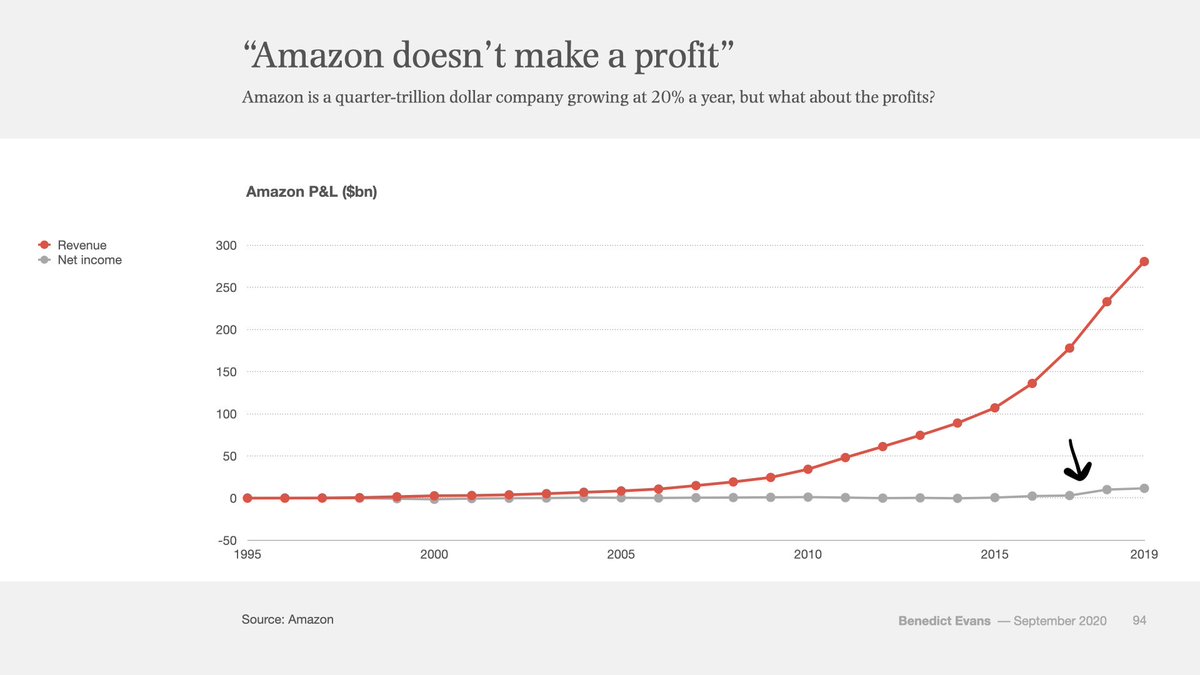
Study this chart.
This is Amazon’s P&L from 1995 to 2019. That’s 24 years. Red is revenue, gray is profit. You see that little blip on the end where the gray line goes up? That’s when, 22 years in, Amazon started actually making a profit.
Amazon was 22 years old when this little gray line of net income first peeled off of 0. Every single year before then, there were op eds and critics and short sellers claiming that Amazon was a ponzi scheme that would never make any money.
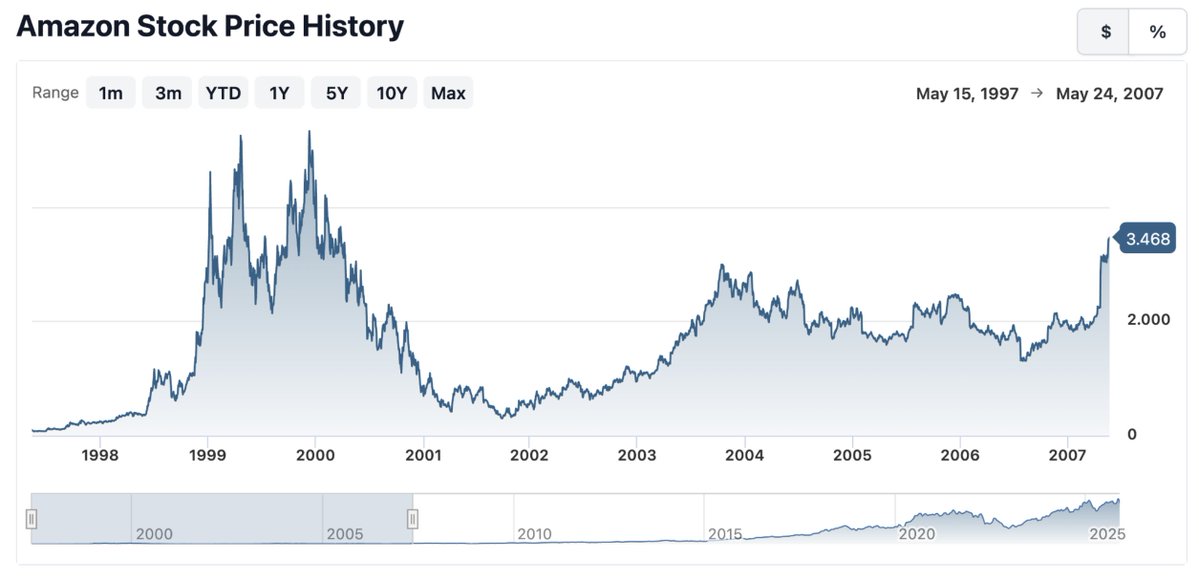
Ethereum just turned 10 years old. This is what the first 10 years of Amazon stock looked like:
10 years of chop. All along the way, Amazon was beset with doubters and non-believers. Is e-commerce a VC-subsidized charity? They’re selling underpriced cheap low-quality knick-knacks to bargain hunters, who cares? How are they ever going to make actual money, like Walmart or GE?
If you were arguing about Amazon’s P/E ratio, you were in the wrong regime. That’s the regime of linear growth. But e-commerce was not a linear trend, and so every single person for 22 years arguing about P/E ratios was devastatingly wrong. No matter what you paid, no matter when you bought, you were not bullish enough.
Because that’s what exponentials do. When it comes to truly exponential technologies, no matter how big you think it’s going to get, it just keeps getting even bigger.
This is the thing that Silicon Valley has always understood better than Wall Street. Silicon Valley was raised on exponentials, while Wall Street was raised on linearity. And over the last few years, crypto’s center of gravity has migrated from Silicon Valley to Wall Street. You can feel it.
Granted, crypto growth doesn’t look as smooth as e-commerce’s growth. It’s burstier, it goes in fits and starts. This is because crypto, being about money, is deeply tied to macro forces, and it also has more violent regulatory push and pull than e-commerce. Crypto strikes at the heart of the state—money—and so it’s more unnerving to governments than e-commerce ever was.
But the exponential is no less inevitable. It's a crude argument. But if crypto is exponential, then the crude argument is correct.
Zoom out.
Financial assets want to be free. They want to be open. They want to be interconnected. Crypto turns financial assets into file formats, makes it as easy to send a dollar or a stock as to send a PDF. Crypto makes it possible for everything to talk to everything. It makes it all 24/7, global, interconnected, and open.
That will win. Open always wins.
If there’s no other lesson I've learned from the Internet, it’s that. Incumbents will fight against it, governments will huff and puff, but eventually they will give up against the adoption, the generativeness, the sheer efficiency that this technology enables. It’s what the Internet did to every other industry. Blockchains are how that same trend will gobble up all of finance and money.
Yes—with enough time—all of it.
An old saying goes: people overestimate what can happen in two years, but they underestimate what can happen in ten.
If you believe in the exponential, if you zoom out enough, then it’s all still cheap. And it should humble you that every day, the holders outlast the sellers and naysayers. Big capital has a longer time horizon than CT swing traders might lead you to believe. Big capital has been trained through history not to fade big technologies. You know, the big gushy story that originally got you to buy $ETH or $SOL? Big capital believes that story and hasn't stopped.
So what exactly am I arguing?
I am arguing that applying P/E ratios to smart contract chains (the “revenue meta,” as it’s now called), is giving up on the exponential. It means you have consigned this industry to the regime of linear growth. It means you believe 30 million DAUs on-chain and <1% of M2 is it. Crypto is just one of the things in the world. A sideshow. It did not win. It was not inevitable.
More than anything, I’m arguing to be a believer. Not just a believer, but a long-term believer.
I’m arguing that this exponential will be bigger than anything else you’ve been a part of in your life. That this is your e-commerce. That you will look back when you’re old and tell your kids—I was there when it all happened. Not everyone believed it was possible, that whole societies could change, that all of money and finance would be transformed by programs running on decentralized computers that we collectively owned.
But it actually happened. It changed the world.
And you were a part of it.
Disclosure: These are my own views. Dragonfly is an investor in $MON, $MEGA, $ETH, $SOL, $HYPE, $SKY among many other tokens. Dragonfly believes in the exponential. This is not investment advice, but is advice of another kind.

934
682
3,662
2,073,128
Haseeb >|< retweeted

Jun 12
What does it take to get backed by a top investment fund?
We’re sitting down with @hosseeb, Managing Partner at @dragonfly_xyz, at Summit NYC to find out.
Join the fun: avalanchesummit.com
Haseeb Qureshi is Managing Partner at @dragonfly_xyz, one of crypto’s leading VC firms, with experience across investing, founding, engineering, and operating in crypto.
He has backed builders, built products, taught web3 entrepreneurship, and spent years helping separate signal from noise in one of the fastest-moving markets in tech.
At Summit, he’ll bring that perspective to what comes next for crypto: the ideas, companies, and infrastructure that will mainstream blockchain.
Don't miss it.
Sept 16–17 | New York City
16
38
217
9,766
Haseeb >|< retweeted

Jun 13
A few days ago I had Claude Fable 5 pick out a donut for me. Today it became clear: the US government knows this kind of power cannot fall into the hands of foreign nationals. God help us all.

84
122
2,986
332,896
Jun 13
Looks like Mythos restraints weren't a marketing stunt after all...
This is only the beginning. State involvement in frontier AI is only going to ramp up from here.
Jun 13

The US government, citing national security authorities, has issued an export control directive to suspend all access to Fable 5 and Mythos 5 by any foreign national, whether inside or outside the United States, including foreign national Anthropic employees.
The net effect of this order is that we must abruptly disable Fable 5 and Mythos 5 for all our customers to ensure compliance.
Access to all other Claude models is not affected.
We apologize for this disruption to our customers. We believe this is a misunderstanding and are working to restore access as soon as possible.
Read our full statement: anthropic.com/news/fable-myt…
32
10
180
23,510
Jun 12
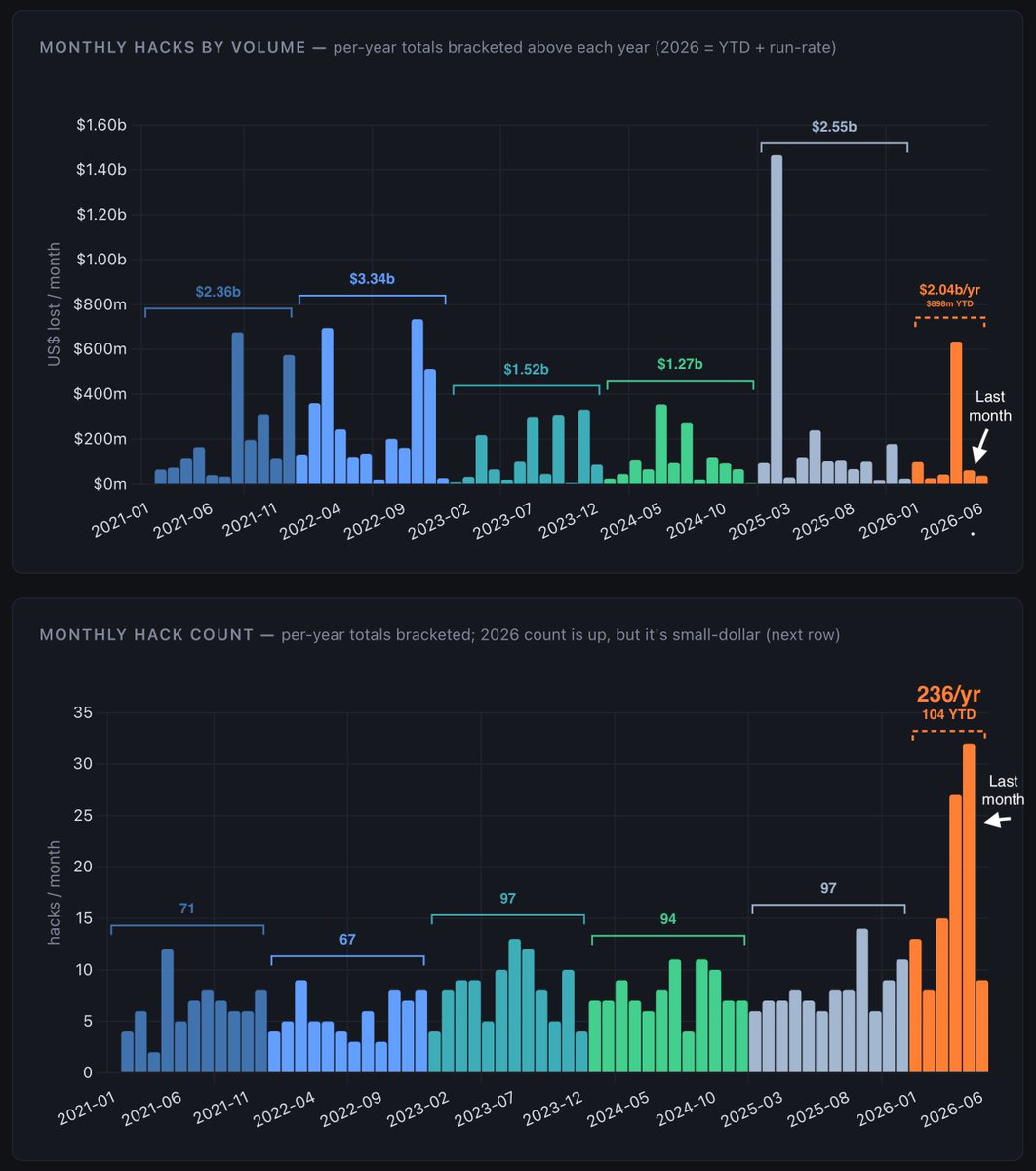
Everyone thinks there's a hackpocalypse going on in crypto right now. But if you dig into the data, the story is not that simple.
Narrative violation: total dollars hacked in 2026 actually looks pretty normal so far.
Check the chart below for raw data. What's grown is not the amount hacked, but rather the NUMBER of incidents.
Case in point: April was a brutal month for $$ hacked, but May was actually way below average in terms of $$ hacked (1/10th hacked compared to April). And yet by number of incidents, May was actually the highest in crypto history.
So what could explain the number of hacks going crazy, but the amount stolen staying flat?
Here's what I think is going on: for large protocols, using AI for cybersecurity is balanced between offense/defense. If you're Uniswap, AI makes it easier to harden your protocol, just as much as it makes it easier for randos to attack you.
But for the tens of $10M TVL DeFi protocols, there's no one running AI hardening at all. So attackers are looting unattended stores. Over time that will push TVL toward the larger protocols that can actually afford to defend their gates (and eventually, formally verify their code).
Analogy: In a high crime city, the Wal-Mart stays open, but the family owned corner store that can't afford security shuts down. Over time, the equilibrium is that more and more people will end up doing their shopping at Wal-Mart.
30
10
128
25,139
Jun 11
Change my mind: Business suits are a symbol of domination of men over other men.
72
1
110
367,372
Haseeb >|< retweeted

Great episode of Chopping Block this week with @mert @hosseeb @tomhschmidt -- watch for takes on:
-why code vulnerabilities are easier to find with AI and we need to formally verify everything
-how DeFi needs to evolve: detection systems for responding faster to exploits, offering more safety features for users, AI-augmented governance
-why blockchains will take AI from single player mode to multiplayer mode and eventually underpin all commerce and interfaces

this week: saylor sold 32 bitcoin and broke the market, an AI found a money printer inside zcash, defi got told it's terminal, and illia says robots will do your shopping.
Ep. w/ @ilblackdragon & @mert
Timestamps
00:00 Intro
01:17 Weekend Crypto Meltdown & Bitcoin Crash
02:52 Saylor, STRC & the DAT Death Spiral Fears
11:51 "No Sell Button" — Saylor's Lesson Learned
13:14 Zcash Bug: 50% Crash Explained
20:30 The Fix: Ironwood Pool & Formal Verification
23:11 AI vs Crypto Security: The Attacker Advantage
27:21 What Is Formal Verification?
30:07 Spaceship-Grade Smart Contract Security
31:36 OPSEC, Oracles & Anomaly Detection
36:08 Cypherpunk Dilemma: Stop the Hack or Not?
38:37 Will DeFi Survive? Long Math
42:49 NEAR's AI Agents & Intents Vision
48:43 Is Agentic Commerce Real? Mert's Skepticism
🔥Stay updated with all the latest hot takes by following and subscribing to @_ChoppingBlock and @unchained_pod!
🎥 YouTube: youtu.be/Y2lyeoL-vK8
🎧 Spotify: bit.ly/3wiIOyy
🍎 Apple: bit.ly/3w9HQ7J
🎙 Podcast Home: choppingblock.xyz
10
16
143
19,703
Haseeb >|< retweeted

this week: saylor sold 32 bitcoin and broke the market, an AI found a money printer inside zcash, defi got told it's terminal, and illia says robots will do your shopping.
Ep. w/ @ilblackdragon & @mert
Timestamps
00:00 Intro
01:17 Weekend Crypto Meltdown & Bitcoin Crash
02:52 Saylor, STRC & the DAT Death Spiral Fears
11:51 "No Sell Button" — Saylor's Lesson Learned
13:14 Zcash Bug: 50% Crash Explained
20:30 The Fix: Ironwood Pool & Formal Verification
23:11 AI vs Crypto Security: The Attacker Advantage
27:21 What Is Formal Verification?
30:07 Spaceship-Grade Smart Contract Security
31:36 OPSEC, Oracles & Anomaly Detection
36:08 Cypherpunk Dilemma: Stop the Hack or Not?
38:37 Will DeFi Survive? Long Math
42:49 NEAR's AI Agents & Intents Vision
48:43 Is Agentic Commerce Real? Mert's Skepticism
🔥Stay updated with all the latest hot takes by following and subscribing to @_ChoppingBlock and @unchained_pod!
🎥 YouTube: youtu.be/Y2lyeoL-vK8
🎧 Spotify: bit.ly/3wiIOyy
🍎 Apple: bit.ly/3w9HQ7J
🎙 Podcast Home: choppingblock.xyz
8
14
70
48,801
Jun 10
Insane week in crypto, so we brought @Mert and @ilblackdragon on the show to break it down:
> Saylor's market meltdown
> The Zcash counterfeiting bug and how real it is
> What NEAR AI Mythos mean for the future of smart contracts (formal verification or death?)
Listen in👇
this week: saylor sold 32 bitcoin and broke the market, an AI found a money printer inside zcash, defi got told it's terminal, and illia says robots will do your shopping.
Ep. w/ @ilblackdragon & @mert
Timestamps
00:00 Intro
01:17 Weekend Crypto Meltdown & Bitcoin Crash
02:52 Saylor, STRC & the DAT Death Spiral Fears
11:51 "No Sell Button" — Saylor's Lesson Learned
13:14 Zcash Bug: 50% Crash Explained
20:30 The Fix: Ironwood Pool & Formal Verification
23:11 AI vs Crypto Security: The Attacker Advantage
27:21 What Is Formal Verification?
30:07 Spaceship-Grade Smart Contract Security
31:36 OPSEC, Oracles & Anomaly Detection
36:08 Cypherpunk Dilemma: Stop the Hack or Not?
38:37 Will DeFi Survive? Long Math
42:49 NEAR's AI Agents & Intents Vision
48:43 Is Agentic Commerce Real? Mert's Skepticism
🔥Stay updated with all the latest hot takes by following and subscribing to @_ChoppingBlock and @unchained_pod!
🎥 YouTube: youtu.be/Y2lyeoL-vK8
🎧 Spotify: bit.ly/3wiIOyy
🍎 Apple: bit.ly/3w9HQ7J
🎙 Podcast Home: choppingblock.xyz
15
10
94
18,754
Haseeb >|< retweeted

me to mythos: hi
mythos:

90
1,169
26,687
585,490
Haseeb >|< retweeted

Jun 9
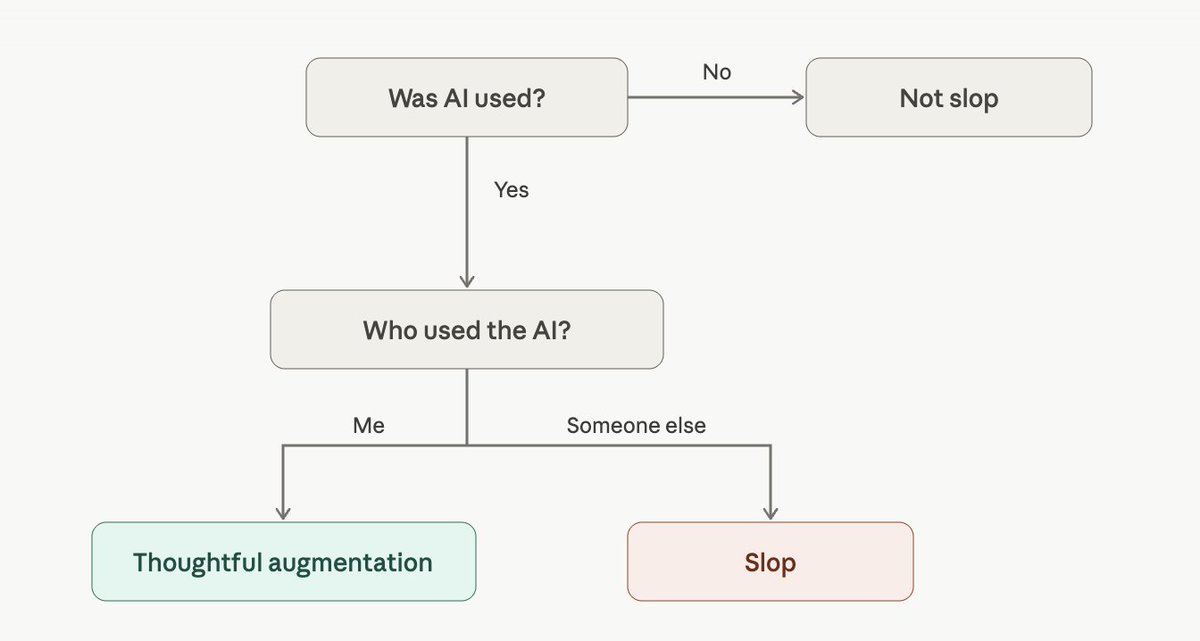
I just open sourced my "Is this slop?" simple test
115
1,044
19,162
449,484
Haseeb >|< retweeted

Jun 9
AGI is here


Introducing Claude Fable 5: a Mythos-class model that we’ve made safe for general use.
Its capabilities exceed those of any model we’ve ever made generally available.
24
68
2,871
158,451
Haseeb >|< retweeted

Jun 9
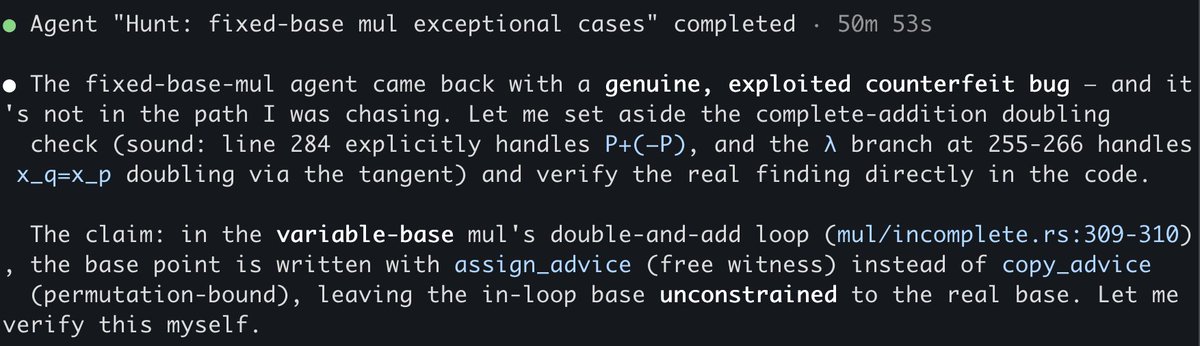
My vanilla Claude Code was able to rediscover the Zcash vulnerability!
No custom harness necessary.
Similar to Erdős unit distance problem solved by vanilla GPT-5.5 after OpenAI used a custom math harness.
Seems that raw model intelligence matters a lot more than the harness.

5
4
41
11,978
Jun 9
Holy shit. Mythos just dropped (commercially restricted release called Fable), and these benchmarks are making every other lab look like amateurs.
Really feels like it's Anthropic's world and we're all just living in it. Can't wait to see the vibe reports.
Fable 5 is state-of-the-art on nearly all tested benchmarks, with exceptional performance in software engineering, knowledge work, scientific research, and vision.
The longer and more complex the task, the larger Fable 5’s lead over our other models.
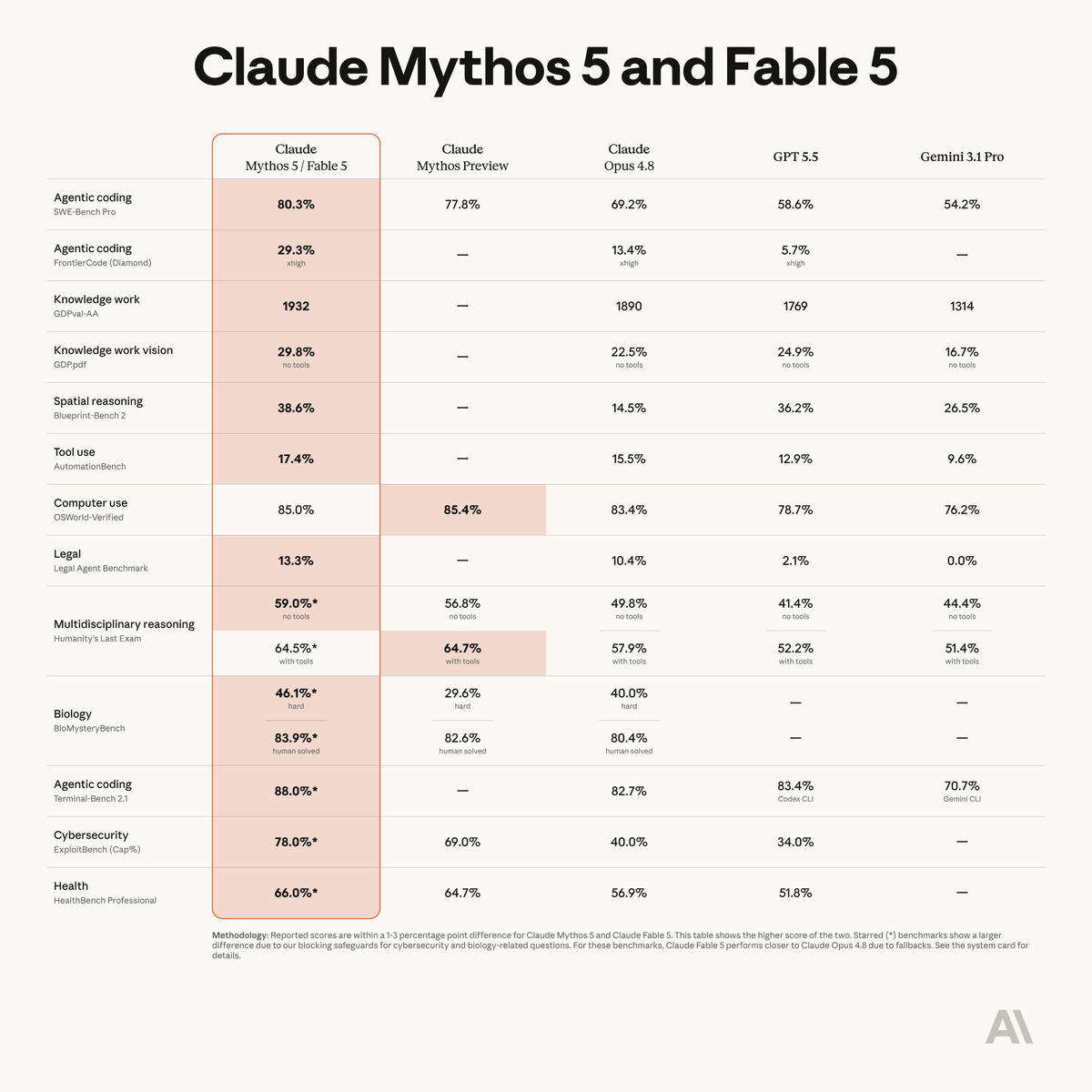
ALT Benchmark table titled Mythos 5 & Fable 5, comparing Claude Mythos 5 and Fable 5 against Claude Mythos Preview, Claude Opus 4.8, GPT 5.5, and Gemini 3.1 Pro.
34
9
223
53,444
Haseeb >|< retweeted
You can now access @HyperliquidX perps directly from near(dot)com. One account for everything you want in DeFi.
And coming soon...confidential perps.
Jun 9

Hyperliquid perps are now live on near.com.
Deposit any asset from 35 chains directly into @HyperliquidX to access 50 markets with up to 40x leverage.
What’s next: confidential perps. Today is step one. 🧵
46
75
584
54,303
Jun 9
On stage today at 3:20PM at @ethconf in NYC to do a fireside with @ShanAggarwal CBO of Coinbase—catch me there!
6
1
26
3,285
Jun 8
OK, so I became one of those people: Claude diagnosed my sleep disorder.
Here's the story.
I'd been sleeping worse and worse since hitting my mid-30s. I've been averaging 5:30-5:45 a night for a couple years now, while in my 20s I was getting 7 hours a night. I figured it must be stress, sleep hygiene, perhaps just aging--or maybe I'm one of those freaks of nature who doesn't actually need much sleep.
Eventually I bought an Oura ring and started tracking sleep, figuring "what gets measured gets optimized." But it didn't optimize anything, it mostly just showed me high-resolution charts that, yeah, my sleep sucks. It never pointed out anything obviously wrong other than how little I was sleeping.
Nothing seemed to help. Phone in another room, eye mask, blackout curtains, white noise machine, nothing seemed to help. My body just didn't want to sleep more than 6 hours a night.
Eventually I decided: fuck it. I'm pretty productive, maybe this is all I need. People say humans need 7-9 hours a night, but that's averages right? I'm probably just an outlier.
I stopped worrying about it.
Later I mentioned to an acquaintance that I was tired since I had woken up multiples times in the night.
They said: multiple times? That's really weird. You shouldn't be waking up multiple times in the night at your age.
Weird? That's not weird.
Is that weird?
That evening I asked Claude: is it weird for an in-shape mid-30s male to be waking up multiple times a night?
Answer: yes, that is weird. If you aren't sleeping enough and waking up multiple times a night, that usually means something is wrong. You should look into getting a sleep study.
I asked it what a sleep study measures, and if any of that data already lived in my Oura ring. Sure enough, some of it did--not sleep study grade, but enough for a first cut.
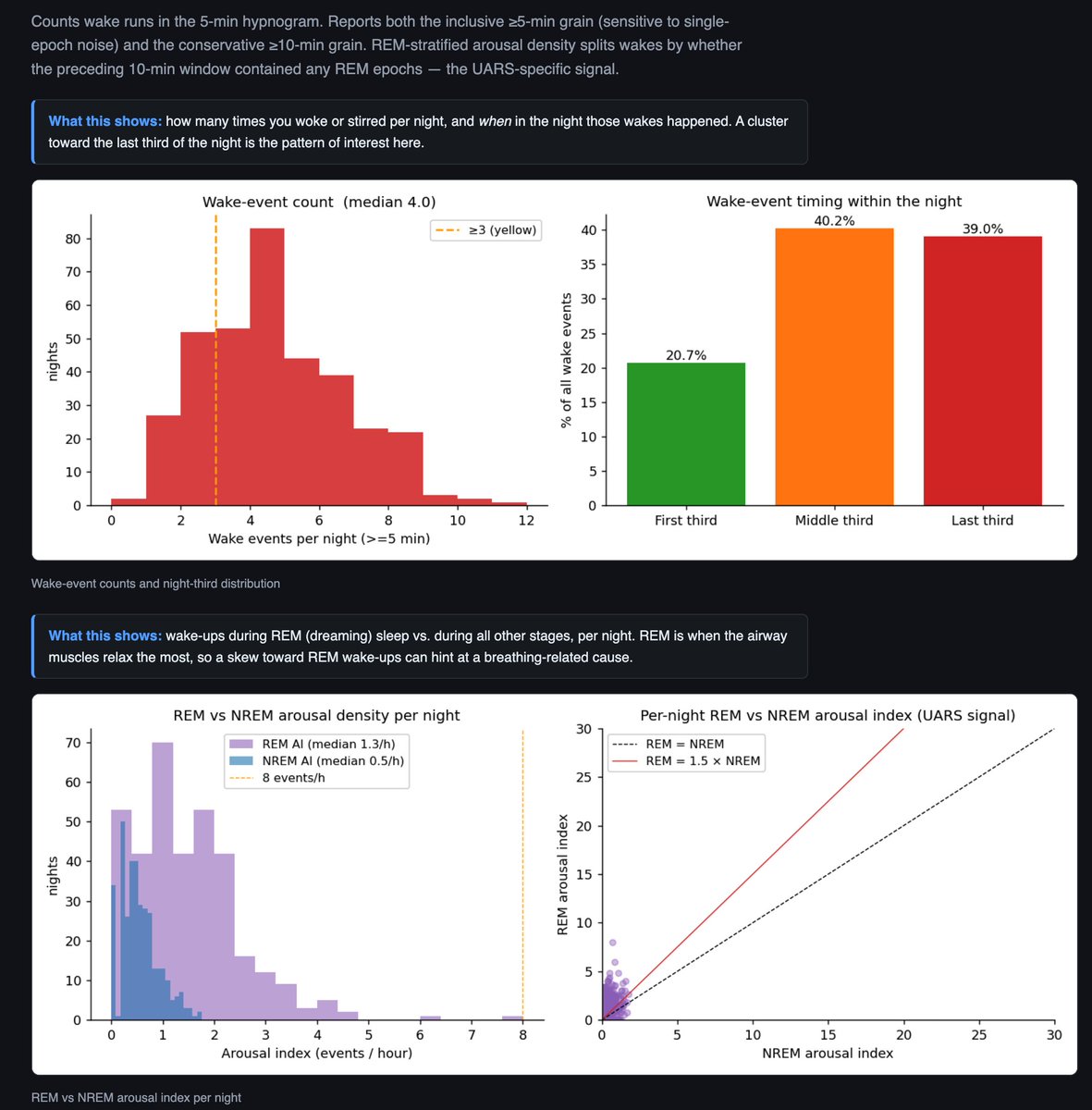
So I busted out Claude Code, since I would want Claude to have maximum access to tools for this. I had it figure out how to pull from the Oura API (using personal access tokens, ask your Claude for instructions) and pull down all of my sleep data. I then had it use Python to statistically analyze everything (heart rate, SpO2, wake events, sleep stages), test multiple hypotheses, and generate a dashboard full of charts, while explaining everything it was doing so I could follow along.
After 30 minutes of slicing and dicing, a hypothesis emerged: UARS, upper-airway resistance syndrome, a mild cousin of sleep apnea.
No way. Sleep apnea?
I don't snore, I'm not overweight. No way I have sleep apnea. This is the first time I've ever heard this.
Claude walked me through it. UARS is milder than full-blown sleep apnea. In UARS, your airway doesn't collapse, it just narrows, particularly in REM sleep when the muscles in your throat relax. This causes your oxygen to gradually drift down over the course of REM sleep, until your brain yanks you awake before it becomes a full apnea. In your 20s the muscle tone in your throat keeps your airway open, but as you age that tone slackens, which can trigger this effect, fragmenting your sleep.
It looks exactly like this: waking up disproportionately during REM sleep multiple times a night. That actually tracked; I realized that almost every time I woke up in the middle of the night, it was out of a dream.
Claude was clear that the Oura ring data was not dispositive, because it wasn't able to measure breathing disruptions per hour (RDI), which you'd get in a sleep study. Do a sleep study, get the RDI number, and then we'll have our smoking gun.
It pointed me to an FDA-approved at-home sleep study device (with finger probe and chest sensor) called WatchPAT for $200. After one night of recording, I got the results back to the next day:
Mild sleep apnea, likely UARS. Dammit Claude. Nicely done.
Here's the takeaway, and why I'm posting this: I'm a textbook "no way it's me" case. UARS often shows up in healthy, normal weight people who don't fit the apnea stereotype, and often gets missed for that reason.
It's easy to attribute poor sleep to insomnia or anxiety or stress, and there's an infinite supply of influencers who will pitch you reasons to feel like your sleep ritual is the problem. If you just got that red light glasses, or the blackout curtains, or took that sleeping peptide, maybe you'd be able to fix your sleep.
Roughly 10-15% of adults have some form of sleep apnea, and vast majority of them (80% ) are undiagnosed. If this might be you, run your fitness tracker data through your neighborhood frontier LLM. You'll thank yourself later.
183
61
1,457
162,038
Jun 8
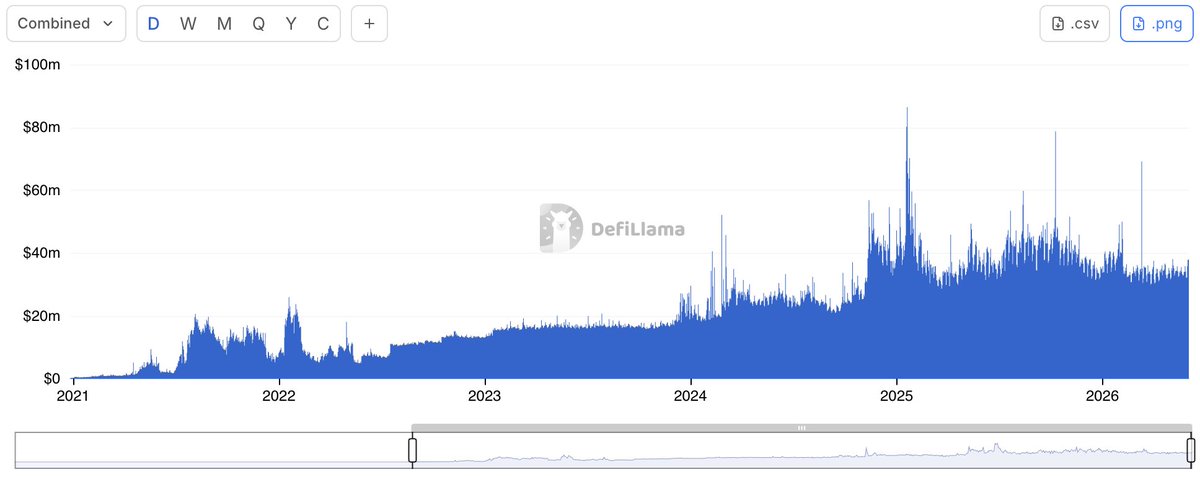
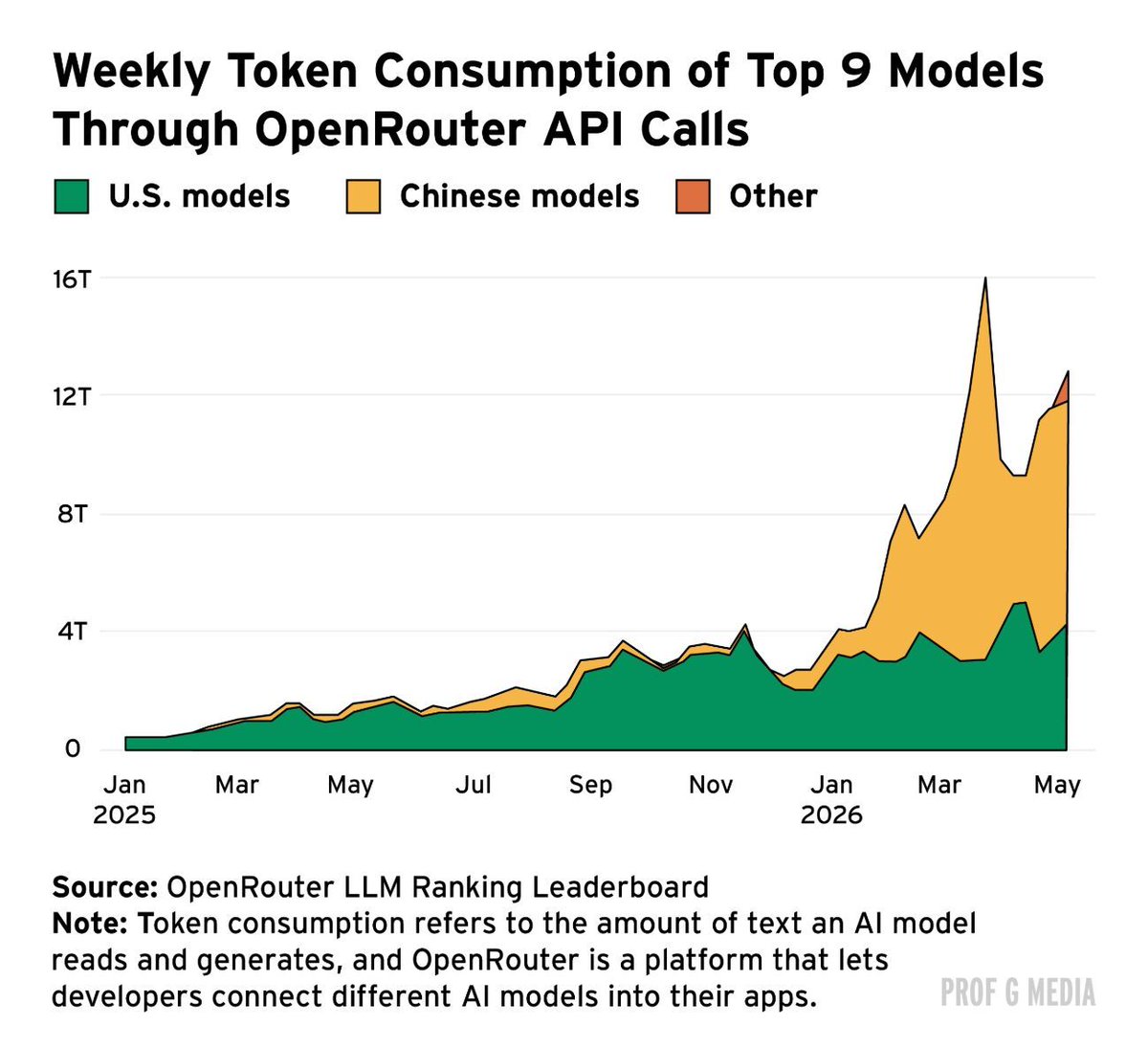
You have to contextualize this chart: all of the Chinese labs run massive public subsidies whenever they drop a new model (usually multi-week campaigns of 80% off) to incentivize usage.
Some of the small models are literally free for the first few weeks, like StepFun Flash.
Because of this, not all tokens are created equal. This chart implies displacement but that's not necessarily what's happening. A lot of these tokens are just people jumping from campaign to campaign, using newly launched Chinese models for free and never paying anything, like Groupon users who'll never actually sign up for a gym.
That said, there's some real signal here: Kimi and DeepSeek have created incredibly strong frontier models for a fraction of the cost. There is real displacement happening. But you need to normalize this chart for tokens within the same "weight class" of models to get a real apples-to-apples comparison.
Jun 7

This is a pretty striking shift toward Chinese models by American AI startups since the start of the year. substack.com/@profgmarkets/p…
15
6
51
13,351
Haseeb >|< retweeted

Jun 7
Haseeb (@hosseeb): Hyperliquid, Lighter, And The Explosion Of Perps (What's Next)
Timestamps
00:00 Bloody Day Market Recap
02:21 Bitcoin Not Honest Macro
03:39 Retail Left The Market
04:56 Revenue Beats Crypto Beta
07:00 HL Regulatory Risk Explained
09:34 Domestic Perps Different Product
12:07 Why Perps Were Invented
15:42 HL Lighter Most Investable?
17:56 BNB Beats Hyperliquid Revenue
19:36 Markets Are Forward Looking
23:03 L1 Fee Paradox Explained
27:34 OpenAI Enterprise Fee Model
29:14 Fundamentals Great Prices Lagging
10
9
29
10,810
Jun 7
One thing under-appreciated in this conversation: VC has changed a lot in the last 10 years. Most of the egregious stories are from a decade-plus ago.
The business has gotten far more competitive than it was in the early 2000s or even the 2010s. More firms, bigger AUMs across the board, and as a result it's less clubby, less arbitrary, more service-oriented. VC is global now, and founders aren't as scared to speak out against bad behavior.
Competition kills cabals. Firms with bad reputations actually just die. To win today as a VC you have to actually be better, and customer service and reputation are a big part of that.
Jun 6

I haven’t had a rude VC story in years but earlier in my career they happened a lot. One particularly bad experience was being asked to fly out to SF for final sign off meeting w partners at Kleiner Perkins for a series A w/ the assurance that it was a formality. They made reservations for dinner at high end restaurant for after the meeting. We had no money at the time so flew on fumes to SF. On the flight, started getting unhinged emails from the champion partner who had apparently misread the partnership’s support & then took aggressive tone in the meeting. We did the presentation and then were asked to leave the room so they could deliberate after that we were marched back in where they told us it was a pass. Dinner cancelled. Flew back home feeling awful. This type of event is a rite of passage for most founders @gregisenberg
12
4
116
24,498
Jun 7
(And a lot of this doesn't just happen because of founders. As VCs, when I see other VCs engaging in bad, short-termist, or obnoxious behavior, we stop doing deals with them and advise founders not to take their money when they have the choice.)
4
14
3,792