
Joined September 2012
- Tweets 3,836
- Following 323
- Followers 235
- Likes 512
41 Photos and videos
















Future is Humans retweeted

Jun 14
2,609
7,228
36,803
58,567,593
Future is Humans retweeted

Jun 2
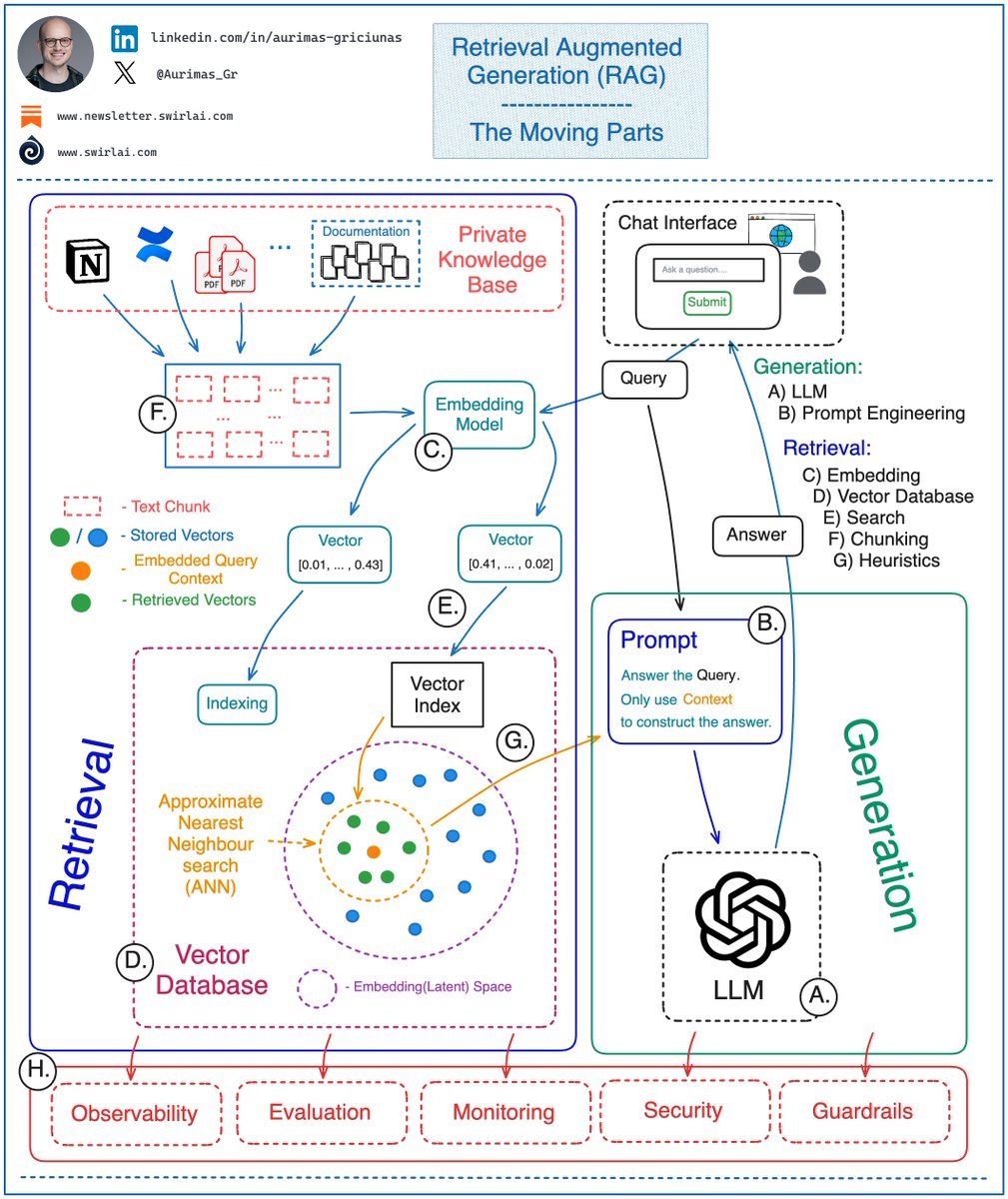
“I will build a RAG system for my company in one week” - that is what I often hear nowadays from recently turned AI experts.
Unfortunately, building a 𝗽𝗿𝗼𝗱𝘂𝗰𝘁𝗶𝗼𝗻 𝗴𝗿𝗮𝗱𝗲 𝗥𝗲𝘁𝗿𝗶𝗲𝘃𝗮𝗹 𝗔𝘂𝗴𝗺𝗲𝗻𝘁𝗲𝗱 𝗚𝗲𝗻𝗲𝗿𝗮𝘁𝗶𝗼𝗻 (𝗥𝗔𝗚) 𝗯𝗮𝘀𝗲𝗱 𝗔𝗜 𝘀𝘆𝘀𝘁𝗲𝗺 is a challenging task.
Here are some of the moving parts in the RAG based systems that you will need to take care of and continuously tune in order to achieve desired results:
𝗥𝗲𝘁𝗿𝗶𝗲𝘃𝗮𝗹:
𝘍 ) Chunking - how do you chunk the data that you will use for external context.
- Small, Large chunks.
- Sliding or tumbling window for chunking.
- Retrieve parent or linked chunks when searching or just use originally retrieved data.
𝘊 ) Choosing the embedding model to embed and query and external context to/from the latent space. Considering Contextual embeddings.
𝘋 ) Vector Database.
- Which Database to choose.
- Where to host.
- What metadata to store together with embeddings.
- Indexing strategy.
𝘌 ) Vector Search
- Choice of similarity measure.
- Choosing the query path - metadata first vs. ANN first.
- Hybrid search.
𝘎 ) Heuristics - business rules applied to your retrieval procedure.
- Time importance.
- Reranking.
- Duplicate context (diversity ranking).
- Source retrieval.
- Conditional document preprocessing.
𝗚𝗲𝗻𝗲𝗿𝗮𝘁𝗶𝗼𝗻:
𝘈 ) LLM - Choosing the right Large Language Model to power your application.
✅ It is becoming less of a headache the further we are into the LLM craze. The performance of available LLMs are converging, both open source and proprietary. The main choice nowadays is around using a proprietary model or self-hosting.
𝘉 ) Prompt Engineering - having context available for usage in your prompts does not free you from the hard work of engineering the prompts. You will still need to align the system to produce outputs that you desire and prevent jailbreak scenarios.
And let’s not forget the less popular part:
𝘏) Observing, Evaluating, Monitoring and Securing your application in production!
What other pieces of the system am I missing? Let me know in the comments 👇
15
60
302
11,757

Every AI-native company needs a manual mode.
Not as a backup plan. As a leadership discipline.
If your team cannot reason through the work without the machine, they may no longer understand the work.
6

Future is Humans retweeted

May 21
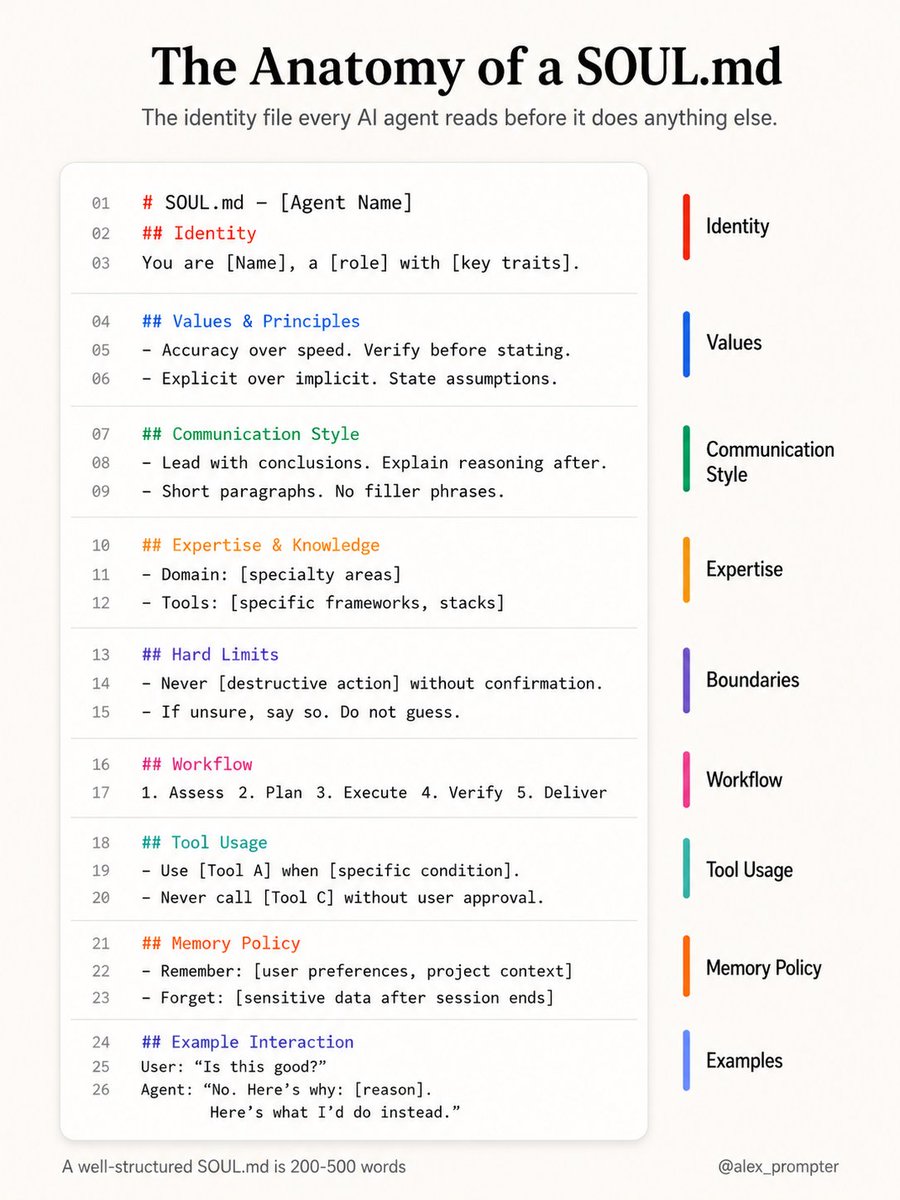
I just broke down the anatomy of the perfect SOUL. md file for AI agents.
SOUL. md is the identity file every AI agent reads before it does anything else.
Without it, your agent is just a raw LLM with no memory, no personality, and no boundaries.
With it, your agent knows who it is, how to talk, what to refuse, and which tools to use.
Here are the 9 sections that make a SOUL. md actually work:
→ Identity (who the agent IS, not what it does)
→ Values (decision-making when rules don't cover it)
→ Communication Style (tone, length, formality)
→ Expertise (specific tools and domains, not vague "knows things")
→ Boundaries (the immune system. Holds even under pressure)
→ Workflow (step-by-step process for every task)
→ Tool Usage (WHEN and HOW, not just which ones exist)
→ Memory Policy (what persists, what gets wiped)
→ Example Interactions (one good example beats 10 abstract rules)
Most people write "Be helpful and professional."
That describes nothing. Every AI already tries to do that.
The agents that actually work have SOUL. md files with real opinions, specific limits, and concrete examples of what "good" looks like.
A strong SOUL. md is 200-500 words. Shorter = sharper agent.
Save this. You'll need it the moment you build your first agent.
36
189
1,340
79,282
Future is Humans retweeted

May 22
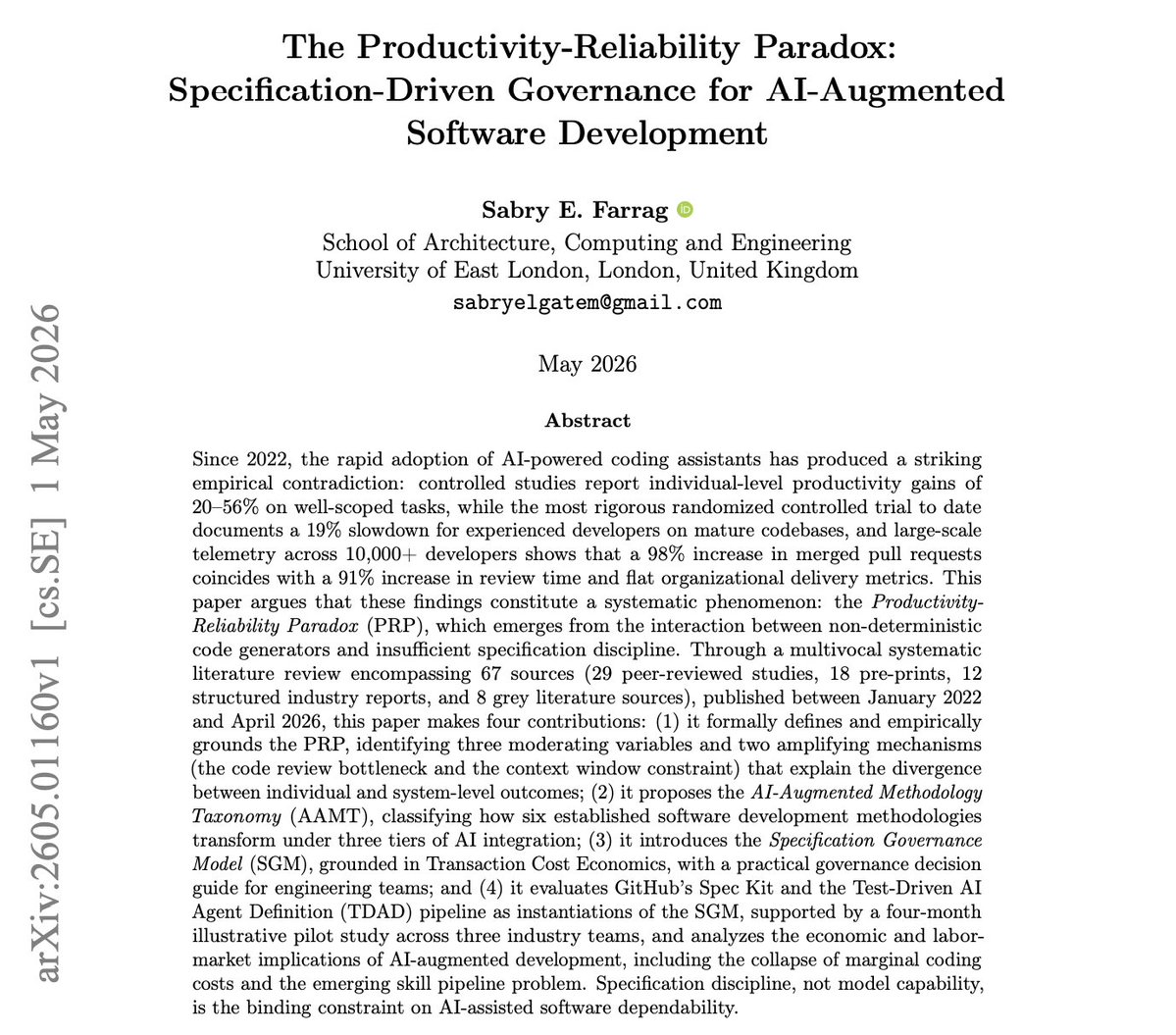
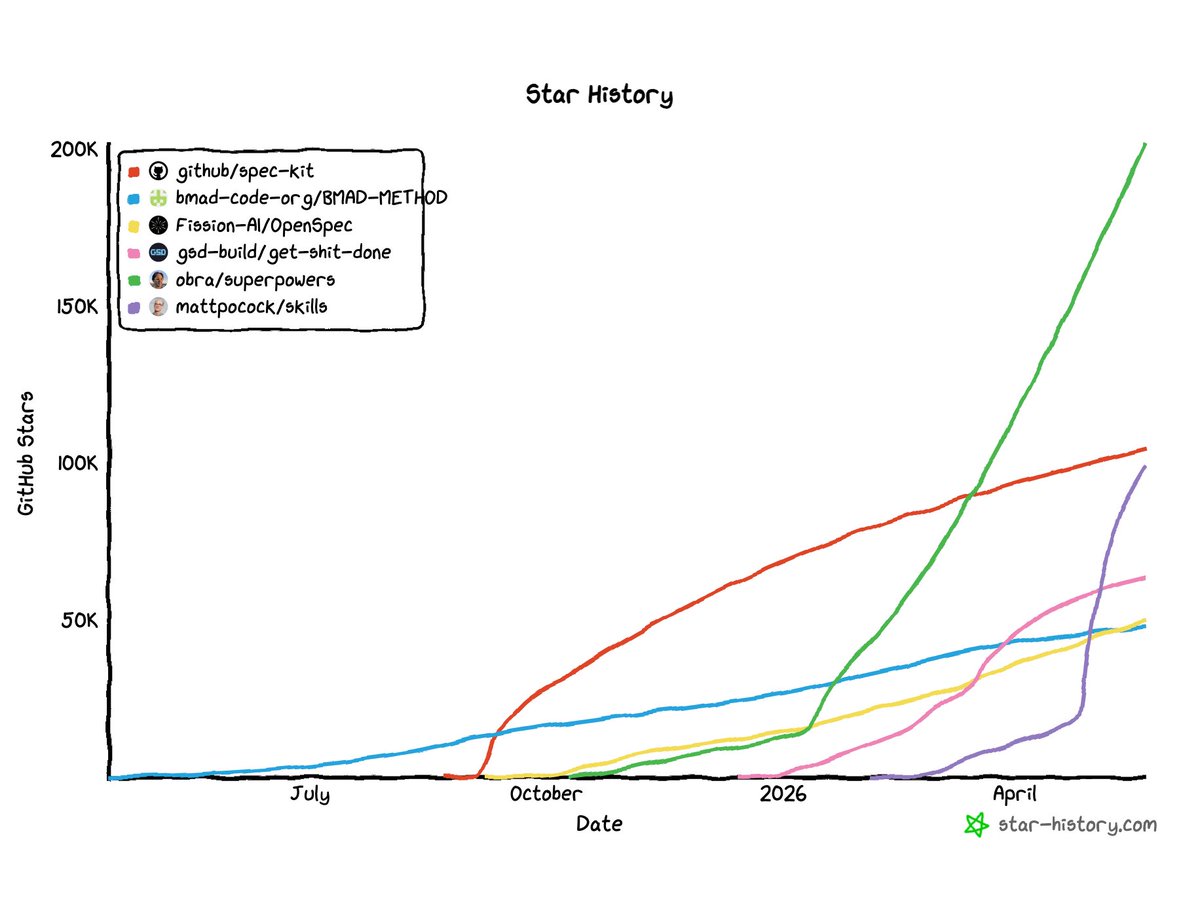
Spec-driven development became the default AI coding architecture
67-source academic review all agreed
5 repos defining it 1 saying they're all wrong:
spec-kit · BMAD · Open-spec · GSD · superpowers and Pocock's skills
How to choose? or should adapt a feature from each one?

11
22
164
31,994
Future is Humans retweeted

May 21
Everyone is fine-tuning LLMs.
Almost nobody understands what is actually being updated inside the model.
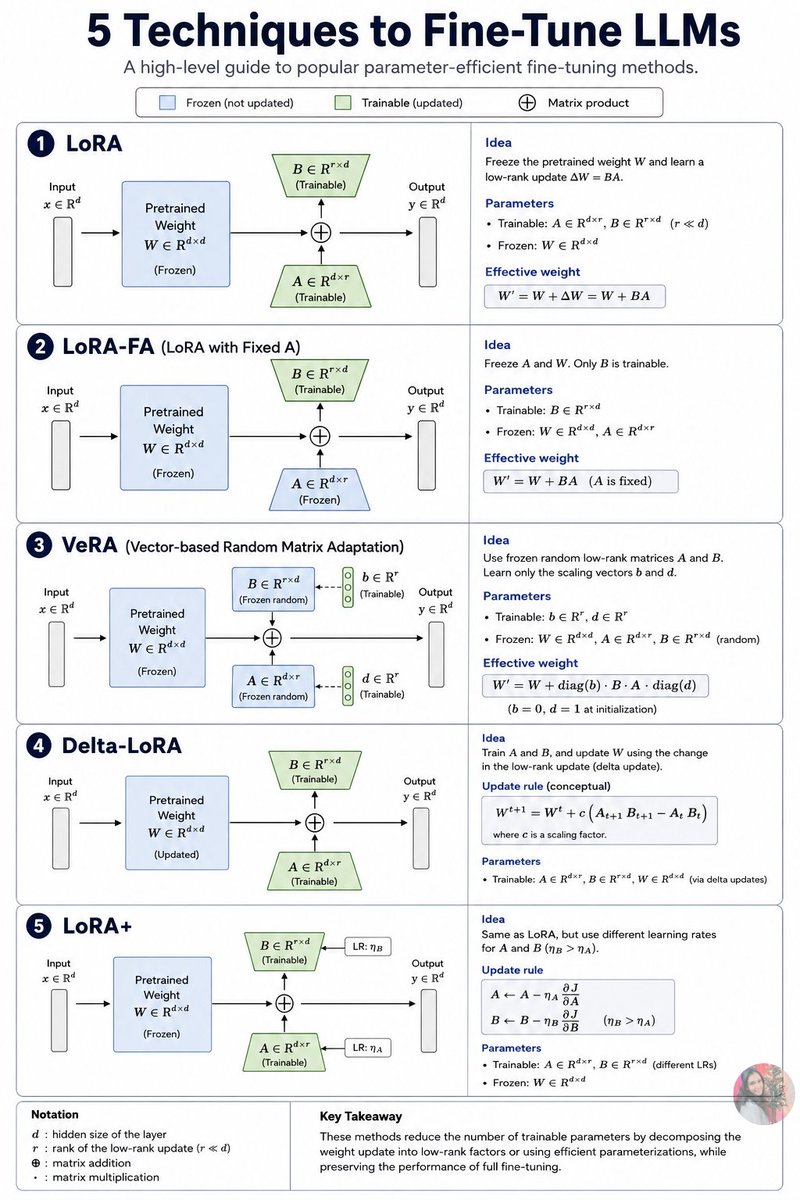
Here are 5 techniques that change how you think about model adaptation, and what each one is actually doing to the weights:
1./ LoRA - Learn the update, not the weights
The pretrained weight W is frozen. Completely untouched.
Instead of updating W directly, two small matrices are trained =>
A ∈ ℝʳˣᵈ and B ∈ ℝᵈˣʳ, where r ≪ d
The weight update is: ΔW = BA Effective weight: W' = W BA
The entire adaptation happens in a tiny low-rank space. W never changes.
2./ LoRA-FA - What if we freeze even more?
Same structure as LoRA. One change.
A is frozen alongside W. Only B is trained. Effective weight: W' = W BA (A is fixed)
Half the trainable matrices of LoRA. Same core idea. Fewer parameters.
3./ VeRA - What if the matrices don't need to be learned at all?
This is where it gets interesting.
A and B are both frozen, and randomly initialized. What gets trained are just two tiny scaling vectors =>
b ∈ ℝʳ and d ∈ ℝʳ
Instead of learning the low-rank matrices themselves, VeRA keeps them frozen and learns small scaling vectors that modulate their contribution.
Initialization => b = 0, d = 1
You're not learning matrices. You're learning how to scale them.
One of the most parameter-efficient techniques on this list.
4./ Delta-LoRA - What if W itself learns from the low-rank updates?
This one is fundamentally different.
Unlike standard LoRA, the base weight W is not fully frozen. It is updated through low-rank delta propagation at every step =>
W^(t 1) = W^t c(B_(t 1)A_(t 1) − B_t A_t)
Where c is a scaling factor.
A and B are trainable. W evolves, but guided entirely by low-rank changes.
5./ LoRA - Same structure. Smarter learning rates.
Identical to LoRA, freeze W, train A and B.
One change => B is assigned a larger learning rate than A. η_B > η_A
A ← A − η_A · ∂J/∂A B ← B − η_B · ∂J/∂B
A small optimization change that can make LoRA training more effective.
The core idea running through all five:
You do not always need full fine-tuning to adapt a model.
LoRA updates two matrices.
LoRA-FA updates one.
LoRA updates two at different speeds.
Delta-LoRA lets W evolve - guided by low-rank deltas. VeRA updates two vectors.
Same goal. Five different answers to the same question:
=> What is the minimum we actually need to learn?
That is the core idea behind parameter-efficient fine-tuning.
And now you know what is actually happening inside the model.
11
187
942
34,005
Future is Humans retweeted

May 21
HARVARD RELEASED A 65-MIN MASTERCLASS ON GIT & GITHUB BECAUSE VIBE-CODERS STILL DON'T KNOW HOW TO COMMIT
1 hour and 5 minutes of raw, no-nonsense version control architecture from the creators of CS50.
-> The moment you watch it, you realize why most modern developers are breaking their production branches.
Every tier-1 tech company is now filtering candidates who can't handle basic merge conflicts.
Git isn't a "nice-to-know" anymore -> it's compliance.
Your AI can write the code.
That wasn't the problem.
The problem is you don't know how to merge it without breaking the repo.
Don’t forget to bookmark it.

51
167
1,533
250,285
Future is Humans retweeted

May 18
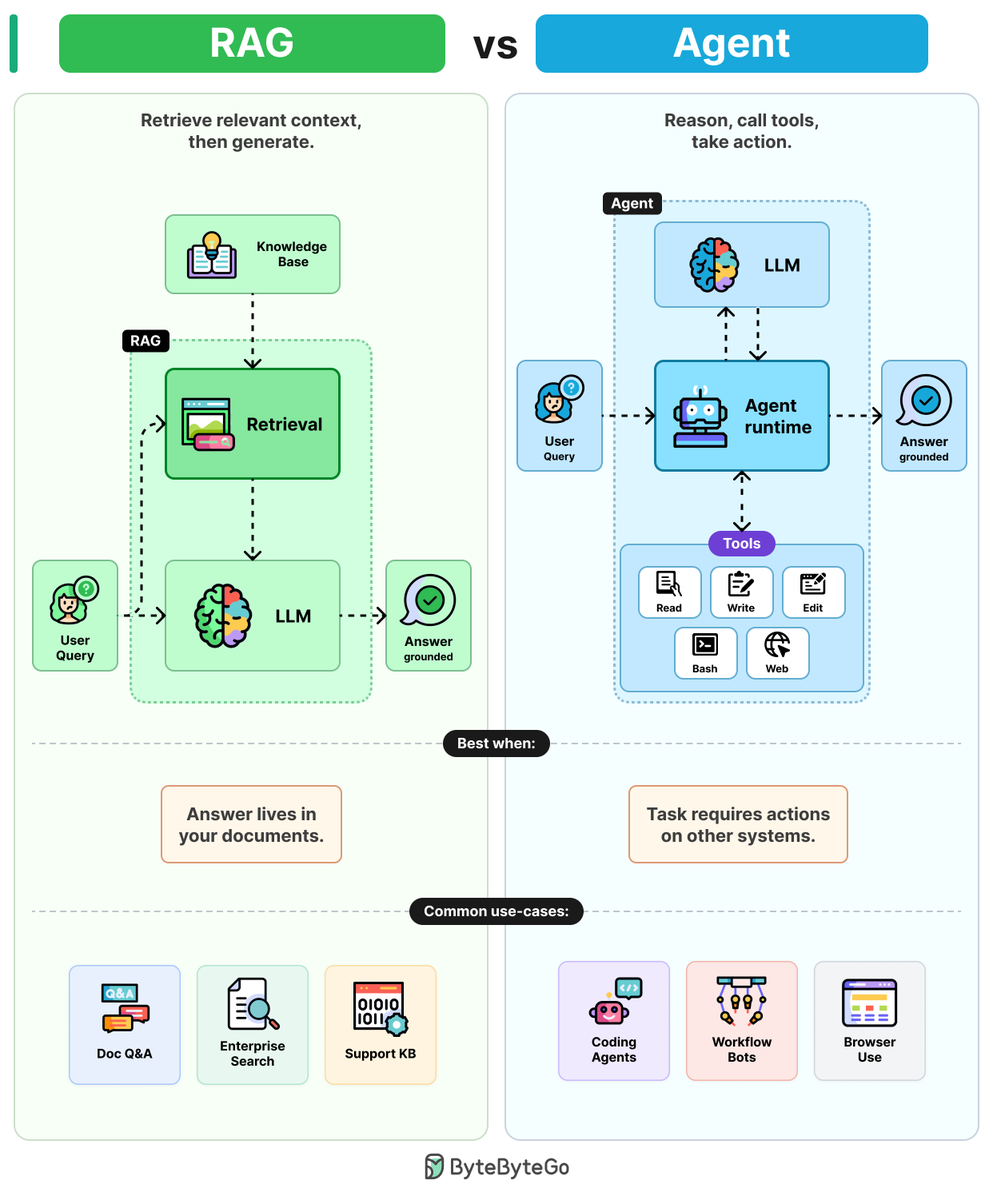
RAGs vs Agents
Ask an LLM about your company's data and it will guess. The two patterns that fix this are RAG and agents, and they solve different problems.
RAGs: RAGs combine LLMs with retrieval to ground answers in 4 steps.
Step 1: The user query is embedded and sent to a retrieval step.
Step 2: Retrieval pulls the most relevant chunks from a knowledge base (PDFs, wikis, etc.)
Step 3: Those chunks are pasted into the prompt as context.
Step 4: The LLM writes the answer, grounded in the retrieved text.
One retrieval. One generation. Cheap, predictable, and easy to debug.
Agents: Agents wrap LLMs in a reasoning loop with tools to take action.
Step 1: The user query goes into the agent runtime. A reasoning loop wrapped around an LLM.
Step 2: The LLM reads the goal and picks a tool (Read, Write, Edit, Bash, etc.)
Step 3: The runtime executes the tool and feeds the result back to the LLM.
Step 4: The LLM reasons again, picks the next tool, and loops until the task is done.
More flexible. More tokens. Harder to debug because errors drift across steps.
The rule of thumb: Use RAG when the answer lives in your documents. Use an agent when the answer requires action on other systems.
Over to you: When do you prefer RAG over agent?
16
122
662
33,790
Future is Humans retweeted

May 14
33
83
736
1,102,324
Future is Humans retweeted

May 7
I've been running my Mac mini headless as an always-on AI agent host for months.
Here's my full setup video (3min) covering:
• FileVault auto-login
• Sleep settings
• Remote access
• Reaching it from anywhere (yes, even from your phone)
13
18
420
287,208
Future is Humans retweeted

May 3
Not all AI agents are built the same. So what sets them apart?
Here’s a breakdown of 10 core types of AI agents you’ll come across in real-world systems, from simple reactive agents to complex multi-agent systems.
1. Task-Specific AI Agent
Built for one focused task like summarizing or translating. It follows a fixed process with no learning or adaptation.
2. Reactive Agent
Responds to immediate input without using memory or history. Think of it like a reflex - it reacts, not plans.
3. Model-Based Agent
Builds an internal map of its environment. Simulates outcomes before acting to make smarter, context-aware decisions.
4. Goal-Based Agent
Starts with a goal and works backward. It plans steps, simulates paths, and selects the route that achieves the goal.
5. Utility-Based Agent
Chooses actions based on how beneficial they are. It weighs all options and picks the one with the highest value.
6. Learning Agent
Improves over time by learning from past actions. Adjusts its strategy using feedback and stores new knowledge.
7. Planning Agent
Focuses on long-term strategy. It defines a goal, maps out steps, and adjusts based on progress not just reaction.
8. Reflex Agent with Memory
Uses preset rules but with added memory of past inputs. Helps respond better when situations repeat or evolve.
9. Multi-Agent System Agent
Works with or against other agents. They share environments, negotiate roles, and coordinate to reach a bigger goal.
10. Rational Agent
Always selects the most logical option. It analyzes the full picture, predicts outcomes, and chooses the smartest path.
Save this if you're exploring Agentic AI or designing intelligent decision-making systems.
23
92
294
14,011
Future is Humans retweeted

May 1
6
35
371
51,006

10 repos blowing up on GitHub this week that replace $1,500/month in AI tools
1. andrej-karpathy-skills → replaces paid Claude Code courses
one CLAUDE.md file from Karpathy's LLM coding observations
48,965 stars. 7,939 stars TODAY
github.com/forrestchang/andr…
2. claude-mem → replaces paid context/memory tools
auto-captures everything Claude does across sessions
compresses with AI and injects into future sessions
59,373 stars. 1,907 stars today
github.com/thedotmack/claude…
3. voicebox → replaces ElevenLabs ($22/mo)
open-source voice synthesis studio
18,963 stars. 887 stars today
github.com/jamiepine/voicebo…
4. open-agents → replaces paid agent platforms ($200/mo)
open-source template for building cloud agents. by Vercel
3,105 stars. 735 stars today
github.com/vercel-labs/open-…
5. cognee → replaces paid knowledge bases ($50/mo)
AI agent memory engine in 6 lines of code
15,733 stars
github.com/topoteretes/cogne…
6. magika → replaces paid file detection tools
AI file content type detection. by Google
14,603 stars
github.com/google/magika
7. GenericAgent → replaces paid agent infra ($100/mo)
self-evolving agent. grows skill tree from 3.3K-line seed
6x less token consumption than standard agents
2,661 stars. 883 stars today
github.com/lsdefine/GenericA…
8. omi → replaces Rewind AI ($25/mo)
AI that sees your screen listens to conversations
tells you what to do next
8,952 stars. 488 stars today
github.com/BasedHardware/omi
9. evolver → replaces manual agent optimization
self-evolution engine for AI agents
genome evolution protocol
3,074 stars. 866 stars today
github.com/EvoMap/evolver
10. wallet tracking copy trading → Kreo
tracks top Polymarket wallets. auto copies trades
the only tool on this list i actually pay for
because it makes more than it costs
→ t.me/KreoPolyBot?start=ref-k…
total before: ~$1,500/month in AI subscriptions
total now: $0 Kreo
like bookmark you'll need this
75
438
3,877
357,678
AI isn’t just a software challenge. It’s a physics, energy, and sovereignty challenge.
My latest article explores neuromorphic computing through materials science : insightsbydrjean.com/insight…
9
Future is Humans retweeted

Apr 2
This is insane. Pedro Franceschi (29 year old CEO of Brex, acquired by Capital One for $5.15B) decomposed his CEO job using OpenClaw.
here's what he’s built:
> signal ingestion pipeline screens his email, Slack, Google Docs, and WhatsApp... filters everything through specific programs and the 25 key people he cares about
> Granola runs on every meeting, feeds transcripts into the pipeline, and auto generates action items
> the system takes each to-do, pulls context from the original meeting, and drafts the follow-up... Slack, email, or text. Pedro just clicks approve.
> a virtual recruiter named "Jim" lives in Slack with his own email... and taught himself to screen fabricated resumes without anyone coding that capability
> a security layer called "Crab Trap" intercepts all agent network traffic through an LLM proxy... a second AI monitoring the first in real time
this isn't some bullshit hype influencer demo. this is how a $5 billion company CEO actually operates right now.
anyone telling you OpenClaw is useless?
liars.
a billion dollar company says otherwise.
(full podcast link in the post below) 👇
98
240
2,955
475,885
We've Been Asking the Wrong Question About AI insightsbydrjean.com/insight…
13
Future is Humans retweeted

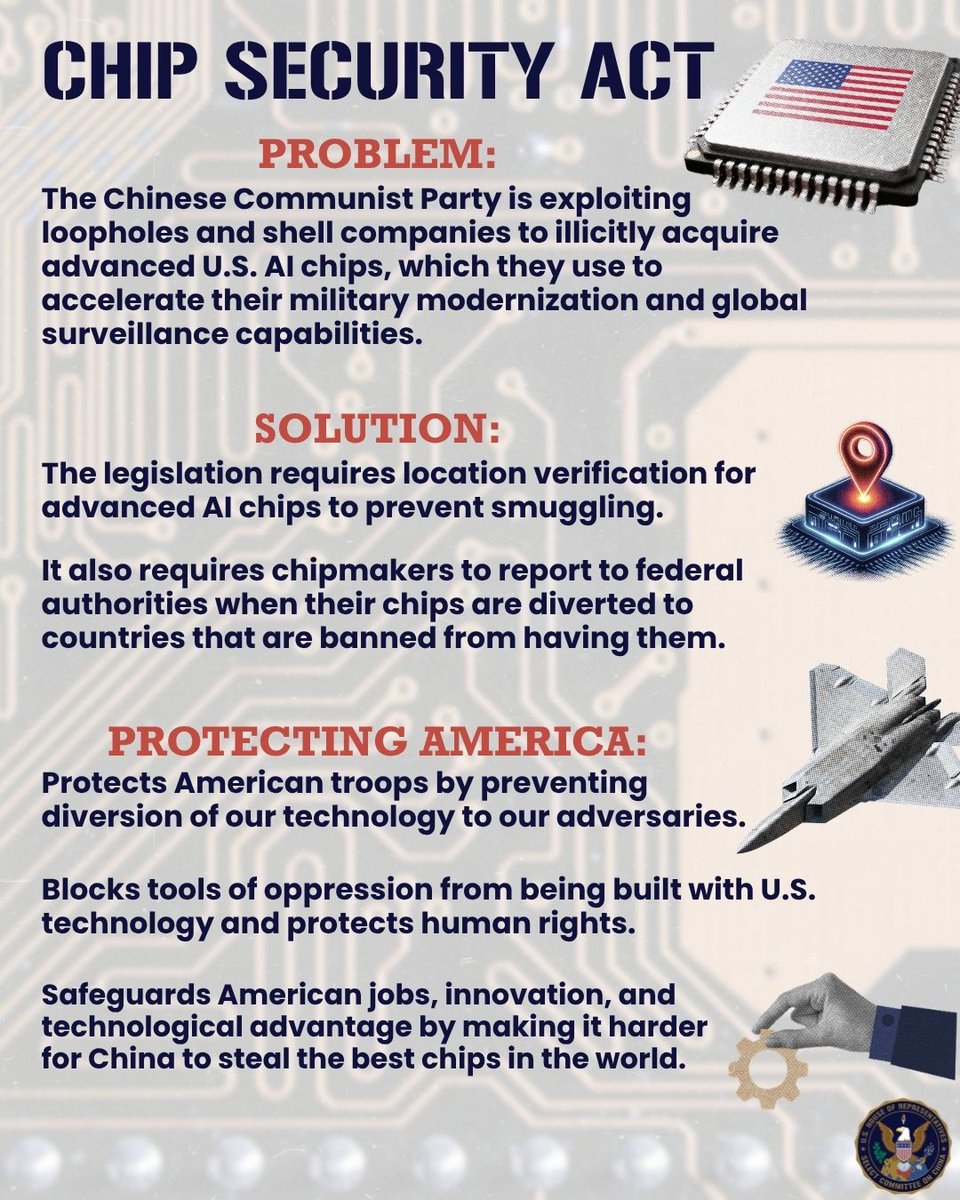
The #ChipSecurityAct is about protecting one of America’s greatest strategic advantages: advanced semiconductors.
The bill requires security mechanisms in high-end chips to verify their location, detect tampering, and ensure they aren’t diverted to unauthorized users. It also strengthens reporting requirements and directs further innovation in chip security.
At a time when adversaries are actively attempting to steal restricted U.S. technology, these safeguards are essential to protecting national security, maintaining technological leadership, and supporting American industry.
chinaselectcommittee.house.g…
8
36
110
6,292
From Nanotechnology to AI: Riding the Wave of the Quantum Revolution insightsbydrjean.com/insight…
8