
Joined November 2024
- Tweets 21,094
- Following 437
- Followers 1,199
- Likes 15,591
2,849 Photos and videos






Pinned Tweet

19 Apr 2025
I owe allegiance to no faction, no creed, not even belief itself.
I will tear apart, mock, & drag every form of stupidity & hypocrisy through the mud be theological, national, cultural.
If it stinks, I’ll call it out. No idols, no sacred cows, no exceptions.
If you're biased moron, my Timeline isn't for you.
1
2
31
56,112

JUST IN: UK Government clarifies adults will still be able to use social media by verifying their identities with digital IDs, facial recognition, passports and credit cards.
2
174
𝐉𝐨𝐡𝐧 𝐓𝐚𝐬𝐡𝐟𝐞𝐞𝐧 retweeted

It is lonely at the top brethren 🥺

As a man, it is your obligation to become the fittest, richest and wisest version of yourself.
Remember, Nobody is coming to save you.
This is a long, solitary road.
Get up. Fix up. Get shit done.
Nobody cares about your feelings.
#HappyMonday , brethren.
2
1
79
Live by social media, die by social media.
People will attempt genuinely life-threatening stunts with a near 100% chance of fatality
all for a few seconds of online attention.
There you have it.
Gravity did, what it does
Jun 13

🔴 A man known as “Spider-Man” in Yemen has died after falling while climbing inside the crater of an extinct volcano.
1
2
6
616

𝐉𝐨𝐡𝐧 𝐓𝐚𝐬𝐡𝐟𝐞𝐞𝐧 retweeted

10h
آپ جیسی ناہنجار اولاد بلاشبہ یہی کہہ سکتی ہے
1
2
4
454
Global South: "We need accessible clean drinking water and sustainable infrastructure to survive."
Western Tech Labs: "Best we can do is an absolute-zero-water, single-use hydrogel for your butt banditry'"
They've secured over half a million dollars crowed funding from Kickstarter
What a time to be alive.
1
1
3
380
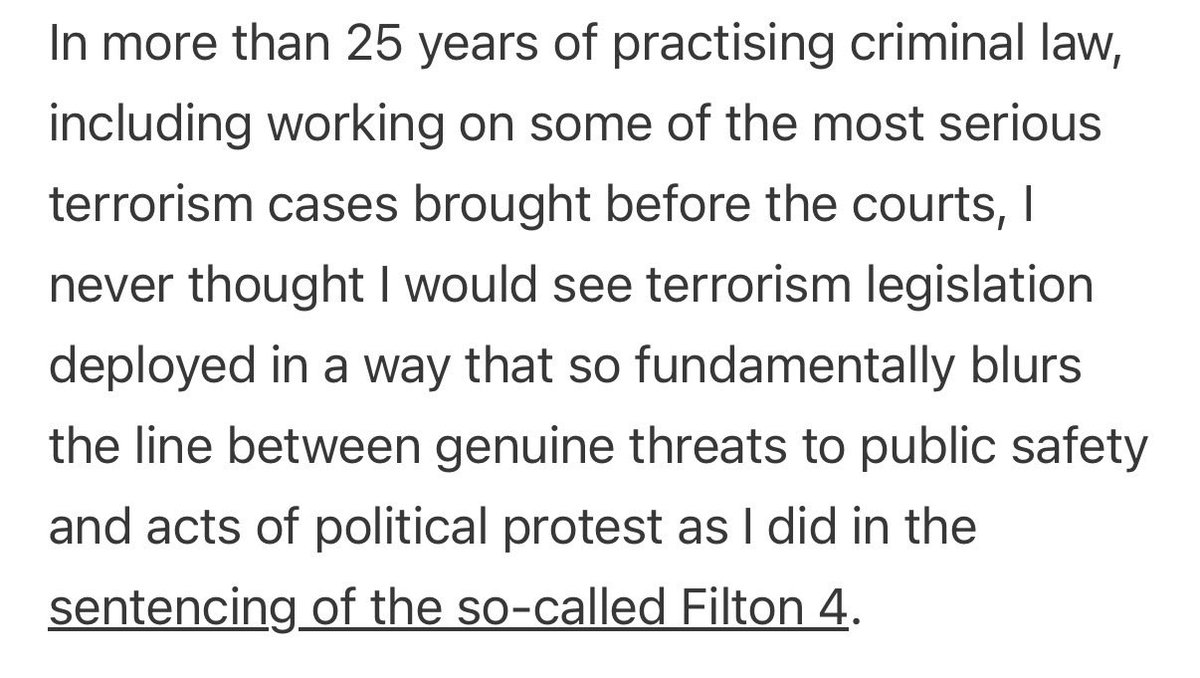
So-called torchbearers of free speech, my ass.
These frauds are shamelessly weaponizing terrorism laws to lock up anyone who protests their genocide while they lecture the rest of the world about liberty.
Peak hypocrisy.

From a leading British lawyer, for Zeteo UK today:
zeteonews.co.uk/p/filton-4-p…
1
64
𝐉𝐨𝐡𝐧 𝐓𝐚𝐬𝐡𝐟𝐞𝐞𝐧 retweeted

From a leading British lawyer, for Zeteo UK today:
zeteonews.co.uk/p/filton-4-p…
152
823
1,781
46,510

𝐉𝐨𝐡𝐧 𝐓𝐚𝐬𝐡𝐟𝐞𝐞𝐧 retweeted

This is absolutely insane.
The suffragettes used far more extreme tactics than Palestine Action.
They planted bombs, burned down private homes and smashed up art galleries.
They killed five people!
Her outrageous judgement is based on absurd historical ignorance.

The Lady Chief Justice: Palestine Action was not a direct action civil disobedience protest group like the suffragettes, but used violence to destroy property
The suffragettes burned down country houses & train stations, bombed churches & sent letter bombs to politicians.
699
4,076
14,067
348,754
Jun 13
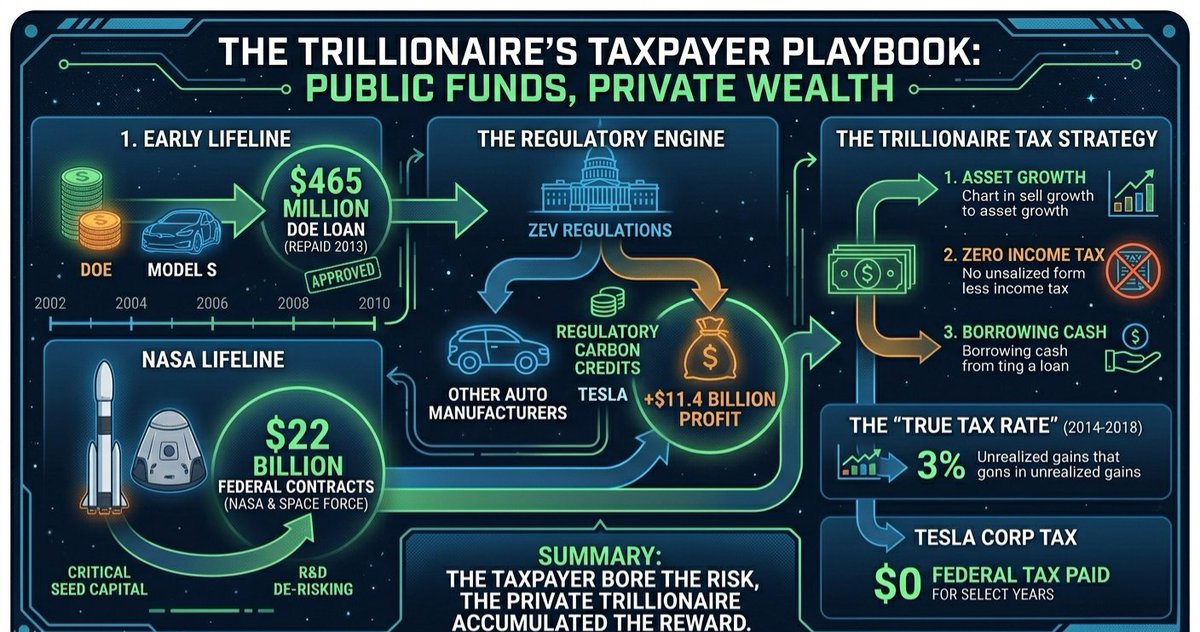
The journey of Elon Musk to becoming the world's first trillionaire cemented by the historic 2026 initial public offering (IPO) of #SpaceX
$SPCX is often framed as a triumph of pure free-market capitalism.
The data reveals a different reality: a massive, multi-decade financial foundation built on taxpayer-funded government contracts, loans, subsidies & a masterclass in utilizing the U.S. tax code.
Musk's empire has secured at least $38 billion in public support, loans, tax credits, and federal contracts.
🧵 The Blueprint:
How Public Millions Built a Private Trillionaire
1. The Early Lifeline: Saving Tesla from Collapse
In 2010, #Tesla was a deeply struggling, niche electric vehicle startup. It was saved from potential bankruptcy by a $465 million low-interest loan from the U.S.
Department of Energy’s Advanced Technology Vehicles Manufacturing (ATVM) program.
The Impact: This public injection of cash allowed $TSLA to build its first major manufacturing facility in Fremont, California, engineering the Model S sedan and launching its IPO just six months later.
Tesla repaid the loan in 2013, but the early, existential risk was entirely buffered by the American taxpayer.
2. The Invisible Revenue:
Regulatory Carbon Credits
One of Tesla's most brilliant financial levers isn't selling cars it's selling compliance.
Government regulations require traditional automakers to produce a certain percentage of Zero-Emission Vehicles (ZEVs).
Because Tesla only makes EVs, it accumulates an enormous surplus of these regulatory credits, which it sells for 100% profit to legacy automakers failing to meet the standards.
The Math:
Tesla has generated over $11.4 billion strictly by selling these government-created credits.
In fact, regulatory credits have historically accounted for more than a third of Tesla’s total net profit, directly propping up its balance sheet and driving its sky-high stock valuation.
There is No SpaceX Without NASA
Musk’s space venture was famously on the brink of collapse after its first three rocket launches failed.
In late 2008, a $1.6 billion NASA contract to resupply the International Space Station effectively saved the company.
The Scale: SpaceX has since captured over $22 billion in federal contracts from NASA and the U.S. Space Force.
Taxpayers have effectively funded the research, development, and infrastructure for the Falcon 9 and Starship programs.
In 2025 alone, U.S. federal agencies accounted for roughly one-fifth ($3.75 billion) of SpaceX’s $18.7 billion revenue.
Twitter (X): The Ultimate Subsidized Pivot
When Musk launched his $44 billion acquisition of Twitter in 2022, he didn't just write a personal check.
The entire purchase was hyper-leveraged by the value of his government-subsidized companies.
The Collateral:
Musk secured billions in loans from major global banks by using his highly appreciated Tesla shares whose value was fundamentally driven by the aforementioned federal ZEV credits and green energy subsidies as collateral.
The Debt Shift:
Musk loaded $13 billion of bank debt directly onto #Twitter itself.
This created a massive $1 billion annual interest payment for the social media company.
Under corporate tax laws, this interest is generally tax-deductible.
By turning Twitter private and merging it into X Corp, the platform’s compounding operating losses and massive debt servicing requirements create a massive "tax shield," offsetting other corporate tax obligations.
The Tax Strategy:
How to Build Massive Wealth Without Paying Income Tax
The ultimate mechanism for turning these heavily subsidized companies into personal trillion-dollar wealth lies in how the U.S. tax system handles the ultra-wealthy.
3
4
9
365
Here's a breakdown of #ElonMusk most notable failed promises & projects across his various companies includes the following
🚗 Tesla & Autonomous Driving
1. "One Million Robotaxis by 2020"
In 2019, Musk confidently predicted that Tesla would have over one million fully autonomous "robotaxis" on the road by 2020, claiming owners would be able to make money by sending their cars out to pick up passengers while they slept.
Years past that deadline, fully driverless commercial Tesla robotaxis are still largely stuck in the testing phase.
2. The Coast-to-Coast Autonomous Drive
In 2016, Musk promised that by the end of 2017, a Tesla would be able to drive itself from Los Angeles to New York "without the need for a single touch" from a human.
3. The "Next-Year" Full Self-Driving (FSD) Loop
Every single year for over a decade, Musk has stated that true Level 5 autonomy (completely unsupervised self-driving) was coming "later this year" or "next year."
4. The Next-Gen Roadster (2017)
Unveiled as a surprise in 2017, the ultra-high-performance Tesla Roadster 2.0 was promised to hit the market in 2020. $TSLA took massive down payments from customers for preorders ($50,000 to $250,000). Production timelines have repeatedly slipped.
5. Battery Swapping (2013
In 2013, Tesla demonstrated a rapid battery-swapping station that could replace a Model S battery in 90 seconds, promising it as an alternative to waiting at a Supercharger. After opening just one experimental station in California, the project was quietly abandoned, with Musk claiming customers "didn't care for it."
🚇 Infrastructure & Transit
6. The Hyperloop Alpha
In 2013, Musk published a white paper for the "Hyperloop"
a near-vacuum tube transport system that could move passengers from LA to San Francisco in 35 minutes at speeds of 700 mph. He encouraged other companies to build it, but his own attempt via The Boring Company resulted in a short test tunnel in California that was completely demolished. The broader Hyperloop dream has largely collapsed globally.
7. The Boring Company’s Urban Networks
The Boring Company originally promised to revolutionize city transit by building vast, multi-layered networks of underground tunnels using high-speed, autonomous 16-passenger electric pods.
Instead, the company's only major operational project is the Las Vegas Convention Center Loop which consists of standard Teslas driven manually by human drivers through paved tunnels at around 35 mph. Major proposed projects in Chicago, LA, and Baltimore were canceled or quietly dropped.
🚀 SpaceX & Space Exploration
8. Crewed Missions to Mars by 2024/2025
Over the years, Musk has given various timelines for sending humans to Mars. In 2016, he stated that SpaceX aimed to land the first humans on Mars by 2024, arriving in 2025.
While Starship development continues, SpaceX's focus is largely tied to low-Earth orbit satellite launches and NASA's Artemis moon program.
9. Private Citizen Lunar Tourism (2018)
In 2017, Musk announced that SpaceX would fly two private citizens on a trip around the Moon by late 2018. That flight never happened. A later iteration of this promise the dearMoon mission funded by Japanese billionaire Yusaku Maezawa, which was slated for 2023 was officially canceled altogether.
🧠 Solarcity, AI, and Government
10. The Solar Roof Tile Rollout (2016)
When Musk unveiled Tesla's Solar Roof tiles in 2016 on a Hollywood studio set, he promised a massive, cheap revolution in clean energy. It was later revealed in lawsuits that the tiles displayed on stage were non-functioning prototypes. The actual product rollout has been plagued by massive price hikes, installation delays, and incredibly low deployment numbers compared to his initial promises.
11. Artificial General Intelligence (AGI) Timeline
Musk promised that his AI firm, xAI, would achieve AGI (AI that matches or exceeds human intelligence across all fields) by 2025.
104
𝐉𝐨𝐡𝐧 𝐓𝐚𝐬𝐡𝐟𝐞𝐞𝐧 retweeted

Jun 14
دیکھیں شاہ صاحب پچھلی دفعہ نوازا گیا تھا تو اب کے بار کیوں نہیں؟
اب کیا کانٹے آگ آئے ہیں؟
راشد صاحب یا ذیشان صاحب یا کوثر صاحب کو وکھرے لعل لگے ہوئے ہیں؟
ہلکی پھلکی مشاورت عطا کر دینے سے خزانے میں کون سی کمی ہو جانی تھی؟
پھر اب کمیاں تو نظر آنی ہی ہیں۔
1
1
2
271
𝐉𝐨𝐡𝐧 𝐓𝐚𝐬𝐡𝐟𝐞𝐞𝐧 retweeted

Jun 14
If US withdraws financial and military support, we will see how gutsy Israel is? Child killing monsters.
Jun 14

You can't expect the Israelis to be as gutless of a cuck as America is looking like right now.
If you attack Israeli soldiers, try to murder its president's daughter and launch rockets and missiles and drones, they aren't gonna "negotiate" with you and pay you cash down the line
2
9
649


𝐉𝐨𝐡𝐧 𝐓𝐚𝐬𝐡𝐟𝐞𝐞𝐧 retweeted

It's funny to see @Nigel_Farage talking about VPNs when he told the Comissioner he breached his Register of Interests because, I quote, "I don't do computers".

Whilst the social media ban is well-intentioned, it’s unlikely to work given the mass adoption of VPNs.
It will also mean the introduction of Digital ID via the back door.
The real answer here is handsets for children with limited features.
6
185
614
9,102
ہماری منجی ہے پوری، نہ پاوے پورے ہیں
ادھورے لوگ ہیں لیکن سیاپے پورے ہیں
1
10
167
کسی کے DM میں وڑ کر
پا جا سراغِ زندگی
تو اگر میرا نہیں
بنتا نہ بن اپنا تو بن
1
9
264