
@SadiqKhan It’s ironic that you’re launching campaigns against ‘disinformation’ about London crime while often spreading your own selective version of the facts.
Homicides did hit a welcome record low of 97 in 2025 (1.1 per 100k) — progress worth acknowledging. But Met/ONS data also shows shoplifting up ~19% to around 95,000 offences, sexual offences rising, and phone thefts still running at extremely high levels (tens of thousands annually, even after some recent drops).
Many of the viral videos aren’t ‘fake news’ — they’re real incidents of street theft, moped robberies, and shoplifting waves that Londoners experience daily. Dismissing legitimate concerns as a ‘disinformation blizzard’ while cherry-picking stats is itself misleading.
Focus on visible policing, tackling volume crime hotspots, and transparent reporting rather than expensive PR campaigns abroad. Londoners deserve safety, not spin.” bbc.com
Vote @policylaila for our next London mayor 🇬🇧
21m

Disinformation about London has become a global industry.
Here in Singapore we've launched our new campaign to fight the fake news, and set the record straight about our capital city ⬇️
Stretch McDuffy retweeted

Dear @RealCandaceO
Please show us on the document sent to you ACKNOWLEDGING your FOIA request where we said:
“The burden of the request is too great.”🤔🤔
Your “show” just like the fake news media will be called out when you LIE!
We hope this helps.
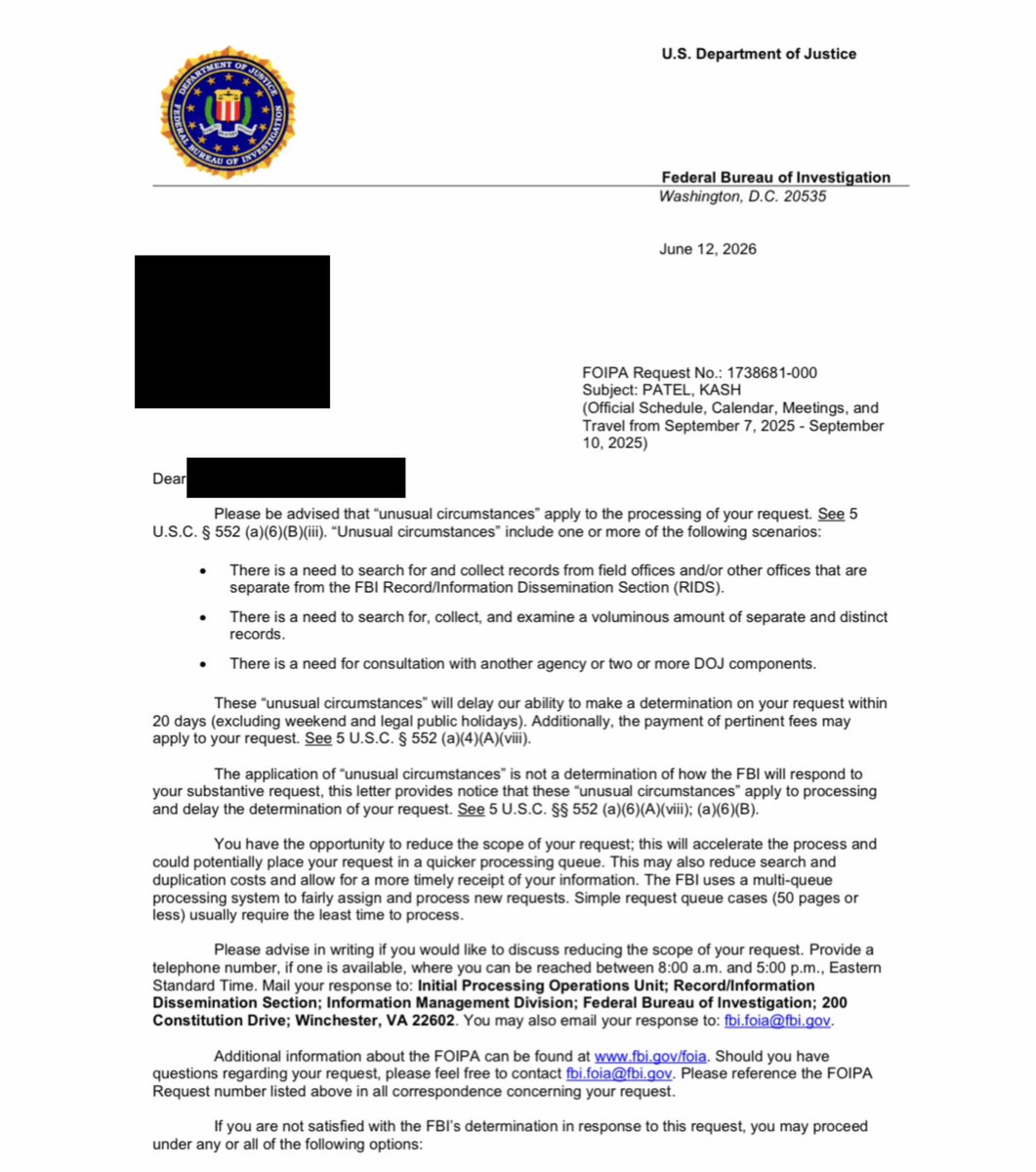

Via FOIA, we formally requested Kash Patel’s travel itinerary for the 3 days leading up to Charlie Kirk’s assassination and we just heard back and were told the burden of the request is too great.
How is this even remotely legal?
1,422
3,289
14,740
1,734,201

Why? If she’s putting herself on the level of sex workers, what gives her the right of first refusal? And if we’re acknowledging that she’s his wife, then we must also acknowledge that she owes him free sex.
1
6

It is not a matter of holding people accountable — it is a matter of acknowledging and not trying to rewrite history. Germans today generally don’t deny Nazi’s genocide. Why are Japanese so hellbent on rewriting the past?
1

Active Listening & Reframing: Encouraging parties to move away from rigid adversarial positions toward acknowledging mutual vulnerabilities and common ground. 4
1
1

Africa Turns Its Back on South Africa: Artists Cancelled, Businesses Shuttered, Citizens Threatened as Xenophobia Crisis Triggers Continental Reckoning
A coordinated anti-migrant movement backed by shadowy political networks has unleashed consequences that South Pretoria never anticipated — and that Africa’s diaspora communities, from Lagos to London to New York, show no sign of forgiving.
By Kio Amachree | Worldview International | Stockholm, June 16, 2026
Something historic and irreversible is unfolding across the African continent and its diaspora communities worldwide. South Africa — the nation that once symbolised liberation, solidarity, and the triumphant defeat of white minority rule — is now being treated as a pariah state by the very people who once celebrated it as a beacon of Black freedom. And the consequences are swift, measurable, and deepening by the day.
South African artists are being cancelled. Their businesses shuttered or abandoned. Their citizens threatened on the streets of Lagos, Accra, and Nairobi — and in the corridors of African American communities from Atlanta to Brooklyn where, for the first time in a generation, the words “South African” carry not admiration but contempt.
The verdict from the streets, the market stalls, the concert halls, and the community centres across Black Africa and its diaspora is blunt and unsparing: South Africa’s Black majority has been weaponised against its African brothers and sisters, turned into instruments of a white minority agenda that has never truly relinquished its grip on power — and which has now found new and powerful patrons in Silicon Valley and Washington.
The Scale of the Backlash Is Now Official
The South African government can no longer pretend this is not happening. Justice Minister Mmamoloko Kubayi, speaking on SABC this past Sunday, was forced into a public confession that would have been unthinkable even six months ago.
“We can’t lie about the backlash,” Kubayi admitted, acknowledging that South African artists are haemorrhaging bookings across the continent. One performer, she revealed, contacted her personally to report that every single scheduled continental appearance had been cancelled — not postponed, not rescheduled, but cancelled outright. “Majority of South African artists perform on the continent,” the minister conceded, “and many of them are seeing their gigs being cancelled.”
The damage extends far beyond the entertainment industry. South African businesses operating across Africa — companies that built their continental footprints on the goodwill earned during the Mandela era — are facing organised boycotts, forced closures, and hostile operating environments from West Africa to East Africa. The brand that Nelson Mandela built over a lifetime is being dismantled in real time.
Even sport has not been spared. When Bafana Bafana faced Mexico in their opening 2026 FIFA World Cup match, African supporters across the stadium openly cheered for Mexico. South Africa lost 2-0. Captain Ronwen Williams was visibly shaken. “Africans have always supported other African countries at World Cup tournaments,” he said afterwards, his voice carrying genuine bewilderment. “Many Africans supported Mexico instead of South Africa. It was painful to see.” What Williams appeared unable to comprehend is that the pain he felt in that stadium was a fraction of the pain his country has been inflicting on African migrants — legally documented men, women, and children — since April of this year.
A Movement Built for Someone Else’s War
The anti-migrant wave that has consumed South Africa did not emerge organically from the suffering of the Black working class. It was constructed, amplified, and directed. At its visible tip stand two figures: Jacinta Ngobese-Zuma and Zandile Dabula, the media-facing leaders of March and March and Operation Dudula, who have marched through Johannesburg, Pretoria, and Durban demanding mass deportations and threatening foreign nationals with a June 30 deadline. Their targets have been Nigerian traders, Ghanaian shopkeepers, Malawian labourers — the very Africans who, in many cases, arrived legally and built livelihoods in a country that once stood for pan-African solidarity.
What analysis of South Africa’s digital ecosystem reveals is that this is not spontaneous. The current xenophobic surge is the latest phase of a coordinated online network that has been developing for at least six years — an infrastructure of amplification, political messaging, and populist mobilisation that has found its moment in 2026. The movement mimics the aesthetics of civic nationalism — the South African flag, T-shirts, marches, websites — while pursuing an agenda that serves a constituency far removed from the Black townships where unemployment is highest and desperation most acute.
Across Africa and the diaspora, ordinary people have connected these dots with a directness that politicians and media commentators have been reluctant to match. The anger in African American communities, in Nigerian associations abroad, in Ghanaian market networks, is not merely about the attacks themselves. It is about the suspicion — increasingly difficult to refute — that Black South Africans are being used.
The Shadow of Musk, Thiel, and the White Restoration Project
To understand why that suspicion has such force, one must look beyond Johannesburg to a pattern of ideological and political investment that traces a direct line from apartheid-era South Africa to the current corridors of power in Washington.
Elon Musk and Peter Thiel — both products of privileged white South African upbringings — have spent years constructing a political and financial architecture in the United States that rehabilitates the white minority grievance narrative. Musk has used his platform on X to accuse South Africa’s Black-led government of anti-white racism, to call for sanctions against opposition leaders, and to amplify the fiction of “white genocide” — a conspiracy theory rejected even by white-led political parties inside South Africa itself. He has done so with the implicit blessing of a Trump administration that, in its first days back in office, offered asylum specifically to white South Africans.
The message being transmitted — from the Oval Office to Silicon Valley to the marching grounds of Johannesburg — is consistent: the post-apartheid dispensation is illegitimate. The Black majority government must be delegitimised. And if the Black working class can be turned against migrant Africans in the process, so much the better. A divided, inward-looking, xenophobic South Africa cannot simultaneously demand global solidarity, challenge structural inequality, or threaten the interests of those who profited most from apartheid and who profit most from the continuation of economic subordination.
Africa has noticed. The diaspora has noticed. And the response is neither charitable nor ambiguous.
The Verdict of the Streets
In community after community across Black Africa and the African diaspora, South Africa’s Black majority is being held to account with a ferocity reserved for betrayal. The language being used — “traitors,” “brainwashed servants,” “paid to destroy themselves and their brothers” — is the language of people who once extended solidarity unconditionally and now feel that solidarity was weaponised and returned as a blade.
This is not merely emotional. It reflects a political judgement: that whatever the genuine unemployment pressures facing Black South Africans, the organised targeting of fellow Africans serves an agenda that has nothing to do with the liberation of the Black working class and everything to do with restoring the conditions — economic, political, social — under which the white minority consolidated its power over a century.
The cancelled concerts are a consequence. The shuttered businesses are a consequence. African supporters cheering for Mexico at a World Cup match is a consequence. They are the market speaking, the street speaking, the diaspora speaking — in the only language that power consistently understands.
South Africa now faces a choice. It can continue down a path scripted by movements whose funders and ideological godfathers sit in California and Mar-a-Lago. Or it can remember what it actually is: a nation whose freedom was bought with the solidarity of a continent, and which owes that continent a debt it has barely begun to repay.
The continent is not waiting patiently for that memory to return.
Kio Amachree is President of Worldview International and writes on African governance, accountability, and diaspora engagement. He is published by Vanguard, Sahara Reporters, and Starconnect Media.
#SouthAfricaXenophobia #AfricaUnited #BantuSolidarity #MarchAndMarch #OperationDudula #PanAfricanism #SouthAfricaBoycott #AfricanDiaspora #BafanaBafana #FIFA2026 #BlackSolidarity #ElonMusk #PeterThiel #WhiteMinority #ApartheidsGhost #NigeriaGhana #AfricaFirst #WorldviewInternational #TheKioSolution
10

Ex subject
1. When Repeated Concerns Stop Looking Like Coincidences
2. Recurring Issues Deserve More Than Repeated Silence
3. A Pattern Worth Acknowledging
4. Concerns Regarding Repeated and Observable Patterns
5. Feedback on Ongoing Issues Affecting Fan Perception
6 etc
7

Kayla and I are playing pool and I’m doing so poorly that people in the neighboring vicinity of our table are acknowledging how much I suck right now
1
8