
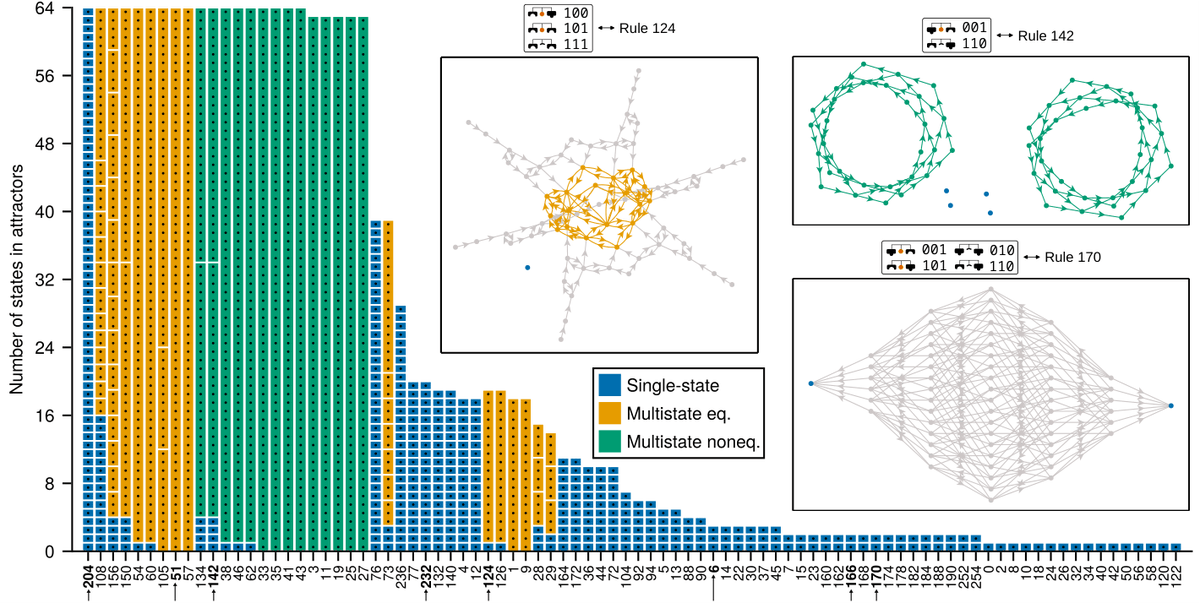
ALT A graph displaying the number of states in attractors (y-axis) for each of the 88 non-redundant rule-sets (x-axis, labelled by their Wolfram codes) for a complex of size N = 6. States in the same type of attractor are grouped together into colored boxes (blue for single-state attractor, yellow for multistate equilibrium attractor, and green for multistate nonequilibrium attractor). Three smaller, inset graphs depict three rule-sets, where nodes denote a unique state of the complex and transitions are catalyzed reactions between states. The first inset displays states and transitions under rule 124, the second inset displays the same under rule 142, and the third displays the same under rule 170, with states not in an attractor colored in gray.

ALT Cover of PRX Life, Issue 01, March 2026, titled “Adaptation and Learning.” A stylized 3D biological scene shows a web-like cytoskeleton structure wrapping around a cell. The network is made of bead-like filaments in green and blue, with glowing, colorful regions and flowing wave patterns suggesting activity, signaling, and learning within the structure.
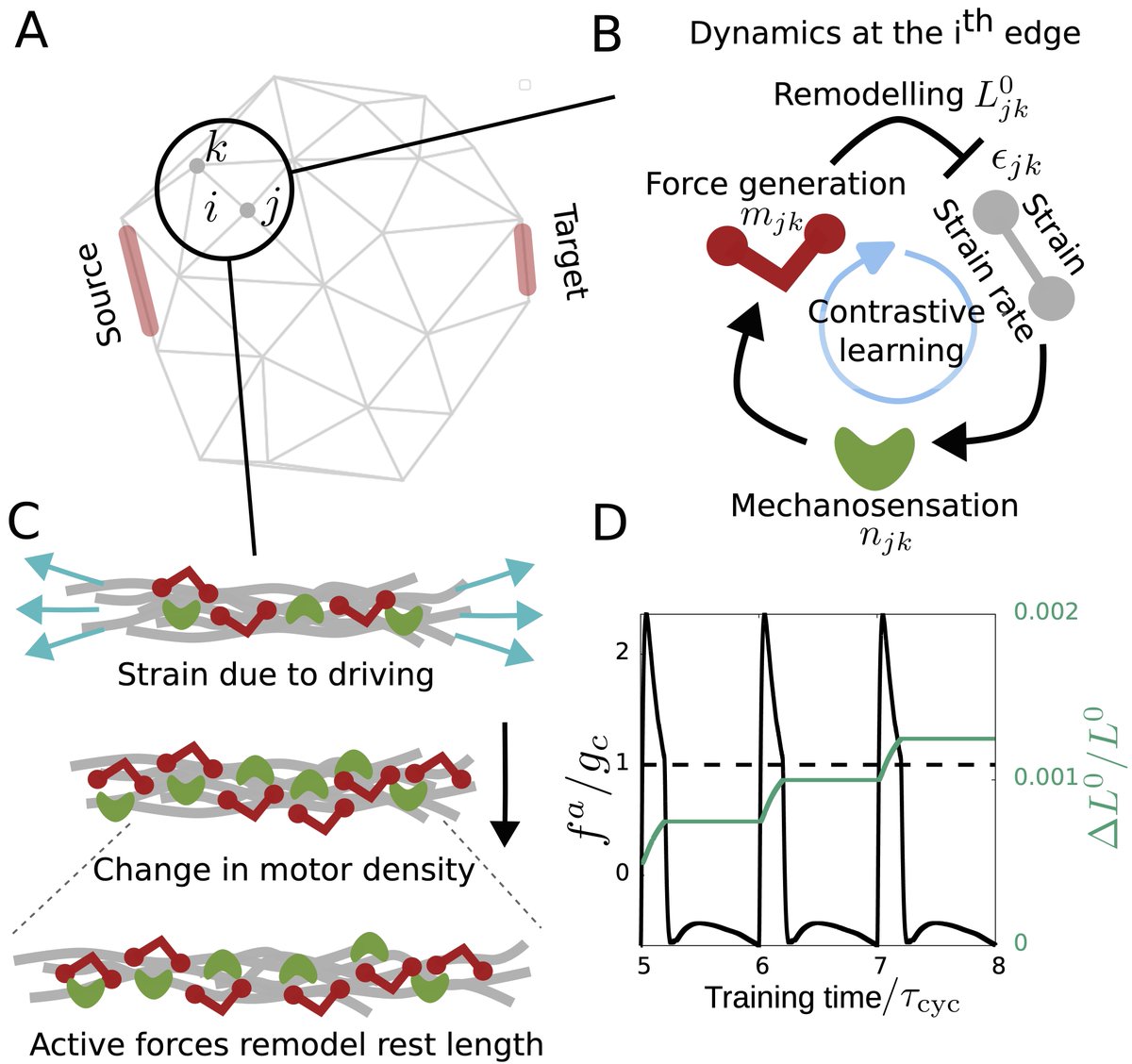
ALT The top left image shows a disordered spring network of nodes connected by edges. Source and target edges are colored red, and dots labeled k, i, and j are circled. To the right an illustration shows the molecular mechanism of learning, with the dynamic coupling between network elasticity and agents mimicking molecular motors and mechanosensitive proteins that can bind/unbind from each edge. Below and to the left is an illustration of how driving at the target edge creates local strain and enables an update of the learning degree of freedom, or rest length, at any arbitrary edge of the network via mechanosensation and active force generation. To the right is a depiction of learning dynamics on one edge of the network. The change in the learning degree of freedom at the edge is in response to active forces generated by motor dynamics. The dashed line indicates where the active force reaches the threshold active force value above which rest length changes according to the learning rule.