

Interesting commentary on the state of AI and the Labour governments head in the sand approach to it.
However I am yet to be convinced of the Tories “Road to Damascus” conversion to cheap energy after 14 years of their rule delivered us the most expensive energy in the world …

Overnight, major US AI company, Anthropic, has been ordered by the Trump administration to deny foreigners access to its latest AI models. This is the kind of tech that Labour has spent all week telling British companies to make themselves dependent on via its AI Adoption Summit.
Let me set out why this is yet another example of how Labour’s TOTAL lack of preparedness for government has left the UK exposed (something I touched on with Matt Chorley on 5Live earlier this week)…
There is a whole dance going on right now in the States among and between these AI companies and the US government - that’s for separate comment on AI regulation, the sustainability of their underpinning commercial models and more. But amidst this, Labour’s combination of political naivety and economic failure has created a dependency problem that DSIT’s belated, frenetic barrage of announcements at London Tech Week is unlikely to solve any time soon.
Advances in tech were already making it more important for the UK economy to have high quality digital infrastructure - ultra fast internet, telecoms and cloud, reliable supply chains and so on.
The pandemic accelerated the trend. AI put it on speed.
It means that politicians need to be looking more seriously at who owns and controls the software, hardware and government systems on which Britain relies, what leverage our country can build in critical technologies and how we access or develop the best AI models.
Instead Labour spent its first year in office making all our economic fundamentals worse. Higher taxes, higher employment costs, higher regulation, higher energy costs, a total screw up on defence procurement where dual-use tech is vital to modern warfare, and the same old government contracting that sees players with massive lobbying operations favoured. All of this has weakened home grown enterprise and made us less attractive to international companies despite us having some of the best talent and most innovative start-ups in science, tech and security in the world.
It meant that by the time the US-UK tech summit rolled around a year later to puff out President Trump’s State visit, Labour Ministers were totally dazzled by big tech and its promise to provide positive investment headlines. (Remember this was the time when Deputy PM, Angela Rayner, and US Ambassador, Peter Mandelson, were both resigning from scandal and the Chinese spy case was collapsing.) Crazy investment pledges were being bandied around, many of which were repackaged existing deals or promises which received very little scrutiny despite Labour building policies like AI growth zones around them. Lo and behold some of the biggest deals have now been junked because UK energy costs are nuts and because some of these companies are struggling to make their own numbers work.
In the wider economy, companies were told ‘adopt, adopt, adopt’ when it comes to AI to stay up with any AI-enabled competitors. The promised ‘benefit’ would be a reduction in a ballooning payroll bill. Despite this, a lot of companies have struggled to get the productivity gains that have been billed from AI adoption. Many were told that was because they need to totally rewire their systems to maximise the benefits. But that rewiring makes them dependent on the kinds of AI models that President Trump has just restricted foreigners’ access to and whose token prices were already being jacked up (humans not so inefficient and expensive after all…).
This is not to deny the transformative potential of AI or its disruptive effect on the workforce and wider society. But as the initial AI mania begins to fade, the risks of Labour's approach are becoming clearer. Rather than using the strength of the wider economy to preserve choice and resilience, Labour doubled down on dependence on a small number of companies whose technologies are now becoming more expensive, more restricted and harder to access.
The penny half-dropped with some of their Ministers a few months ago. They started playing into the Mark Carney ‘middle powers’ speech, talking of British-first procurement and making noisy headlines against Musk and the like after realising that that the government had reduced its own own leverage on issues like social media regulation and more. A delayed launch came of a Sovereign AI Fund. A litany of announcements on chips and sovereignty flowed from London Tech Week. But this all risks being small beer when it comes to the scale of what is required, especially when the UK government stubbornly refuses to confront the fact that it has moved all the economic fundamentals in the wrong direction.
This is why the first priority of any incoming leader or government has to be on getting those fundamentals right. Kemi and the Shadow Cabinet have been relentlessly focused on policies to give our companies the tools to win - cheap energy, less red tape, lower taxes, an education pipeline that produces the talent we need, a Sovereign Defence Fund for dual-use technologies, pensions reform so that we see more money going into UK equities. It’s why I spent London Tech Week talking to the people and companies that understand the nature of the challenge, including techy details like the need for open architecture.
Is there a messiah coming this week from Makerfield in the form of Andy Burnham who understands the nature of the challenge? Forget it - the papers are today being briefed that Ed Miliband is his front runner to be Chancellor. There are more rounds of this chaos to go before this UK gets a government that recognises that without a strong economy, all else fails. Being ready for that moment is the project to which the Conservatives under Kemi are dedicated.
O.K Chief Priest. retweeted

Same Approach on $btcusdt
3m TF bullish
1m TF breakout
Weekly TF breakout
Daily breakout
4h confirmation entry




1
2
37

Kebab shop like Afghanistan
No one win in Afghanistan
Approach with caution

Of course. The same in Italy. For example, Muslims open their shops in Italy on Sundays. I mean the ones I have seen. Sometimes, on my way home from work,
I had to rush there to buy catfish for Sunday pepper soup, and other times, they were my last hope of getting items I'd forgotten during the week.
In Italy, some Christian vendors load their car booth with items they sell to the church. After church service some members approach them to get items on their way home so they cook at home.


You have failed as a man but Daddy is here to transform you into the perfect sissy slut for real men
My Non-stop Brainwashing session is the answer for every failed man seeking to transition
Approach with tribute, loser!!
Ribbit ~ ✨ retweeted

.ooc main call available. pls interact so I know who I can approach. 🫶🏻
2
15
277
Kaflawa🌻 retweeted

"Strongly encouraged"?
They need to be forced!
Also those disgusting ugly carpenter shops as you approach Talanta need to be done away with.

Ngong road is going to be the “face of Nairobi and Kenya in general” during Afcon 2027 for matches held in Talanta Stadium.
Suggestion: All building/land owners need to be “strongly encouraged” to improve the external architectural look of their property. Secondly we need proper non-motorized paths plus footbridges

3
8
47
1,806
AyanfeXtra✨ retweeted

How to approach women in real life:
1. Approach within 3 seconds of seeing her.

6
52
162
18,838

30s
Tool design is a core part of the agentic product experience. In a lot of products, it basically is the product.
The tools you expose are the entire action space of your agents. The model can only be as good as that surface. Good surface, capable agent. Bad surface, and no model upgrade is going to help you with the degraded experience.
You have an API with fifty endpoints, so the first approach you see often is to convert each end point into a tool call. You're giving the model the full range of what it can do. It is also a famous generalization “MCP is just a wrapper on backend APIs”, well, yes if you approach it this way. But agents don’t need and want all that overload at once.
The problem is that more options make the model worse, not better. Somewhere past 30 to 50 tools it starts reaching for the wrong one. It is burning tokens, thinking on which tool to call instead of the work you actually wanted done. That is just “you” making things harder for the agent.
To be honest MCP protocol took the burn for a long time, until folks realized we need to think from an agentic world view. Folks would watch the agent fumble the tool choice over and over, concluding the protocol is broken. The teams who pushed past that found the protocol was never the issue. The design was. The fix was a change in approach. To stop writing tools like traditional APIs, and start designing them like you're building an interface for a very literal user who happens to be a model.
Block’s Layered Approach: One approach I like breaks the interaction into functional layers that walk the model through a process. The Square MCP server collapses 200 endpoints into just three tools: one to discover what services exist, one to learn how to call a given method, and one to actually make the call. The agent moves through them in order, so it navigates the API instead of being overwhelmed by a giant list of available tools.
More surface area isn't more capability. The agents that feel good to use are almost always the restrained ones, where someone shaped the tools around how the agent actually works instead of how the backend happens to be organized.
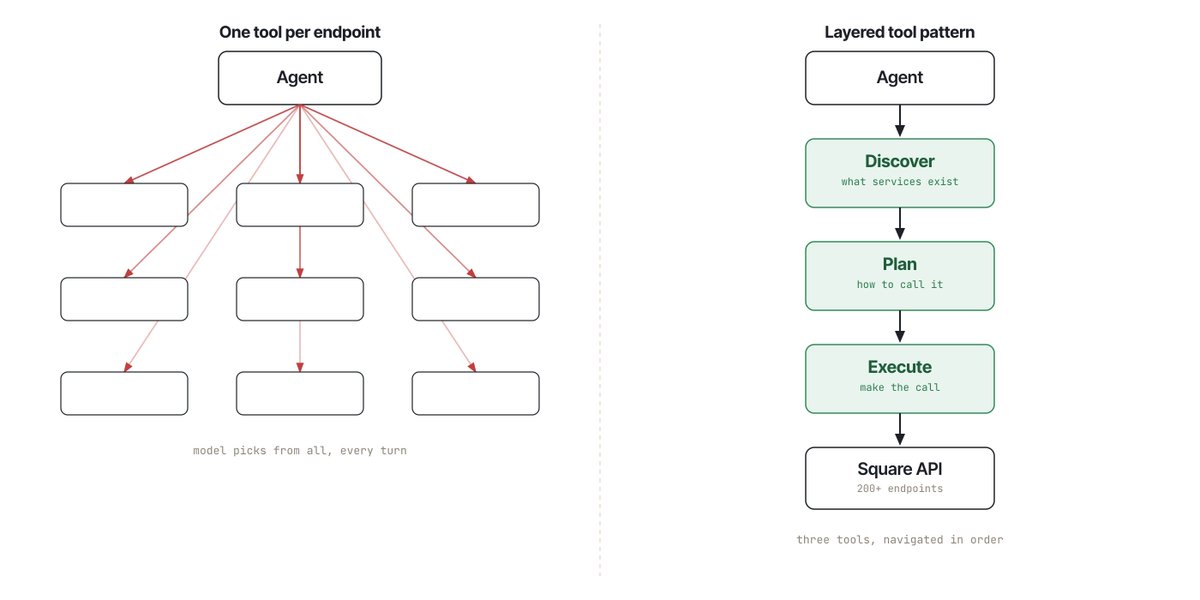
1

The stranger's trades become your fate' — that line stopped me cold. Reading your chapter from Ghana Africa and rethinking my whole approach to risk.
2

Exploring @tradeonpear and its approach to making on-chain trading more accessible. Clean experience, growing ecosystem, and interesting opportunities for traders looking to engage with DeFi.
Looking forward to seeing how PearTrade continues to evolve. 🍐📈
#DeFi #Crypto
1

The more you iteratively step outside of your comfort zone, the more expansive it becomes. It's almost the same process as expanding territory. What seems foreign (or new) at first, step by step, becomes part of your natural order. Branch out, but with a wise, tentative approach.
1

36s
"should the blood examination not lead to a conclusive result, it cannot discredit the original tridosha theory but can only show that this approach is unsuitable" lmfao

1

resonates with the noble ventures
KADUNA state stands out under the leadership of His Excellency, the people-oriented project Governor Uba Sani
Uba Sani's approach to party leadership reflects his strong belief in inclusion, fairness, and internal democracy.
While many
Doggy Hawks retweeted

Czechia 🇨🇿 are a physical side. Their only chance of scoring against us will be via a set piece. We need to approach the game the same way South Korea 🇰🇷 did against them. Play it on the ground and go at them.
The problem though will be the game against South Korea 🇰🇷 who play it on the ground but extremely quick. This game could be the one that sends most South Africans to hospitals. 🏥
22
9
94
3,207
Chris Link retweeted

Crypto's defining feature isn't long-term trendiness.
It's volatility.
That's also the reason why you need an active approach if you want to profit from the crypto market.
1
82

