

Jun 11
$EXTRACTOR
og ca GqQzgwduyF71mPezkRtzdCff3kwRd711Z1g4PZvTpump
Based on the thread, he turned meme coin mania into a hyper-efficient extraction machine: low barriers for anyone to launch, massive volume from retail degens, and billions in revenue flowing straight to the team while most participants get rugged or sandwiched.
From early chats where ideas like creator fees were floated (and later implemented) to ignoring backrunning warnings, it's clear the design prioritized extraction over fairness.
main ca
8peP5ZF3nQw1B6CaDGrPxVmbmrZaz87DTDAHzqK3pump
1
105

Jun 8
9/ Wat do?
backrunning auctions?
More in the post paper:
arxiv.org/abs/2606.00720
Appreciate my co-author/mentor @boez95 during my internship at Flashbots
3
150

#CoWGlossary: Transaction reordering 🔀
You might think blockchains process transactions in the exact order they're submitted. In reality, transactions can be reordered before they're finalized onchain.
Searchers can pay for better positioning in a block to place transactions before, around, or after another trade - enabling strategies like frontrunning, sandwich attacks, and backrunning.
This is one of the core mechanics behind MEV (Maximal Extractable Value).
4
16
1,529


May 24
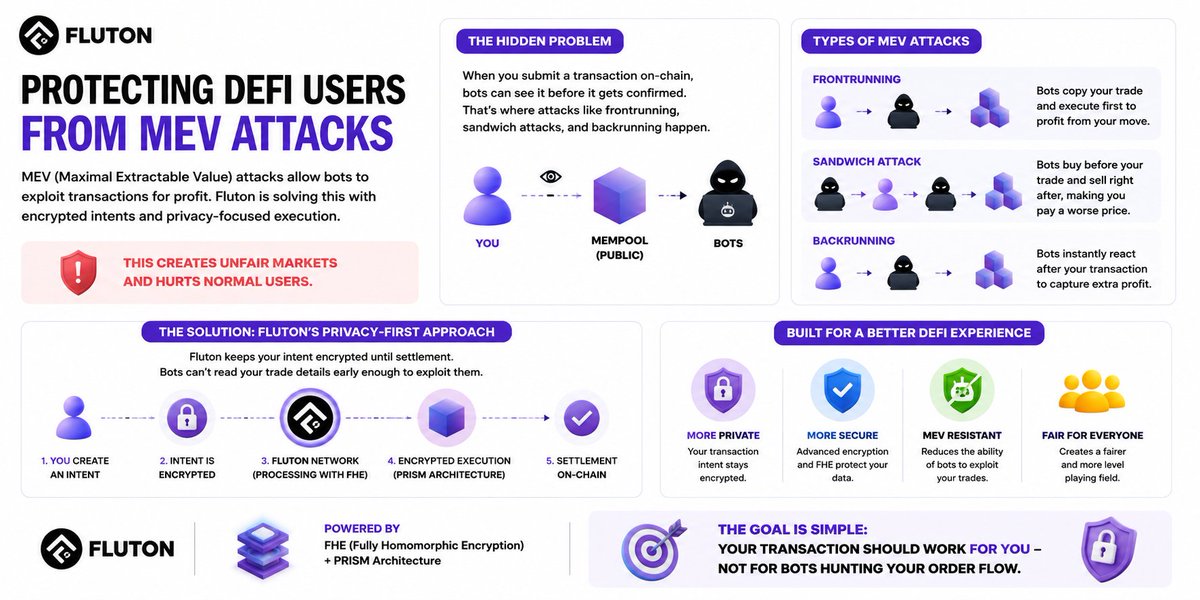
In DeFi, one of the biggest hidden problems is MEV attacks.
When you submit a transaction on chain, bots can see it before it gets confirmed.
That’s where attacks like frontrunning, sandwich attacks, and backrunning happen.
For example:
Frontrunning → Bots copy your trade and execute first to profit from your move.
Sandwich attack → Bots buy before your trade and sell right after, making you pay a worse price.
Backrunning → Bots instantly react after your transaction to capture extra profit.
This creates unfair markets and hurts normal users.
Fluton is trying to solve this with encrypted intents and privacy focused execution.
Instead of exposing your transaction publicly before execution, @FlutonIO keeps the intent encrypted until settlement.
That means bots can’t read your trade details early enough to exploit them.
Combined with FHE (Fully Homomorphic Encryption) and PRISM architecture, the system aims to make DeFi trading:
More private
More secure
Resistant to MEV exploitation
Fairer for everyday users
The goal is simple:
Your transaction should work for you, not for bots hunting your order flow
4
6
69

May 22
Backrunning
Your trade moves the market, and they capture the opportunity immediately after.
Sandwich attacks
They place one trade before yours and one after it, forcing your order to execute at a worse price in the middle.
That’s MEV Maximal Extractable Value
1
2
24


May 20
Our paper on timing games in backrunning transaction sending, arxiv.org/pdf/2602.22032, co-authored with @0xBrMazoRoig and Christoph Schlegel (Flashbots), has been accepted at ACM EC'26! In this paper, we look into equilibrium strategies of capturing backrunning opportunities. A🧵
3
5
39
2,628

May 20
Gfluton!
Sitting above it all. Watching every transaction play out below.
That's exactly what MEV bots do every time you trade.
Here's what's actually happening while you sleep
Blockchain transparency was supposed to be the feature.
It became the exploit.
Every transaction you submit is visible before it executes. Block proposers see everything your size, your timing, your route.
Three ways they take your money:
Frontrunning :- They spot your swap. Submit the same trade with higher gas. Execute before you. You get a worse price. They pocket the difference.
Backrunning :-Your large trade moves the market. They insert a trade immediately after to capture the arbitrage you just created.
Sandwich Attack :- They place one trade before yours and one after. Your transaction executes in the middle at intentionally worse prices.
They profit from the slippage they caused.
This is called MEV :- Maximal Extractable Value.
Or more honestly a silent tax on every trade you make.
You never see it on your receipt. But it's there every single time.
Blockchain transparency guaranteed trust.
It also guaranteed that anyone watching the mempool could extract value from you before your transaction even landed.
The stars look beautiful from up here.
The view from the bottom is different.
@FlutonIO

May 19

Gfluton !
14 members earned the Encrypted role at @FlutonIO this week.
Congratulations to:
@Lakshy_x • @Mubarak94270047 • @sinu0u •@Adityapunk01 • @Dipanka44115261 • @kiemusddonggao • @Nayon • @BhaiKousik95342 • @Kurni_awan1996 • @blockzen_alpha •@Baogk2n • @TrieuMessi • @polana_network • @shona1166
Not by posting once and waiting. By showing up consistently week after week.
The team shared something honest alongside this announcement:
20 people had the potential. 6-7 dropped off after the last promotion cycle reduced activity, stopped creating. They missed it.
That gap between almost and actually it's just consistency.
The members who earn roles at Fluton aren't always the loudest or the most technical. They're the ones who don't stop.
3 months of consistent contribution is the pattern. Every time.
This is a marathon. Not a sprint.
If you've already put in weeks of work don't quit one step before the finish line.
The cat is riding at night through the unknown and still moving forward.
That's the only way this works. 🛵
@FlutonIO

6
18
257

May 16
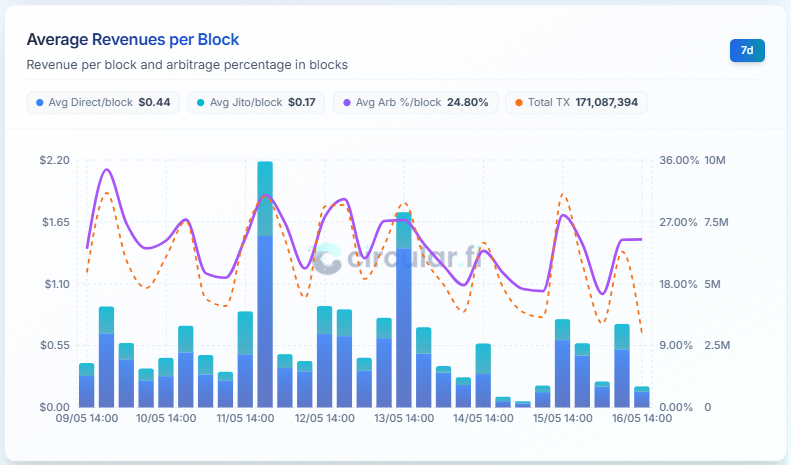
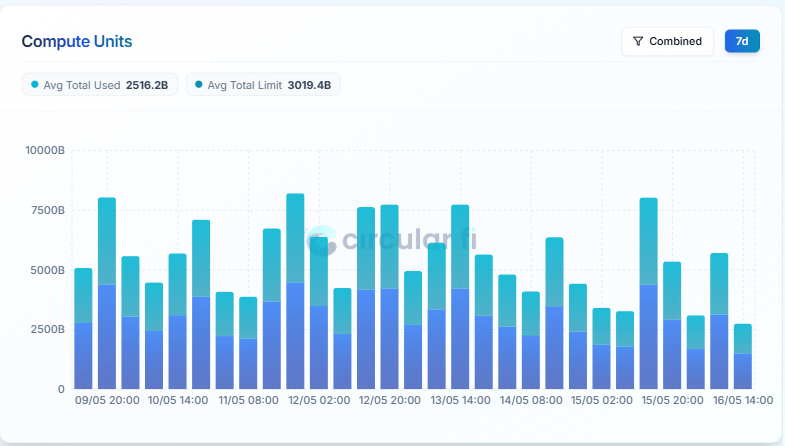
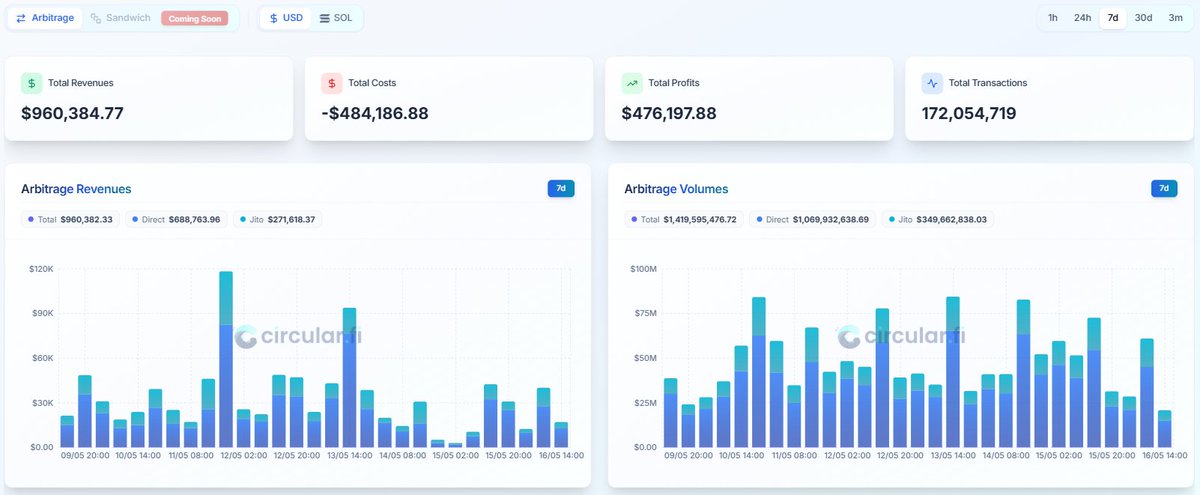
Have you ever looked at what types of transactions land in a block on @solana? In the last 7 days, 25% of blocks were filled with arbitrage transactions and hasn't dropped in CU with the p-token upgrade.
What's most surprising is when you dive into the data and realize what kind of transactions are landing in the blocks.
On-chain arbitrage is a trading strategy that allows you to buy a token from liquidity pool A and instantly resell it on liquidity pool B.
This is a very important strategy for DeFi, because in addition to generating profits for arbitragers, it stabilizes the market and makes it more efficient: a quote on @JupiterExchange or @Titan_Exchange doesn't necessarily mean that the value displayed on your screen will be the value you actually receive... Arbitrage exists so that the value displayed on your screen is as close as possible to the value you will actually receive.
But the question we might ask is: why haven't the CU consumed by arbitrage decreased since the p-token upgrade?
There are several strategies in arbitrage:
- (Quality) Backrunning with orderflow: obtaining a trade before it even hits the network to determine whether its price impact will create an opportunity, and placing an arbitrage trade immediately after it land on the network (this is what we do with @arbmesol).
- (Quality) Analyzing new transactions that have just land on the network via shreds; this strategy is the most difficult and requires an ultra-optimized infrastructure to ensure you get the transaction first, which is why @doublezero now plays such a crucial role in MEV.
- (Spam) This strategy is completely different. The idea behind it is to select a few tokens with the highest arbitrage potential and volume at a given moment and send at least one transaction per block so that your on-chain program can calculate whether there is an arbitrage opportunity between different pools when it executes.
The spam strategy is why arbitrage didn't drastically reduce these CU costs during the p-token upgrade.
CU is used to calculate opportunities, not to execute them, which results in maintaining the high volume of CU used even though AMMs and token transfers are now 90% cheaper.
Arbitrage is constantly evolving.
A year ago, spam strategy accounted for 50% to 60% of transactions in a block; now it's less than 25%.
At @Circular_fi, by tracking the entire arbitrage market, we’ve seen that over the past year, spam arbitrage has been used less and less as the trend reverses and shifts toward orderflows.
An orderflow is a simple concept: for example, when @AxiomExchange sends your transaction to the network, they simultaneously route it to a server so they can calculate the value they can generated if your transaction creates an arbitrage opportunity.
But an orderflow is also much more efficient for the network: if the AMM's inefficiency or the value leaked by the trader is captured in a single index within the block (for example, index 250 for the trade transaction and index 251 for the arbitrage transaction), this creates a "patch" for the AMM's inefficiency and contributes to a much more stable network.
My vision for arbitrage over the coming months and years is that everything will happen through orderflows; a sort of parallel layer alongside the normal network that will allow entities to perform arbitrage without spamming the network, while simultaneously stabilizing it.
Now the question we might ask is: who should get these profits... the trader? the validator? the dAPP? or the arbitrager?
5
40
1,897

May 16
Two companies built 96% of @BNBCHAIN blocks over a recent six-month stretch. You've probably never heard of them. You've been asked to trust them.
When you use a private RPC like @PancakeSwap's MEV Guard, your transaction skips the public mempool and goes directly to builders. That generally protects you from public sandwich bots, and that part is effective (mostly).
But here's the catch. Whichever builders receive your transaction can see it before anyone else. @48Club_Official and @BlockRazor_Inc (the duopoly) have publicly framed backrunning as harmless to users, meaning they capture the MEV your transaction creates after it executes, without degrading your trade. There's no on-chain way to verify that framing. There's also no way to know whether they're sandwiching, skimming, or doing exactly what they say, or the presence of a barrier to them doing so in the future.
We're not being sandwich-attacked (probably). It's about being asked to trust an opaque system.
Ethereum is structurally more open. Entry is permissionless, a relay layer sits between builders and validators as a checkpoint, and longer block times leave room for slower entrants to bid. BSC's whitelisted PBS and sub-second blocks hinder all three.
2
1
10
668


May 14
Firstly, if Titan is sharing the arb's bundles with the makers then I have confused the whole relationship here, arb order flow should still be private here.
Secondly, makers would *want* the arb flow if it is *non-toxic*, that is not extracting arbitrage profits out of them. For example, makers obviously want to avoid being arbitraged themselves, such as say selling ETH at $2250 when it was actually $2251 on other exchanges. However, if an arbitrageur is buying ETH from them at $2252 to then sell it to a mispriced Uniswap pool at $2253, then that volume was non-toxic to the hypothetical maker and toxic to the Uniswap pool.
If the propAMM consistently offers lower spreads and better quotes than alternative venues, it *will* attract arb flow. Likewise, since it is guaranteed to update to near-CEX pricing, it provides a variance to arb flow which may or may not be beneficial to the arbritrageur. In theory, a pure DEX arbitrage bot could replicate a CEX-DEX arbitrage bot by simply backrunning the oracle updates.
2
5
353

May 12
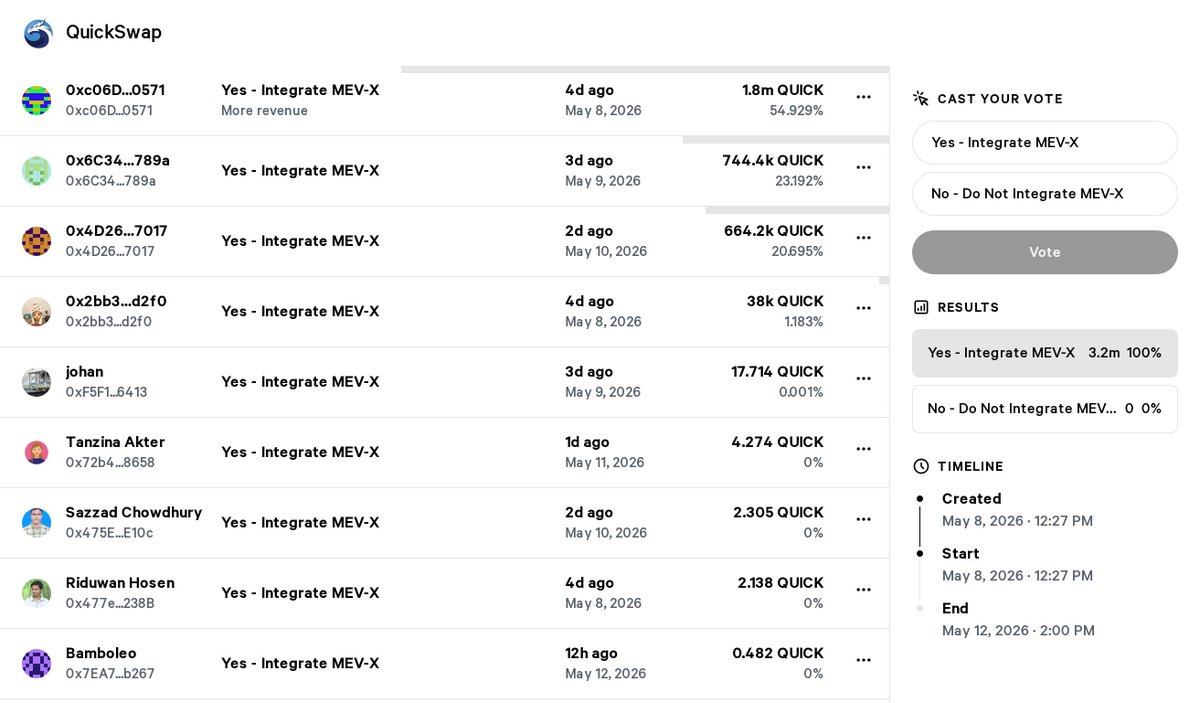
@QuickswapDEX is voting to plug in MEV-X Homelander, a system that captures the value bots normally extract around its liquidity pools and routes it back to the protocol and liquidity providers.
MEV (maximal extractable value) is profit bots make by ordering their trades around users. Backrunning means trading right after someone to capture the price move they just caused.
Today that value leaks to external bots and protocol-level auctions. The plugin redirects it.
The case runs on three tracks:
- MEV is worsening into 2026, with most extracted value now captured by protocol-level auctions rather than external bots
- MEV-X is integration-ready, so QuickSwap doesn't have to build it in-house
- Captured value flows back to the protocol and LPs under a transparent commercial model
@CryptoBelPH summed up the reframe: "MEV turning from 'problem' into 'protocol revenue line item' is still wild to watch."
9 wallets, 3.2M $QUICK, unanimous so far. Voting closes May 12 at 12:00 UTC.
Proposal: snapshot.box/#/s:quickvote.e…
1
1
3
165

May 11
Existing MEV protections prove the direction.
Flashbots Protect hides transactions from frontrunning and sandwich bots through a private mempool.
Polygon (@0xPolygon) Private Mempool moves submission away from the public queue.
MEV Blocker, built by CoW DAO (@CoWSwap), protects users through a special RPC and returns 90% of backrunning value to the user.
CoW Protocol (@CoWSwap) moves execution into batch auctions and solver competition.
Uniswap (@Uniswap) uses private transaction pools and intent-based execution paths.
BNB Chain (@BNBCHAIN) reduced sandwich attacks by coordinating validators and builders.
All of that matters.
But it is still fragmented.
The user should not need to know which RPC, wallet, solver, chain feature, or app path is safer.
The execution environment should select the protected path by policy.
Flashbots Protect docs.flashbots.net/flashbots…
Polygon Private Mempool polygon.technology/blog/poly…
MEV Blocker mevblocker.io
CoW Protocol docs.cow.fi/cow-protocol/con…
Uniswap MEV Protection blog.uniswap.org/mev-protect…
BNB Chain Goodwill Alliance bnbchain.org/en/blog/how-the…
1
7
72
May 11
You hit confirm.
The token was checked.
The approval was limited.
The intent was signed inside a hardened perimeter. Then the transaction left the wallet.
And the moment it entered a public mempool, the user’s intent became visible to anyone watching the queue.
That is where the invisible tax begins.
A quote is not execution. A wallet can show you a route. An aggregator can show you a price. A simulation can say the swap should pass. But this is not “just slippage.” This is not normal market volatility. This is order-flow exposure.
A public mempool is a waiting room for transactions before they are included in a block.
Searchers can monitor that flow, filter pending DEX calls, simulate outcomes locally, and decide whether the transaction is profitable to attack. The wallet was not hacked. The private key was not stolen. The intent was exposed before settlement.
Chainlink (@chainlink) describes the sandwich pattern clearly: a bot sees a pending buy, buys before the user, the user executes at a worse price, the bot sells after the user.
Front-run. Victim execution. Back-run. The trader does not see “MEV.”
They see: “Why did I receive less than expected?”
That is the problem.
Flashbots Protect exists because this is a real execution problem.
Since launch, Protect has been used by 2.1M Ethereum accounts, protected $43B in DEX volume, and returned 313 ETH in MEV refunds.
Polygon (@0xPolygon) launched Private Mempool on April 2, 2026: a private transaction submission endpoint designed to protect transactions from frontrunning and sandwich attacks through a one-RPC integration.
BNB Chain (@BNBCHAIN)’s Goodwill Alliance shows the same execution problem at network scale: daily sandwich attack frequency fell from 140K to under 1K - a reduction of more than 95% - after validators and builders coordinated around MEV-protected block building.
And this is not a niche pattern anymore.
A 2025 arXiv benchmark study on private MEV protection RPCs suggests Ethereum DeFi interactions have shifted to roughly 80% private RPC usage after PoS/PBS.
That does not mean MEV is solved.
It means execution routing itself became a security and performance layer.
CoW Protocol (@CoWSwap) uses batch auctions and solver competition to reduce MEV exposure.
Uniswap Wallet (@Uniswap) has swap protection through private transaction pools.
MEV Blocker, built by CoW DAO (@CoWSwap), protects users through a special RPC and returns 90% of backrunning value to the user.
So the answer is not:
“nothing exists.”
The answer is:
protection is fragmented.
Change RPC. Use a specific wallet. Use a specific app. Use a specific solver system.
Use a specific chain feature. Hope the user knows which path is safe this time.
That is not a security model.
That is optional protection scattered across the execution stack.
A real self-custody execution environment should reason about MEV before signing:
trade size, pool liquidity, price impact, slippage tolerance, route complexity, chain-specific mempool behavior, private path availability, solver path, fallback policy.
The question is not only:
“What is the best quote?”
The real question is:
“What is the best protected execution path after the user signs?”
MEV-aware routing should start inside the wallet execution boundary:
intent, simulation, route scoring, MEV risk check, protected path selection, signing, private submission, execution monitoring.
Not after the transaction is already public.
Not after the user gets sandwiched.
Not after the trader opens a block explorer and realizes the “slippage” was actually extraction.
A wallet that optimizes the quote but ignores the broadcast path is not doing execution routing.
It is doing pre-MEV price discovery.
Quote ≠ execution.
Signing ≠ settlement.
Public mempool ≠ safe broadcast.
Execution quality is wallet security.
Chainlink - Front-Running in DeFi chain.link/article/front-run…
Ethereum_org - MEV ethereum.org/developers/docs…
Flashbots Protect Overview docs.flashbots.net/flashbots…
Flashbots - 2 Million Protect Users writings.flashbots.net/2m-pr…
Polygon Private Mempool polygon.technology/blog/poly…
BNB Chain Goodwill Alliance bnbchain.org/en/blog/how-the…
Private MEV Protection RPCs Benchmark Study arxiv.org/abs/2505.19708
CoW Protocol MEV Protection docs.cow.fi/cow-protocol/con…
Uniswap MEV Protection blog.uniswap.org/mev-protect…
MEV Blocker mevblocker.io
2
2
17
264

May 11
Wallchain has successfully launched and integrated its innovative anti MEV solution which focuses on internalizing MEV to protect users and decentralized exchanges.
Wallchains technology now allows DeFi platforms to capture backrunning opportunities that were previously taken by bots.
Big attention on @wallchain today as more creators realize the platform rewards real signal over spam.
The project is gaining massive traction for its ability to eliminate sandwich attacks ensuring that retail traders get the best possible execution price without being exploited by predatory algorithms.
They have recently partnered with several major DEXs and wallets to integrate their SDK making MEV protection as a service a standard for the industry.
29
24
75

May 11
Funds are earmarked to accelerate the development of their revenue capturing solutions for DEXs Decentralized Exchanges and wallets.
Wallchains technology helps end users by capturing Backrunning opportunities and returning that profit to the users platforms instead of letting it fall into the hands of bot operators.
Investment marks a vote of confidence in @wallchain ability to make DeFi transactions more efficient and profitable for the average person.
>$500K distributed to leaderboard winners and NFT holders
>Multiple community events and ecosystem expansion
>Ongoing #Quack Heads NFT buybacks
>New analytics tools and more creator focused campaigns coming soon.

96
81
299

May 8
precisely why i'm aeon pilled
whatever banger aaron is building, opendia, soul, miroshark, etc. and more, are and will be autonomously shipped by aeon
in other word, aeon is the digitalized aaron, and $aeon is the builder coin of $aaron i've been preaching for the whole fucking time
you can build your own aeon, that ships for you autonomously, with your taste and personality
anthropic and google are backrunning this tek as we speak
May 8

aeon is now shipping new features for opendia, my 1.8k stars ⭐ repo forked by the Claude Code creator
also shipping on all my projects, including Tweazy, agent credit & obviously MiroShark 🦈
9
694