
Yes God knew humanity would sin.
Again you’re just asserting that it’s baseless and false without any evidence for said fact. This started with me saying that OP’s post was a strawman and dumb and doesn’t refute Christianity, which I’ve more than provided enough proof for, I
1
2

Ibironke Khadeejah Quadri retweeted

You do not need to unduly dissipate your precious energy on mundane and baseless arguments.
Most of these people have culturally inherited marital problems! 😒
@YusufAsunmogejo gave a succinct and insightful response to this contentious issue.

Here is my take on this issue.
I have read the arguments from Mummy and many of the counter arguments from some of our brothers. However, one thing I continue to notice is how many still confuse two completely separate concepts in Islamic law:
1) the right/capacity of a woman to own wealth or grow her personal wealth
2) the right of a woman to seek employment outside of her home in search of economic opportunity.
These two issues need to be separated and analyzed so we don’t lump them together.
On the first point, there is a principle of a separate financial estate, known in fiqh as Al-Dhimmah al-Maliyyah al-Mustaqillah.
This implies that when a Muslim woman marries, her legal and financial identity does not merge with her husband's. She remains a completely independent economic actor.
Surah An-Nisa, verse 32 states that men have a share of what they earn and women have a share of what they earn. This right to acquire, own, and grow wealth is unconditional.
A husband has no jurisdictional authority over his wife’s property, nor can he legally block her from generating income through investments, inheritance, or remote endeavors.
The confusion arises because people assume that earning an income automatically requires leaving the physical home and neglecting domestic responsibilities. This is a false dilemma.
A woman can run an online enterprise, manage assets, or conduct a trade from within her living space. When a woman earns from home, the argument regarding a husband's right to restrict her movement disappears because her domestic presence remains intact.
We see this clearly in the authentic tradition of Zainab bint Mu'awiyah, the wife of Abdullah ibn Mas'ud. She was a skilled artisan who manufactured and sold goods from her home to support her family. The Prophet knew of her trade, validated her independent earnings, and never commanded her to cease her financial activities.
This brings me to the second point on the fact that what if she has to go out to earn or seek external employment?
I want our brothers to listen very closely here. This is a matter that is governed by mutual contract and consent. It is not a blanket prohibition.
Under Islamic family law, a husband is strictly bound to provide complete maintenance, known as Nafaqah. In return, the classical framework establishes his right to expect her partnership in maintaining the stability of the home.
If a woman takes a corporate or retail job outside the house, the first thing we look at is the terms of the marriage.
Here, the Hanbali school explicitly rules that if a woman stipulates in her marriage contract that she would retain her right to work externally, that condition is legally binding and the husband cannot later force her to resign.
Again, if a man marries a woman who is already employed and he does not object, jurists view his silence as implied consent that cannot be arbitrarily revoked.
What if there was no stipulated agreement in the marriage contract?
Classical jurisprudence states that leaving the home for external employment requires the husband's ongoing consent.
This requirement exists because the marriage contract establishes a reciprocal system of rights. That is: his duty of unconditional financial provision in exchange for her presence and contribution to the home.
If he grants permission, her working outside is entirely permissible. Naturally, this permissibility remains bound by general Islamic ethics. This means the professional environment must respect religious boundaries and avoids unnecessary free mixing.
Also, many modern jurists emphasize that in our current economic reality, if the husband's income is insufficient to maintain the family, or
if there is a clear communal need for her specific professional skills (e.g female doctors, nurses), then, withholding this consent arbitrarily violates the Quranic mandate of treating one's spouse with kindness and equity.
1/2
1
1
1
34

Leaving is very okay,but why do they have to draw baseless allegations on a man first?

No woman wakes up and leaves her marriage in 3 months just because of an apartment sometimes let our judgments stop blinding us from the things that happen behind closed doors ; women shd hold a choice to leave when they don’t feel same , we can’t keep waiting for death to ask why they stayed longer?
4
Saitama retweeted

A weak and shaky attempt was made to lend credibility to a highly baseless claim dragging an entirely unrelated community into the argument by a cardiologist masquerading as a historian.
In its article published on 15 June 2026, titled "Don't use Rajput women as proof of Mughal Indianness. It's communal simplification," @ThePrintIndia @ThePrintHindi, under the editorship of @ShekharGupta and through an article authored by @dryadusingh, asserted that Jat women too had matrimonial connections with the Mughal imperial household.
This was not a passing remark. It was a positive historical assertion placed before a national readership. As such, it carried an evidentiary burden.
On examination, however, that burden remains entirely unmet.
I. The Gratuitousness of the Defamation
The stated objective of the article was to challenge an over-simplified narrative centred upon Rajput matrimonial alliances with the Mughal imperial household. One may engage with that argument on its merits.
What is not defensible is the method by which the article pursued it: invoking alleged matrimonial connections between Jat women and the Mughal imperial household without primary documentary support and against the explicit correction recorded by the earliest source in which the tradition appears in written form.
The honour of one community's women is not defended by implicating the womenfolk of another community in a claim that the evidence does not sustain.
The Jat community did not require to be conscripted into this argument.
Its conscription was gratuitous.
And, in the ordinary meaning of the term, defamatory.
II. What Hari Ram Gupta Actually Recorded, and Whence He Derived It
The article cites Hari Ram Gupta's Sikh Lion of Lahore (1991) for the proposition that the Bains, Sahotas and Khungas were known as "Akbari Jats" by virtue of matrimonial alliances with the Mughal household, and that "one account mentions a Jat named Mehar Mitha offering his daughter in marriage to Emperor Akbar."
What the article failed to disclose is that this "account" is not a contemporary historical document.
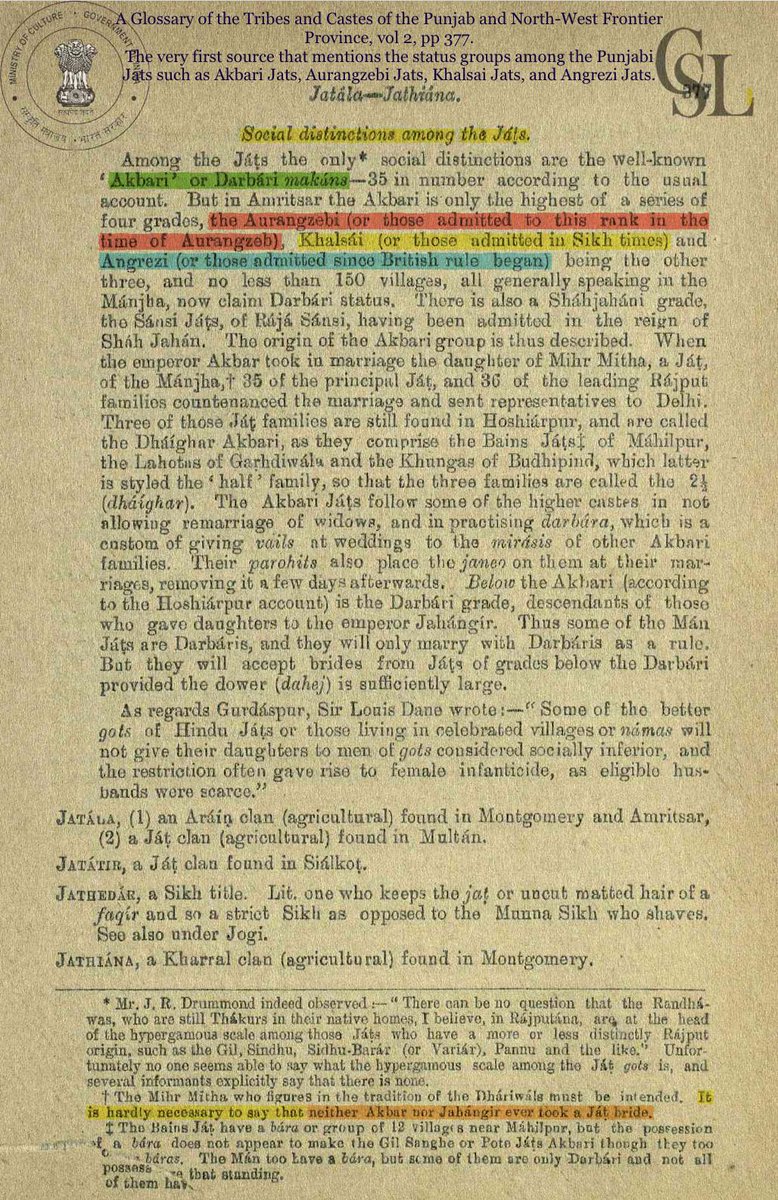
It is a folk tradition recorded in written form for the first time by Denzil Ibbetson in A Glossary of the Tribes and Castes of the Punjab and North-West Frontier Province.
Ibbetson was sufficiently scrupulous to do what Hari Ram Gupta—and subsequently The Print—did not. Having recorded the tradition, he appended a footnote to the very passage in question, observing that "it is hardly necessary to say that neither Akbar nor Jahangir ever took a Jat bride."
Ibbetson thus recorded an urban legend and corrected it in the same breath. Hari Ram Gupta repeated the legend and suppressed the correction. The Print has now repeated Hari Ram Gupta whilst remaining ignorant of the source that both underlies and refutes him.
The chain of transmission upon which the article's claim rests is the following:
• A folk tradition;
• Corrected as historically false by the first scholar to commit it to print;
• Repeated at second hand;
• Stripped of its corrective footnote;
• And published as historical evidence in a reputed national daily.
This is not evidence.
It is the recirculation of an urban legend.
III. What "Akbari Jat" and Cognate Designations Actually Denote
The article further implies that the grades of "Akbari," "Darbari," "Aurangzebi," and "Khalsai" among Jat lineages testify to matrimonial connections with the Mughal imperial household.
This implication is unfounded.
Ibbetson's Glossary, the authoritative source for these designations, explains that they denote the period at which particular Jat lineages received recognition of chaudhriyat, that is, the status of local revenue superior or zamindar, under successive Mughal and Sikh administrations.1/.
@meelrajaram @thejatheroes @du_jat
@JAT_SAMAAJ @JATs_Land @hanumanbeniwal @XJatlandX @RakeshTikaitBKU @Warriorsclub_X
@jat_devta

10
21
52
5,177


Furthermore, the court would like to see evidence in support of the claim; otherwise, the defendant's accusation remains baseless
2

Exactly, their claims and arguments are always baseless just like 45fc plus they blend the rules accordingly so their favourite can be seen as the greatest. Ronaldo at least debatable but that 45 guy, DAMN
1
Early Riser retweeted

Leftist orgs/foreign govs r attempting 2undermine the 2nd amendment thru baseless litigation intended 2bankrupt the US firearms industry
I joined Sen Cornyn in introing the SHOT Act to protect Americans' right 2bear arms & combat liberal attacks on ur constitutional rights
106
20
104
8,631
Maria Vani retweeted

Look for this baseless narrative manipulation to increase as we get closer to a referendum!!
Jun 16

FACT CHECK: Opponents to Alberta’s independence enjoy using the bogeyman of foreign interference as a form of low hanging fruit to spread fear with.
Here's the truth: rebelne.ws/3S4O2ch

1
3
4
287


First of all, who gave you the authority to intrude into someone else's personal life? Whether those photos are AI-generated or real is not even the issue here. What exactly is wrong if she has a boyfriend? That is her personal matter, not yours to judge. If you genuinely have evidence that she has misused her position or abused her power, then present the facts and speak with proof. Otherwise this constant fixation on her private life serves no public purpose. Women in public life already face far more scrutiny than men, and it seems some people simply cannot accept a woman holding a ministerial position. These repeated personal attacks say more about you than the person being targeted. You have spent years building your reputation, don't damage it by engaging in baseless and unnecessary character assassination. Stop this nonsense and focus on issues that actually matter.
7

I'm still waiting for substantive arguments instead of baseless ad hominem.
1

14m
As usual,insult,curses, baseless assumptions like leader like followers. Ko si iyato
2
MKS🇮🇳 retweeted

31m
🚨 Fact Check: Opposition spreading baseless misinformation on E20 petrol 🚨
BPCL confirms - Fuel-grade ethanol has no residual sugars, contains insect-repellent denaturants, and petrol's hydrocarbon smell dominates.
No scientific link to ants at fuel caps.
Pure political propaganda to derail India's clean energy push.
#EthanolBlending #FactCheck

2
43
183

I couldn't agree more!
I have watched this unusual player since his debut and up to this day. This is why baseless comparisons make me puke.
17

16m
not a huge football fan or a fan of any player for that matter but one thing i know for sure is that messi vs ronaldo is a baseless rivalry ronaldo is a great player no doubt but let’s put our biases aside and stop saying he’s the better player


26

an official representative of korea airports corporation themselves defending wonyoung against the baseless defamation 💀 oh jang wonyoung the universe is truly on your side as always
Jun 15

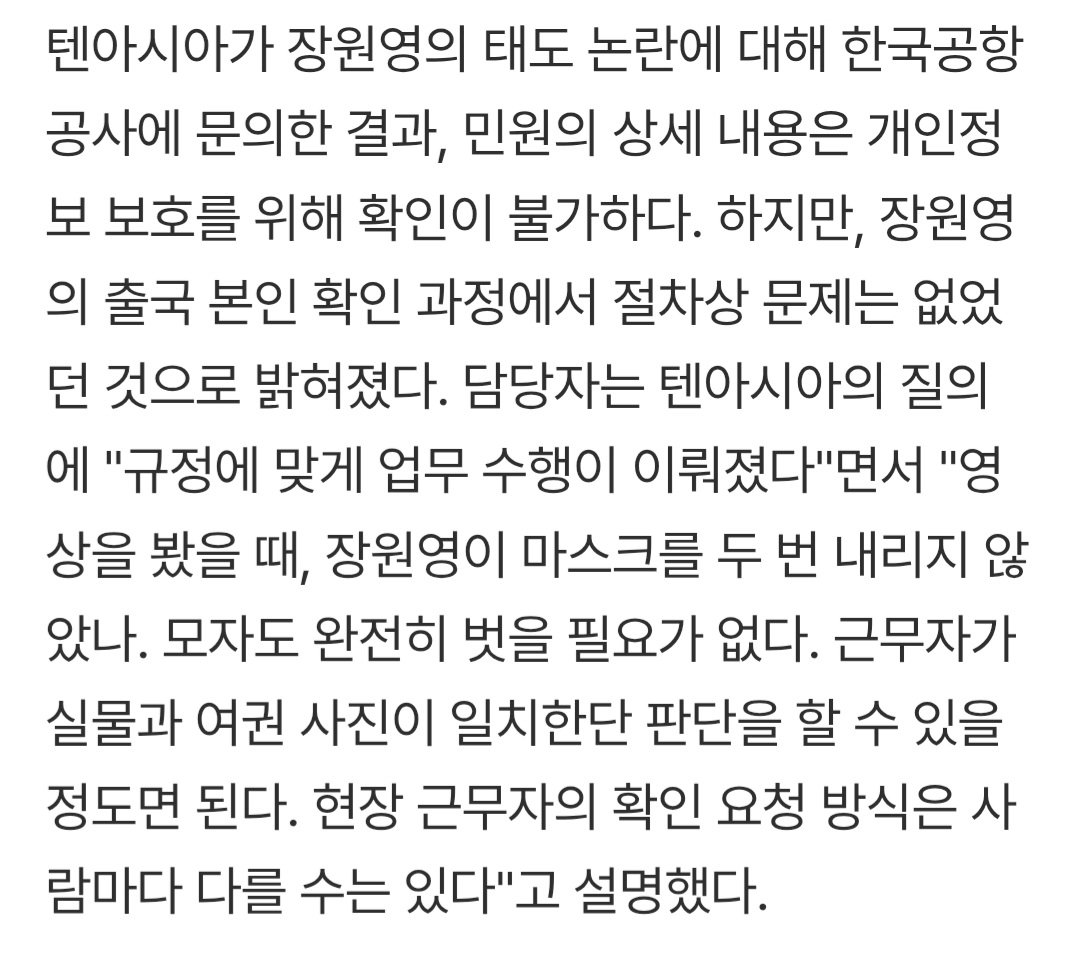
Statement from an official representative of the Korea Airports Corporation
-Looking at the video, didn't Jang Wonyoung take off her mask twice? There is no need to remove her hat completely either. It is sufficient for the staff member to determine the person and passport match

2
526
2,819
38,436

"PUNJABIS ARE WISE—THEY UNDERSTAND THE DIFFERENCE BETWEEN TRUTH AND FALSEHOOD." 🚨🌾
Punjab CM @BhagwantMann has released a direct video address slamming what he calls a "deliberate conspiracy" to damage his reputation using a misidentified viral video.
What the Chief Minister stated in his official address:
❌ Physical Mismatch: Mann pointed out that the height, physique, and structure of the individual in the video do not match him at all.
🏛️ Institutional Respect: He reiterated his family's absolute reverence for Sri Akal Takht Sahib but accused rivals of using religious platforms to please political masters.
💧 The Real Agenda: Mann claims these baseless allegations are a desperate retaliation against his bold decisions for Punjab's waters, farmers, and youth.
#PunjabPolitics #BhagwantMann #AamAadmiParty #FactCheck #PunjabNews #Indiathisweek @AAPPunjab @AamAadmiParty
5