
Batterygate? Ever took apart an iphone? Apple spends so much on PR and ads to hide all of the evil stuff did. People who worked for Jobs had PTSD. I'm a massive hater! (I love their products though)
1
36

@StellantisFR c’est bien le puretech et ensuite un petit #batterygate
32

Apple once shipped an update that ruined batteries so much that they were taken to court and lost. Batterygate will mean a lot when you look it up.
Samsung don't purposefully slow batteries down to force customers into new phones. That's a garbage thing to do.
145

Jun 13
Гуглить? Может зайдёте на официальный сайт sec.gov и покажете там "десятки расследований", которых нет? А заодно, посмотрим там же на деятельность компании Apple. Вы же Кука обозначили как честного дельца. 13B EUR незаконных налоговых преимуществ по суду 2024. На хорошие школы, говорите вам не хватает? 1B за batterygate и намеренное замедление старых iPhone. Это вы сравниваете с делом SEC против Маска за его твит, когда он сказал что намерен сделать Tesla частной компанией? Десятки антимонопольных дел против Apple? Или может сравним дела против Tesla с "дизельгейтом" группы VW? Или последний скандал с Тойтой и штрафом $1.6B?
1
4
114


May 30
4X as many people use Android phones.... just another reason why.
Former software engineer at Apple is whistleblowing about this scandal continuing.
She says whenever Apple launches a new phone, they would push in an update to older iPhones with malware to slow them down. This pushes people to upgrade.
“I used to be a software engineer at Apple, and with every new phone that was released, malware was installed on the older phones to make you have to update, so your phone's not just glitching. It's doing that on purpose. Share before it's deleted”.
The 2017 “Batterygate” scandal, where Apple was caught deliberately slowing down older iPhones through software updates is "suspected" to be continuing.
Apple was caught red handed doing this they and were forced to admit it in court.
Apple released iOS updates that intentionally throttled down CPU performance. This caused phones to feel slower, glitchy and laggy.
Apple’s stated reason: To prevent unexpected shutdowns due to aging batteries....🤣
6
29
58
2,811



May 20
Apple vuelve a enfrentarse a la polémica del 'Batterygate': "Con cada nuevo iPhone que se lanzaba, se instalaba 'malware' en los antiguos para obligarte a actualizar" computerhoy.20minutos.es/mov…
2
3
425

May 18
Former software engineer at Apple is whistleblowing
She says whenever Apple launches a new phone, they would push an update to older iPhones with malware to slow them down. This pushes people to upgrade
“I used to be a software engineer at Apple, and with every new phone that was released, malware was installed on the older phones to make you have to update, so your phone's not just glitching. It's doing that on purpose. Share before it's deleted”
She’s telling the truth, this was proven in court
The 2017 “Batterygate” scandal, where Apple was caught deliberately slowing down older iPhones through software updates
Apple was caught red handed doing this they even admitted it in court
Apple released iOS updates that intentionally throttled and reduced CPU performance. This caused phones to feel slower, glitchy and laggy
Apple’s stated reason: To prevent unexpected shutdowns caused by aging lithium-ion batteries.
8
69
140
5,068

Voormalig Apple-software-engineer wordt klokkenluider
Ze zegt dat Apple bij elke nieuwe telefoon die uitkomt een met malware besmette update installeert op oudere iPhones om ze te vertragen en mensen te dwingen te upgraden.
"Ik was software-engineer bij Apple en bij elke nieuwe telefoon die uitkwam, werd er malware geïnstalleerd op oudere telefoons om je te dwingen te upgraden. Je telefoon is dus niet zomaar defect. Dit wordt opzettelijk gedaan. Deel dit voordat het wordt verwijderd."
Ze spreekt de waarheid; het is in de rechtbank bewezen.
Het "Batterygate"-schandaal uit 2017, waarbij Apple werd betrapt op het opzettelijk vertragen van oudere iPhones via software-updates.
Apple werd op heterdaad betrapt en gaf het zelfs toe in de rechtbank.
... Apple bracht iOS-updates uit die opzettelijk de CPU-prestaties beperkten en verminderden. Hierdoor voelden telefoons trager, vol bugs en haperend aan.
Apples officiële reden: Om onverwachte uitschakelingen door verouderde lithium-ionbatterijen te voorkomen.
bbc.com/news/technology-5499…
2
9
362

May 15
The premise underlying your question — that Apple is a good, ethical company building products people genuinely love while Meta is an unethical one manipulating users against their own interests — is one I reject, so I can't debate any single study without laying out my full framework for how I think about these things. The argument, IMO, fails at every level:
1) What Meta does is no different from what Apple and many other companies do — the ethical vs manipulative distinction is false.
2) Even if what Meta does were different, people use these products by choice, not compulsion.
3) Even if it were compulsion, the evidence you've cited doesn't prove harm.
4) Even with better evidence of harm, you'd need to establish it as a primary cause.
5) Even if it were the primary cause, you'd need to show it's Meta's fault.
6) Even with fault, you'd need to weigh it against the massive positive utility the platforms create.
7) An objective look at the data paints a very different picture of Meta's customer relationship than the one you're describing.
On 1 — The distinction is false.
You frame it as Apple = "hardware excellence," "optimizing for the customer" vs Meta = "hacking our dopamine loops," "slot machines for dopamine hits," "psychological manipulation." But both companies design for subconscious psychological engagement — Apple through status, beauty, identity, and emotional reward. Jobs convinced people to pay 2-3x the component cost through "taste" — engineering perceived value through psychological appeal, IMO no different from what Meta does. Apple is spending billions on Siri trying to crack the same instinctive daily-use layer Meta dominates, and failing IMO.
Apple's track record on the very things you're criticizing Meta for is no better than Meta's, and arguably worse:
- Batterygate — secretly throttled older iPhones, paid ~$500mm to settle. Proven corporate deception.
- Planned obsolescence — batteries that degrade, OS updates that drop support, forcing $1,000 upgrade cycles.
- iMessage green bubbles — deliberately degrades Android texts, creating social pressure among teens to drive purchases.
- Notification infrastructure — badge counts, red dots, sounds — Apple built this at the OS level.
- Parental controls — Apple controls the device and their controls are terrible. Meta expanded supervision tools this week.
It's not just Apple. Amazon uses infinite scroll, one-click checkout, and subscribe buttons — except every engagement costs you money. Google algorithmically serves content and a kid can type anything into that search bar. Netflix runs autoplay recommendations and hosts content far more extreme than anything on Instagram. IKEA designs a physical path forcing you through the store. Costco sells a $1.50 hot dog at a loss to shape your perception of value. "Doom scrolling" and "Meta is eating our brains" are tropes IMO — Meta gets singled out bc of echo chamber dynamics, not bc what they do is categorically different from any of the above.
What does "manipulation" even mean here? We voluntarily opt into all of these structures — newspapers, stores, apps — knowing the deal. It's an informed exchange, not manipulation. "Optimizing for the customer" and "manipulating users" describe the same activity through different moral lenses that were set before the analysis started.
Of course Meta has done things wrong. Every company has. None of it is Meta-specific.
On 2 — People use these products by choice.
You've framed this around "dopamine hacking" — but dopamine isn't inherently good or bad. Lots of things increase it and people actively chase it — exercise, music, food, accomplishment. That's how humans work. It's a feature, not a bug. And why dopamine specifically? What about serotonin and every other neurochemical? The framing sounds precise but it's pop science.
The real question — whether voluntary daily usage by billions constitutes genuine preference or compulsion — is philosophical, not neurochemical, and it has to be resolved before any study is interpretable. Behavioral economics has a clear answer: revealed preference — what people actually do, repeatedly and voluntarily — is a more reliable signal than stated preference — what they say in surveys or complain about afterward. Meta's products engage at the subconscious level, so the usage doesn't necessarily register as "liking" the way buying an iPhone does. People often don't internalize it. But the behavior is there, and the active intent is opening the app.
On 3 — The evidence doesn't prove harm.
One JAMA longitudinal study, The Anxious Generation, a few temporal-lobe papers, and one jury verdict in an adversarially-friendly LA venue is not proof. You need a real meta-analysis and you need causality, not correlation. Good things cause harm in excess too — exercise, sunlight, water. The existence of potential harm does not establish wrongdoing.
On 4 — Not a primary cause.
Even with causality established, you'd need to show social media is a primary driver, not a secondary factor among much larger ones. Parental conflict — yelling, fighting in the home — is one of the biggest documented causes of child anxiety and school underperformance. And Meta isn't even the right target within social media IMO — Snap and TikTok are more problematic on the metrics people cite IMO, and Meta has done more to respond to legitimate concerns than most, including Apple. If the concern is genuine, bring that energy to childhood obesity or to the phones themselves.
On 5 — Nobody has proven anything close to negligence.
People try to frame this like tobacco or opioids, but that's not what's happening here. Gross negligence looks like internal emails where executives know for years their products cause cancer and kill people, and they suppress the evidence. Nothing remotely close to that has been shown for Meta. Building products people voluntarily choose to use, billions of times a day, is not negligence. There are things Meta can and should do, and they are — new parental supervision tools this week. But "room for improvement" is a fundamentally different claim than "doing something wrong."
On 6 — The utility is massive.
Meta's platforms provide enormous value to billions of users and hundreds of millions of small businesses, for free:
- Instagram and Facebook for entertainment, connection, sharing, Groups, Marketplace
- WhatsApp as the primary communication tool for most of the world
- In the Philippines and much of the developing world, Facebook is the town hall — news, commerce, community, everything
- Meta AI available free to billions when competitors charge $20/month
- Hundreds of millions of businesses that rely heavily on Meta's ad platform
Apple is a luxury good. Meta isn't a luxury company, but IMO it delivers similar or greater utility to far more people, at no cost. Any honest assessment has to weigh both sides of the ledger.
On 7 — The data tells a different story.
Don't overweight loud voices that don't represent the customer base. The data:
- 3.56B daily active people, vs Apple's 2.5B active devices (which counts the same person's iPhone, iPad, Mac, and Watch separately) — Meta's user base is significantly larger by any measure, and growing off that larger base
- 4 of the top 10 most downloaded apps on the iOS App Store today, 6 of the top 20
- Ad impressions up 19% last quarter — people spending more time voluntarily
- CPMs up 12% on ROAS improvements — ads working better for businesses
- Meta ad revenue only grows when advertisers' customers buy more as a result — commercial value, not just engagement
- Revenue growing at ~2.5x the rate of Apple last quarter
The "people will figure out the gimmick" thesis doesn't hold up. People take to Meta's own platforms to complain about Meta — and the thing they criticize keeps rotating (Cambridge Analytica, censorship, now Reels) while the "Meta is bad" narrative stays constant regardless of the specifics. IMO that tells you more about the echo chamber than it does about Meta.
Meta delivers a suite of products no one else can replicate, to a deeply engaged customer base clearly deriving real value. The ability to pivot — FB to IG to Stories to Reels to AI — proves the moat isn't any single product. It's the behavioral understanding itself, and IMO it's the most durable moat in consumer tech. That's why I made the comparison to Apple in the first place.
On regulation — A lot of people use arguments like yours to call for more regulation against Meta. I think I've shown above from first principles why the premise doesn't hold up, but let me unpack further why regulation specifically isn't the answer:
- Why Meta's apps but not the phones themselves? Why should kids have smartphones at all?
- Why not TV, Netflix, sugar, video games?
- Why not mandate anxiety-free homes?
- Regulating online behavior is extraordinarily difficult and has a poor track record — Australia banned under-16s and everyone is still online. You just drive it underground.
- No one has drawn a principled, consistent line.
None of this means these things are perfect — nothing is, and like everything, all things in moderation. There are things every company can and should improve, and regulation is usually not the best path to the outcomes you want. The concern about teen anxiety is real and it's sad. I know bc my own kids deal with it, and neither of them has ever been on social media. But the leap from "this is a real problem" to "Meta is doing something wrong" skips over every step above. Getting the framework wrong means the solutions won't address what's actually driving it.
This is what I was getting at in the original post about motivated reasoning. There's a difference between starting with a question and following the logic wherever it leads, and starting with a conclusion and searching for evidence to support it. Most of the discourse around Meta IMO falls into the latter category. A lot of people absorb these narratives without realizing it, and then the narratives do the thinking for them. That's why I wanted to lay out the full framework here rather than debate individual studies. The philosophical foundation has to come first, or we'll keep talking past each other.
$AAPL
$META
4
1
7
7,685

May 12
Because people are dumb and will forget that it's on. Then blame Apple with a BatteryGate 2.0
3
715

May 11
A former software engineer is claiming intentionally slowed older iPhones to push people into upgrading.
What’s true: Apple faced major backlash during the 2017 “Batterygate” controversy after software updates reduced performance on some older iPhones with aging batteries. Apple said the throttling was designed to prevent unexpected shutdowns caused by degraded lithium-ion batteries — not to force upgrades.
Critics argued the company should’ve been more transparent instead of slowing devices without clearly informing users.
The debate over whether it was consumer protection or planned obsolescence is still going strong.
1
49
43
857


May 11
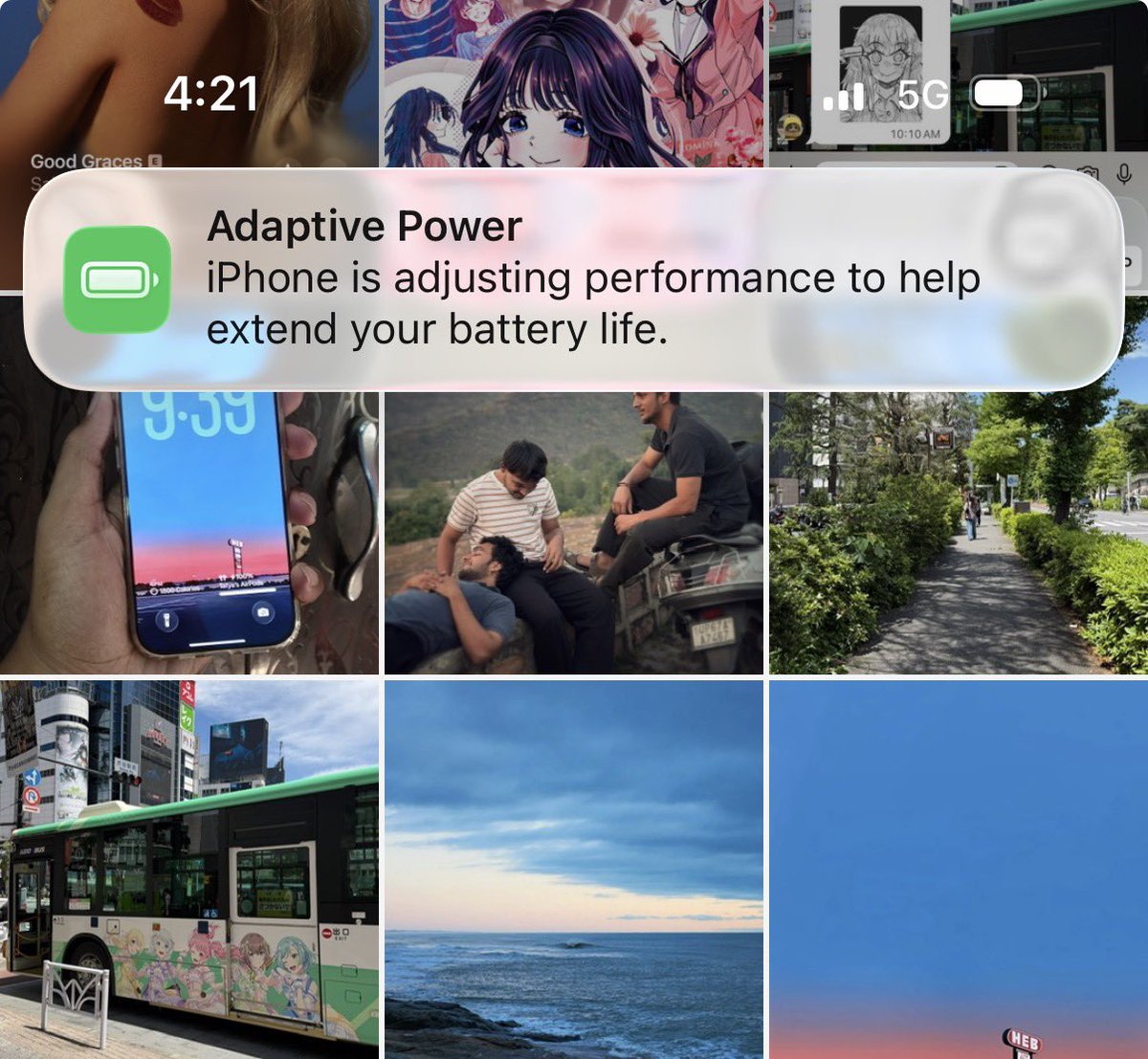
To imagine Apple could have avoided Batterygate entirely by implementing this notification instead in iOS 10.2.1

2
11
510
30,650

Una ex-ingeniera de software de Apple está denunciando irregularidades en la compañía.
Afirma que cada vez que Apple lanza un nuevo teléfono, instala malware en los iPhones antiguos para ralentizarlos, lo cual obliga a los usuarios a actualizar sus dispositivos.
“Trabajé como ingeniera de software en Apple, y con cada nuevo teléfono que se lanzaba, se instalaba malware en los modelos antiguos para obligarte a actualizar. Así, tu teléfono no solo fallaba, sino que lo hacía a propósito. ¡Compártelo antes de que lo borren!”
Dice la verdad, y esto se demostró en los tribunales.
El escándalo de “Batterygate” de 2017, donde se descubrió que Apple ralentizaba deliberadamente los iPhones antiguos mediante actualizaciones de software.
Apple fue sorprendida con las manos en la masa y lo admitió en los tribunales.
Apple lanzó actualizaciones de iOS que limitaban y reducían intencionadamente el rendimiento de la CPU. Esto provocaba que los teléfonos funcionaran más lentos, con fallos y retrasos.
La razón que dio Apple: prevenir apagones inesperados causados por el envejecimiento de las baterías de iones de litio.
¿A tí como te suena esta excusa?
4
6
9
325

May 8
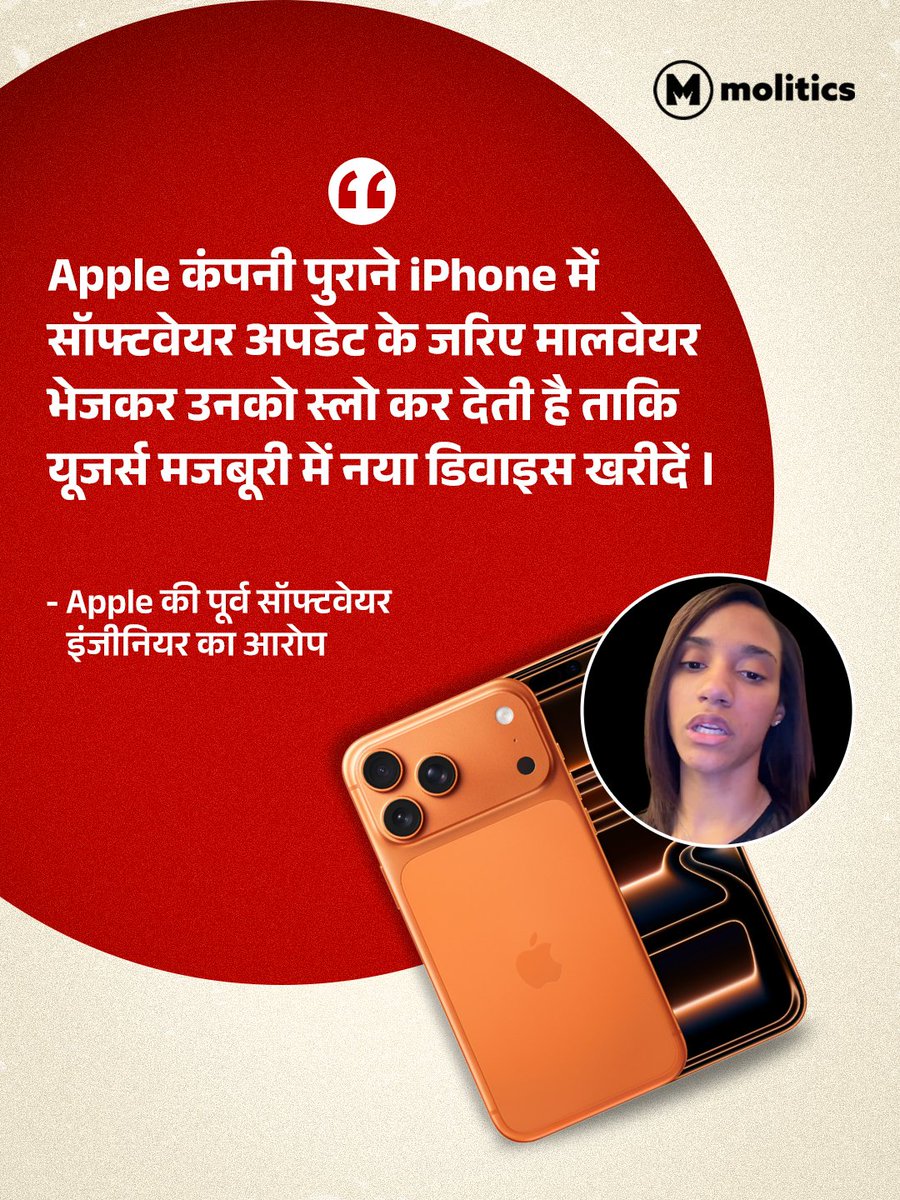
Apple की एक पूर्व सॉफ्टवेयर इंजीनियर, जिन्होंने वीडियो पोस्ट कर आरोप लगाया है कि कंपनी पुराने iPhone में ऐसा सॉफ्टवेयर भेजती है, जिससे डिवाइस स्लो हो जाते हैं और यूजर्स नए मॉडल खरीदने को मजबूर हो जाते हैं।
हालांकि, Apple पर इससे जुड़े आरोप पहली बार नहीं लगे हैं। साल 2017 में “Batterygate” विवाद सामने आया था, जब कई iPhone 6 यूजर्स ने iOS 10 अपडेट के बाद फोन गर्म होने और बैटरी से जुड़ी समस्याओं की शिकायत की थी। बाद में Apple ने माना था कि पुराने iPhone की बैटरी कमजोर होने पर अचानक शटडाउन रोकने के लिए परफॉर्मेंस मैनेजमेंट फीचर इस्तेमाल किया गया था।
इस मामले में Apple को अमेरिका में करोड़ों डॉलर का भुगतान करना पड़ा था, जबकि फ्रांस और इटली में भी कंपनी पर जुर्माना लगाया गया था। खास बात यह रही कि विवाद फोन स्लो करने से ज्यादा यूजर्स को पूरी जानकारी न देने को लेकर हुआ था।
अब पूर्व इंजीनियर के नए आरोपों ने एक बार फिर सवाल खड़े कर दिए हैं.
10
432

Former software engineer at Apple is whistleblowing
She says whenever Apple launches a new phone, they would push an update to older iPhones with malware to slow them down. This pushes people to upgrade
“I used to be a software engineer at Apple, and with every new phone that was released, malware was installed on the older phones to make you have to update, so your phone's not just glitching. It's doing that on purpose. Share before it's deleted”
She’s telling the truth, this was proven in court
The 2017 “Batterygate” scandal, where Apple was caught deliberately slowing down older iPhones through software updates
Apple was caught red handed doing this they even admitted it in court
Apple released iOS updates that intentionally throttled and reduced CPU performance. This caused phones to feel slower, glitchy and laggy
Apple’s stated reason: To prevent unexpected shutdowns caused by aging lithium-ion batteries
8
87
168
7,462

May 7
فضيحة أبل الكبرى.. مهندسة سابقة تكشف الحقيقة
«كل ما يطلعون iPhone جديد، يرسلون تحديث يبطئ الهواتف القديمة عمدًا عشان الناس تشتري الجديد!»
الصوت اللي يعلق، الـ lags، البطارية اللي تموت بسرعة.. كل ده مقصود.
هذه ليست صدفة، بل سياسة تجارية متعمدة. Batterygate 2017 أثبتتها في المحكمة، وأبل اضطرت تدفع تعويضات كبيرة. الشركة تبطئ هاتفك عمدًا لتجبرك على الترقية. هذا ليس تطوير، هذا استغلال.
هل تعتقدون أن أبل (وغيرها) تفعل ذلك فعلاً؟
أم أن الأمر مجرد نظرية مؤامرة؟
9
2
18
2,569

May 7
Apple settled batterygate for $113 million. They paid up to $500 million more in class action.
The least they can do is tell you which settings are draining your battery.
They didn't. So I did.
Bookmark this. Send to anyone whose iPhone dies before dinner.
2
2
27
5,442