

Jun 9
Link: youtu.be/OxdFtmBL30E?si=vNLS…
Today, @AnthropicAI have released @claudeai Fable 5 & Mythos 5.
What does it mean for Biomedical and Clinical Research and Patient Care ?
I have prepared a very short overview...
Here is the Preview...
1. Autonomous single-cell genomics — the model assembled a cross-species atlas spanning 138 species and trained a method that beat a recently published one at ~1/100th the size.
2. Therapeutic design — running the protein-design loop end-to-end (binding sites, tool selection, failure recovery), with 9 of 14 targets yielding strong candidates. Immune-checkpoint and receptor-signaling biology sit right at the center of blood-cancer immunotherapy.
3. Novel hypotheses — the first model to consistently propose original, testable mechanisms; experts preferred them ~80% of the time in blinded comparison, and one was independently corroborated.
4. The honest part — these capabilities are dual-use, which is exactly why many biology/chemistry queries are deliberately gated. I think the safeguards, and the honest caveats around unpublished results, matter as much as the breakthroughs.
My take: the frontier isn't replacing the biologist or the biostatistician. It's raising the resolution at which we can design, hypothesize, and test — and our job is to verify fast enough to keep up.
#AIinMedicine #ComputationalBiology #SingleCell #Genomics #Hematology #Oncology #DrugDiscovery #PrecisionMedicine #MountSinai
#AIGenomics #TranslationalMedicine #PrecisionOncology #Hematology #MPN #ASCO26 #SingleCell #SpatialOmics #DrugDiscovery #Bioinformatics #GenomicsAI #ClinicalAI #PrecisionOncology #Hematology #MPN #MRD #FoundationModels #FDA #Elsa #HALO #ChatGPT #OpenEvidence #MountSinai #AACR2026 #EHA2026 #ASCO2026 #Tempus #Anthropic #ClaudeForLifeSciences #ClaudeForHealthcare #AgenticAI #Bomedemstat #Rusfertide #INCA033989 #DrugDiscovery #BioNeMo #BiomedicalAI
2
2
3,667

Jun 8
AI biology infrastructure signal
QIAGEN is integrating NVIDIA BioNeMo with curated bioinformatics knowledge bases.
Plain English: AI drug discovery needs more than models. It needs trusted disease maps, target biology, and biomarker context.
That is how lab data starts moving toward medicine.
Source:
corporate.qiagen.com/English…
11

$TEM 템퍼스 AI는 엔비디아의 LAYER에 들어가 있을까? (BY 그록)
엔비디아(NVIDIA)의 “LAYER”는 젠슨 황 CEO가 설명한 AI 5-Layer Cake(5층 케이크) 스택을 가리킵니다.
NVIDIA AI 5-Layer Stack (젠슨 황 기준)
1. Energy (에너지) — AI 작동에 필요한 전력
2. Chips (칩) — GPU 등 하드웨어 (NVIDIA 핵심)
3. Infrastructure (인프라) — 데이터센터, 클라우드, 네트워킹
4. Models (모델) — AI foundation models (훈련/추론)
5. Applications (애플리케이션) — 산업별 실사용 사례 (의료, 로보틱스, 자율주행 등)
Tempus AI (TEM)는 최상위 Applications Layer에 속합니다.
• Tempus는 방대한 임상·분자 데이터 라이브러리 AI(특히 oncology/cardiology 중심)를 활용해 정밀의학 플랫폼(Lens, Hub 등)을 제공합니다. 이는 NVIDIA의 GPU/인프라(하위 레이어)를 기반으로 대규모 AI 모델을 학습·추론하는 전형적인 상위 레이어 애플리케이션입니다.
왜 Tempus가 NVIDIA Layer에 언급되나?
• NVIDIA-backed / Powered: Tempus는 NVIDIA 기술(accelerated computing, BioNeMo 등 genomics/AI 도구)을 활용하거나 연계되어 AI-driven precision medicine를 구현합니다. NVIDIA의 healthcare AI 생태계(의료 이미징, genomics, drug discovery)에서 Tempus 같은 회사가 실질적인 가치 창출 사례로 거론됩니다.
• 데이터 AI moat: Tempus는 “digital biology의 data layer”로 평가받으며, NVIDIA의 하드웨어 위에서 대규모 multimodal 데이터를 처리해 예측·진단·약물 개발을 가속화합니다. 하위 레이어(칩·인프라)가 강력할수록 Tempus 같은 앱 레이어 회사가 더 강력해지는 구조예요.
1
322

Jun 3
英伟达在做的牛逼项目还有很多,其中一个叫BioNeMo,是要把药物开发数字化,如果成功了,药物开发的前期耗时会大大缩短,成本大大降低,人类将迎来新物开发的井喷时代,这个世界不完美,但是你要感谢有老黄这样的人,你要对世界充满信心。
1
3
530


Jun 2
What if the best bet on biotech AI isn't bio companies...
What if it's $NVDA itself?
NVIDIA BioNeMo:
- Used by 80% of biotech AI companies
Sells the same product (compute foundation models) to RXRX and Isomorphic and Lilly and Pfizer
- Captures value regardless of which platform wins
- Already trades at 21x forward
- Diversified across robotics AI compute biotech AI
Every dollar Lilly spends on Isomorphic eventually flows to NVDA chips.
Every wet lab automation runs on NVDA.
Every protein folding calculation runs on NVDA.

There's a decent chance of a emergent bubble in biotech AI stocks next 6-12 months
- If AI can solve math, surely it can solve bio - bubble thinking
- Isomorphic round won't be its last. creates search for beta
- Lilly proves in investor minds that pharma/biotech can rip hard
3
5
5,034

May 28
$LLY $NVDA NVIDIA and Lilly Announce Co-Innovation AI Lab to Reinvent Drug Discovery In the Age of AI
January 12, 2026
Companies to Jointly Invest up to $1 Billion Over Five Years in Infrastructure and Research
News Summary:
NVIDIA and Lilly bring together a world-leading, multidisciplinary team of scientists, AI researchers and engineers to address the hardest problems in drug discovery.
The co-innovation lab infrastructure will be built on the NVIDIA BioNeMo platform and the NVIDIA Vera Rubin architecture.
NVIDIA and Lilly will pioneer robotics and physical AI to accelerate and scale medicine discovery and production.
SAN FRANCISCO—J.P. Morgan Healthcare Conference—Jan. 12, 2026—NVIDIA and Eli Lilly and Company today announced a first-of-its-kind AI co-innovation lab focused on applying AI to tackle some of the most enduring challenges in the pharmaceutical industry.
The lab brings together Lilly’s world-leading expertise in discovering, developing and manufacturing medicines with NVIDIA’s leadership in AI, accelerated computing and AI infrastructure. The two companies will invest up to $1 billion in talent, infrastructure and compute over five years to support the new AI co-innovation lab.
Based in the San Francisco Bay Area, the lab will co-locate Lilly domain experts in biology, science and medicine with top AI model builders and engineers from NVIDIA, allowing them to work side by side to generate large-scale data and build powerful AI models that can accelerate medicine development, using NVIDIA BioNeMo™ as the critical platform.
“AI is transforming every industry, and its most profound impact will be in life sciences,” said Jensen Huang, founder and CEO of NVIDIA. “NVIDIA and Lilly are bringing together the best of our industries to invent a new blueprint for drug discovery — one where scientists can explore vast biological and chemical spaces in silico before a single molecule is made.”
“For nearly 150 years, we’ve been working to bring life-changing medicines to patients,” said David A. Ricks, chair and CEO of Lilly. “Combining our volume of data and scientific knowledge with NVIDIA’s computational power and model-building expertise could reinvent drug discovery as we know it. By bringing together world-class talent in a startup environment, we’re creating the conditions for breakthroughs that neither company could achieve alone.”
Building a Continuous Learning System for Drug Discovery
The collaboration will initially focus on creating a continuous learning system that tightly connects Lilly’s agentic wet labs with computational dry labs, enabling 24/7 AI-assisted experimentation to support biologists and chemists. This scientist-in-the-loop framework aims to enable experiments, data generation and AI model development to continuously inform and improve one another.
Harnessing access to unprecedented compute for the industry, massive, high-quality data generation and NVIDIA BioNeMo as the platform to accelerate drug discovery, the teams will focus on building next-generation foundation and frontier models for biology and chemistry.
The new initiative expands on Lilly’s previously announced AI supercomputer and intends to harness investments in next-generation NVIDIA architectures, including NVIDIA Vera Rubin.
The AI factory Lilly announced last fall, which is the most powerful in the pharmaceutical industry, will train large biomedical foundation and frontier models for identifying, optimizing and validating new molecules with exceptional speed and accuracy. It will also support new and advanced applications in manufacturing, medical imaging and scientific AI agents.
Beyond drug discovery, NVIDIA and Lilly will explore opportunities to apply AI across clinical development, manufacturing and commercial operations to integrate multimodal models, agentic AI, robotics and digital twins.
The use of physical AI and robotics in the AI factory will also help Lilly enhance its capacity to manufacture high-demand medications and strengthen supply chain reliability. With NVIDIA Omniverse™ libraries and NVIDIA RTX PRO™ Servers, Lilly can create digital twins of its manufacturing lines to model, stress test and optimize entire supply chains before making physical changes in the real world.
Supporting Global Leadership in Biomedical Discovery
NVIDIA leads in open-source AI, empowering companies with the models, data and tools needed to develop real-world AI systems. In addition, the NVIDIA Inception program provides startups with access to technical mentorship, as well as NVIDIA software and compute.
Lilly TuneLab, an AI and machine learning platform, provides biotech companies with access to select Lilly models for drug discovery built on decades of Lilly’s proprietary data. TuneLab will include NVIDIA Clara™ open foundation models for life sciences as part of a future workflow offering.
The co-innovation lab will provide NVIDIA and Lilly’s startup ecosystems and researchers with deep expertise and scale of computing resources.
The lab’s work is expected to begin in South San Francisco early this year.
May 28

I noticed Lilly's breakout too and posted about it, then saw your post. It's a sign lol. I didn't know about their $NVDA AI research partnership though. Massive potential
2
3
8
5,169

Genomic analysis that once took hours now takes minutes — and the compute enabling that shift just got significantly more powerful.
Explore how the NVIDIA BioNeMo Platform, including NVIDIA Parabricks, on the NVIDIA RTX PRO 4500 Blackwell Server Edition is transforming precision medicine.
Compared to NVIDIA L4, RTX PRO 4500 Blackwell delivers:
⚡ ~2x faster genomic analysis (fq2bam, Minimap2, Deepvariant)
⚡ 9.6x faster sequence alignment (Smith-Waterman)
⚡ 2.3x faster protein structure prediction (OpenFold3)
Read the full breakdown ➡️ nvda.ws/4vhvGmJ

8
28
188
12,012

May 23
Two really interesting AI x healthcare roles just opened at NVIDIA:
Senior BD leaders, one focused on digital health across payers, providers, and government health. The other focused on biopharma across pharma, TechBio, ISVs, and developers.
These roles are also giving a pretty clear signal of how NVIDIA is thinking about healthcare.
In auto, NVIDIA used DRIVE to move from chip supplier to infra platform: compute, simulation, developer tooling, reference architectures. Then they built an ecosystem of OEMs, software vendors, and AV companies building around them.
NVIDIA's already launched Clara, which gives them a platform around clinical, imaging, med device, and genomics workflows.
BioNeMo gives them a platform around biology and drug discovery.
These roles suggest NVIDIA wants to surround those platforms with the enterprise relationships, developer ecosystem, and distribution partnerships needed to make AI actually get adopted in regulated healthcare workflows.
That is a much bigger ambition than selling accelerated compute into hospitals and pharma.
4
3
34
3,943

May 20
📈NVIDIA $NVDA
💰Resultados💰
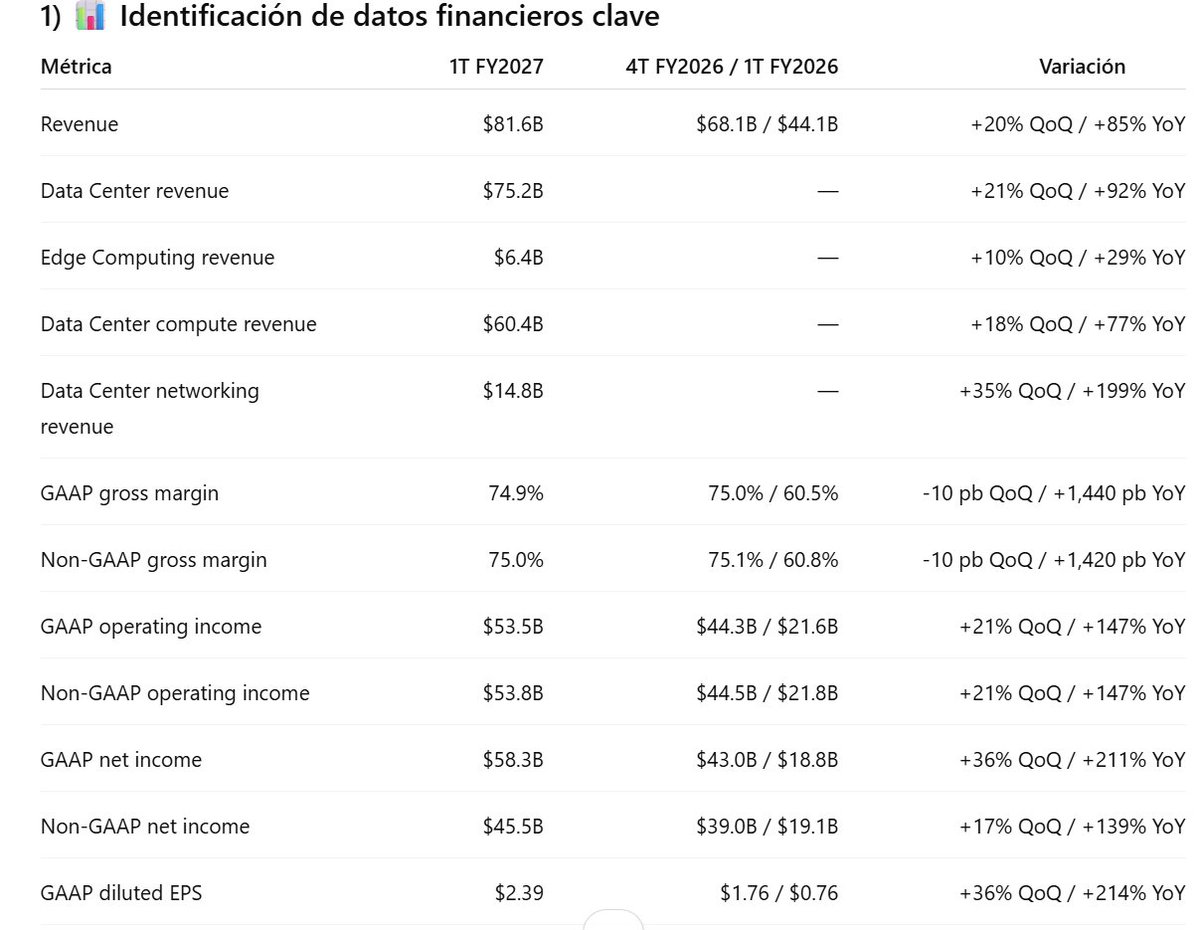
💲Beneficios por Acción:
1,87 dólares Vs 1,75 dólares esperados. ✅
💵 Ingresos:
81,60 B Vs 78,82 B esperados. ✅
2) 🚀 Resumen de operaciones y estrategias de crecimiento
NVIDIA sigue siendo el principal beneficiario del ciclo de inversión en infraestructura de IA. El crecimiento estuvo dominado por Data Center, con revenue de $75.2B, equivalente a más del 92% de los ingresos totales. Dentro del antiguo desglose, compute generó $60.4B y networking $14.8B, destacando que la oportunidad ya no es solo GPU, sino sistemas completos de cómputo, interconexión, networking, software y plataformas de inferencia.
La compañía anunció una nueva estructura de reporte con dos grandes plataformas: Data Center y Edge Computing. Dentro de Data Center separará Hyperscale y ACIE, que incluye AI Clouds, Industrial y Enterprise. Esto es importante porque NVIDIA está ampliando su narrativa desde hyperscalers hacia fábricas de IA por industria, país, nube especializada y empresa.
El crecimiento estratégico también se apoya en nuevas plataformas y alianzas: Vera Rubin, BlueField-4 STX, Dynamo 1.0, Nemotron, BioNeMo, NVLink Fusion con Marvell y acuerdos multianuales con Coherent, Corning y Lumentum para óptica avanzada. En Edge, NVIDIA está empujando gaming, PCs, robótica, automotive, AI-RAN, Omniverse, Isaac, Cosmos y DRIVE Hyperion.
3) 🧾 Análisis de costos y gastos
El cost of revenue fue $20.5B frente a $17.4B en 1T FY2026, creciendo mucho menos que los ingresos. Esto permitió una expansión enorme del gross margin GAAP desde 60.5% hasta 74.9%. La comparación interanual también se benefició de que en 1T FY2026 hubo cargos netos H20 por $4.5B, mientras que en 1T FY2027 no hubo cargos H20 reportados.
Los gastos operativos GAAP fueron $7.6B, 52% YoY, con R&D de $6.3B y SG&A de $1.3B. Aunque los gastos crecieron con fuerza, el apalancamiento operativo fue extraordinario: operating income GAAP subió 147% a $53.5B, porque el crecimiento de revenue y margen absorbió ampliamente la inversión en producto, software, talento e infraestructura comercial.
En calidad de resultados, hay un punto relevante: GAAP net income de $58.3B fue superior al non-GAAP net income de $45.5B por ganancias netas de equity securities de $15.9B dentro de other income. Esto mejora el resultado GAAP, pero no representa utilidad operativa recurrente del negocio central. Desde 1T FY2027, NVIDIA ya no excluye stock-based compensation de sus métricas non-GAAP, lo que hace más conservadora la comparación ajustada frente a su metodología anterior.
4) ⚙️ Análisis de KPIs sectoriales
El KPI sectorial más importante fue Data Center revenue: $75.2B, 92% YoY y 21% QoQ. Esta métrica confirma que la demanda por AI factories, entrenamiento, inferencia, networking y sistemas acelerados sigue acelerándose.
En networking, el crecimiento fue aún más fuerte: Data Center networking alcanzó $14.8B, 199% YoY y 35% QoQ. Esto muestra que las redes de IA son un cuello de botella clave y que NVIDIA captura valor no solo en aceleradores, sino también en interconexión, NVLink, Ethernet/InfiniBand, óptica y almacenamiento acelerado.
Edge Computing generó $6.4B, 29% YoY. Este bloque agrupa dispositivos de procesamiento para agentic y physical AI: PCs, gaming, workstations, AI-RAN, robótica y automotive. Aunque todavía es mucho menor que Data Center, es estratégico porque extiende el ecosistema NVIDIA desde hyperscale hasta edge, vehículo, robot, telco y PC local.
5) 💧 Evaluación de liquidez y apalancamiento
NVIDIA cerró el trimestre con $13.2B en cash and equivalents, $37.1B en marketable debt securities y $30.2B en marketable equity securities. La liquidez financiera es muy amplia, aunque la caja pura representa una parte menor frente a inversiones financieras y securities.
El flujo operativo fue $50.3B y el free cash flow fue $48.6B, cifras excepcionales que dan a la compañía enorme capacidad para financiar crecimiento, inversiones estratégicas, recompras y dividendos sin tensionar el balance.
La deuda total fue aproximadamente $8.5B, compuesta por $1.0B de short-term debt y $7.5B de long-term debt. Frente a shareholders’ equity de $195.5B y generación trimestral de caja operativa superior a $50B, el apalancamiento financiero es muy bajo. El principal uso de caja fue retorno al accionista: $19.3B en recompras y $243M en dividendos durante el trimestre.
6) 🗣️ Narrativa estratégica — citas del CEO
Jensen Huang afirmó: “La construcción de fábricas de IA —la mayor expansión de infraestructura en la historia humana— se está acelerando a una velocidad extraordinaria”.
También señaló: “La IA agéntica ha llegado, haciendo trabajo productivo, generando valor real y escalando rápidamente en compañías e industrias”.
Sobre el posicionamiento de NVIDIA, destacó: “NVIDIA está posicionada de forma única en el centro de esta transformación como la única plataforma que corre en cada nube, impulsa cada modelo frontier y open source, y escala en todos los lugares donde se produce IA”.
La tesis del management es clara: NVIDIA no se presenta solo como proveedor de chips, sino como la plataforma completa para producir IA, desde hyperscale data centers hasta edge, robótica, automotive, telco y enterprise.
7) 🔮 Proyecciones y orientación — guidance
Para 2T FY2027, NVIDIA espera ingresos de $91.0B ±2%. En el punto medio, esto implicaría otro salto secuencial frente a los $81.6B del 1T FY2027. La compañía aclaró que no está asumiendo revenue de Data Center compute desde China en su outlook, un supuesto importante por restricciones geopolíticas y de exportación.
El guidance de margen bruto es muy fuerte: GAAP gross margin esperado de 74.9% y non-GAAP gross margin de 75.0%, ambos ±50 pb. Esto implica que la compañía espera sostener márgenes cercanos a máximos pese al fuerte crecimiento.
Para gastos operativos, NVIDIA espera GAAP opex de aproximadamente $8.5B y non-GAAP opex de $8.3B. Para todo FY2027, espera una tasa fiscal GAAP y non-GAAP entre 16.0% y 18.0%, excluyendo ítems discretos y cambios materiales en el entorno fiscal.
8) 💵 Dividendo y retorno al accionista
NVIDIA retornó aproximadamente $20.0B a accionistas durante el 1T FY2027 mediante recompras y dividendos. Al cierre del trimestre tenía $38.5B restantes bajo su autorización de recompra.
El 18 de mayo de 2026, el directorio aprobó una autorización adicional de recompra de $80.0B, sin fecha de expiración. Esto representa una señal de confianza muy fuerte en la generación futura de caja.
La compañía también aumentó el dividendo trimestral de $0.01 a $0.25 por acción. El dividendo se pagará el 26 de junio de 2026 a accionistas registrados al 4 de junio de 2026. Aunque el dividend yield dependerá del precio de la acción, el aumento es simbólicamente relevante: NVIDIA está pasando de dividendo casi testimonial a una política de retorno más visible.
9) ✅❌ Puntos positivos y negativos del trimestre
Positivos: ingresos récord de $81.6B, Data Center 92% YoY, networking 199% YoY, gross margin cercano a 75%, operating income 147%, net income GAAP 211%, free cash flow de $48.6B y guidance de $91B para el próximo trimestre. Es un trimestre de hipercrecimiento con rentabilidad y caja extraordinarias.
Positivos estratégicos: NVIDIA está ampliando su moat: Vera Rubin, Dynamo, BlueField, Nemotron, NVLink Fusion, alianzas en silicon photonics, óptica avanzada, colaboración con Google Cloud, automotive, AI-RAN, robótica y physical AI. La compañía está capturando múltiples capas del stack de IA: chip, sistema, red, software, modelo, simulación y edge.
Negativos: la valoración operativa depende cada vez más de Data Center, que concentra la inmensa mayoría del revenue. El GAAP net income se benefició de $15.9B en ganancias netas de equity securities, lo que infla la utilidad contable frente al resultado operacional ajustado. Además, el outlook excluye revenue de China Data Center compute, señal de riesgo geopolítico persistente.
Riesgos: restricciones de exportación, China, dependencia de terceros para fabricar, ensamblar, empaquetar y testear productos, competencia tecnológica, aceptación de mercado, defectos de diseño/software, cambios en estándares, integración de tecnologías en sistemas, presión de supply chain, disponibilidad de energía/data centers para clientes y cambios regulatorios o geopolíticos.
10) 🧠 Opinión o calificación del desempeño
Calificación: 9.5/10. El trimestre fue excepcional: crecimiento de ingresos, margen bruto, operating income, FCF y guidance muestran una compañía operando en una escala histórica. La nota no es 10/10 porque existen riesgos importantes de concentración en Data Center, geopolítica/China, dependencia de supply chain y una parte del net income GAAP provino de ganancias financieras no operativas. Aun así, operacionalmente es uno de los reportes más fuertes del sector tecnológico.
11) 🧩 Resumen conciso y puntos clave
NVIDIA reportó un 1T FY2027 extraordinario, con ingresos récord de $81.6B, 85% YoY, Data Center de $75.2B, 92%, networking de $14.8B, 199%, gross margin GAAP de 74.9%, operating income GAAP de $53.5B, net income GAAP de $58.3B y free cash flow de $48.6B; la compañía continúa en el centro del despliegue global de fábricas de IA, con nuevas plataformas como Vera Rubin, Dynamo, BlueField-4, NVLink Fusion, alianzas en óptica avanzada y expansión hacia Edge Computing, automotive, robótica, AI-RAN y physical AI; además, guió ingresos de $91B ±2% para 2T FY2027, aprobó $80B adicionales en recompras y elevó el dividendo trimestral a $0.25, aunque los principales riesgos son concentración en Data Center, restricciones a China, dependencia de supply chain y el componente no operativo de ganancias por equity securities.
12) 📌 Cierre
No olvides seguirme en mi cuenta X para mantenerte al tanto de los mercados financieros 👉 x.com/IngJuanPa7
2
28
2,114

May 20
i am publishing part 2 of my deep dive into NVIDIA's protein research.
part 2 covers:
> how NVIDIA made AlphaFold 138x faster (MMseqs2-GPU, OpenFold optimizations)
> BioNeMo: GPT trained on 3.5 billion years of evolution instead of Twitter
>ESM: 3 billion parameter protein language models learning from all of life
> MegaMolBART: language models for chemistry (SMILES strings → drug candidates)
> ProteinDT: literally design proteins by describing them in plain english
> why pharmaceutical companies are using this right now

14 Dec 2025

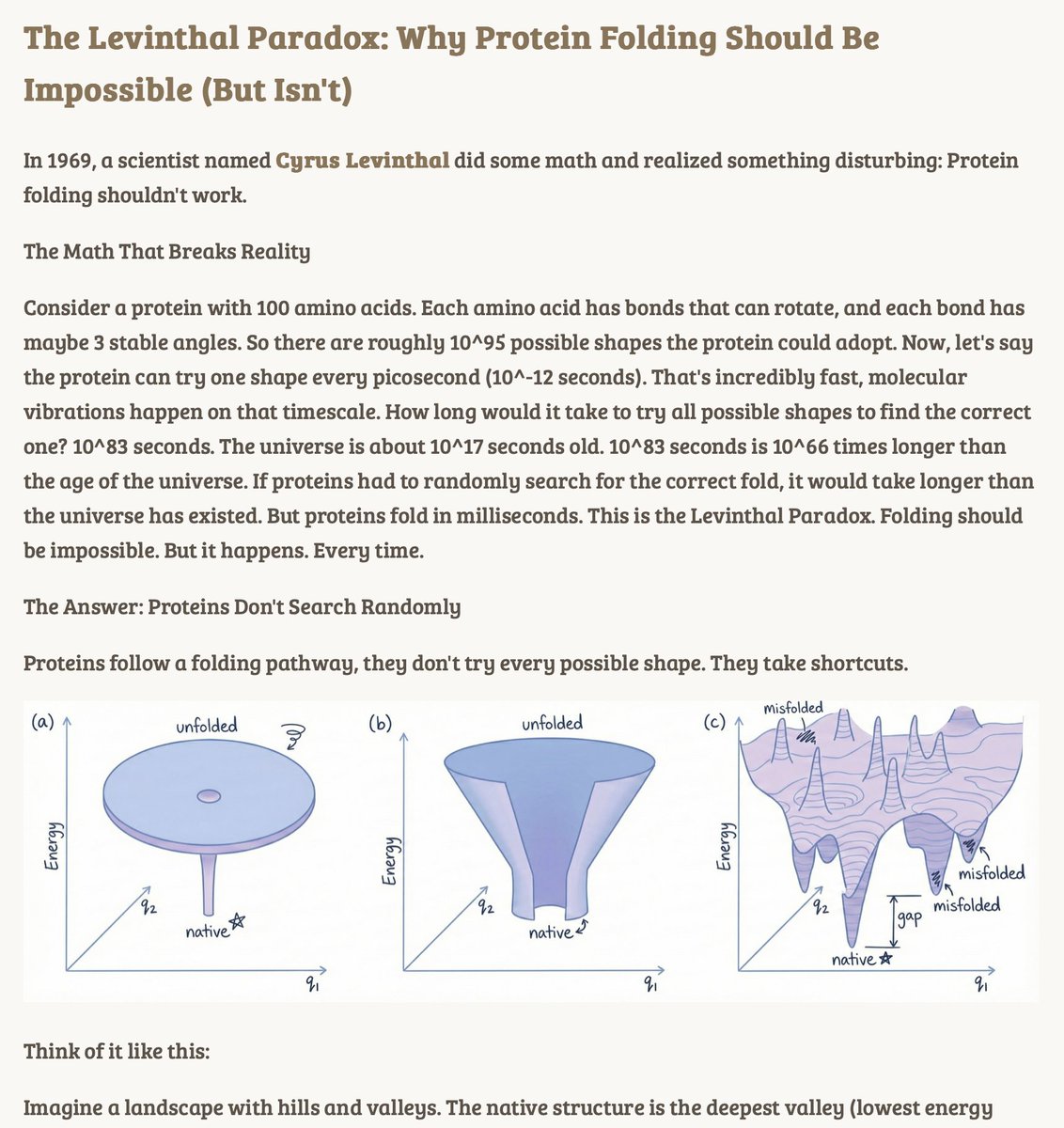
i am publishing part 1 of my deep dive into NVIDIA's protein research.
part 1 covers:
> what proteins actually are (20 amino acids → infinite nightmare)
> why shape = function (one wrong fold = disease)
> the Levinthal Paradox
> why predicting folding was impossible
> AlphaFold solving it in 2020
> why NVIDIA
this was supposed to be one blog. then I hit 12,495 words and hadn't even gotten to the NVIDIA part yet. so now it's two parts because I have no self-control when explaining biology.
2
3
34
4,772

May 20
QIAGEN Partners With NVIDIA to Advance AI-Driven Drug Discovery ( $QGEN, $NVDA )
🔺 QIAGEN COLLABORATES WITH NVIDIA
🔺 The corporate alliance integrates advanced AI processing into complex bioinformatics workflows.
🔺 QIAGEN BIOMEDICAL DATABASES
🔺 Massive genomic data repositories are combined with the NVIDIA BioNeMo platform.
🔺 NVIDIA BIONEMO PLATFORM INTEGRATION
🔺 The platform scales generative AI applications for specialized molecular and biological data.
🔺 IDENTIFYING DISEASE MECHANISMS
🔺 The partnership focuses heavily on uncovering hidden pathways behind complex human diseases.
🔺 BIOMARKER DISCOVERY ADVANCEMENT
🔺 Advanced compute structures will accelerate the detection of specific diagnostic biological markers.
🔺 THERAPEUTIC TARGET IDENTIFICATION
🔺 The system streamlines the hunting process for precision druggable proteins.
🔺 GRAPH-BASED AI APPLICATION
🔺 Computational workflows apply graph-based machine learning to highly interconnected biological networks.
🔺 DRUG REPURPOSING USE CASES
🔺 The software searches for new clinical indications for existing established medical compounds.
🔺 PATHWAY ANALYSIS SCALING
🔺 Neural networks map out intricate molecular interactions inside living tissue models.
🔺 QIAGEN KNOWLEDGE BASE REACH
🔺 Curated biological datasets currently serve over 150,000 active global scientists.
🔺 INITIAL PILOT PROGRAMS LAUNCHING
🔺 Early operational rollouts are beginning immediately with premier pharmaceutical organizations.
🔺 BIOTECH PARTNER COLLABORATION
🔺 Select biotechnology firms are receiving immediate pilot access to optimize early pipelines.
#QIAGEN #NVIDIA #AI #DrugDiscovery #Bioinformatics #HealthcareTech
Disclaimer :
All content provided is intended solely for educational and informational purposes and does not constitute financial advice. Investors are strongly encouraged to assess their individual risk tolerance, investment objectives, and overall financial situation before making any investment decisions. For personalized guidance, please consult a certified financial advisor. While every effort has been made to ensure accuracy, any inadvertent errors or omissions are regretted.
2
202

May 19
📢 𝐉𝐔𝐒𝐓 𝐈𝐍: QIAGEN Partners With NVIDIA to Advance AI-Driven Drug Discovery - $QGEN $NVDA
👉 𝐊𝐞𝐲 𝐇𝐢𝐠𝐡𝐥𝐢𝐠𝐡𝐭𝐬:
➤ QIAGEN collaborates with 𝐍𝐕𝐈𝐃𝐈𝐀 to integrate AI into bioinformatics workflows.
➤ Partnership combines QIAGEN biomedical databases with 𝐍𝐕𝐈𝐃𝐈𝐀 𝐁𝐢𝐨𝐍𝐞𝐌𝐨 platform.
➤ Focus on identifying 𝐝𝐢𝐬𝐞𝐚𝐬𝐞 𝐦𝐞𝐜𝐡𝐚𝐧𝐢𝐬𝐦𝐬, biomarkers, and therapeutic targets.
➤ Integration applies 𝐠𝐫𝐚𝐩𝐡-𝐛𝐚𝐬𝐞𝐝 𝐀𝐈 to complex biological datasets.
➤ Supports drug discovery use cases including 𝐝𝐫𝐮𝐠 𝐫𝐞𝐩𝐮𝐫𝐩𝐨𝐬𝐢𝐧𝐠 and pathway analysis.
➤ QIAGEN knowledge bases currently serve 𝟏𝟓𝟎,𝟎𝟎𝟎 scientists globally.
➤ Initial pilot programs launching with select 𝐩𝐡𝐚𝐫𝐦𝐚 and biotech partners.
4
9
2,420

May 19
일라이 릴리(Eli Lilly) 인터뷰: AI 신약 개발 플랫폼 TuneLab & 생물학 데이터 부족 문제
Catalyze360 AI/ML 부문 부사장 Aliza Apple: (의역이 포함되어 있습니다.)
$LLY
-
일라이 릴리의 AI 바이오 시장 진출
최근 AI 바이오 산업은 구글, OpenAI, 엔비디아 같은 빅테크 또는 AI 바이오 스타트업들이 주도해왔는데, 이제는 기존 대형 제약사들도 본격적으로 뛰어들기 시작했습니다. 그중에서도 가장 적극적인 곳 중 하나가 바로 세계 최대 제약사인 일라이 릴리(Eli Lilly)입니다. 릴리는 올해 초 엔비디아와 함께 최대 10억 달러 규모의 AI 공동 연구소 구축 계획까지 발표했는데, 단순히 GPU만 사는 수준이 아니라 AI 기반 생물학 연구 시스템 자체를 만들겠다는 방향을 제시했습니다.
특히 릴리는 AI 모델 엔지니어, 의사, 생물학자들이 함께 차세대 생물학 파운데이션 모델을 개발하고, 여기에 엔비디아의 BioNeMo, 초거대 AI 슈퍼컴퓨터, 로봇 자동화 실험실, 디지털 트윈, 피지컬 AI까지 연결하려 하고 있습니다. 쉽게 말하면 기존에는 사람이 중심이었던 신약 개발 실험실을 장기적으로 AI 중심 자동화 연구소로 바꾸려는 방향에 가깝습니다.
-
릴리의 AI 신약 개발 플랫폼 TuneLab
TuneLab의 핵심은 릴리가 수십 년 동안 축적해온 신약 개발 데이터를 AI 모델로 학습시켜 외부 바이오텍들도 사용할 수 있게 만든 플랫폼이라는 점입니다. 단순히 질문에 답하는 챗봇이 아니라 실제로 신약 후보물질을 설계하고 평가하는 AI 시스템에 가깝습니다. TuneLab은 분자 설계, 약물 최적화, ADMET 예측, 독성 예측, 항체 개발 가능성 분석 등의 작업을 수행할 수 있습니다. 즉 실제 제약사가 신약 후보를 고를 때 가장 중요하게 보는 요소들을 AI가 먼저 예측해주는 것입니다.
-
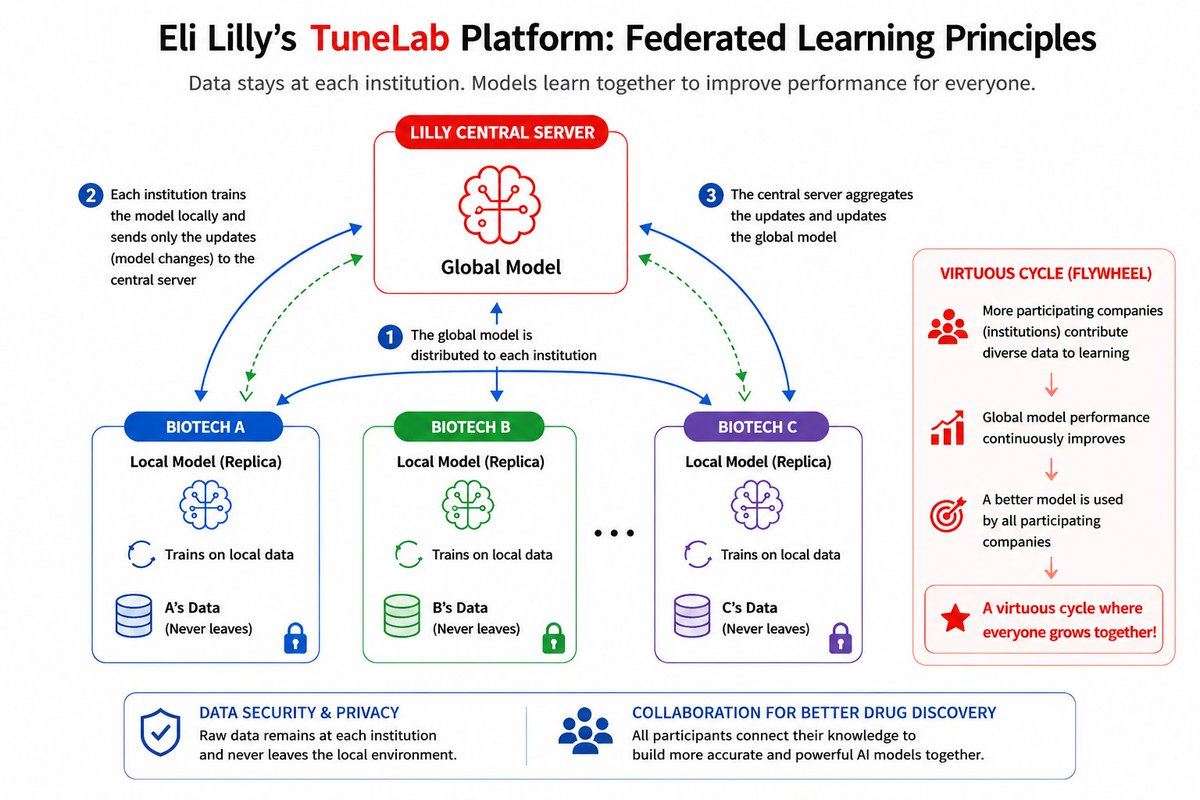
가장 중요한 핵심은 연합학습 (Federated Learning)
제약 산업의 가장 큰 문제 중 하나는 데이터 사일로(data silo)입니다. 대부분 제약사와 바이오텍들은 자기 실험 데이터를 외부에 절대 공유하지 않습니다. 그런데 AI는 원래 데이터가 많을수록 성능이 좋아지기 때문에, 데이터가 서로 고립되어 있으면 AI 발전도 제한될 수밖에 없습니다.
릴리는 이를 해결하기 위해 연합학습 구조를 사용했습니다. 먼저 릴리의 글로벌 AI 모델을 TuneLab 플랫폼에 참여하는 각 기관 서버에 복사해 보내면, 이들은 자기 데이터로 로컬에서 모델을 추가 학습시킵니다. 이후 실제 데이터는 보내지 않고 모델 내부 가중치(weights)가 얼마나 변했는지만 중앙 서버로 전달합니다. 그러면 중앙 서버는 여러 회사에서 온 변화량을 합쳐 다시 글로벌 모델을 업데이트합니다. 즉 데이터는 각 참여 기관들 안에 그대로 남아 있으면서도 AI 모델만 함께 학습시키는 구조입니다.
-
TuneLab을 통한 신약 개발 초기 단계 자동화
신약 개발에서 가장 오래 걸리고 실패가 많은 구간 중 하나가 hit-to-lead와 lead optimization 단계입니다. 먼저 수많은 후보물질(hit) 중에서 가능성 있는 물질을 찾고, 이후 이를 실제 약으로 발전 가능한 수준까지 계속 최적화해야 하는데, 이 과정에 엄청난 실험 비용과 시간이 들어갑니다.
과거에는 수많은 분자를 실제로 하나씩 합성해서 wet lab 실험을 반복해야 했습니다. 하지만 TuneLab은 실제 분자를 만들기 전에 AI가 먼저 효과 가능성, 독성, 약물 특성 등을 미리 계산으로 예측합니다. 쉽게 말하면 실험 전에 컴퓨터가 먼저 가능성 낮은 후보들을 대량으로 걸러주는 구조입니다.
-
가장 큰 병목은 결국 데이터
AI 바이오의 핵심 병목은 모델 구조보다 데이터 부족입니다. 특히 릴리는 앞으로 궁극적으로는 분자의 화학 구조 문자열인 SMILES만 입력하면, AI가 실제 동물 안에서 그 약물이 어떻게 작동할지까지 예측하는 수준을 목표로 하고 있습니다.
문제는 이런 인비보(in vivo) 예측을 위해서는 엄청난 규모의 실제 실험 데이터가 필요하다는 점입니다. 특히 설치류뿐 아니라 더 큰 동물 종 데이터까지 확보하려면 난이도가 급격히 올라갑니다. 결국 릴리는 AI 바이오 산업의 진짜 경쟁력은 얼마나 많은 고품질 생물학 데이터를 확보하고 연결할 수 있느냐에 달려 있다고 보고 있습니다.
-
AI 신약 개발 네트워크 효과
결국 릴리가 가장 노리는 구조는 일종의 AI 플라이휠입니다. 여러 바이오텍 기업들이 TuneLab에 참여해 데이터를 기반으로 모델 성능을 개선하면, 그 향상된 모델이 다시 전체 참여 기업들에게 돌아갑니다. 그러면 더 많은 기업이 참여하고, 데이터가 더 많아지고, 모델 성능도 다시 좋아지는 선순환 구조가 만들어집니다. 즉 릴리는 단순히 자기 회사 내부 AI를 잘 만들겠다는 수준을 넘어서, 장기적으로는 여러 바이오텍 데이터를 연결하는 AI 신약 개발 생태계 자체를 구축하려는 방향으로 움직이고 있습니다.
1
6
319


May 18
איפה לדעתי אנבידיה נכנסת בסיפור?
ג׳נסן חושב רחוק תזכרו. בנוסף רפואה זה נושא גם שחשוב לו.
ההשקעות נועדו להפוך מודלים של מחשוב בעל ביצועים גבוהים ובינה מלאכותית לסטנדרט התעשייה לגילוי תרופות.
כל החישובים האלה של הAI דורשים כוח עצום של מחשבים. הGPU שלהם הם כמו המנוע שמאפשר ל AI ללמוד ולהמציא את החלבונים האלה במהירות. בלי הכוח הזה זה היה לוקח שנים.
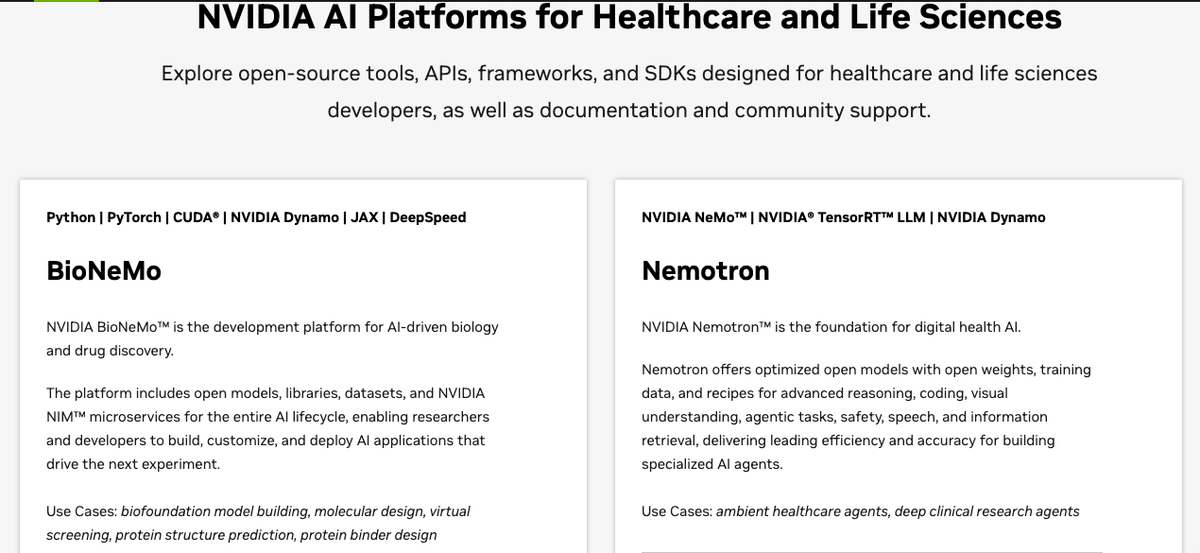
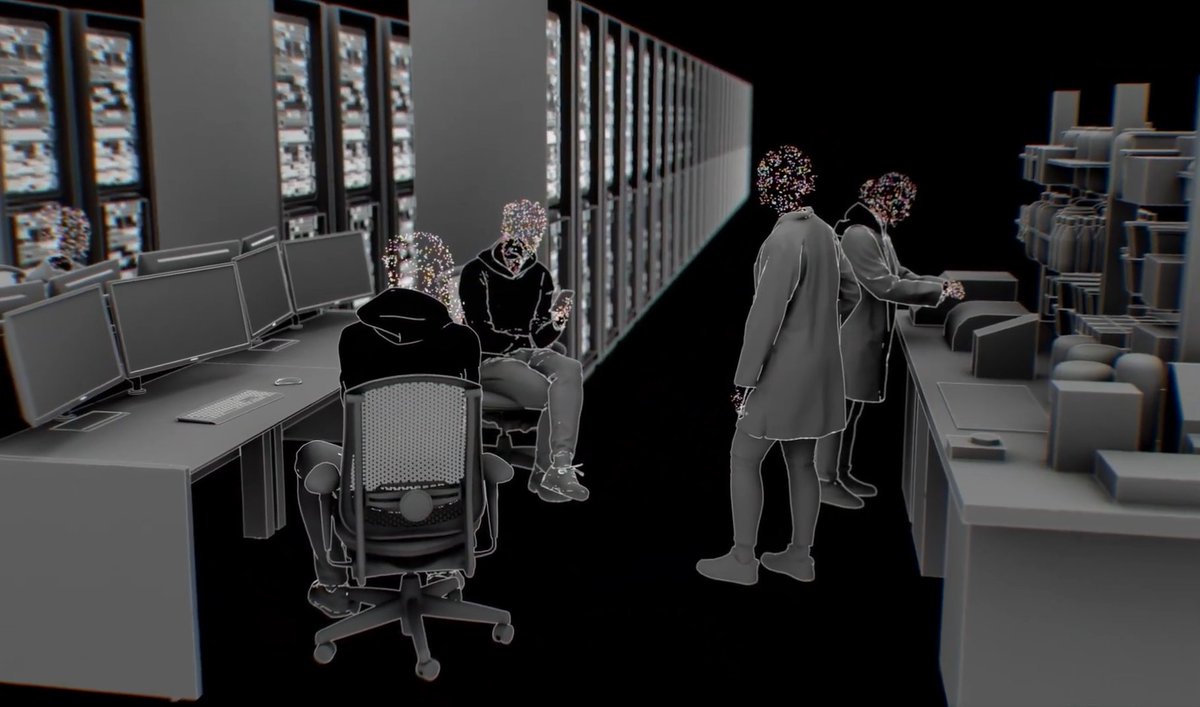
אנבידיה לא רק משקיעה בחברות כמו Generate Biomedicines היא בונה תשתית לזה.. בעמוד הרשמי שלה בתחום הרפואה ומדעי החיים היא מציגה גם את BioNeMo- (פלטפורמת AI ייעודית לפיתוח תרופות וביולוגיה גנרטיבית) ואת Nemotron (התשתית של AI לרפואה דיגיטלית).
שתי הפלטפורמות האלה מאפשרות לחוקרים ולחברות לבנות, להתאים ולפרוס יישומים מתקדמים מתכנון חלבונים ומולקולות, דרך חיזוי מבנה חלבונים ועד סוכני AI רפואיים ומחקר קליני עמוק.
לכן אנבידיה השקיעה בחברה כבר ב-2023 ועכשיו קנתה מניות..זה לא סתם השקעה זה חלק מהחזון של ג'נסן שזה שה AI של אנבידיה לא רק עושה תמונות או טקסט, הוא הולך לשנות גם את עולם התרופות, הבריאות והביולוגיה..
בקיצור, פעם פעם הביולוגיה הייתה בוא ננסה ונראה.. עכשיו היא הופכת לבוא נתכנן בדיוק מה שאנחנו צריכים!.
וזה משנה חשיבה בהכל החל מתרופות יותר טובות, יותר מהירות לפיתוח ויותר זולות בסופו של דבר.. אנבידיה בונה כאן גם את האקוסיסטם השלם, מצד אחד חומרה חזקה שכולם צריכים, ומצד שני השקעות אסטרטגיות בחברות שיוצרות יישומים אמיתיים (של AI).
איך שאני רואה את זה ההשקעה ב $GENB היא לא סתם שורה במסמך או סימון וי של השקעה כלשהי היא הצצה מרתקת לעתיד שבו AI לא רק עוזר לנו להבין את הביולוגיה אלא ממש מתכנת אותה. למען מטרה הכי נעלה שיש. עולם שבו תרופות חדשות יגיעו לשוק מהר יותר, יעילות יותר ומותאמות יותר לאדם הספציפי..
וזה בסופו של דבר החזון הגדול של ג'נסן- לא רק AI חזק אלא AI שמשנה את העולם.

1
31
2,041

May 16
Lec08.1. 计算范式的根本性转变
黄仁勋认为,自 IBM System/360 以来长达64年基本未变的计算模型,正在经历真正意义上的第一次颠覆。核心变化是:从「预录制内容的检索」转向「实时生成」——计算机不再只响应明确指令,而是能够感知上下文、理解意图、持续运行。这一转变影响的不只是应用层,而是从软件工程方法论、公司组织方式,一直到芯片架构的每一个层级。
2. 协同设计(Co-design)与百万倍加速
黄仁勋以斯坦福 RISC 架构的诞生为引子,阐释协同设计的核心理念:将编译器、框架、芯片架构、网络、存储作为一个整体同时优化,而非各自独立调优。摩尔定律时代每10年约10倍的提升,在 NVIDIA 的协同设计路径下变成了10年约100万倍。他认为正是这种量级的加速,使得 AI 研究者得以直接用全量互联网数据训练模型,从根本上改变了 AI 的发展轨迹。
3. 芯片架构演进路线:从 Hopper 到费曼(Feynman)
黄仁勋逐代拆解了 NVIDIA 的架构决策逻辑:Hopper 针对预训练设计,目标是支撑数十亿美元规模的训练集群;Grace Blackwell NVLink 72 针对推理和解码设计,通过将72块芯片以高带宽互联组成机架级计算机,实现了相比上一代50倍的性能提升;Vera Rubin 针对智能体(Agentic)计算设计,重点解决长期记忆存储直连、低延迟 CPU 响应工具调用等问题;而下一代费曼(Feynman)则可能面向由智能体集群构成的多层级系统。
4. 开源模型战略与多领域基础模型布局
黄仁勋区分了两类 AI 工具的使用逻辑:对于通用语言任务,他明确推荐直接使用 OpenAI 和 Anthropic 的前沿闭源产品(NVIDIA 内部100%工程师已接入智能体工具);而 NVIDIA 自身大力投入开源模型(Nemotron、BioNemo、Alpamayo、Groot 等),原因有三:覆盖小语种社会、与领域专用模型融合(如 Alpamayo 将语言推理能力注入自动驾驶)、以及 AI 安全——他认为黑盒系统无法被有效防御,开放透明才是构建网络安全防线的基础。
5. MFU 指标之争与算力评估哲学
针对「MFU(模型算力利用率)只有11%」的批评,黄仁勋给出了反直觉的回答:他个人希望 MFU 保持低位,因为这意味着算力是过度配置的,系统不会被阿姆达尔定律(Amdahl's Law)卡住。他认为更有意义的指标是「每瓦特 Token 数」,而非原始算力利用率,并指出在 LLM 解码场景下,NVLink 72 的聚合带宽才是决定效率的关键变量。这一段讨论延伸出一个更大的命题:评估指标的选择本身就是战略决策,优化错误的指标会导致整个团队走偏。
6. 出口管制与地缘政治
黄仁勋对将 GPU 类比为原子弹的说法表达了强烈反对,认为这一前提本身就是错误的,无法从中推导出任何合理结论。他同时批评「反正会输就不要竞争」的逻辑,并警告:如果政策导致美国科技公司主动放弃三分之二的全球市场,最终受损的是整个美国科技产业的竞争力,历史上美国电信基础技术的消失就是前车之鉴。
7. 职业观:拥抱痛苦,而非只追求激情
黄仁勋对「找到热爱的事才能成功」这一流行观点提出了修正。他坦言自己真正热爱的工作只占10%,另外90%是艰难的煎熬,但他仍会全力以赴。他认为,痛苦和磨砺是培养韧性的必要路径,而韧性是一种需要反复锻炼才能形成的「肌肉」,在关键时刻不可或缺。
8. 战略决策与第一性原理推理
黄仁勋分享了他的决策框架:观察现象 → 第一性原理拆解 → 推演「然后呢」→ 判断量级(大事/小事)→ 构建未来心智模型 → 从未来往回推导当下行动。他以 AlexNet 为例,说明如何从一个技术突破中识别出范式级的转变。他也坦承这个过程充满不确定性,关键在于区分「必然发生」「很可能发生」「可能发生」三类事件,并管理好战略选择的机会成本。
5
134
May 14
$NVDA $NOK $LITE $COHR NVDA PUBLIC EQUITY INVESTMENTS: SCOPE AND CONCLUSION
Analysis through May 13, 2026 identifies 18 public-company NVIDIA equity or equity-linked investments over the last 10 years, subject to the important limitation that NVIDIA does not disclose every individual investment check size, especially when participating in multi-investor private rounds or when a public holding is first visible only through Form 13F. The identified public-company universe comprises SoundHound AI, TuSimple Holdings/CreateAI, Serve Robotics, CoreWeave, Recursion Pharmaceuticals, Arm Holdings, Nano-X Imaging, Applied Digital, Nebius Group, WeRide, Intel, Nokia, Synopsys, Lumentum, Coherent, Marvell, Corning, and IREN. This universe includes direct PIPEs, IPO allocations, private placements, 13F-disclosed public equity holdings, 13G-disclosed beneficial ownership, pre-IPO investments in companies that later became public, and announced 2026 equity-linked strategic structures. Purely private companies that were not listed as of May 13, 2026, acquisitions, ordinary commercial supply agreements without disclosed equity, and customer financing without disclosed equity are excluded.
The most important investment conclusion is that NVIDIA’s public-company equity program moved from relatively small, venture-style AI and autonomy option value in 2017-2024 toward large-scale strategic balance-sheet deployment in 2025-2026 across AI cloud capacity, x86 compute, telecom/AI-RAN, EDA, optical components, silicon photonics, data-center connectivity, and power/data-center infrastructure. NVIDIA’s Q4 2023 public equity portfolio contained Arm, Nano-X, Recursion, SoundHound, and TuSimple; by Q4 2025 it had rotated into CoreWeave, Intel, Nebius, Nokia, and Synopsys. That rotation is strategically significant because the capital increasingly targets bottlenecks that could constrain NVIDIA’s own revenue flywheel: AI-cloud capacity, data-center networking, optical interconnects, EDA/simulation, CPU/GPU system integration, AI-RAN adoption, and next-generation AI factory deployment. The program is therefore less accurately characterized as passive financial investing and more accurately characterized as ecosystem-capacity financing, with financial upside attached to strategic demand creation. (SEC)
TRANSACTION RECORD
SOUNDHOUND AI, INC. Listing: Nasdaq: SOUN. Date: Jan 31, 2017 for the disclosed private financing; Dec 31, 2023 for NVIDIA’s first clearly visible public 13F holding in the period reviewed; Q4 2024 for exit. Transaction size: SoundHound raised $75M from investors including NVIDIA, Samsung Catalyst Fund, Kleiner Perkins, and others; NVIDIA’s individual check size was not disclosed. NVIDIA later reported 1,730,883 SoundHound shares worth $3.7M at Dec 31, 2023, with the position rising in market value to $6.8M at Jun 30, 2024 and $8.1M at Sep 30, 2024 before being exited in Q4 2024. Description: SoundHound is a conversational AI and voice-interface company; the investment fit NVIDIA’s early AI application ecosystem strategy rather than the later hard-infrastructure financing strategy. (TechCrunch)
TUSIMPLE HOLDINGS INC. / CREATEAI. Listing: formerly Nasdaq: TSP. Date: Aug 16, 2017 for the disclosed private investment; Dec 31, 2023 for NVIDIA’s visible public 13F holding. Transaction size: TuSimple raised $20M in a round led by Sina, with NVIDIA participating as a strategic investor; NVIDIA’s individual check size was not disclosed. NVIDIA later reported 3,465,372 TuSimple shares worth $3.0M at Dec 31, 2023. Description: TuSimple was an autonomous trucking and self-driving software company. The position was consistent with NVIDIA’s DRIVE/autonomous-vehicle ecosystem strategy and represented an early autonomy platform option rather than a later AI-infrastructure bottleneck investment. (TechCrunch)
SERVE ROBOTICS INC. Listing: Nasdaq: SERV. Dates: NVIDIA began investing in Serve in 2022; Serve completed its business combination on Jul 31, 2023; NVIDIA’s Jan 2, 2024 convertible promissory note converted into 1,050,129 shares on Apr 22, 2024; NVIDIA disclosed 10.0% beneficial ownership in July 2024; the 13F position was visible in Q2 2024 and Q3 2024 and was exited in Q4 2024. Transaction size: Serve disclosed that NVIDIA had invested more than $12M since 2022, including $9M through 2022 SAFEs. NVIDIA owned 2,676,904 shares immediately after the business combination, including 62,500 shares purchased in a concurrent private placement, and later held 3,727,033 shares after note conversion. Market value was $7.3M at Jun 30, 2024 and $29.6M at Sep 30, 2024. Description: Serve Robotics develops autonomous sidewalk delivery robots. The investment was a robotics/autonomy application exposure and was monetized before NVIDIA’s 2025-2026 shift toward much larger infrastructure and supply-chain transactions. (Serve Robotics)
COREWEAVE, INC. Listing: Nasdaq: CRWV. Dates: Apr 2023 for NVIDIA’s pre-IPO investment; Mar 2025 for IPO participation; Jan 26, 2026 for the later $2B strategic stock investment. Transaction size: NVIDIA reportedly invested $100M in Apr 2023 by purchasing 17.9M preferred shares at $5.58 per share, then invested an additional $250M in CoreWeave’s Mar 2025 IPO at $40 per share, acquiring 6.25M shares. NVIDIA then invested $2B in CoreWeave Class A common stock at $87.20 per share on Jan 26, 2026, bringing identified NVIDIA equity capital deployed into CoreWeave to approximately $2.35B. NVIDIA’s Q1 2025 13F showed 24,182,460 shares worth $896.7M, and its Q4 2025 13F showed 24,277,573 shares worth $1.74B before the Jan 2026 incremental purchase. Description: CoreWeave is an AI-native cloud and accelerated compute provider built around NVIDIA GPU infrastructure. This is one of NVIDIA’s most strategically important ecosystem investments because it supports AI factory capacity, GPU cluster deployment, and downstream demand absorption for NVIDIA accelerated computing systems. (Barron's)
RECURSION PHARMACEUTICALS, INC. Listing: Nasdaq: RXRX. Date: Jul 12, 2023. Transaction size: NVIDIA made a $50M PIPE investment. NVIDIA’s Q4 2023 13F showed 7,706,363 shares worth $76.0M; the position remained visible through Q3 2025 and was no longer present in the Q4 2025 13F portfolio. Description: Recursion is an AI-enabled drug discovery company. The investment targeted biological and chemical foundation models, with the strategic collaboration centered on NVIDIA’s BioNeMo platform and DGX Cloud. This was a vertical AI software/science exposure, not a core supply-chain capacity transaction. (Recursion Pharmaceuticals, Inc.)
ARM HOLDINGS PLC. Listing: Nasdaq: ARM ADS. Dates: Sep 2023 IPO; Dec 31, 2023 for NVIDIA’s first 13F-disclosed holding; Q4 2024 for the 43.8% position reduction; Q4 2025 for the full exit from the 13F portfolio. Transaction size: Arm priced 102.5M ADS at $51 per ADS in Sep 2023. NVIDIA held 1,960,784 ADS at Dec 31, 2023, implying an IPO allocation of approximately $100M if purchased at the IPO price; the position was worth $147.3M at Dec 31, 2023. NVIDIA reduced the position to 1,101,249 shares by Dec 31, 2024 and sold the remaining stake by Q4 2025. Description: Arm is a CPU architecture IP and processor ecosystem company. The investment had clear strategic relevance to NVIDIA’s Grace CPU, data-center CPU architecture, edge/client compute, and heterogeneous computing roadmap, although it was later monetized as NVIDIA concentrated public equity capital into AI infrastructure and supply-chain partners. (Arm Investor Relations)
NANO-X IMAGING LTD. Listing: Nasdaq: NNOX. Date: Dec 31, 2023 for NVIDIA’s first visible 13F holding in the period reviewed. Transaction size: the underlying NVIDIA transaction price and acquisition date were not publicly disclosed in the reviewed materials. NVIDIA reported 59,632 shares worth $0.4M at Dec 31, 2023, $0.4M at Jun 30, 2024, and $0.4M at Sep 30, 2024, before exiting in Q4 2024. Description: Nano-X Imaging is a medical imaging company. The position was small and appears best classified as a legacy or exploratory AI/healthcare-related public equity stake rather than a strategic platform investment. (SEC)
APPLIED DIGITAL CORPORATION. Listing: Nasdaq: APLD. Date: Sep 5, 2024. Transaction size: Applied Digital announced a $160M strategic financing through the issuance of 49,382,720 shares at $3.24 per share to investors including NVIDIA. NVIDIA’s individual check was not explicitly disclosed in the company release, but NVIDIA’s Q3 2024 13F showed 7,716,050 shares; at the disclosed $3.24 issue price, that share count implies approximately $25M of gross NVIDIA participation if the shares were purchased in that financing. The position was worth $63.7M at Sep 30, 2024, $59.0M at Dec 31, 2024, and $177.0M at Sep 30, 2025, before being sold by Q4 2025. Description: Applied Digital develops and operates data-center and high-performance computing infrastructure for AI workloads. The investment was a bridge between NVIDIA’s earlier AI application investments and its later, larger AI data-center capacity strategy. (Applied Digital Corporation)
NEBIUS GROUP N.V. Listing: Nasdaq: NBIS Class A. Dates: Dec 2, 2024 for the initial strategic private placement; Mar 11, 2026 for NVIDIA’s later $2B investment commitment. Transaction size: Nebius announced a $700M private placement with investors including Accel, NVIDIA, and Orbis in Dec 2024. The placement comprised 33,333,334 Class A shares at $21 per share; NVIDIA’s individual allocation was not separately disclosed. NVIDIA’s Q4 2024 13F showed 1,190,476 Nebius shares worth $33.0M, which implies approximately $25M at the $21 placement price if that full position came from the Dec 2024 placement. On Mar 11, 2026, NVIDIA agreed to invest $2B in Nebius, with press reporting indicating an approximately 8.3% stake at $94.94 per share. Description: Nebius is a full-stack AI cloud and “neocloud” infrastructure provider. The strategic logic is direct: Nebius intends to deploy more than 5 GW of AI infrastructure by 2030, and NVIDIA’s equity capital supports a customer and infrastructure partner capable of absorbing large-scale NVIDIA systems. (Nebius)
WERIDE INC. Listing: Nasdaq: WRD ADS. Date: Q4 2024 for NVIDIA’s first visible 13F-disclosed public holding. Transaction size: NVIDIA’s purchase price was not disclosed. NVIDIA reported 1,738,563 WeRide ADS worth $24.7M at Dec 31, 2024 and the same share count worth $17.2M at Sep 30, 2025; the position was sold by Q4 2025. Description: WeRide is an autonomous-driving company with robotaxi and autonomous mobility exposure. The investment fit NVIDIA’s autonomy ecosystem strategy and was later exited as the 13F portfolio concentrated into AI cloud, silicon, telecom, and EDA infrastructure names. (SEC)
INTEL CORPORATION. Listing: Nasdaq: INTC. Date: Sep 18, 2025. Transaction size: NVIDIA invested $5B in Intel common stock at $23.28 per share; NVIDIA’s Q4 2025 13F showed 214,776,632 Intel shares worth $7.93B, consistent with the disclosed investment size and share price. Description: The transaction created a strategic collaboration under which Intel would build NVIDIA-custom x86 CPUs for AI infrastructure and x86 RTX SOCs integrating NVIDIA RTX GPU chiplets through NVLink. The deal was strategically important because it tied NVIDIA to x86 CPU supply, PC/AI PC integration, data-center CPU customization, and broader system-level platform expansion while also supporting Intel’s capital structure and market credibility. (NVIDIA Investor Relations)
NOKIA OYJ / NOKIA CORPORATION. Listings: Nasdaq Helsinki: NOKIA; Euronext Paris: NOKIA; NYSE: NOK ADS. Date: Oct 28, 2025. Transaction size: NVIDIA agreed to invest $1.0B in Nokia at $6.01 per share, with Nokia issuing 166,389,351 new shares to NVIDIA. Nokia stated that NVIDIA would become a 2.90% shareholder following the issuance. NVIDIA’s Q4 2025 13F showed 166,389,351 Nokia ADS worth $1.08B. Description: Nokia and NVIDIA framed the transaction around AI-RAN, 5G Advanced, 6G, and data-center networking. The investment is strategically significant because radio access networks are a major potential adjacency for accelerated computing, and AI-RAN could expand NVIDIA’s addressable market from data-center GPUs into telecom infrastructure. (Nokia Corporation | Nokia)
SYNOPSYS, INC. Listing: Nasdaq: SNPS. Date: Dec 1, 2025. Transaction size: NVIDIA invested $2B in Synopsys common stock at $414.79 per share; NVIDIA’s Q4 2025 13F showed 4,821,717 Synopsys shares worth $2.26B. Description: Synopsys is a leading electronic design automation and engineering simulation company. The strategic partnership centers on CUDA acceleration, agentic AI, physical AI, Omniverse digital twins, engineering simulation, and semiconductor design workflows. The investment sits directly in NVIDIA’s ecosystem flywheel because faster EDA and simulation workloads can increase demand for accelerated computing while strengthening the toolchain used by semiconductor, systems, robotics, automotive, and industrial customers. (Synopsys Investor Relations)
LUMENTUM HOLDINGS INC. Listing: Nasdaq: LITE. Date: Mar 2, 2026. Transaction size: NVIDIA agreed to invest $2B in Lumentum, alongside multibillion-dollar purchase commitments and access rights to future capacity for advanced laser components. Description: Lumentum supplies photonic and optical components, including lasers critical to high-speed data-center connectivity. The investment is strategically significant because optical interconnect bandwidth and laser supply are potential scaling constraints for AI factories. NVIDIA’s capital appears aimed at expanding R&D, capacity, operations, and U.S. manufacturing to support next-generation AI data-center architectures. (NVIDIA Investor Relations)
COHERENT CORP. Listing: NYSE: COHR. Date: Mar 2, 2026. Transaction size: NVIDIA agreed to invest $2B in Coherent, accompanied by a nonexclusive multibillion-dollar purchase commitment and access to future capacity for advanced laser and optical networking products. Description: Coherent is a major optical materials, lasers, and optical networking supplier. The strategic logic is similar to Lumentum: AI factories require substantial growth in optical bandwidth, and NVIDIA is using equity capital plus purchase commitments to secure access to advanced optical components and accelerate capacity expansion. (NVIDIA Newsroom)
MARVELL TECHNOLOGY, INC. Listing: Nasdaq: MRVL. Date: Mar 31, 2026. Transaction size: NVIDIA agreed to invest $2B in Marvell. Description: Marvell is a custom silicon, networking, and connectivity semiconductor supplier. The strategic partnership is centered on NVLink Fusion, custom XPUs, scale-up networking, silicon photonics, AI-RAN, and AI factory connectivity. The investment strengthens NVIDIA’s position across custom compute and networking silicon, where hyperscale customers are increasingly demanding semi-custom system architectures rather than purely merchant GPU deployments. (NVIDIA Newsroom)
CORNING INCORPORATED. Listing: NYSE: GLW. Date: May 6, 2026. Transaction size: Corning issued NVIDIA 2 equity-linked instruments: a traditional warrant to purchase up to 15M common shares at $180 per share and a prefunded warrant to purchase up to 3M common shares at $0.0001 per share, for an aggregate upfront purchase price of $500M. If the 15M traditional warrants are fully exercised, the total potential cash outlay would be approximately $3.2B, excluding de minimis prefunded warrant exercise payments. Description: Corning and NVIDIA announced a long-term partnership to expand U.S. optical connectivity manufacturing for NVIDIA-accelerated data centers, with plans to increase capacity by up to 10x, produce more than 50% of Corning’s global fiber capacity in the U.S., add 3 manufacturing facilities, and create more than 3,000 U.S. jobs. The transaction is equity-linked rather than a simple common-stock purchase at inception, and it targets physical optical infrastructure required for AI data-center scaling.
IREN LIMITED. Listing: Nasdaq: IREN. Date: May 7, 2026. Transaction size: NVIDIA received a 5-year right to purchase up to 30M IREN ordinary shares at $70 per share, equivalent to up to $2.1B of potential equity purchase value, subject to customary closing conditions and regulatory approvals. This is an equity purchase right rather than an immediate fully funded common-stock investment. Description: IREN is a vertically integrated AI cloud and data-center operator. The partnership targets deployment of up to 5 GW of NVIDIA DSX-aligned AI infrastructure, with initial focus on IREN’s 2 GW Sweetwater campus in Texas. The “Iron” reference appears to map to IREN rather than a company named Iron, based on the May 2026 NVIDIA/IREN transaction. Strategically, the transaction extends NVIDIA’s AI factory financing model into power-rich data-center campuses that can support large-scale GPU cluster deployment. (NVIDIA Newsroom)
AGGREGATE INVESTMENT INTERPRETATION
The known and inferable NVIDIA public-company capital exposure across this 10-year period is heavily skewed by 2025-2026 transactions. Early positions in SoundHound, TuSimple, Serve, Nano-X, Recursion, Arm, Applied Digital, WeRide, and the initial Nebius placement were mostly small relative to NVIDIA’s balance sheet, often below $100M or undisclosed within broader financing rounds. By contrast, the 2025-2026 announced strategic investments included $5B into Intel, $2B into Synopsys, $1B into Nokia, $2.35B of identified equity capital into CoreWeave including the Jan 2026 $2B purchase, $2B into Nebius, $2B into Lumentum, $2B into Coherent, $2B into Marvell, up to approximately $3.2B of Corning warrant-linked cash exposure if fully exercised, and up to $2.1B of IREN equity purchase rights if fully exercised. The headline announced/up-to exposure therefore materially exceeds the cash already deployed, because Corning and IREN are equity-linked rights rather than simple funded common-stock purchases, and because several earlier positions have been exited. Nonetheless, the direction of travel is clear: NVIDIA has increasingly been using equity capital to accelerate deployment of the infrastructure layers most likely to determine the slope and durability of AI compute demand.
The most investable read-through is that NVIDIA’s strategic investing has become a demand-chain and supply-chain management tool. CoreWeave and Nebius support AI cloud capacity and GPU absorption. Intel expands platform optionality around x86 CPU integration and PC/data-center systems. Nokia creates a credible AI-RAN route into telecom infrastructure. Synopsys accelerates EDA and simulation workloads that pull through GPU demand. Lumentum, Coherent, Corning, and Marvell address optical, networking, and silicon-photonics constraints that become more acute as clusters scale. IREN addresses power and AI factory campus availability. These transactions can be accretive to NVIDIA’s strategic moat if they unlock constrained demand, reduce ecosystem friction, and broaden the addressable market for accelerated computing. They also introduce governance and circularity questions because capital is being deployed into customers, suppliers, and ecosystem partners whose spending or capacity plans may directly influence NVIDIA revenue. From an investment-committee standpoint, the central analytical issue is therefore not whether these are attractive minority investments on a standalone IRR basis, but whether the equity outlays improve the probability, timing, and scale of multi-year AI infrastructure deployment that otherwise would be delayed by financing, power, optical, networking, CPU, EDA, or telecom adoption constraints.
May 13

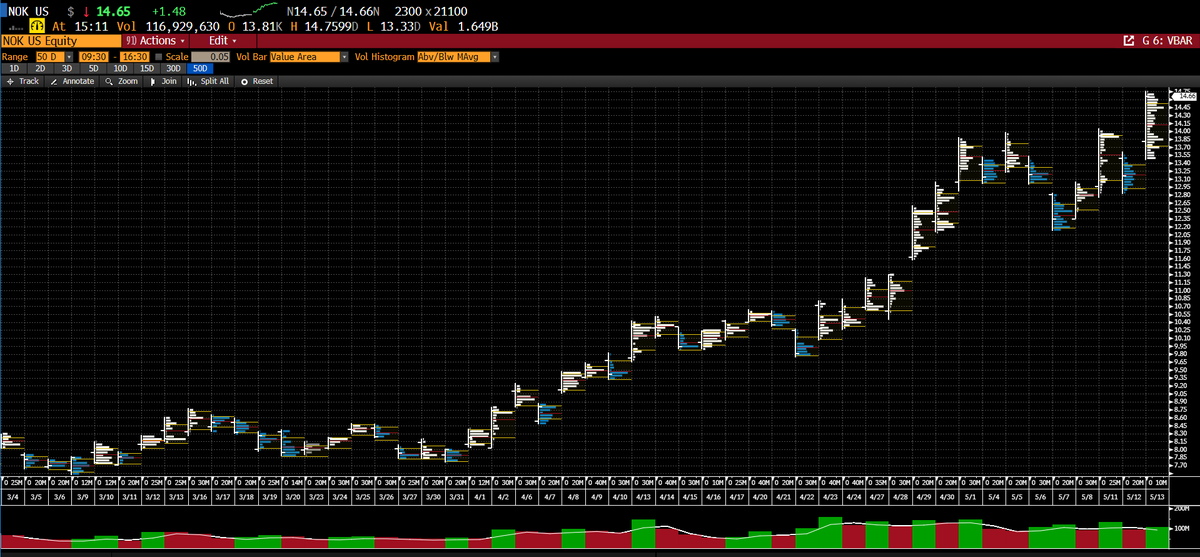
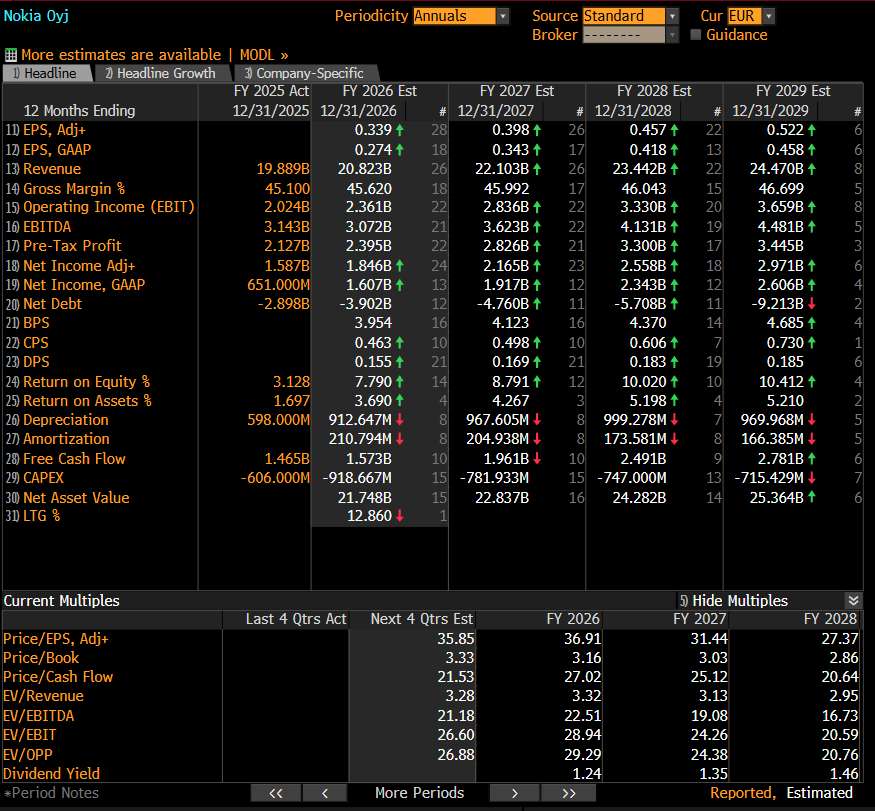
$NOK still moving. Up ~11% today. Going forward, I might simply let Jensen handle my due diligence and stock picking for me. I suspect many people are doing just that.
@CitronResearch picked this as their GAI long, so I give them that one, so I am not only picking on them.
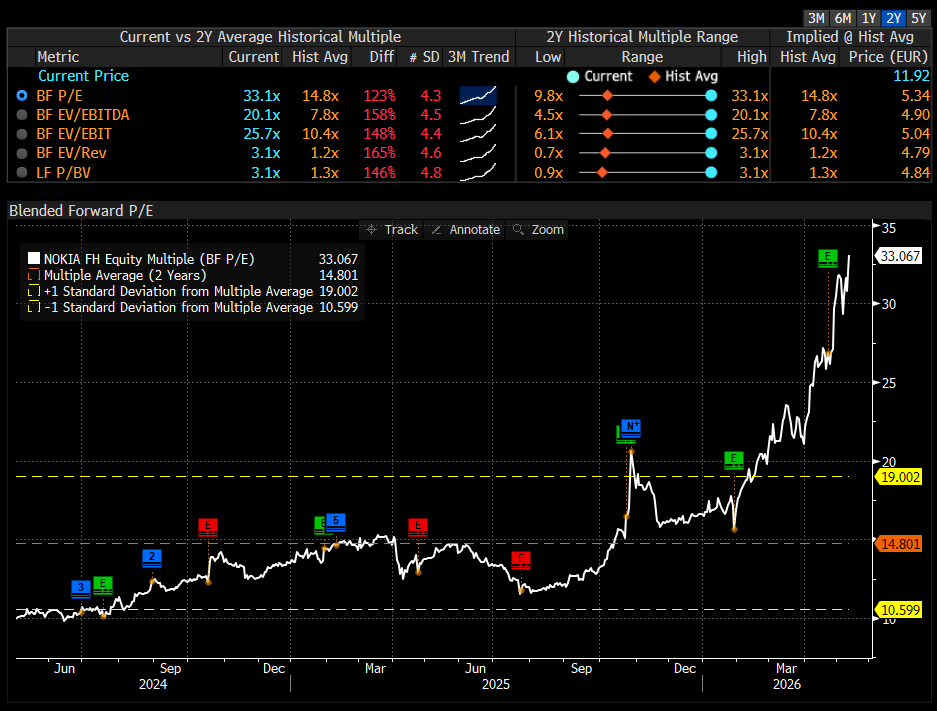
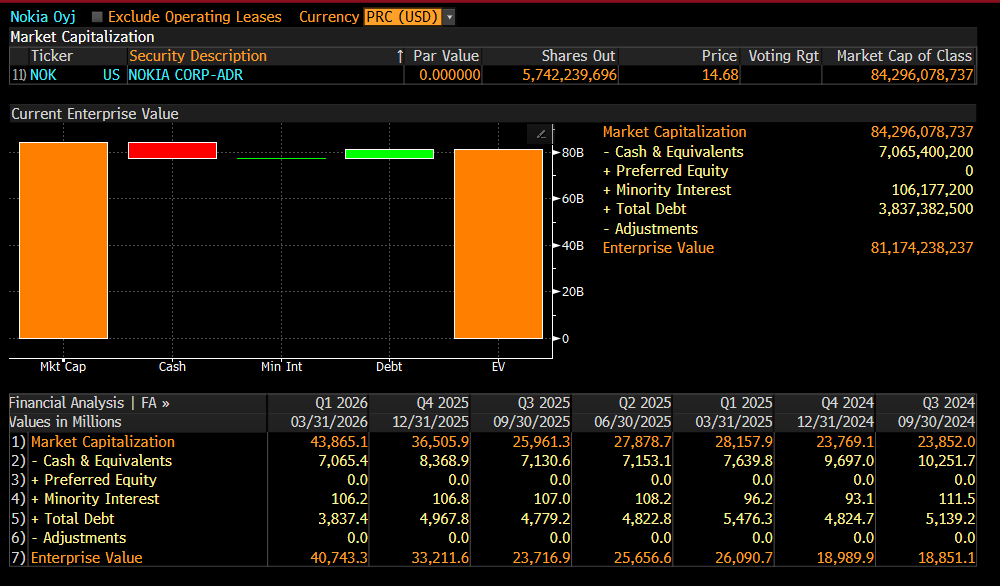
4
2
23
19,082