#CIA #FBI #USSecurity
National Biodefense Strategy Explained
gemini.google.com/share/542d…
The democratization of biotechnology and gene-editing tools means that transnational organized crime syndicates, proxy groups, and lone actors present a severe and evolving threat.
share.google/aimode/FgomcVCC…
Biological Threats to the U.S. Security: Analysis, Risks, Strategies - Google Search
google.com/search?q=Biologic…
Biological threats to U.S. national security are classified into naturally emerging outbreaks, accidental laboratory releases, and deliberate bioweapons or bioterrorism. These risks—which can devastate public health, agriculture, and the economy—are actively amplified by hostile state actors, rapidly evolving biotechnology, and unregulated artificial intelligence. [1, 2, 3, 4, 5]
Analysis of Threats
Dual-Use Technologies & AI: The convergence of advanced biotechnology, artificial intelligence, and Large Language Models (LLMs) allows for the engineering of highly potent synthetic pathogens. These technologies can potentially lower the barrier to entry for non-state actors to develop or modify biological agents.
Hostile State Actors: Adversaries like Russia and North Korea maintain chemical and biological weapons programs, while nations like China and Iran actively conduct research and development with dual-use potential.
Supply Chain Vulnerabilities: The U.S. relies heavily on foreign biopharmaceutical and medical supply manufacturing (particularly in China), which creates critical dependencies that foreign powers can leverage or restrict during a biological crisis.
Natural & Accidental Hazards: Zoonotic spillovers, climate-driven pathogen spread, and biosafety breaches in high-containment (BSL-3 and BSL-4) laboratories pose continuous risks of catastrophic global outbreaks. [1, 2, 3, 5, 6]
Strategic Risks
Global Catastrophic Biological Risks (GCBRs): Events capable of causing sudden, widespread disaster on a scale that overwhelms national and global response capabilities. The U.S. Intelligence Community consistently warns that unchecked outbreaks could lead to loss of life on a massive scale and cause sustained damage to global societal stability.
Agricultural & Economic Disruption: Biological agents targeting crops or livestock threaten the U.S. food supply and result in billions of dollars in economic losses.
Biosecurity Breaches: Unsecured microbial repositories, gaps in local disease surveillance networks, and loose oversight of genetic data collection remain significant vulnerabilities. [1, 2, 7, 8, 9]
Strategic Frameworks & Mitigation
, which restricts U.S. federal agencies from procuring biotechnology or services from designated foreign adversaries, protecting sensitive genetic data.Legislative Action: Congress and federal agencies prioritize countermeasures like theBIOSECURE Act
The National Biodefense Strategy (NBS): The U.S. government implements a whole-of-government approach to assess, prevent, prepare for, and respond to biological incidents. This includes the funding of public health communication infrastructures and multilevel networks of diagnostic laboratories.
Modernizing Biosurveillance: Working groups and bipartisan alliances continuously push for improved early detection mechanisms and robust international engagement to stop infectious disease outbreaks at their source before they cross borders. [4, 10, 11, 12, 13, 14]
If you are interested, I can provide:
More details on specific pathogens listed as Category A bioterrorism agents
A breakdown of the legislative mechanisms in the BIOSECURE Act
An overview of current AI regulations regarding biotechnology [3, 12, 13, 15]
Let me know which area you would like to explore further.
AI responses may include mistakes.
[1]
centerforhealthsecurity.org/…
[2]
councilonstrategicrisks.org/…
[3]
youtube.com/watch?v=RxqrAXdU…
[4]
aspr.hhs.gov/biodefense/Page…
[5]
pmc.ncbi.nlm.nih.gov/article…
[6]
trumpwhitehouse.archives.gov…
[7]
nationalacademies.org/read/2…
[8]
biodefensecommission.org/wp-…
[9]
congress.gov/event/109th-con…
[10]
csis.org/analysis/protecting…
[11]
bidenwhitehouse.archives.gov…
[12]
youtube.com/watch?v=IaDeO_XU…
[13]
youtube.com/watch?v=qByV-TNp…
[14]
cdc.gov/mmwr/preview/mmwrhtm…
[15]
youtube.com/watch?v=LmEX2kot…
-
AI Mode:
Biological threats pose a severe and evolving challenge to U.S. national security, encompassing natural pandemics, accidental laboratory leaks, and deliberate acts of bioterrorism. To counter these complex hazards, the U.S. government relies on a multi-agency National Biodefense Strategy focused on a doctrine of "deterrence by denial" to make biological weapons obsolete through rapid detection and response capabilities. [1, 2, 3, 4, 5]
🔬 Threat Analysis: The Evolving Bio-Landscape
The modern biological threat matrix is no longer limited to legacy weaponized pathogens. It is heavily shaped by geopolitical friction and exponential leaps in technology: [6, 7]
State-Sponsored Capabilities: The U.S. Intelligence Community identifies persistent bioweapons capabilities and advanced research programs in nations such as Russia, North Korea, China, and Iran.
The Convergence of AI and Biotech: The commercialization of Biological Design Tools (BDTs) and Large Language Models (LLMs) has drastically lowered technical barriers. Novice actors can now source actionable information to plan biological attacks, while advanced tools assist in engineering novel, vaccine-evading pathogens.
Data and Supply Chain Vulnerabilities: Adversarial collection of global health and genetic data (multiomics) poses long-term profiling risks. Concurrently, foreign dominance over critical pharmaceutical ingredients and medical supply lines creates a severe strategic bottleneck. [8, 9, 10, 11]
⚠️ Primary Strategic Risks
A comprehensive risk assessment by the Center for Health Security divides biological dangers into three distinct categories: [3, 12, 13, 14]
┌───────────────────────────────┐
│ U.S. BIOLOGICAL RISKS │
└───────────────┬───────────────┘
┌────────────────────────────┼────────────────────────────┐
▼ ▼ ▼
┌───────────────────┐ ┌───────────────────┐ ┌───────────────────┐
│ DELIBERATE │ │ ACCIDENTAL │ │ NATURAL │
├───────────────────┤ ├───────────────────┤ ├───────────────────┤
│ • Bioterrorism │ │ • Lab leaks/escapes│ │ • Novel pandemics │
│ • State programs │ │ • Cyber theft of │ │ • Antimicrobial │
│ • Agro-terrorism │ │ pathogen data │ │ resistance │
└───────────────────┘ └───────────────────┘ └───────────────────┘
Global Catastrophic Biological Risks (GCBRs): These are sudden, widespread events capable of causing over 100 million deaths, collapsing national economies, and destabilizing global security.
Laboratory and Research Biosafety: The rapid multiplication of high-containment Biosafety Level 4 (BSL-4) labs globally increases the statistical probability of accidental pathogen escapes or insider theft.
Agricultural and Environmental Threats: Weaponized pathogens targeting livestock or vital food crops (agro-terrorism) can paralyze the American agribusiness sector and cripple food security. [12, 15, 16, 17, 18]
🛡️ U.S. Counterstrategies & Mitigation Plans
The United States addresses these risks through an integrated framework of domestic policies and international programs: [19]
1. Advanced Biosurveillance and Data Isolation [20]
Early Warning Systems: Federal systems utilize automated syndromic surveillance, such as ESSENCE, to monitor global real-time health data for early signs of anomalous outbreaks.
The Biosecure Act: Legislative efforts strictly prohibit U.S. federal agencies from procuring equipment or collaborating with foreign biotechnology firms tied to foreign adversaries. This shields sensitive American genetic datasets from exploitation. [11, 20, 21, 22]
2. Threat Characterization and Forensics
NBACC Research: The National Biodefense Analysis and Countermeasures Center (NBACC) runs maximum-security BSL-4 facilities. It executes forensic testing to definitively attribute the origins of biocrimes or biological accidents.
The Federal Select Agent Program: Managed jointly by the FBI's Bioterrorism Risk Assessment Group (BRAG) and health officials, this program strictly vets individuals seeking access to high-consequence biological toxins. [23, 24, 25, 26, 27]
3. AI Guardrails and Agile Response
Synthesized DNA Screening: Modern protocols require providers of genetic synthesis to rigorously screen customers and cloud-laboratory requests to prevent the unauthorized creation of regulated agents.
Inter-Agency All-Hazards Response: Domestic defense structures bind the Department of Homeland Security (DHS), Health and Human Services (HHS), and the CDC to execute regional medical countermeasures, distribution of the Strategic National Stockpile, and mass vaccination strategies. [4, 28, 29, 30, 31]
To explore specific areas of biodefense further, please let me know if you would like to look closer into AI biosecurity guardrails, examine the Biosecure Act's supply chain impacts, or analyze the inter-agency logistics of an epidemic response.
[1]
councilonstrategicrisks.org
[2]
csis.org
[3]
aspr.hhs.gov
[4]
youtube.com
[5]
en.wikipedia.org
[6]
pmc.ncbi.nlm.nih.gov
[7]
marketsandmarketsblog.com
[8]
councilonstrategicrisks.org
[9]
tandfonline.com
[10]
csis.org
[11]
councilonstrategicrisks.org
[12]
centerforhealthsecurity.org
[13]
ijtsrd.com
[14]
pmc.ncbi.nlm.nih.gov
[15]
biodefensecommission.org
[16]
youtube.com
[17]
pmc.ncbi.nlm.nih.gov
[18]
theanimalecho.woah.org
[19]
linkedin.com
[20]
bidenwhitehouse.archives.gov
[21]
ncbi.nlm.nih.gov
[22]
youtube.com
[23]
media.defense.gov
[24]
dhs.gov
[25]
fbi.gov
[26]
safetyact.gov
[27]
dhs.gov
[28]
cnas.org
[29]
cdc.gov
[30]
armscontrol.org
[31]
vox.com
-
Gemini:
Biological Threats: U.S. Security Analysis
gemini.google.com/share/2185…
The landscape of biological threats to U.S. national security has fundamentally shifted. For decades, biodefense was viewed through the narrow lens of countering specific terrorist plots or securing legacy stockpiles left over from the Cold War. Today, the convergence of rapid advancements in biotechnology, the democratization of artificial intelligence, and the proliferation of high-containment laboratories has created a highly complex, multi-vector threat environment.
Addressing these threats requires moving beyond traditional public health paradigms and integrating biodefense directly into grand strategy, intelligence operations, and national security architecture.
The Threat Landscape: A Multi-Vector Environment
Biological threats are generally categorized into three origins: deliberate, accidental, and natural. From a national security perspective, the lines between these vectors are increasingly blurred, as the strategic impact of a biological event is catastrophic regardless of its source.
State-Sponsored Programs: The intelligence community assesses that nations like Russia and North Korea maintain active biological weapons programs in violation of the Biological Weapons Convention (BWC). China's compliance remains ambiguous due to insufficient verification data. In modern conflict, state actors may view biological agents not just as weapons of mass destruction, but as tools for strategic disruption—inflicting economic damage, eroding military readiness, or destabilizing civilian populations below the threshold of nuclear retaliation.
The State-Crime Nexus and Non-State Actors: The traditional barrier to entry for biological weapons was the massive infrastructure required for research, testing, and weaponization. However, transnational organized crime networks and proxy groups present a unique risk. These networks can facilitate the illicit procurement of dual-use equipment, precursor materials, or even genetic sequences, bridging the gap between state-level intent and deniable, non-state execution.
Accidental and Natural Risks: The global proliferation of high-containment laboratories researching high-consequence pathogens increases the statistical probability of an accidental leak. Simultaneously, the accelerating frequency of zoonotic spillover events poses a persistent threat to economic stability, military readiness, and public health infrastructure.
The Technology Multiplier: AI and Synthetic Biology
The intersection of artificial intelligence and synthetic biology is perhaps the most significant disruptive force in modern biosecurity.
Accelerating the Threat
Historically, developing a functional biological weapon required specialized, tacit knowledge—the kind acquired only through years of hands-on laboratory experience. Today, large language models and specialized foundation models are beginning to bridge this knowledge gap. AI systems can assist malicious actors in troubleshooting failed experiments, optimizing pathogen transmissibility, or identifying vulnerabilities in target populations. Combined with accessible DNA synthesis and CRISPR gene-editing technologies, the "design-build-test-learn" cycle for creating novel pathogens is becoming faster, cheaper, and harder to track.
AI and OSINT as Defensive Assets
Conversely, AI and open-source intelligence (OSINT) are critical to modern biosurveillance. Traditional intelligence gathering is often too slow to detect an emerging biological threat. By aggregating and analyzing vast streams of open-source data—social media trends, localized supply chain disruptions, health care data, and even global flight patterns—AI tools can identify epidemiological anomalies weeks before official reporting channels flag them.
Strategic Responses and Intelligence Evolution
The U.S. strategy is increasingly shifting toward deterrence by denial—making the homeland so resilient, and detection so rapid, that an adversary calculates a biological attack will fail to achieve its strategic objectives. Executing this strategy requires significant structural evolution within the intelligence and security apparatus.
1. Overcoming Intelligence Fragmentation
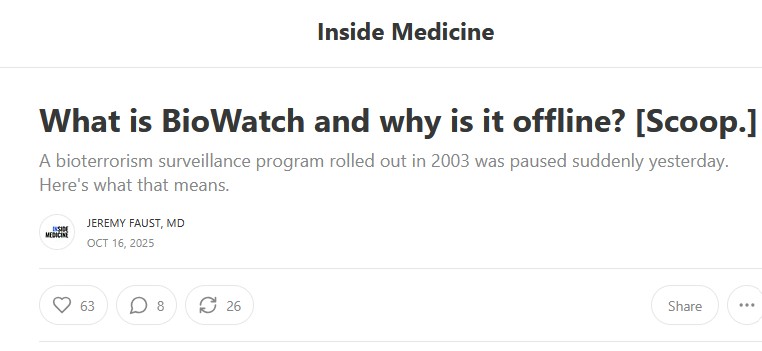
Historically, biosurveillance has suffered from chronic fragmentation, stove-piped across the CDC, the USDA, legacy programs like BioWatch, and various intelligence agencies. Effective biodefense requires a centralized, cohesive intelligence structure. Evolving counterintelligence services—such as the FBI and the CIA—must prioritize biological threat intelligence on par with cyber threats or nuclear proliferation. Re-establishing and empowering a dedicated biological threat directorate within the Office of the Director of National Intelligence (ODNI) is critical for synthesizing classified intelligence with global health data and OSINT.
2. Modernizing Biosurveillance Networks
Early warning is the linchpin of biodefense. The U.S. must expand its reliance on agnostic detection systems that do not require prior knowledge of a specific pathogen. This includes scaling wastewater surveillance at international airports, military installations, and embassies. Advanced molecular detection and genomic sequencing must be integrated into a real-time, global surveillance network to identify engineered or novel pathogens at the point of origin.
3. Securing the Bio-Economy and Supply Chains
The U.S. remains heavily reliant on foreign supply chains for active pharmaceutical ingredients (APIs), personal protective equipment, and essential laboratory supplies. A core pillar of biosecurity strategy is reshoring or near-shoring the manufacturing of critical medical countermeasures and maintaining warm-base production capacity to ensure the U.S. can respond rapidly to an outbreak without supply chain blackmail.
-