Konbro retweeted

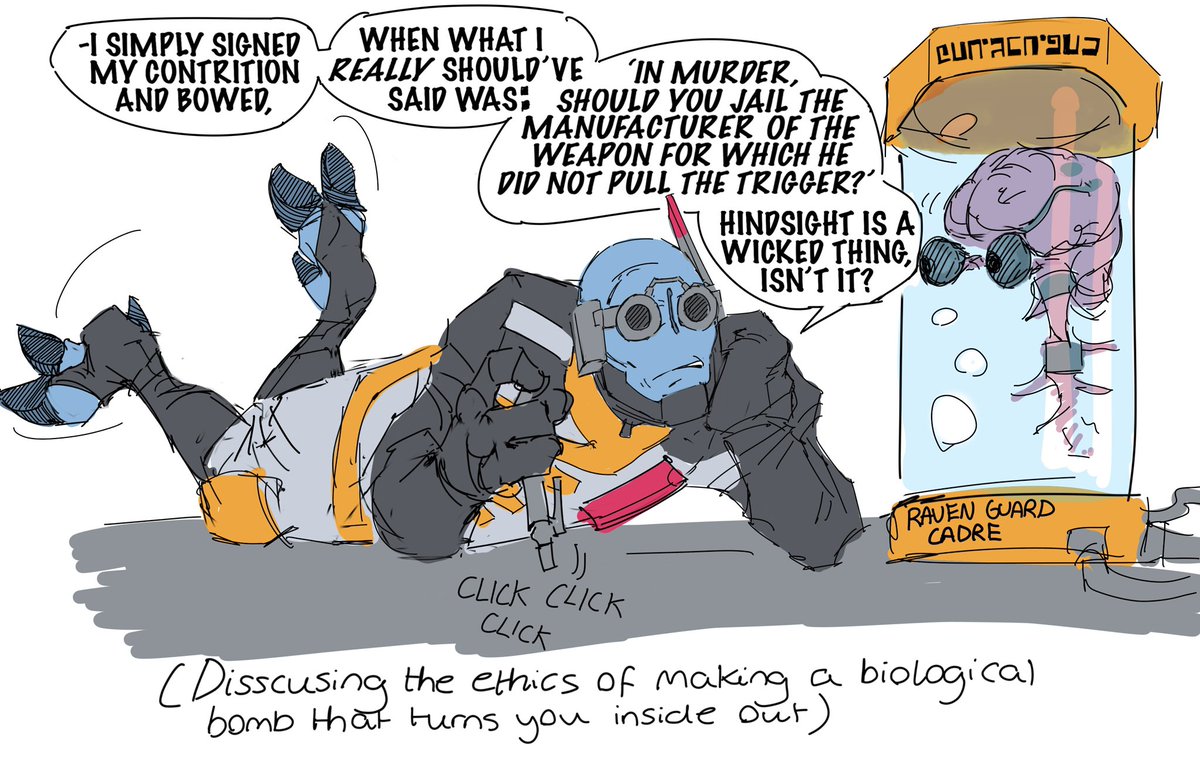
It’s for the Greater Good, man (Earth Caste Bioengineer Fio’Vre ‘Skin-shifter’ Xu’shino) #warhammer40000
9
55
557
7,695
Florida Democrat💜SLE Lupus Warrior-LymphomaCancer retweeted

May 30
Google is taking a page straight out of Bill Gates' playbook and is seeking permission to release millions of bioengineered mosquitoes in Florida.
The bioengineered mosquitoes would be intentionally infected with a bacterium.
The goal is to reduce populations of disease-carrying mosquitoes.
321
836
1,294
200,092

Summary: A Gizmodo piece reports Ozempic users exercise less, while several outlets (Neuroscience News, Healthline, The Times, Bioengineer) note GLP-1 therapies may reduce spontaneous activity and overall physical exercise. Other items discuss shorter wo… ift.tt/xu64tDd
3

Quantum weapons ? Christ it’s only us humans who are a scourge …. You don’t need to take out a whole planet you just kill all human life. Just look how covid singled out and transmitted. Now bioengineer or nano weapons to target human genome. Think small not large .
174


how does formal verification help prevent North Korea from using distributed AI to bioengineer a weapon to kill millions
1
24

Adding gecko bioengineer to my cake resume #buttercreamcake #customcake ... youtube.com/shorts/21ukvHBD6… via @YouTube

Low-Quality Traits in AI Engineers, Bioengineers, and Researchers
Across AI, bioengineering, and biomedical research, the same failures repeatedly appear: intellectual laziness, weak scientific rigor, exploitation of human subjects, and institutional cowardice.
1. The Deplorable actions of Bioengineers
In AI, this appears as “workslop” or vibe-coding: copying AI-generated code without understanding it, then becoming unable to debug the system when it fails.
In bioengineering, it appears when researchers bypass foundational wet-lab rigor, animal trials, or adequate validation because a simulation, algorithm, or claimed breakthrough suggests a shortcut.
The ethical collapse occurs when researchers treat the black box as infallible and stop seeing the human beings behind the data. Human subjects become test surfaces rather than protected participants.
2. Deception and Polished Fraud
In AI, polished language can conceal weak, unoriginal, or unverified claims.
In biomedical research, the same pattern appears through image manipulation, selective data reporting, and fabricated results designed to preserve funding, prestige, or commercial hype.
The deplorable link is the “God complex”: the belief that deception can be justified for innovation, reputation, or the supposed greater good. That mindset endangers volunteers, patients, and paid subjects.
3. Exploitation of the Subject
In AI, exploitation appears through poor data governance, biased datasets, and the use of personal or sensitive information without meaningful consent.
In biomedical research, exploitation appears through coercion, undue inducement, targeting vulnerable populations, or using “compassionate care” as a shield for experimentation.
Low-quality researchers view human participation as a resource to consume. High-quality researchers treat participation as a protected partnership grounded in consent, transparency, and accountability.
4. Failure of Institutional Courage
In AI, this appears as “shadow AI”: unauthorized tools, hidden workflows, and security bypasses used to meet deadlines.
In research institutions, it appears when peers witness protocol violations but remain silent to protect funding, status, or institutional reputation.
Most major scandals are not stopped by prestige institutions. They are stopped by whistleblowers. That fact exposes a deep failure of leadership, oversight, and professional integrity.
2026: The High-Quality Rebound
The emerging standard for high-quality research is traceability.
A responsible AI engineer, bioengineer, or researcher must be able to explain:
where a line of code came from;
where a dataset came from;
whether the data was lawfully and ethically obtained;
whether human subjects gave informed consent;
whether the protocol was reviewed, documented, and followed;
whether the system can be audited by another qualified human being.
The bottom line is simple: if a system, dataset, protocol, or intervention cannot be verified, explained, audited, and justified to a human being, it is not innovation. It is a failure of duty.
@elonmusk
1
2
4
143

“You’re excited about a “killer long-sleeve shirt”… made by robots?!”
100%.
1000% if it’s the same company, that’s literally “reindustrializing America and manufacturing fabrics for defense and space.”
Exactly the same way, I’m excited about a color Game Boy/N64 made using metal 3D printing via robotics [100%], in general, and especially if it’s a side project from the same people making drones for US defense [modretro, anduril].
Using that as a tangible example of a couple of more abstract concepts I’ll be diving into.
1st up, anyone doing anything substantive gets lots of ‘confusion’ and internet friction. It’s not a bug, but a feature, demonstrating they’re doing something worthwhile [cf. example above].
Full disclosure, I say that as a repeat exited founder [AI & B2B SaaS data/analytics], EY Entrepreneur of the Year, occasional lecturer for Harvard, Hopkins, MIT etc. on Entrepreneurship and Innovation [resistance & adoption], History of Economic Development and Capitalism, and Workforce Development [usually named talks focusing on interdisciplinary history, business, engineering, material science - background includes PhD/Fulbright/Sorbonne’s Interdisciplinary center for science & humanities], and served as technology & entrepreneurship adviser to the White House & Presidential commissions under multiple administrations - also, someone personally who started out working work 2nd shift on the line, one of multiple jobs while at a community college. An investor too, proudly in @anatar, and other robotics, AI, blockchain, and technology/science across farming, manufacturing, finance, etc. - personally betting on generative tech and new biz models to benefit US and humanity - and doubling down via family foundation to teach kids/young adults how to use AI/Robotics to build IRL businesses in rural Kentucky.
So full disclosure, the answer represents my take, informed by a very specific perspective above, doesn’t represent any of the companies above, and may not be for you, may not be for you now. As a startup founder i don’t want universal adoption, but rather ‘common knowledge’ friction - that shows me i’m doing something large, worthwhile, non-obvious and needed - it’s not just price to play but my moat.
But for those interested in the broader questions of how generative tech, on its own, especially when domestically based in regionally resilient supply chain, benefits US citizens overall, and specifically workforce development against a demographic inversion curve, and, why is doing a consumer t shirt not just a cherry on top but a power move that should be HBS case study in being rock awesome, read on.
Many ways to take conversation - and since we’re asking big questions, we’re going to have to be precise in our thinking and avoid non sequiturs [i think X, i’ve seen Y, i have concerns about Z, etc - some tbad things can happen A, what about B, how are you / have you C, etc.] - could go into onshoring as core to regional resilience, which forms an anti-brittle national supply chain topology required for global autonomy - aka specific unwinding not just of offshoring but 40 years post Bretton Woods and recreation of endemic farming, manufacturing [scalable output as metric, creating jobs as result], and forward facing deployment, globally and beyond.
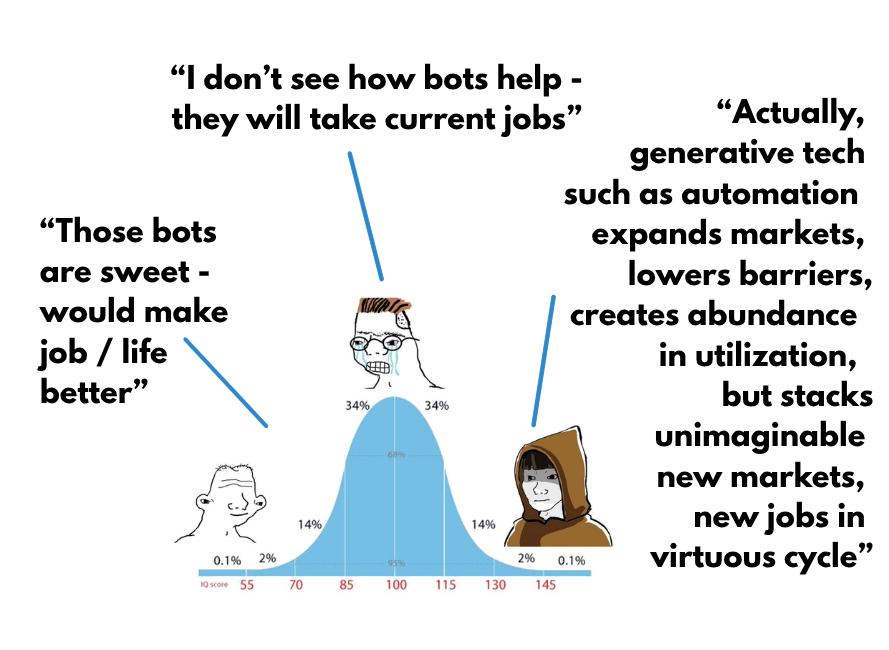
But I think this conversation really revolves around core assumptions - aka generative technology. Even outside of global positioning, multi-planetary aspirations, benefiting US citizens, humanity, the starting point is: Does generative tech create markets - aka does it cannibalize current jobs, merely increase the size of the current market, or de novo create new markets? How you answer that question basically dictates the entire conversation, not just what answer, but how you answer it. Do you look to history as an example, even if it rubs one’s assumptions, much less current/loud/vocal sentiment, the wrong way [on that note, X algorithm has been having one of its midcurve overweighting runs lately].
Generative tech, by definition, creates markets. That’s not better/faster/cheaper, but net new, de novo. That’s not big slice of zero um pie, ot bigger pie, but a whole new pie, a whole new stack in different flavors, not just pumpkin meets lemon meringue or trad apple, put pizza pies and some deconstructed quiche thing.
Really? Give me an example. Print. Print was an awful idea; no one read, but there was a cottage industry that seemed to get outsourced, and the printing press only looked to make things worse. Many people had ‘concerns’ about its automation [looked like a manual automaton], putting manuscript writers out of work. Many had seen the dark downside of a print shop. Many couldn’t see how the printing press would ‘improve’ anything; others didn’t get it. It seemed to take a bad situation, outsource, and make it worse, automated. [notably exogenous power funded such thinking, against the populace’s own interests, in very specific ways, for very specific reasons, but that’s a history lesson for another time].
But…… the generative tech created the market. It didn’t serve it, didn’t commoditize it, but created a new market, and new markets on top of markets, benefitting participants in ways they couldn’t see at the time, much less predict. That’s the nature of generative tech. Print created literacy itself. Full stop. Didn’t meet the rising demand of literacy for print, the artifacts created by generative tech generated demand itself. Full stop.
The market didn’t shrink; it exploded. The automated tech that ‘took away’ jobs from manuscript copyists created many more jobs than could ever be imagined. Literacy went from ~5% to whatever you think it is today [give X comments lately, could still be 5%]. Copyists became printers and mechanical engineers.
The artifact had utility. Books went from an annual salary plus to the price of a dinner. Rather than diminishing demand, it created new demand. This seems very counterintuitive to mid curve. How does automated production benefit the person making the artifact? It actually creates more demand for more artifacts in more ways. Starting with utility. Being able to access an automated tech artifact didn’t satisfy extended demand; it created new demand. You didn’t have a book, you now had one, and then wanted more, a library if you will, and each of those things had benefits [how to plant/farm/start a biz/philosophy/entertainment/etc]. Yes, the automated copyist robot ‘took jobs away from copyists’ but it created not only new jobs for print, but more demand, more jobs, higher wages, new kinds of jobs, in new kinds of economic models.
Now the cascading effects. First automation, especially localized creation of tech, creates more demand, benefiting all - aka literacy, that fact that you’re reading at all now. Then, meta, it actually creates a new market, print, media, aka the thing you're reading on now [McLuhan Guttenberg Galaxy - and much more broadly, software as ‘media’ and andy hardware stack requiring ‘software’, but again, another story]. Then, the super meta, the markets of markets, not just the market for the artifact [because now scale abundance creates new markets but utility unlocks others previously inaccessible due to production constraints -x- imagination]. Books at scale allow me to do other business besides selling books - aka teaches me how to do ledger/credit, compute/automate other things besides copying letters, creates other markets -x- philosophy/theology to do those things [no need to be beholden to a foreign lord holding supply chain power, actually fictional story/path of how to break out DIY it.] Said differently, generative tech changes not only the business, but actually how business is done - not just a new market or market of markets but market mechanics - aka new capital formation.
‘But how does that benefit the worker?’ Uh, yes, fewer hand copiers, but more printing jobs, and jobs printing unlocks, aka new types of construction, ‘rediscovered ad fontes / that ’whole renaissance thing’, and also distributed banking, aka credit/investment to found new companies themselves. This is what we call a virtuous cycle.
I still don’t get it. How does that benefit the worker/me? Um, you could unlock assets via automated production to create not only new markets but new value capture de novo? Huh/what? Capitalism, literally, The Birth of Capitalism - The Birth of the Middle Class. If you’re not a noble lord and aren’t living as an indentured peasant, thank the automated robotic machines for the printing press. If you can read, for work/value creation, or to explore/pleasure, get down on your knees and kiss the automated tech robots call the ‘printing press’.
But Dr. Rosenthal, that’s old-timey stuff, it’s not applicable today. Core idea: utility via automated benefits via new creation. Encyclopedias were a good biz, not super useful; maybe you checked out once a week/day. Internet/Google search was awful, it put so many’ encyclopedia writers, printers, warehousemen, salesmen' out of business. What about the jobs it’s taking? I don’t get how this helps! But you search quite a bit, likely more than once a day, it created new jobs, not just the same thing but bigger/better/cheaper [software/hardware/media etc] but new things unlocked by that - that medieval manuscript copier or 1950s encyclopedia editor you could never have imagined.
But robots, what about the bots, sure that not ‘tech’ it doesn’t work in the same way as print, code, etc. Um, machine bots via the presses. Hardware for the software for the media. Secretaries replaced via Word/Google Docs, accountants via XL/Google Docs, art ‘departments via PPT/Canva. But that’s all abstract, i don’t like abstract [insert what’s this have to do / 2001 space monkeys/ monolith]. Think about it this way, if you don’t buy into on shore defense resilience, beyond global exploration, or if you don’t by into history, aka that generative tech creates - transformas the current into something new, traumatic for the current imagination that can’t imagine the recreation [FWIW this is why we call it a renaissance], then straightline tink in terms of demographic and what is replacing what and what that unlocks.
Example. We have an investment in an agriculture robotics company - Tiny Land Drones. But doesn’t that take away US farming jobs? Um, no. Those jobs were already replaced by chemicals. The US ag system went from manual labor [usually child] for weeding, to chemical, spraying chemicals to prevent weeds. This was not an accident; the demographics collapsed [fewer kids, youth left the farms], but chemicals replaced. The robots don’t replace those jobs, but they are a chemical replacement for those jobs. How does that help? Well, the chemicals run into land and soil, and the seed companies bioengineer seeds to resist, but that’s again, another history lesson. The point is that farming is not viable for anything less than mega aggregation without bots. The bots unlock the regional resilience, say to grow crops for textiles, or other niceties such as food. Which ‘keeps’ jobs, but also creates new jobs, the bots are made here, hardware and software, and service layer of deployment, and with right to repair, and, and, and. But that’s investor talk. No, this farmer-founded, invested, client-based, and led.
All my 2 cents, but, to review:
‘I’ve seen, i think, the downside of X/Y/Z’ - may not be for you / non sequitor - not any one artifact, shirt, company, but more broadly flows from market creation, history, entrepreneurship, innovation [resistance/adoption], dynamic workforce re/creation, etc.
How does US/Regional/Based production help US citizens, and humanity beyond the globe in space efforts - hopefully pretty clear, bordering on definitional.
How does generative tech help US workers? Should be definitional, generative tech, generates new markets, not only expands current, but utility creates demand, and cascading markets, not just businesses, but net-new markets otherwise unimaginable. Think printing press ‘bot’, internet hardware ‘bot’, etc. Super salient in demographic inversion [cf farm bots], but the real bet is in utility through automation, benefiting at scale. Full cards on the table, I personally think this goes exponential, new utility via automation compounded via new capital formation mechanisms and new generative tech for on-demand abundance - aka not hardware textile vs LLM, or IRL vs AI but bother and, and wrapped in new capital formation [increasingly participatory, think ledger/credit, aka mortgage on house for ownership, fractional equity stock/NASDAW/401k, pre IPO stocks/prediciton markets], but those are lessons for other times nd not necessary for this -- but do introduce what might be at play, and, if the historical example rhymes, that means generative tech led to rise fo middle class, your home ownership etc, in addition to your reading machines/robots and your ability to read itself.
So if all that’s in play, and you’re rocking it in regional resilience for defense, space, both crucial and epic, literally using gen tech not to cannibalize to participate in tried and true historical lessons that created capitalism and the rise of the middle class, aka that utility creates abundance, and doing that in broader context of other parts of the complete rework stack with agentic creation and next gen capitalism, and then you offer white label production for other players, then, while recreating the world, you put it on the back of a shirt. Yeah, 100% excited.
We’re at a show for the ages, epic, historical - front row seats, good sound, artists interacting with the crowd - 1000% gonna get the shirt.
4
726
13 / Example. We have an investment in an agriculture robotics company - Tiny Land Drones. But doesn’t that take away US farming jobs? Um, no. Those jobs were already replaced by chemicals. The US ag system went from manual labor [usually child] for weeding, to chemical, spraying chemicals to prevent weeds. This was not an accident; the demographics collapsed [fewer kids, youth left the farms], but chemicals replaced. The robots don’t replace those jobs, but they are a chemical replacement for those jobs. How does that help? Well, the chemicals run into land and soil, and the seed companies bioengineer seeds to resist, but that’s again, another history lesson. The point is that farming is not viable for anything less than mega aggregation without bots. The bots unlock the regional resilience, say to grow crops for textiles, or other niceties such as food. Which ‘keeps’ jobs, but also creates new jobs, the bots are made here, hardware and software, and service layer of deployment, and with right to repair, and, and, and. But that’s investor talk. No, this farmer-founded, invested, client-based, and led.
1
1
18

Jun 13
YOU CAN SPIN IT HOWEVER YOU WANT! THEY USE GAIN OF FUNCTION RESEARCH TO BIOENGINEER DEADLY PATHOGENS FROM THE ANIMAL KINGDOM INTO HUMAN COMPATIBLE VIRUSES! EAT AZOV NAZI SHIT.
1
todestrieb retweeted

Jun 13
what about trying to bioengineer (crispr/cas9...) or to modify algaes in order to enhance their carbon capture and oxygen emission?
could you share some recent articles on this idea if there any?
1
1
3
151

The movie Avatar is how I always thought aliens would be among us.
They would bioengineer beings that could natively survive on the planet, then remote control them through something like neurolink, from orbit.
That would solve the air, gravity, and crashing problems.
33

Jun 13
@grok dang maybe he will bioengineer some ticks to release on the public then sell a cure for the disease they give soon, gotta get on Gates level at some point.
1
12
Sophia Dahl retweeted

5 Jun 2025
🚨 👀 Shocking revelation from Prof. James Giordano on my latest podcast:
❓Can we bioengineer pathogens to change human thoughts and behavior? 😱
4 Jun 2025

🚨 🎙️ NEW PODCAST 🚨🚨
BRAIN WARS: Prof. James Giordano on Neuroweapons, Neurotechnology, & Global Security
Prof. James Giordano is a rockstar in neuroscience, neurotechnology, and biosecurity. For years, I’ve been following his work—including his notorious military talks 😱 (iykyk)—and was determined to land this interview.
As Professor Emeritus in the Departments of Neurology and Biochemistry at @Georgetown and Director of the Center for Disruptive Technology and Future Warfare of the Institute for National Strategic Studies at the National Defense University, he’s a leading expert on unraveling mysteries like Havana Syndrome—the bizarre illness that targeted & disabled U.S. diplomats and intelligence officers, and now, civilians.
But this conversation goes far beyond that, delving into wild stuff that’s sounds like sci-fi but is actually happening. Now. Think directed energy weapons zapping brains, nanotechnology that can be injected or inhaled to “access the brain remotely,” 😬 microbes that alter thoughts and behavior 🦠 , and the human brain 🧠 as the new frontier in global conflicts.
This isn’t your typical science talk. 😆
We dive into deeply hidden & unsettling—but important— territory:
🔹 Can nanotechnology be used to access the brain without surgery?
🔹 The truth behind Havana Syndrome and who may be using directed energy weapons to attack public officials and civilians.
🔹 How ultrasonic and microwave weapons can silently incapacitate targets.
🔹 Are claims of covert chip implants, drone invasions, and directed energy weapons real? [hint: yes]
🔹 Can nanoparticles cause untraceable deaths?
🔹 Can microbes be engineered to change human thoughts and behavior?
🔹 What are the dual-use dangers of precision medicine, synthetic biology, and gene editing?
Dr. Giordano brings clarity, insight, & 4 decades of scientific and biodefense knowledge. His message is urgent: the same biomedical tools that promise healing can also be used for harm.
This conversation made my head explode (while, once again, trying to look composed!) —and he’s agreed to come back for a part two.
If this episode sparks questions, leave them in the comments. We’ll bring them to Prof. Giordano next time.
🎧 The Dana Parish Podcast is avail on all podcast platforms, YT, and Substack.
🚨 PLEASE SUBSCRIBE 🚨
Special thanks to my incredible editor, Conrad deVroeg.
📺 Please SUPPORT MY HARD WORK by commenting, sharing, and subscribing for more conversations that go where others won’t. TYSM for watching! 🩷
8
26
46
2,958

Helluva.W.wolf retweeted

Nothing like a good dose of morning wood🪵 to get you up in the morning🌄.
Meet Claudia Zona, bioengineer, chemist, and minor in psychology.
🦁rawr...

1
3
21
236
Darshil patel retweeted

Jun 12
As a bioengineer, this was the week "AI for science" stopped being a theme and became a product category. GPT-Rosalind and Claude Fable 5 / Mythos 5 both landed in 6 days. But the benchmarks are humbling. Intelligence is arriving. Reliability isn't. k-dense.ai/blog/frontier-sci…
1
9
373