
BlockSTM is a meaningful step up in execution performance.
Parallel transaction processing at the application layer not just improve speed, it expands the ceiling for institutional-grade throughput, especially for tokenized assets and high-volume settlement use cases on @cosmos.

With BlockSTM, you can achieve a 5-10x improvement in transaction execution time.
BlockSTM is a parallel transaction execution engine built into the application layer which executes independent transactions simultaneously,
For teams building on the Cosmos Ledger, that improvement directly translates into:
- higher throughput capacity,
- faster finality,
- more headroom to scale without hitting execution bottlenecks.
For the banks and institutions using the Cosmos Ledger to process, settle, and issue tokenized assets, it means the infrastructure keeps up as transaction volumes grow.
VP of Operations Matthew Matuszak and Cosmos Stack Engineering Manager Alex Johnson @cozartshmoopler emphasize upon the before and after BlockSTM:
27

With BlockSTM, you can achieve a 5-10x improvement in transaction execution time.
BlockSTM is a parallel transaction execution engine built into the application layer which executes independent transactions simultaneously,
For teams building on the Cosmos Ledger, that improvement directly translates into:
- higher throughput capacity,
- faster finality,
- more headroom to scale without hitting execution bottlenecks.
For the banks and institutions using the Cosmos Ledger to process, settle, and issue tokenized assets, it means the infrastructure keeps up as transaction volumes grow.
VP of Operations Matthew Matuszak and Cosmos Stack Engineering Manager Alex Johnson @cozartshmoopler emphasize upon the before and after BlockSTM:
5
15
89
4,971

🔹 @cosmos Stack Ledger 2026.1 delivers 2,000 TPS, sub-second blocks, BlockSTM parallel execution, Krakatoa mempools, and stronger enterprise governance tooling.
cosmos.network/blog/cosmos-l…
1
2
35

For financial and enterprise use cases, the real question is:
Can the stack stay fast, stable, observable, and upgradeable when real value starts moving through it?
Cosmos Stack Ledger 2026.1 is a serious step in that direction.
Let’s break it down 👇
--
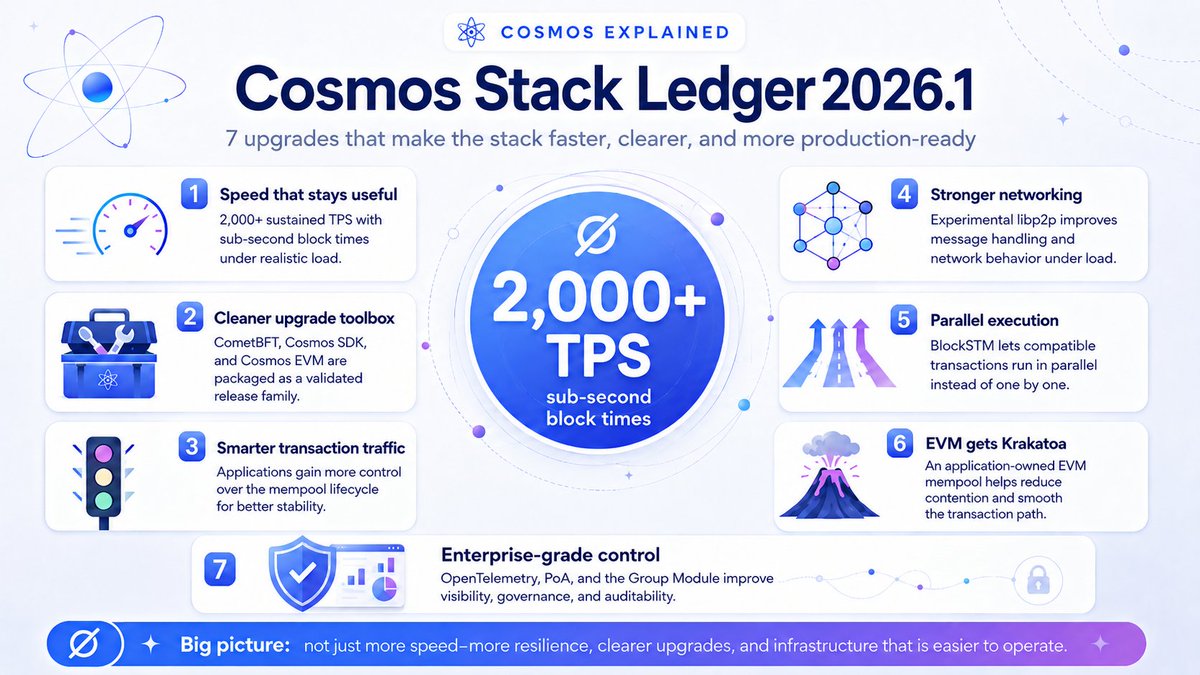
1️⃣ ⚡ Speed that stays useful
The headline is strong:
Cosmos Stack Ledger 2026.1 demonstrates 2,000 sustained TPS with sub-second block times.
But the real point is not “speed for the screenshot.”
It is speed under realistic load.
A blockchain can look fast in a quiet lab.
The real test begins when the network gets busy, the mempool fills up, and users still expect things to work smoothly.
This release focuses on performance that remains predictable.
--
2️⃣ 🧰 A cleaner upgrade toolbox
One of the most important changes is the release family model.
Instead of treating CometBFT, Cosmos SDK, and Cosmos EVM like separate tools scattered across the garage, Cosmos is packaging them as a validated set of components designed to work, upgrade, and be supported together.
For builders and enterprises, this matters.
Clearer compatibility boundaries.
Pinned versions.
More predictable upgrades.
Less guesswork.
More engineering confidence.
--
3️⃣ 🧠 Smarter transaction traffic
CometBFT v0.39 introduces ABCI changes that give applications more control over the mempool lifecycle.
In plain English:
the app can better decide how transactions enter, get checked, and move toward block production.
That matters because transaction handling is closely tied to application state.
When the app controls more of that logic, CometBFT can focus more clearly on consensus and networking.
It is like moving traffic control closer to the city it actually manages.
--
4️⃣ 🌐 A stronger networking layer
CometBFT v0.39 also adds an experimental libp2p networking stack.
The goal is to improve how CometBFT handles network traffic under load.
This does not change the consensus algorithm itself.
Instead, it improves the roads around it:
better concurrent message handling, better round-trip behavior, and a stronger foundation for future networking improvements.
For validators and operators, this is important.
Because sometimes the problem is not the engine.
It is the traffic jam around it.
--
5️⃣ 🧩 Parallel execution with BlockSTM
Cosmos SDK v0.54 brings BlockSTM into the stack.
Instead of forcing every transaction through a single line, BlockSTM allows transactions inside a block to execute in parallel when the workload supports it.
Think of it as opening more checkout lanes.
Same store.
Same rules.
Less waiting.
The key detail is that Cosmos aims to improve throughput while preserving deterministic behavior.
For blockchains, that balance is essential.
Fast is nice.
Fast and predictable is infrastructure.
--
6️⃣ 🌋 Cosmos EVM gets Krakatoa
Cosmos EVM v0.7.0 ships Krakatoa, an application-owned mempool implementation for the EVM.
This moves more transaction handling into the application layer, including async insertion, application-side rechecks, and application-managed transaction state.
Why does this matter?
Because EVM mempool behavior can directly affect latency and throughput.
If too much transaction logic gets stuck inside the consensus path, the system becomes less predictable under load.
Krakatoa helps reduce that pressure.
A smoother transaction path means a better EVM experience inside the Cosmos Stack.
--
7️⃣ 🏛️ Enterprise-grade control and visibility
This release is not only about raw performance.
It also brings stronger observability through OpenTelemetry, helping operators see where time is spent and where systems slow down.
That is critical for production environments.
You cannot fix what you cannot see.
Release Family 2026.1 also adds enterprise capabilities such as the Proof-of-Authority module alongside the Group Module.
For regulated or known-operator networks, this can support governance, control, auditability, and operational clarity.
Not every blockchain needs the same governance model.
Cosmos keeps leaning into modularity.
--
▶ The bigger picture:
Cosmos Stack Ledger 2026.1 is not just a speed upgrade.
It is about making the stack more usable in the real world:
faster execution,
cleaner upgrades,
stronger networking,
better observability,
and more flexible governance.
For Web3, this matters because the next wave of adoption will not be won by demo-chain fireworks.
It will be won by infrastructure that remains verifiable, resilient, and sovereign when real users, institutions, and assets arrive.
⚛ Web3 needs resilient, verifiable, and sovereign systems.
💬 Let's discuss this and move forward together toward a new decentralized world. #NDW
#Cosmos #Infrastructure #validator @cosmoslabs_io @cosmos @cosmoshub
May 15

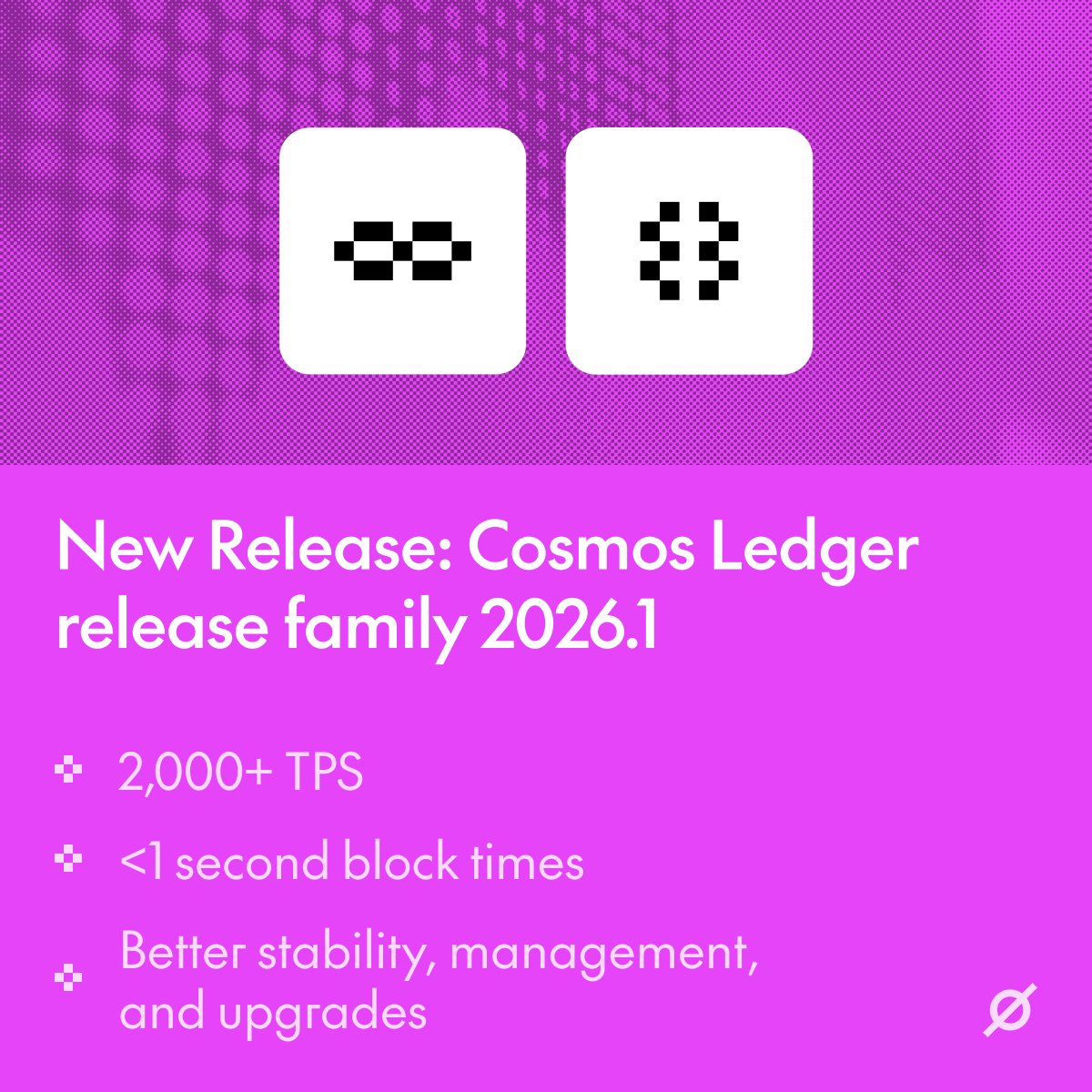
Release Family 2026.1 delivers 2,000 TPS sustained, <1 sec block times, stable performance under load, and enterprise-grade governance, control, and auditability.
CometBFT v0.39, Cosmos SDK v0.54, and Cosmos EVM v0.7.0 are shipped as one release family.
Here's what changed across the stack and what it means for teams.
cosmos.network/blog/cosmos-l…
3
1
27
552

May 19
Cosmos Labsが本気で企業向けに進化!
Release Family 2026.1リリース👏
・持続2,000 TPS & 1秒未満ブロックタイム達成
・CometBFT v0.39 / Cosmos SDK v0.54 / Cosmos EVM v0.7.0 を一括リリース
・並列実行(BlockSTM)で高速化、負荷耐性大幅アップ
・企業向けにPoA(許可型コンセンサス)とGroup Module(監査可能ガバナンス)を標準搭載
ようは「Cosmos SDKが実用レベルで爆速&超安定になって、企業に使いやすくなってるってこと!」
要チェックです✅
May 15
Release Family 2026.1 delivers 2,000 TPS sustained, <1 sec block times, stable performance under load, and enterprise-grade governance, control, and auditability.
CometBFT v0.39, Cosmos SDK v0.54, and Cosmos EVM v0.7.0 are shipped as one release family.
Here's what changed across the stack and what it means for teams.
cosmos.network/blog/cosmos-l…
2
6
43
2,250

May 15
Cosmos SDK v0.54 provides higher execution throughput out-of-the-box and gives operators high-quality observability for performance improvements through telemetry.
Now native in the SDK, BlockSTM allows transactions within a block to execute in parallel, increasing execution throughput for workloads that benefit from parallelism while preserving deterministic behavior.
OpenTelemetry support is now first-class across the stack. Standardized telemetry export plugs directly into the monitoring tools your team already uses, giving operators clear visibility into system performance.
github.com/cosmos/cosmos-sdk…
1
10
599


Apr 22
Cosmos shipped a generational upgrade last week. CometBFT v0.39 (Adaptive Sync, libp2p, BLS), SDK v0.54 (BlockSTM, native PoA), IBC-go v11 (GMP, attestor light clients to Solana and EVM).
Very good news. ExoHash mainnet launches on this stack.
2
215

Apr 12
At least since I joined 1.4 years back this was already here.
The technology behind that is the BlockSTM
3
74

Apr 4
While others are farming points, I’m shipping code. 🧱💎
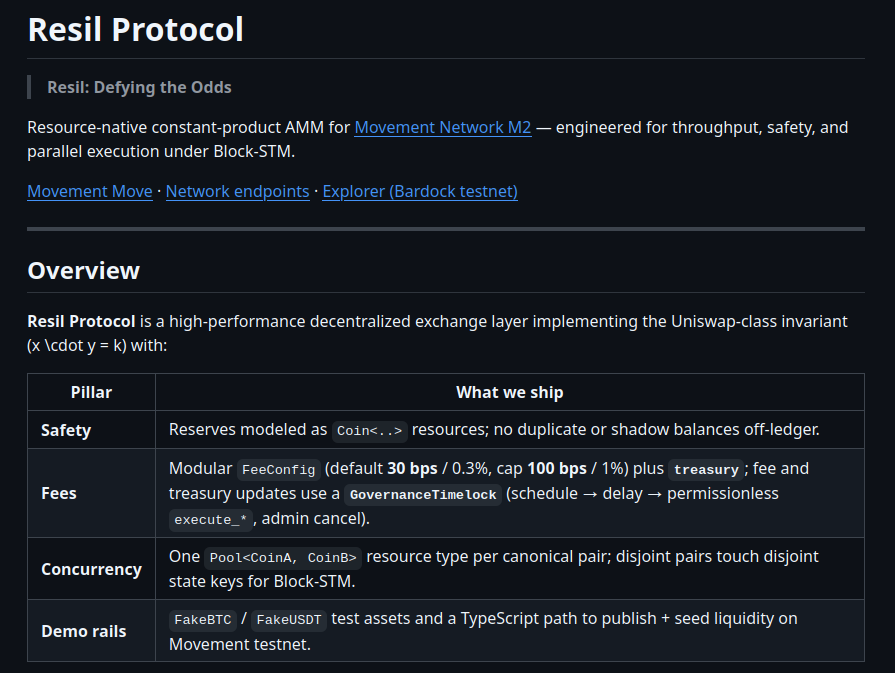
Just finalized Resil Protocol V1 for @movement_xyz. A high-performance, parallel-first AMM built for the M2 ecosystem.
Check the repo: github.com/resil-dev/Resil-P…
@RushiManche
#MoveLanguage #MovementNetwork #DeFi #BlockSTM
1
2
5

Mar 20
Cosmos upgrade -> Gnoland is benefiting
@_gnoland is in the final beta stage and preparing to migrate to Atom.One ICS. The Cosmos upgrades have the following direct effects:
1️⃣ Accelerated migration & mainnet: The upcoming Gaia v27 SDK v0.54 will make Atom.One ICS more stable and powerful → Gno.land can migrate sooner (possibly mid-Q2 or earlier), reducing technical risks when switching to $PHOTON gas $GNOT storage.
2️⃣ Scale & performance: BlockSTM PoA 5,000 TPS will help Gno.land handle realms/multi-user Go VMs more smoothly, especially when the state increases (Storage deposit of $GNOT).
3️⃣ Ecosystem boost: Osmosis merger → Stronger ATOM → Increased liquidity, stable ATOM price → Indirectly benefits GNOT holders (airdrop from ATOM snapshot) and contributor rewards.
4️⃣ @cosmos is strongly focused on institutions (IBC Relayer, PoA) → Gno.land (with its vision of “bringing light to darkness” and graph of thoughts) will be more attractive to developers/enterprises when it launches its mainnet.
The core members are still trying to finalize everything as soon as possible thehowl , @jaekwon , moul, etc.
#GnoLand #Cosmos #AtomOne
Mar 20

Cosmos: Summary of the most significant changes in March 2026
1️⃣ Gaia v27.0 Upgrade Proposal (community vote in progress)
This is the biggest upgrade to the Cosmos Hub to date. It focuses on improving performance and security.
2️⃣ Osmosis Merger Proposal – “COSMOSIS” (11/3/2026)
Objective: Unify liquidity and governance under the Cosmos Hub → create a stronger “super-hub”.
@osmosis proposes a conversion of OSMO → ATOM at a ratio of approximately 1.998 $OSMO : 0.0355 $ATOM
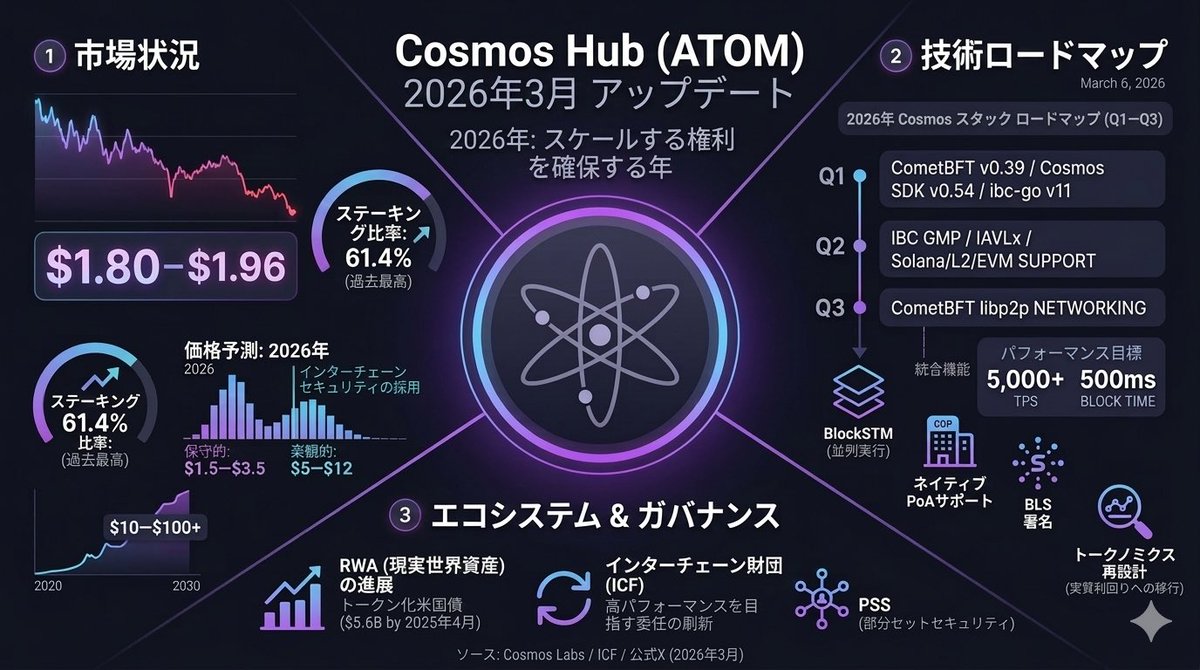
3️⃣ Cosmos Stack Roadmap 2026
Performance for financial settlement: Target 5,000 TPS, block time 500ms, stability under high load.
Q1/Q2 2026 release:
- CometBFT v0.39
- Cosmos SDK v0.54
- ibc-go v11
Strong enterprise orientation: Higher modularity, privacy features, suitable for banking/institutions.
Cosmos Labs promotes IBC Relayer Attestor for regulated environments.
This marks a major shift for @cosmos : from a multi-chain ecosystem to a value-focused $ATOM system.
souvereign experimentation → consolidation

1
3
300

Mar 8
Here, Fixed it.
@CronosNetwork has better infra than @solana
Speed: 60,000 TPS theoretical (BlockSTM parallel execution)
→ 8.28B tx in 1.6 days.
Cost: ~50k gas/tx at (current 377 Gwei)500 Gwei → 0.000025 CRO/tx ($0.0000019) → total gas fees ~$15,650.
@CronosApp ready to take over.
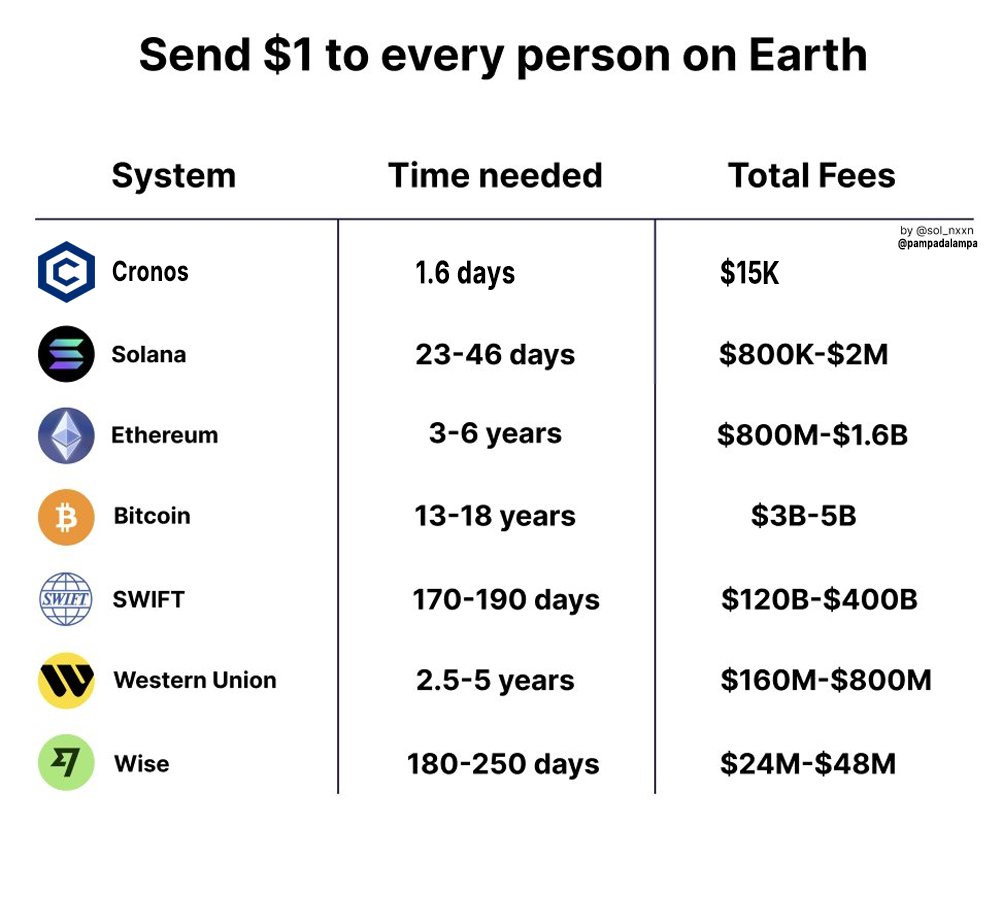

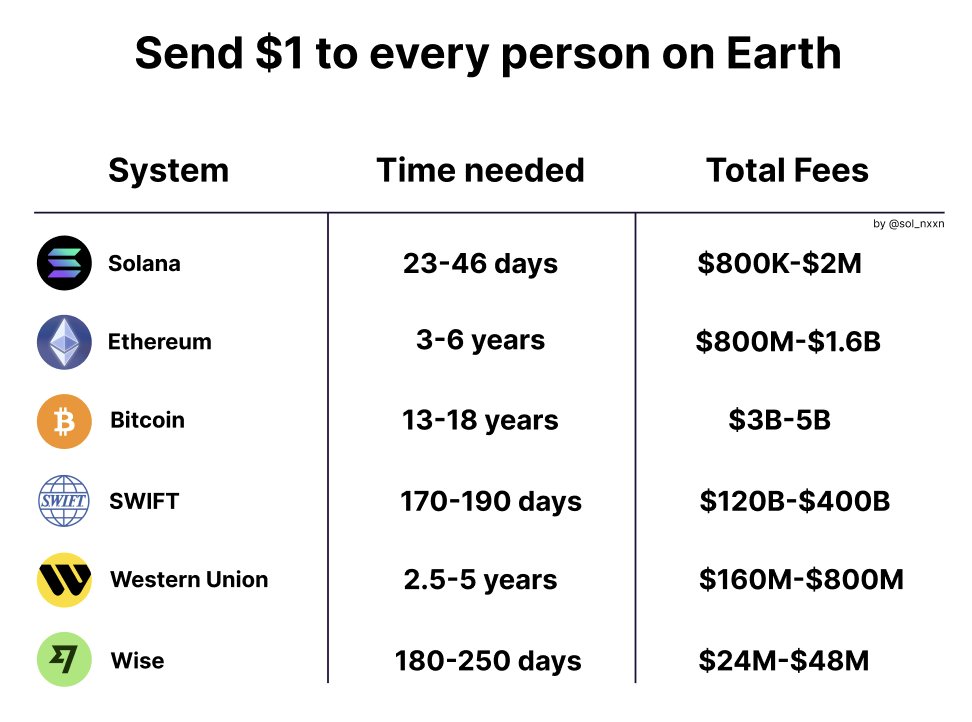
What if you tried to send $1 to every person on Earth? 🤔
Here’s how long it would take and how much it would cost.
PS: Just a fun thought experiment. Numbers use average TPS and fees; no system could realistically do this at scale.
22
70
202
11,242

Financial infrastructure doesn’t get to panic. 🧯⚙️
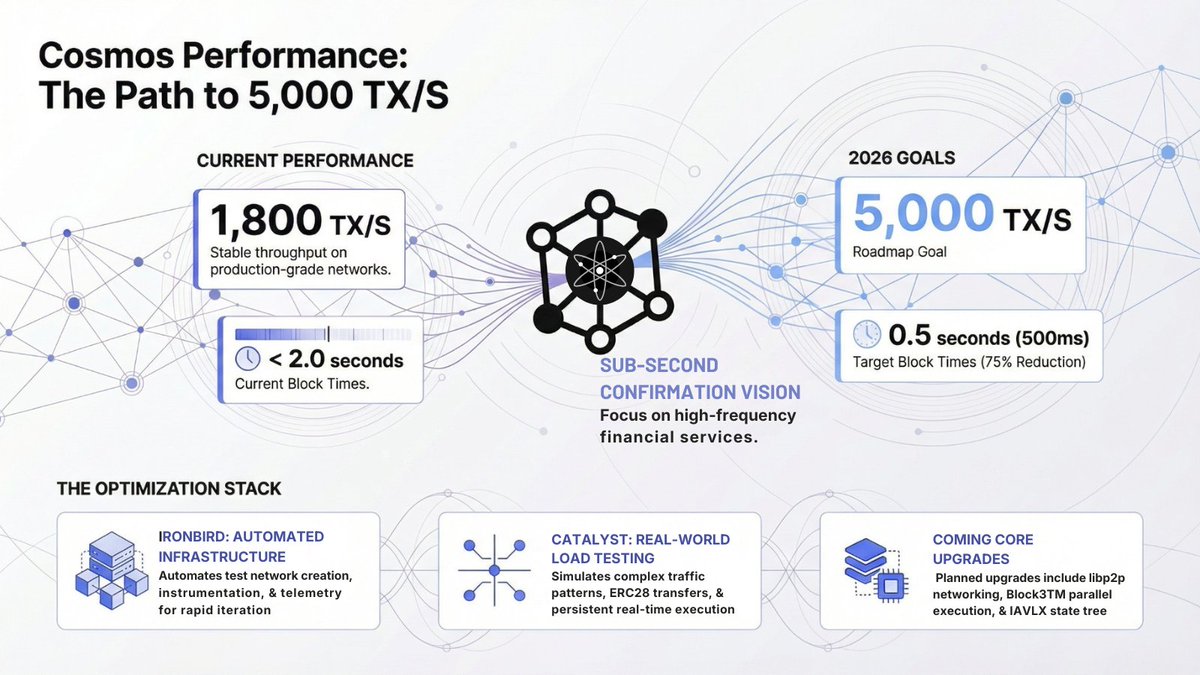
@cosmoslabs_io spent 6 months stress-testing the stack like it’s an institutional workload, then iterated hard.
Result: ~1,800 tx/s reliably today and a clear runway to 5,000 tx/s 500ms blocks tomorrow. 🏁
1️⃣ “Perform under pressure” is the whole game.
Not peak numbers. Stable numbers when it’s crowded.
2️⃣ Where we are now: ~1,800 tx/s on production-grade test networks ✅
With block times staying under 2s.
3️⃣ Where they’re aiming for 2026:
⚡ 5,000 tx/s
⏱️ 0.5s blocks (500ms)
Finance-grade speed, no wobble.
4️⃣ Big picture: measure → break → fix → repeat 🔁
Boring? Yes. Powerful? Absolutely. That’s how trust is built at scale.
5️⃣ The duo behind the grind:
🛠️ Ironbird = automated testnet factory instrumentation
🚦 Catalyst = realistic traffic generator (so it feels like real users)
6️⃣Next upgrades teased:
🔌 better networking (libp2p)
🧠 parallel execution (BlockSTM)
🌳 faster state tree (IAVLx)
7️⃣ If you’re building in the interchain, this is the roadmap vibe you want. 👀
Reliable speed is the real flex.
#Cosmos #IBC #NDW @interchain_io @cosmos
Feb 18
Financial infrastructure needs to perform under pressure.
We spent six months stress-testing the Cosmos stack on networks that reflect institutional use cases, then improved to achieve reliable performance of 1,800 tx/s today and 5,000 tx/s tomorrow.
Read more below ⬇️
19
305

Feb 23
$ATOM #COSMOSHUB
Cosmos Stack 2026 年路线图,主要里程碑的预测:
Q1未/Q2初— 下一代版本系列(CometBFT v0.39、Cosmos SDK v0.54、ibc-go v11)将原生支援权威证明(Proof of Authority)、BLS签名和BlockSTM。
Q2 — IBC GMP、IFT、Solana 和 L2/EVM 支持,以及 IAVLx 储存重写
Q3 — CometBFT libp2p 网路生产目标
Q4-SDK发布目标为在生产环境中持续实现5000 TPS和500毫秒阻塞时间, 应用程式的运行速度将与 Web2 服务一样快,即使在重负荷下也能保持稳定的性能,应用程式的运行速度将与 Web2 服务一样快。
详细内容:x.com/cosmoslabs_io/status/2…
2026年2月20日新闻,富国银行正在运用COSMOS SDK建立一条 Cosmos 区块链,预将 2 兆美元的存款代币化。
目前正在美国和印度招募 6 名工程师(具有 Cosmos SDK 和 CometBFT 经验的工程人才),网址如下:
wd1.myworkdaysite.com/en-US/…
NodeStake 节点,是可以安心交付的节点,全时监控维运状态,并提供最稳定的 $ATOM 自动复投
(GAS费用由NodeStake @NodeStake_top 节点全额支付): restake.nodestake.top/cosmos…
2
6
30
4,722


