Sepi retweeted

Witness & Feel Alive
Both are editions on TransientLabs
Both so close to my heart
Both i remember the moment of creation so well
Both waiting for their first mint
Happy Thursday 🖇️⬇️


2
2
4
23

Nope. Kalam has been debunked for years.
List of notes on Causation
-Quantum Spontaneity:
At the subatomic level, events occur randomly and spontaneously without a direct, deterministic trigger. Because the early universe was smaller than a subatomic particle, quantum fluctuations could have triggered the Big Bang naturally, without an external cause.
No-Boundary Proposal:
Physicists like Stephen Hawking suggested that asking what caused the universe is like asking what is north of the North Pole. In this framework, space and time are finite but have no boundary or starting point, meaning the universe contains within itself the explanation for its existence without needing an external trigger.
Causation and Law of Contradiction
1. Deconstructing the Kalam & The "Contradiction" Claim
The standard Kalam Cosmological Argument is formulated as:
Whatever begins to exist has a cause.
The universe began to exist.
Therefore, the universe has a cause.
You're claiming that saying the universe "began to exist" but "has no cause" is a logical contradiction.
Why you are wrong about the Law of Non-Contradiction:
A formal logical contradiction occurs only when you assert two mutually exclusive propositions simultaneously (e.g., "The universe is entirely caused and the universe is entirely uncaused").
Saying "The universe had a beginning but did not have a cause" is a synthetic proposition, not a logical contradiction.
It might be physically counterintuitive, but it is not a violation of formal deductive logic. It is only a contradiction if they have already sneakily defined "beginning to exist" as meaning "must be caused"—which is begging the question (assuming the conclusion in the premise).
2. "Need for Causation"
Kalam- I only need to show that Premise 1 or Premise 2 is not an absolute, universal law. Here are the most robust, evidence-backed ways to challenge the absolute necessity of causation.
A. The Equivocation on "Begins to Exist"
In everyday life, when we see something "begin to exist" (like a table, a house, or a baby), it is actually just creatio ex materia—the rearrangement of pre-existing matter and energy. The cause is efficient and material.
The origin of the universe is claimed to be creatio ex nihilo—the literal popping into existence of matter, energy, and spacetime itself out of nothing.
The Counter:
We have zero empirical examples of things beginning to exist ex nihilo. Therefore, you cannot use inductive reasoning from everyday experience ("everything we see has a cause") to apply to the birth of spacetime itself. It is a massive equivocation fallacy.
B. Quantum Mechanics (True Indeterminism)
In classical physics, causality reigns supreme. But at the quantum scale, the universe behaves differently.
Quantum Fluctuations:
Particles (like virtual particle pairs) pop into and out of existence spontaneously in a vacuum without a classical deterministic cause.
Radioactive Decay:
A specific atom of Uranium-238 will decay at a completely unpredictable moment. There is no underlying physical trigger or "cause" that makes it decay at second 5 instead of second 10; it is fundamentally probabilistic.
The Counter:
If subatomic particles can lack a deterministic cause, then the early universe—which was smaller than a subatomic particle during the Planck epoch—could also have originated from a quantum event without a prior cause.
C. The B-Theory of Time (Static Block Universe)
The Kalam relies entirely on the A-Theory of time (presentism), which states that the past is gone, the future doesn't exist, and time "flows" lineally.
However, modern physics (specifically Einstein’s General Relativity) heavily favors the B-Theory of time (eternalism). In a block universe, past, present, and future are all equally real. Time is a spatial dimension.
The Counter:
1/2...
1
2
Odogwu praise retweeted

Men are 1m times more ruthless than women bro, those bandits are they not men? The people that lied about creation of the world, are they not men? So wetin women really do way make dem ruthless
25
1
13
2,681

One could even say I,, participate in the ,, JOY OF CREATIO - 💥💥💥💥💥💥💥💥💥 🔫
1
1
10

JOB ALERT!!!
HIRING Business Analyst – Remote
Location: Remote
Salary: Competitive
Job Type: Full-time
Schedule: Flexible
ROLE OF THE JOB:
* Gather, analyze, and document business requirements while modeling and improving business processes using Creatio tools
* Configure and customize Creatio applications using low-code/no-code capabilities and support project delivery from requirements through deployment
* Collaborate with stakeholders, developers, QA teams, and solution architects to ensure successful implementation and user adoption
Apply Now job.digichocolat.com/2026/06…
Repost and tag someone with experience in Business Analysis, CRM systems, BPM, or Creatio!
#BusinessAnalysis #RemoteWork
1
17


𝐟𝐥𝐨𝐜𝐨 ❄️ retweeted

25 Mar 2017
At #OUATVan Con this weekend? Look out for the #EvilRegals Snapchat filter only available at the convention! 🤘🏽😈 @CreationEnt

211
841
3,272

I saw an interesting quote from Maccabees that supports creatio ex nihilo
1
4
Northeast Queens NY retweeted

Story here 👉️ abc7ny.com/post/balloon-bank… Balloon artist Joel Klein, 76, rightly assumed that people would love his balloon creation of Knicks captain Jalen Brunson. The retired electrician started by making simple balloon animals at events for kids but stepped his game up after going to a balloon art convention. Now, he is celebrating the NBA champions in the West Village.

2
11
1,422

16h
Creatio Highlights Gartner Recognition as Agentic AI Reshapes CRM Platforms | citybiz citybiz.co/article/861482/cr… #AgenticAI
4
ashoke dasgupta retweeted

Jun 17
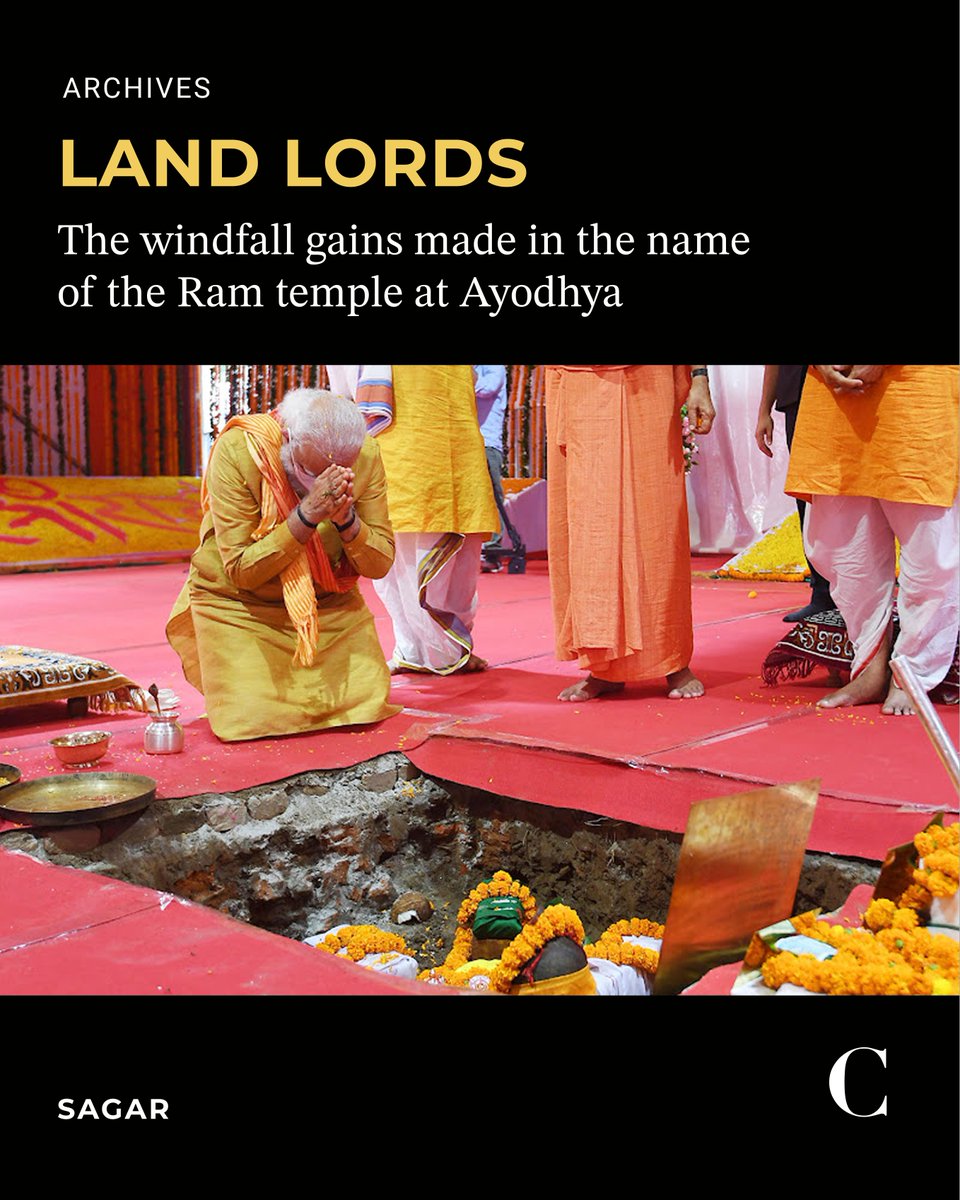
Archives | On 5 February 2020, the government established the Ram Janmabhoomi Teertha Kshetrar to work for the creation of a Ram temple in the place of Babri Masjid. The RJTK's acquisition of additional land for the Ram temple complex allowed local notables to make crores of rupees in profits.
A common pattern was found in an analysis of several land deals involving the RJTK in Kot Ramchandra and the nearby Bagh Bijaisi neighbourhood. Instead of the trust acquiring the land directly from its owners, it went through a number of intermediaries, many of whom were connected to Rishikesh Upadhyay, the mayor of Ayodhya at the time.
From our January 2024 issue, report by Sagar (@Sagar_reporter): caravanmagazine.in/religion/…
2
20
31
2,664
黄昏狐 retweeted

Apr 26
通説としての位置づけ
ヘーゲル本人の立場と解釈の一致:ヘーゲルは自分をルター派キリスト教徒と自認していましたが、彼の「神」(あるいは絶対精神)は、聖書的な外在的創造主(creatio ex nihilo)とは明確に異なります。
1
1
21