
⚗️🇨🇳 China's rare earth strategy just went deeper than ore and magnets. It extended all the way into the chemistry cupboard.
And most people building Western REE separation plants haven't fully priced in what that means. 🧵
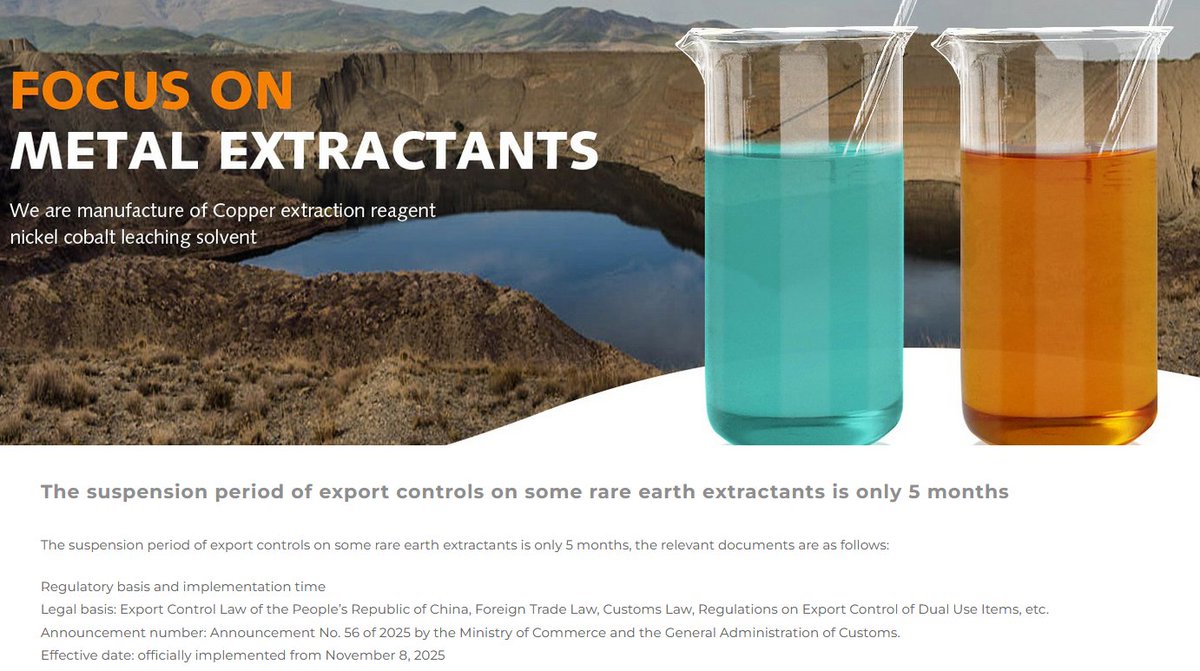
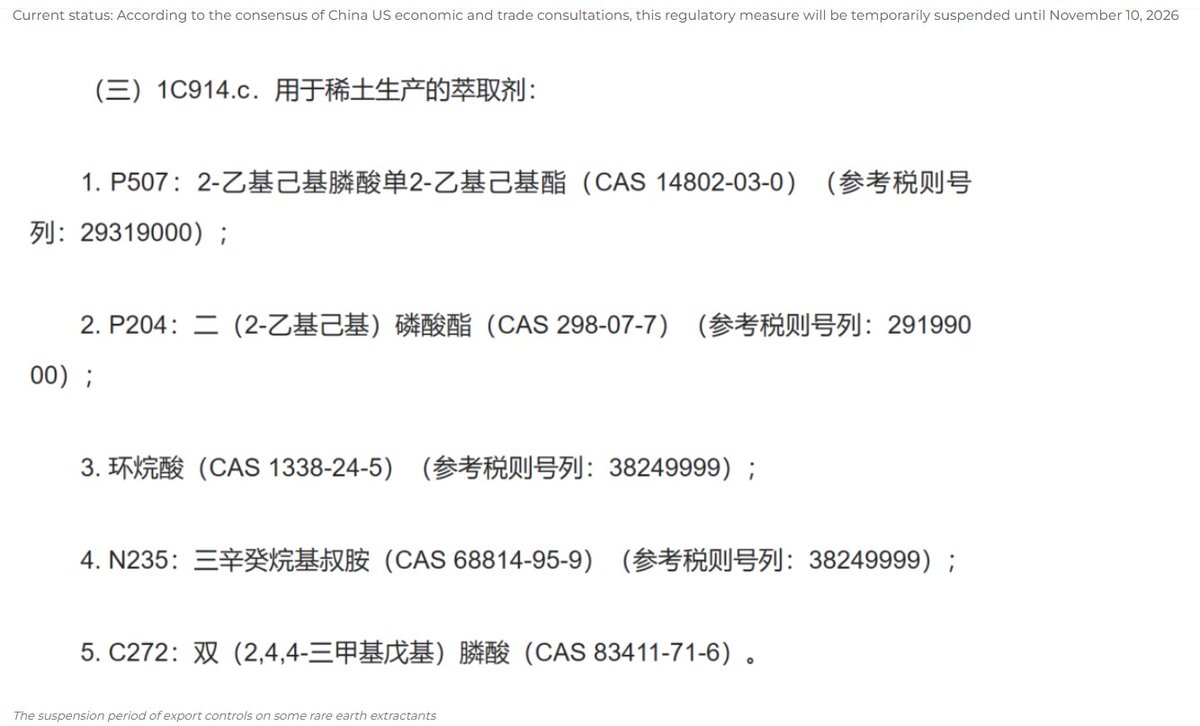
In November 2025, China's Ministry of Commerce formally implemented export controls on five key solvent extraction reagents — the organic chemicals that sit at the heart of virtually every rare earth separation plant on earth.
🧪 The Three Core Extractants — and What Each Does
The Chinese rare earth industry standardised around three primary organophosphorus extractants, each targeting a different part of the separation sequence:
⚗️P204 (D2EHPA / HDEHP)
Bis(2-ethylhexyl) phosphoric acid
Acidic extractant — strong affinity for heavier lanthanides and yttrium
Used for first-stage impurity removal and heavy REE separation (Sm, Eu, Gd, Y)
Also the benchmark extractant for removing iron and other impurities before the main REE circuit
⚗️P507 (EHEHPA)
2-Ethylhexyl phosphonic acid mono-2-ethylhexyl ester
Acidic extractant with higher separation coefficients than P204
Now the mainstream reagent for light rare earth separation — La, Ce, Pr, Nd
Preferred over P204 for NdPr separation because of better selectivity and lower saponification requirements
Critical for producing the magnet-grade NdPr oxide that LCM, Solvay, Carester, and every other Western metallization house needs
⚗️N235 (N1923)
Tri(octyl-decyl) tertiary amine
Alkaline/neutral extractant — operates in chloride systems
Used for light REE separation and associated element extraction in hydrochloric acid leach circuits
Together, these three chemicals underpin virtually every industrial REE separation plant operating outside China today — including Solvay's La Rochelle facility, Energy Fuels' White Mesa circuits, and the planned Carester/Caremag plant at Lacq, France.
These are not obscure laboratory reagents. P507 and P204 are the workhorse extractants of the global REE solvent extraction industry. They are used in virtually every commercial REE separation circuit operating today — including facilities in France, Estonia, the United States, and Japan.
⏸️ The current status: suspended — but not cancelled
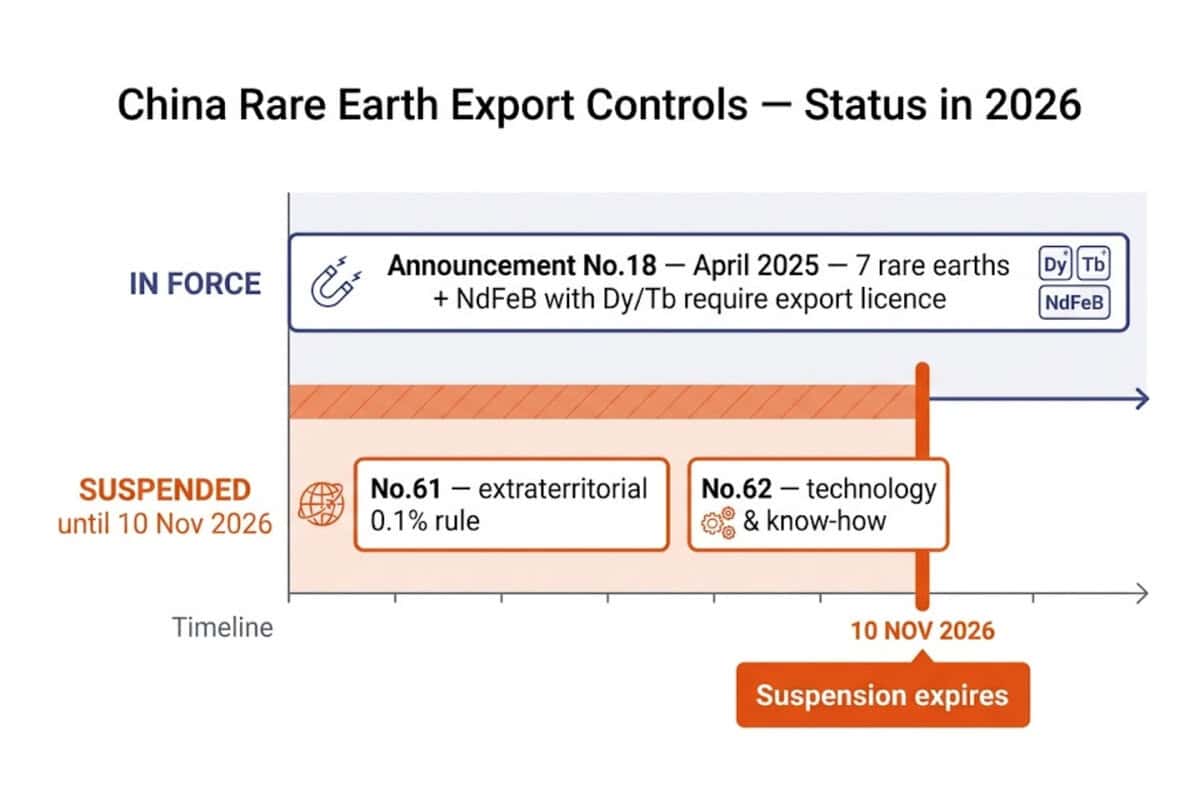
Following the US-China economic and trade consultations, the controls have been temporarily suspended until November 10, 2026.
That is approximately five months from now.
The controls have not been lifted. They have been paused. They remain on the books under China's Export Control Law and the Regulations on Export Control of Dual Use Items — and they can be reactivated at any time, for any destination, based on end use, customer, or geopolitical circumstances.
For any Western REE separation project currently in development, that five-month window and the uncertainty beyond it are not background noise. They are a project risk that belongs on the critical path. ⚠️
🏭 Why this matters for Western separation plants
To understand the exposure, consider what a solvent extraction circuit actually needs:
A single commercial-scale REE separation plant — capable of processing thousands of tonnes of mixed rare earth concentrate per year — requires hundreds of tonnes of organic extractant just for the initial circuit fill before a single kilogram of separated REO is produced.
After that, ongoing solvent makeup is required continuously, because extractants degrade over time through radiolytic breakdown, chemical oxidation, and entrainment losses. The circuit never stops consuming them.
If export of P507, P204, and C272 from China requires a licence — and that licence is denied, delayed, or made conditional — a fully constructed, fully feedstocked REE separation plant simply cannot operate.
The concrete is poured. The mixer-settlers are installed. The leach circuits are running. And the plant sits idle because it cannot get its solvent inventory across the border. That is the specific vulnerability these controls create.
🌍 The broader strategic read
This is the most important point, and it goes beyond rare earths specifically.
⚗️C272 (Cyanex 272) is the benchmark extractant for cobalt/nickel separation by solvent extraction — used in battery recycling and lithium-ion battery precursor manufacturing globally. Its inclusion in these controls means the reach extends well beyond rare earth refining into the entire battery metals processing ecosystem.
What China has done is demonstrate that its leverage in the critical minerals value chain does not stop at:
❌ Controlling the ore deposits
❌ Controlling the separation and refining capacity
❌ Controlling the metal and alloy manufacturing
It now extends to controlling the process chemicals required to operate separation plants that Western countries are spending billions to build.
A rare earth project that has secured its mining licence, its offtake agreements, its government funding, and its construction contracts — but sources its extractants from China — carries a vulnerability that sits entirely outside its own control.
🔬 What the response looks like
There are credible paths forward, but none of them are instant:
1. Western extractant production
P507, P204, and C272 can be synthesised outside China. The chemistry is not secret — it is decades old. But commercial-scale Western production of these specific organophosphorus compounds has atrophied as Chinese supply became dominant on price. Restarting or scaling that production takes capital, time, and permitting.
2. Alternative extractant chemistries
This is where the technology landscape becomes directly relevant. Several next-generation separation approaches are specifically designed to eliminate dependence on Chinese organophosphorus extractants entirely:
A. 🫧Ionic liquid-based SX (e.g., MAIL-type systems) uses engineered amide ionic liquids instead of conventional organic diluents and phosphoric acid extractants — produced in Western laboratories
B. ⏳Continuous ion exchange / chromatography operates in entirely aqueous media with resin-based columns — no organic solvent phase at all
C. 📱Membrane-assisted SX uses immobilised extractant phases that dramatically reduce solvent inventory requirements
These are not just greener alternatives. In the current regulatory environment, extractant sovereignty is supply chain sovereignty.
3. Strategic inventory building
During the current suspension window, any Western operator relying on Chinese P507, P204, or C272 should be assessing whether they need to build forward inventory before November 2026 — and what their contingency is if the suspension is not extended.
⏰ The clock is running
The suspension expires November 10, 2026. That is not a distant horizon. For projects in active construction or commissioning, it is within the current project timeline.
The controls were implemented once. They were suspended under diplomatic pressure. The underlying regulatory framework — China's Export Control Law, dual-use classification, licence requirements — remains entirely intact.
⏰ November 10, 2026
The export control suspension expires in approximately five months.
Every Western REE separation project currently operating or commissioning on P507 or P204 should have a clear answer to three questions:
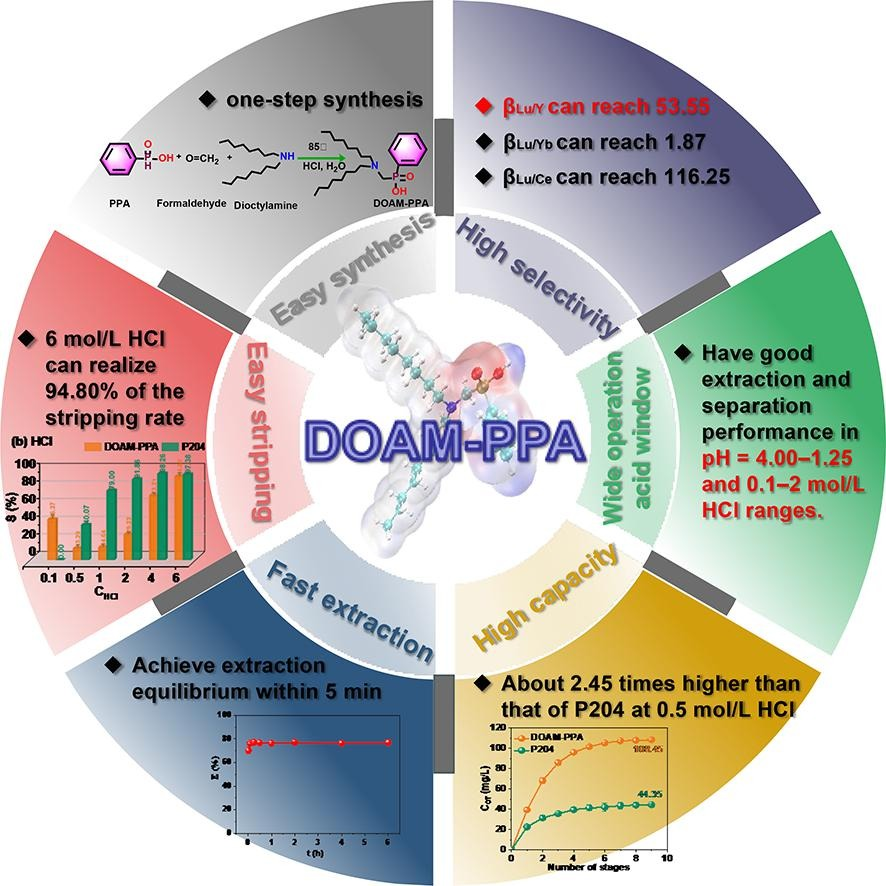
Last Slide, shows DOAM-PPA —
⚗️🫧((dioctylamino)methyl)phenylphosphonic acid — a novel rare earth extractant synthesised by a research team at the Fujian Institute of Research on the Structure of Matter, Chinese Academy of Sciences.
It is in the same organophosphorus extractant family as P204, P507, and Cyanex 272 — the three Chinese-controlled extractants — but it is a next-generation molecule specifically engineered to outperform them, particularly for heavy rare earth (HREE) separation.
If the next generation of high-performance HREE extractants is also being developed inside Chinese state research institutes, what does Western extractant sovereignty actually look like long-term — and is ionic-liquid or aqueous-based separation chemistry the only credible path to genuine independence from Chinese process chemicals?
📦 What is your current extractant inventory and how long does it run your circuit?
🌍 Do you have a non-Chinese supply source qualified and contracted?
🔬 What is your longer-term chemistry strategy — and does it reduce or eliminate Chinese extractant dependency?
These are not theoretical questions. They are operational ones. ⚗️
🔗 metalleaching.com/rare-earth…
🔗 metalleaching.com/export-con…
#RareEarths #REE #CriticalMinerals #SolventExtraction #SX #P507 #P204 #D2EHPA #HDEHP #EHEHPA #N235 #C272 #Cyanex272 #REEExtractants #OrganophosphorusChemistry #LanthanideSeparation #CascadeExtraction #XuGuangxian #MixerSettlers #REESeparation #Hydrometallurgy #NdPr #Neodymium #Praseodymium #Dysprosium #Terbium #Yttrium #Samarium #MagnetGrade #REOPurity #ExportControls 🇨🇳⚗️🔬🧪⚠️🌍🏭⏰🔒🌱
1
2
13
619