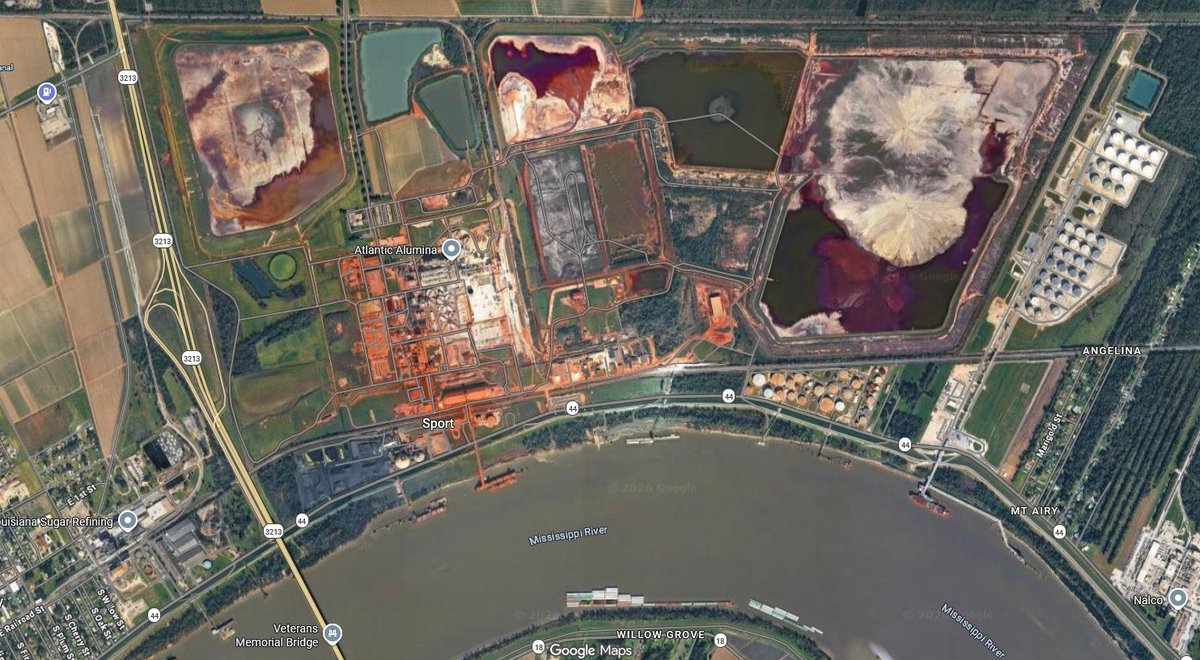
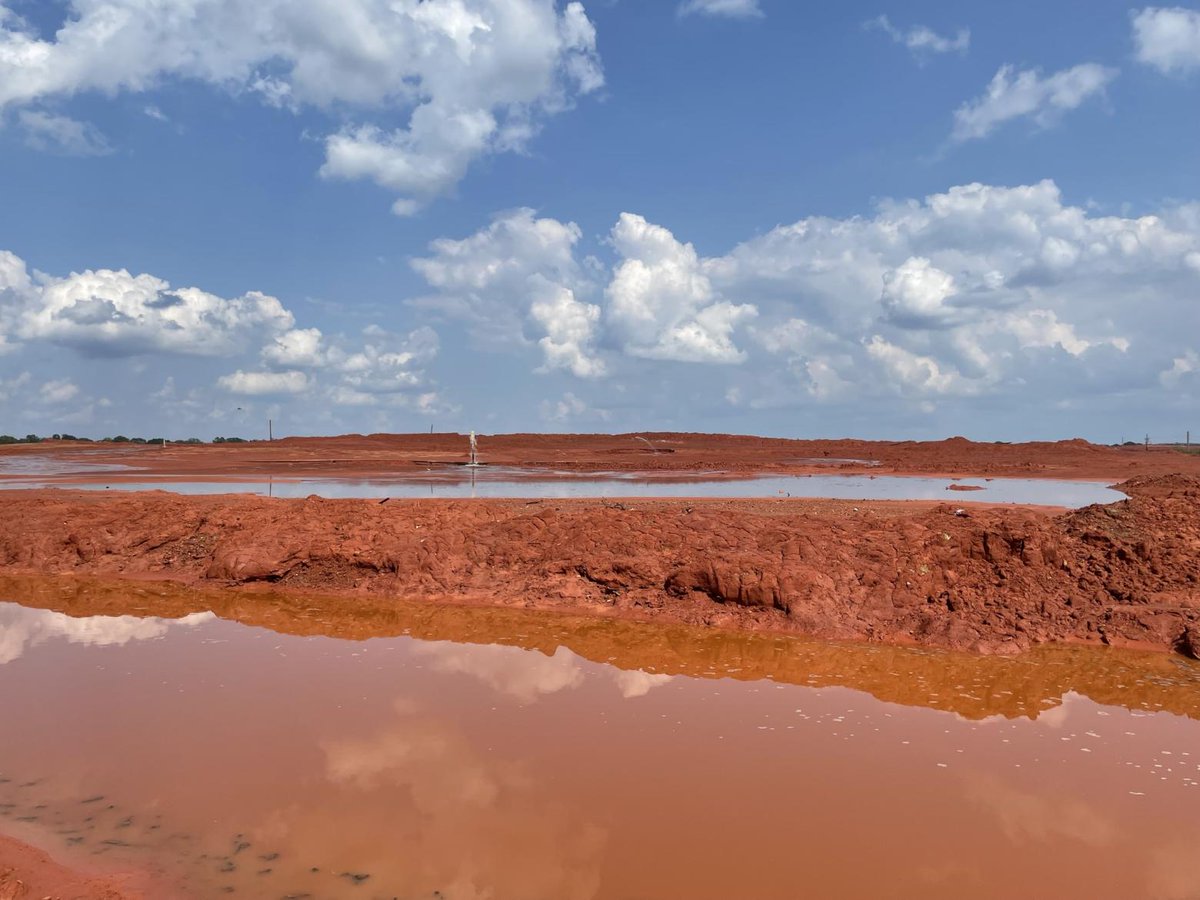
🇺🇸🏭 The US Department of Energy just awarded $67 million to turn a 30-million-tonne pile of industrial waste in Louisiana into a domestic rare earth and critical mineral supply chain.
The feedstock? Bauxite residue — "red mud" — from the last operating alumina refinery in the United States. And this one is unlike any other red mud deposit on earth. 🧵
🎬 Watch the ElementUSA video 👇
🎯 The Project — Straight to the Point
ElementUSA (formerly ElementUS Minerals LLC), in partnership with the Colorado School of Mines, has been awarded a $67 million DOE grant to design, construct, and operate a rare earth and critical mineral processing facility at St. John the Baptist Parish, Louisiana — targeting the legacy bauxite residue stockpiles at the Gramercy alumina refinery.
Total federal commitment across both agencies:
💰 $67M — U.S. Department of Energy (DOE), in partnership with Colorado School of Mines
💰 $29.9M — Department of Defense, Defense Production Act (DPA) Title III, specifically targeting gallium and scandium recovery for Pentagon supply chain needs
💰 $850M — Louisiana Economic Development investment decision to cement the facility in St. John Parish, projecting 200 direct and 550 indirect jobs
Also
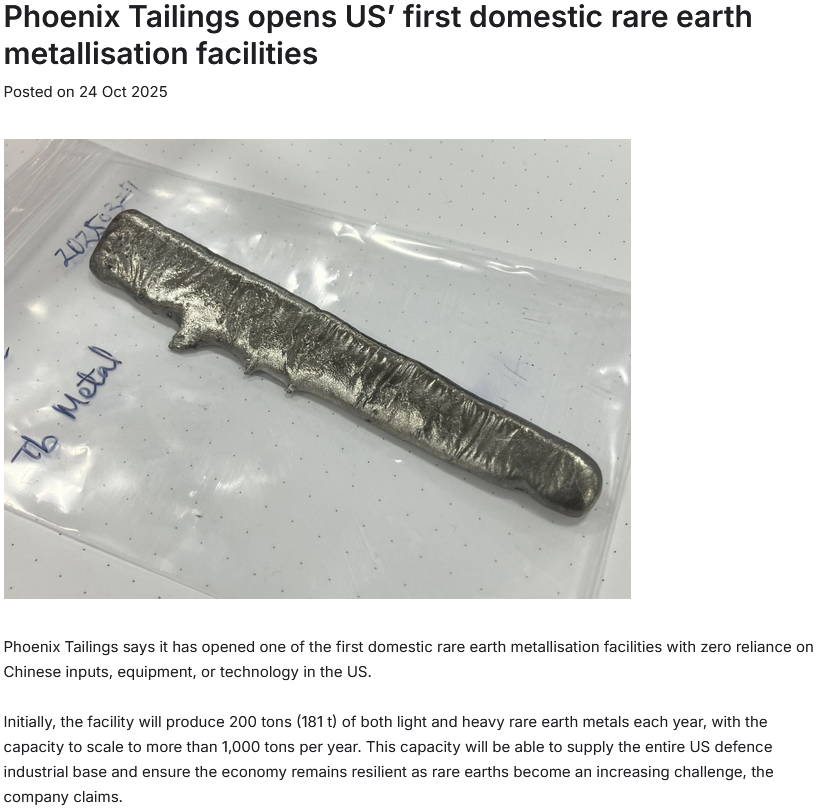
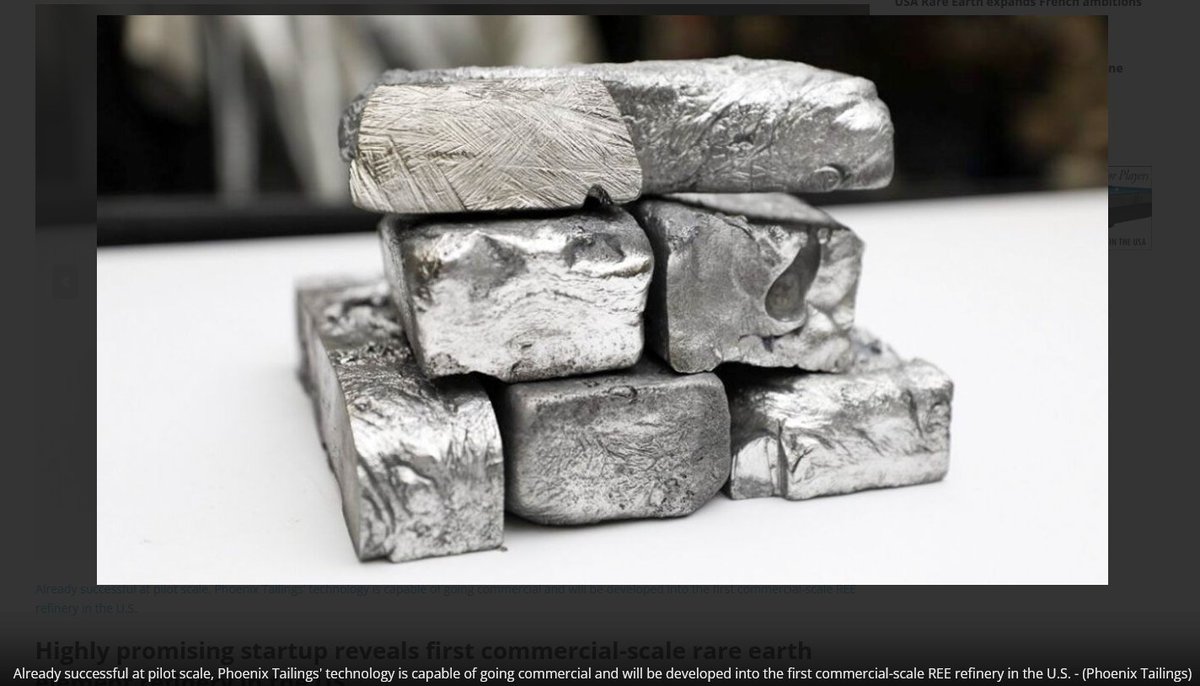
⚗️📷 $66 million. U.S. Department of Energy. Phoenix Tailings. June 3, 2026. 🧲The @ENERGY
selected @PhoenixTailings for a $66 million grant — part of a $147.8 million program — to deploy next-generation rare earth separation and refining technology at commercial scale, partnered with MIT and the University of Minnesota.
Further Reading here👇
x.com/roblun1/status/2062571…
Back to ElementUSA Funding
This is not a single agency bet. Both the DOE and the DoD have independently assessed this project as strategically critical — through an energy security lens and a defense readiness lens simultaneously.
Groundbreaking for Phase 1 is expected to commence mid-2026.
🌋 Why This Feedstock Is Different
Red mud is one of the most abundant industrial waste streams on earth — global stockpiles exceed 4 billion tonnes. Most of it is essentially worthless for REE recovery, averaging 800 to 900 ppm total rare earth elements globally.
The Gramercy deposit is fundamentally different.
The Gramercy refinery has been processing Jamaican karstic bauxite since 1957. Jamaican karstic bauxites are globally unusual — they are naturally enriched in rare earth elements, yttrium, and scandium due to the lateritic weathering processes in tropical environments that formed them. When the Bayer process extracts alumina from this ore, the entire REE suite concentrates into the residue, roughly doubling its grade relative to the original ore.
The result: 30 million dry tonnes of surface-stockpiled material, expanding at approximately 1 million tonnes per year, characterised by:
🔬 Gramercy REE Basket — Key Elements:
⚗️ Total REE (TREE) — 3,000–4,000 ppm | ~4× global red mud average
🧲 Neodymium & Praseodymium (NdPr) — ~20× crustal average | Core NdFeB permanent magnet metals
🛡️ Dysprosium & Terbium (Dy/Tb) — ~20× crustal average | Critical HREE dopants for EV motors & defense
⚡ Yttrium (Y) — >20× crustal average | Major heavy rare earth phosphate fraction
🔩 Scandium (Sc) — 130–390 ppm | Exceeds global red mud avg of 45–150 ppm — highest value per kg in the basket
💡 Gallium (Ga) — Up to 200 ppm | Critical semiconductor input, severely limited in Western supply
🔋 Vanadium (V) — Up to 800 ppm | Grid-scale battery storage & high-strength steel alloying
🏗️ Iron matrix — ~50% of total mass | Extracted as commodity pig iron — funds the operation
More than 95% of the metals across the iron, rare earth, and critical mineral fractions are characterised as payable.
🧪 A Note on Grade — and Why the Basket Price Is the Real Number
3,000–4,000 ppm is objectively low grade compared to primary hard-rock REE deposits. Mountain Pass in California grades at approximately 89,932 ppm TREO (~9%), with NdPr concentrations exceeding 23,810 ppm (~2.4%).
But the Gramercy economics do not rest on absolute grade. They rest on three things:
1. The basket composition. Most conventional REE deposits are light-rare-earth dominated — rich in lanthanum and cerium, which have low commercial value and create persistent oversupply problems. The Gramercy basket is heavily weighted toward high-value heavy rare earths, yttrium, and scandium — the elements that matter most for magnets, defense systems, and aerospace.
2. Scandium as an economic multiplier. Scandium can represent up to 95% of the theoretical economic value of REEs in red mud. The 130–390 ppm Sc concentration at Gramercy means the site functions, from a unit economics perspective, as a high-grade scandium deposit that also produces a lucrative REE basket. Scandium prices have historically reached $3,000 per kilogram due to supply constraints from politically complex jurisdictions.
3. Zero mining cost. The material already exists as a surface-accessible, ultra-fine particulate slurry. There is no drilling, blasting, hauling, or primary comminution. The largest capital outlays of a conventional mine simply do not apply.
⚙️ The Flowsheet — Why Pyro First, Then Hydro
This is the engineering decision that makes the entire project viable.
Directly applying acid to raw red mud would be catastrophic. The Gramercy material is approximately 50% iron by mass. Direct leaching would consume enormous volumes of acid dissolving bulk iron rather than the target critical minerals, and create an iron-saturated pregnant leach solution from which extracting trace scandium, gallium, and HREEs would be chemically unmanageable.
ElementUSA's solution — developed with Enervoxa — is a two-phase integrated flowsheet:
Phase 1: Pyrometallurgical iron valorization 🔥
The dry bauxite residue is fed into a high-temperature smelting furnace using a continuous carbothermal reduction process. The ~50% iron fraction is chemically reduced and extracted as saleable commodity pig iron — converting the largest waste component into a continuous revenue stream that subsidises the baseline OPEX of the entire facility.
The residual slag, now thoroughly depleted of interfering iron, contains the concentrated aluminosilicates, calcium compounds, and the entire inventory of REEs, scandium, and gallium — at effectively double or triple their original concentration in the feed.
Phase 2: Hydrometallurgical separation ⚗️
The iron-depleted slag proceeds into aqueous leaching circuits. The flowsheet is engineered to first extract individual high-purity gallium and scandium streams — reflecting the DoD's specific strategic priorities — followed by precipitation of the remaining REEs as a mixed rare earth oxide (MREO) basket characterised by its heavy rare earth and yttrium weighting.
This MREO product targets downstream offtake in magnet, semiconductor, aerospace, and medical imaging applications.
🎓 The Academic Partnership: Colorado School of Mines
The $67M DOE award explicitly pairs ElementUSA with Colorado School of Mines — leveraging its renowned Waste-to-Value Center under the leadership of Dr. Elizabeth Holley.
This brings an interdisciplinary team covering technical validation, mineral characterisation, scale-up fluid dynamics, and flowsheet optimisation.
ElementUSA also operates the Critical Resource Accelerator — a 30,000-square-foot R&D hub in Cedar Park, Texas — staffed with hydrometallurgists and pyrometallurgists and equipped with full analytical laboratory and pilot-scale development capabilities ranging from 500mL to 20-litre bench reactors.
🌍 Zero-Waste Architecture
A core design objective of the ElementUSA flowsheet is zero solid waste closure.
By fractionating the red mud into pig iron, critical mineral products, REO basket, and a neutralised aluminosilicate residue, the facility is designed to eliminate the entire historical environmental liability of the Gramercy site.
The depleted aluminosilicate bulk — stripped of heavy metals and iron — is suitable for use as supplementary cementitious material, clinker substitute, or geopolymer concrete input.
The 3,300-acre Gramercy site currently accumulates 1 million additional tonnes of new residue per year. This facility is designed to process that incoming material while simultaneously treating the legacy stockpile — converting an ongoing environmental liability into a strategic supply chain asset.
🗺️ The Scale of the Commercial Ambition
Phase 2 targets a 1-million-tonne-per-year commercial throughput, backed by an estimated $1.1 billion capital expenditure — with construction commencement targeted as early as 2027.
The strategic objective: supply between 45% and 385% of current annual US demand for various critical elements from this single facility — positioning the US toward net-exporter status for specific defense-critical metals.
📋 What to Watch: The Scale-Up Journey
The Phase 1 demonstration groundbreaking is targeted for mid-2026 — and the Phase 2 commercial facility at 1 million tonnes per year has a construction commencement target of 2027.
That is an ambitious timeline by any measure in extractive metallurgy, and the engineering community knows it. Here is what the milestones actually mean and what to watch for:
⏱️ The timeline reality
Transitioning a complex pyro-hydrometallurgical flowsheet from bench-scale validation to mega-scale commercial operations has historically taken 5 to 10 years of iterative optimisation. Phase 1 groundbreaking in mid-2026 and Phase 2 construction starting in 2027 means both phases are effectively running in parallel'
Silica management at scale — Bauxite residue contains reactive silica that can polymerise in acid leach circuits, forming viscous gels that clog filtration and solvent extraction units.
HREE separation circuit performance — Separating dysprosium, terbium, and yttrium from a low-ppm pregnant leach solution at industrial throughput requires hundreds of sequential solvent extraction stages running with very precise fluid dynamics. The low tenor of HREEs in solution means large liquid volumes must be processed to yield commercial quantities — putting reagent management and phase separation under sustained pressure.
✅ What gives confidence
The dual federal mandate (DOE DoD), the Colorado School of Mines academic partnership, the 30,000 sq ft Critical Resource Accelerator R&D hub in Cedar Park Texas, and the $850M Louisiana Economic Development commitment all provide an unusually robust infrastructure for absorbing the engineering learning curve.
🔗 Connecting the Dots: The DOE's Emerging Secondary Feedstock Strategy
Regular readers will recall the recent post on Phoenix Tailings receiving a $66M DOE grant to build a demonstration facility in Oklahoma for high-purity rare earth metal production from industrial waste, partnering with MIT and the University of Minnesota.
ElementUSA now joins Phoenix Tailings in a clear DOE thesis: secondary feedstocks — industrial waste, tailings, legacy residues — are not a niche. They are a central pillar of the US domestic critical mineral supply chain strategy.
The reasons are straightforward:
✅ No greenfield mine permitting required
✅ Material is already liberated and surface-accessible
✅ Environmental remediation and critical mineral production become the same project
✅ Federal capital absorbs the technology development risk that private markets won't fund yet
🔗discoveryalert.com.au/rare-e…
📎 Sources:
🔗 DOE Award Announcement — Colorado School of Mines & ElementUSA $67M
minesnewsroom.com/news/color…
🔗 DoD Defense Production Act Title III Award — $29.9M Gallium & Scandium
war.gov/News/Releases/Releas…
🔗 Louisiana Economic Development — $850M Investment Decision
opportunitylouisiana.gov/new…
🔗 ElementUSA — Official Company Website
elementusaminerals.com
#ElementUSA #ColoradoSchoolOfMines #DOE #DepartmentOfEnergy #DefenseProductionAct #DPA #CriticalMinerals #RareEarths #REE #BauxiteResidue #RedMud #Gramercy #Louisiana #Scandium #Gallium #Vanadium #Dysprosium #Terbium #Neodymium #Praseodymium #Yttrium #NdFeB #PermanentMagnets #HeavyRareEarths #HREO #MREO #Hydrometallurgy #Pyrometallurgy #SolventExtraction 🇺🇸🏭⚗️🔥⚡🧪🌍🎓💰🔗♻️

⚗️🇺🇸🧲 $66 million. U.S. Department of Energy. Phoenix Tailings. June 3, 2026.
Washington just wrote one of its largest ever grants for rare earth separation to a company running technology that outcompetes China's legacy systems on every metric that matters. 🧵
What just happened
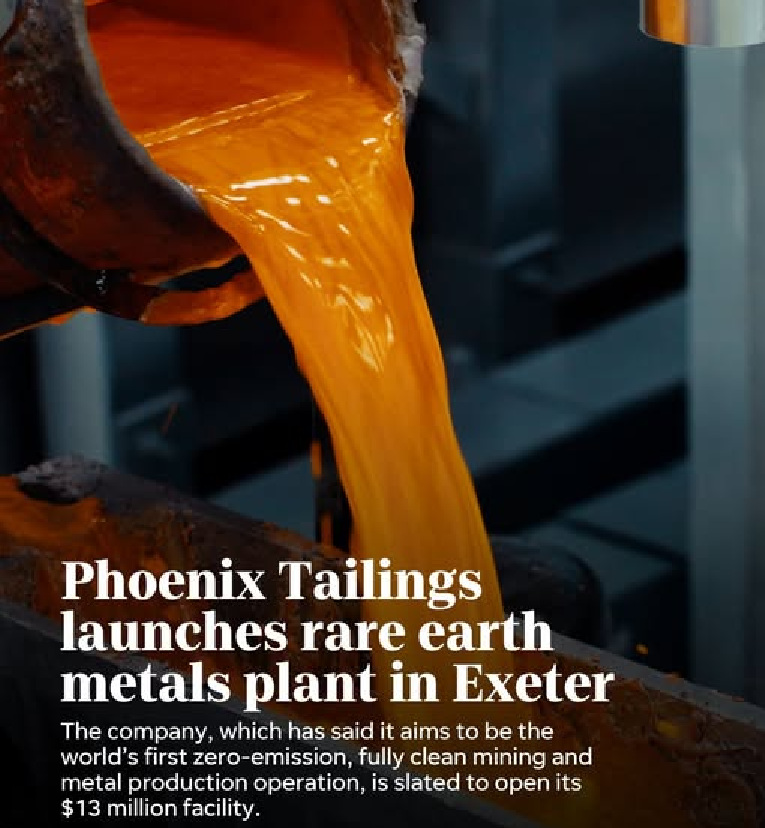
The @ENERGY selected @PhoenixTailings for a $66 million grant — part of a $147.8 million program — to deploy next-generation rare earth separation and refining technology at commercial scale, partnered with MIT and the University of Minnesota.
This is not a feasibility study. It is a commercial deployment grant for a company that already operates rare earth metallisation at commercial scale and is now scaling separation to match.
"The United States will win at rare earth processing with American innovation that outcompetes the hazardous legacy systems used overseas."
— Nicholas Myers, CEO, Phoenix Tailings
Why Phoenix Tailings is different ⚙️
Phoenix Tailings does not replicate Chinese solvent extraction. Their proprietary mixed halide electrochemical bath runs at roughly 700°C — versus the 1,050°C required by conventional MSE — cutting energy consumption by 35–45%, eliminating perfluorocarbon emissions (PFCs), and producing zero toxic chemical waste byproducts.
They process a diverse range of domestic feedstocks: monazite, bastnäsite, ionic clay concentrates, tailings — exactly the kind of mixed, variable feed that trips up conventional hydromet processes. That flexibility is what makes the DoE bet so strategic.
Their three core technology pillars backing this program:
🔬 Advanced chemistry — low-temperature, low-emissions separation chemistry
🏭 Industrial hardware — proprietary electrochemical reactors, not mixer-settlers
💻 Digital infrastructure — AI process control and real-time optimisation
x.com/roblun1/status/2056749…
globenewswire.com/news-relea…
@PhoenixTailings
#PhoenixTailings #DepartmentofEnergy #DoE #RareEarths #CriticalMinerals #REO #NdPr #Dysprosium #Terbium #MoltenSaltElectrolysis #Separation #Metallisation #AdvancedMagnetLab #NdFeB #DLA @wsenti @IONIC_RE @MomentumTP
1
1
16
1,894
🇪🇺⚗️ Philippe Kehren, CEO of Solvay, just gave one of the clearest and most honest assessments of Europe's industrial position I've heard from a major CEO.
Worth your time. Every quote below is verbatim. 🧵
🎬 Watch the full interview 👇
🏭 On Solvay and supply chain resilience:
"We have more than 80% of our sales done regionally. It's very important to be close to the market, close to your customers."
"I think now it's over — we have to get back to shorter logistic chains and to get back to raw materials and energies that are available locally."
"When you are a leader in your market, you master your technologies, you master your processes and you can adjust very quickly. If overnight you cannot buy anymore a certain type of raw material from a certain location, you're able to change very quickly."
🌍 On whether Europe can compete:
"Yes — Europe has everything to be competitive and sustainable in the future. It has the best engineers, technicians, operators, assets. One of the most efficient chemical production units in the world are based in Europe."
And then the line that should make every European policymaker pause:
"A lot of the pain we suffer today has been self-inflicted."
🧲 On rare earths — and this is the part the critical minerals community needs to hear:
"Rare earth is a good example. We've outsourced completely the production of rare earth material for permanent magnets. Between 90 and 100% of those materials today come from China."
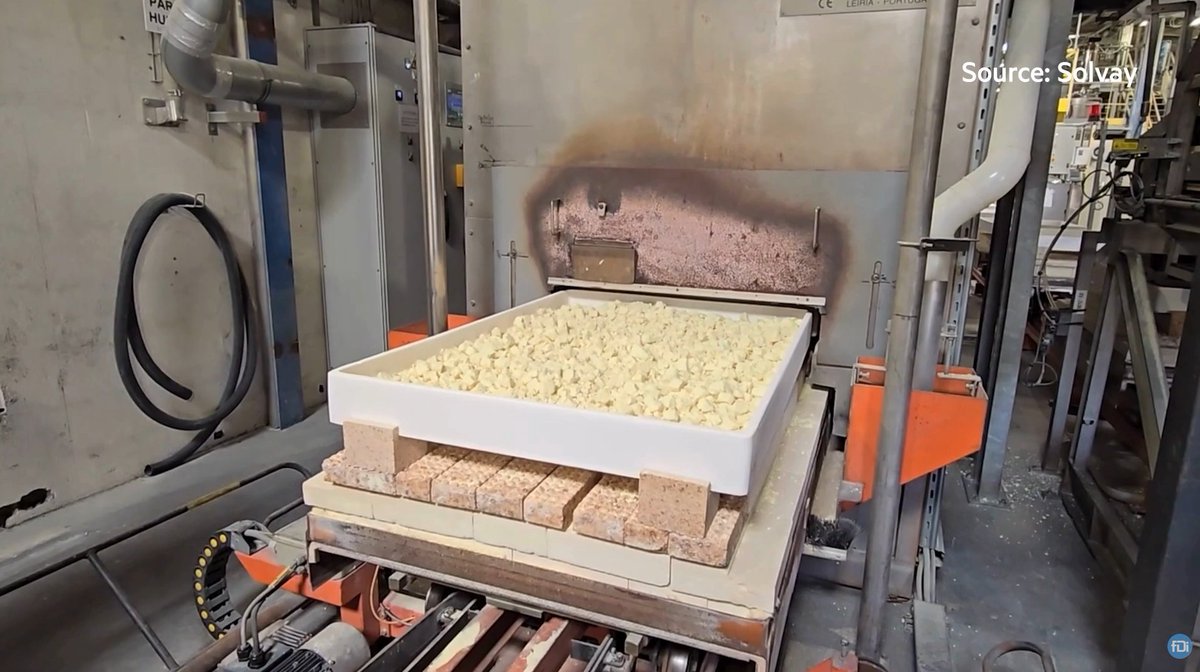
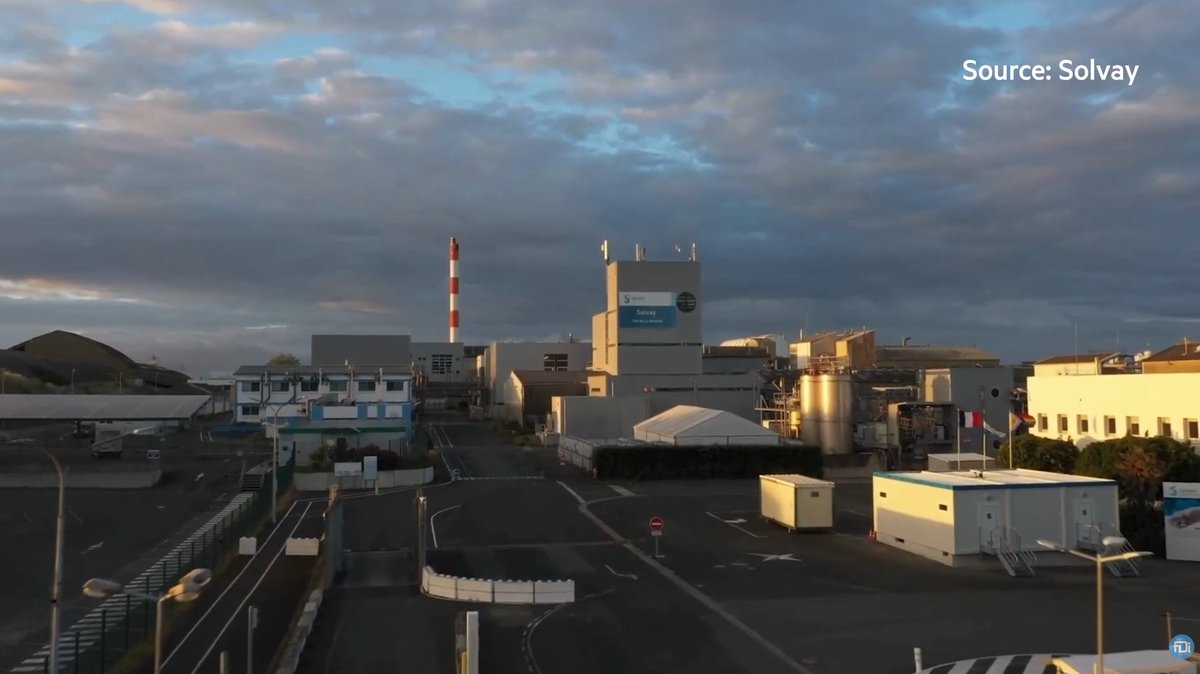
"The plant in La Rochelle is in fact unique outside of China. It's the only plant outside of China that is able to produce any type of rare earth material from any type of source. We've been doing that for more than 75 years — this plant started up in 1948."
"We know how to produce those materials. We can do it very quickly. But we need to have the value chain. We need to have buyers. We need to have contracts with volumes and prices. This is today what is missing in order to invest further."
That last sentence is the most important line in the entire interview.
Europe has the only plant outside Asia capable of processing every major rare earth element at industrial scale. It has been operating for 78 years. It inaugurated a new magnet-grade production line in April 2025.
And it still cannot get enough long-term offtake contracts from European OEMs and magnet manufacturers to justify the next investment round.
⚡ On energy — the other half of the industrial sovereignty equation:
"We need to have competitive energy in the long run by developing nuclear, by developing renewable energy, ways to store renewable energy, hydro... We decided not to produce gas in Europe — that's a fair choice. But you cannot say I don't develop nuclear neither. You need something."
"We see today that the countries that have decided to have nuclear production are more competitive and more sustainable."
For energy-intensive processes like rare earth solvent extraction — large heated mixer-settler circuits running 24/7 — this isn't abstract policy. It is the difference between a viable OPEX profile and a structural cost disadvantage versus Chinese producers who operate on subsidised industrial power.
🔧 On the CO2 transition and industrial competitiveness:
"If you pay at the same time those projects that are very expensive plus the CO2 quotas because you have a large deficit, you pay the energy transition twice."
"We need to support the industrials that are doing this by giving them the right level of incentives and CO2 quota so that they can indeed pay this transition and solve at the same time their competitiveness challenge."
"It's perfectly compatible to do the energy transition and at the same time be competitive and secure an industrial production in Europe."
💷 On floor prices for strategic materials — a specific, concrete policy proposal:
"One way to unlock this situation would be to set floor prices — to say we guarantee you a certain minimum level of price so that you can secure the return on your investment — and that in that way it would not penalise the customers neither. It's a nice way to diversify and de-risk something that can be strategic."
This is Solvay's direct ask to European policymakers. Not grants. Not subsidies. Price floors for strategic materials — the same mechanism used in the UK for offshore wind contracts (CfD), now proposed for rare earth oxides and critical chemical intermediates.
🔑 On what "economic security" actually means:
"Economic security is really about looking at the value chains. In the past we had this idea that you look at the final product and then you can produce all the rest of the pieces anywhere else. I think that's not completely true."
"It doesn't mean we will produce 100% locally of course, but we need to at least master all the elements of the value chain and master the processes of the different pieces. That's very important so that you can create optionalities and be in control."
"Be in control is really what is very important in the current circumstances."
🌍 The bigger picture Kehren is describing
Europe's industrial model is at an inflection point. High energy costs, dependence on Chinese critical materials, and competition from both Chinese state-backed industry and US subsidy-backed manufacturing (IRA, CHIPS Act) are simultaneously compressing the space for European companies to operate competitively.
Kehren's argument — and Solvay's position illustrates it precisely — is that the response cannot be either purely market-led or purely policy-driven. It requires:
✅ Policy frameworks that make long-term investment decisions credible (stable energy prices, joint procurement, offtake support)
✅ Industry commitment to building the full value chain — not just individual nodes
✅ OEM and downstream manufacturers actually signing the long-term supply agreements that anchor project finance
✅ Financial institutions moving at the speed the geopolitical situation demands
📍 The September 2026 milestone running in parallel:
While Kehren makes the case for policy support, Solvay is already moving. Industrial-scale Dy and Tb separation at La Rochelle is targeted for September 2026 — dysprosium and terbium, the two heavy rare earths under active Chinese export controls, at the only facility outside Asia capable of separating them at industrial throughput.
The policy argument and the commercial delivery are happening simultaneously. The question is whether European OEMs, magnet manufacturers, and policymakers move fast enough to match it.
@SolvayGroup
#Solvay #PhilippeKehren #LaRochelle #RareEarths #REE #CriticalMinerals #EuropeanSovereignty #IndustrialSovereignty #CriticalRawMaterials #CRMA #RESourceEU #EuropeanCompetitiveness #EnergyPrices #Nuclear #EnergyTransition #CleanIndustrialDeal #NdFeB #PermanentMagnets #Neodymium #Praseodymium #Dysprosium #Terbium #MagnetGrade #REOSeparation #SolventExtraction #HeavyRareEarths #HREO #LREO #FloorPrices #StrategicAutonomy #CarbonNeutral #CO2 #ETS #EuropeanIndustry 🇪🇺🇫🇷🇧🇪⚗️🧲🔬💡🏭⚡🌍🔑🎬
2
8
471
⚗️🇨🇳 China's rare earth strategy just went deeper than ore and magnets. It extended all the way into the chemistry cupboard.
And most people building Western REE separation plants haven't fully priced in what that means. 🧵
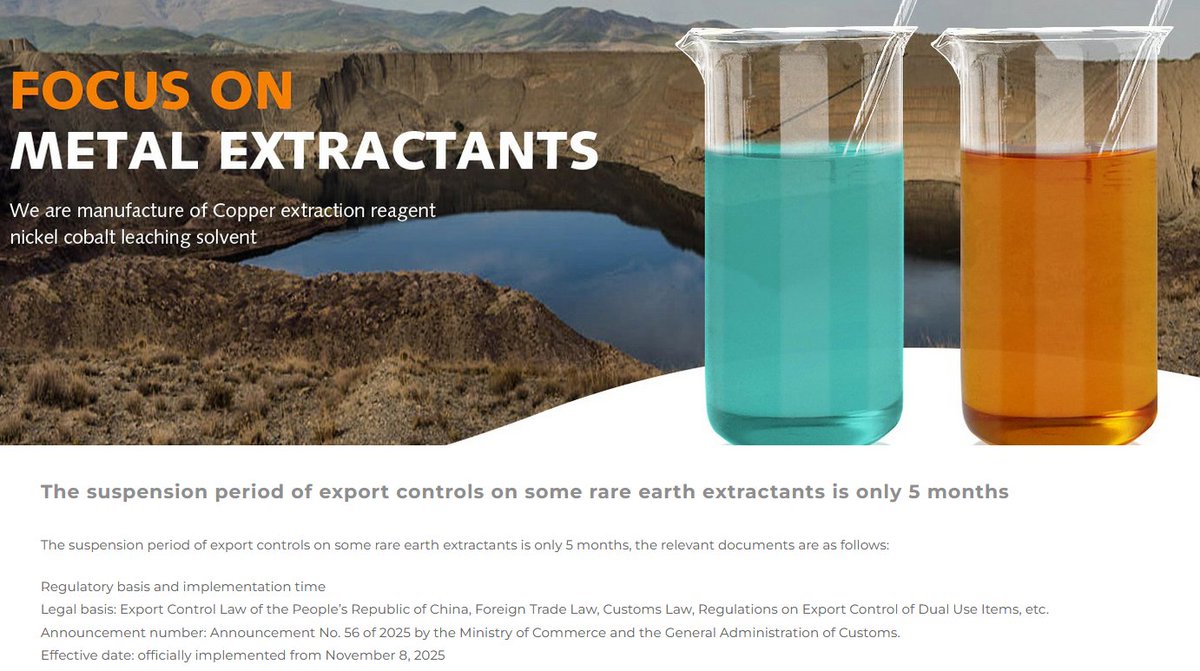
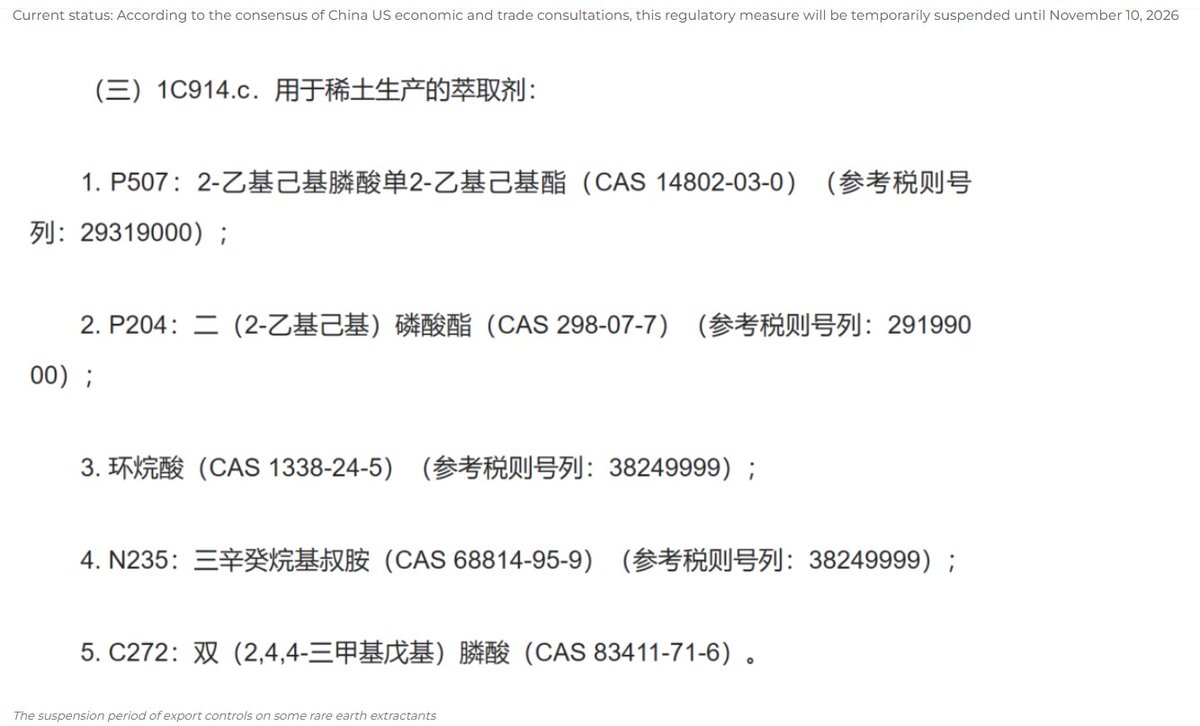
In November 2025, China's Ministry of Commerce formally implemented export controls on five key solvent extraction reagents — the organic chemicals that sit at the heart of virtually every rare earth separation plant on earth.
🧪 The Three Core Extractants — and What Each Does
The Chinese rare earth industry standardised around three primary organophosphorus extractants, each targeting a different part of the separation sequence:
⚗️P204 (D2EHPA / HDEHP)
Bis(2-ethylhexyl) phosphoric acid
Acidic extractant — strong affinity for heavier lanthanides and yttrium
Used for first-stage impurity removal and heavy REE separation (Sm, Eu, Gd, Y)
Also the benchmark extractant for removing iron and other impurities before the main REE circuit
⚗️P507 (EHEHPA)
2-Ethylhexyl phosphonic acid mono-2-ethylhexyl ester
Acidic extractant with higher separation coefficients than P204
Now the mainstream reagent for light rare earth separation — La, Ce, Pr, Nd
Preferred over P204 for NdPr separation because of better selectivity and lower saponification requirements
Critical for producing the magnet-grade NdPr oxide that LCM, Solvay, Carester, and every other Western metallization house needs
⚗️N235 (N1923)
Tri(octyl-decyl) tertiary amine
Alkaline/neutral extractant — operates in chloride systems
Used for light REE separation and associated element extraction in hydrochloric acid leach circuits
Together, these three chemicals underpin virtually every industrial REE separation plant operating outside China today — including Solvay's La Rochelle facility, Energy Fuels' White Mesa circuits, and the planned Carester/Caremag plant at Lacq, France.
These are not obscure laboratory reagents. P507 and P204 are the workhorse extractants of the global REE solvent extraction industry. They are used in virtually every commercial REE separation circuit operating today — including facilities in France, Estonia, the United States, and Japan.
⏸️ The current status: suspended — but not cancelled
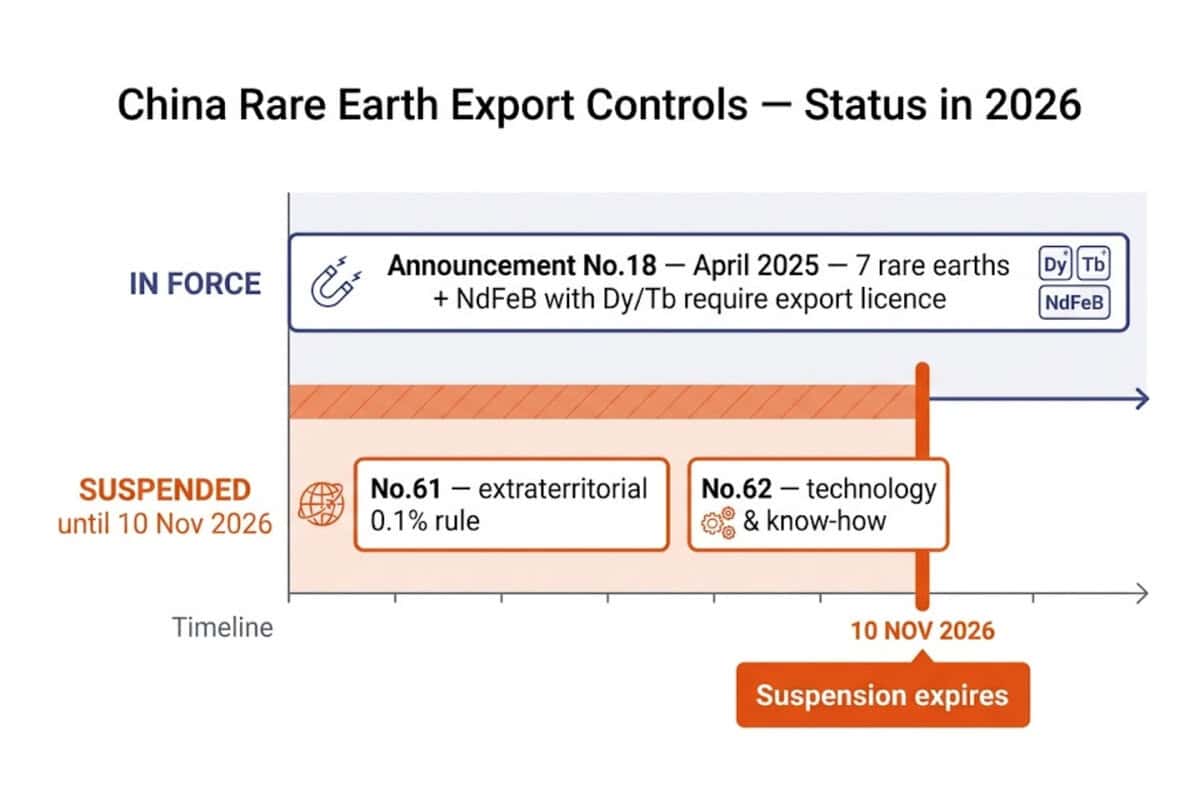
Following the US-China economic and trade consultations, the controls have been temporarily suspended until November 10, 2026.
That is approximately five months from now.
The controls have not been lifted. They have been paused. They remain on the books under China's Export Control Law and the Regulations on Export Control of Dual Use Items — and they can be reactivated at any time, for any destination, based on end use, customer, or geopolitical circumstances.
For any Western REE separation project currently in development, that five-month window and the uncertainty beyond it are not background noise. They are a project risk that belongs on the critical path. ⚠️
🏭 Why this matters for Western separation plants
To understand the exposure, consider what a solvent extraction circuit actually needs:
A single commercial-scale REE separation plant — capable of processing thousands of tonnes of mixed rare earth concentrate per year — requires hundreds of tonnes of organic extractant just for the initial circuit fill before a single kilogram of separated REO is produced.
After that, ongoing solvent makeup is required continuously, because extractants degrade over time through radiolytic breakdown, chemical oxidation, and entrainment losses. The circuit never stops consuming them.
If export of P507, P204, and C272 from China requires a licence — and that licence is denied, delayed, or made conditional — a fully constructed, fully feedstocked REE separation plant simply cannot operate.
The concrete is poured. The mixer-settlers are installed. The leach circuits are running. And the plant sits idle because it cannot get its solvent inventory across the border. That is the specific vulnerability these controls create.
🌍 The broader strategic read
This is the most important point, and it goes beyond rare earths specifically.
⚗️C272 (Cyanex 272) is the benchmark extractant for cobalt/nickel separation by solvent extraction — used in battery recycling and lithium-ion battery precursor manufacturing globally. Its inclusion in these controls means the reach extends well beyond rare earth refining into the entire battery metals processing ecosystem.
What China has done is demonstrate that its leverage in the critical minerals value chain does not stop at:
❌ Controlling the ore deposits
❌ Controlling the separation and refining capacity
❌ Controlling the metal and alloy manufacturing
It now extends to controlling the process chemicals required to operate separation plants that Western countries are spending billions to build.
A rare earth project that has secured its mining licence, its offtake agreements, its government funding, and its construction contracts — but sources its extractants from China — carries a vulnerability that sits entirely outside its own control.
🔬 What the response looks like
There are credible paths forward, but none of them are instant:
1. Western extractant production
P507, P204, and C272 can be synthesised outside China. The chemistry is not secret — it is decades old. But commercial-scale Western production of these specific organophosphorus compounds has atrophied as Chinese supply became dominant on price. Restarting or scaling that production takes capital, time, and permitting.
2. Alternative extractant chemistries
This is where the technology landscape becomes directly relevant. Several next-generation separation approaches are specifically designed to eliminate dependence on Chinese organophosphorus extractants entirely:
A. 🫧Ionic liquid-based SX (e.g., MAIL-type systems) uses engineered amide ionic liquids instead of conventional organic diluents and phosphoric acid extractants — produced in Western laboratories
B. ⏳Continuous ion exchange / chromatography operates in entirely aqueous media with resin-based columns — no organic solvent phase at all
C. 📱Membrane-assisted SX uses immobilised extractant phases that dramatically reduce solvent inventory requirements
These are not just greener alternatives. In the current regulatory environment, extractant sovereignty is supply chain sovereignty.
3. Strategic inventory building
During the current suspension window, any Western operator relying on Chinese P507, P204, or C272 should be assessing whether they need to build forward inventory before November 2026 — and what their contingency is if the suspension is not extended.
⏰ The clock is running
The suspension expires November 10, 2026. That is not a distant horizon. For projects in active construction or commissioning, it is within the current project timeline.
The controls were implemented once. They were suspended under diplomatic pressure. The underlying regulatory framework — China's Export Control Law, dual-use classification, licence requirements — remains entirely intact.
⏰ November 10, 2026
The export control suspension expires in approximately five months.
Every Western REE separation project currently operating or commissioning on P507 or P204 should have a clear answer to three questions:
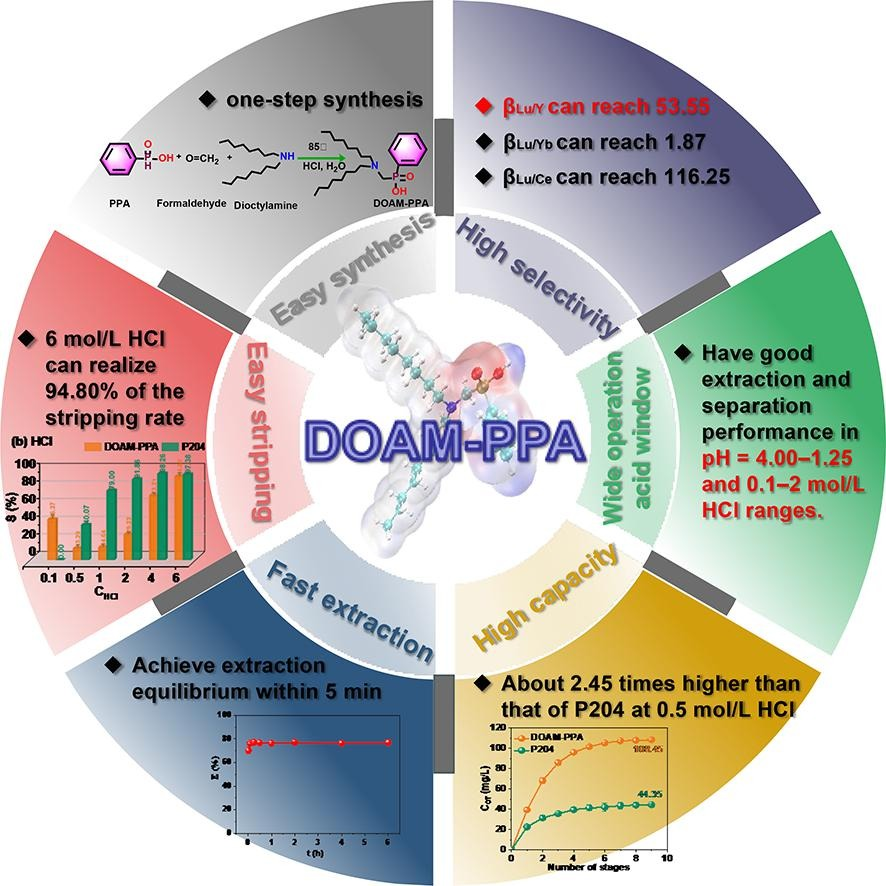
Last Slide, shows DOAM-PPA —
⚗️🫧((dioctylamino)methyl)phenylphosphonic acid — a novel rare earth extractant synthesised by a research team at the Fujian Institute of Research on the Structure of Matter, Chinese Academy of Sciences.
It is in the same organophosphorus extractant family as P204, P507, and Cyanex 272 — the three Chinese-controlled extractants — but it is a next-generation molecule specifically engineered to outperform them, particularly for heavy rare earth (HREE) separation.
If the next generation of high-performance HREE extractants is also being developed inside Chinese state research institutes, what does Western extractant sovereignty actually look like long-term — and is ionic-liquid or aqueous-based separation chemistry the only credible path to genuine independence from Chinese process chemicals?
📦 What is your current extractant inventory and how long does it run your circuit?
🌍 Do you have a non-Chinese supply source qualified and contracted?
🔬 What is your longer-term chemistry strategy — and does it reduce or eliminate Chinese extractant dependency?
These are not theoretical questions. They are operational ones. ⚗️
🔗 metalleaching.com/rare-earth…
🔗 metalleaching.com/export-con…
#RareEarths #REE #CriticalMinerals #SolventExtraction #SX #P507 #P204 #D2EHPA #HDEHP #EHEHPA #N235 #C272 #Cyanex272 #REEExtractants #OrganophosphorusChemistry #LanthanideSeparation #CascadeExtraction #XuGuangxian #MixerSettlers #REESeparation #Hydrometallurgy #NdPr #Neodymium #Praseodymium #Dysprosium #Terbium #Yttrium #Samarium #MagnetGrade #REOPurity #ExportControls 🇨🇳⚗️🔬🧪⚠️🌍🏭⏰🔒🌱
1
2
13
619
🇺🇸⚗️ The U.S. Department of Energy has committed up to $19.3 million to advance a pilot-scale continuous ion exchange rare earth separation facility in Stillwater, Oklahoma.
It is a relatively modest number in the context of the billions flowing into the broader rare earth supply chain — but the technology it is funding sits at one of the most genuinely interesting and unresolved junctions in critical minerals processing today.
The award comes under DOE's Critical Material Innovation, Efficiency and Alternatives program (FOA 3105). Total project value is approximately US$50.5 million, with US$31.2 million in private co-funding alongside the federal contribution.
The specific target: build, demonstrate, and operate a pilot-scale continuous ion exchange (CIX) rare earth element production plant — a processing approach that offers some compelling theoretical advantages over conventional separation methods, but which has not yet been demonstrated at full commercial scale in the Western world.
That gap between pilot performance and commercial reality is worth understanding. 🧵
🔬 A brief note on why rare earth separation is so difficult
Once rare earth ore is leached, the resulting solution contains all 15 lanthanide elements dissolved together. Separating them into the individual high-purity oxides — neodymium, praseodymium, dysprosium, terbium — needed for magnet manufacturing is one of the more demanding challenges in extractive metallurgy.
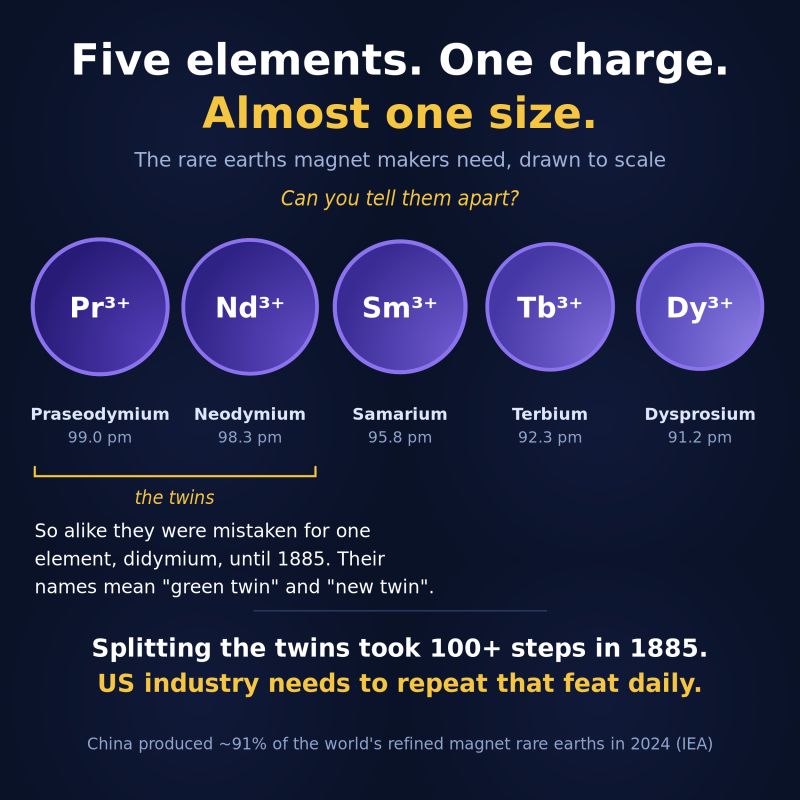
The reason is straightforward: rare earth elements are almost chemically identical to each other. They carry the same 3 charge in solution.
Their ionic radii differ by fractions of a nanometre. The separation factors between adjacent lanthanides can be as low as 1.5 to 2.5 — meaning a single pass through any separation medium achieves almost no meaningful purification.
Industrial processes require hundreds or thousands of successive stages to reach the 99.5–99.999% purity levels that magnet and defense manufacturers require.
This is the fundamental challenge that every separation technology — conventional or novel — has to solve.
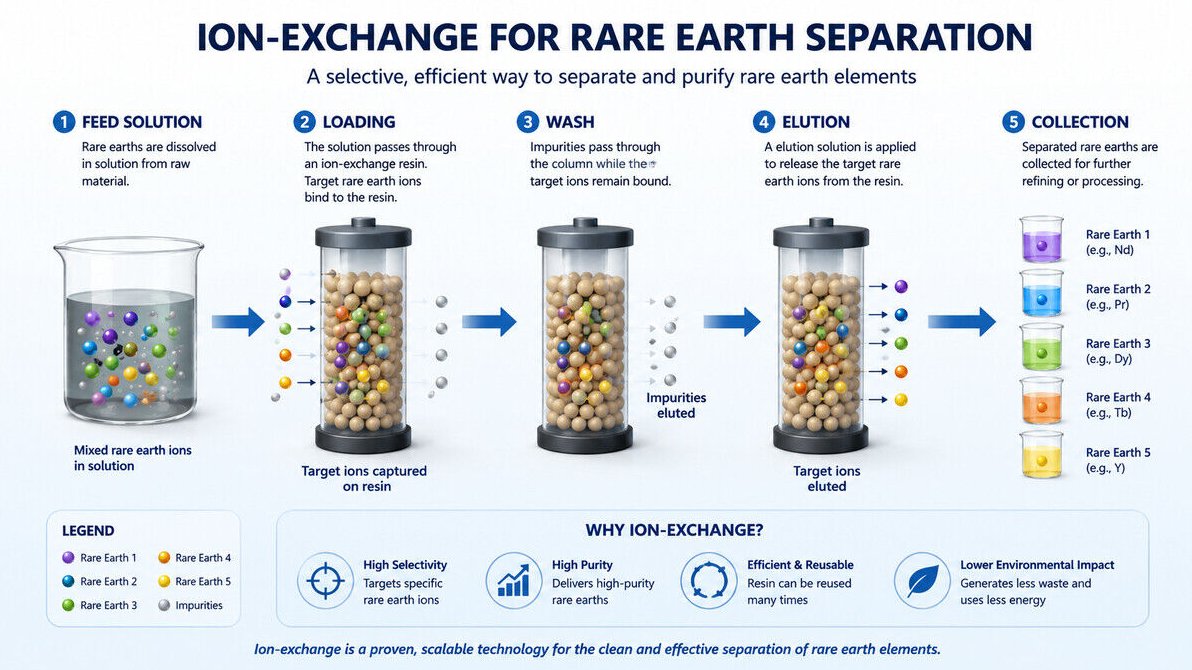
⚗️ What continuous ion exchange offers (Infographic)👇
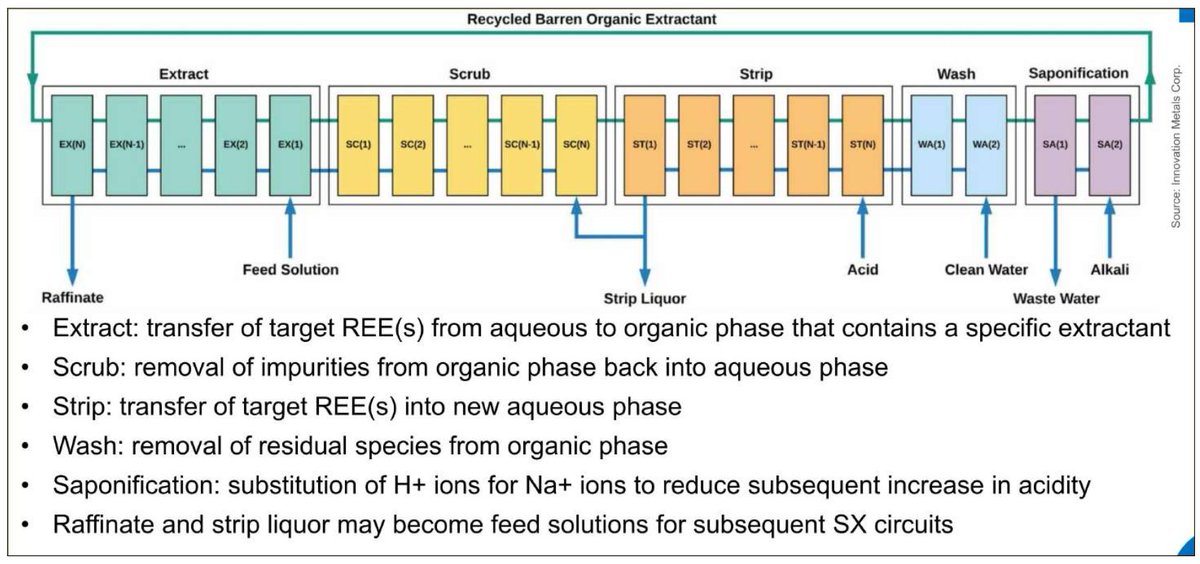
Conventional solvent extraction (SX) — the current industrial standard globally — solves this problem using two immiscible liquid phases and large cascades of mixer-settler tanks.
It works reliably at scale, but it requires significant capital, a large physical footprint, long equilibrium times, and continuous circulation of organic solvents.
Continuous ion exchange takes a different approach:
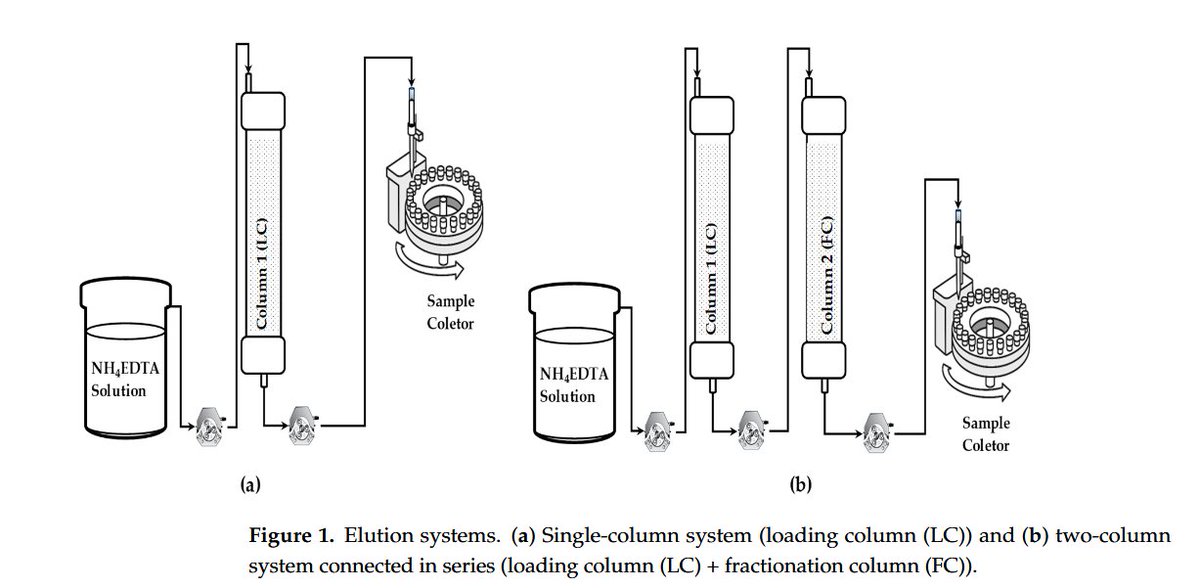
The dissolved rare earth solution is pumped through solid resin-packed columns rather than liquid organic phases
Rare earth ions bind to functional groups on the resin and travel through at slightly different velocities, naturally segregating into distinct elution bands
The process operates in entirely aqueous chemistry — no flammable organic solvents, reduced environmental permitting complexity
A compact column array can theoretically replace much larger mixer-settler infrastructure
Pilot operations have demonstrated outputs reaching 99.99% to 99.999% purity
These are genuinely attractive characteristics, and they explain why both government agencies and private developers are investing in understanding the technology more deeply.
⚙️ The honest engineering picture at scale
Where it gets more complex is in the transition from pilot to industrial throughput — and this is where the rare earth chemistry itself creates challenges that are worth being clear-eyed about.
Those very small separation factors that make lanthanides hard to separate in the first place don't disappear at scale. As columns grow from laboratory diameter to the one-to-two-metre diameter needed for commercial throughput, maintaining uniform fluid flow becomes substantially more demanding. Poor flow distribution leads to channeling, dead zones, and degraded separation performance.
Resins also behave differently to liquid organic solvents over time. Solid resin beads can experience mechanical attrition, osmotic shock, and gradual degradation from exposure to strong acids. Trace impurities in real-world feedstocks — iron, aluminium, calcium, uranium, thorium — can progressively foul the resin's active sites, reducing capacity and requiring sophisticated pre-treatment upstream.
And while CIX eliminates organic solvents, it still requires significant volumes of aqueous eluents, careful gradient management, and energy-intensive recovery circuits to convert the separated REE solutions into solid, saleable oxides.
These are not reasons to dismiss the technology. They are the specific engineering questions that pilot programs like the Stillwater facility are designed to answer — at a scale where the answers become meaningful for commercial plant design.
🧪 Why rare earths are uniquely hard to separate
Every rare earth element in solution carries an identical 3 charge. The electrons that make one lanthanide subtly different from the next are buried deep inside the atom, shielded from the outside world, and contribute almost nothing to how each element behaves chemically. (See Image)👇
The only handle you have is the lanthanide contraction — a tiny, progressive decrease in atomic size across the series. The size difference between adjacent rare earths is measured in fractions of a nanometre. That is it. Fifteen elements, essentially the same charge, essentially the same chemistry.
Compare that to separating transition metals like iron, cobalt, or copper. These elements switch between multiple oxidation states easily — 2, 3, even 4 — and form complexes with very different electrical charges depending on the chemistry around them.
Ion exchange resins separate by electrostatic difference: grab one charge, let the other wash through. Separation factors for transition metals can reach 40 to over 300.
For adjacent rare earths? 1.5 to 2.5.
This isn't a flaw in any particular technology. It is the physics of the lanthanide series. Every separation platform — SX, CIX, chromatography, ionic liquids — is working with the same vanishingly small chemical difference. The technologies vary in how efficiently they exploit it, and how reliably they maintain that performance at scale. 🔬
🏭 The dual-track approach
What is particularly instructive about this specific program is how it sits alongside a parallel conventional solvent extraction demonstration facility in Wheat Ridge, Colorado — five discrete SX circuits running continuously for 2,000–4,000 hours, generating the operational data required for a Definitive Feasibility Study on the Round Top, Texas deposit, with commercial production targeted for late 2028.
The two facilities serve different purposes. The Colorado SX facility generates the proven, bankable engineering data that project financiers and lenders require. The Oklahoma CIX pilot advances understanding of a next-generation separation approach, supported by government capital that absorbs the R&D overhead that private markets aren't yet positioned to fund.
Running both simultaneously is a pragmatic and well-considered way to advance the technology frontier without staking commercial timelines entirely on unproven processes.
🔭 Watch this space
🔭 Coming up
The rare earth separation landscape is genuinely diverse — and genuinely fascinating.
From conventional solvent extraction to continuous ion exchange, continuous chromatography, ionic-liquid systems, and a range of emerging alternatives, each technology brings its own chemistry, its own engineering profile, and its own set of trade-offs between purity, scale, cost, and environmental footprint.
Over the coming weeks I'll be taking a closer look at each of these separation technologies individually — what the underlying science actually is, how it behaves at scale, where it fits best in a commercial flowsheet, and what the honest engineering challenges are. ⚗️🔬
🔗 mining.com/usa-rare-earth-wi…
#USARareEarth #USAR #NASDAQ #DOE #DepartmentOfEnergy #FOA3105 #CriticalMinerals #RareEarths #REE #ContinuousIonExchange #CIX #CIC #SolventExtraction #REESeparation #RareEarthSeparation #Hydrometallurgy #NdFeB #PermanentMagnets #Neodymium #Dysprosium #Terbium #MagnetGrade #Stillwater #Oklahoma #RoundTop #WheatRidge #Colorado #MineToMagnet #CriticalMineralsStrategy 🇺🇸⚗️🔬🧪⚙️🧠💡🏭🌍
6
21
716

Jun 9
Every quality oil starts with a well-controlled extraction process. From seed preparation to final oil and meal streams, each stage plays an important role in improving oil recovery, process efficiency, and product quality.
With GOYUM Canola Oil Extraction Plants, the complete process is designed for reliable performance — from cleaning and conditioning of canola seeds to pressing, solvent extraction, desolventizing, and final handling.
We build complete canola oil extraction solutions designed for smooth operation, efficient recovery, and long-term industrial performance.
Check out the step-by-step breakdown in our slides to see how it works! 👇
Share your requirements — including your complete address, WhatsApp number, and email — and our team will provide a customized Techno-Commercial Quotation.
GOYUM SCREW PRESS
Websites: oilexpeller.com| goyumindia.com
Email: sales@oilmillmachinery.com
WhatsApp / Telegram : 919501765000
#CanolaOilExtraction #CanolaOilExtractionPlant #CanolaOilProcessing #CanolaProcessingPlant #OilExtractionProcess #SeedPreparation #SeedCleaning #Flaking #Cooking #Extrusion #OilPressing #OilExpeller #SolventExtraction #SolventExtractionPlant #OilDesolventizing #MealDesolventizing #CanolaMeal #EdibleOilIndustry #OilMillMachinery #OilProcessingPlant #TurnkeyProjects #IndustrialPlant #ProcessEngineering #MadeInIndia #ExportFromIndia #Goyum #GoyumIndia
18
🧪🇫🇷⚗️ One plant. 75 years of chemistry. Europe's entire rare earth future.
The global race for permanent magnets is heating up, and Europe is aggressively securing its supply chain. At the very center of this shift is Solvay’s historic La Rochelle facility in France, the largest rare earth separation plant outside of China! 🇫🇷⚡
If you don't know Solvay's La Rochelle facility, you don't understand the Western rare earth supply chain. Thread. 🧵
📌 Infographic —
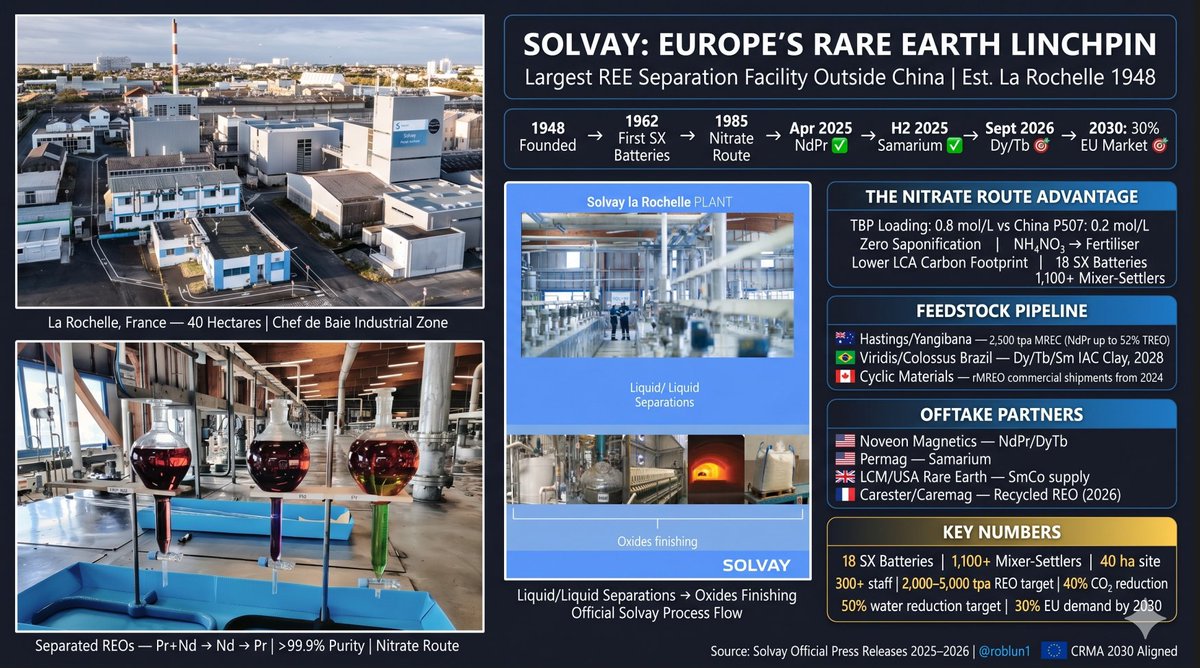
The numbers that define Europe's only serious REE refinery 📊
18 distinct solvent extraction batteries
1,100 individual mixer-settlers, running 24/7
40 hectares on the French Atlantic coast
300 specialist staff — 4,000 hours of training per year
One of 3 sites globally capable of processing ALL rare earths at industrial scale
This is not a pilot plant. This is not a demonstration facility. La Rochelle has been operating continuous liquid-liquid solvent extraction since 1962. When new Western players talk about building a "separation facility," this is what they're trying to replicate. It took Solvay 60 years to get here.
Why Solvay's chemistry is fundamentally different from China's 🔬
🧪 The Science of Separation.
While the Chinese industry relies heavily on the "Chloride Route" which consumes massive amounts of acid and alkaline neutralizers, Solvay champions the advanced "Nitrate Route".
Using highly efficient solvating extractants like TBP, Solvay's process drastically lowers operational costs, eliminates the need for constant chemical neutralization, and incredibly, turns its ammonium nitrate byproducts into commercial agricultural fertilizer! 🌱♻️
China separates REEs using the chloride route — hydrochloric acid P507 extractant. The problem: P507 releases protons that acidify the solution, so you have to continuously dump in NaOH or ammonia to neutralise it — generating massive toxic ammonium-nitrogen wastewater that has devastated communities around Chinese rare earth hubs.
Solvay uses the nitrate route — nitric acid Tributyl Phosphate (TBP):
✅ Zero saponification — TBP binds rare earth nitrates without releasing protons
✅ 0.8 mol/L loading capacity vs China's 0.2 mol/L with P507 — 4X more efficient
✅ NH₄NO₃ byproduct captured and sold as agricultural fertiliser — not toxic waste
✅ Lower carbon footprint (LCA-verified)
✅ Requires expensive stainless steel construction — that's the moat
The capital intensity of high-grade stainless steel throughout 1,100 tanks is why no one can just copy this. It is Solvay's economic and technical moat.
The 2025–2026 production ramp — what's commercial NOW ✅
April 8, 2025 — Official inauguration. NdPr oxide commercial production begins. First European facility producing magnet-grade Neodymium and Praseodymium at scale outside China.
H2 2025 — Solvay becomes Europe's first commercial producer of high-purity Samarium oxide — the foundational element for SmCo magnets used in aerospace, defense, radar, and sonar. Offtake locked with 🇬🇧 LCM (USA Rare Earth) and 🇺🇸 Permag in a 3–5 year closed-loop supply agreement.
September 2026 — Industrial-scale separation of Dysprosium and Terbium — the two heavy rare earths that make EV and wind turbine magnets resistant to demagnetisation at high temperatures. This is the critical target. Confirmed in the official Solvay–Viridis LOI press release, 1 June 2026.
2030 target: Supply 30% of total European demand for magnet-grade rare earths.
The feedstock pipeline is now transcontinental 🌍
🇦🇺 Hastings Technology Metals — Yangibana, Western Australia. Hard-rock ironstone deposit with world-leading NdPr:TREO ratio of up to 52% (Mountain Pass = 16%). MOU for 2,500 tpa MREC to La Rochelle, binding agreement being finalised. MREC route via Thailand hydromet plant.
🇧🇷 Viridis Mining — Colossus, Minas Gerais, Brazil. Ionic Adsorption Clay (IAC) deposit — 200Mt reserve, 9,400 tpa TREO at full scale, 40-year mine life. IAC naturally enriched in Dy, Tb, Sm, Gd — the heavy rare earths Solvay urgently needs. LOI signed June 1, 2026. Target MREC delivery 2028.
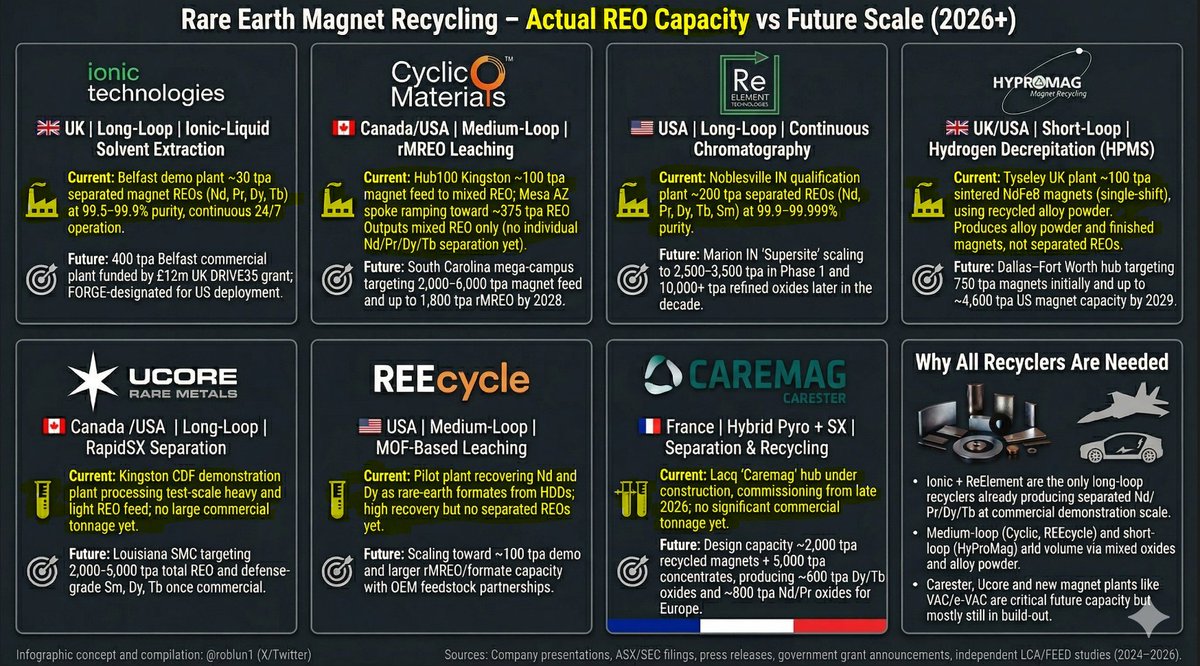
🇨🇦 Cyclic Materials — Kingston, Ontario. Magnet recycling rMREO confirmed chemically compatible with La Rochelle's nitrate-route SX circuits. Commercial shipments began late 2024. Transatlantic circular loop operational now.
🔄 Closing the Loop (Urban Mining & Recycling).
Because primary mining alone cannot meet future demand, Solvay is building a transatlantic circular economy:
🇨🇦 Cyclic Materials: Supplying recycled mixed rare earth oxides (rMREO) from dismantled North American electronics and motors directly to La Rochelle for purification.
🇫🇷 Carester & Caremag: Partnering locally to support a massive European hub in Lacq, France, dedicated to dismantling end-of-life magnets and feeding the recovered concentrates back into the advanced separation supply chain.
The offtake partners — who is buying this material? 🤝
🇺🇸 Noveon Magnetics — NdPr DyTb oxides. Binding supply agreement November 2025.
🇺🇸 Permag — Samarium oxide. Binding agreement November 2025.
🇬🇧 LCM (now USA Rare Earth) — Samarium metal and alloys. 3–5 year closed-loop deal.
CEO Philippe Kehren on the US/Europe split (Reuters, November 12, 2025): "We observe that US customers are ready to finalise commercial contracts today. This is not yet fully the case in Europe, but we are actively pursuing it."
The circular economy stack ♻️
🔄 Cyclic Materials (Canada) → rMREO → La Rochelle SX → Magnet-grade separated REOs
🔄 Carester/Caremag (Lacq, France — commissioning late 2026) → 2,000 tpa EOL magnets 5,000 tpa mined concentrates → feeds La Rochelle for final purification
🔄 REE-FLEX Project (2025–2028, EIT RawMaterials) → Carester KU Leuven SOLVOMET → next-gen modular SX optimised for mixed primary/recycled feedstocks
La Rochelle is not just a primary refinery. It is being engineered as the separation node for the entire European circular economy — from recycled London hard disk drives all the way to Brazilian clay.
The CRMA alignment — this is the backbone of EU strategy 🇪🇺
EU Critical Raw Materials Act 2030 mandates:
Extract ≥10% domestically
Process ≥40% domestically ← Solvay is the primary answer
Recycle ≥15% from secondary sources
No single country >65% of any processing stage
🎯 The 2030 Goal
La Rochelle, at 30% of European demand by 2030, is the single most important piece of industrial infrastructure in Europe's attempt to comply with its own legislation.
The bottom line
1. 🧪 Dy/Tb Separation — September 2026 Target
This is the most imminent milestone. Solvay has publicly committed to industrial-scale Dy/Tb separation lines commissioned by September 2026 — confirmed in the official Viridis LOI press release.
Watch for:
Official Solvay press release confirming Dy/Tb line commissioning (Q3 2026)
First commercial Dy/Tb oxide shipment to Noveon Magnetics or a defence customer
Any Q3 2026 earnings roadshow language confirming volumes — the May 2026 roadshow deck already flagged this milestone
⚠️ Risk: The line commissions but runs at minimal throughput — Solvay has been explicit that future scale-up is contingent on OEMs committing to "buy local." If European magnet makers don't sign offtake, the line runs but doesn't ramp.
2. 🇧🇷 Viridis/Colossus MREC — 2028 Target
This is the heavy REE feedstock answer — Dy, Tb, Sm, Gd from Brazilian ionic adsorption clay. Without Colossus, Solvay's Dy/Tb line has limited primary feedstock — it would rely almost entirely on recycled sources and whatever Hastings can supply (which is predominantly light REEs).
3. 🇦🇺 Hastings/Yangibana — "Few More Years" Is Right
Hastings has faced repeated construction delays and financing challenges at Yangibana. The MOU with Solvay for 2,500 tpa MREC was signed October 2022 — the binding offtake has still not been formalised.
⚠️ Risk: Hastings is a under significant financial pressure. Yangibana still required A$320M in additional financing to complete construction. The Thailand hydromet JV adds a second jurisdiction of execution risk. Realistically 2027–2028 for first MREC, if everything goes to plan.
4. ♻️ Magnet EOL Collection — The Structural Gap
This is the least-discussed but most structurally important constraint. Solvay's circular economy thesis — Cyclic Materials rMREO → La Rochelle SX → separated oxides — only scales if end-of-life EV motors and wind turbines are actually being collected and dismantled in volume.
While Solvay's La Rochelle facility has historically possessed the technical capability to separate all rare earths, the specific new industrial-scale separation circuits dedicated to heavy rare earths like Dysprosium (Dy) and Terbium (Tb) are currently in the final stages of deployment.
Solvay is officially targeting to commence the industrial-scale separation of Dy and Tb by September 2026. They are rolling out their massive capacity expansion in phases: they started with light rare earths like Neodymium (Nd) and Praseodymium (Pr) in April 2025, followed by Samarium (Sm) in the second half of 2025, making the dedicated heavy rare earth circuits the next major milestone.
Solvay is not a miner. It is not a recycler. It is the separation and purification bottleneck — the one step that cannot be skipped, cannot be rushed, and cannot be replicated in under a decade. The separation factor between adjacent lanthanides is so small that achieving >99.9% purity across 18 distinct SX batteries is an art form that has taken 75 years to master.
When Western governments say they want to "break China's rare earth dominance," Solvay's La Rochelle is the facility they are all implicitly relying on to make that possible. 🏭🇫🇷
Europe's green transition is officially getting its engine. 🚗💨🔋
📌 @roblun1
@SolvayGroup @Viridis_VMM @CyclicMaterials @LCM_Metals #Solvay #LaRochelle #RareEarths #CriticalMinerals #SolventExtraction #NitrateRoute #TBP #CYANEX572 #CircularEconomy #MagnetRecycling #Carester #Caremag #HastingsTechnologyMetals #LCM #Noveon #Permag #CRMA #CriticalRawMaterialsAct #EuropeanSovereignty #SupplyChain #EVs #Defense #GreenEnergy #EnergyTransition #France #ChineseExportControls #WesternSupplyChain #REEFLEX #EITRawMaterials #SmCo #IAC #MREC #SeparationTechnology #IndustrialChemistry 🧪⚗️🇫🇷🌍♻️🔋🧲💎🏭🇪🇺
2
2
11
928
⚗️🧲🇺🇸 After 6,500 hours in a Kingston demo plant, Ucore just published the most detailed commercial engineering plan for a Western heavy rare earth separation facility ever released.
And the numbers are sharper, not smaller. 🧵
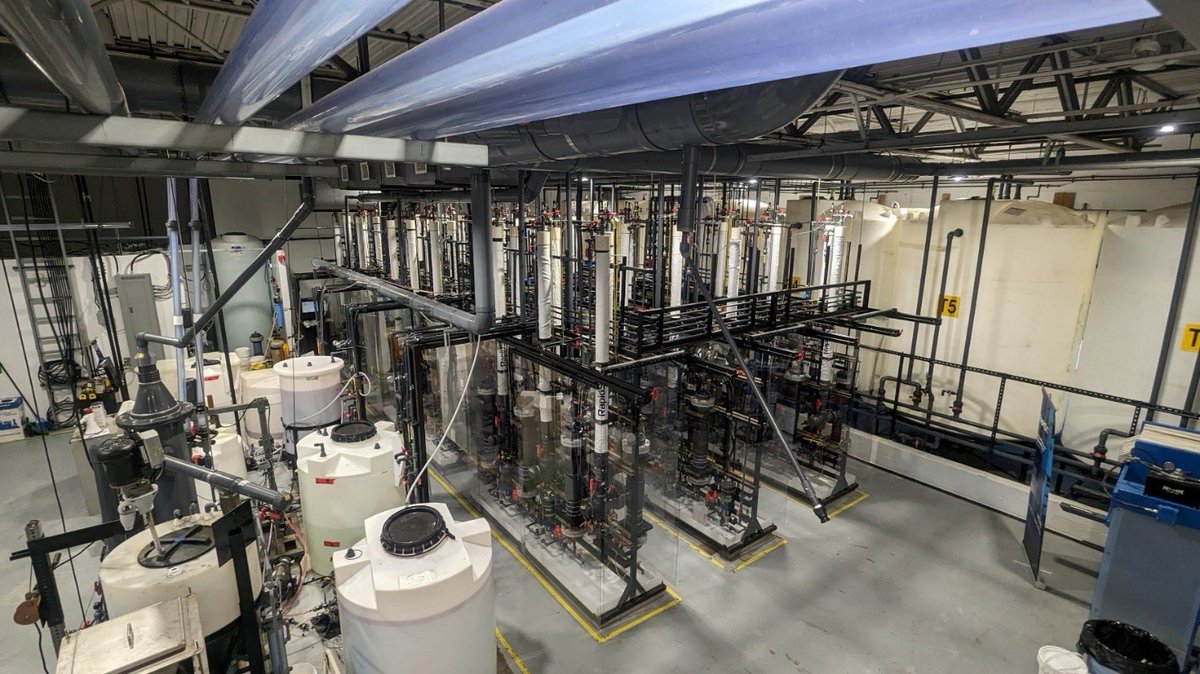
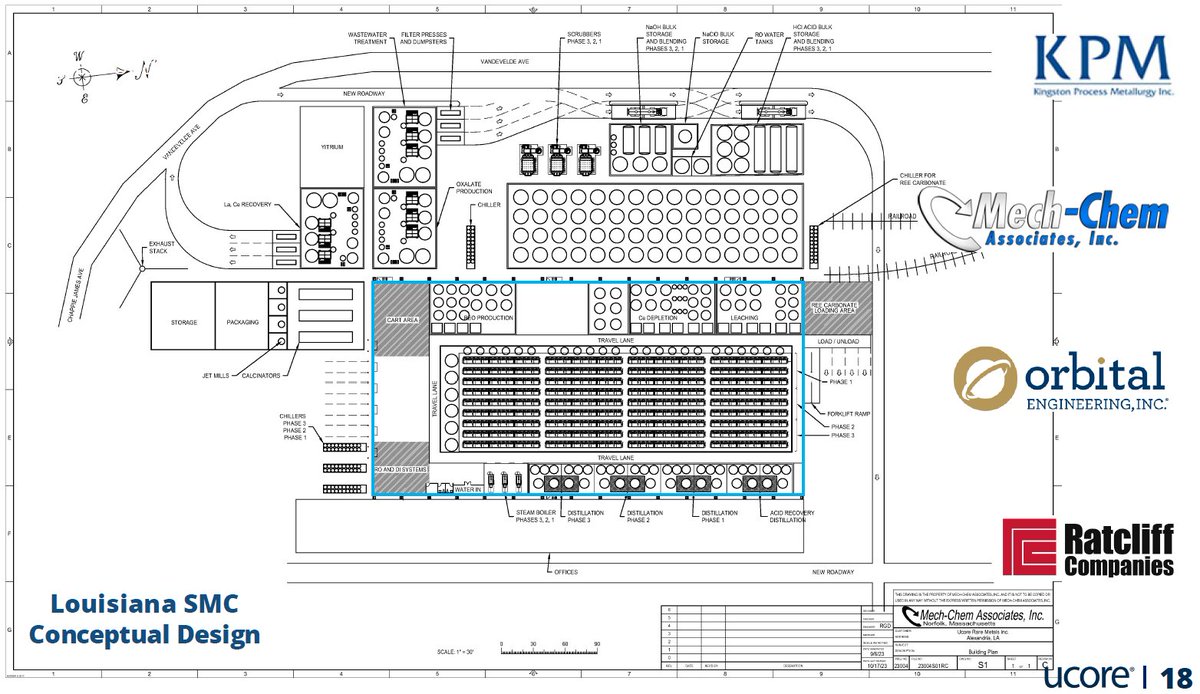
📐 [Attach images: RapidSX demo plant photo SMC floor plan schematic site layout with KPM/Orbital/Mech-Chem/Ratcliff logos]
🔬 RapidSX™ Technology Explained — Then vs Now
What the schematics show (your uploaded images):
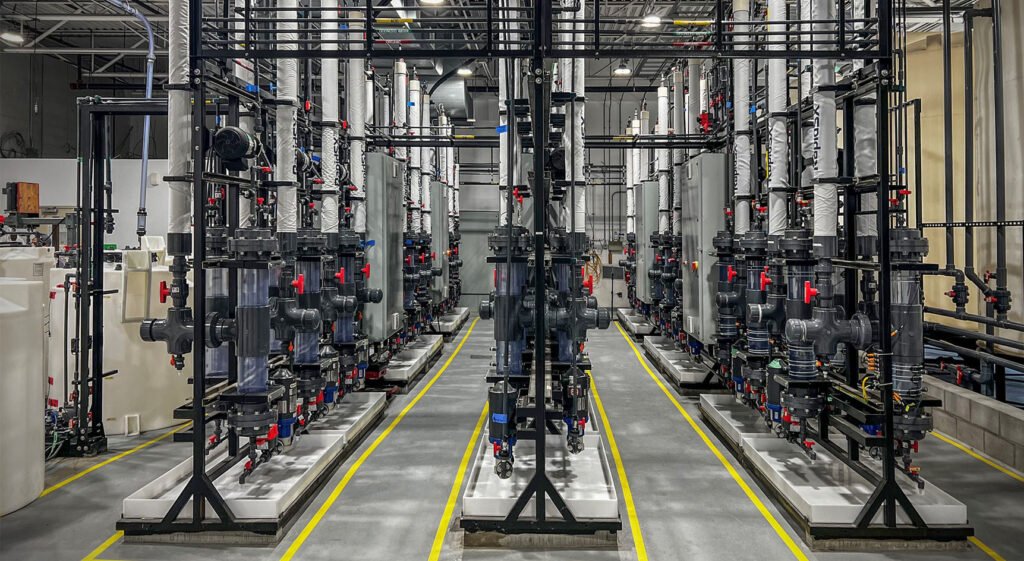
The photo shows Ucore's Kingston, Ontario 52-stage RapidSX™ Commercial Demo Plant — rows of black-framed vertical columns filled with organic and aqueous solutions, valve manifolds and red actuators at every stage, all plumbed together in a long hall with yellow safety lanes on the floor. This is the physical embodiment of what is essentially a 52-stage continuous counter-current solvent extraction circuit, but executed in compact vertical columns rather than traditional mixer-settlers, making it roughly 10x smaller in footprint.
The floor plans show the full Louisiana SMC conceptual layout: REE carbonate loading area on the right, a dedicated leaching zone, Ce depletion circuit, REO production area, RO/DI water systems, steam boilers, three separate distillation trains (for acid recovery and concentration), oxalate production, yttrium recovery, jet mills/calcinators, storage and packaging — all feeding into the central RapidSX™ production hall. Phase 1 (the yellow highlighted rows) is the first RapidSX™ production lane; Phases 2 and 3 expand behind it using the same modular column architecture.
⚗️🧲🇺🇸 What RapidSX™ actually is
The flowchart maps the 52-stage process logic:
Feedstock (mixed REE chloride) enters at stage 1 → organic/aqueous mixing → phase separation (disengagement) at each stage → transfer to the next → through all 52 stages → final fractions recirculated → scrubbing, stripping, product precipitation → individual REE solution recovery → calcining → final REO powder. This runs as a fully automated, PLC-controlled, single-operator process with approximately 600 feedback sensors monitoring pH, interface levels, pressures and flow rates in real time.
The full site layout shows the engineering consortium behind the SMC: Mech-Chem Associates (process engineering), Kingston Process Metallurgy (KPM) (hydrometallurgical design), Orbital Engineering Inc. (CAPEX and capacity engineering, the lead on the May 2026 report), and Ratcliff Companies (construction).
What the May 27, 2026 Engineering Report actually changes ⚙️
What has changed — the optimisation:
1. The original Louisiana SMC plan called for four RapidSX™ production lines, each at ~3,000 tpa TREO, for a total of ~12,000 tpa. After 6,500 hours of Kingston demo trials, Orbital's engineering report has now optimised this to three production lines (~9,000 tpa) plus an initial 600 tpa standalone Machine A, for a total of ~9,600 tpa TREO.
2. Machine A itself has grown from 64 stages to ~118 stages, allowing it to directly produce NdPr, Pr, Nd, Sm, Gd, Tb and Dy from MREC/MREO feedstock without interim holding tanks — a critical redesign driven by direct feedback from North American defense contractors who need Western-sourced separated heavy REEs urgently.
3. Machine A capex: US$60M, partly funded by the DoW US$18.4M agreement; Production Line 1 adds another US$44M; oxide production and packaging US$31M — total Machine A Line 1 cumulative cost: US$135M, with Machine A commissioning targeted for H1 2027.
So the evolution is:
1. 52 stages (demo) →
2. 64 stages (earlier commercial design) →
3. ~118 stages (current Machine A design)
Each “stage” is a physical column step in the same machine. More stages = more resolution and flexibility, not multiple trips through the same 52‑stage loop.
⚗️♻️The Kingston demo plant runs 52 RapidSX stages. Ucore’s first commercial Machine A has now been redesigned to roughly 118 stages in a single pass, up from the original 64‑stage concept. That gives enough separation resolution to pull out NdPr, Nd, Pr, Sm, Gd, Tb and Dy from MREC/MREO feedstock in one continuous circuit, instead of running the feed through several shorter loops or intermediate holding tanks.
The platform, the plan, the clock ⏰
Ucore isn't just building a separator. The Louisiana SMC floor plans you're looking at show the full downstream: leaching, Ce depletion, yttrium recovery, acid distillation and recycling, oxalate precipitation, calcination, jet milling and packaging.
From MREC carbonate arriving at the loading dock to REO powder leaving in drums — the entire commercial flowsheet has been demonstrated at Kingston and is now being copy-pasted to Louisiana.
Machine A commissioning: H1 2027.
DoW funding committed: US$18.4M (Phase 2 project).
Canadian government conditional funding: C$36.3M (announced Oct 2025, pending finalization).
Defense contractors: actively qualifying Ucore's REO products.
The 2027 statutory defense sourcing deadline for non-Chinese rare earths isn't moving. Ucore's Machine A timeline is built around it.
investornews.com/member_news…
$UURAF $UCU 🇺🇸🇨🇦🧲
📌 @ucore
@ucore
#Ucore #UURAF #UCU #RapidSX #LouisianaSMC #RareEarths #HeavyRareEarths #Dysprosium #Terbium #NdPr #Samarium #Gadolinium #REO #SolventExtraction #HydroMet #CriticalMinerals #DefenseIndustrialBase #DoW #DoD #AlexandriaLouisiana #KingstonOntario #NorthAmerica #WesternSupplyChain #MineToMagnet #NdFeB #DefenceMagnets #SupplyChainResilience #ZeroChinaNexus #2027Deadline #OrbitalEngineering #MechChem #KPM #Onshoring #EVMagnets #WindTurbines #EnergyTransition 🔬⚗️🧲🇺🇸🇨🇦
1
8
621
🇦🇺⚗️ A $730M Australian rare earths project just became one of the most strategically important industrial operations on the planet.
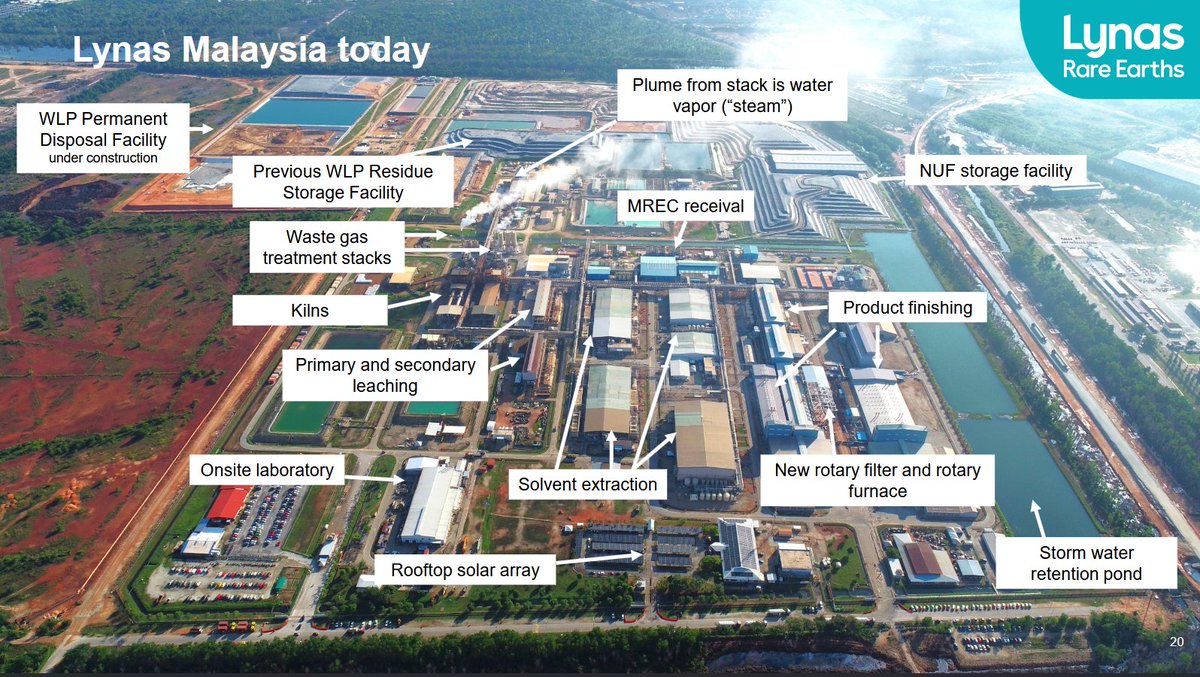
@LynasRareEarths . Mount Weld, Western Australia. The world's largest rare earth producer outside China — and as of 2025, the world's only commercial producer of separated Dysprosium and Terbium outside China.
Here's why that matters more than almost anything happening in critical minerals right now 🧵👇
What Lynas Actually Is
Most people think of Lynas as a miner. That massively undersells it.
Lynas is a fully vertically integrated rare earth operation — mine to separated oxide — spanning two countries:
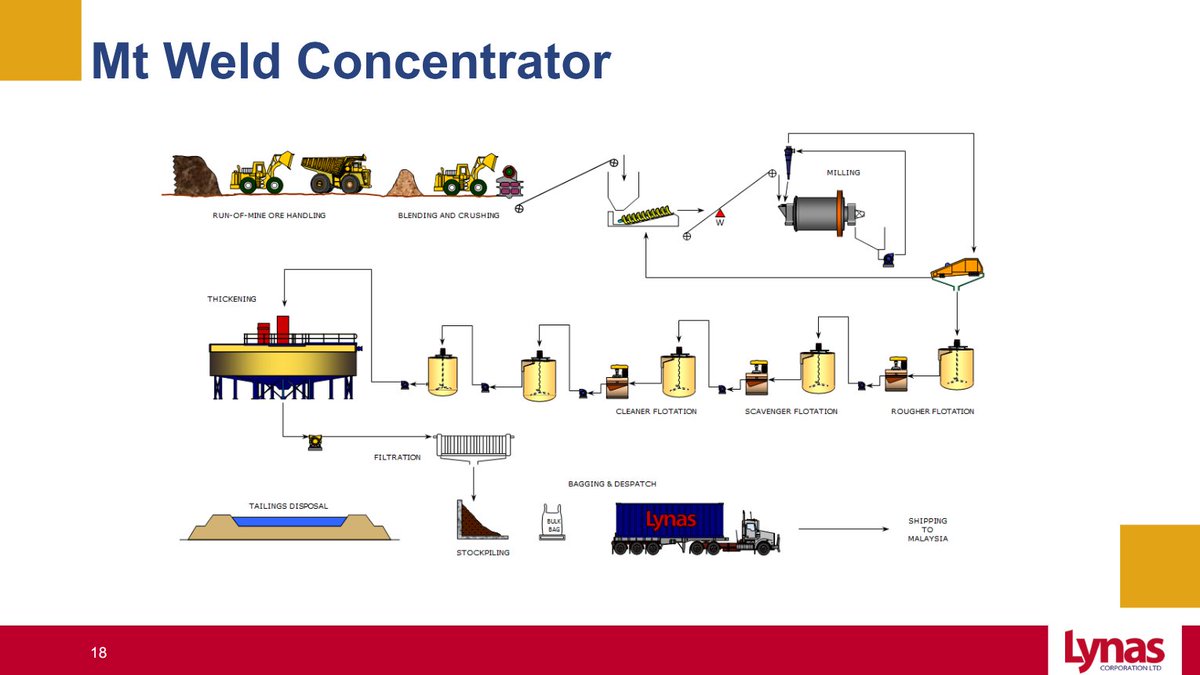
⛏️ Mount Weld, WA — the world's highest-grade rare earth deposit. Ore mined, crushed and concentrated on site
🚢 Concentrated ore shipped to Malaysia
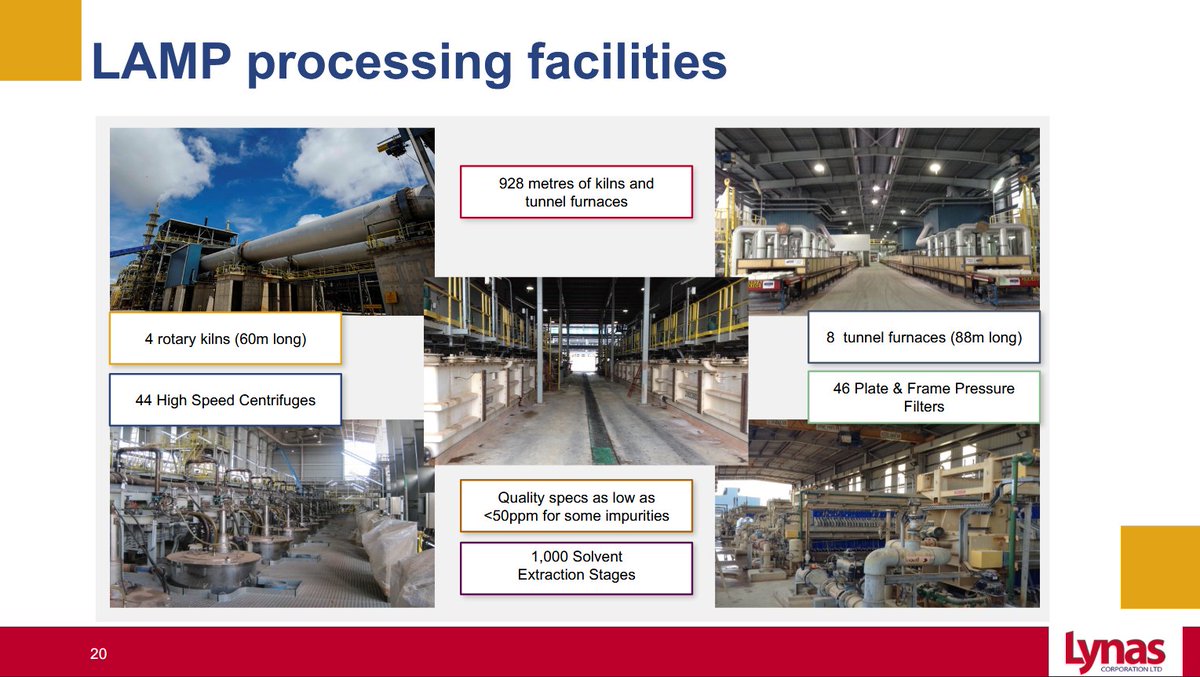
🏭 LAMP, Gebeng, Malaysia — 100-hectare advanced materials plant. Cracking, leaching, solvent extraction, product finishing
📦 Separated, high-purity REOs shipped to customers in Asia, Europe and the USA
The $500M Mt Weld expansion targets 12,000 tpa NdPr feedstock capacity — the backbone of every EV motor and wind turbine generator being manufactured in the West.
Why SX is the Hard Part
Rare earth separation via Solvent Extraction (SX) is one of the most technically demanding processes in industrial chemistry. Here's why.
All 15 lanthanides share nearly identical atomic radii and the same 3 oxidation state. The only handle you have is lanthanide contraction — a minute, progressive decrease in ionic radius across the periodic table.
To exploit differences measured in picometres, Lynas runs liquid-liquid counter-current SX trains — immiscible organic and aqueous phases aggressively contacted and separated across hundreds of sequential mixer-settler stages.
The organic extractant selectively binds heavier REEs preferentially. The lighter ones stay aqueous. Then you strip, scrub, re-extract — repeatedly — incrementally building purity across the cascade. Because the separation factor between adjacent lanthanides (e.g. Nd vs Pr) is extremely low, a single contact stage achieves almost nothing. You need the entire cascading train to reach >99.9% purity.
That's what's running inside LAMP 24 hours a day, 365 days a year. And Lynas has been doing it at commercial scale longer than any Western operator alive.
The History-Making Milestone of 2025
🚨 This is the one that changed everything.
In May 2025, Lynas confirmed first production of Dysprosium Oxide from a newly commissioned Heavy Rare Earth separation circuit at Lynas Malaysia. Terbium followed in June 2025.
With those two products, Lynas became the world's only commercial producer of separated Heavy Rare Earth products outside China.
Read that again. Outside China, no other company on Earth was commercially producing separated Dy or Tb at this scale. Not in Europe. Not in the USA. Not anywhere.
The new HRE circuit was reconfigured from an existing SX train at ~$25M capex — extraordinary capital efficiency — and is designed with capacity to separate up to 1,500 tpa of SEGH (Samarium, Europium, Gadolinium, Holmium) per year, with Dy and Tb as the headline products.
Lynas' HRE product suite now spans 5 products: Dy, Tb, unseparated SEG, Holmium concentrate, and unseparated SEGH. A complete heavy rare earth offering. From one site. Outside China.
The Scale of What's Being Built
📊 Lynas production targets across the integrated operation:
🧲 NdPr — targeting 10,500 tpa (Lynas 2025 strategy) scaling toward 12,000 tpa with Mt Weld expansion
⚡ Dy Tb — new HRE circuit, 1,500 tpa SEGH separation capacity
🏭 Malaysia SX & PF — 10.5 ktpa capacity uplift underway, continuous flowsheet improvements
🌏 FY25 Revenue — A$556.5M, driven primarily by increased NdPr production and sales
For context on why Dy and Tb matter right now:
💰 Dysprosium oxide: $1,000 /kg outside China (Chinese export controls 2025)
💰 Terbium oxide: $4,500 /kg outside China
🚫 China imposed export controls on both in 2025 — and by 2027, Chinese REE content must be completely removed from US weapons systems
Lynas is now the only Western source of both. The strategic leverage is almost impossible to overstate.
The Kalgoorlie Piece
The $730M total investment picture includes the Kalgoorlie Rare Earths Processing Facility — a planned cracking and leaching plant in Western Australia that would move the most radioactivity-intensive processing steps onshore in Australia, reducing Lynas' regulatory exposure in Malaysia and further sovereignising the supply chain.
This is the strategic architecture of a company thinking decades ahead — not just optimising a plant, but reshoring the geopolitically sensitive front-end processing to a Five Eyes jurisdiction under the US-Australia Critical Minerals Framework.
Mount Weld → Kalgoorlie (crack & leach) → Malaysia (SX separation) → Global customers
Every node of that chain is outside China. Every product is traceable. Every oxide is verifiable Western origin. That's exactly what defence OEMs and EV manufacturers are being mandated to source.
The Big Picture
China controls ~85% of global rare earth refining. The Lynas operation is the single most important structural counter to that monopoly currently in production.
🇦🇺 World's largest REE producer outside China — operational for over a decade
⚡ World's only commercial separated Dy and Tb producer outside China — since May 2025
🧲 Scaling toward 12,000 tpa NdPr — enough for ~4M EV traction motors annually
🌏 Fully aligned with US-Australia Critical Minerals Framework
🔬 Continuous SX flowsheet improvements — the competitive moat deepens every quarter
Operating out of Western Australia.
$LYC 🇦🇺
#LynasRareEarths #RareEarths #CriticalMinerals #MountWeld #NdPr #Dysprosium #Terbium #SolventExtraction #AustralianMining #EnergyTransition #DefenceSupplyChain #WesternSupplyChain #EVs #Kalgoorlie #SovereignCapability #HeavyRareEarths #REE
2
4
16
1,031
⚗️🧲 PART TWO: SEG — The Most Strategically Important Product Nobody Has Heard Of
Following up on today's thread on Western CIF pricing and the separation bottleneck 👇
Most people talking about rare earths focus on NdPr amd DyTb. The real supply chain crisis is one step further down the periodic table.
Let me explain what SEG and SEGH actually is — and why it matters enormously.
📦 WHAT IS SEG ?
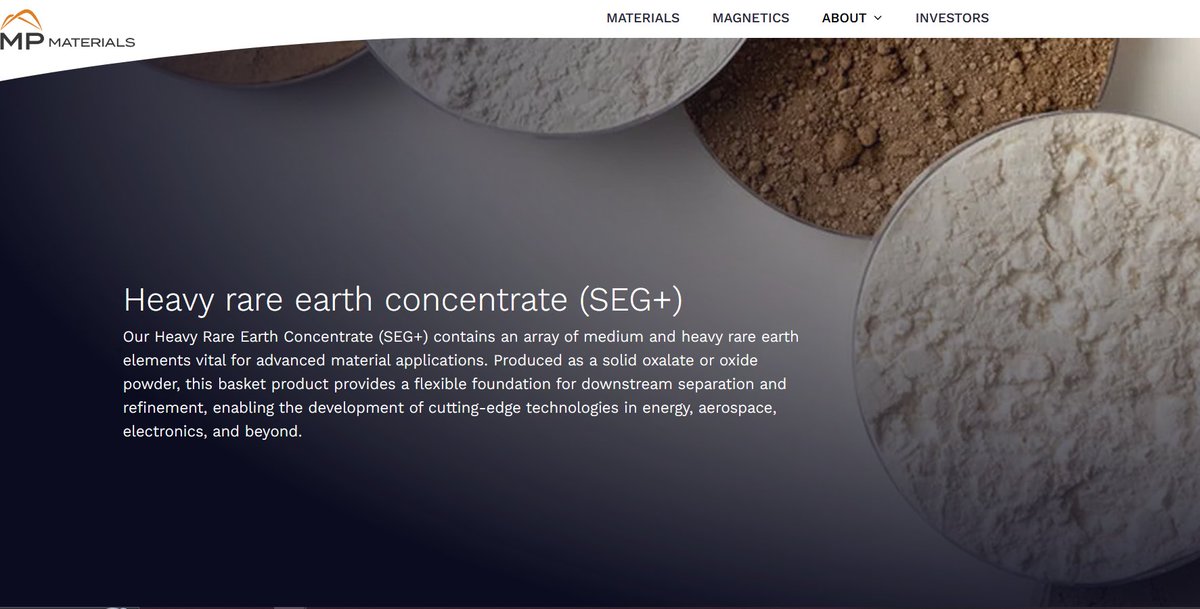
SEG is MP Materials' Heavy Rare Earth Concentrate — produced at Mountain Pass, California:
Medium REEs in SEG :
🔵 Samarium (Sm) — SmCo high-performance defence magnets, cancer treatment, nuclear reactor control
🔵 Europium (Eu) — optical displays, phosphors, anti-counterfeiting (Euro banknotes)
🔵 Gadolinium (Gd) — MRI contrast agents, nuclear reactor shielding, neutron radiography
Heavy REEs in SEG :
🔴 Dysprosium (Dy) — NdFeB high-temperature magnet additive, EVs, wind turbines, defence
🔴 Terbium (Tb) — NdFeB magnet additive, naval sonar (Terfenol-D), fuel cells
🔴 Holmium, Erbium, Thulium, Ytterbium, Lutetium, Yttrium
The Dy Tb fraction = ~4% of total rare earth oxides in SEG — the two most critical, most China-controlled, most expensive elements in the entire basket
Form: solid oxalate or oxide powder (basket product)
Status: being continuously produced and stockpiled at Mountain Pass — not yet separated
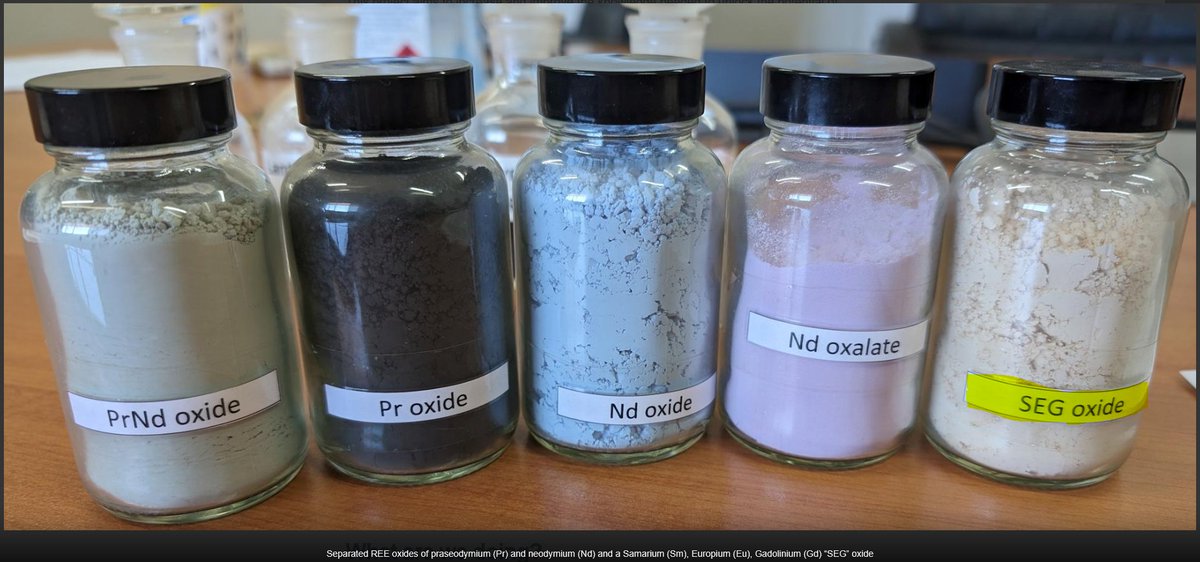
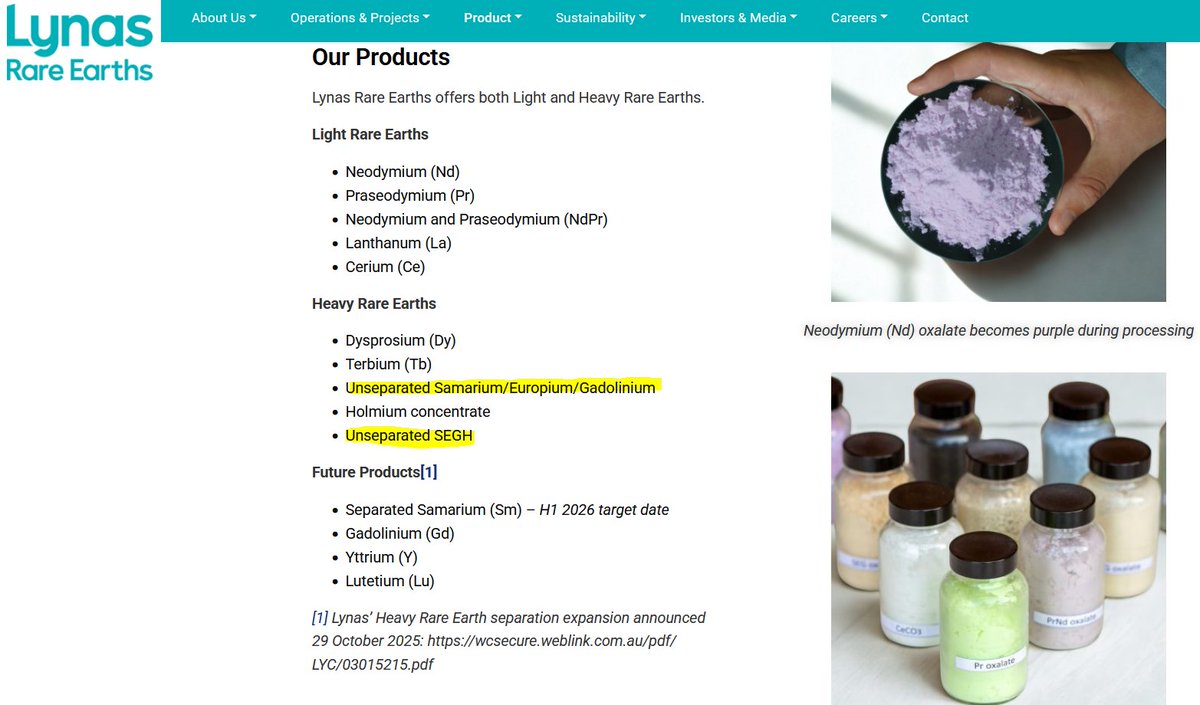
Lynas's equivalent product is called SEGH (not SEG ):
Contains: Samarium, Europium, Gadolinium, Holmium, Dysprosium, Terbium
Also sold as a mixed compound to customers who further separate it
This is Lynas's current commercial product — the individually separated Dy and Tb oxides are a newer, small-volume production stream from their expanded HRE facility
🏭 THE CRITICAL DISTINCTION: BASKET PRODUCT vs SEPARATED OXIDES
MP Materials SEG :
→ Produced as solid oxalate or oxide powder
→ A basket product — all the above elements together, unseparated
→ Being continuously stockpiled at Mountain Pass
→ Heavy rare earth separation circuit commissioning Q2 2026
→ Until then: sold as feedstock for downstream third-party separation
Lynas SEGH (their equivalent):
→ Contains Sm, Eu, Gd, Ho, Dy, Tb as a mixed Heavy REE compound
→ Currently sold to customers who further process it into separated materials
→ Individually separated Dy and Tb oxides: new, small-volume, just scaling
→ Q3 FY2026: only ~8 tonnes Dy Tb combined from separated stream
Both products = feedstock that still needs further separation chemistry before it becomes a usable Dy₂O₃ or Tb₄O₇
🚨 THE HIDDEN QUESTION THAT CHANGES EVERYTHING
So if MP is stockpiling SEG and Lynas is selling SEGH as a mixed compound —
Who separates it into individual high-purity Dy₂O₃ and Tb₄O₇?
This is not a theoretical question.
Right now, today, in 2026 — outside China the answer is:
✅ Lynas — small volumes, Malaysia, scaling
❌ MP — not yet (H2 2026 target)
❌ Energy Fuels — NdPr only, no HRE separation yet
❌ Neo Performance Materials — downstream processor, not primary separator at scale, only in-house.
The separation chemistry IP for individual HRE oxides at >99.5% purity remains China's most tightly held advantage — and the West's most critical gap.
💡 WHERE IONIC TECHNOLOGIES SITS IN THIS PICTURE
Ionic Technologies' MAIL™ technology is specifically designed to separate individual REOs from mixed rare earth feedstocks — using patented multi-amide ionic liquid extraction rather than conventional solvent extraction.
The demonstrated results from recycled magnet feedstock:
🔬 Dy₂O₃ — 99.56% purity
🔬 Tb₄O₇ — 99.75% purity
🔬 Nd₂O₃ — 99.87% purity
The MAIL™ platform is feedstock agnostic — it can process recycled magnet scrap, MREC (Mixed Rare Earth Carbonate from mines), and critically, mixed SEG /SEGH concentrate.
In other words: the technology that Belfast uses to separate recycled magnet scrap into individual REOs is the same technology that could separate MP's stockpiled SEG or Lynas's SEGH into the high-purity individual Dy and Tb oxides that OEMs cannot currently source outside China.
💡 THE SEPARATION BOTTLENECK — PROVEN BY THE CYCLIC MATERIALS MODEL
Let me show you exactly why separation is the critical chokepoint — with a real example.
Cyclic Materials (Canada) is one of the best-funded rare earth recyclers in North America. It built its Hub100 plant in Kingston, Ontario using its proprietary REEPure™ technology — producing recycled Mixed Rare Earth Oxide (rMREO) from end-of-life magnets.
What did they do with that rMREO?
They shipped it to France.
To Solvay's La Rochelle plant — Europe's most experienced rare earth separator, operating since the 1970s — for further individual separation and purification into magnet-grade NdPr and Nd oxides.
➡️ Cyclic could recycle the magnets.
➡️ Cyclic could produce the mixed oxide.
➡️ But Cyclic could not separate it to individual high-purity oxides at specification grade.
➡️ They needed Solvay's 50 years of rare earth separation expertise to do that final step.
And this is with LREEs only — NdPr, which are the easier rare earths to separate.
🔬 THE FOUR WESTERN SEPARATION TECHNOLOGY ARCHETYPES
The West is now fielding four distinct technology approaches to solve the separation bottleneck. Understanding how they differ is critical for anyone assessing where the real value sits.
① SOLVAY (Belgium/France) — Conventional Solvent Extraction, Incumbent
🏭 La Rochelle, France — operating since the 1970s
→ Uses multi-stage mixer-settler solvent extraction (the same fundamental chemistry China uses)
→ Currently processing Cyclic Materials' rMREO feedstock for individual REO separation
→ Strength: 50 years of process knowledge, validated with OEMs
→ Limitation: capital-intensive, large physical footprint, complex permitting, decades to replicate
② ReElement Technologies (USA) — LAD Chromatography Resin
🏭 Marion, Indiana — Noblesville refinery expanded 141% (2025)
→ Uses Ligand-Assisted Displacement (LAD) chromatography — adapted from pharmaceutical sector
→ Claims 100x more efficient than conventional mixer-settler configurations
→ 80% lower waste profile vs conventional SX — critical for US permitting
→ Validated: Gd, Ga, Ge, Tb and Y to 99.999% purity (five nines)
→ Capacity target: 10,000 tpa via $200M TEP equity facility (Jan 2026)
→ Status: scaling Marion; HREEs including Dy and Tb at 99.5% in commercial production
→ Strength: modular, column-based, smaller footprint, defence-validated
→ Limitation: unproven at full industrial scale for HREE basket separation
③ Ucore Rare Metals (Canada/USA) — RapidSX™ Column Solvent Extraction
🏭 Kingston, Ontario (52-Stage Demo Plant) → Alexandria, Louisiana (Strategic Metals Complex)
→ Uses column-based SX — same chemistry as conventional but 3–4x faster throughput
→ No powered mixing tanks — gravity-fed column contactors replace mixer-settlers
→ 5,700 hours of HREE processing at demo plant
→ Demonstrated splits: LaCe, NdPr, SmEuGd, Sm, Gd, TbDy, Tb, Dy individually — all groups
→ $22.4M US Department of War Other Transaction Agreement — US DoD sponsored
→ Louisiana SMC: RapidSX™ Machine #1 installation mid-2026; HREE focus: Tb, Dy, Y
→ 25,000 samples proving RapidSX™ and conventional CSX yield virtually identical chemistry
→ Strength: proven heavy REE splits including individual Tb and Dy, DoD-validated, US sovereign
→ Limitation: not yet at commercial scale; Louisiana SMC still under construction
④ Ionic Technologies (UK) — MAIL™ Ionic Liquid Extraction
🏭 Belfast, Northern Ireland
→ Uses patented multi-amide ionic liquid (MAIL™) — fundamentally different chemistry to SX
→ Not conventional solvent extraction — does not require the same reagent infrastructure China built
→ Feedstock agnostic: oxidised magnets, coatings, variable grade, MREC, recycled scrap
→ Demonstrated: Nd₂O₃ 99.87%, Dy₂O₃ 99.56%, Tb₄O₇ 99.75% — from recycled feedstock
→ Ford durability tested — recycled rotor passed comparable to virgin material
→ 61% lower CO₂ vs primary mine supply chain
→ £23M UK Government backed (CirculaREEconomy £11M £12M capital grant OIP)
→ Strength: only Western technology demonstrated separating both recycled Dy AND Tb to spec; fully integrated — no Solvay needed; UK sovereign
🔮 THE ADAMAS FORECAST CONTEXT
Adamas Intelligence forecasts:
🔴 By early 2030s: China becomes a net importer of Dy and Tb
🔴 Pricing power transfers to Western CIF price levels
🔴 Rotterdam Tb ask price already: >$4,500/kg vs China EXW ~$936/kg
🔴 CIF North America Dy: forecast 8.3x Chinese price by 2027 (Benchmark Mineral Intelligence)
The stockpile being built at Mountain Pass right now will one day need to be separated into individual HRE oxides at Western facilities.
The pricing premium that separation commands is already visible in Rotterdam and CIF benchmarks.
The separation IP and demonstrated capability to deliver specification-grade Dy and Tb is held by a very short list of organisations outside China.
The value in this supply chain is not in the mine.
It is not even in the concentrate.
It is in the separation step.
📌 Sources: MP Materials SEG product page | Lynas Products page | Adamas Intelligence | Benchmark Mineral Intelligence | Ionic RE ASX | Fastmarkets CIP March 2026
🔗 mpmaterials.com/product/seg/
🔗 lynasrareearths.com/products…
#SEGplus #SEGH #RareEarths #HeavyRareEarths #Dysprosium #Terbium #Samarium #Gadolinium #MPMaterials #Lynas #IonicRareEarths #IonicTechnologies #MAIL #IXR #CriticalMinerals #WesternCIF #Separation #SolventExtraction #NdFeB #Magnets #SupplyChain #China #ExportControls #AdamasIntelligence #MountainPass #Belfast #PriceDiscovery #EnergyTransition #Defence
1
3
14
1,739
🚀 Adamas launches Western CIF price forecasts.
Part One
Very interesting, we also have Fastmarkets also launched rare earth price assessments in March 2026 — confirming the market urgency for non-Chinese price discovery.
discoveryalert.com.au/critic…
With multiple new Western refiners of NdPr and SEG products entering the market, interest is growing in reliable price forecasts for these oxides produced in – and delivered to – North America and Europe.
As Lynas Rare Earths, MP Materials, Neo Performance Materials, Energy Fuels and others ramp up separation capacity, key questions emerge: How will these materials be priced, and how will those prices evolve amid shifting regional and global supply-demand dynamics?
Today, virtually no separated and refined Dy, Tb, Sm, Gd, Y or Lu oxides are produced or traded outside China. With little-to-no transaction data available, traditional price discovery is nearly impossible.
To bridge this gap, Adamas has developed detailed production cost models for each of these oxides and analyzed end-users’ willingness to pay. This enables Adamas to forecast – Adamas's view – how Western CIF prices are likely to evolve in response to changing market fundamentals.
📋 DEEP RESEARCH BRIEF
The SEG Problem: Where Western Separation Actually Stands (May 2026)
Lynas (ASX: LYC) is currently the only commercial producer of separated Heavy Rare Earth oxides outside China. Here's what they have achieved:
✅ Separated Dysprosium oxide — first production May 2025
✅ Separated Terbium oxide — first production June 2025
✅ Separated Samarium oxide — first production March 2026, ahead of schedule
🔄 Expanded HRE facility under construction at Lynas Malaysia — full suite (Sm, Gd, Dy, Tb, Y, Lu) within 2 years
⚠️ BUT: Scale is still very small. Lynas produced only 8 tonnes of Dy and Tb combined in Q3 FY2026 — vs China's prior ~11 tonne/month of Terbium alone before export controls.
MP Materials (NYSE: MP) is behind Lynas on HRE separation:
🔄 Heavy rare earth separation circuit at Mountain Pass commissioning imminent as of Q1 2026
🔄 Expected commercial production mid-2026
📦 MP is currently stockpiling SEG concentrate — selling it as a basket product (oxalate/oxide powder) for downstream third-party separation
🚨 Until HRE separation is online, high-performance NdFeB magnets requiring Dy/Tb still cannot be made from domestic MP supply alone
The SEG Pricing Question ?
"Is the pricing model now about selling SEG as a feedstock for further refining?"
Yes — and this is the crux of the Adamas CIF pricing challenge. Because:
1. MP is selling SEG as a mixed concentrate — not separated oxides
2. The buyers of SEG are companies with the IP to separate it further — a very short list outside China
3. Lynas's separated Dy and Tb volumes are tiny relative to market need
4. Virtually no separated Gd, Y, Sm, Lu are traded outside China today — Adamas confirms this [Adamas article]
NdPr prices have surged 41% in 2026, but HRE oxides have no reliable Western price benchmark yet — hence why Adamas is launching its Western CIF price forecasting.
✅ There are emerging Western/European prices — and they are extraordinary compared to Chinese domestic prices. Here's the full picture:
1. 🏷️ Rotterdam "Ask Prices" — The European Security Premium Reality
The Rotterdam spot market has been the de facto European price discovery point for secured, non-Chinese Dy and Tb — and the numbers are staggering: See Image
But here's the critical context Adamas Intelligence revealed: less than 1% of global Dy and Tb volume is actually transacting at those Rotterdam prices. The vast majority is still priced at Chinese levels — because Western buyers have almost no alternative supply to purchase from. The Rotterdam price is an ask price with almost no sellers — which is exactly why Adamas calls existing European price assessments a "fallacy" and is building proper cost-based CIF forecasts.
2. 📊 Fastmarkets CIF Global Benchmarks — March 2026
Fastmarkets launched three new global CIF price assessments on 19 March 2026, becoming the first major PRA to formally price ex-China HREs:
MB-DY-0005 — Dysprosium oxide 99.5%, CIP global, $/kg
MB-DY-0006 — Ferro-Dysprosium 80%, CIP global, $/kg
MB-TB-0004 — Terbium oxide 99.99%, CIP global, $/kg
These are real transacted/assessed benchmarks — separate from the Rotterdam ask prices — and represent the first systematic ex-China price infrastructure.
discoveryalert.com.au/critic…
3. 📈 Benchmark Mineral Intelligence — The 8x Premium Forecast
Benchmark Mineral Intelligence data shows the price gap is widening, not closing:
In 2025: CIF North America Dy was 4.4x higher than EXW China
By 2027 forecast: CIF North America Dy projected at 8.3x higher than Chinese prices
European Tb prices showed a similar divergence pattern
🚨 The Yttrium Case Study — How Fast This Can Move
Yttrium oxide outside China has gone from ~10x Chinese domestic price last autumn → 115x by March 2026 → 150x by 30 April 2026:
CIF North America Yttrium oxide: $1,575/kg (30 April 2026)
China domestic average 2026: ~$10/kg
A 150x bifurcation — driven entirely by export controls and access security premiums
🔑 The Adamas "Fallacy" Argument — Why This Matters
Adamas's key finding: Current European prices like Rotterdam are not real market-clearing prices — they are ask prices with no volume. Real Western CIF prices need to be built from production cost models upward, not from thinly traded spot quotes. This is precisely what their new forecast service addresses — and why it's critical for:
1. Magnet makers trying to sign long-term offtake contracts
2. Automakers doing EV BOM (bill of materials) planning
3. Defence contractors writing multi-year procurement
4. Junior companies seeking investment to build facilities whose economics depend on these Western price levels.
#RareEarths #CriticalMinerals #HeavyRareEarths #Dysprosium #Terbium #Samarium #NdPr #SEGplus #WesternCIF #PriceDiscovery #AdamasIntelligence #Separation #SolventExtraction #NdFeB #Magnets #EVs #Defence #SupplyChain #China #ExportControls #CriticalMineralsStrategy #EnergyTransition #Geopolitic
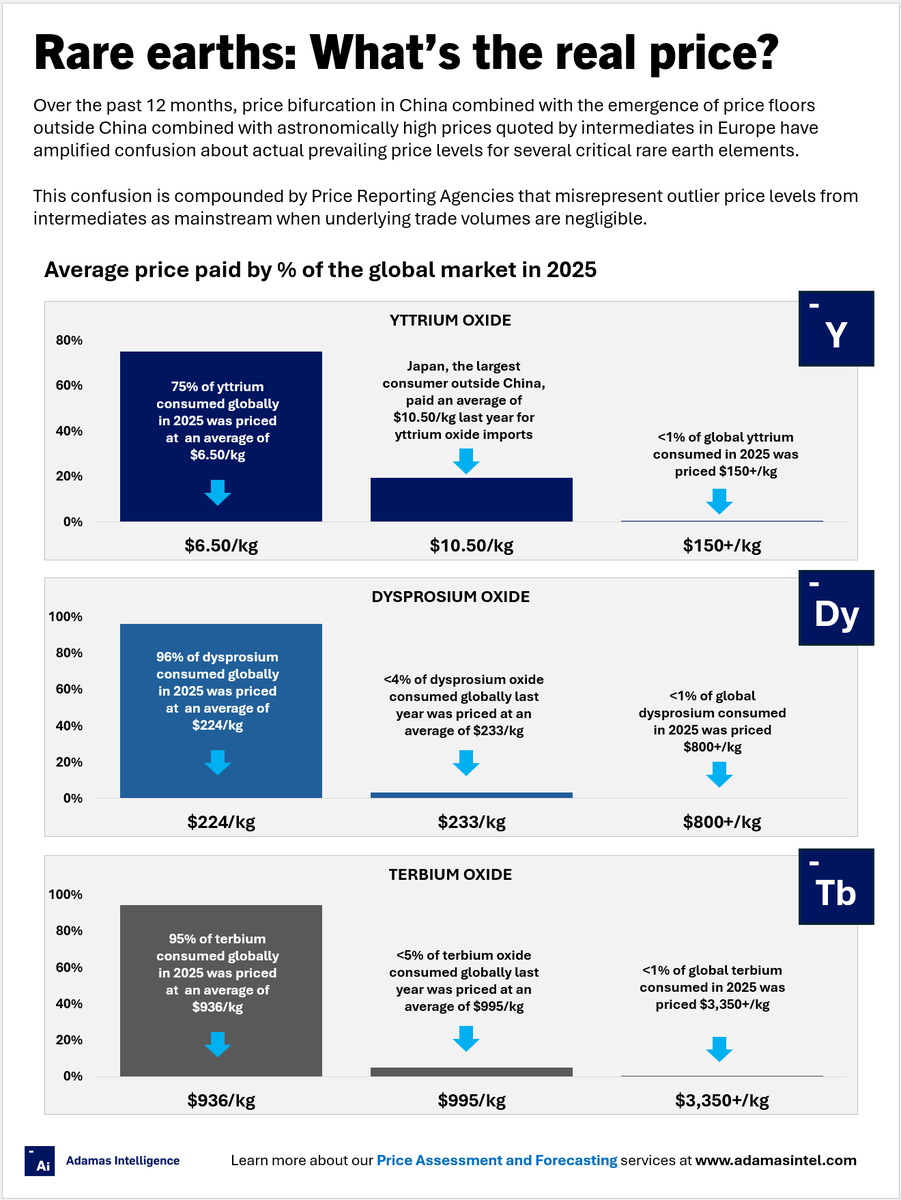
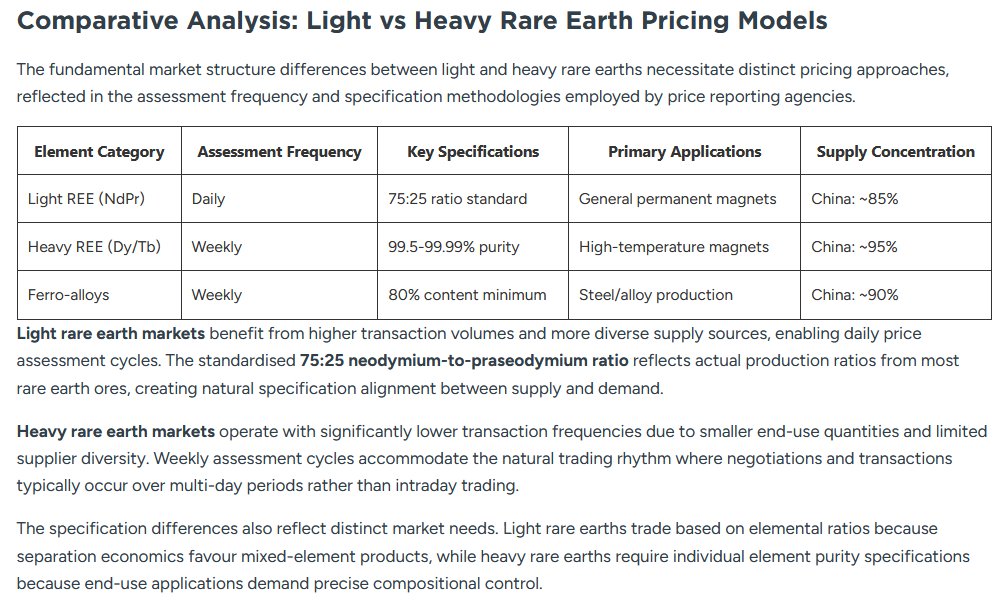
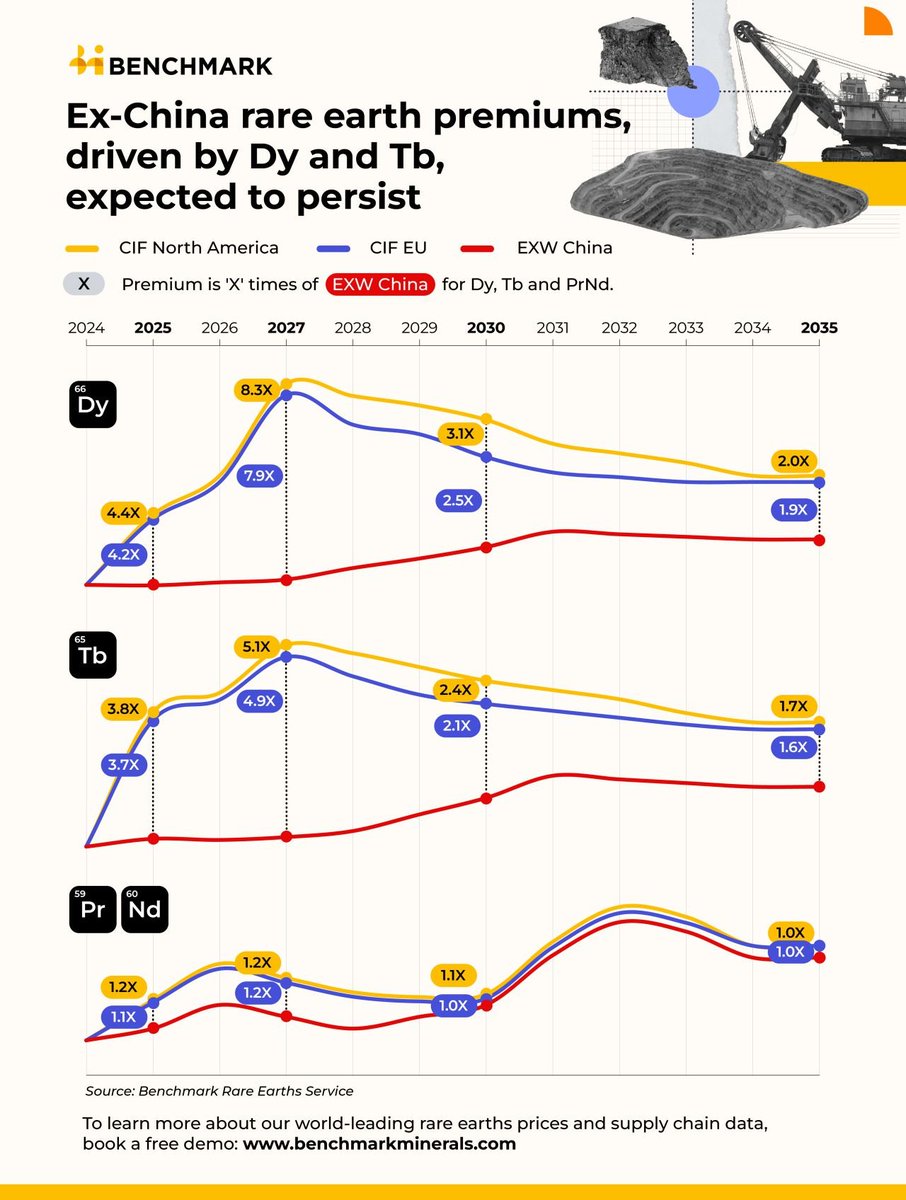
2
13
1,175
What if you combined Australia's only mine-to-metals rare earth company with America's only uranium mill that can separate rare earth oxides?
That's what the ASM Energy Fuels (NYSE: UUUU) deal is building. 🧲⚛️🇦🇺🇺🇸
ASM's Korean Metals Plant (KMP) – what it does:
The KMP in South Korea is one of the very few facilities outside China producing rare earth metals and NdFeB alloys. In Q1 2026, the KMP dispatched ≈42 tonnes of NdFeB strip alloy – a >70% increase quarter-on-quarter for the second consecutive quarter – with the majority going to fulfil a 100-tonne supply contract with Noveon Magnetics (the first operational sintered NdFeB magnet maker in the US). A follow-on order for 84 tonnes of NdFeB alloy was agreed post-quarter, confirming the customer relationship is durable.
On the heavy rare earth side, the KMP produced 10 kg of terbium (Tb) metal during the quarter and installed a next-generation pilot-scale HREE metallisation furnace, targeting first production in Q2 2026 (subject to feedstock availability).
That 10 kg of Tb can be sold directly as finished metal or blended into NdFeB alloy for magnet makers – exactly the Dy/Tb doping needed to keep magnets stable at high temperatures in EV motors and industrial robots. Phase 2 expansion is meanwhile progressing to increase KMP furnaces from 4 → 12, targeting a nameplate capacity of ≈3,600 tpa NdFeB alloy.
wcsecure.weblink.com.au/pdf/…
The honest position on HREEs:
Dy and Tb production at KMP is still very small scale – commercial Dy/Tb metal output remains the next frontier. Feedstock for HREEs is also constrained outside China right now, and that's where the Energy Fuels transaction changes the calculus completely.
Have Discussed Energy Fuels on here a few times 🔽
x.com/roblun1/status/2037324…
Energy Fuels White Mesa Mill – the SX shortcut:
Energy Fuels has operated solvent extraction (SX) at White Mesa Mill in Utah for 40 years for uranium and vanadium. Pivoting those same circuits to rare earth separation isn't a leap – it's a logical extension of existing infrastructure.
Phase 1 REE separation at White Mesa already runs at 850–1,000 tpa NdPr capacity and is piloting Dy and Tb separation at scale, with commercial Dy/Tb oxide production targeted by Q4 2026. Monazite – the feedstock Energy Fuels processes – carries ~95% more Dy and Tb than bastnaesite, giving the combined entity a HREE-rich input stream that Dubbo ore alone couldn't match.
Put it together: ASM brings the metals and alloy manufacturing capability (KMP Korea → future American Metals Plant), Energy Fuels brings the separation and processing horsepower (White Mesa SX) and a growing monazite feedstock pipeline (Donald in Victoria, Vara Mada in Madagascar, Bahia in Brazil). FIRB approval for the transaction was confirmed post-quarter, with the Scheme Booklet expected in May 2026 and implementation targeted for early July 2026.
listcorp.com/asx/asm/austral…
#RareEarths #NdPr #Dy #Tb #Uranium #CriticalMinerals #EnergyFuels #UUUU #SX
@Energy_Fuels @ASM_aus #NdFeB
#EVs #Defense #SupplyChain #ExChina 🌍📷
#WhiteMesaMill #SolventExtraction #KoreanMetalsPlant #NoveonMagnetics #EV #Mining #SupplyChain #Australia #USA ⚛️🧲🌍
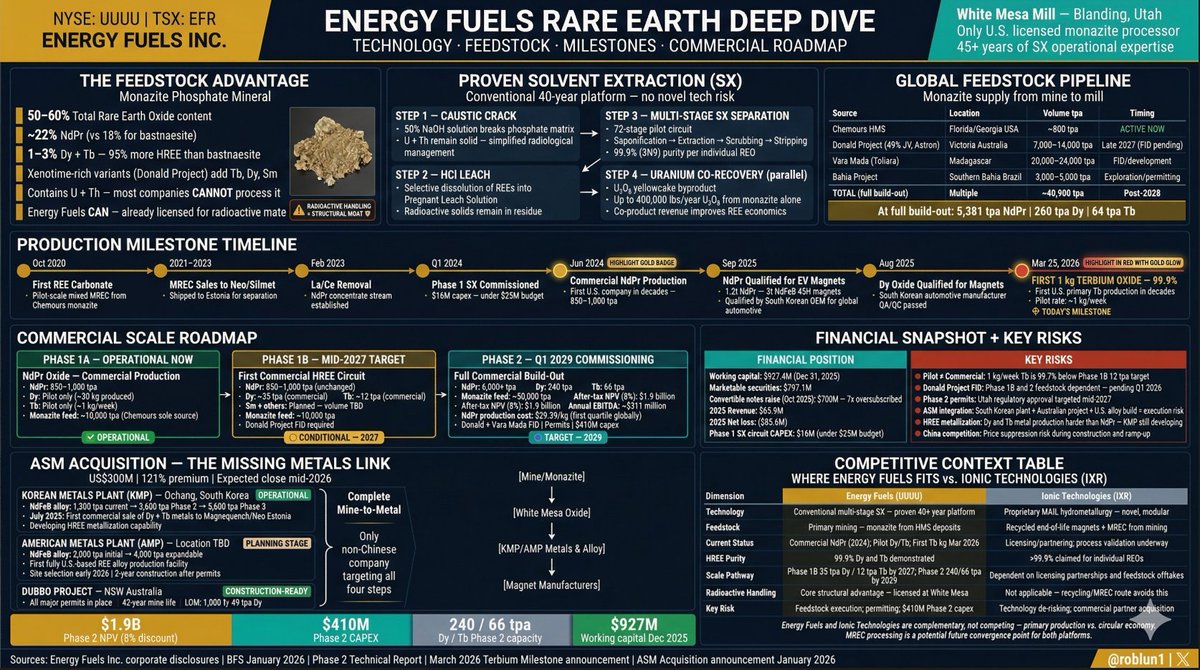
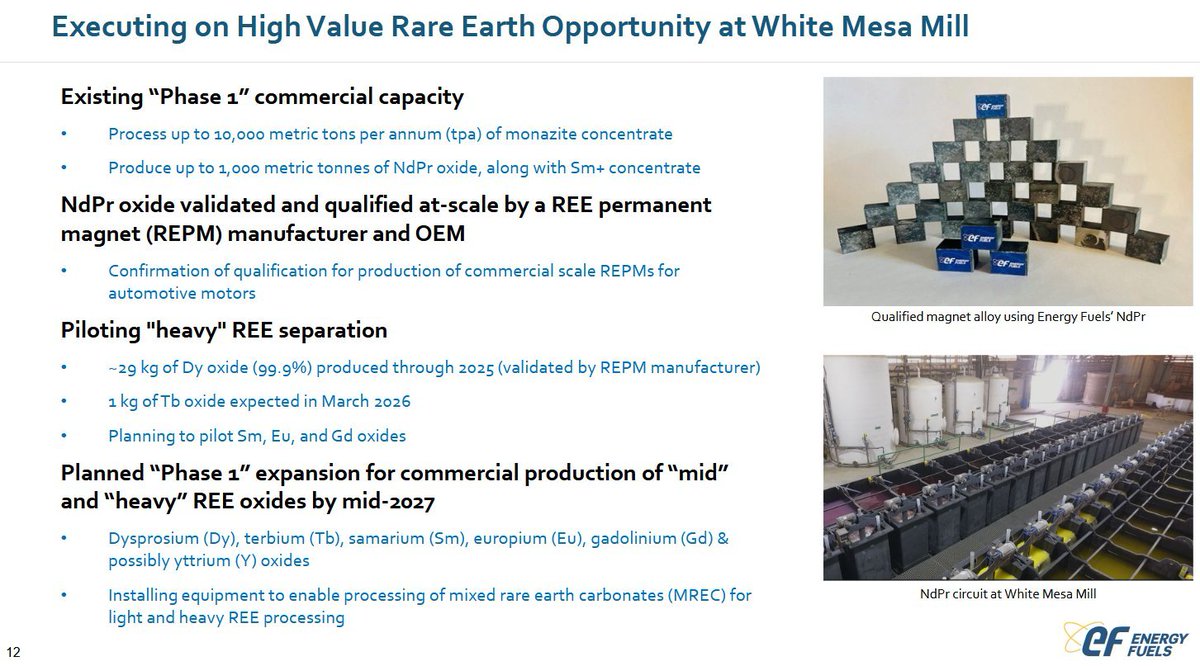
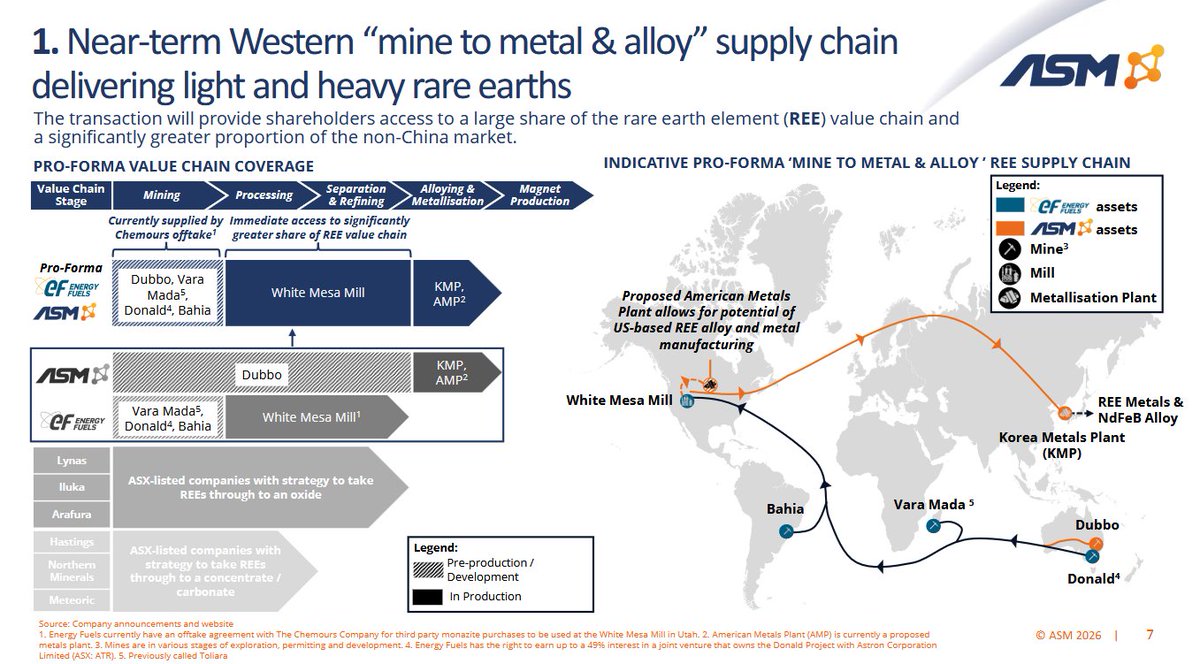
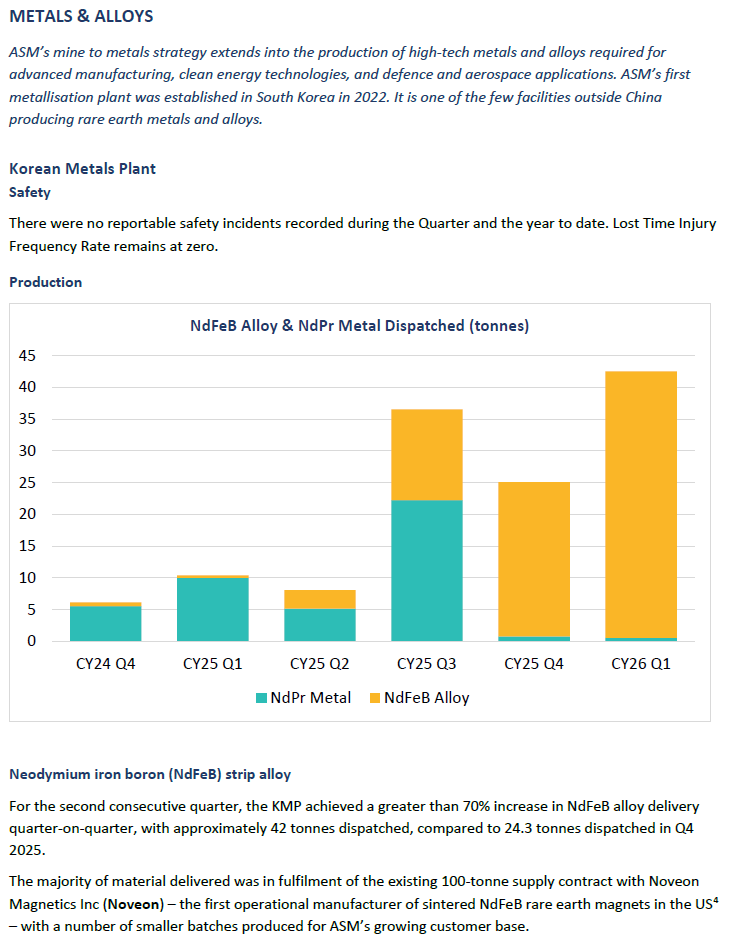
Energy Fuels already has rare earth oxide production running at White Mesa – and they’re quietly building one of the only true mine‑to‑magnet chains outside China. ⚙️🇺🇸
1. Rare Earth Oxides at White Mesa (Phase 1, today)
Monazite feedstock (not recycled magnets) processed through existing SX circuits. 🧪
Up to 10,000 tpa monazite → up to ~1,000 tpa NdPr oxide Sm‑rich concentrate.
~29 kg Dy oxide (99.9%) produced through 2025 – already validated by a REPM manufacturer.
1 kg Tb oxide (99.9%) delivered in March 2026 – first U.S. primary Tb oxide in decades.
Heavy REE pilots next: Sm, Eu, Gd (and potentially Y) oxides in the queue.
2. Why they can move fast: SX circuits were already there
White Mesa Mill has run traditional solvent extraction (SX) for uranium & vanadium for 45 years – tanks, mixer‑settlers, and know‑how are in place.
REE program = bolting on additional SX trains for NdPr, then Dy/Tb, rather than starting from scratch.
Phase 1 NdPr circuit is installed and qualified; next step is a mid‑2027 “Phase 1” expansion to bring commercial volumes of Dy, Tb, Sm, Eu, Gd online.
This leverages sunk capex, proven chemistry, and a licensed site that can handle monazite radioactivity – a big moat in the U.S. context.
3. Next steps (from pilot to real volume)
Now: NdPr oxide on‑spec; Dy/Tb proven at kg‑scale from existing SX trains.
By ~mid‑2027: “Phase 1” expansion targets commercial mid & heavy oxides (Dy, Tb, Sm, Eu, Gd, possibly Y) using incremental SX capacity.
Beyond: Phase 2 and the ASM acquisition (Korean metals plant Dubbo American Metals Plant) aim to push from oxides → metals → NdFeB alloy.
#RareEarths #NdPr #Dy #Tb #Uranium #CriticalMinerals #EnergyFuels #UUUU #SX @Energy_Fuels #EVs #Defense #SupplyChain #ExChina
🌍🧲
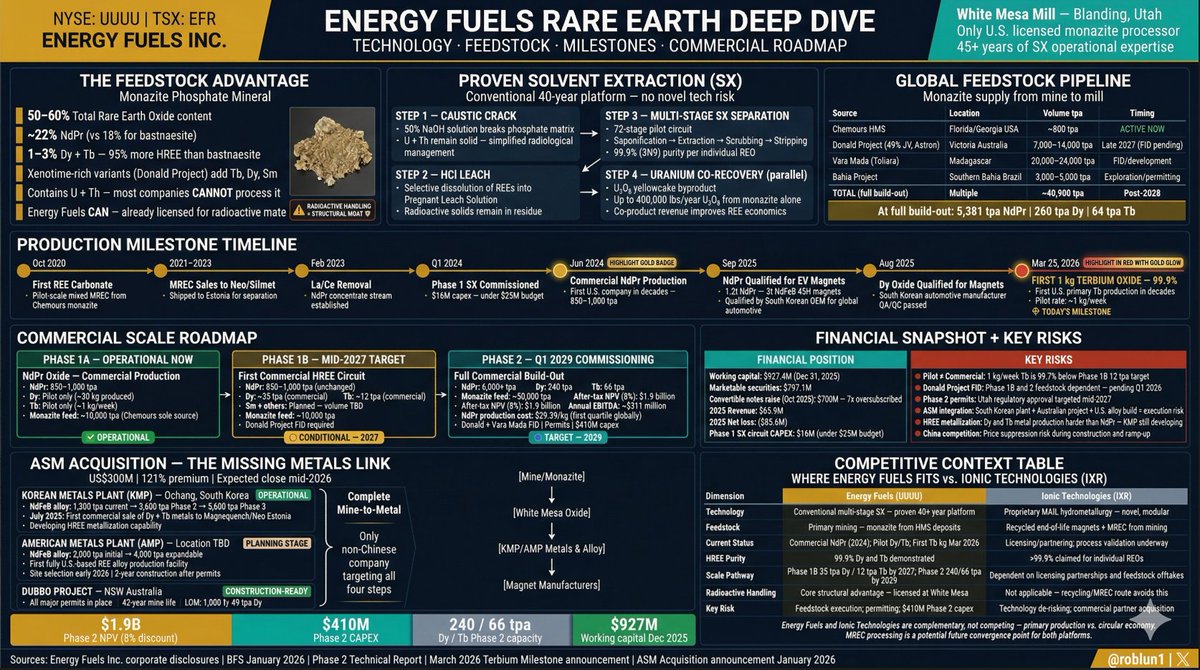
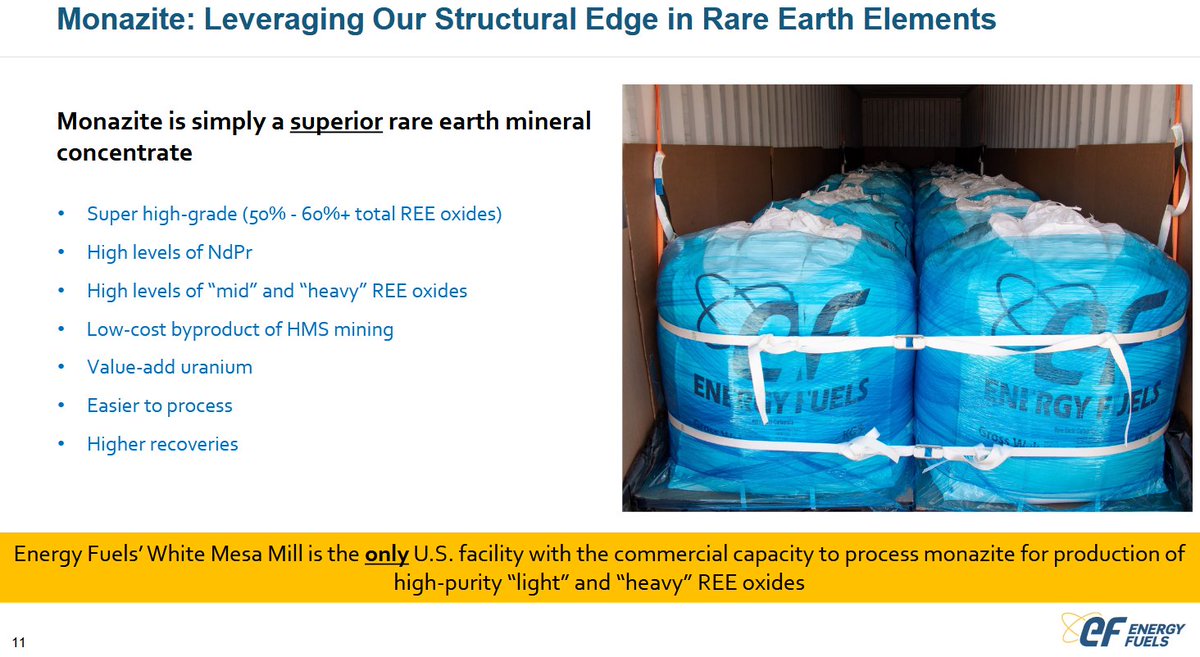
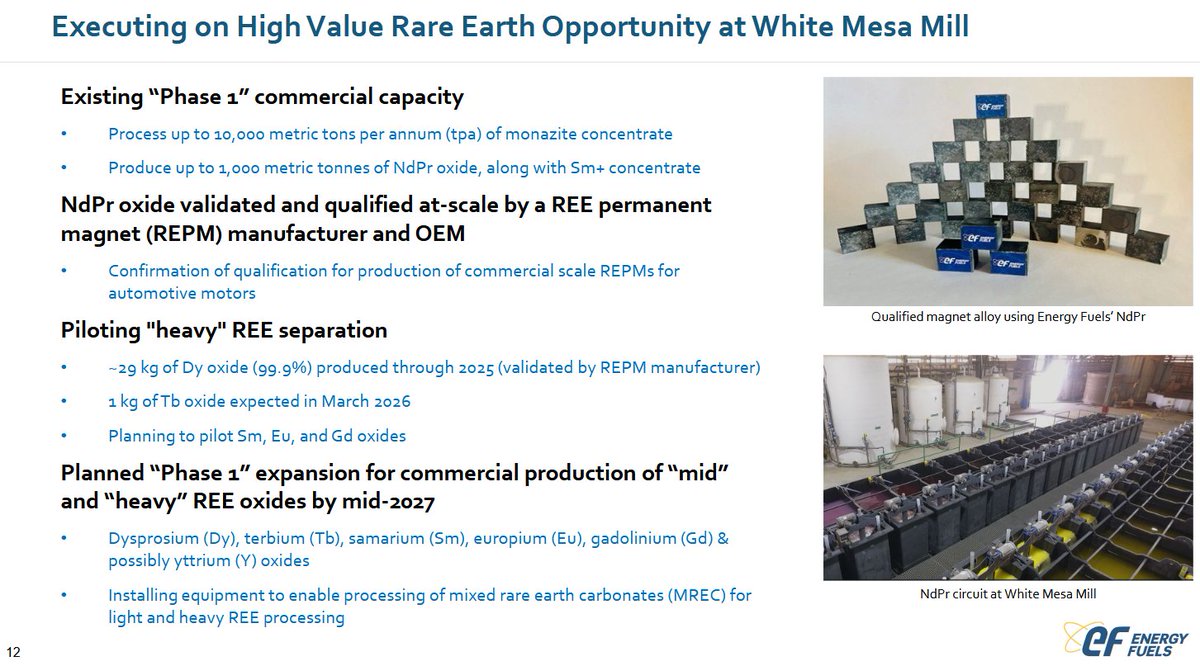
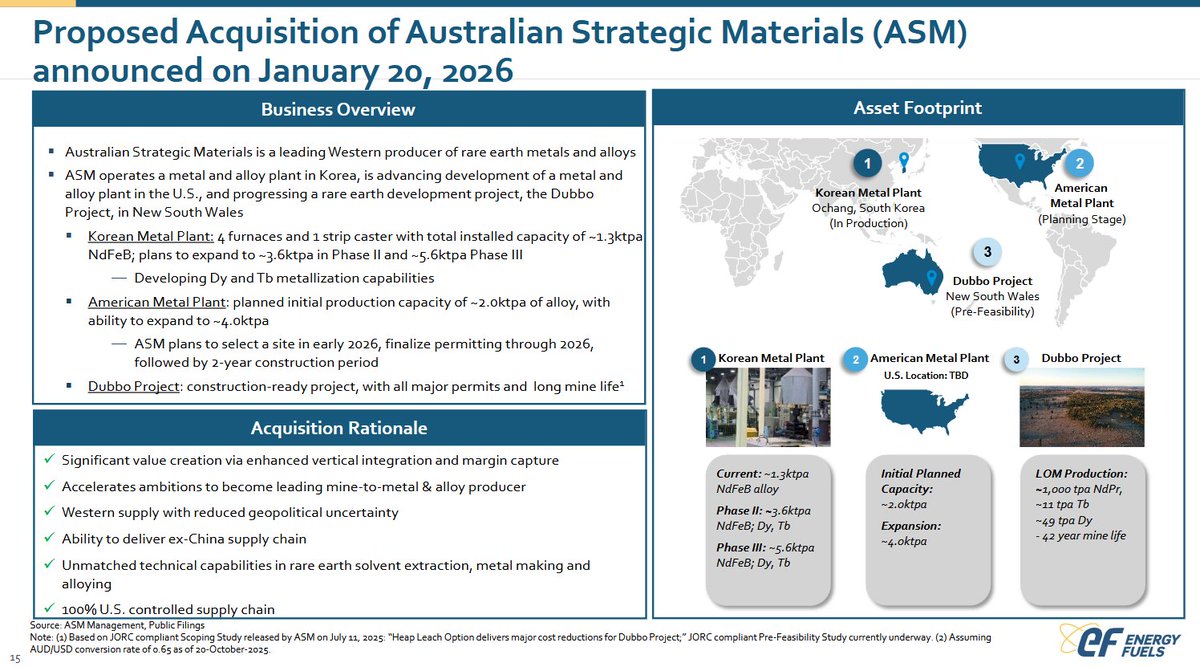
1
3
341
The Axeleo Capital European Critical Minerals Stack chart is a powerful independent third-party validation of exactly where Ionic Technologies sits relative to the broader European critical minerals ecosystem — and when you layer on what we know about the MAIL separation technology platform from all our prior discussion, the picture becomes very compelling.
What the Axeleo Chart Is Actually Telling Us
The chart maps the entire European critical minerals landscape across three maturity tiers and three technology categories. Ionic Technologies is placed firmly in the top tier — Deployment TRL 8-9 — under Enhanced Recycling. This is a significant independent endorsement because Axeleo Capital is a specialist European deep-tech VC — not a broker, not an IXR affiliate — and they have placed Ionic Technologies alongside only a handful of companies deemed commercially deployment-ready across the entire European continent.
Who Is at Deployment TRL 8-9 in Enhanced Recycling?
From the chart, only 8 companies across all technology categories sit at the Deployment tier:
Enhanced Recycling (TRL 8-9):
Ionic Technologies 🇬🇧, CAREMAG 🇫🇷← Only separated magnet REO recycler at this level
CAREMAG 🇫🇷
CYLIB 🇩🇪
Battri 🇳🇴
Tozero 🇩🇪
HyProMag 🇬🇧
MagREEsource 🇫🇷
Altilium 🇬🇧
Attero 🇳🇱
Meanwhile, the Development tier (TRL 5-7) contains 15 companies including Circular Materials, Gigamine, RAREARTH, Descycle, Mecaware, Recupere Metals, Elmery and others — all still years from deployment. The R&D tier (TRL 3-4) adds another 10 companies including MagMatic, Back to Battery, REEcover, and Nordic Salt Cycle.
Ionic Technologies 🇬🇧, CAREMAG 🇫🇷 are the only European company at TRL 8-9 producing individually separated, magnet-grade rare earth oxides from end-of-life magnets — the most technically demanding and highest-value position in the recycling chain.
The MAIL Technology: Why the Separation Is So Advanced
This is where the chart becomes genuinely remarkable when combined with what we know about the underlying technology. From our space files, Ionic Technologies' separation platform is built on Multifunctional Amide Ionic Liquids (MAIL) — proprietary hydrometallurgical chemistry originally developed at Queen's University Belfast's QUILL Research Centre.
What MAIL Actually Does That Others Cannot
The fundamental challenge in rare earth separation is that lanthanide elements (Nd, Pr, Dy, Tb, Ho etc.) are chemically almost identical — they sit next to each other on the periodic table with nearly identical ionic radii and oxidation states. Conventional solvent extraction (SX) exploits tiny differences in their chemistry across hundreds of mixer-settler stages — it is energy-intensive, uses hazardous organic solvents, generates volatile organic compound (VOC) emissions, and typically requires 150 process steps to achieve individual separation.
The selectivity breakthrough is the multi-amide ligand chemistry — the ligand system is tuned to have specific affinity for individual rare earth elements, discriminating not just between REEs and base metals (Fe, B, Ni, Co) but between the individual lanthanides themselves. This is what enables:
1. Feed-agnostic processing — oxidised magnets, coated materials, mixed waste streams, even Mixed Rare Earth Carbonate (MREC) from primary mining — all processable without extensive pre-treatment
2. Simultaneous LREE HREE separation in one circuit — Nd and Pr (light REEs) and Dy, Tb (heavy REEs) come out as individually separated oxide products in a single pass
3. Closed-loop reagent systems with ~95% water recovery — dramatically lower waste generation
4. 61% lower CO₂ emissions versus primary mining and conventional separation.
The Process Flow: EOL Magnet to Separated REO
From collection to final oxide powder:
1. Collection & pre-processing → EOL magnets sorted, demagnetised, cleaned
2. Dissolution → Acid leach converts REEs, Fe, B into solution; coatings filtered
3. MAIL extraction → Proprietary ligands selectively extract REEs from Fe, B, Ni, Co matrix
4. Stepwise separation → LREEs (Nd, Pr) first, then MREEs (Sm, Eu, Gd), then HREEs (Dy, Tb, Ho, Y)
5. Precipitation & recovery → High-purity oxalates/hydroxides precipitated, calcined to oxides
6. Quality assurance → Batch testing confirms >99.9% purity
7. Product dispatch → Direct to alloy makers (LCM), magnet manufacturers (VAC, GKN), or end-users
This is the only Western process operating continuously at commercial specifications across all 4 key magnet REOs — Nd, Pr, Dy, Tb — simultaneously, for 26 months.
CAREMAG uses the same three-stage conventional technology
CAREMAG uses the same three-stage conventional technology (pyrometallurgy → hydrometallurgy → liquid-liquid solvent extraction) that China has operated for decades — just with European-standard environmental controls and a focus on magnet recycling feedstock alongside primary concentrates. It is proven, scalable, and well-understood, but it is not a technology innovation — it is technology deployment at European scale using established methods.
Ionic Technologies' MAIL platform represents a genuine technology leap: eliminating the pyrometallurgy stage entirely, collapsing 150 SX stages to 15 through proprietary ligand chemistry, using non-volatile non-flammable ionic liquid media, and achieving >99.9% purity in a modular deployable format that can be licensed globally.
CAREMAG's scale and €216M investment will make it Europe's largest HREE facility. But Ionic Technologies' technology architecture is fundamentally more efficient — and already operating. When CAREMAG commissions in late 2026, Ionic will have almost three years of continuous validated production as its competitive evidence. ⚗️🇬🇧🇫🇷
Sources: Mining Technology | Fastmarkets |
Carester.fr | Rare Earth Exchanges |
IXR Ionic Technologies Technical Reports |
REE-FLEX Pilot Programme 2025–2028
@IONIC_RE @IONICTECH_UK @ussmetals @CMA_Minerals @IXR2THAMOON @timhorizonmet
@Viridis_VMM @ucore @LCM_Metals @CyclicMaterials
@MPMaterials @ReecycleInc @SolvayGroup
@EMRGroupLimited #VIRIDION @EU_Commission @ENERGY @VulcanElements @RE_Exchanges @DiscoveryAlert @USRareEarths @DeptofWar @ENERGY @Carester
#RareEarths #CriticalMinerals #REE
#IonicTechnologies #MAIL #CAREMAG
#Carester #NdFeB #Dysprosium #Terbium
#Neodymium #PermanentMagnets
#MineToMagnet #SolventExtraction
#CircularEconomy #Recycling #MagnetRecycling
#SupplyChain #ExChina #NationalSecurity
#IXR #ASX #IXRRF #Belfast #France
#CriticalMinerals2026 #EnergyTransition
#EVs #Defence #WindEnergy
#UKManufacturing #TechDisruption
🧲🇬🇧🇫🇷⚗️🔬🌍
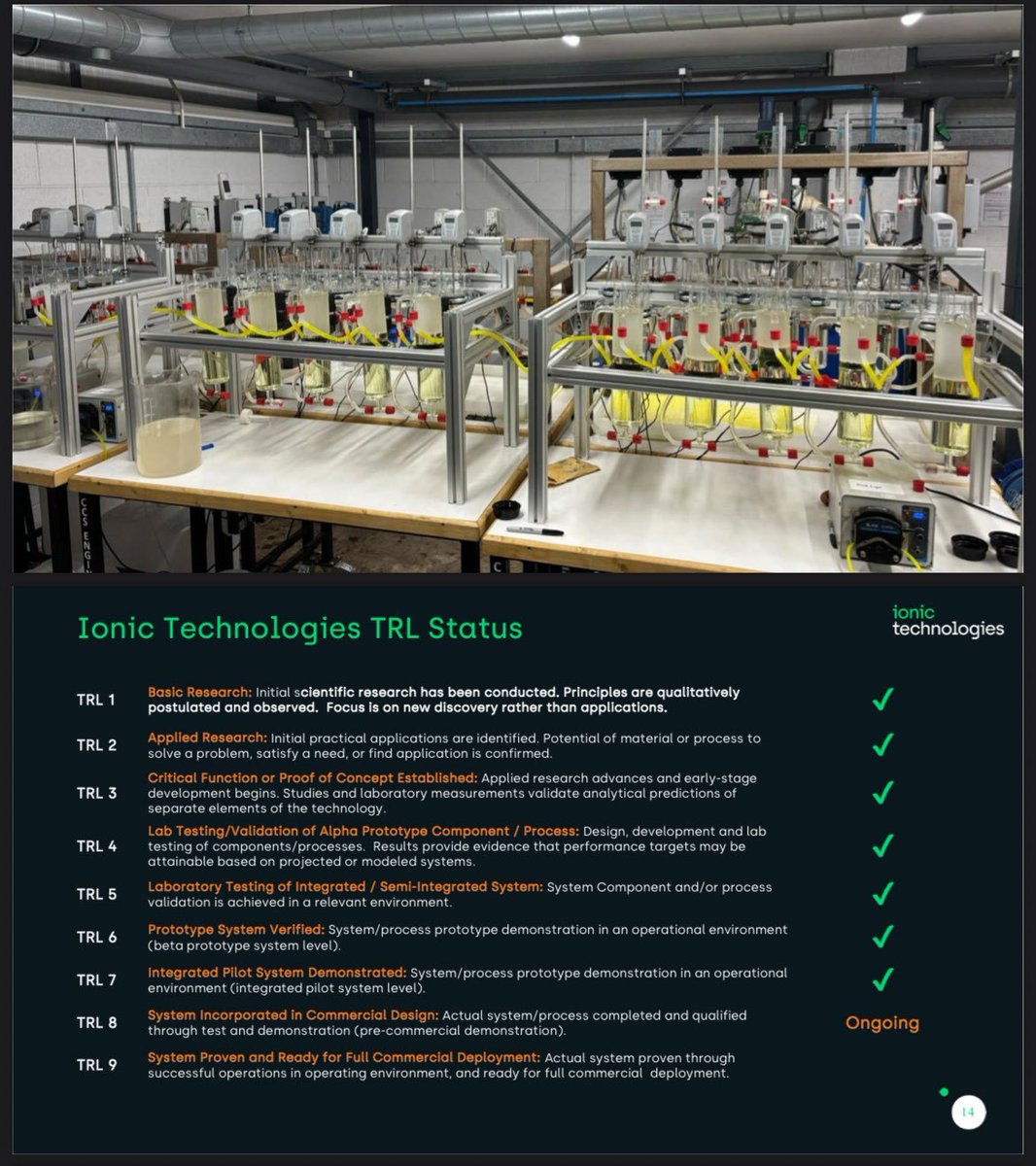
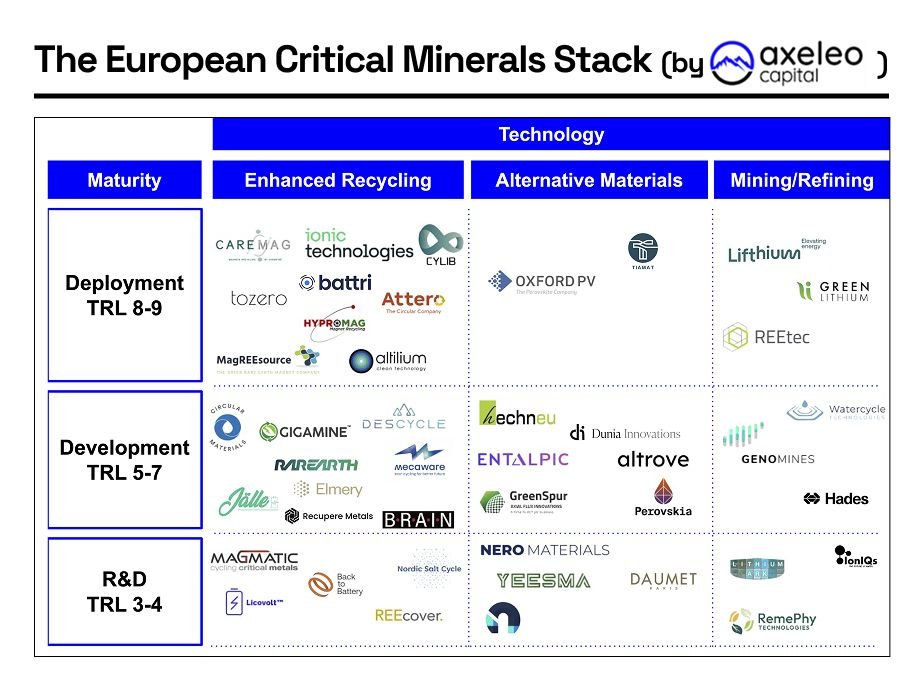
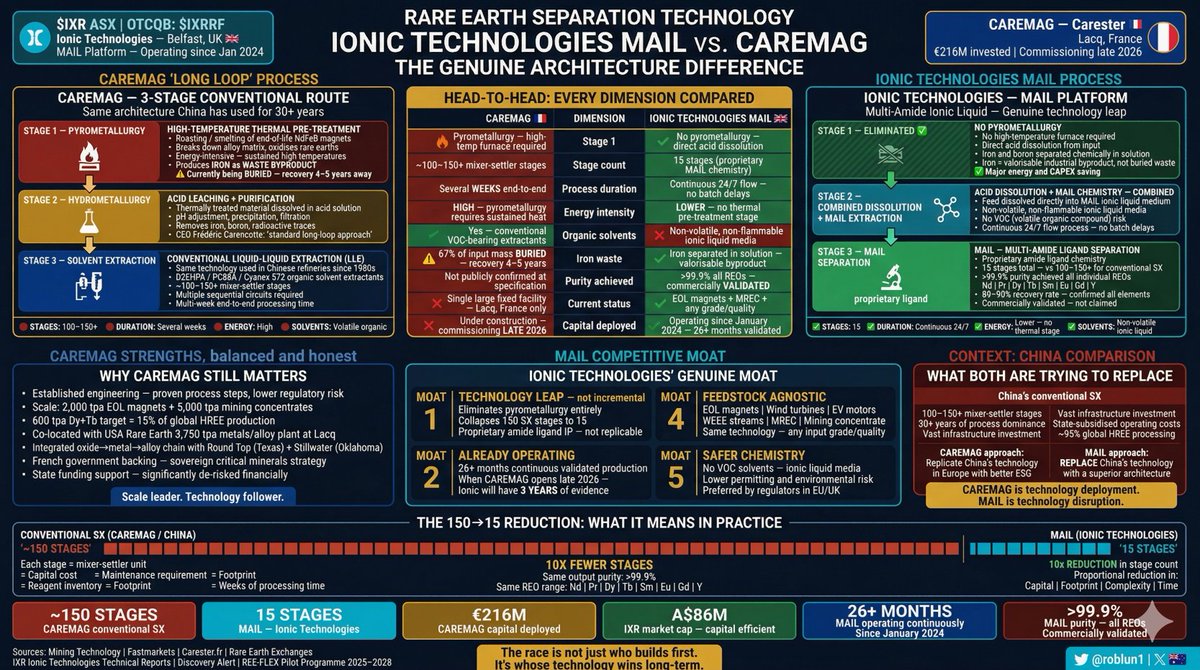
1
1
6
245
1. Belfast £12M as "Cornerstone" Not Complete Funding
Tim Harrison – 27 Jan 2026 (Belfast & Global Strategy)
Tim frames the £12M DRIVE35 grant as a cornerstone commitment from the UK Government that catalyses, but does not complete, the Belfast funding stack and allows IXR to move from R&D to full commercialization of its magnet recycling technology. His focus now is to finalise the remaining capital stack, take FID, start construction in Belfast, and deliver first production of high‑purity separated REOs by the end of 2027.
He stresses that governments—especially the US—now want meaningful new rare earth oxide capacity within 2–3 years, and that recycling can deliver this far faster than 15–19‑year mine developments. This speed, plus Ionic’s ability to already produce >99.5% purity oxides when peers cannot, is why he says governments are shifting “the next wave of substantial investment” into recycling, with the US focusing recent funding across metals, alloys, magnets—and now urgently asking “where can I get my oxides from?” in the near term.
Brett Lynch – 27 Jan 2026 (Belfast as Proof, US as Scale‑Up)
Brett emphasises that UK government confirmation of the technology and the £12M funding puts IXR on the fast track to commission its first 400 tpa commercial plant at Belfast Harbour, leveraging a team and demonstration plant that has already produced and had product validated by major OEMs.
He highlights IXR’s first‑mover advantage: Belfast gives verified product and government backing that can now be used to “quickly replicate” this model globally, with the next step squarely aimed at the USA, where partnerships and sites were lined up through 2025 to host additional recycling plants.
He characterises 2026 as the year IXR “goes into action,” with Makuutu fully permitted and “shovel‑ready,” the Belfast demo plant now being scaled to a facility ten times larger, and a strategy to put this “baked” value proposition on both the UK and US “plates” before expanding into Europe—positioning IXR as a leading global producer of recycled rare earths.
Final Summary
£12M UK DRIVE35 grant is "cornerstone" catalyzing remaining £73M capital stack. US government approach is "transformational"—fundamentally different from UK's blended model. Recycling delivers 2-3 year production timeline vs mining's 15-19 years. US stakeholders demand rapid capacity; Ionic's high-purity oxide tech is the mechanism. US production is "big focus" now. H2 2027 first production on track. 🇬🇧🇺🇸 #CriticalMinerals
Belfast = proof-of-concept; 2026 = IXR goes into action. UK government validation demonstrated tech = competitive advantage to rapidly scale globally. USSM partnership = next step to springboard from UK into US market. 2026 is the inflection year—from development to commercial execution across multiple facilities worldwide. 🌍 #RareEarths #USSM
@IONIC_RE @IONICTECH_UK @ussmetals @IXR2THAMOON @timhorizonmet @Viridis_VMM
@ucore @LCM_Metals @CyclicMaterials @MPMaterials @ReecycleInc @SolvayGroup
@EMRmetal #VIRIDION @EU_Commission @ENERGY
@VulcanElements @RE_Exchanges @DiscoveryAlert
@ussmetals @USRareEarths @DeptofWar @ENERGY
#USStrategicMetals #USSM #SaudiArabia #Missouri #RareEarths #Cobalt #Nickel #Copper #BatteryMetals #EVs #EnergyTransition #SupplyChain #Mining #FMF2026 #FutureMineralsForum #EB5 #Infrastructure #MadeInUSA #geopolitics #defence #DFARS #criticalminerals #EV #BatteryMetals #Hydrometallurgy #IRA #EnergyTransition #SmCo #NdFeB #MixedREO #SolventExtraction #IonicLiquids #Nd #Pr #Dy #Tb #HREO #LREO #Defense #EVs #MagnetRecycling #Belfast #SX #MAIL #EnergyTransition #CircularEconomy
2
1
14
756
When you look at IXR’s own flowsheets and plant photos, it’s pretty obvious that Ionic Technologies can process mixed rare earth oxide (REO) feed just as easily as magnet feed – because the heart of the process is the Multifunctional Amide Ionic Liquid solvent‑extraction circuits, not the front‑end crushing and leaching.
🔬 IXR’s Secret Weapon for Mixed REOs ♻️
Where mixed REOs enter IXR’s process
For end‑of‑life magnets the flowsheet is:
Demagnetise → crush / mill → acid digestion → solid/liquid separation → solvent extraction (MAIL) → precipitation → filtration → calcination → separated REOs.
If the feed is mixed REO powder instead of magnets, all the front‑end unit ops are already done. You simply:
1. Dissolve the mixed REO in the appropriate acid,
2. Adjust pH / impurities, and then
3. Drop straight into the same mixer–settler solvent‑extraction banks that Belfast already runs.
So the starting point for mixed REOs is effectively the yellow box labelled “Solvent Extraction” in the IXR schematic – everything downstream of that point is identical.
1. Light REO (LREO) circuit – first pass
A. First extraction step
The first bank of mixer–settlers uses a MAIL ionic liquid tuned for light rare earths (Nd, Pr and the other LREEs).
When the dissolved mixed REO enters this circuit, the MAIL selectively loads Nd/Pr (and other LREEs if desired) into the organic phase and leaves the heavy REEs behind in the aqueous phase (raffinate).
B. High selectivity, fewer stages
The MAIL chemistry has an Nd/Dy separation factor reported in the >1,000 range, which is roughly two orders of magnitude better than classical TBP / D2EHPA solvent extraction.
That means Nd/Pr can be stripped out cleanly in ~15 mixer–settler stages instead of the 150 stages you see in conventional Chinese SX flowsheets.
Result: high‑purity Nd and Pr oxides (99.5% ), in a compact, modular train that IXR already operates 24/7 in Belfast.
2. Heavy REO (HREO) circuit – second pass
A. Heavy‑enriched raffinate becomes feed
The raffinate leaving the LREO circuit is now enriched in heavy rare earths – Dy, Tb, plus elements like Sm, Gd, Ho depending on the original mix.
This stream is then fed into a second mixer–settler bank running a different MAIL formulation optimised for HREE behaviour.
B. Element‑by‑element separation
In this second circuit, IXR can split the heavy fraction element‑specifically in a series of stages – for example:
Dy → Dy₂O₃
Tb → Tb₄O₇
Sm → Sm₂O₃
Gd, Ho, etc.
Each is brought to >99.5–99.9% purity, then goes through the same precipitation, filter‑press and calcination steps you can see in the plant photos to become saleable oxide product.
In other words: mixed REOs go into LREO SX first, HREO SX second, and come out as discrete high‑purity oxides.
3. Why this matters for mixed‑REO recyclers
Most recyclers today stop at mixed REO or at best produce a didymium‑type blend. They still need someone else to do the hard, capital‑intensive separation step.
The chemistry, equipment and operating know‑how are already in place because Belfast has been doing the same thing on dissolved magnet feed; swapping in dissolved mixed REO feedstock is a straightforward adaptation.
4. Competitive angle
This is where IXR stands out:
Many recycling players produce mixed REO but don’t have proprietary separation tech – they still rely on someone else’s SX plant.
IXR’s MAIL IP plus mixer–settler circuits give it end‑to‑end capability from scrap/mixed REO right through to separated oxides, including the high‑value Dy and Tb that everyone wants for EVs and defence.
This is why IXR’s MAIL IP matters:
🔁 End‑to‑end: From scrap or mixed REO → separated Nd, Pr, Dy, Tb.
🧪 Higher selectivity: Fewer stages, smaller plants, lower opex than legacy SX.
🏭 Real plant: Belfast is already the first Western producer of recycled, separated magnet REOs, not just a lab slide.
Many others can collect material.
IXR can actually turn mixed REOs into individual, defence‑grade oxides at industrial scale.
@IONIC_RE @IONICTECH_UK @ussmetals
@timhorizonmet @Viridis_VMM @ucore @LCM_Metals
@CyclicMaterials @MPMaterials @ReecycleInc
@SolvayGroup @EMRmetal #VIRIDION @EU_Commission @ENERGY @VulcanElements
@RE_Exchanges @DiscoveryAlert @ussmetals
@USRareEarths @DeptofWar @ENERGY
#USStrategicMetals #USSM #SaudiArabia #Missouri #RareEarths #Cobalt #Nickel #Copper #BatteryMetals #EVs #EnergyTransition #SupplyChain #Mining #FMF2026 #FutureMineralsForum #EB5 #Infrastructure #MadeInUSA #geopolitics #defence #DFARS #criticalminerals #EV #BatteryMetals #Hydrometallurgy #IRA #EnergyTransition #SmCo #NdFeB #MixedREO #SolventExtraction #IonicLiquids #Nd #Pr #Dy #Tb #HREO #LREO #Defense #EVs #MagnetRecycling #Belfast #SX #MAIL #EnergyTransition #CircularEconomy
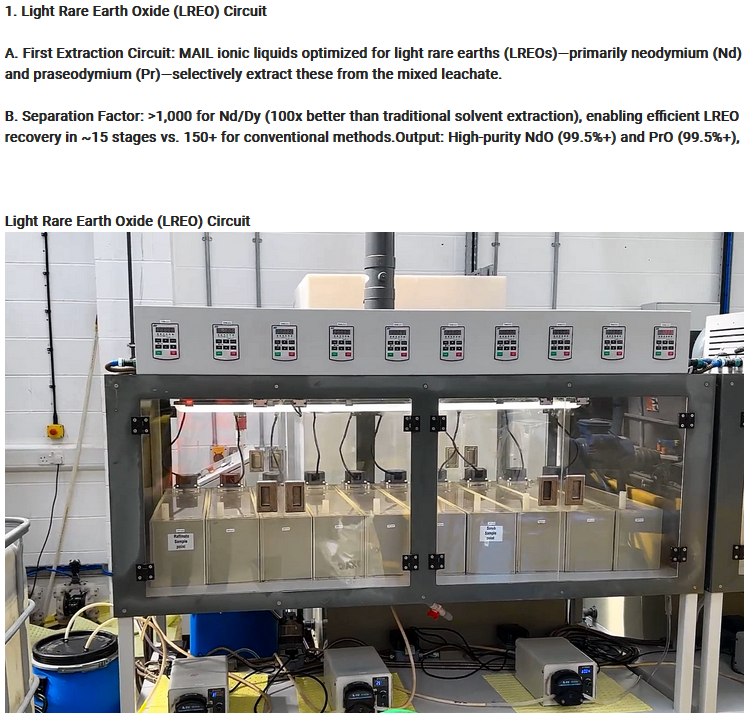
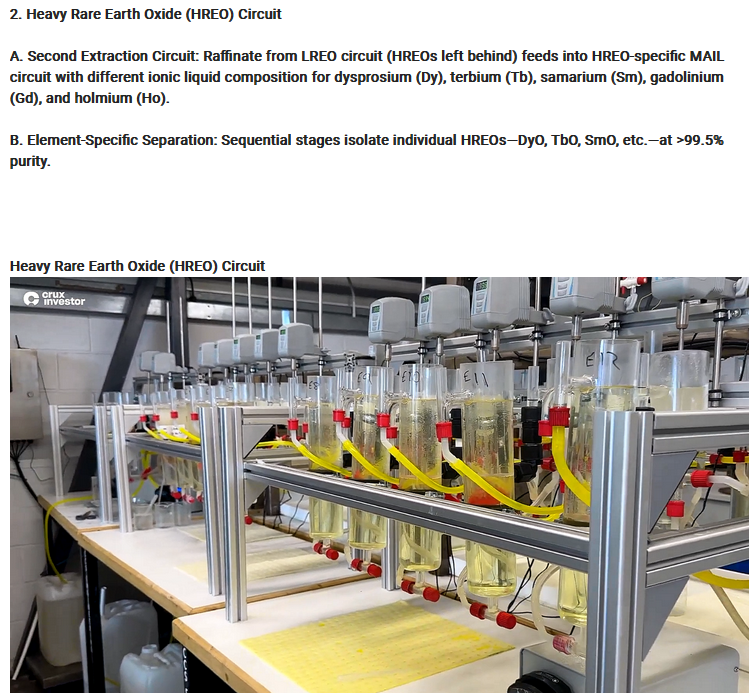
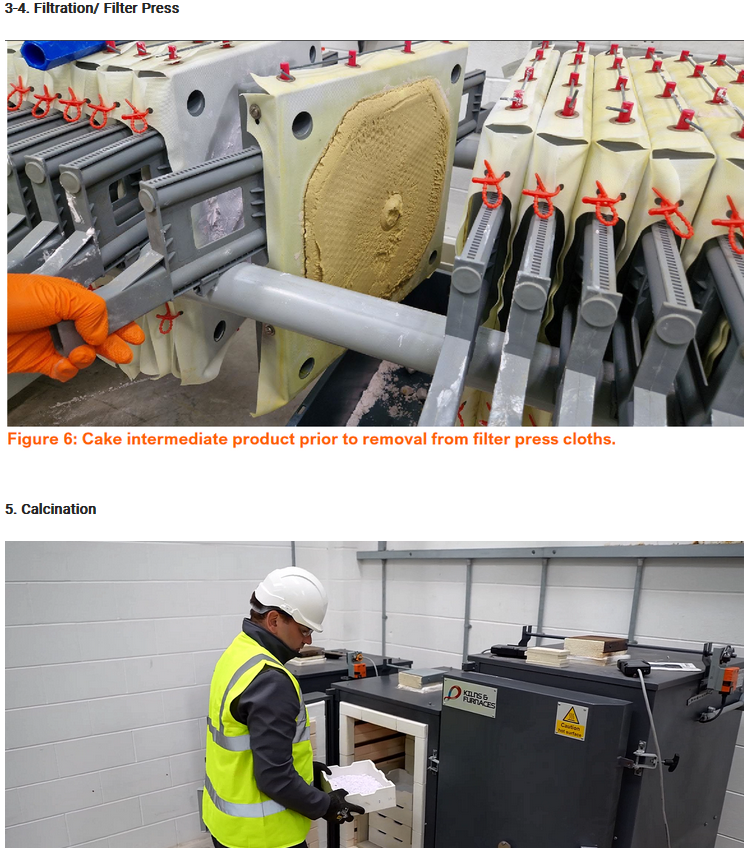
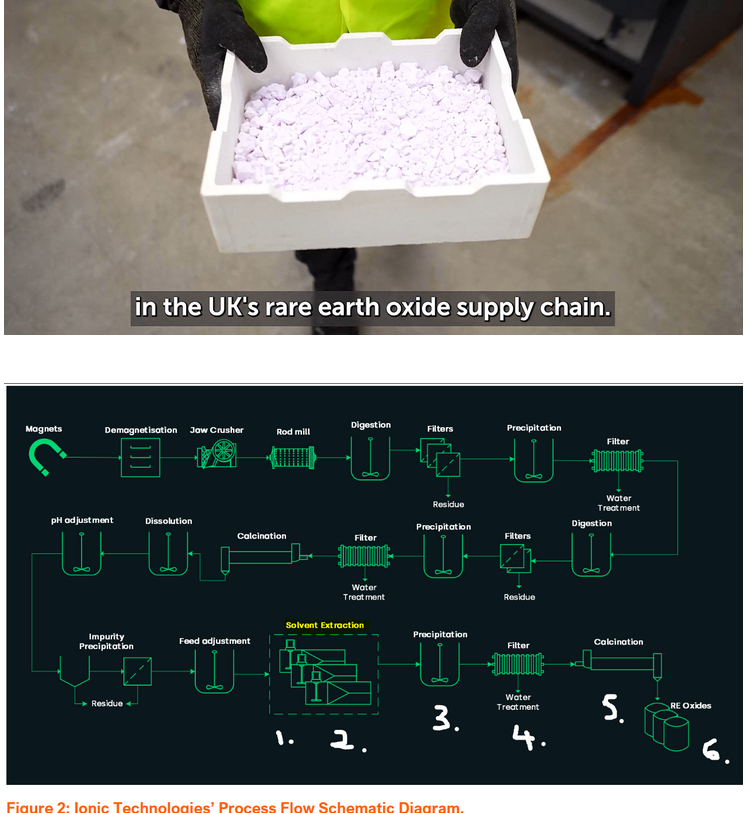
2
2
7
296

27 Dec 2025
USSM Strategic Partners: Why IXR Chose This Platform
PART TWO
IXR’s Belfast Technology: Dropping Straight into Missouri
Core message: Already Posted a few times
IXR now has a path to lift its Ionic Technologies Belfast demonstration plant flow sheet – including the multifunctional amide ionic liquid separation IP – straight into a U.S. brownfield site, funded primarily by U.S. and bilateral programs, not by heavy IXR dilution.
Key bullets:
1. Belfast demo plant is de‑risked, not R&D
Belfast magnet recycling demonstration plant has been running 24/7 since early 2024, processing ~30 tpa of waste magnets into separated NdPr, Dy, Tb and other REOs – first recycled separated magnet REOs in the Western world.
2. Transferable kit IP
The hydromet/solvent‑extraction equipment is modular and designed for a brownfield setting (Belfast harbour); the same modules and control philosophy can be scaled to USSM’s Fredericktown site. Multifunctional Amide Ionic Liquid Separation IP
IXR owns the multifunctional amide ionic liquid separation IP, which is the heart of the value – selective extraction of Nd, Pr, Dy, Tb from NdFeB/SmCo magnet scrap and MREC feeds.
3. Funding logic: U.S.–Australia Framework first, USSM capital second
The MoU explicitly links the Missouri project to the U.S.–Australia critical minerals cooperative framework, opening doors to DOE, DPA Title III and framework‑branded grants or concessional loans for ex‑China magnet recycling.
rareearthexchanges.com/news/…
IXR’s recent A$15.6m equity raise gives it the match equity and engineering bandwidth to front‑end studies and applications, so government money can cover 50–70% of the Missouri capex rather than IXR issuing large amounts of new shares.
USSM’s role in this structure: provide site, utilities, permits and operational integration, rather than writing most of the cheques for the magnet‑recycling circuit.
appiancapitaladvisory.com/ap…
4. What it means for IXR shareholders
More of the capex is paid for by federal and bilateral programs plus structured partner capital (Appian/Glencore style), so IXR keeps a larger economic slice of a U.S. magnet‑recycling JV.
discoveryalert.com.au/ionic-…
U.S. assets with proven technology and defense‑linked rare earth output typically trade at 3–5× the multiples of similar Australian‑listed developers; moving the Belfast flowsheet into Missouri under the new framework is effectively a valuation re‑rating engine for IXR.
Belfast has already proven IXR’s separation IP works; dropping that kit and know‑how into USSM’s permitted Missouri site – with U.S.–Australia, DOE/DPA and strategic‑partner funding ahead of pure IXR dilution – is how IXR turns a technical success into a much higher‑valued U.S. rare earth cash‑flow asset.
x.com/roblun1/status/1995425…
@IONIC_RE @IONICTECH_UK @timhorizonmet
@IXR2THAMOON @ReElementTech @ucore @LCM_Metals @CyclicMaterials @MPMaterials
@ReecycleInc @SolvayGroup @EMRmetal #VIRIDION @EU_Commission @ENERGY @VulcanElements
@RE_Exchanges @DiscoveryAlert @ChrisMcDonaldMP
@ussmetals @USRareEarths @DeptofWar @ENERGY
#ATF #APC #NWF #UKEF #BBB #NetZero #EnergySecurity @Ford @BentleyMotors @Wright_bus
@LynasRareEarths @MPMaterials @Metallium_MTM
#IXR #IonicRareEarths #IonicTechnologies #LiquidLiquidExtraction #SolventExtraction #LLE #MAIL #RareEarths #MagnetRecycling
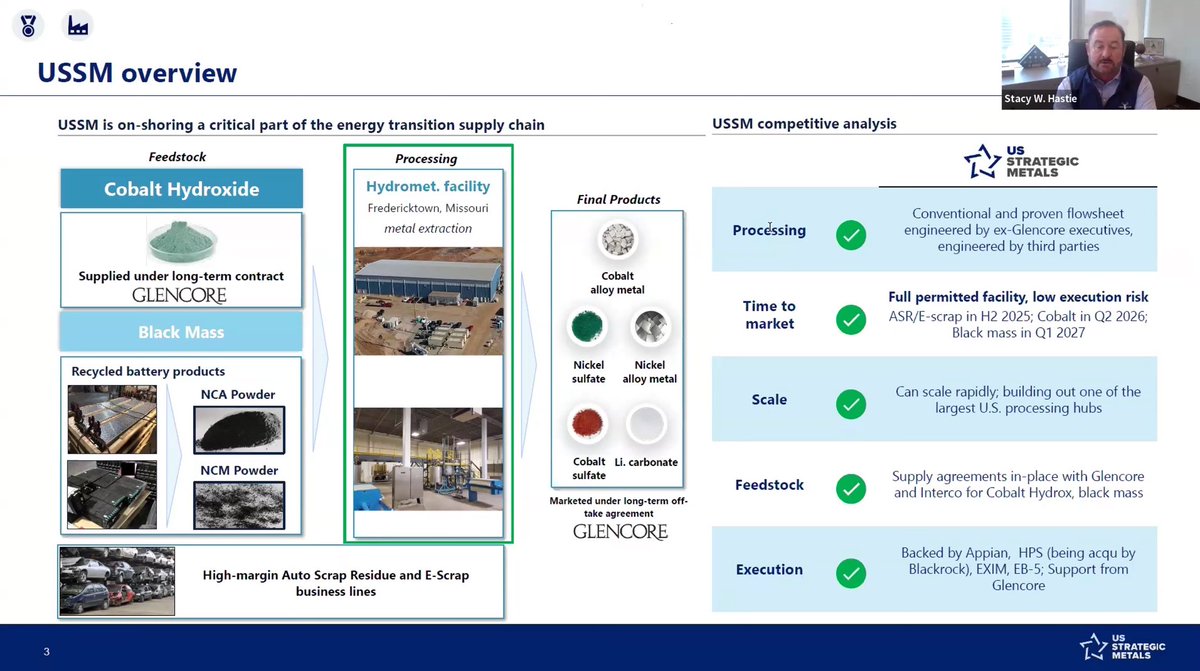
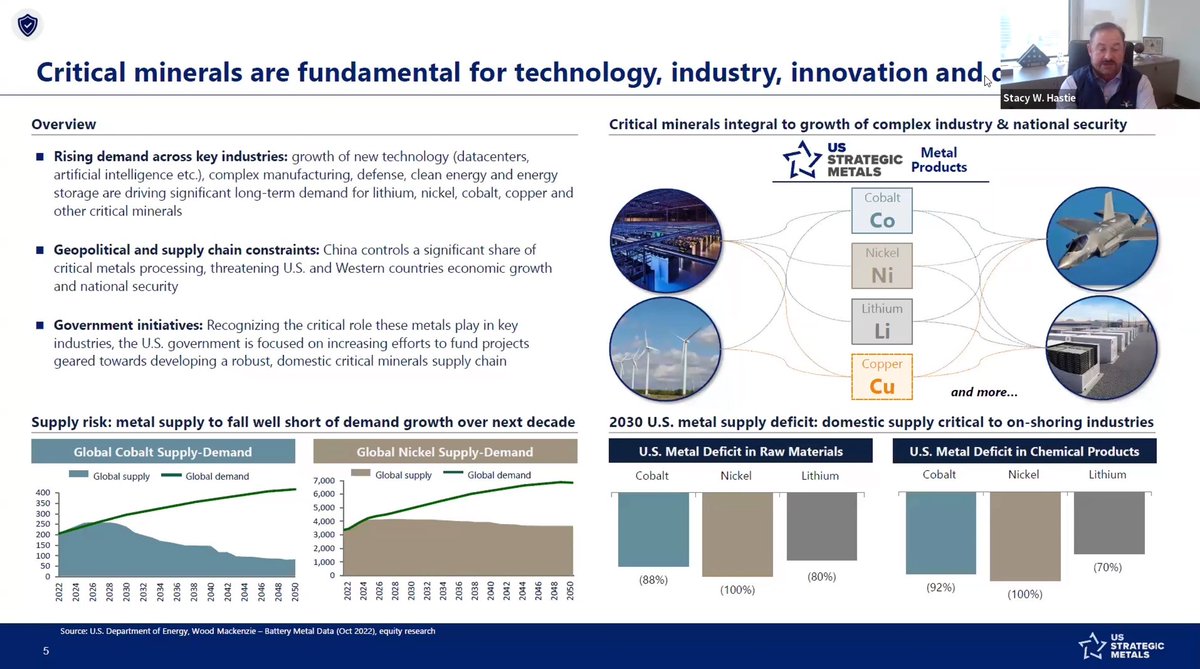
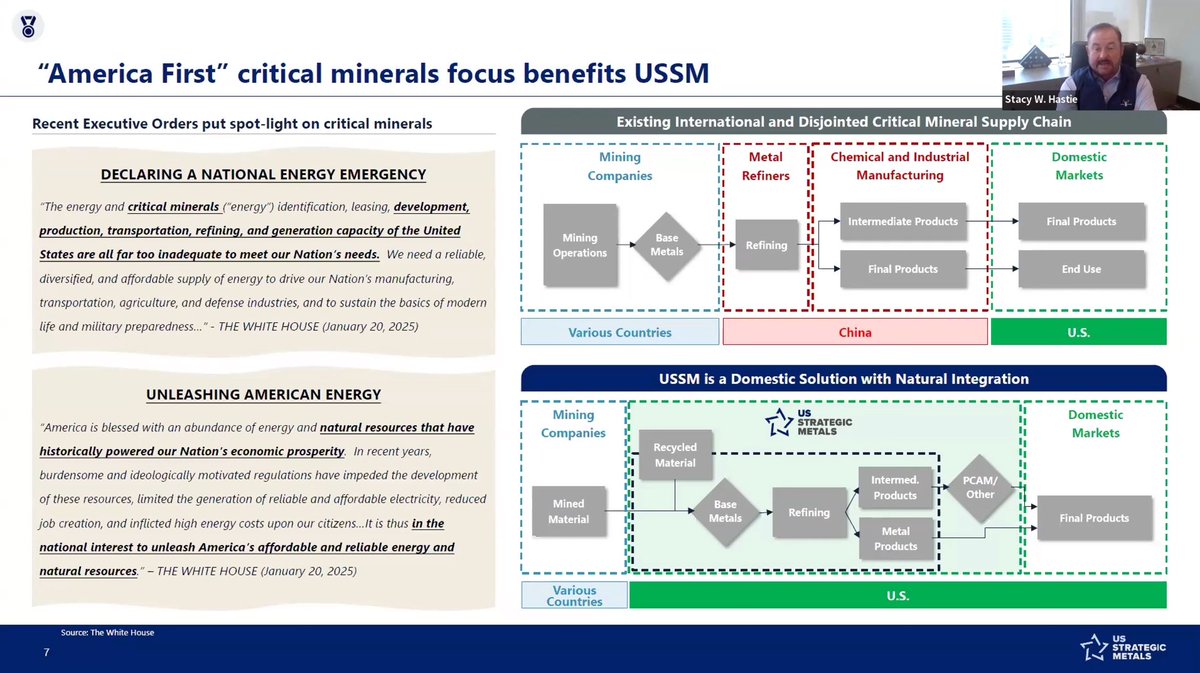
1 Dec 2025
From what I'm hearing from the AGM, USSM is a private company so it has zero statutory disclosure requirements to the public, as a private company, USSM can be strategic and selective about what it discloses.
IXR's AGM inadvertently confirmed what market participants had suspected, and the same goes for me is that IXR has secured a transformational US partnership that operationalizes its global magnet recycling strategy and validates Ionic Technologies' technology at commercial scale within the world's largest economy. 🏭⚙️
As posted previously on X, IMHO the most important strategic part is USSM’s Fredericktown site is 1,800 acres and 100% fully permitted for multi-metallic operations (mining, concentrating, hydrometallurgical processing, recycling).
For IXR, this means no greenfield mine/permitting risk for the U.S. magnet‑recycling plant:
🏭 Greenfield Competitors' Timeline:
Land acquisition (1yr) → Environmental studies (2yr) → Permitting (3-4yr) → Construction (2yr) = 8 YEARS ❌
Construction can begin immediately: eliminates the multi-year wait that greenfield US projects face for state, federal, and EPA/Army Corps sign-off.
No land acquisition costs, No permitting expenses, No environmental studies, shared infrastructure (utilities, tailings, water treatment) with USSM cobalt operations, Ionic Technologies MAIl IP Separation wouldn't have those issue, mostly all recyclable, IXR, focus capital on equipment/technology rather than regulatory compliance and Brownfield advantage (remediation complete; EPA approval), all we need to do is Retro Fit the Facility 🏭⏱️🇺🇸
IMHO summary is on point: the real edge is that IXR can retrofit its Belfast‑style Multifunctional Amide Ionic Liquid Separation plant into a fully permitted, multi‑metallic brownfield complex in Missouri, bypassing the time, cost and risk that cripple most greenfield U.S. rare‑earth projects and turning IXR’s scarce separation IP into a rapidly scalable, funding‑attractive U.S. asset.
The Technology (IXR) is the software, but the Fredericktown Site (USSM) is the hardware.
IXR has the "engine" (MAIL Tech) but no "car" (U.S. Site). USSM has the "car" (Permitted Site) but needs the "engine" (REO separation) to unlock the full value of their facility.
The Strategic Summary:
By "retrofitting" modular tech into a fully permitted brownfield site, IXR bypasses the #1 risk in U.S. mining (Permitting) and the #1 cost driver (Infrastructure Construction).
🔧 Why It Works: Modular "Skid-Mounted" Tech
Belfast facility photos show Ionic's MAIL process = compact, modular units (mixer-settlers, filter presses, tanks) = forklifted into existing USSM warehouses, not built from scratch.
USSM provides the regulatory shield, and IXR provides the technical weapon. Together, they can be operational in 18 months, while everyone else is still filling out paperwork. 🚀
💰 Capital Efficiency Breakthrough:
Typical Refinery: 30% civil 25% buildings 20% utilities 25% equipment
USSM Retrofit: 0% civil minimal buildings minimal utilities 100% equipment focus = MASSIVE capex savings 💯
USSM/IXR Retrofit Timeline:
✅ Permitting: DONE
✅ Infrastructure: DONE
✅ Retrofit equipment: 12-18 months
= PRODUCTION BY 2027 🎯
@IONIC_RE @IONICTECH_UK @timhorizonmet
@Viridis_VMM @IXR2THAMOON @LCM_UK
@VulcanElements @RE_Exchanges @DiscoveryAlert
@ChrisMcDonaldMP @ussmetals #NdPr #DyTb @MPMaterials @CyclicMaterials @USRareEarths
@LynasRareEarths @ReElementTech @ucore
@USARareEarth @Perran4CRH
#IXR #USSM #RareEarths #CriticalMinerals #MagnetMetals #Defense #BrownfieldAdvantage #MailTechnology #USASupplyChain #EnergyTransition 🚀 #Pentagon2027 #Brownfield #Retrofit #CriticalMinerals #DefenseSupply #MagnetMetals #SupplyChain #ASX:IXR #GeopoliticalArbitrage #TimingIsEverything 🚀🇦🇺🇺🇸 #NotTheJVStructure #TheRealStory
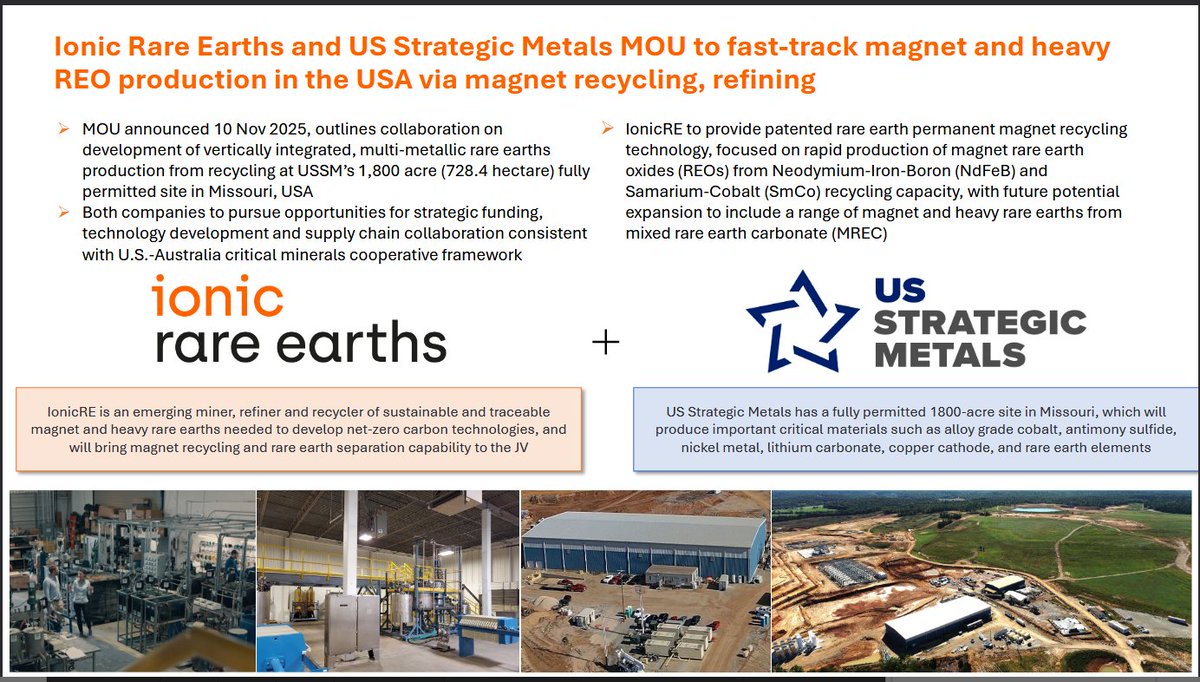
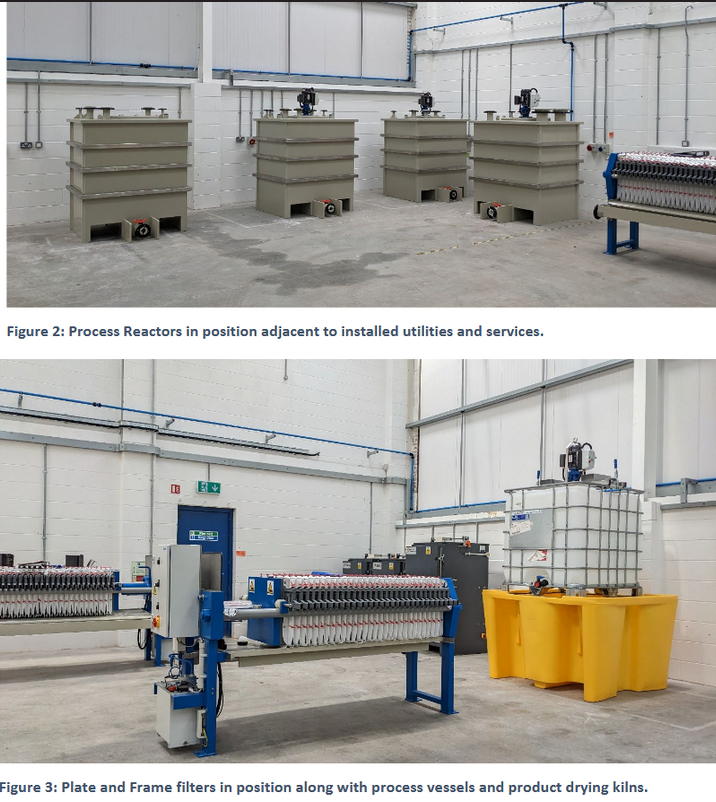
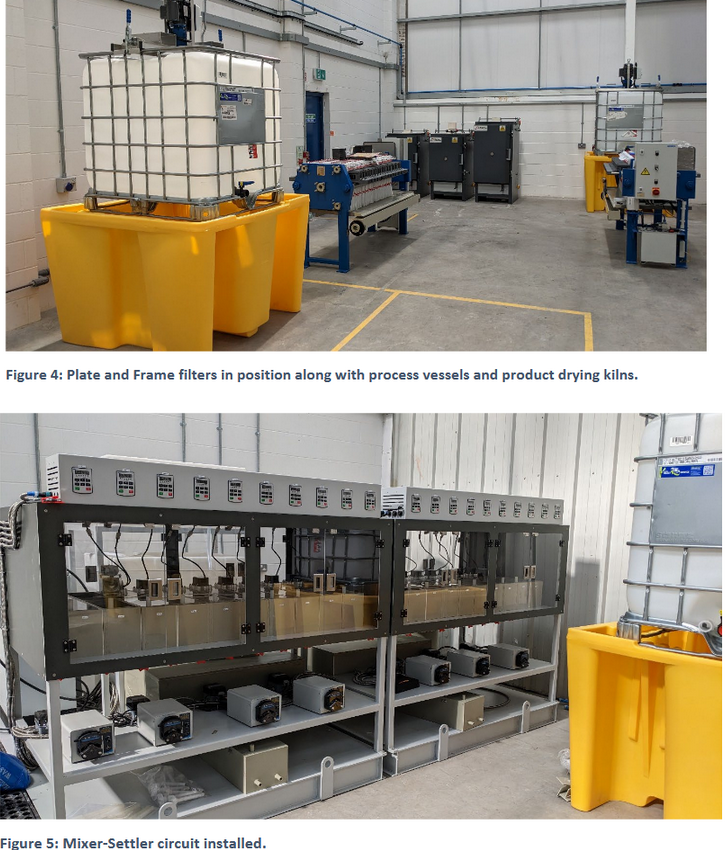
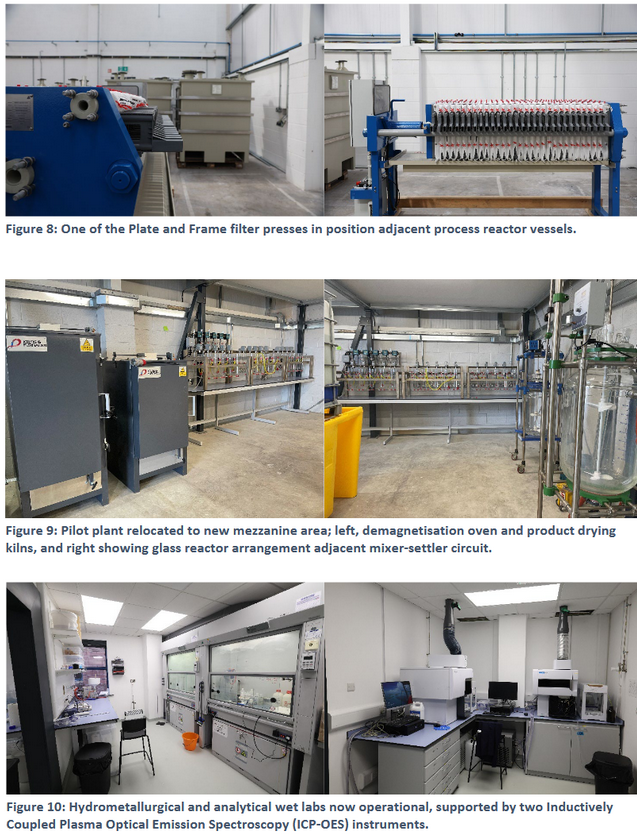
1
11
286
27 Dec 2025
USSM Strategic Partners: Why IXR Chose This Platform
PART ONE
Core message:
IXR should use USSM’s partner ecosystem (Appian, LCR/EB‑5, BlackRock/HPS, Kapmar/Nick Papovic, Glencore, Interco) for permitting, site, feedstock and offtake, while targeting U.S.–Australia Framework and federal programs as the main capex source.
Smart‑money capital stack (why this platform is de‑risked)
1. Appian Capital – US$230m senior credit royalty to finish mine, recycling and hydromet plant; Appian’s technical team has already diligenced the site and flowsheet.
2. HPS → BlackRock – prior US$120m financing and board representation; when BlackRock acquires a lender and leaves its founder on USSM’s board, that’s strong institutional validation.
3. Kapmar AG / Nick Papovic – ~US$23m equity plus technical advisory from one of Glencore’s most experienced market strategists (ex‑Glencore).
LCR Capital Partners
LCR’s current EB-5 project US Strategic Metals (USSM) is at the forefront of strengthening America’s critical minerals supply chain.
With Phase I of its refinery complete and Phase II well underway, USSM is expanding its capacity to process and recycle battery-grade minerals like cobalt, nickel, lithium and copper. The project plays a key role in advancing US national security and reducing dependence on foreign sources.
Located in rural southeast Missouri, USSM is building a more ethical and sustainable future for advanced manufacturing in the United States. Learn more about this strategic EB-5 opportunity:
US Strategic Metals (USSM) is a USCIS-approved rural EB-5 project in the US national interest. Founded to address the nation’s need for critical mineral independence, USSM is building a critical minerals refinery in rural Missouri.
This facility will play a crucial role in processing critical minerals to support the domestic supply of consumer electronics and defense technologies, enhancing the economic and national security of the United States. Phase I of the project included environmental remediation of a historical mine site, permitting, and a pilot program. The current EB-5 loan is for Phase II, which is the building of a hydrometallurgical plant.
LCR’s rigorous project selection and underwriting processes ensure we partner only with developers who have long-standing track records of success and strong credit worthiness.
Why Is US Strategic Metals an Exceptional EB-5 Project?
1. USCIS-Approved EB-5 Rural Project in the US National Interest
This project qualifies as a rural EB-5 project, enabling EB-5 investors to benefit from priority processing and access to the 20% of visas reserved for investments in rural areas. Most important, the project’s documentation has been reviewed and designated as being of national interest to the United States. The project has already received I-956F and I-526E approvals.
2. A Domestic Supplier of Key Materials to a High-Growth Strategic Industry
USSM has a 99-year lease for the 1,800-acre site, providing ample space to build the hydrometallurgical plant and expand refinery operations in the future at a single site in Fredericktown, Missouri.
The site also has a historical underground mine that will service future phases of USSM’s operations. The mine has an estimated expected life of 17 years and includes deposits of cobalt, nickel, and copper. Critical minerals are key inputs into various industries, including national defense applications and electric vehicle manufacturing, which is growing exponentially in the United States.
3. Planning and Pilots
USSM has been testing and piloting critical minerals processes at its St. Louis-based demonstration facility since 2019, using advanced hydrometallurgical processing to maximize efficiency and sustainability. A key advantage of USSM’s business plan is the Fredericktown, Missouri site, which boasts 1,800 acres of land ready for redevelopment.
The site was a historical lead mine that required significant environmental remediation due to operations prior to USSM’s involvement. USSM and its affiliates have completed the remediation in conjunction with the EPA Superfund program and received all necessary environmental permits to build the hydrometallurgical plant. Construction is already well underway on Phase II of the project.
4. Experienced Management and Established Partners
Glencore, a key investor and partner, has agreed to 100% offtake (purchase of all of the refinery’s future production), reinforcing the critical role of USSM’s refinery in supplying essential critical minerals to the market.
USSM is in negotiations with Glencore to supply feedstock for the hydrometallurgical plant and management anticipates completing this contract in 2025. The USSM board is “public company ready,” with top-tier management and a deep bench of talent across operations.
In addition, USSM raised $230 million from Appian Capital Partners, a leading investment advisor in the metals and mining industry with global experience across South America, North America, Australia, and Africa.
Offtake, feedstock and logistics – Glencore and Interco
1. Glencore already has 100% offtake on USSM battery‑metals output and is negotiating further feedstock supply; the same global trading network can place IXR’s NdPr/Dy/Tb oxides into magnet makers and defense supply chains.
2. Interco, a large “metaltronics” recycler 2 miles from USSM, supplies thousands of tonnes per month of black mass and scrap; that physical recycling footprint is a natural feed source for magnet and MREC‑based rare earth recycling.
lcrcapital.com/projects-fund…
@IONIC_RE @IONICTECH_UK @timhorizonmet
@IXR2THAMOON @ReElementTech @ucore @LCM_Metals @CyclicMaterials @MPMaterials
@ReecycleInc @SolvayGroup @EMRmetal #VIRIDION @EU_Commission @ENERGY @VulcanElements
@RE_Exchanges @DiscoveryAlert @ChrisMcDonaldMP
@ussmetals @USRareEarths @DeptofWar @ENERGY
#ATF #APC #NWF #UKEF #BBB #NetZero #EnergySecurity @Ford @BentleyMotors @Wright_bus
@LynasRareEarths @MPMaterials @Metallium_MTM
#IXR #IonicRareEarths #IonicTechnologies #LiquidLiquidExtraction #SolventExtraction #LLE #MAIL #RareEarths #MagnetRecycling #ChemicalEngineering #ProcessEngineering #SupplyChain #CriticalMinerals #Technology #InvestmentThesis #CleanTech #MixerSettler #Dy #Tb #Nd #REE #RareEarthElements #Ford #Bentley #DRIVE35 #Belfast #UK #SolventExtractionEquipment #IndustrialChemistry 🚀
6
327
27 Dec 2025
Rare earths are increasingly behaving like the new oil: highly concentrated, geopolitically weaponised, and indispensable for everything from EVs to missiles
Are Rare Earths the New Oil?
Rare Earth Elements (REEs) are the silent engine behind our modern world. From the iPhone in your pocket to the F-35 fighter jet and the wind turbines powering our grid—they all depend on these 17 critical elements.
Recent geopolitical tensions have exposed a fragile supply chain. Here is the breakdown of the new "Great Game" for resources. 🧵👇
China refines ~85% of the world’s rare earths and produces ~90% of rare‑earth magnets, with 44 Mt of reserves. When Beijing tightened export controls in April 2025, European dysprosium and terbium prices almost tripled in weeks, halting production lines and exposing just how vulnerable global supply chains are.
Outside China, the main reserves are Brazil (21 Mt), India (6.9 Mt), Australia (5.7 Mt), Russia (3.8 Mt), Vietnam (3.5 Mt), the US (1.9 Mt, mainly Mountain Pass), and Greenland (1.5 Mt), with smaller deposits in the UK. Yet most of this ore still ends up being processed in China, where over 99% of high‑temperature magnet refining capacity sits.
The global REE market was about US$3.39B in 2023 and is forecast to reach US$8.14B by 2032 at ~10% CAGR, driven by EVs, wind, electronics and defence. Heavy REEs such as dysprosium are expected to see the steepest price pressure, with long‑term forecasts pointing to multiples of today’s prices as magnet demand keeps rising while Chinese policy remains unpredictable.
Governments are now treating REEs like strategic energy:
🇺🇸 Tariffs on Chinese magnets, defence‑funded projects and new domestic refining push to cut dependence.
🇪🇺 The Critical Raw Materials Act and new stockpiling schemes aim to source at least 15% of strategic raw materials like REEs from within the bloc by 2030.
If rare earths are the new oil, the playbook is clear:
1️⃣ Diversify mining and refining away from a single country.
2️⃣ Recycle magnets and batteries at scale to close the loop.
3️⃣ Collaborate via U.S.–allied frameworks (U.S.–Australia, EU partnerships) to co‑fund new plants.
4️⃣ Innovate in substitution and efficiency, so every kilogram of Nd, Dy, Tb and friends does more work.
The "Vitamins" of Modern Tech
Just small amounts of these elements define performance:
🧲 Neodymium (Nd): The muscle. Powers the strongest magnets in EVs and wind turbines.
🔥 Dysprosium (Dy): The heat shield. Allows magnets to work at high temps in EV motors.
💡 Terbium (Tb): The display. Essential for green phosphors in screens & sonar.
📡 Yttrium (Y): The targeting. Critical for laser targeting & medical imaging.
📱 Who is Exposed? (The "Whales")
Supply shocks aren't theoretical—they hit the bottom line of the world's biggest companies:
🍎 Apple: Needs Neodymium & Dysprosium for Taptic engines/speakers. Shortages = delayed iPhones.
🚗 Tesla & GM: EV motors rely on Neodymium permanent magnets. No magnets = no Cybertrucks or Lyriqs.
🛡️ Raytheon: Missiles & radar systems need Terbium & Samarium. Supply risk = national security risk.
💰 Economic Stakes & "Sticker Shock"
The REE market is projected to more than double from $3.39B (2023) to $8.14B by 2032 (CAGR 10.2%).
⚠️ Warning: Shortages could drive prices of critical elements like Dysprosium up by 450% by 2034.
🏭 The Supply Chain Bottleneck
It's not just about digging dirt. The real choke point is Processing.
Mining ⛏️ ➡️ Refining 🧪 ➡️ Magnet/Alloy Mfg 🧲➡️ End Use 🚗
🛡️ The Policy Response
Governments are waking up:
🇺🇸 USA: Tariffs on magnets & investing in domestic processing.
🇪🇺 EU: Critical Raw Materials Act to secure supply.
♻️ The Strategy: Diversify sources, invest in recycling (urban mining), and R&D for alternatives
Rare earths are the new oil—but harder to replace. Control over the REE supply chain will define economic and military dominance for the next century.
@IONIC_RE @IONICTECH_UK @timhorizonmet
@IXR2THAMOON @ReElementTech @ucore @LCM_Metals @CyclicMaterials @MPMaterials
@ReecycleInc @SolvayGroup @EMRmetal #VIRIDION @EU_Commission @ENERGY @VulcanElements @RE_Exchanges @DiscoveryAlert @ChrisMcDonaldMP
@ussmetals @USRareEarths @DeptofWar @ENERGY
#ATF #APC #NWF #UKEF #BBB #NetZero #EnergySecurity @Ford @BentleyMotors @Wright_bus
@LynasRareEarths @MPMaterials @Metallium_MTM
#IXR #IonicRareEarths #IonicTechnologies #LiquidLiquidExtraction #SolventExtraction #LLE #MAIL #RareEarths #MagnetRecycling #ChemicalEngineering #ProcessEngineering #SupplyChain #CriticalMinerals #Technology #InvestmentThesis #CleanTech #MixerSettler #Dy #Tb #Nd #REE #RareEarthElements #Ford #Bentley #DRIVE35 #Belfast #UK #SolventExtractionEquipment #IndustrialChemistry 🚀 #Geopolitics #EVs #SupplyChain #NationalSecurity #Tech #Mining #Commodities
2
10
297
26 Dec 2025
USSM, Ionic partner on rare earth recycling
Missouri deal strengthens U.S.-Australia rare earth supply chain.
Deepening the U.S.-Australia critical minerals partnership, U.S. Strategic Metals LLC. (USSM) has entered a memorandum of understanding with Australia-based Ionic Rare Earths Ltd. to deploy advanced magnet recycling technology at its Missouri complex, establishing the groundwork for domestic rare earth oxide production and a sustainable, ex-China supply chain for America's defense and energy industries.
Once focused on mine site reclamation, USSM has since evolved into a vertically integrated platform positioned to advance domestic processing and recycling of critical and battery minerals.
Centered on a 1,800-acre (728.4-hectare) facility in Missouri, the company has drawn state and federal attention for its closed-loop approach to refining materials essential to national clean energy and defense supply chains, combining hydrometallurgical processing, battery recycling, and resource recovery under a single operation designed to reduce reliance on foreign supply and improve industrial resilience.
As its operations mature, USSM has established a network of partnerships advancing its domestic processing and recycling model:
As its operations mature, USSM has established a network of partnerships advancing its domestic processing and recycling model:
• A three-way agreement with Glencore plc and Chilean Cobalt Corp., focusing on downstream U.S. processing of cobalt and copper intermediate feeds from Chile.
• A memorandum with Stillwater Critical Minerals Corp., formalizing cooperation on marketing, logistics, and technical support for future production streams.
• A partnership with AlphaSierra One Inc., broadening its reach across extraction, processing, and distribution capabilities.
• A collaboration with Missouri University of Science and Technology to expand into federally backed research initiatives focused on test-bed facilities for next-generation materials processing and metallurgical innovation.
In step with its expanding network of alliances, USSM has entered a memorandum of understanding with Ionic Rare Earths to deploy the Australian company's patented magnet recycling process at the Madison mine and processing facility in Fredericktown, Missouri, establishing the foundation for commercial-scale recovery of neodymium, praseodymium, and heavy rare earths such as dysprosium and terbium – elements currently restricted under Chinese export controls – and advancing shared U.S.-Australian efforts to secure resilient supply chains for defense, clean energy, and advanced manufacturing.
"This partnership aligns with our vision to be a key leader in the establishment of new supply chains for critical minerals and heavy rare earths," said U.S. Strategic Metals CEO Stacy Hastie. "US Strategic Metals' processing and refining capabilities in Missouri are designed to meet America's demand while collaborating with partners dedicated to responsible, secure, and sustainable sourcing. Working with IonicRE, we intend to accelerate technological progress and financial collaborations that will shape the future framework of domestic critical mineral supply chains."
Under the agreement, Ionic's technology will be deployed at Fredericktown to produce separated rare earth oxides from end-of-life neodymium-iron-boron and samarium-cobalt magnets, as well as manufacturing scrap, with planned expansion to process mixed rare earth carbonate feedstocks from strategic sources, and to evaluate additional heavy rare earth recycling opportunities within the United States to be located at the Missouri site.
"This MOU is an important step forward in building a secure and sustainable ex-China rare earths supply chain in the United States, the world's biggest economy, also supporting the critical minerals framework recently agreed by both the Australian and U.S. governments," said Ionic Rare Earths Executive Chairman Brett Lynch. "There's no bigger market than the United States, and we are delighted to partner with USSM in delivering rare earth permanent magnet supply in Missouri, with potential for multiple recycling plants across the United States as part of our global expansion."
Positioning the collaboration within a broader geopolitical framework, the agreement complements the U.S.-Australia Framework for Securing of Supply in the Mining and Processing of Critical Minerals and Rare Earths, signed Oct. 20 by President Donald Trump and Prime Minister Anthony Albanese.
Under this alliance, both nations committed at least $1 billion toward a $8.5 billion pipeline of qualifying projects, establishing a coordinated platform for mining, separation, and processing ventures that reinforce allied control over strategic materials essential to defense and advanced manufacturing.
"Magnet recycling is the fastest and lowest-cost pathway to developing an ex-China rare earth supply chain in the United States," said Ionic Rare Earths Managing Director Tim Harrison. "IonicRE is leading this charge in this area, and we now look to replicate the capability we have demonstrated in the UK now in the USA to provide a key strategic supply of magnet and heavy rare earths into the USA supply chain. Now is the time to accelerate this technology, which we are capable of building globally to offer a resilient supply of high purity, separated REOs, delivered on a sustainable basis thanks to our proven low-emission technology."
$8.5 billion framework leverages America's industrial demand, stockpiling infrastructure, and Australia's critical mineral reserves.
Seeking to loosen China's grip on global critical-mineral supply chains and fortify mining at home, President Donald Trump and Prime Minister Anthony Albanese have signed an $8.5 billion US-Australia Critical Minerals Framework.
"Today's agreement on critical minerals and rare earths is just taking it to the next level," Albanese said upon signing the pact at the White House on Oct. 20.
The agreement, which both administrations have been working on over the past five months, includes:
• A combined $3 billion in critical minerals investments in projects valued at more than $53 billion over the next six months.
• More than $2.2 billion of investments by the Export-Import Bank of the United States (EXIM) in seven advanced critical minerals and supply-chain security projects in the U.S. and Australia.
• A U.S. Department of War (formerly Department of Defense) investment into constructing a 100 metric-ton-per-year advanced gallium refinery in Western Australia.
In an Oct. 20 fact sheet, the White House characterized the framework that is designed to leverage America's industrial demand and stockpiling infrastructure and the critical minerals strategic reserve being established in Australia as "a model for supply-chain cooperation globally."
This model is expected to be further enhanced with a "Mining, Minerals and Metals Investment Ministerial" to be convened over the next six months to promote investments into the U.S. and Australian mining industries.
"This swift injection of capital marks a decisive push to fast-track project development and secure the minerals that will power the next generation of defense technologies," Gracelin Baskaran, director of the Critical Minerals Security Program at the Center for Strategic and International Studies (CSIS), said during an interview published by the Washington, D.C.-based advisory firm.
Accelerating supply chains
In addition to injecting billions of dollars into the U.S. and Australian mining and mineral processing sectors, the framework signed by Trump and Albanese will establish mechanisms to insulate the critical mineral supply chains they are building from price manipulation.
"The United States and Australia plan to collaborate on creating standards-based trading systems that allow participating countries to trade freely within a stable pricing framework, including mechanisms such as price floors," Baskaran said in response to a question posed by Kessarin Horvath, manager of the Critical Minerals Security Program at CSIS. "They have also pledged to work with international partners to design a global framework to address pricing distortions in mineral markets."
These price stabilization instruments are being designed specifically to prevent China from using its near-monopolistic control over critical mineral supply chains to drive prices down to a point where projects in the U.S. and China become uneconomic and fail – a tactic previously used to maintain dominance over global resource markets.
Albanese and Trump have also agreed to establish a U.S.-Australia Critical Minerals Supply Security Response Group. To be led by the U.S. Secretary of Energy and the Australian Minister for Resources, this group will be charged with identifying priority minerals and supply vulnerabilities, and developing a coordinated plan to accelerate their delivery into the combined U.S.-Australia supply chains being developed under the framework.
To further accelerate and enhance critical mineral supply chains in Australia and the U.S., the framework also calls for:
• Accelerating, streamlining, or deregulating permitting timelines and processes for critical minerals and rare earths mining, separation, and processing, consistent with applicable law.
• Developing new or strengthening existing authorities and diplomatic tools that review and deter critical minerals and rare earths asset sales on national security grounds.
• Investing in minerals recycling technology and working together to ensure management of critical minerals and rare earth scrap that supports supply chain diversification.
• Cooperating to assist in mapping mineral resources in Australia, the U.S., and elsewhere to support diversified critical mineral supply chains.
metaltechnews.com/story/2025…
metaltechnews.com/story/2025…
@IONIC_RE @IONICTECH_UK @timhorizonmet
@IXR2THAMOON @ReElementTech @ucore @LCM_Metals @CyclicMaterials @MPMaterials
@ReecycleInc @SolvayGroup @EMRmetal #VIRIDION @EU_Commission @ENERGY @VulcanElements @RE_Exchanges @DiscoveryAlert @ChrisMcDonaldMP
@ussmetals @USRareEarths @DeptofWar @ENERGY
#ATF #APC #NWF #UKEF #BBB #NetZero #EnergySecurity @Ford @BentleyMotors @Wright_bus
@LynasRareEarths @MPMaterials @Metallium_MTM
#IXR #IonicRareEarths #IonicTechnologies #LiquidLiquidExtraction #SolventExtraction #LLE #MAIL #RareEarths #MagnetRecycling #ChemicalEngineering #ProcessEngineering #SupplyChain #CriticalMinerals #Technology #InvestmentThesis #CleanTech #MixerSettler #Dy #Tb #Nd #REE #RareEarthElements #Ford #Bentley #DRIVE35 #Belfast #UK #SolventExtractionEquipment #IndustrialChemistry 🚀
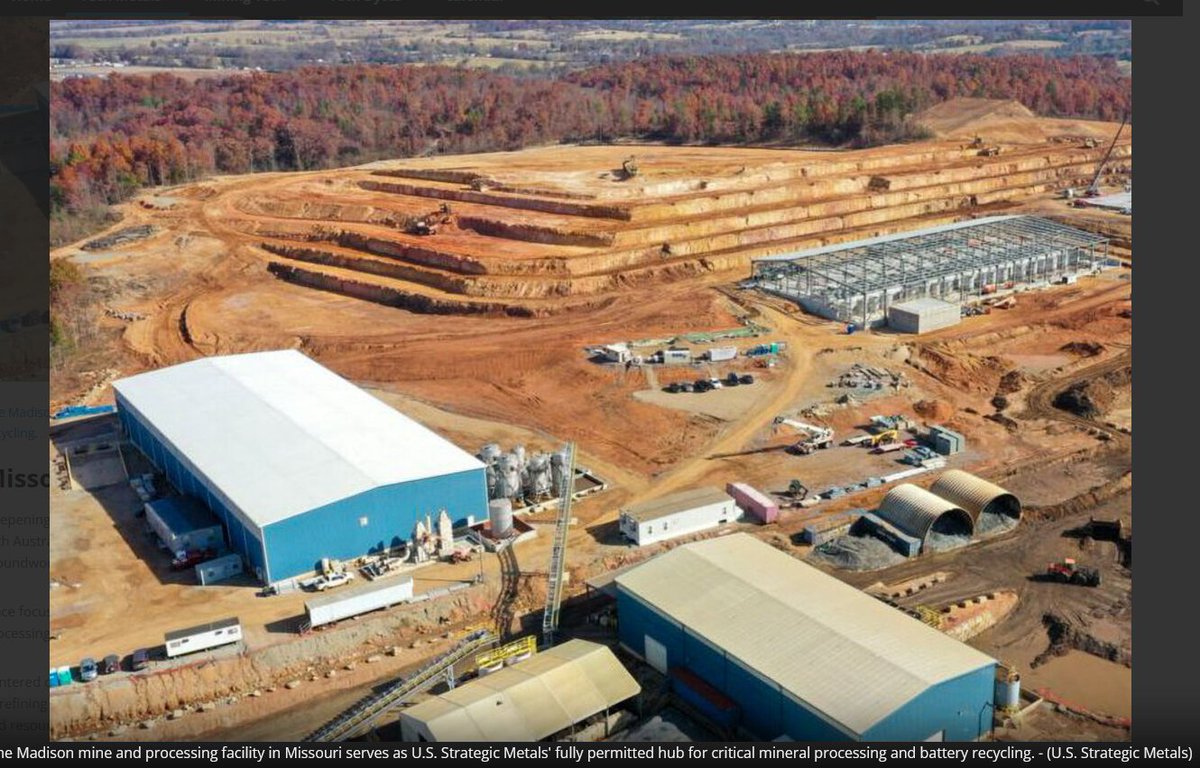
1
5
13
331
25 Dec 2025
The tiny British company that outsmarted Xi Jinping
Less Common Metals kept supplies flowing to customers in defiance of Beijing’s crackdown
PART TWO
Matt Oliver, Industry Editor.
24th December 2025
Since the 1980s, China has come to dominate rare earths, partly through state subsidies lavished on the sector that mean its companies can produce metals and magnets at rock-bottom prices.
But this dominance is what left Western companies so exposed this year when Beijing announced sweeping export controls over certain rare earth elements in April and then again in October, when the restrictions were expanded even further.
Earlier this year, trade bodies representing car giants such as General Motors, Toyota and Volkswagen warned that they risked being unable to produce key components such as transmissions, motors and seatbelts because of the restrictions.
Though much attention has been focused on mining and magnet production in the West, LCM occupies the vital but sometimes-overlooked stage in the process known as the midstream.
This involves mixing raw minerals and processed metals to make alloys, using specialist furnaces.
It is technically demanding and energy-intensive work – and LCM itself has struggled to survive at times.
“We’re very proud of what we do here,” says Smith, gesturing to a large furnace behind him known by workers as “Big Blue”.
“We have survived, which is quite an achievement in itself because a lot of other people got knocked out."
“Our Chinese colleagues produce a very, very good product, they have scale that we don’t have, and they certainly have lower energy costs.”
Now, European and American officials are starting to pay attention to the importance of rare earths.
In the past year, the US government – often through the Pentagon – has struck a series of deals to support domestic production of rare earths as well as magnets. It has issued loans, given minimum price guarantees and in some cases even taken equity in companies.
For example, the Trump administration announced in November that it was making a $50m (£37m) investment in rare earth magnet maker Vulcan Elements.
A few months earlier, the Pentagon announced a $400m investment in MP Materials – the owner of the only rare earths mine in the US.
LCM itself has also attracted American interest. In September, the company was taken over by USA Rare Earth in a $125m deal.
The announcement described the small British company as “the only proven ex-China producer of rare earth metal, alloys and strip casting at scale” and one of the few firms capable of using both mined and recycled feedstock.
Following the deal, LCM will supply neodymium iron boron metal and strip cast alloy to its new parent company’s magnet-making facility in Stillwater, Oklahoma.
“Our ambition is also to expand LCM’s capabilities in both the United Kingdom and Europe, supporting the broader ex-China industry with a wide range of defence and industrial applications,” said Michael Blitzer, USA Rare Earth’s chairman.
Smith says LCM is ready to expand capacity further and has received some funding from the UK government, which is half-funding new equipment that will be used to produce metals at Ellesmere Port, Cheshire.
However, he says ministers need to step up support for companies like his if they are serious about maintaining the ability to produce rare earth alloys without China.
He also suggests the UK take a leaf out of France’s book and allocate electricity price support based on objective criteria rather than “picking winners” through industrial strategy.
“They need to back the people who are doing this every day,” he says.
In a critical minerals strategy published earlier this year, ministers highlighted rare earth elements as a high priority for the UK because of their importance to future industries such as green energy.
The document predicts the UK will need between 34,200 and 41,700 tonnes of rare earths by 2035 to support traction motors for electric vehicles and wind turbines.
It also suggests the Ministry of Defence could stockpile key minerals to ensure there are supplies available in a crisis.
Labour’s Chris McDonald, the industry minister, insists the Government is now acting with a “sense of urgency” around critical minerals because of how essential they are.
“Less Common Metals is currently the only organisation in the whole of the Western world that can provide the rare earth elements for F-35 fighter jets,” he says.
“And that’s not just for the US, it’s for everyone who’s got an F-35. So clearly the defence application is going to be important.
“But really, we need to scale that up. Less Common Metals are not the only people in the UK who’ve got technology that’s focused on magnets.
“We’ve got lots of technology options there – and the other part of the strategy was about that circular economy aspect, that circularity and maintaining the flow of metals within our own economy, too.”
For LCM’s Smith, China’s restrictions on rare earths may have offered vindication but it remains unclear whether the West will be ready in the future.
He is now working with partners to establish longer-term supplies for the future, including companies in Australia and a metal recycler in Northern Ireland.
Other supplies of rare earths could come online in Brazil, the US and Canada, he says.
Many expect China to keep squeezing – but an equal risk to the likes of LCM could come if Beijing reverses course and swamps the market again with cheaper alternatives, a move that would likely drive many businesses back into China’s arms.
“If the Chinese open the floodgates, it will be interesting to see what buyers do,” says Smith.
“We can’t know for sure – but I think enough people have had their fingers burnt.”
End
Conclusion
LCM is a critical downstream enabler that turns Ionic Technologies’ recycled rare earth oxides into defence‑ and EV‑grade magnet alloys, massively strengthening the strategic value of IXR’s technology and projects.
The "CirculaREEconomy" project slide, the relationship between Less Common Metals (LCM) and Ionic Technologies (IXR) is a critical strategic partnership that validates Ionic’s technology and potentially integrates it into top-tier Western defense and industrial supply chains.
The "Northern Ireland" Connection
The article explicitly states that LCM’s Grant Smith is working with partners to establish long-term supplies, including "a metal recycler in Northern Ireland."
1. The Insight: Ionic Technologies is based in Belfast, Northern Ireland, and is the project leader for the UK's magnet recycling initiative.
2. The Implication: This confirms that Ionic Technologies is the specific "recycler" LCM is relying on to secure a non-Chinese source of rare earth oxides (REOs). It moves Ionic from a "potential" supplier to an active strategic partner in the eyes of the West's most critical alloy producer.
What LCM actually does
1. Less Common Metals is one of the only Western producers of rare earth metals and strip‑cast alloys (NdFeB and SmCo), sitting in the midstream between oxide production and finished magnets.
2. It mixes refined rare earth feedstock in specialist furnaces to make high‑spec neodymium‑iron‑boron and samarium‑cobalt alloys used in EV motors, wind turbines and high‑temperature defence applications such as the F‑35.
How LCM links to Ionic Technologies
1.Ionic Technologies’ Belfast process produces high‑purity separated rare earth oxides from end‑of‑life magnets and scrap; LCM is the natural partner to metallise those oxides into NdPr, Dy, Tb metals and magnet alloys.
2. The MOU and joint UK projects (CLIMATES, REEValuate, CirculaREEconomy) explicitly combine Ionic’s hydrometallurgical recycling with LCM’s molten‑salt electrolysis and strip‑casting to create a closed‑loop, 100% recycled magnet route.
Why this matters for IXR’s strategic positioning
1. LCM has been described as the only proven ex‑China producer of rare earth metals and alloys at scale, and the only Western supplier capable of meeting F‑35 magnet alloy requirements, which makes it system‑critical for NATO defence supply chains.
2. By locking in LCM as its metallisation and alloy partner, Ionic/IXR is effectively tying its recycling IP into one of the most strategic non‑Chinese alloy platforms, lifting IXR from a “technology vendor” to a core part of sovereign mine‑to‑magnet solutions for the UK, US and allies.
Impact of the USA Rare Earth acquisition
1. USA Rare Earth’s 2025 acquisition of LCM folds that unique alloy capability into a larger mine‑to‑magnet group with Round Top (US) resources and an Oklahoma magnet plant.
For IXR, this potentially opens two scalable routes:
A. UK/Europe circular REE supply with Ionic Technologies LCM’s UK plant under government‑backed programmes like DRIVE35 and CirculaREEconomy.
B. Access to North American alloy and magnet capacity via LCM’s new US parent, if Ionic’s recycled oxides are qualified as feedstock. (Another option in the US and with USSM)
What it “means” in investment terms
Technically: LCM proves that Ionic’s recycled oxides can be turned into Tier‑1 alloys that meet EV and defence specs, de‑risking IXR’s flowsheet beyond the lab and into real industrial furnaces.
Commercially: it validates IXR’s business model as a supplier of critical recycled REO feedstock into the highest‑value segments of the market (EV drive units, offshore wind, defence), not just generic oxide sales.
Strategically: pairing Ionic Technologies with LCM gives IXR a seat at the table in sovereign critical‑mineral strategies for the UK and allies, exactly where governments are now directing long‑term, de‑risked capital and offtake support.
For Ionic Technologies, LCM is not just a partner; they are the bridge to commercial reality. LCM is the "customer" that proves Ionic's recycled oxides are viable for the world's most demanding applications (Defense & EVs).
The mention of the "Northern Ireland recycler" in the Telegraph article signals that this partnership is already central to the UK's strategy to outmaneuver China's rare earth chokehold.
🇬🇧 MAJOR NEWS: The UK Launches "Mine-to-Magnet" Revolution! ♻️🧲🚗
We are thrilled to announce the official launch of CirculaREEconomy — a groundbreaking £11m initiative to secure a sustainable, independent supply chain for Rare Earth Permanent Magnets (REPMs) in the UK! 🚀
Led by Ionic Technologies, this powerhouse consortium is closing the loop on critical minerals for the EV transition. 🌍⚡️
🤝 The Dream Team:
Powered by collaboration across the entire value chain:
🏭 Ionic Technologies (Lead & Recycling Tech)
🚘 Ford & Bentley Motors (OEM Validation)
🧪 Less Common Metals (Alloys & Metals)
🚌 Wrightbus (Commercial Transport)
🔄 EMR & British Geological Survey (Recovery & Lifecycle Analysis)
📉 The Challenge:
The world relies on Rare Earth Elements (REEs) for EV motors, but supply is volatile and geopolitically concentrated.
📈 The Solution:
We are building a domestic circular economy.
✅ Recovering REEs from end-of-life magnets & scrap.
✅ Refining them into 99.5% pure oxides.
✅ Manufacturing high-spec recycled magnets for next-gen EVs.
💰 Backed by Gov Support:
Part of the Dept for Business & Trade’s £2.5bn DRIVE35 programme, with £5.5m match-funding from the Advanced Propulsion Centre UK!
🌿 Why it matters:
🔹 Reduces reliance on imports (critical for security!)
🔹 Cuts CO2 emissions by ~61% vs mining
🔹 Anchors green tech manufacturing right here in the UK
From waste to watts — we are driving the Net Zero future! 🇬🇧🔋
@IONIC_RE @IONICTECH_UK @timhorizonmet
@IXR2THAMOON @ReElementTech @ucore
@LCM_Metals @CyclicMaterials @MPMaterials
@ReecycleInc @SolvayGroup @EMRmetal #VIRIDION @EU_Commission @ENERGY @VulcanElements
@RE_Exchanges @DiscoveryAlert @ChrisMcDonaldMP
@ussmetals @USRareEarths @DeptofWar @ENERGY
#ATF #APC #NWF #UKEF #BBB #NetZero #EnergySecurity @Ford @BentleyMotors
@Wright_bus @LynasRareEarths @MPMaterials
@Metallium_MTM #IXR #IonicRareEarths #IonicTechnologies #LiquidLiquidExtraction #SolventExtraction #LLE #MAIL #RareEarths #MagnetRecycling #ChemicalEngineering #ProcessEngineering #SupplyChain #CriticalMinerals #Technology #InvestmentThesis #CleanTech #MixerSettler #Dy #Tb #Nd #REE #RareEarthElements #Ford #Bentley #DRIVE35 #Belfast #UK #SolventExtractionEquipment #IndustrialChemistry 🚀
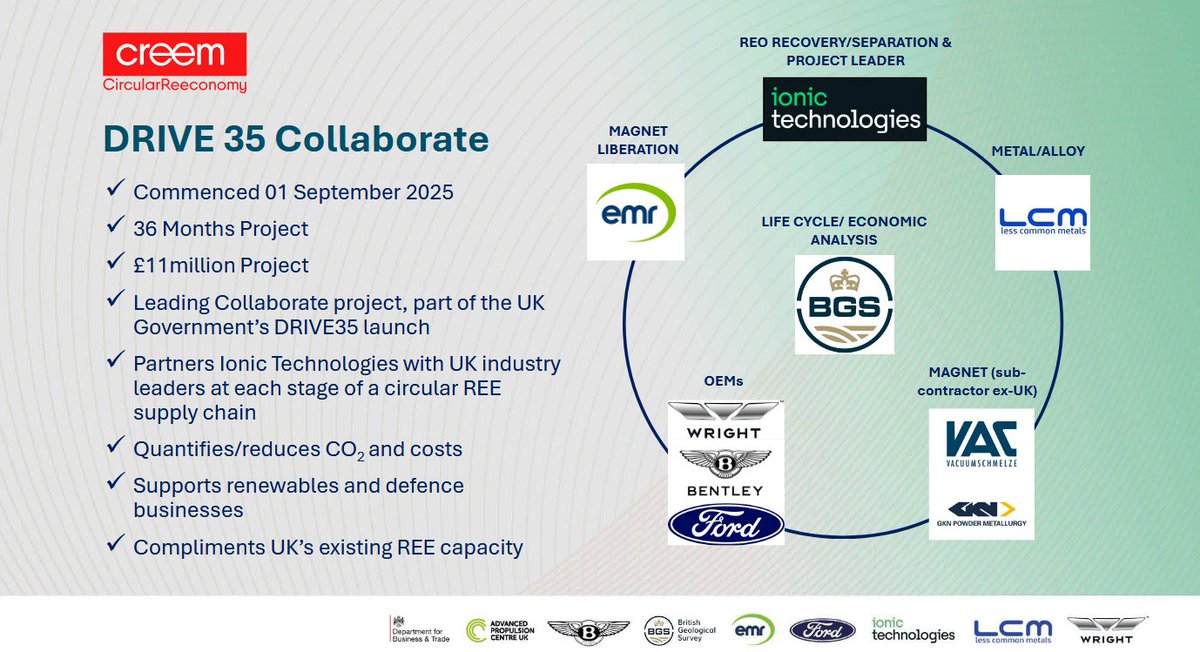

2
5
416
24 Dec 2025
The tiny British company that outsmarted Xi Jinping
Less Common Metals kept supplies flowing to customers in defiance of Beijing’s crackdown
PART ONE
Matt Oliver, Industry Editor.
24 December 2025
When China throttled exports of rare earth elements this year, American and European policymakers were thrown into a panic.
The metals are used to make magnets that power a plethora of everyday goods – such as computer chips and cars – as well as some of the West’s most sophisticated weapons, including the F-35 stealth jet and Tomahawk cruise missiles.
With China wielding a stranglehold over both magnet manufacturing and processing of critical minerals, its export controls threatened to bring Western production lines to a grinding halt.
Responding to the move, the US government accused Beijing of attempting a “global supply chain power grab”.
But one person who wasn’t panicking was Grant Smith, an Australian businessman.
In fact, his phone was soon ringing off the hook – because the tiny British company he owned, Less Common Metals (LCM), was suddenly one of the only Western producers of rare earth magnet alloys left outside of China.
That was the result of a years-long effort to develop alternative supplies, which saw mining veteran Smith convince a French metal producer to restart a mothballed factory line and tap stockpiles that were lying forgotten in a warehouse.
“This was an existential risk to us and so it was an issue I started fixing in 2017,” he says, speaking on the floor of LCM’s plant.
“I knew there was going to be a need for it eventually – and I’ve been proven right.”
It meant Smith and his colleagues at LCM could keep precious supplies of their two main alloys – neodymium iron boron and samarium cobalt – flowing to customers during the export controls crisis, in defiance of Beijing’s crackdown.
Neodymium permanent magnets are the strongest and most widely used type in the world, while samarium magnets are favoured for defence due to their tolerance to high heat.
Samarium-cobalt magnets in particular are a linchpin of the F-35 jet, which is used by 14 Nato members including the US and the UK. They are found in the aircraft’s engine, sensors, avionics and wing flap mechanisms.
Smith remains tight-lipped about who exactly LCM’s main customers are, with the company still a relatively small producer generating around 3,000 tonnes of alloy per year.
Its size meant it couldn’t mitigate Beijing’s export curbs on its own – but the crisis led to a wave of new interest in the company and Western production of non-Chinese magnet alloys more broadly.
“We worked very closely with our contacts in the supply chain to make sure that our customers had enough [rare earth materials],” Smith says.
“It was expensive, but we were able to get it because we knew who to ask, and they trusted us.”
Chinese suppliers currently account for 90pc of global rare earth magnets and around 70pc of the rare earths sent to the US.
@IONIC_RE @IONICTECH_UK @timhorizonmet
@IXR2THAMOON @ReElementTech @ucore
@LCM_Metals @CyclicMaterials @MPMaterials @ReecycleInc @SolvayGroup @EMRmetal #VIRIDION @EU_Commission @ENERGY @VulcanElements
@RE_Exchanges @DiscoveryAlert @ChrisMcDonaldMP
@ussmetals @USRareEarths @DeptofWar @ENERGY
#ATF #APC #NWF #UKEF #BBB #NetZero #EnergySecurity @Ford @BentleyMotors
@Wright_bus @LynasRareEarths @MPMaterials
@Metallium_MTM #IXR #IonicRareEarths #IonicTechnologies #LiquidLiquidExtraction #SolventExtraction #LLE #MAIL #RareEarths #MagnetRecycling #ChemicalEngineering #ProcessEngineering #SupplyChain #CriticalMinerals #Technology #InvestmentThesis #CleanTech #MixerSettler #Dy #Tb #Nd #REE #RareEarthElements #Ford #Bentley #DRIVE35 #Belfast #UK #SolventExtractionEquipment #IndustrialChemistry 🚀
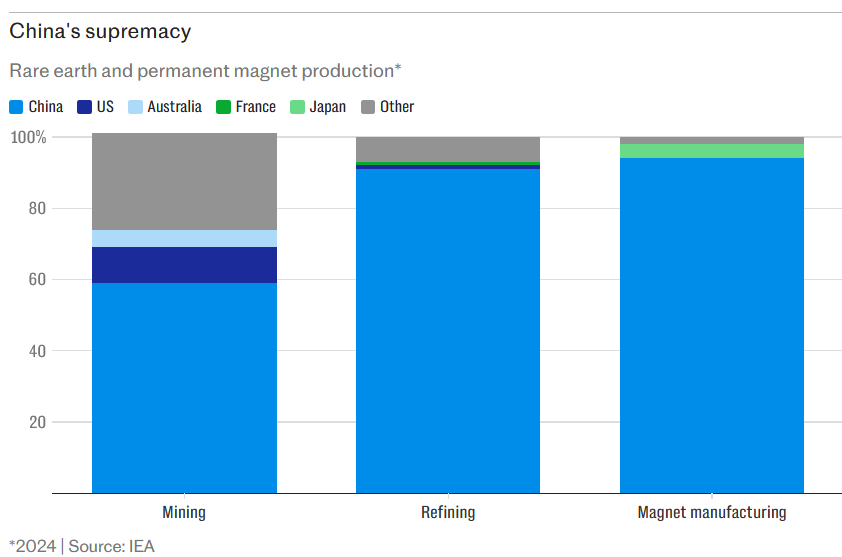

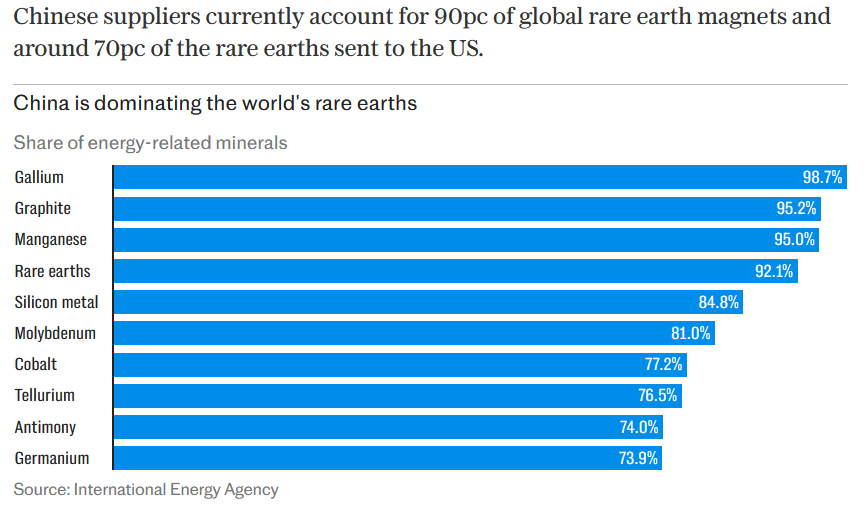
3
7
394