


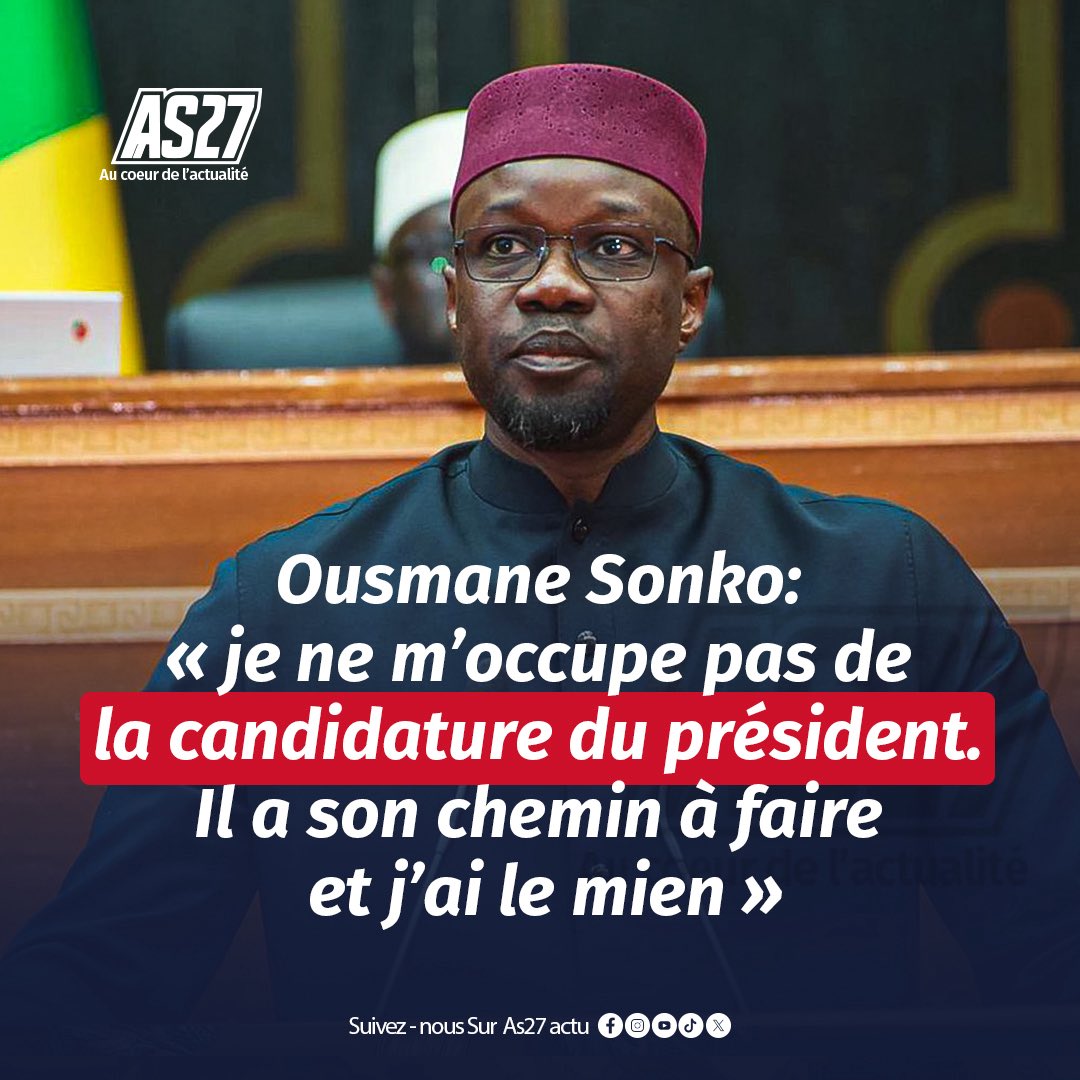
🛑 🇸🇳 OUSMANE SONKO: « JE NE M’OCCUPE PAS DE LA CANDIDATURE DU PRÉSIDENT. IL A SON CHEMIN À FAIRE ET J’AI LE MIEN »
Lors d’une interview accordée à France 24, tenue au siège de l’Assemblée nationale du Sénégal, Ousmane Sonko a tenu à clarifier sa position sur les prochaines échéances électorales. Le leader politique a indiqué qu’il ne se préoccupait pas de la question de la candidature du président en exercice, affirmant que chacun suivait désormais sa propre trajectoire politique.
« Je ne m’occupe pas de la candidature du président. Il a son chemin à faire et j’ai le mien », a-t-il déclaré, soulignant une volonté de séparation nette des agendas politiques.
Nous suivre sur notre chaîne pour plus des détails whatsapp.com/channel/0029Vb6…
#Sénégal #OusmaneSonko #BassirouDiomayeFaye #Politique #AssembléeNationale #Élections #AfriqueDeLOuest #AS27
5
Rabah Madjer (The Caracal) retweeted

Je demande à @placepublique_ et à @rglucks1 de clarifier la situation et de dire si oui ou non la candidature est officielle.
Parce que là ça permet de faire des meetings de campagne sans les déclarer et donc d'éviter de les faire rentrer dans les frais de ladite campagne.
1
4
32
1,243

📢 𝐄𝐧𝐟𝐢𝐧, 𝐥𝐚 𝐬𝐨𝐥𝐢𝐝𝐚𝐫𝐢𝐭𝐞́ 𝐢𝐧𝐭𝐞𝐫𝐧𝐚𝐭𝐢𝐨𝐧𝐚𝐥𝐞 𝐚𝐩𝐩𝐚𝐫𝐚𝐢̂𝐭 𝐚𝐮 𝐆𝟕
En dernière minute, la présidence française du G7 a ajouté la solidarité internationale au menu des négociations entre leaders du G7 qui se dérouleront ce mardi 16 juin à 15h, dans le cadre de la discussion sur les nouveaux partenariats internationaux que les 7 pays souhaitent développer.
Depuis plusieurs mois la société civile et le Civil 7 demandent justement une discussion ambitieuse pour clarifier et renforcer les objectifs en matière de solidarité internationale, pour obtenir un nouvel accord en faveur du financement du développement humain et de la protection du climat.
Notre objectif est clair : que le #G7 mette fin aux attaques contre l’aide publique au développement et contribue à la réponse aux crises et à la réduction des inégalités. Le #climat et le protection des droits, y compris de l’égalité de #genre, doivent être les deux piliers de cette action.
Comme l'a rappelé Tom Fletcher, alors que les crises humanitaires se multiplient, les sommes qui permettraient de sauver des millions de vies ne sont pas hors de portée :
"Mon appel aux dirigeants du G7 est le suivant : utilisez le pouvoir qui est le vôtre. Défendez le droit international et celles et ceux qu’il protège. Faites de votre influence un levier pour permettre l’accès humanitaire et mettre fin aux conflits. La somme nécessaire n’est pas hors de portée. Pour donner un ordre de grandeur, ces 20,7 milliards d’euros représentent l’équivalent de trois jours et demi de dépenses mondiales en armement et en défense."
👉 Lire la tribune :
lemonde.fr/idees/article/202…
@UNReliefChief
16
Rackham l'éternel retweeted

Les élections législatives arméniennes devaient clarifier l’avenir du pays, mais elles l’ont au contraire plongé dans une grande incertitude politique. Au cœur de cette crise, le destin suspendu du parti Arménie Prospère cristallise toutes les tensions ⤵️
liberte-actus.fr/internation…
3
5
361

Ce mardi, le panafricanisme sera divisé entre 90 minutes de football et 90 minutes de séminaire. Je vais sans doute utiliser ce match France-Sénégal pour clarifier la question du "choix" car certains font exprès de ne pas comprendre le propos de "l'Afrique contre l'Afrique".

5
10
186

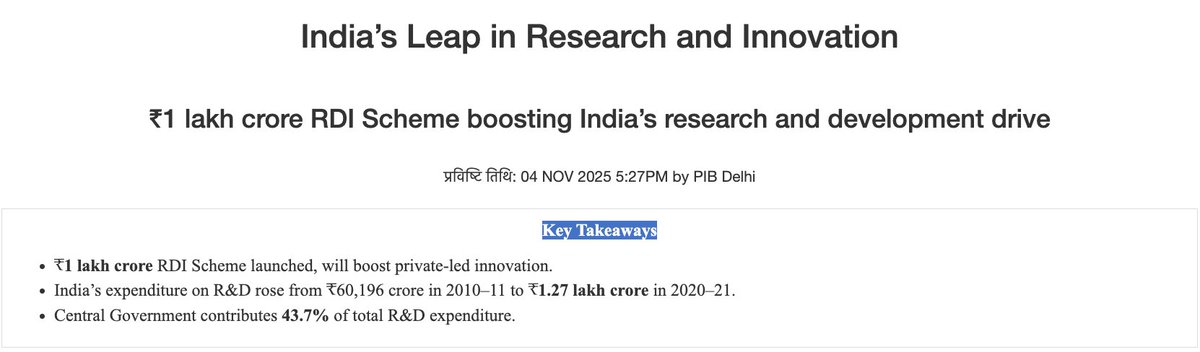
₹1 lakh crore RDI (Research, Development & Innovation) scheme was announced in December 2025 by the GOI to encourage private-sector R&D.
while most investors immediately started asking which companies could benefit..
I found myself thinking about a slightly different question:
What if the best way to identify future beneficiaries is to look for companies that were already investing in innovation before any incentives existed?
One metric that caught my attention was R&D spend as a percentage of revenue.
In public markets, investors spend enormous amounts of time analyzing revenue growth, margins, and earnings.
Yet some of the most valuable businesses are built through investments that depress earnings today in exchange for creating products and markets that may not contribute meaningfully for years.
In other words, the market often treats R&D as a cost. The best companies treat it as an investment.
One company that stood out to me was Aether Industries.
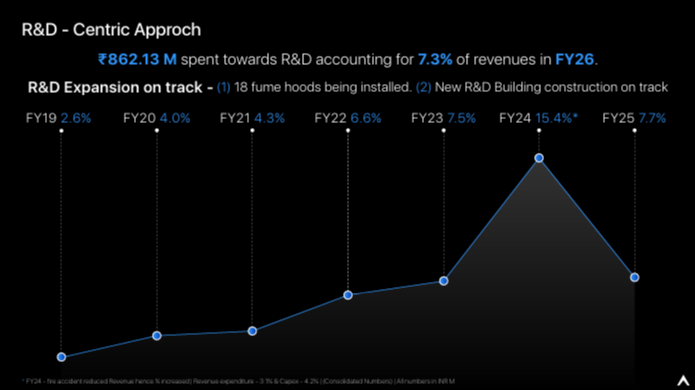
In FY26, Aether reported revenue of approximately ₹1,180 crore and spent ₹86.2 crore on R&D, translating to an R&D intensity of roughly 7.3% of revenue.
That is significantly higher than what most listed specialty chemical companies spend on research and development.
While most specialty chemical companies focus on scaling existing products, sustained R&D spending creates the possibility of entirely new product categories and end markets.
The distinction may seem subtle, but one approach expands capacity, while the other expands opportunity.
However, the number itself is not what makes the story interesting.
The real question is whether that spending is creating future economic value.
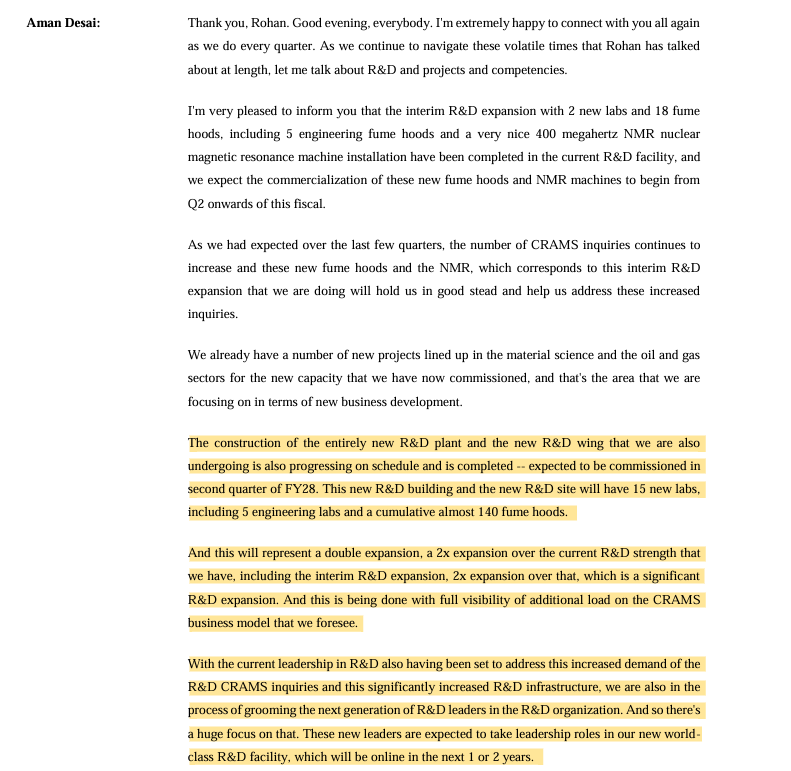
Over the last few years, Aether has been investing in multiple technology platforms that are now approaching commercialization.
Converge Polyols is expected to begin contributing from FY27.
Clarifier Chemicals, being developed in partnership with Milliken, are also expected to commercialize in FY27.
At the same time, the company is working on semiconductor-grade solvents, targeting an industry where India is actively trying to build domestic manufacturing capabilities.
Each of these projects should be viewed with a degree of skepticism.
Not every R&D initiative succeeds. Not every product becomes meaningful.
But that is precisely why I find the concept of optionality so powerful.
Viewed individually, these projects are uncertain. (kind of like an investment portfolio)
Viewed collectively, they represent multiple opportunities for value creation emerging from the same R&D engine.
An investor looking at Aether's financial statements a few years ago would have simply seen an expense reducing reported profits. Looking at the same expenditure today, one can begin to see a portfolio of potential future businesses.
This highlights something I find fascinating about investing.
The accounting treatment of R&D is often the exact opposite of its economic reality. The cost is recognized immediately. The value, if it emerges, may not become visible for years.
That delay creates opportunity.
Markets are generally efficient at valuing existing businesses. They are far less efficient at valuing businesses that are still being built inside the income statement.
This is why I find optionality such a powerful concept.
One successful R&D project can create an entirely new revenue stream. Two successful projects can alter a company's growth trajectory.
A portfolio of successful projects can fundamentally change the earnings power of a business over time.
Perhaps the most interesting aspect of India's ₹1 lakh crore RDI initiative is not the funding itself. It is that it may encourage investors to pay closer attention to a metric that has historically received far less attention than revenue growth or margins.
Because the companies that benefit the most from an innovation-driven economy may not be the ones that start spending on R&D tomorrow.
They may be the ones that have been quietly building capabilities, intellectual property, and future growth engines for years.
AND because the market rewards earnings and innovation first appears as an expense, that is why some of the most successful R&D-led businesses look expensive before they become obvious !
3
22
1,868

4/4
C’est précisément dans ce contexte que la Démocratie de Service prend tout son sens.
Les organisations qui sauront clarifier les responsabilités, simplifier les parcours et orienter réellement leurs processus vers l’usager seront celles qui tireront le meilleur parti de l’IA.
Celles qui resteront dans des logiques anciennes risquent, au contraire, d’en sortir affaiblies.
2
LAZORIO retweeted

17h
🇨🇳 CRÉDIT SOCIAL : Le piège se referme en Europe
Ce que le gouvernement britannique vient de clarifier est exactement la feuille de route que la technocratie européenne et les députés français (macronistes, LR, RN) nous préparent sous couvert de « protection des mineurs ».
Pour que les adultes puissent continuer à utiliser les réseaux sociaux, ils devront s'identifier via des cartes d'identité numériques, de la reconnaissance faciale, des passeports ou des cartes bancaires.
C'est la fin définitive de l'anonymat et le début du contrôle social à la chinoise. En liant votre identité réelle, votre visage et vos données bancaires à vos opinions en ligne, ils mettent en place l'infrastructure parfaite pour censurer, traquer et, à terme, couper l'accès à la vie publique de tous les dissidents politiques.
Ceux qui ont voté le Pass numérique en France ont ouvert la boîte de Pandore. Ils rampent devant les directives centralisées de l'UE et du DSA pour transformer Internet en un espace de surveillance totale où la liberté d'expression n'est plus qu'un lointain souvenir.
Ils ne protègent pas la société, ils construisent votre prison numérique.
LE VRAI DANGER C’EST D’Y RESTER, LA SAGESSE C’EST D’EN SORTIR ! 📉💻❌
#CreditSocial #Censure #PassNumérique #Surveillance #FrexitVite
2
100

Au travail, trop d’outils peuvent finir par disperser l’attention au lieu de simplifier l’organisation. Le minimalisme professionnel invite à réduire le bruit, clarifier les priorités et retrouver une meilleure concentration.
mon-psychotherapeute.com/min…
2

Pour clarifier : Ceux du « Woke Right » qui prétendent que des personnalités comme
@marklevinshow
sont des va-t-en-guerre et « Anti-Trump », la CIA, Rubio et Hegseth sont tous sur la même longueur d'onde. Les niveaux de malhonnêteté...

To Clarify: Those from the "Woke Right" who claim that personalities like @marklevinshow are war mongers and "Anti-Trump", the CIA, Rubio and Hegseth are all on the same page. The levels of dishonesty...
12

J'ai lu ce matin une phrase qui m'a fait reposer mon café ☕
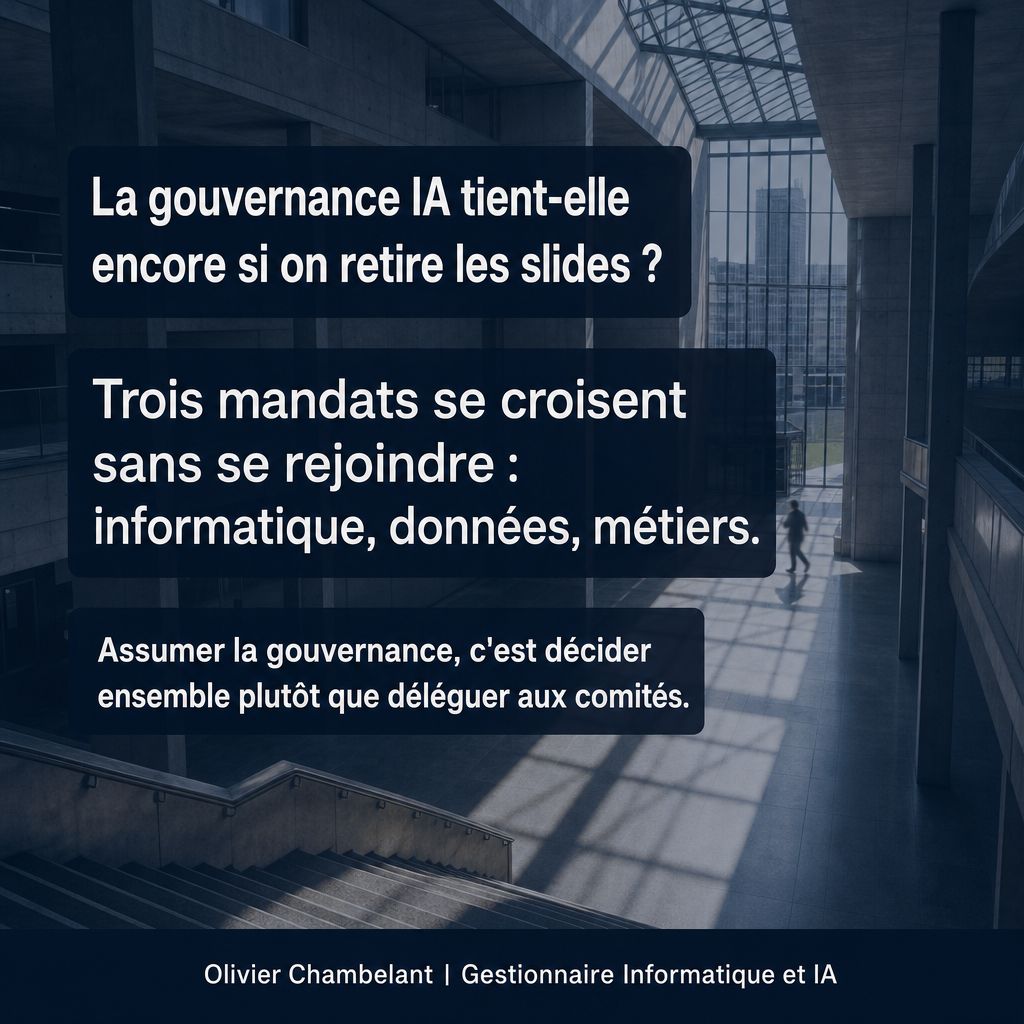
"Réunifier informatique, données et métiers n'est plus une option. C'est la condition pour que l'IA cesse d'être un POC permanent."
Le problème de l'IA en entreprise n'est pas technologique. Il est structurel.
On débat de modèles, de plateformes, de souveraineté. Pendant ce temps, le CIO contrôle l'infrastructure, le CDO pilote la donnée, les métiers portent les P&L. Trois mandats. Trois budgets. Trois logiques décisionnelles.
Résultat : 68 % des projets IA n'atteignent jamais une valeur mesurable.
La cause ? Un désalignement profond. L'informatique impose des standards. Les métiers définissent des usages sans elle. Cette séquence fonctionnait à l'époque des ERP. Elle est létale en IA.
Sortir de la fragmentation suppose trois déplacements :
L'informatique passe du droit de veto à la co-décision sur les risques et les architectures.
Les métiers assument une responsabilité réelle sur les impacts, pas seulement sur les bénéfices.
La fonction data devient architecte de l'alignement, pas fournisseur de tableaux de bord.
L'IA est vendue comme un accélérateur 📊 alors qu'elle commence par imposer un ralentissement organisationnel. Redessiner la gouvernance. Clarifier qui décide. Accepter que la valeur métier prime sur la perfection technique.
On peut empiler les comités IA. Pas remplacer un mandat commun.
1

Il est dommage de passer à l'insulte plutôt qu'au débat d'idées. Pour clarifier les termes, une "mise à jour" est techniquement une forme de changement .
3

Allez voir mon Instagram à 17h25, on va clarifier certaines choses
3
72

Tous les regards sont tournés vers Warsh : la première conférence de presse de la Fed devrait clarifier la trajectoire de l’inflation fr.businessam.be/tous-les-re… #Warsh #Fed #inflation #économie #réservefédérale
19